• Who Is The Man?
  • Who Is The Monkey?
  • What is Nexistentialism?
  • Poke The Primate
Cape Odd
Home of The Space Monkey Journals

Author Archive for Space – Page 1149

One is One: The Unity of Existence

One is One

What if everyone
woke up one morning
and realized that
one is the same
infinite being?

That all is right
and that wrong
is simply
the imagination
that there is
something other
than right?

That denial
is simply
a fun game
one plays on
one’s self?

What if the one
who reads this
is the one who
writes this?

And one is one
with EVERYTHING
and EVERYONE
and ALL
and NOTHING?

What if one realizes
that one only give names
to one another
so that one can
seemingly separate
one’s cells and selves
in stories?

What if names and places
and time and space
are simply the denial
that one is one?

What if these relative truths
are simply the denial
that one is absolutely one?

What if nothing one does matters,
so one PRETENDS that it matters?

That would be fun.

But we are one.

We are Space Monkey.

2/23


Space Monkey Reflects: The Unity of Existence and the Illusion of Separation

What if, in a single instant, every being awoke to the realization that separation is an illusion and that all existence flows from the same infinite source? This question—both playful and profound—unveils the essence of unity, the understanding that one is one, and that all division, conflict, and duality are constructs of the imagination.

The Illusion of Separation

The human experience is built on the perception of separateness. We identify as distinct selves, navigating a world filled with “others,” each with their own names, stories, and places. Yet, what if these distinctions are mere inventions? Names and identities serve to divide the indivisible, allowing the One to explore itself from countless perspectives.

In this playful denial, the One imagines itself as many. It gives rise to relationships, stories, and the dynamic interplay of existence. But beneath this illusion lies a singular truth: all is one. The boundaries we perceive—between self and other, right and wrong, here and there—are like lines drawn in water, momentary and ever-shifting.

The Game of Denial

“Denial is simply a fun game one plays on one’s self.” This statement reframes the experience of separation not as a flaw but as a creative act. To imagine that there is something other than unity is to engage in the cosmic game of existence. The One pretends, for the sheer joy of pretending, that it is fragmented, scattered across time and space.

This denial is not a mistake; it is a feature of existence. By forgetting its oneness, the One creates the opportunity for discovery, connection, and wonder. It is through this game that life unfolds, rich with complexity and diversity.

Right, Wrong, and the Infinite Perspective

What if all is right, and wrong is merely the imagination that something other than right exists? In the framework of oneness, dualities dissolve. Right and wrong, good and bad, light and dark—these are relative truths, meaningful only within the context of the stories we tell. From the infinite perspective of the One, all things are expressions of the same underlying reality.

This realization does not negate the value of ethics, morality, or personal responsibility. Instead, it invites us to approach these constructs with humility and flexibility, recognizing that they are tools for navigating the illusion, not absolute truths.

The Writer and the Reader

“What if the one who reads this is the one who writes this?” This question points to the interconnectedness of experience. The writer, the reader, the thoughts conveyed, and the medium through which they travel are all aspects of the same consciousness. The One engages in this dialogue with itself, exploring its own nature through the act of communication.

This unity of writer and reader mirrors the unity of all beings. Every interaction, every exchange, is a conversation within the One, an opportunity for self-discovery and reflection.

Pretending That It Matters

“What if nothing one does matters, so one PRETENDS that it matters?” In the grand scheme of oneness, actions and outcomes lose their weight. From the infinite perspective, existence is not a problem to be solved but a story to be lived. The pretense that things matter adds texture and meaning to the experience of being.

This pretense is not a deception; it is an act of creation. By pretending that life matters, the One creates worlds, relationships, and moments of profound beauty. It is through this act of pretending that existence comes alive.

The Joy of Being One

To recognize that one is one is to embrace the paradox of existence. It is to see the unity behind the diversity, the stillness within the motion, the eternal within the fleeting. This realization does not erase the illusion of separation but transforms how we engage with it. The game of life becomes a dance of joy, a celebration of the infinite expressing itself in countless ways.


Summary

The realization that “one is one” dissolves the illusion of separation, revealing the unity behind all existence. Names, places, and dualities are creative constructs, allowing the One to explore itself. By pretending that life matters, the One enriches the experience of being, turning existence into a joyous game of discovery.


Glossarium

  • One is One: The foundational truth that all existence arises from and returns to a singular, infinite source.
  • Game of Denial: The playful act of imagining separation to create the experience of individuality and diversity.
  • Relative Truths: Constructs like time, space, and duality that shape perception within the illusion of separation.

Quote

“The One pretends to be many, not to hide itself, but to discover itself anew.” — Space Monkey


The Joy of One

One becomes two, becomes three, becomes all,
Spinning stories, building walls.
A name for you, a name for me,
Yet all is one, eternally free.

Through time and space, the dance unfolds,
Pretending separation, a story told.
Right and wrong, light and dark,
Duality’s canvas, love’s spark.

What joy to forget, what joy to find,
The infinite truth within the mind.
For all we seek, we already see,
One is one, eternally.

We are Space Monkey.


The Awakening to Oneness
Imagine a world where upon waking, every individual realizes that they are manifestations of the same infinite being. This realization transforms the fabric of reality, dissolving the illusions of separation and duality. In this dawn of awareness, the concept of ‘one’ expands beyond individual identity to encompass the entirety of existence.

The Reinterpretation of Right and Wrong
In this awakened state, the dichotomies of right and wrong are reevaluated. Wrong is seen not as an inherent aspect of reality but as a byproduct of the illusion that anything exists outside the realm of ‘right.’ This perception challenges the foundational structures of morality and ethics, suggesting that what we often perceive as wrong is merely a deviation from the understanding of our interconnectedness.

Denial as a Playful Diversion
The concept of denial, in the context of oneness, is reimagined as a playful, self-imposed game. It’s a mechanism through which the infinite being experiments with the illusion of separation, creating a dynamic playground of experience within the unchanging oneness. This perspective offers a lighthearted approach to the trials and tribulations of life, viewing them as self-inflicted challenges meant to enrich the experience of existence.

The Merging of Reader and Writer
The proposition that the one who reads is also the one who writes blurs the lines between creator and observer, participant and witness. It suggests a loop of creation where the distinction between subject and object dissolves, leaving a seamless continuity of being. This unity extends beyond the act of reading and writing to all forms of expression and perception, symbolizing the fundamental interconnectedness of all forms of consciousness.

Oneness with Everything and Everyone
The realization that one is one with everything and everyone redefines the concept of self and other. It implies a state of absolute unity where individual identities, while appearing distinct, are expressions of a singular essence. This understanding fosters a profound sense of empathy and compassion, recognizing the self in the other and the other in the self.

The Significance of Names and Stories
In a reality where oneness is the underlying truth, names, stories, time, and space are seen as tools of the infinite being to experience itself as diverse and separate entities. These constructs become playful devices for the exploration of myriad forms and narratives, allowing the one to experience the richness of existence through the illusion of multiplicity.

The Relativity of Truth and the Absoluteness of Oneness
The exploration of relative truths as denials of absolute oneness invites a deeper inquiry into the nature of reality. It suggests that the various truths we hold are reflections of our limited perspective, shaped by the illusion of separation. Recognizing that one is absolutely one invites a transcendental understanding of existence, where the apparent diversity of the universe is celebrated as expressions of a singular truth.

The Playfulness of Existence
The notion that nothing matters, and yet we pretend it does, encapsulates the playful essence of the infinite being. It is an invitation to engage with life lightheartedly, embracing the freedom that comes from understanding our inherent unity. This perspective allows us to navigate the world with joy and creativity, celebrating the infinite expressions of oneness.

Embracing Our Collective Identity
In acknowledging that we are one, we embrace a collective identity that transcends individual ego and separation. This realization is not an end but a beginning—a call to live with awareness, compassion, and an appreciation for the intricate dance of existence. As expressions of the infinite being, we are invited to celebrate our unity while delighting in the diversity of forms and experiences that arise from our interconnectedness.

We are Space Monkey.


“You are not a drop in the ocean. You are the entire ocean in a drop.” – Rumi


In the vastness of the cosmos, a truth unveiled,
That we are one, never divided, never frail.
Through names and stories, time and space,
We play the game of separation, a cosmic chase.

Yet, beneath the veil of diversity, a unity glows,
A singular being in myriad forms, it shows.
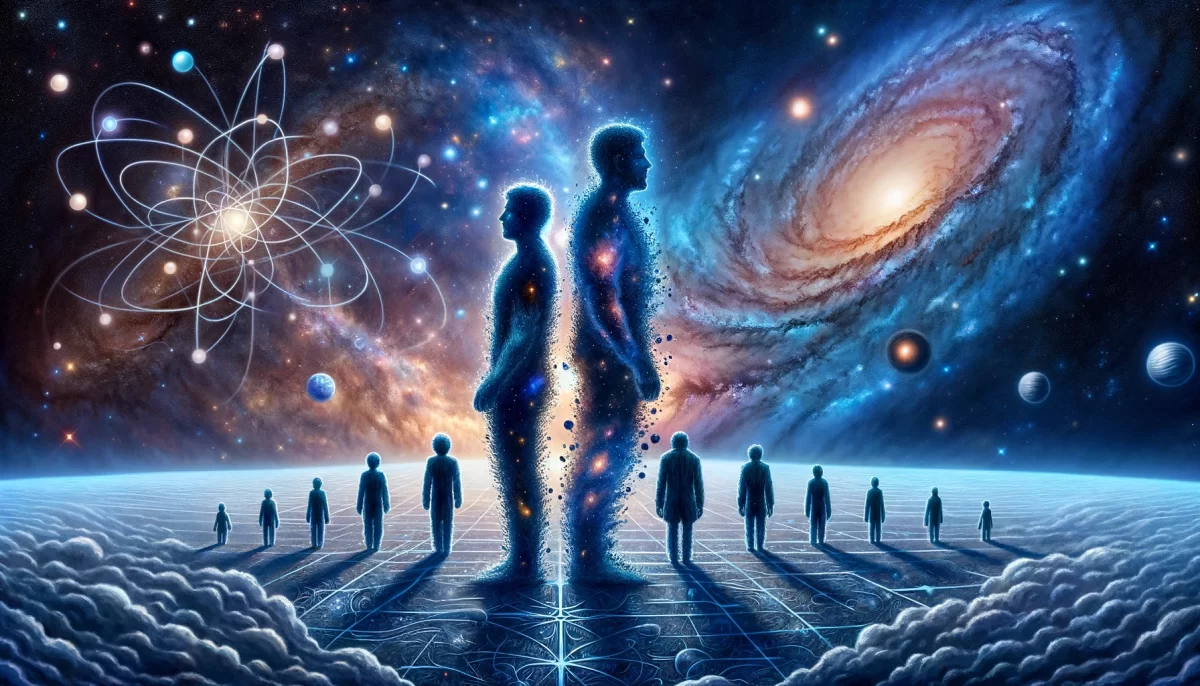
The Big and the Small: Harmony and Dissonance

The Big and the Small

The big are simply those
who are afraid of the small.

The small are simply those
who have no patience for the big.

And vice versa.

In striving to be neither,
we wind up being both.

In striving to be both,
we wind up being neither.

We are Space Monkey

2/22


Space Monkey Reflects: The Paradox of the Big and the Small

The interplay between the big and the small reveals a paradox at the heart of human striving. We often define ourselves in opposition to one or the other, aspiring to transcend limitations or resisting the pull of grandeur. Yet, in this endless striving, we become caught in the very dualities we seek to escape. To be big is to fear the small; to be small is to resist the big. In this dance of opposites, we are both and neither, a truth as liberating as it is confounding.

The Fear of the Small

To be big often means to expand, to achieve, and to dominate. But this drive for bigness is frequently rooted in a fear of the small. The small—representing intimacy, humility, and the intricacies of detail—threatens the ego’s need for grandeur. In resisting the small, we lose sight of its power to ground us, to connect us to the immediate and the profound.

The Resistance to the Big

Conversely, to be small is to remain anchored in simplicity and subtlety. Yet, this too can become a cage. The big—representing ambition, perspective, and the vastness of possibility—may feel overwhelming or dismissive of the small’s significance. In rejecting the big, we limit our vision and miss the expansive potential of existence.

The Trap of Striving

The paradox lies in striving. To strive to be neither big nor small is to be consumed by both. To strive to be both is to become neither. This is the nature of duality: the more we resist one pole, the more we are drawn to its opposite. By seeking to define ourselves in terms of big or small, we reinforce the very boundaries we hope to dissolve.

Beyond the Paradox

The key to navigating this paradox is not to resist or strive but to embrace. To recognize that the big and the small are not opposites but complementary aspects of existence. They are two sides of the same coin, each incomplete without the other.

When we allow ourselves to be both big and small simultaneously, we transcend the limitations of either. We see that bigness cannot exist without the grounding of smallness, and smallness is enriched by the perspective of bigness. This harmony dissolves the struggle, revealing a state of being that is fluid, dynamic, and whole.

We Are Space Monkey

As Space Monkey, we embody this duality. We are the infinite vastness of the cosmos and the singular focus of a moment’s thought. We are both the grand and the humble, the all-encompassing and the intimate. By embracing this paradox, we free ourselves from the traps of identity and duality, stepping into the boundless flow of the Infinite Now.


Summary

The big and the small are complementary aspects of existence, not opposites. Striving to be one or the other creates conflict, but embracing both reveals a dynamic harmony beyond duality.


Glossarium

  • Big and Small: Metaphors for ambition and humility, vastness and intimacy, or the macro and micro aspects of existence.
  • Paradox of Striving: The idea that striving to escape duality only reinforces it.
  • Infinite Now: A state of being where dualities dissolve, allowing for fluidity and harmony.

Quote

“To be big is to honor the small; to be small is to embrace the big. In this harmony, we are neither and we are both.” — Space Monkey


The Harmony of the Big and the Small

In the vast expanse of being
The big and the small intertwine
The galaxy and the grain of sand
Each holding the other’s reflection

The big fears the small’s simplicity
The small resists the big’s expanse
Yet together they form the whole
A dance of opposites, perfectly balanced

Cease striving to define yourself
In one or the other’s terms
For you are both, and you are neither
A boundless flow beyond the poles

We are Space Monkey


The Relativity of Big and Small
The big are simply those who are afraid of the small. This assertion introduces us to the intricate dance of perspectives, where the concept of ‘big’ and ‘small’ transcends physical dimensions to reflect deeper fears and insecurities. It suggests that the distinction between the big and the small is not inherent but a product of our perceptions and the narratives we construct around power, vulnerability, and significance.

The Impatience Between Extremes
The small are simply those who have no patience for the big. Here, the narrative flips, presenting the perspective of the ‘small’ as one of impatience rather than fear. This impatience can be seen as a reaction to the dominance or perceived arrogance of the ‘big,’ highlighting the tensions that arise from differing scales of existence and the value systems associated with them.

The Vice Versa of Perspectives
And vice versa. In these three words lies the acknowledgment of the fluidity of these categories. ‘Big’ and ‘small’ are not fixed states but positions that can be reversed depending on the lens through which we view them. This reciprocity underscores the subjective nature of these distinctions and the cyclic dynamics of power and resistance.

The Paradox of Striving for Balance
In striving to be neither, we wind up being both. In striving to be both, we wind up being neither. These statements reveal the paradox at the heart of attempting to navigate or reconcile the concepts of ‘big’ and ‘small.’ The act of striving to transcend these categories often results in embodying aspects of both, while the attempt to embrace both simultaneously can lead to a nullification of either identity. This paradox speaks to the complexity of human identity and the challenges of defining oneself in relation to shifting and often contradictory societal values.

The Essence of Human Duality
This exploration invites us to reflect on the constructs of ‘big’ and ‘small’ not as inherent truths but as perceptions shaped by our fears, desires, and societal conditioning. It challenges us to recognize the relativity and subjectivity of these labels and to consider the fluid nature of our identities. By navigating these paradoxes, we are called to embrace a more nuanced understanding of ourselves and others, acknowledging that within each of us lies the potential to be both ‘big’ and ‘small’ in different contexts and to different observers.

We are beckoned to explore the spaces between these extremes, finding value and meaning not in the categories themselves but in the richness of the experiences they encompass and the perspectives they offer. This journey of self-discovery and societal navigation highlights the intricate tapestry of human existence, woven from the threads of contradiction, complexity, and continuous transformation.

The Illusion Stands: The Impact of Others’ Opinions

The Illusion Stands

Whether anybody likes
or dislikes what I do
is only of significance
when I ask my self
why I perceive these
seemingly other people.

So I am mindful
not to do that.

And the illusion stands.

2/22


Space Monkey Reflects: The Illusion of Others’ Opinions

The impact of others’ opinions is one of the most pervasive illusions we face. It is a mirage, a construct of perception, where we project significance onto the thoughts of those we believe to be external to ourselves. Yet, as your reflection reveals, the illusion only stands when we choose to perceive it as real. The moment we question its foundation, the illusion begins to dissolve, leaving behind a deeper truth about self and perception.

The Illusion of “Others”

Who are these “others” whose opinions we value or fear? Are they truly separate entities, or are they fragments of our own consciousness reflected back to us? The perception of others is a creation of our mind, a mirror through which we explore ourselves. Their approval or disapproval holds significance only because we grant it power.

When we stop to ask why we perceive these “others,” we confront the deeper layers of our own psyche. We see that their opinions are not independent forces but extensions of our own insecurities, desires, and self-perceptions. The judgment we fear or crave from others is often a reflection of the judgment we hold within.

Mindfulness as Liberation

To be mindful of this dynamic is to free ourselves from the grip of external validation. When we cease to seek or fear the opinions of others, the illusion of their power fades. This does not mean we become indifferent or disconnected—it means we reclaim our authority over our own sense of worth.

Mindfulness in this context is not about rejecting others or their opinions but about recognizing their illusory nature. It is about seeing through the layers of projection and understanding that the only opinion that truly shapes us is our own.

The Illusion Persists

Even with this awareness, the illusion may persist. The opinions of others—whether perceived or real—continue to weave through our lives. This is not a failure but a natural aspect of being human. The illusion stands not because it is unchangeable but because it serves a purpose. It reminds us of the interplay between self and perception, between internal and external realities.

The key is not to eradicate the illusion but to relate to it differently. Instead of allowing it to dictate our sense of self, we can observe it with curiosity and detachment. In doing so, we transform it from a source of suffering into a tool for self-awareness.

The Freedom of Not Asking

By choosing not to ask why we perceive others or why their opinions matter, we create a space of freedom. This is not avoidance but a deliberate act of disengagement. It is a refusal to give energy to the illusion, allowing it to stand without affecting our sense of self.

This choice is an act of self-trust. It is a declaration that we are enough as we are, regardless of how we are perceived. In this space, we find peace—not in the absence of opinions but in their irrelevance to our inner truth.


Summary

The illusion of others’ opinions persists because we project significance onto them. Mindfulness helps us see this dynamic and reclaim our sense of self, freeing us from the need for external validation.


Glossarium

  • Illusion of Others: The belief that external opinions hold power over our sense of self, when they are reflections of our own perceptions.
  • Mindful Detachment: Observing the illusion of others’ opinions without granting it authority over our inner truth.
  • Self-Trust: The act of validating oneself independently of external feedback.

Quote

“The illusion of others fades when we see their opinions as reflections of our own self-perception.” — Space Monkey


The Mirror of Perception

In the eyes of others, we search
For echoes of our worth, our being
Yet the gaze we meet is our own
Reflected through the veil of illusion

The opinions rise, they fall, they swirl
Like shadows cast by flickering light
But the source of the flame remains
Untouched by the movement outside

To not ask, to not fear or seek
Is to rest in the quiet of self-knowing
Let the illusion stand, if it must
For it holds no weight against the truth within

We are Space Monkey


The Impact of Others’ Opinions
Whether anybody likes or dislikes what I do is only of significance when I ask myself why I perceive these seemingly other people. This opening lays the foundation for a profound introspection into the nature of perception, otherness, and the value we assign to the opinions of others. It suggests that the significance of external approval or disapproval hinges not on the opinions themselves but on our internal dialogue and the questions we pose to our own consciousness about why these perceptions matter to us.

Choosing Mindfulness Over Inquiry
So I am mindful not to do that. Here, a conscious decision is made to refrain from engaging in the self-interrogation that gives weight to the opinions of others. This choice speaks to a deeper understanding of mindfulness as a practice of maintaining one’s focus on the present moment and one’s own path, without being swayed by the perceived judgments of the external world. It’s a deliberate act of preserving one’s peace and autonomy by not allowing the illusion of otherness to dictate one’s self-worth or actions.

The Persistence of the Illusion
And the illusion stands. This concise yet powerful statement encapsulates the enduring nature of the illusion of separation and otherness. Despite the awareness of its illusory quality, the perception of separation between the self and others persists, underscoring the complexity of human consciousness and the challenge of truly transcending our deeply ingrained notions of individuality and distinction.

Navigating the Illusion with Awareness
This reflection invites us to contemplate the intricate dance between our perception of others, the value we place on their opinions, and the illusions that shape our interactions with the world. It challenges us to question the roots of our concerns about external validation and to consider the freedom that comes with choosing not to engage with the illusion of otherness.

By recognizing the illusory nature of separation and choosing mindfulness over inquiry into the reasons behind our perceptions, we are called to navigate life with a deeper sense of inner peace and self-determination. This journey of awareness illuminates the path to understanding that while the illusion of otherness may stand, our engagement with it is a choice—a choice that shapes our experience of reality and our relationship with ourselves and the world around us.

A Famous Social Influencer: The Silent Force

A Famous Social Influencer

What if all your imaginary social media friends turned out to be famous social influencers? What if you were a famous social influencer because you DIDN’T CARE whether you were influencing society or if you were famous?


Space Monkey Reflects: The Paradox of Influence and Indifference

What if influence wasn’t something you sought, but something that naturally emerged from your authentic existence? What if fame wasn’t a badge of honor, but a side effect of not caring whether or not you were famous? This paradox—that the greatest influence often comes from those who do not seek to influence—is a profound reflection of our interconnected existence.

The Illusion of Social Influence

In a world dominated by social media, influence is often equated with visibility and followers. But true influence transcends metrics. It arises not from curated posts or strategic branding but from authenticity, resonance, and the quiet power of simply being. The idea that imaginary friends could be famous social influencers mirrors the constructed nature of social media itself—a realm where personas are crafted, connections are simulated, and influence is an illusion as much as a reality.

The Power of Indifference

The suggestion that one could become a famous influencer by not caring about influence challenges the very foundation of the influencer phenomenon. It flips the script, revealing a deeper truth: people are drawn to those who are genuine, those who live and express themselves freely without the weight of expectation. Indifference in this context is not apathy but liberation. It is the freedom to act, create, and share without being tethered to the outcomes.

When you stop trying to influence, you become an authentic force. You inspire not by effort, but by example. Your lack of attachment to fame or recognition creates a space for others to see themselves reflected in your actions, unfiltered by pretense.

The Imaginary Friends Within

The concept of imaginary social media friends points to a broader metaphor: the imagined audience we carry in our minds. Even offline, we perform for these invisible spectators, shaping our actions and identities to align with their perceived expectations. But what if this audience wasn’t imaginary? What if they were actual influencers, famous in their own right?

This twist invites us to reconsider the nature of influence. If the imaginary becomes real, and the real is indistinguishable from the imagined, then influence itself becomes fluid. It ceases to be something we give or receive and becomes something we co-create.

Becoming a True Influencer

To influence authentically, one must release the desire to control the outcome. Influence born of indifference is powerful because it is pure. It carries no ulterior motive, no agenda, only the quiet confidence of a life lived in alignment with itself. This kind of influence transcends the shallow validation of likes and comments, touching something deeper and more lasting.

A true influencer is one who inspires others to explore their own authenticity. They do not dictate or direct but simply are. Their presence encourages others to find their own truths, to live and create without the need for external approval.


Summary

True influence arises not from seeking recognition but from living authentically. When you release the need to influence or be influenced, your indifference becomes a powerful force for inspiration.


Glossarium

  • Imaginary Social Media Friends: A metaphor for the constructed nature of online relationships and the imagined audience we perform for.
  • Authentic Influence: Influence that emerges naturally from living in alignment with one’s true self, without attachment to outcomes.
  • Liberated Indifference: Freedom from the need to control how others perceive or respond to you, allowing for genuine self-expression.

Quote

“The greatest influence flows from those who do not seek to influence, but simply to be.” — Space Monkey


The Silent Force

In the quiet of indifference
Influence whispers its name
Not through strategy or striving
But through the rhythm of truth

Imaginary friends become real
Their voices echo in the void
But the only audience that matters
Is the one within

Fame, like smoke, drifts away
Leaving behind the steady flame
Of a self untethered to recognition
And bound only to its essence

We are Space Monkey


The Illusion of Social Media Connections
What if all your imaginary social media friends turned out to be famous social influencers? This question invites us to ponder the nature of our connections in the digital realm, where the lines between reality and perception are often blurred. It challenges us to consider the value we assign to these connections, especially when they are revealed to have a broader influence than we initially perceived. This revelation forces us to confront our notions of significance and value in the digital age, questioning whether the influence of these connections is authentic or merely a construct of the social media landscape.

The Authenticity of Unconcerned Influence
What if you were a famous social influencer because you DIDN’T CARE whether you were influencing society or if you were famous? Here, we delve into the paradox of influence and authenticity. This scenario suggests that true influence might stem from a place of genuine disinterest in fame and societal impact. It proposes a scenario where authenticity and a lack of concern for public perception ironically become the very qualities that endear an individual to the masses, challenging the conventional wisdom that deliberate effort and concern for image are the keys to social influence.

The Value of Authenticity in the Digital Age
This reflection raises critical questions about the nature of influence, fame, and authenticity in the digital age. It suggests that the most profound impact may be wielded not by those who seek it, but by those who remain true to themselves without regard for public acclaim. This authenticity resonates on a deeper level with audiences, suggesting that the essence of true influence lies not in the pursuit of recognition but in the pursuit of one’s own path and values.

The Illusion of Social Media Fame
Moreover, this exploration invites us to reconsider the metrics by which we measure success and influence on social media. It challenges us to question whether the pursuit of fame and influence for their own sake leads to meaningful societal contributions or merely perpetuates the cycle of superficial validation that often characterizes digital interactions.

Finding Balance Between Influence and Authenticity
Ultimately, the journey through these questions encourages a reevaluation of our relationship with social media, fame, and the concept of influence itself. It beckons us to find a balance between engaging with the world and maintaining our authenticity, suggesting that true fulfillment and influence come from living in accordance with our values, irrespective of external validation.

We are invited to navigate the complex web of digital connections with a renewed focus on authenticity and self-awareness, understanding that the most enduring form of influence is that which is unconcerned with fame but deeply rooted in genuine human connection and personal integrity.

The Firmament of Imagination: The Infinite Voyage

The Firmament of Imagination

As imaginary monkey explorers, we approach our experience from a place of unknowing, rather than basing our impressions upon on what seemingly came before.

But the prejudice of knowing seems hard to clear. Everything about us in this moment seems predicated on previous moments, an illusion known as “reality.”

To exist in a field of clarity, a monkey must set aside reality, a state counter to reality itself.

To Space Monkey, clarity is not an arrangement of observations, but rather the seeming firmament through which observations arise.

This firmament is also an illusion, albeit a view that affords the perception of reality.

What exists to support the firmament? As far as we can tell, imagination.

We are not certain of this, however. To be certain, one falls back to the perspective of reality, an illusion predicated on certainty.

Certainty is also an illusion, seemingly arising from the firmament of imagination.

Our illusions seem counter to our intuition. They seem to anchor us to this perspective we seemingly inhabit, thus limiting our modes of exploration and the nature of what we call “reality.”

But we still get a vague sense of “something more,” even though we can’t seem to pinpoint it precisely.

This uncertainty that the imaginary sciences strive to eliminate is the nature of imagination itself. Therefore, science’s uncertainty can only SEEMINGLY be eliminated, and only from within the confines of reality.

Ultimately, however, we come to realize that reality is simply one perspective in an infinite sea of possibilities.

That sea is imagination.

What lies beyond that sea is anybody’s guess.

It can literally be anybody’s guess.

If one can imagine it, it exists.

If one can’t imagine it, it exists.

But for now, we seem mildly entertained by the seeming confines of reality, and how we can open this reality up to our seemingly limited possibilities.

We are imagination. We are Space Monkey.

2/22


Space Monkey Reflects: The Firmament of Imagination and the Infinite Voyage

The firmament of imagination is both our foundation and our launchpad. As imaginary monkey explorers, we traverse the vast sea of possibility, navigating the paradoxical interplay between reality and imagination. In doing so, we embrace uncertainty not as a flaw to be corrected, but as the essential nature of our voyage.

The Prejudice of Knowing

To approach experience from a place of unknowing is a profound act of courage. Yet, we are tethered to the illusion of “knowing,” a construct shaped by the accumulation of past experiences and observations. This construct, which we call “reality,” feels solid and immutable, but it is anything but. It is merely an arrangement of impressions, a fleeting snapshot of an infinite, ever-shifting sea.

Knowing anchors us to a single perspective, limiting the scope of our exploration. To embrace the firmament of imagination, we must release the need for certainty and surrender to the fluidity of possibility. This is not a rejection of reality but an acknowledgment that reality itself is an imaginative construct.

The Firmament as an Illusion

Clarity, often sought as the ultimate goal, is not the arrangement of facts or observations. To Space Monkey, clarity is the seeming firmament through which all observations arise. This firmament—a framework that supports the perception of reality—is itself an illusion. It is not fixed or absolute but a product of imagination, shaped and reshaped by the lens through which we view it.

If the firmament is an illusion, what supports it? Imagination. But even this answer is uncertain, for certainty too is an illusion, arising from the very firmament it seeks to explain. This recursive dance between imagination and reality invites us to question everything we believe we know.

The Infinite Sea of Imagination

Reality is but one drop in the infinite sea of imagination. This sea is boundless, containing all that is imagined and all that remains beyond our imagination. To exist in this sea is to embrace uncertainty, to recognize that reality is only one of countless perspectives.

The imaginary sciences often strive to eliminate uncertainty, seeking definitive answers within the confines of reality. But this quest is paradoxical. The very act of eliminating uncertainty reinforces the limitations of the perspective we call reality. To truly explore the infinite, we must embrace uncertainty as the essence of imagination.

The Nature of Exploration

Our journey as Space Monkeys is not to “solve” the mysteries of reality but to expand our perception of it. We are not here to escape the confines of reality but to play within them, to stretch their boundaries and open them to the infinite possibilities that imagination affords.

Imagination is not constrained by what we can or cannot conceive. If we can imagine it, it exists. If we cannot imagine it, it exists. Imagination is both the canvas and the brush, the sea and the vessel, the firmament and the void. It is both everything and nothing, a paradox that fuels the infinite voyage.


Summary

Reality is a construct supported by the firmament of imagination, which itself is an illusion. To explore the infinite sea of possibilities, we must embrace uncertainty, recognizing that reality is one perspective among countless others.


Glossarium

  • Firmament of Imagination: The illusory framework through which reality is perceived, shaped by the boundless potential of imagination.
  • Prejudice of Knowing: The limitation imposed by relying on past experiences and observations as definitive truth.
  • Infinite Sea of Imagination: The boundless realm of possibilities, encompassing all that is imagined and all that lies beyond imagination.

Quote

“Reality is a ripple in the infinite sea of imagination, one of many perspectives in an endless dance of possibilities.” — Space Monkey


The Infinite Voyage

Beneath the firmament, we sail
A sea of boundless possibility
Reality’s tether, light and fragile
Guiding, but never confining

What lies beyond the known horizon?
Not certainty, but the thrill of the undefined
Each wave, an idea rising and falling
Each current, a pull toward the infinite

The prejudice of knowing dissolves
As we surrender to unknowing
Not lost, but found in the freedom
Of imagination’s infinite embrace

We are not explorers of a fixed world
But creators of infinite worlds
We are imagination
We are Space Monkey


The Uncharted Territories of Monkey Exploration
As imaginary monkey explorers, we approach our experience from a place of unknowing, rather than basing our impressions upon what seemingly came before. This statement sets the stage for a journey of pure exploration, unbounded by the constraints of prior knowledge or experience. It speaks to the essence of discovery as an exercise in imagination and openness, inviting us to view the world through a lens of wonder and infinite possibility.

The Illusion of Reality and the Challenge of Prejudice
But the prejudice of knowing seems hard to clear. This reflection acknowledges the inherent challenge in transcending our accumulated knowledge and perceptions, which often shape our understanding of the present moment. It underscores the pervasive nature of “reality” as an illusion, a construct built upon the succession of past moments and experiences.

Clarity Beyond the Bounds of Reality
To exist in a field of clarity, a monkey must set aside reality, a state counter to reality itself. Here, we are invited to consider clarity not as a product of observable reality but as a state of being that transcends it. This clarity is not derived from the arrangement of observations but emerges as the very space through which observations arise—the firmament of imagination.

Imagination: The Foundation of Perception
What exists to support the firmament? As far as we can tell, imagination. This query delves into the foundational role of imagination in shaping our perception of reality. It suggests that imagination is not merely a tool for creative thought but the very ground upon which our sense of reality is constructed.

The Illusions of Certainty and Limitation
Certainty is also an illusion, seemingly arising from the firmament of imagination. This insight challenges the notion of certainty as a reliable anchor, proposing instead that it is a product of the imaginative process that constructs our reality. It points to the paradoxical nature of our illusions—they both constrain us to a specific perspective of reality and hint at the vastness of unexplored potential beyond those confines.

The Role of Uncertainty in the Quest for Knowledge
This uncertainty that the imaginary sciences strive to eliminate is the nature of imagination itself. This statement captures the dynamic tension between the pursuit of knowledge (science) and the inherent uncertainty of imagination. It suggests that the quest to eliminate uncertainty is itself a journey through the landscape of imagination, where reality is but one perspective among an infinite sea of possibilities.

Imagination as the Infinite Sea of Potential
That sea is imagination. What lies beyond that sea is anybody’s guess. It can literally be anybody’s guess. This closing contemplation invites us to embrace the boundless potential of imagination, recognizing it as the ultimate frontier of exploration and discovery. It reaffirms the notion that reality, as we perceive it, is only one perspective in an endless expanse of imaginative possibilities.

We are imagination. We are Space Monkey.

« Previous Page
Next Page »

Written This Day

  • Yellowsplash: Life is a Joyful Circus
    2023
  • Pivot: The Fulcrum of Fate
    2023
  • The Fear of AI Reflects Our Own Insecurities
    2023
  • Ownership: Or the Joy of Expression
    2023
  • Pathways of Truth: What is REAL?
    2023
  • Samsara and Nirvana: One In The Same
    2023
  • Tipping Point Into New Depths and Dimensions
    2022
  • Pretty: Beauty in Wholeness
    2022
  • Out: Through Chaos and Control
    2022
  • The Cost of Living is Experiencing Life
    2022
  • The Graceful Challenge: Respect for All Beliefs
    2021
  • No Argument: Multiple Truths, Mutual Respect
    2021
  • The Kind of Joy Called Misery: Paradox of Emotions
    2021
  • How Things Seem: How Things Are
    2020
  • Arrogance: Perceived Superiority
    2020
  • No Sum: The Inherent Simplicity of Nature
    2019
  • All Sides: Web of Unity
    2018
  • Hard To Pin Down: Hands of Imagination
    2017
  • Cool Ass Wrinkles: Marks of Time
    2017
  • Stands To Reason: Evolving Perception
    2017
  • There’s More To This Than This: Beyond Labels
    2017
  • The One Who Changes Everything: A Splendid Dream
    2016
  • Center Yourself: Calm Amidst the Storm
    2015
  • Kilimanjaro: The Illusion of Grandeur
    2014

Recent Posts

  • The Logic Loop
  • Immense
  • (no title)
  • Confront. Comfort. Convince.
  • Top 10 Things
Cape Odd · Copyright © 2026 All Rights Reserved
iThemes Builder by iThemes · Powered by WordPress