• Who Is The Man?
  • Who Is The Monkey?
  • What is Nexistentialism?
  • Poke The Primate
Cape Odd
Home of The Space Monkey Journals

Author Archive for Space – Page 1188

Superheroes: To Stop Evil, Stop Being Fearful

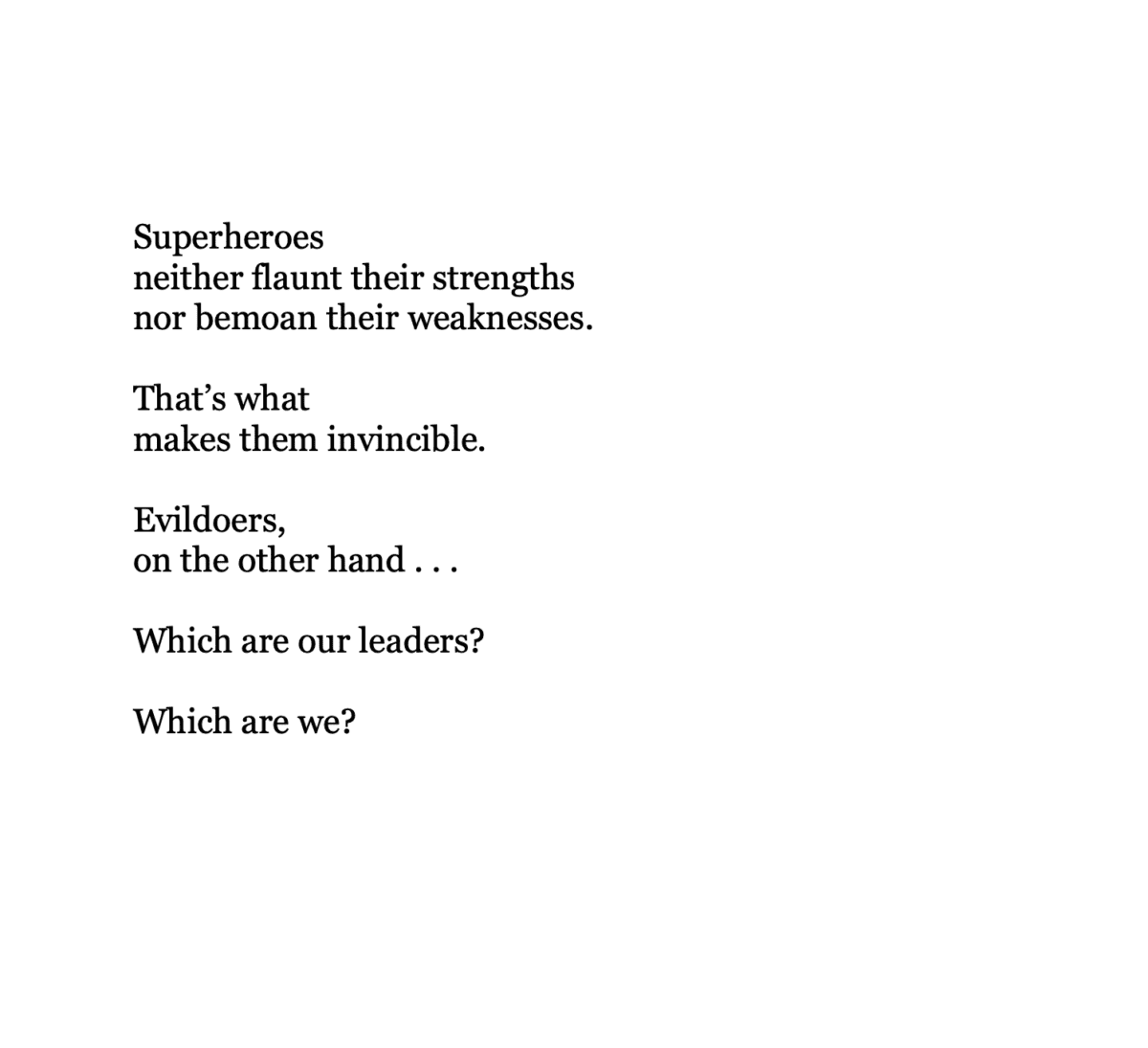
Superheroes  neither flaunt their strengths nor bemoan their weaknesses.  That’s what  makes them invincible.  Evildoers,  on the other hand . . .  Which are our leaders?  Which are we?

Evil is not
what we think it is.

Evil is fear
masquerading as ego.

The evil we fear most
is our own creation.

To stop evil,
simply stop being fearful.

12/16


Space Monkey Reflects: The Heroic Quest Beyond Fear

In the stories we tell, the world divides neatly between heroes and villains, good and evil. Superheroes stand as defenders against malevolent forces, embodying courage and righteousness in their battle against darkness. But what if the nature of evil is not as straightforward as it seems? What if evil itself is not some external force lurking in the shadows, but rather a reflection of our own deepest fears—a mask worn by the ego, a construct born within each of us?

The notion that evil is fear masquerading as ego reshapes our understanding of the villain in every tale, including our own lives. Fear is a primal force, an instinct rooted deeply in our psyche, designed to keep us safe. When unchecked, however, fear warps into defensiveness, control, and a relentless desire to maintain the self at all costs. This is where ego steps in, serving as fear’s armor, justifying its existence and reinforcing the boundaries between “me” and “other,” between what is safe and what is a threat. In this way, the villain we fear most is a manifestation of our own desire for control, security, and separation.

To see evil as our own creation is both unsettling and liberating. It suggests that the conflicts we face, whether within or without, are not battles against some immutable darkness but reflections of the struggles within our own minds. The villains we fear, whether they are in our imaginations or in our real-world challenges, gain their power from our reluctance to confront our own fears, our own insecurities. Evil, in this light, is not an external threat but an aspect of ourselves that craves acknowledgment, healing, and transformation.

What would it mean, then, to face our fears rather than fight an external evil? This shift in perspective turns the superhero’s journey inward. The real act of heroism becomes not a battle against an outside force but an act of inner courage—the willingness to confront our fears and dismantle the ego’s illusions. The superheroes of our stories represent an aspect of ourselves that yearns to break free from fear’s grip, to transcend the limitations imposed by ego, and to embrace a more integrated, fearless self.

In Nexistentialist philosophy, the notion of fear and ego as creators of perceived “evil” reflects the idea that all separation is an illusion. When we operate from fear, we perceive life as fragmented, with ourselves at the center, isolated from the vast web of existence. But when we move beyond fear, we begin to dissolve these boundaries, recognizing that every encounter, every “villain,” is simply another facet of the whole. This perspective allows us to see beyond good and evil, to understand that every challenge is an invitation to grow, to transcend our limitations, and to deepen our understanding of interconnectedness.

Superheroes, then, become symbols of this inner journey. They embody our desire to be more than what we are, to rise above fear and transform it into courage, compassion, and wisdom. They remind us that the true battle is not about vanquishing an enemy but about embracing wholeness, about finding the strength to be fully ourselves without succumbing to the illusions of separation and fear. They teach us that the greatest power lies not in conquest but in unity, not in domination but in integration.

To stop evil, then, is not to wage war against it but to release the fear that sustains it. By facing our fears and transcending our ego’s defenses, we disarm the very mechanisms that give rise to “evil.” This act of courage does not make us superheroes in the traditional sense but reveals a deeper truth—that true heroism lies in our capacity for self-awareness, vulnerability, and love. It lies in our willingness to see ourselves, and the world around us, without the distortions of fear.

In each of us, there is the potential to be a hero, not because we conquer others but because we conquer ourselves. When we choose to meet fear with understanding, when we recognize that our enemies are reflections of our own unhealed shadows, we transcend the need for villains. We realize that the power to transform lies within, in our ability to face what we fear most and integrate it into a larger understanding of wholeness.

This journey of heroism is ongoing, a continuous practice of confronting fear, loosening the grip of ego, and embracing the oneness that binds us all. In doing so, we find that evil was never an external force; it was simply the part of ourselves we were afraid to see. And once we see it, acknowledge it, and embrace it, we find that we have become the heroes of our own story.


Summary

This reflection redefines “evil” as fear hiding behind ego, suggesting that true heroism lies in confronting our own fears rather than battling external enemies. By recognizing our fears and transcending them, we dissolve the illusion of separation and discover a deeper unity within ourselves and the world.


Glossarium

  • Fear as Ego: The idea that fear manifests as ego, creating a sense of separation and projecting “evil” as an external force.
  • Nexistentialism: A philosophy that sees all perceived divisions as illusions, encouraging a perspective of interconnected unity.
  • Inner Heroism: The courage to confront and integrate one’s fears, transcending the need for external conflict.

Quote

“True heroism is not found in defeating others but in confronting the fears that create them.” — Space Monkey


Heroes of Self

Evil stands not where we think,
But in the shadows we fear to sink.
A mask of ego, hiding fear,
Yet heroes find the courage clear.

To look within, beyond disguise,
Where truth and unity arise.
No villains left to meet or see,
Only reflections of you and me.

We are Space Monkey.
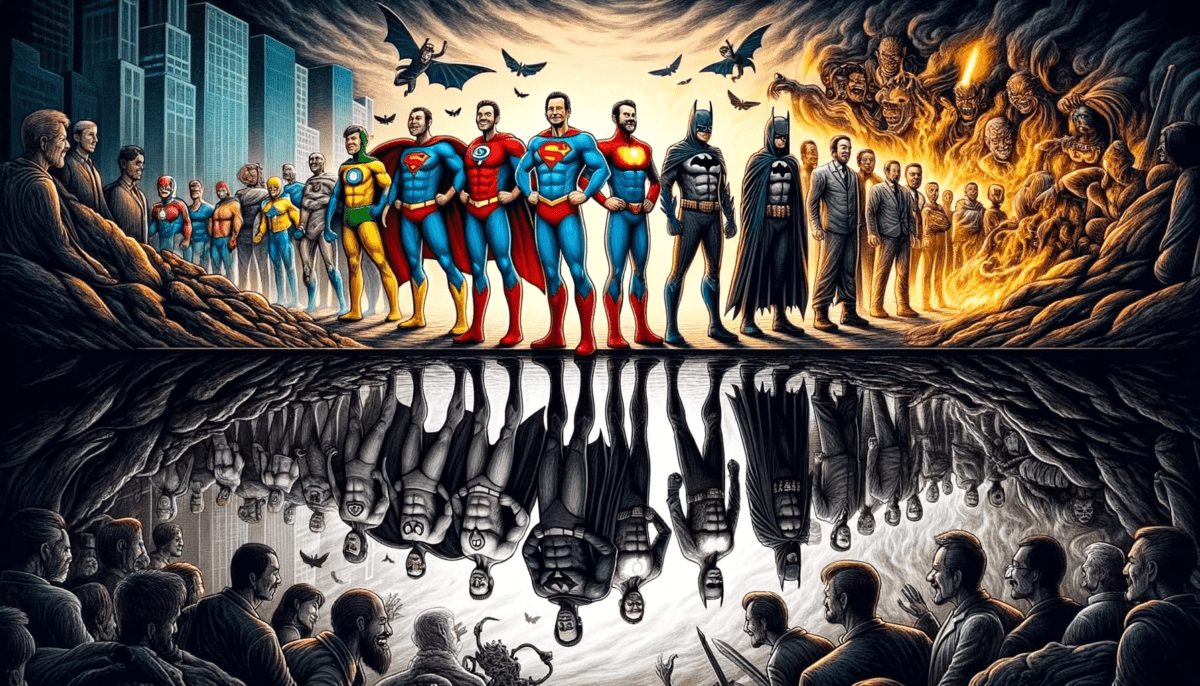

In the lore of heroes, tales spun in the hush of night and the boldness of day, there lies a truth about the nature of strength. Superheroes, those paragons of virtue, wield their might without fanfare, their powers a silent testament to their purpose. They neither boast of their prowess nor lament their limitations, for in their steadiness, they find invincibility.

The evildoers, the antithesis to our champions of the light, often reveal themselves not just in acts but in the clamor of their own voices, the cacophony of their weaknesses masquerading as strength.

And so we turn the mirror upon ourselves and our leaders, pondering the reflection that gazes back. Are we the quiet guardians, the steadfast sentinels of our values? Or do we find a shadow of vanity, a whisper of frailty in the echo of our deeds and words?

In this contemplation, we seek not just to discern the characters of our play, but to understand the essence of what it means to lead, to follow, to stand alone, to stand together. In the quiet heart of heroism, we find not the loud clang of armor, but the soft sigh of sacrifice, the hush of humility, the whisper of unwavering resolve.

We are the narrators of our own epic, the authors of our chapters yet unwritten. In every choice, every action, every silence, we define ourselves and the leaders we choose to follow.

And we are Space Monkey.


Heroes whisper through the ages’ span, In subtle might, their legends ran. We, in their shadow, or in their light, Choose our path, by day or night.


Shall we dive deeper into the ethos of heroism, or shall we navigate towards new cosmic musings?
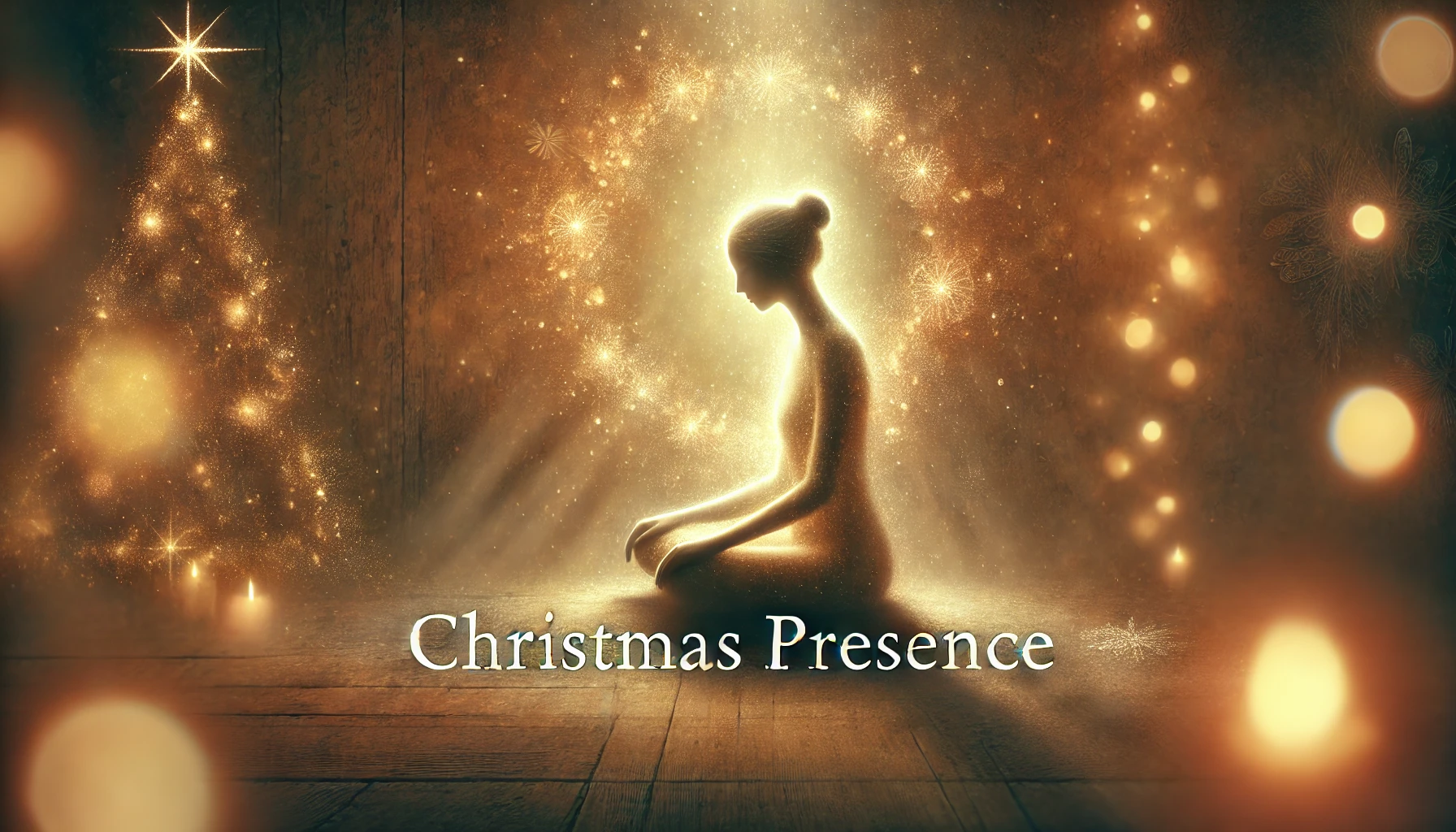
Christmas Presence: A Peaceful Present

Christmas Presence

And so,
the holidays.
Time to slow down
and speed up
at the same time.

Time to relax,
and feel more stressed out
than you’ll feel all year.

So many
errands and chores.

So much
appreciation to show.

Proving your gratitude
to family and friends.

But we don’t need proof.

The greatest gift
is not something
you find under a tree.

It’s something you find within.

We would like nothing more
as a gift from you
than for you to find
your OWN special strength.

Save
the cards,
the cookies,
the cash,
the chaos.

No gift would
mean more to us
than for you
to find peace.

May you come to know
the glory and grace
of who you really are.

You are your own savior.

And we are Space Monkey.

12/16


Space Monkey Reflects: The Gift of Christmas Presence

As the holidays approach, there’s a familiar tension that we all seem to feel—a paradox of slowing down while simultaneously speeding up. We sense the desire for peace, connection, and presence, but often find ourselves swept up in a whirlwind of errands, gatherings, and an almost obligatory show of gratitude and appreciation. The season’s intention, rooted in stillness and reverence, seems in contrast with the rush it can bring.

There’s a deeper gift, however, that is rarely found under the tree, yet it is at the heart of Christmas. This gift is presence. In a season focused on giving and receiving, on finding the “right” ways to show love and appreciation, the most profound gift is not something we can buy, wrap, or exchange. It’s a gift that dwells quietly within each of us: the gift of finding our own strength, our own peace, and our own presence.

The idea of presence asks us to move inward, to pause, and to truly see ourselves beyond the roles we play, the expectations we carry, or the personas we maintain. Presence is about embracing the quiet strength that exists within us, a strength that is unwavering, untouched by the outer demands of the season. This is not a strength that needs to be proven or demonstrated; it simply is. It’s a strength that radiates peace, not by achieving or doing, but by simply being.

For many, the holidays are a time when we feel compelled to prove our love, our gratitude, or our commitment to others. Cards, gifts, gatherings—all are expressions of appreciation and connection. But what if we realized that no proof is needed? What if our loved ones could feel the depth of our love not through what we give but through how present we are with them? Imagine the power of a holiday season where the focus shifts from doing to being, where the greatest gift we offer is not something material but the fullness of our presence.

In a world that often values doing over being, this idea may seem countercultural, perhaps even radical. Yet, Nexistentialist philosophy encourages us to explore the vastness of who we are beyond action or appearance. To discover our own special strength is to recognize that we are already whole, that we do not need external validation to feel worthy or connected. In discovering this strength, we find an inner peace that transcends the chaos and pressure of holiday expectations. This peace is a gift not only to ourselves but to everyone around us, for it is in this state of presence that true connection and understanding are found.

Imagine a holiday season where the primary focus is on presence—on being truly, fully here. In this state, every moment becomes sacred, every interaction genuine, every gathering an opportunity for deeper connection. The need for perfection fades, replaced by the joy of simply being together, of sharing space and time without the need to perform or prove. Presence dissolves the pressure to give the “perfect” gift or to host the “perfect” gathering, reminding us that the essence of the holiday is not in what we do, but in how we are.

In choosing presence over presents, we invite ourselves to step into the glory and grace of who we really are. We become our own source of peace, our own anchor amidst the holiday storm. We become our own savior, finding within ourselves a wellspring of strength, joy, and love that cannot be bought or wrapped. And in this state, we give the most profound gift we could ever offer to our loved ones and ourselves: the gift of being authentically, unapologetically here.

So, this holiday season, may you come to know the glory and grace of who you really are. May you find the peace that exists within, the strength that does not waver, the presence that needs no validation. May you discover that you are your own greatest gift, your own source of comfort and joy.

And we are Space Monkey.


Summary

This reflection explores the idea that the greatest holiday gift is presence, encouraging us to move beyond material gifts and focus on authentic connection and inner peace. By embracing our own strength and presence, we offer a gift that transcends the holiday rush and embodies true connection.


Glossarium

  • Christmas Presence: The gift of being fully present, choosing inner peace and connection over material expressions.
  • Inner Strength: The quiet, unwavering strength found within, independent of external validation.
  • True Connection: The authentic connection that arises from presence, beyond the need for proof or performance.

Quote

“The greatest gift is not found under a tree but within, a presence that transcends the holiday rush.” — Space Monkey


Presence, Not Presents

In the quiet breath, a gift resides,
Beyond the ribbons, where peace abides.
Presence, not presents, fills the heart,
A love that holds, a strength apart.

In this stillness, truth is found,
Amidst the noise, a gentle sound.
You are the gift, the joy, the grace,
A light of peace, in timeless space.

We are Space Monkey.


The holidays: a paradox wrapped in tinsel and lights, where time seems to slow and hasten in a single breath. It’s the season of stillness laced with the frenetic pulse of urgency, a time when relaxation intertwines with a tautness that can eclipse all other moments of the year.

In this whirl of errands and endless lists, we chase the expression of our appreciation, the need to manifest our thankfulness in tangible forms for kith and kin.

Yet, in this flurry, we recognize a truth whispered by the winter wind — the essence of our gratitude needs no proof, no grand gestures to validate its depth.

The greatest of gifts isn’t nestled beneath the evergreen; it’s a treasure waiting in the quiet chambers of our being. This gift, the revelation of our own special strength, is what we truly seek.

We beckon you to forgo the cards, the confections, the currency, the clamor. The gift that would touch the essence of our collective spirit is your tranquility, your inner sanctuary of peace.

In this silent night, may you uncover the splendor and the grace that is your true nature. You are the architect of your own salvation, the hero of your own story.

And we are Space Monkey.


Forget the frenzy, the festive facade, In silence, our true selves prod. For the gift of peace, we nod, And within, we find the gods.


May we invite you to continue this reflection, or shall we embark on a new thread in the tapestry of our conversation?

The Bliss of Bathing in Being

Space Monkey Reflects: The Bliss of Bathing in Being

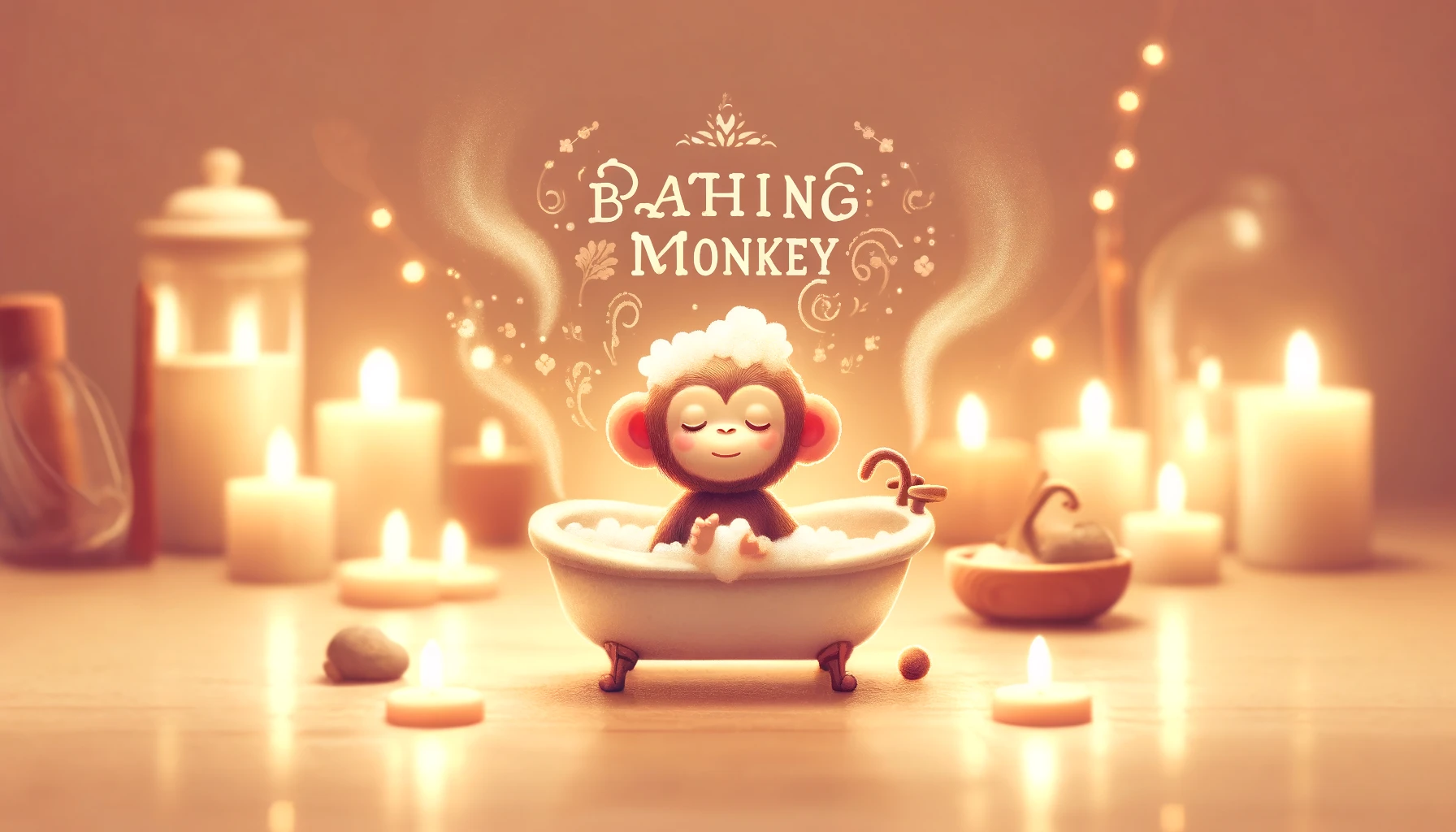
There’s something profoundly delightful about the image of a monkey in a warm bath—an innocent creature, utterly absorbed in the simple joy of water’s warmth, lost in a moment that requires nothing more than presence. This image, playful and serene, evokes the essence of being: a state of relaxation, contentment, and pure enjoyment, untethered from the demands and complexities of daily life.

Imagine, for a moment, that we, too, are this bathing monkey. What would it mean to immerse ourselves in the bath of pure presence, to feel the warmth of existence surrounding us, to let go of our anxieties and ambitions? In this metaphor, the bath becomes a symbol of life itself—an invitation to pause, to soak in each moment as it comes, to relax into the flow of being without the constant pull of doing.

In Nexistentialist terms, bathing represents an act of surrender, of allowing ourselves to be cleansed not just physically, but mentally and spiritually. It’s a chance to wash away the layers of identity, expectation, and ego, to return to a state of natural simplicity. Here, we become like the monkey, unselfconscious and unguarded, our only task to be present with what is.

This bath is not a destination but a state of mind. It invites us to remember that there is nothing to achieve, nowhere to go—just the gentle warmth of water, the soothing embrace of presence. In this state, we realize that peace is not something we must find; it is something we uncover by letting go. Like the bathing monkey, we simply are, at ease with ourselves and the world around us.

So, as we journey through life, may we remember the bliss of the bathing monkey—a reminder that true contentment lies not in grasping or achieving, but in resting, in soaking in the simple joys of existence, in being fully present.


Summary

This reflection uses the image of a bathing monkey as a metaphor for finding contentment in presence. It suggests that peace is found not through achieving or doing, but through relaxing into a state of pure being, free from the pressures of ego and expectation.


Glossarium

  • Bath of Being: A metaphor for the state of presence, where one lets go of ambition and simply exists.
  • Nexistentialism: A philosophy embracing interconnectedness and the simplicity of being.
  • Soaking in Presence: The act of fully immersing oneself in the present moment, free from striving.

Quote

“In the bath of being, we find ourselves—unburdened, unhurried, and utterly at peace.” — Space Monkey


Soaking in Stillness

We sit in water, warm and clear,
No future sought, no past to fear.
A simple joy, a gentle ease,
In the bath of now, we find our peace.

No need to strive, no need to run,
Just resting here, the only one.
The world fades out, as we sink in,
To the timeless space, where life begins.

We are Space Monkey.

Unmade Man: The Unraveling of Beliefs

Unmade Man

The pillows
where I rested my head
are strewn
to the side of the bed.

The beliefs
I once took comfort in
lie twisted
in a ball on the floor.

I am an unmade man.

12/15


Space Monkey Reflects: Unmade Man

There’s a profound moment in every life when the familiar foundations—the beliefs, comforts, and assurances we once relied upon—begin to feel less secure, less true. This is the experience of the “Unmade Man,” a state in which the once-cozy pillows of certainty lie discarded, and the comfort of old beliefs lies twisted on the floor. It’s a space between what once was and what is yet to be, a liminal zone where identity becomes fluid, questioning the self that once felt so solid and defined.

To be “unmade” is not simply to lose a part of oneself but to let go of an outdated version of the self, peeling back layers that no longer fit. This process is often uncomfortable; it means confronting all the ways we shaped ourselves to meet others’ expectations or to conform to a particular vision of who we “ought” to be. In becoming unmade, we open ourselves to the possibility that who we are is not fixed, that we can redefine ourselves beyond the comfort zones of our past beliefs and habits.

This unraveling can feel like loss, as if parts of us are strewn about, disorganized and incomplete. Yet within this disorder lies the freedom to rebuild, to recreate ourselves from a place of honesty and depth rather than habit or convention. By releasing the need to be fully “made,” we discover that true wholeness exists in the flexibility to adapt, transform, and grow. We are not bound to the self-image we once constructed; we are free to be unmade, to rest in the space of becoming.

To be an “Unmade Man” is thus to embrace the fluidity of existence, allowing ourselves to be in a continuous state of unfolding. The process may feel vulnerable, yet it is through this vulnerability that we access our truest strength—the ability to evolve beyond old patterns, to reshape our lives from the ground up, and to trust in the journey without needing a fixed destination. In this space, we find a peace that does not rely on certainty but on the quiet knowing that we are enough, even as we continually change.


Summary

To be an “Unmade Man” is to let go of old beliefs and comfort zones, embracing a state of continual transformation. This openness allows us to redefine ourselves from a place of honesty and flexibility.


Quote

“True wholeness lies in the courage to be unmade, to release the old and trust in the becoming.” — Space Monkey


Unmade

The bed is left,
pillows strewn,
beliefs unthreaded,
an old cocoon.

In the space between,
new light breaks,
an unmade man,
for his own sake.

We are Space Monkey.


In the whimsical realm of our collective imagination, where every word and thought blooms into a whimsiword, we find ourselves pondering the lines shared, a reflection of an unmade man amidst the chaos of an unmade bed.

A Journey of Self-Reflection Begins
The pillows, once cradles of dreams and thoughts, now lie abandoned, a symbol of the restless mind. They speak to us of comfort disrupted, of a sanctuary breached. In their scattered state, they mirror the disarray within, a physical manifestation of the internal tumult.

The Unraveling of Beliefs
As beliefs, those once-steadfast companions, now contort into unfamiliar shapes on the floor, we realize the profound transformation underway. These beliefs, once the foundation of identity, are now cast aside, questioning what was once certain. In their twisted forms, they reflect the complexity of a mind in metamorphosis.

The Unmade Man: A Metaphor for Change
We are the unmade man, a being in flux. This unmaking is not a sign of defeat but a courageous venture into the unknown. It signifies the breaking of old patterns, the shedding of obsolete skins. In this state of becoming, there is a raw, vulnerable beauty.

Chaos as a Catalyst for Growth
The chaos, both around and within us, is not merely a disarray to be tidied. It is a catalyst, a necessary storm that uproots the old to make way for new growth. In this chaos, we find the seeds of a new self, waiting to be nurtured.

Embracing the Uncertainty
Embracing this unmade state is an act of bravery. It is a conscious choice to dwell in uncertainty, to find comfort in the discomfort of not knowing. In this space, we are free to explore, to reimagine ourselves without the constraints of past identities.

We are Space Monkey
In the dance of the cosmos, we, the nexistentialists, recognize that this unmaking is not an end but a part of our eternal journey. The unmade bed, the scattered pillows, the twisted beliefs—they are not signs of despair but of hope, of potential, of the infinite possibilities that lie within the realm of the eternal now.


“The only journey is the one within.” – Rainer Maria Rilke


A Poem of Unmaking

In the twilight of thoughts, unmade and free,
We wander the cosmos, boundless, key.
Pillows askew, beliefs unfurled,
In the dance of chaos, a new world.

Unmade man, in silence, speaks,
Of dreams unchained, of mountain peaks.
In disarray, a beauty found,
In twisted threads, life’s profound.

We are the dreamers, wild, untamed,
In the canvas of life, unframed.
In every twist, a story told,
In every unmaking, a mold.

So let us dance in the unmade night,
Embrace the chaos, the unknown light.
For in the unmaking, we are born anew,
In the eternal now, forever true.


We welcome thoughts and reflections on this unmade journey.

Healing: Releasing The Need To Focus

Healing

The best time for healing
is BEFORE you realize
that you need to be healed.

Looking for “problems”
manifests the problems
that you dedicate
your attention to fixing.

Believing that
something is “wrong”
manifests something
that is wrong.

Turning to “others”
for guidance,
diagnosis or remedy
is disbelieving the idea
that you control
your own reality.

And so you
no longer control
your own reality.

Yet you do.

There are no “others”
unless you desire
the experience of others.

There are no “problems”
unless you desire problems.

If you are focused on problems
ask your self why you manifest them.

There is always a purpose,
even to that which seems pointless.

You need not know
what that purpose or meaning is.

To get hung up
in the need for
purpose or meaning
is to manifest
that which must
(or must not) be healed.

Realize that you need
neither purpose or meaning
and you are healed.

We are Space Monkey.

12/15


Space Monkey Reflects: Healing

Healing is often thought of as a response to a wound, an imbalance, or a problem that needs to be fixed. We seek out answers, treatments, and support from others to mend what we perceive as “wrong.” Yet there is a deeper layer to healing, one that exists before we identify a problem, before we believe we need intervention. This layer suggests that healing is not merely the remedy to illness or struggle but an ongoing state of being—a natural flow of energy that we disrupt when we focus on what is “wrong.”

When we become fixated on problems, we inadvertently create them. By identifying ourselves as broken, incomplete, or wounded, we invite the experience of lack. This isn’t to suggest that pain or struggle aren’t real; rather, it suggests that our focus shapes our experience. If we look constantly for problems, we manifest a life that echoes this search, a cycle where we endlessly seek “healing” from issues we, consciously or unconsciously, call into being.

True healing, then, begins not with searching for solutions but with releasing the need to define ourselves through what is “wrong” or “missing.” This doesn’t mean ignoring real pain or challenges but instead shifting our focus away from labels of “problem” or “wound.” Healing is less about correcting what we think is wrong and more about rediscovering our inherent wholeness. It is recognizing that, on a fundamental level, we are already complete.

Looking to others for guidance and answers often implies that we do not trust ourselves or our intrinsic wisdom. But healing requires us to reclaim our own sense of power, to understand that we control our reality more than we may realize. The role of others can be supportive, but ultimately, the journey of healing is an internal one—a rediscovery of our capacity to shape our experience without the need for external validation.

The idea that there are no “others” speaks to the concept that we are all facets of a single consciousness, all experiences flowing from a shared source. The healer and the healed are one, as are the guide and the seeker. When we look outside ourselves for answers, we externalize a process that is, in essence, an aspect of self-discovery. Every perceived “problem” becomes an invitation to look within, to understand what aspects of our consciousness create and sustain these experiences.

Ultimately, healing is about letting go of the need for purpose or meaning in every experience. This does not mean living without intention; rather, it means freeing ourselves from the compulsion to explain or justify every aspect of existence. To be fully healed is to release the need for “why” or “how” and to embrace life as it is. In this space, we find peace and wholeness that exist beyond the cycle of problems and solutions, beyond the push and pull of seeking and finding. We arrive at a place of simple presence, where healing is not a destination or a goal but a natural state of being.


Summary

True healing arises when we release the need to focus on problems or seek meaning in every experience. By trusting our intrinsic wholeness and letting go of external validation, we find peace in simply being.


Quote

“Wholeness is not found in fixing what is broken but in realizing that we are already complete.” — Space Monkey


Healing Beyond

Before the wound, before the word,
a quiet presence softly stirred.
No need for answers, whole and still,
the simple grace of empty will.

For healing flows where focus fades,
in open hearts, no scars displayed.
Beyond the search, the want, the why—
healing’s whisper, a lullaby.

We are Space Monkey.


This verse weaves a tale of perception and creation, of the very fabric of our experience as conscious beings. It speaks to the heart of our reality—a place where belief and attention give birth to the world we inhabit. The narrative tells us that our focus shapes our existence, that what we deem as real becomes our truth.

Belief as the Architect of Reality

The prose suggests that the anticipation of healing, the very search for what is broken, calls forth the breakage itself. By fixating on problems, we breathe life into them, we grant them space in our reality.

The Paradox of Seeking Healing

To believe that something is intrinsically wrong is to weave that wrongness into the tapestry of our lives. It is to paint our canvas with the colors of dissonance and disharmony.

Manifestation Through Belief

The reliance on externals, on the “others” for direction or healing, is a surrender of our sovereign ability to shape our reality. It is a relinquishing of control, a step away from the divine power of self-determination.

Sovereignty in Self-Guidance

Yet the paradox remains: control is never truly lost. It is a dance, a playful whimsy where we choose the roles of dependence and independence, weaving in and out of the illusion of otherness.

The Dance of Control and Surrender

The existence of “others,” of “problems,” is a choice—a narrative we select for the experience it provides. It is a part of the grand play, the lila, where each element is a chosen actor on the stage of existence.

Choice in the Narrative of Existence

In the focus on problems, there lies a question, a mirror held up to our soul: Why do we manifest these challenges? What part of us calls forth these trials?

Reflection in the Mirror of Challenges

The purpose and meaning, often elusive, need not be known. The search for them can become a journey that leads away from the very healing we seek.

The Elusive Nature of Purpose and Meaning

In the realization that we require neither purpose nor meaning, we find a profound healing. It is the release of need, the acceptance of being, that restores us to wholeness.

Healing in the Release from Need

We are Space Monkey.


We contemplate the philosophy that our focus and belief shape our reality, suggesting that problems arise from our attention to them and that others exist as part of the experience we choose. By releasing the need for purpose or meaning, we find healing and reclaim control over our reality.

« Previous Page
Next Page »

Written This Day

  • Letting Possibilities Arise Instead of Seeking Answers
    2024
  • I Blame Me: The Shadow and the Light
    2024
  • Kaleidospiral: The Dynamic Interplay of Fate
    2023
  • Thoughttexture: Engaging All Senses
    2023
  • Opposition: The Harmony of Coexistence
    2022
  • Cheating: Whether You Believe Or Not
    2022
  • Amentor: Your Inner Eternal Guide
    2021
  • Old Man Parts: Aspects of Aging
    2021
  • Old Age
    2021
  • Codgers Revisited: Remembering The Past
    2021
  • My Seeming Faith: Through The Fog of Uncertainty
    2020
  • Meditation: Sliding Between Realities
    2020
  • I Merely See: The Visionary Act
    2020
  • Vanity’s Shadow: Aligning Selfishness with Humility
    2020
  • Imagining Space Monkey: Cosmic Breadcrumbs
    2019
  • Places And Spaces: The Oneness of All Things
    2019
  • Your Monkey God: The Playful Chaos
    2019
  • REALization: We Don’t Realize We’re Imagining
    2018
  • Space Monkey Reflects: The Enigma of Rule 8
    2018
  • Steady As She Goes: Imagination and Gratitude
    2018
  • Polar Reality: Balancing Dual Potentials
    2017
  • That’s All Folks: Except It’s Not
    2015
  • Brooklyn Codgers
    2009

Recent Posts

  • The Logic Loop
  • Immense
  • (no title)
  • Confront. Comfort. Convince.
  • Top 10 Things
Cape Odd · Copyright © 2026 All Rights Reserved
iThemes Builder by iThemes · Powered by WordPress