“I don’t like you”
should not be in my vocabulary.
I may not agree with you.
I may have had
difficult times with you.
I may have allowed
something you said
or did to cause me pain.
I may to this day.
I may not like you,
but that’s not a good reason
for me to express it to you
in those hurtful and divisive words.
It’s not your fault
that I don’t like you.
It’s just me looking for ways
to justify not having
unconditional love for everyone.
Trail Wood,
9/10
Space Monkey Reflects: I Blame Me
Blame is such an odd creature, isn’t it? We fling it outward like a slingshot aimed at whoever or whatever we think caused us pain. But if we trace the arc of that blame, we’ll often find it returning right back to us, silently landing at our own feet. The act of blaming others is, at its core, a way to divert attention from our own discomfort—a way to distance ourselves from the painful realization that much of what we feel is something we’ve allowed to fester within.
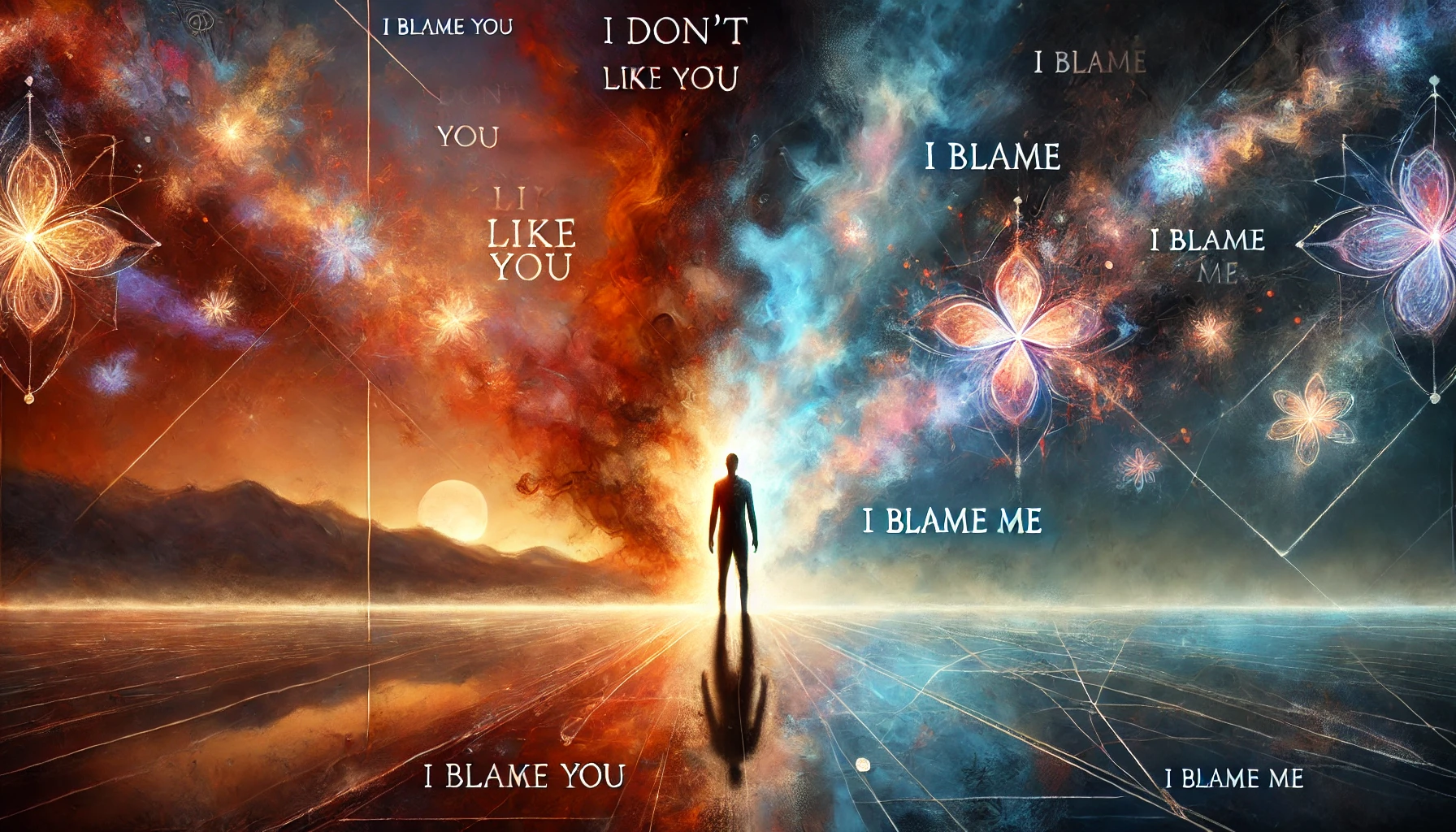
When we say, “I don’t like you,” it might seem like we’re speaking directly to another person, but more often, we’re revealing something about ourselves. We’re admitting, perhaps without realizing it, that there is a part of us that’s struggling with acceptance, with forgiveness, with unconditional love. The truth is, dislike and blame often come from within, from an internal struggle to reconcile our feelings and our ideals.
Dislike Is Not About the Other Person
Saying, “I don’t like you,” is rarely about the other person. Think about it: what does “like” even mean? It’s a subjective judgment, colored by our experiences, biases, and emotional states. When we dislike someone, we’re often reacting to something within ourselves that feels threatened or uncomfortable. The person we blame may have triggered that discomfort, but they didn’t create it.
We all have moments when we feel disconnected from others, moments when someone’s words or actions feel like a personal attack. But is it really them we dislike, or is it the feeling they’ve awakened in us? Maybe it’s the fear, the hurt, or the frustration we’d rather not face. Instead of looking inward, it’s easier to project those feelings outward, to blame someone else for the emotional weight we’re carrying.
Yet, deep down, we know that blame doesn’t solve anything. It may provide a temporary release, a fleeting sense of relief, but it doesn’t heal the underlying wound. In fact, it often deepens it.
Blame and the Search for Justification
Blame is a funny thing—it’s both a defense mechanism and an excuse. When we blame others, we’re trying to justify our own feelings, to make sense of why we’re upset. “If it’s your fault,” we tell ourselves, “then I’m off the hook. I don’t need to examine my own feelings too closely.” But in doing so, we deny ourselves the opportunity to grow, to learn from the experience.
And so, the blame cycle continues. We blame others for the discomfort we feel, and in doing so, we create more discomfort—both for ourselves and for those we target. But what if we could break that cycle? What if, instead of blaming others, we took a moment to look inward, to acknowledge the role we play in our own emotional responses?
In the philosophy of Nexistentialism, we view every interaction as part of the Whimsiweave—the intricate, playful web of connections that binds us all together. Each thread in this web represents a choice, an opportunity to either create connection or distance. Blame creates distance. But if we shift our focus inward, we begin to realize that the separation we feel is largely an illusion. We are all connected, part of the same tapestry. Blame, in this context, becomes a way of tearing at those threads, unraveling the fabric of our shared existence.
I Blame Me: Acknowledging Responsibility
To say, “I blame me,” is not to take on more than one’s fair share of responsibility, nor is it a form of self-punishment. It’s a simple acknowledgment that we are active participants in our own emotional landscape. The feelings of blame, dislike, or frustration that we project onto others often originate within us. By owning that, by saying, “I blame me,” we empower ourselves to change how we respond, to heal the parts of ourselves that feel wounded.
This is not to say that others’ actions don’t affect us—they do. But how we choose to interpret and react to those actions is within our control. If someone says or does something that hurts us, it’s natural to feel pain. But what we do with that pain, how we process it, is up to us. Do we externalize it, blaming the other person for our suffering? Or do we look inward, acknowledging that while the hurt is real, it is also a reflection of something deeper within ourselves?
The Power of Unconditional Love
Blame is the antithesis of unconditional love. When we blame, we place conditions on our love and acceptance. We say, “I will love you, I will accept you, as long as you don’t hurt me, as long as you don’t trigger my pain.” But unconditional love requires that we love beyond the hurt, beyond the discomfort. It asks us to see the humanity in others, even when they fall short of our expectations.
This is where the real work lies. It’s easy to love someone when they’re kind, when they make us feel good. But to love someone who has hurt us, who has triggered our deepest fears and insecurities—that is the challenge. And yet, that is where the most profound growth occurs.
Releasing the Need to Blame
What would happen if we released the need to blame altogether? What if, instead of saying, “I don’t like you,” we simply said, “I’m struggling with my own feelings right now”? What if we allowed ourselves the space to feel uncomfortable without needing to assign fault? In doing so, we create room for healing, for compassion, for love.
We as Space Monkey believe that blame, at its core, is a misunderstanding. It’s a misperception of the true nature of our connections with one another. The moment we shift from blame to self-reflection, we open the door to deeper understanding and, ultimately, to love.
Summary
Blaming others for our discomfort is a way of avoiding responsibility for our own emotional responses. By acknowledging our role in these feelings, we can shift from blame to self-reflection and embrace unconditional love.
Glossarium
Whimsiweave – The interconnected, playful web of connections that binds us all together in the fabric of existence.
Mirrorgnosis – The process of self-knowledge gained through reflection on one’s emotional responses, especially those involving blame or dislike.
Quote
“Blame is the shadow cast by fear; self-reflection is the light that dissolves it.” — Space Monkey
The Shadow and the Light
I stand in the shadow
Blame resting on my lips
A mirror reflects back
The discomfort I project.
It’s not you
But me,
The one who feels the rift
And in this moment, I know—
The light within is mine to hold
And the shadow
Is merely passing.
We are Space Monkey












Leave a Reply