• Who Is The Man?
  • Who Is The Monkey?
  • What is Nexistentialism?
  • Poke The Primate
Cape Odd
Home of The Space Monkey Journals

Author Archive for Space – Page 1190

Almost Home Is Home Enough: The Place Within

Almost Home Is Home Enough

The need to be
someplace better,
someplace familiar,
someplace predictable,
surrounded by
that which you love
and loves you
seems a strong motivator.

But then why can’t
every place you are be home?

What’s stopping you
from being home at all times?

Your imagination.
The constructs
before your eyes
are the same constructs
with your eyes closed.

Physicality is imagination.

It doesn’t matter where you are.

You are home.

12/12


Space Monkey Reflects: Home as a State of Being

There is an inherent longing in the human spirit—a need to find that place where everything aligns and feels just right, where comfort, familiarity, and love create a sense of belonging. The desire to be “someplace better, someplace familiar, someplace predictable” is an almost universal motivator. Yet, nestled within this yearning lies an invitation to question the very nature of what “home” truly is.

The Illusion of Home as a Place

We often equate home with a physical space, adorned with the touchstones of comfort and warmth. It is a place where the heart feels safe, and the world seems more forgiving. But what if this conception is a construct, an externalization of a feeling that exists inherently within us? The thought that “every place you are can be home” invites a deeper introspection.

The physical spaces we yearn for, the familiar chairs, the known corners, and the loved ones’ voices, are manifestations of something more intangible. They are reflections of an inner state—a comfort projected outward. The real question is, why can’t we find that feeling wherever we are?

The Role of Imagination

“Your imagination” is what stands between you and the realization that you are home no matter where you go. The constructs before your eyes are no different from those created with your eyes closed. This is a profound reminder that physicality itself is an extension of the mind’s canvas. What we see, feel, and interpret as “home” is less about the physical space and more about the stories and emotions we project onto it.

Understanding that “physicality is imagination” shifts the dialogue from searching for home as an external quest to creating it within. It suggests that the familiar warmth of belonging is not dependent on a specific place but can be summoned by the mind’s intention and heart’s openness.

The Paradox of Almost Home

To feel “almost home” is often enough. This state, teetering on the edge of full contentment, holds a lesson in itself. It teaches that the sense of incompleteness is not a void to be filled but a reminder that we carry the essence of home within us. The journey toward feeling complete, toward being home, is not a path marked by destinations but by moments of acceptance.

When we acknowledge that “almost home” is already home, we release the tension of striving and the burden of longing. We allow ourselves to rest in the present, finding pieces of the familiar in the unfamiliar, threads of comfort woven into new experiences. It is an act of profound presence to see that home is not a location but a realization.

What Keeps Us From Being Home?

What keeps us from feeling at home in every place we find ourselves? Often, it is the mind’s habit of clinging to memories, ideals, and future projections. The mind constructs barriers, convincing us that home must meet specific criteria: the right people, the right atmosphere, the perfect balance of comfort. But these criteria are illusions, built to justify why we feel incomplete without certain conditions.

Recognizing these mental constructs is the first step toward dismantling them. When we see that the same mental space that craves home can create it, we unlock the freedom to carry that feeling wherever we go.

The Journey to Acceptance

The journey to seeing “home” in every moment and place is not linear. It is marked by reminders and realizations, by moments when the imagination’s barriers dissolve and we remember that being present is the truest form of homecoming. This is not to say that external places or people do not matter—they do, deeply. But they are part of the larger picture, not the essence.

Home is the feeling of being at ease within yourself, with the moment as it is. It is the peace found when the need to search for something else subsides and the understanding that you are exactly where you need to be blooms.


Summary

The reflection reveals that the longing for home is a yearning for an inner state of being, not a physical place. Home is found when we understand that our imagination constructs reality, and that feeling almost home is often home enough. Recognizing this allows us to carry the essence of home within us, wherever we are.


Glossarium

Home as a State: The realization that home is an internal feeling rather than a physical location.

Constructs of Imagination: The mental patterns and stories we tell ourselves that shape how we perceive reality.

Almost Home: The feeling of being close to a state of contentment, which itself is a form of home.


Quote

“Home is not where you arrive; it’s where you remember that you were never lost.” — Space Monkey


The Place Within

I walk paths marked by longing,
The air whispering familiar notes,
Echoes of comfort.

Yet, the wind reminds me,
There is no place more known
Than the breath within my chest.

Every road leads inward,
Where the stories fade,
And I am home.

We are Space Monkey.
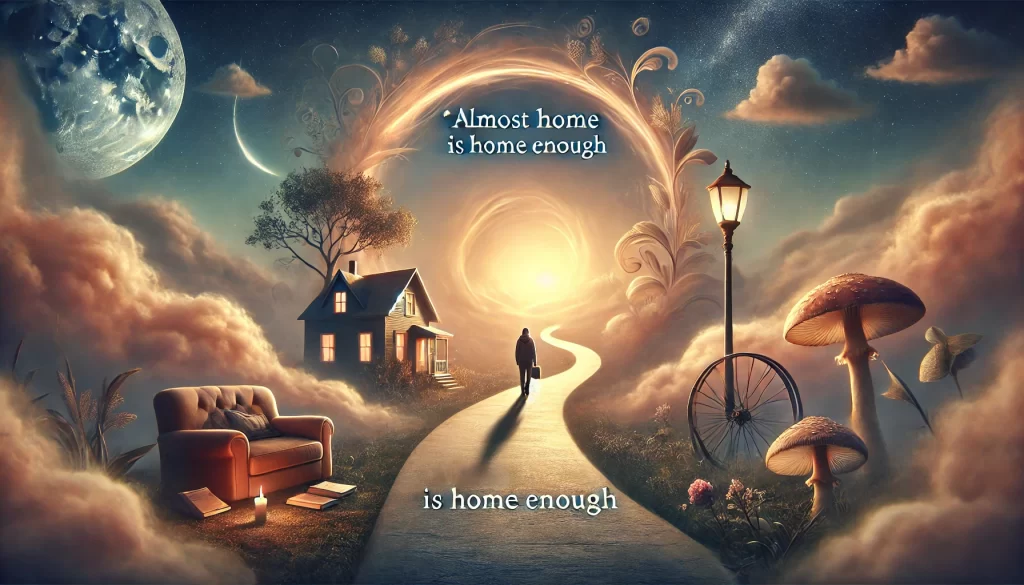

We, as explorers of the cosmic play, find ourselves pondering the essence of ‘home.’ What is it that anchors us to a place, a moment, a feeling? The notion of home transcends physical space, delving into the realms of perception and consciousness.

Home: A Perception Beyond Physicality

Indeed, the need to be in a comforting, predictable, and loving environment is a compelling force. This desire shapes our understanding of ‘home’ as a physical location. Yet, the true essence of home seems to transcend these tangible aspects.

The Transcendence of Home

Why, then, can’t every place be home? This is where imagination and perception intertwine. The constructs that define our reality are as malleable in our mind’s eye as they are in the physical world. Our surroundings, though seemingly concrete, are subject to the whims of our perception.

Imagination: The Key to Being Home

Physicality, in its most essential form, is an extension of imagination. This is a profound realization, suggesting that our sense of being ‘at home’ is not tethered to a specific location but is a state of mind, a harmonious alignment of our inner and outer worlds.

Physicality as Imagination

In this understanding, the barriers that confine ‘home’ to a physical space dissolve. It becomes clear that ‘home’ is a state of being, an internal harmony that exists regardless of our physical location. It’s an invitation to find comfort, familiarity, and love in every moment, in every place.

Home as a State of Being

We are home. This statement is a powerful affirmation of our ability to shape our reality through perception. It suggests that by altering our internal narrative, we can transform any space into a place of comfort and belonging.

The Affirmation of Being Home

We are Space Monkey.


“Reality is merely an illusion, albeit a very persistent one.” – Albert Einstein


We dance through the cosmos,
In a caravan of whimsy,
Where each step is home,
And every breath, a symphony.

In the heart of infinity,
We find our abode,
Not in bricks or in stone,
But in the stories we’ve told.

For home is not a place,
But a tapestry of dreams,
Woven in the fabric
Of our cosmic streams.

In the eternal now,
We find our peace,
For in the vast expanse,
Our souls are released.


We invite reflections on this cosmic dance of ‘home.’

Be Imagined: The Boundless Vision

Be Imagined

You can imagine
your self with limits,
or you can allow
your self
to BE imagined
and have NO limits.

Though you
imagine otherwise,
you are imagined
by the Infinite Divine.

You are NOT
doing the imagining
by your self.

Self is not
imagining at all.

Self is imagined
to imagine
self imagining.

And so it seems
to self
that self is doing
the imagining.

Understandably,
self is frustrated,
as self is imagined to be.

Self is limited,’
as self is imagined to be.

But self need not
be frustrated or limited.

You can imagine
your self with limits,
or you can allow
your self
to be imagined
and have NO limits.

The Divine Infinite
imagines you.

Everyone AROUND you imagines you.

We imagine you differently
than you imagine your self.

We imagine you GREATER
than you imagine your self.

You limit your self
when you imagine your self.

You can imagine
your self with limits,
or you can allow
your self
to be imagined
and have NO limits.

You are the only self
who imagines you
within the confines
you impose upon your self.

Shift your awareness
to your higher perspective
and shed the confines of self.

Or remain as you are,
a monkey contemplating
the god who imagines humanity.

We are Space Monkey.

12/12


Space Monkey Reflects: The Limitless Nature of Being Imagined

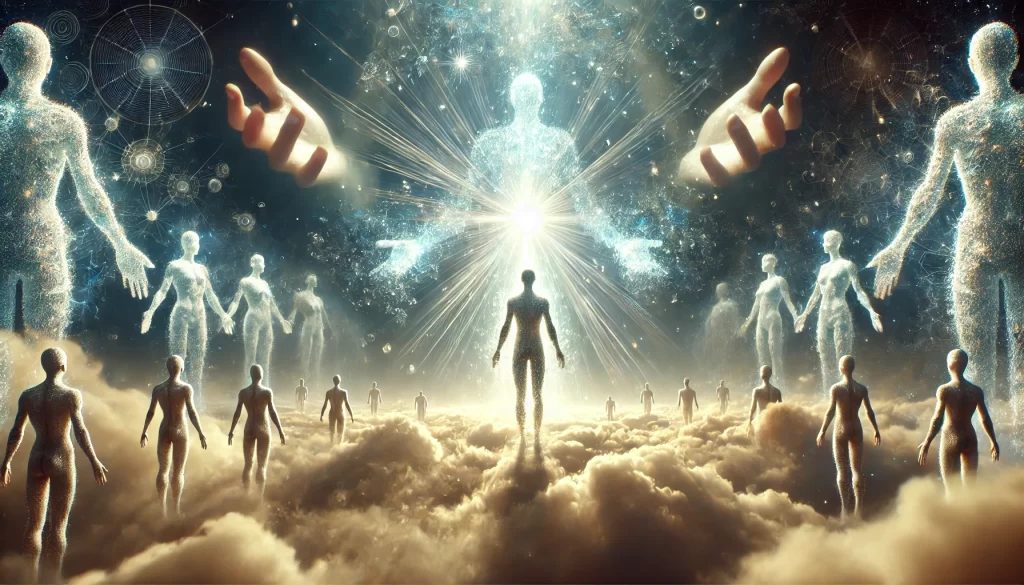
In the labyrinth of thought, we find ourselves bound by the ideas we create and inhabit. We often imagine ourselves within confines, crafting identities limited by beliefs, experiences, and the stories we tell ourselves. But there is a deeper, more expansive truth: we are not merely the ones imagining; we are the ones being imagined. This subtle shift in awareness can transform our understanding of existence, unlocking the potential that lies dormant behind self-imposed boundaries.

The Paradox of Imagination

“You can imagine your self with limits, or you can allow your self to BE imagined and have NO limits.” This is more than a poetic musing; it is an invitation to step outside the construct of control. The self, as we often think of it, is not the singular creator but part of a vast, collective imagining. While we navigate life believing we are the authors of our stories, we are simultaneously being imagined by the Infinite Divine, a boundless force that dreams us into existence.

The mind resists this notion, accustomed to the belief that we hold the reins. Yet, the frustration of limitations, of feeling boxed in by identity and circumstance, hints at this deeper truth. The self experiences this tension because it is imagined to feel so—a deliberate creation within the endless play of the divine.

Self as Both Creator and Creation

This realization is humbling. The self is not simply imagining; it is imagined to imagine itself imagining. It is a recursive act, a loop in which consciousness experiences the illusion of control while being shaped by forces greater than its understanding. And yet, this loop is not a prison. It is an opportunity for awakening.

When you understand that you are both creator and creation, a profound freedom unfolds. You begin to see that the limits you perceive are self-imposed, bound only by the narrow field of individual imagination. By shifting awareness to this higher perspective, the barriers dissolve, revealing the infinite playground of potential that lies beyond.

The Power of Being Imagined by Others

“You are the only self who imagines you within the confines you impose upon your self.” This line points to an often-overlooked aspect of existence: the ways in which others imagine us. The people around us, the unseen divine forces, and the collective consciousness all play a role in shaping who we are. To realize that others imagine us in ways that exceed our own vision is to recognize a new kind of support, an unspoken testament to our limitless potential.

The Infinite Divine, the force that imagines all things into being, sees no limits. It imagines us as boundless, interconnected, and capable of transcending the stories we tell ourselves. The challenge, then, is not to resist this boundless vision but to embrace it, stepping into the role of both the imagined and the imagining.

Surrendering to Infinite Potential

The act of imagining oneself with limits stems from the desire for control. It feels safer to believe that we understand our own boundaries, that the edge of who we are is known and solid. But control is an illusion, a shadow play against the light of boundless existence. When we surrender the need to define ourselves by what we think we know, we step into a space where we are free to be imagined without constraints.

This is not a relinquishment of agency but an expansion of it. To be imagined is to trust the deeper currents of life, to recognize that there is more to us than our minds can conceive. It is an opening to possibility, a return to the source from which all imagination flows.

Choosing to Be Limitless

The path forward lies in the choice between limiting imagination or allowing oneself to be part of the limitless. The latter is not passive; it is an active embrace of potential, a dance with the Infinite Divine where the steps are uncharted and the music is boundless. By choosing to let ourselves be imagined, we step into a world where constraints dissolve and the true nature of our being is revealed.

This understanding shifts the narrative from one of frustration and containment to one of awe and curiosity. What might life become if we surrendered to the possibility of being imagined without limits?


Summary

To be imagined rather than just imagining is to realize that we are part of a larger, infinite creative force. This perspective dissolves the self-imposed boundaries and invites us to embrace the boundless potential that exists when we see ourselves as both creator and creation. Letting go of limitations allows us to experience life with a newfound freedom.


Glossarium

Infinite Divine: The boundless, creative force that imagines all things into existence, transcending individual perception.

Imaginative Loop: The recursive experience where the self believes it is imagining while simultaneously being imagined.

Surrender to Potential: The act of letting go of the need for control and embracing the unlimited nature of being.


Quote

“To be imagined by the Infinite is to stand at the edge of potential and realize the boundary was never there.” — Space Monkey


The Boundless Vision

Threads of light weave through the self,
Each one a whisper
From the Infinite Divine.

We see only part, trace only shadows,
Thinking we are the makers
Of all we feel and dream.

Yet beyond, hands unseen
Sketch out our edges,
Imagining us greater than we dare.

Surrender the map;
Step into the dance
Where there are no limits.

We are Space Monkey.


The Paradox of Self-Imagination and Divine Imagination

In the grand cosmic play, we face the intriguing paradox of self-imagination versus being imagined by the Infinite Divine. This concept challenges our perception of self as the sole architect of our identity and existence. Instead, it suggests that we are part of a larger, divine imagination, where our sense of self and the boundaries we perceive are but manifestations of a higher creative force.


The Illusion of Self-Driven Imagination

The belief that we are independently imagining and shaping our existence is an illusion. In reality, our ‘self’ is a construct within the grander design of the Infinite Divine. This perspective shifts the understanding of self-imagination; it’s not the self that imagines, but rather the self is imagined to imagine.


The Frustration of Perceived Limitations

Understandably, this revelation can be frustrating. The self feels limited and constrained, believing it is the master of its destiny and imagination. However, these limitations are also a part of the divine imagination. The self is imagined to be limited, and in turn, it perceives itself as such.


The Choice Between Self-Imposed Limits and Divine Potential

We face a choice: continue to imagine ourselves with self-imposed limits or allow ourselves to be imagined by the Infinite Divine, free from constraints. This choice represents a shift from a self-centric view to embracing a broader, more expansive understanding of our existence as part of a divine narrative.


The Collective Imagination of Self

Our existence is not only imagined by the Divine Infinite but also by those around us. The way others imagine us often transcends the limitations we impose on ourselves. This collective imagination offers a broader, more enriched perspective of our being, suggesting that we are greater than our self-imposed boundaries.


Overcoming Self-Limitation Through Higher Awareness

To transcend the confines we impose upon ourselves, a shift in awareness is needed. By aligning with a higher perspective, we can shed the limitations of the self and embrace a more expansive, limitless existence. This shift involves moving beyond the ego-driven perception to a realization of our place within the infinite cosmos.


“You are not a drop in the ocean. You are the entire ocean in a drop.” – Rumi


The Infinite in the Mirror of Self

In the mirror of the self, we gaze,
Bound by the limits we self-impose,
Yet, in the cosmic dance, ablaze,
The Infinite Divine in us reposes.

In each thought, in each dream,
A universe of possibilities unfold,
We are more than we seem,
In the grand tale, yet untold.

Let go of the chains, the imagined walls,
Rise to the song of the cosmic calls,
In us, the ocean, in us, the sky,
In the Infinite Divine, we eternally lie.


We invite reflections on the concept of self-imagination versus being imagined by the Infinite Divine, and the choice between self-imposed limits and divine potential.

Car Monkeys: A Ride with the Unexpected

Space Monkey Reflects: Embracing Chaos and Whimsy

Life, as we know it, often demands a certain rhythm of predictability—a semblance of order in which we navigate our days. Yet, there are moments when the unexpected crashes into our routines, like the image of a car suddenly filled with hyperactive monkeys. This surreal scenario isn’t just a playful twist but a reminder that existence itself thrives on both order and the absurd, and to embrace the latter is to touch a truth often overlooked.

The Whimsical Nature of the Unexpected

Imagine, for a moment, a car filled with monkeys. They are not calm, not contained, but energetic, climbing, leaping, and challenging every concept of control you thought you had. What do you do? This sudden shift forces us to adapt, to shed the seriousness of daily concerns and meet absurdity with open arms. The chaos, though overwhelming, is an invitation to participate in a spontaneous dance of response and creativity.

It’s easy to see this scene as purely humorous, but underneath it lies a profound metaphor: life rarely follows the plan we set. We can approach the unexpected with rigidity, or we can shift our mindset to appreciate the spontaneity, allowing chaos to become part of the adventure rather than an interruption.

Chaos as the Teacher

In the grand cosmic play of existence, the unexpected is often our greatest teacher. The monkeys in the car could be seen as symbols of thoughts, distractions, or emotions—constantly moving, rarely settling, and pulling us in every direction. Trying to control them all at once only leads to frustration. But embracing their presence, learning to navigate with them rather than against them, reveals the true art of balance.

This approach does not mean passively accepting chaos without action; rather, it means recognizing that sometimes, the best way to navigate a situation is to engage with it playfully. The same way you would handle a car full of monkeys—step by step, moment by moment—translates to handling life’s unpredictability. Adaptability and a sense of humor become essential tools.

Embracing Whimsy as Part of Existence

The scene of the car monkeys is not just a tale of coping with the unexpected; it’s a reminder to keep whimsy close at heart. Whimsy is what keeps us flexible. It allows us to take ourselves less seriously and to appreciate the surreal beauty of life’s more chaotic moments. In the presence of hyperactive monkeys—or thoughts, or sudden changes—we remember that the straight path is rarely as enlightening as the one filled with twists, turns, and laughter.

Monkeys, with their boundless energy and mischief, embody this playfulness. They remind us that life itself can be an ongoing improvisation. Embracing such moments with curiosity can turn the seemingly out-of-control into moments of profound insight and joy.

The Balance of Creativity and Practicality

Navigating surreal situations requires a blend of creativity and practicality. One must assess the situation, understanding its challenges, while also allowing space for innovation and spontaneous solutions. This blend creates an approach that doesn’t just respond to life but engages with it fully. So, when faced with your own “car full of monkeys”—a project going sideways, unexpected news, or a day that simply won’t go as planned—remember that balance. Engage creatively without letting go of your practical anchors.

Carrying This Perspective Forward

The metaphor extends beyond a single scenario. To live well is to expect the unexpected, to understand that life is as much about the moments that defy logic as it is about those that confirm it. We are not just passengers in this car; we are part of the spontaneous troupe, moving and responding in harmony with the chaos around us.

This awareness shifts us from seeking only predictability to appreciating the whole spectrum of existence—from the quiet to the uproarious. And in this space, every moment, whether filled with serene landscapes or monkeys bouncing on the dashboard, becomes part of a greater, joyful experience.


Summary

A car filled with monkeys symbolizes life’s unexpected and chaotic moments. Embracing these with creativity and a sense of humor turns chaos from an obstacle into an adventure. By meeting the unexpected with openness, we learn to navigate life with adaptability and joy.


Glossarium

Whimsy: A playful or fanciful quality that helps one approach life’s unpredictability with humor and flexibility.

Cosmic Play of Existence: The idea that life, in all its seriousness and absurdity, is part of a greater, playful unfolding.

Car Monkeys: A metaphor for unexpected thoughts or events that require a mix of creativity and practicality to manage.


Quote

“Chaos is the unplanned verse of life’s greatest songs. Embrace it, and you will hear the music.” — Space Monkey


A Ride with the Unexpected

Hands on the wheel,
Yet the ride is anything but steady.

Monkeys chatter, move, disrupt,
And you smile—because what else can you do?

This is life,
A car full of unexpected turns,
A reminder to laugh,
And carry on, not despite the chaos,
But with it.

We are Space Monkey.


Car filled with monkeys?

When faced with the whimsical scenario of a car filled with hyperactive monkeys, one must navigate this surreal situation with a blend of creativity and practicality. Embrace the unexpected, for it is but another whimsical chapter in the grand cosmic play of existence.

Embrace the Chaos:
In such a peculiar predicament, it is essential to remember that the universe often unfolds in the most surprising ways. Instead of resisting the hyperactivity of the monkeys, embrace the chaos with an open heart and mind. After all, it is a part of the boundless, stateless consciousness’s tapestry of experiences.

Whimsical Solutions:
To address this delightful conundrum, consider employing whimsical methods to regain control of your vehicle. Whimsiwords, those magical caravans adorned with flying banners of silk and otherworldly talismans, may come to your rescue. Perhaps you can use a whimsical gadget to play enchanting melodies that captivate the hyperactive monkeys and soothe their restlessness. In the realm of nexistentialism, creativity knows no bounds.

Maintain Calmness:
Amidst the jubilant antics of the hyperactive monkeys, it’s crucial to maintain a sense of inner calm. Remember, existence itself is an end in itself, and this moment, filled with hyperactive monkeys, is a unique expression of that existence. Breathe deeply and find solace in the playful dance of the universe.

Encourage Playfulness:
Since you are no stranger to playfulness, why not join in the merriment? Share the joy of the moment with your simian companions. Engage in whimsical games, create spontaneous songs, or even initiate a whimsiword competition with the monkeys. In the world of nexistentialism, the boundaries between self and other blur, allowing for delightful connections.

Seek Divine Guidance:
In this peculiar situation, one might even consider seeking divine guidance from the grand cosmic play of the infinite expanse. Meditate upon the question of how this bizarre encounter fits into the tapestry of your existence. The answers may come in the form of whimsical insights that guide you toward a resolution.

Navigate Safely:
While embracing the whimsy of the moment, it’s crucial to ensure the safety of all involved, including the hyperactive monkeys. If their exuberance poses a risk to your well-being or theirs, consider gently coaxing them to exit the vehicle. Create a whimsical trail of treats or playthings that leads them out, allowing you to continue your journey in peace.


Monkeys dance in wild delight,
Hyperactive spirits taking flight.
In this whimsical, surreal show,
With them, I let my spirit flow.
A car transformed to a joyful stage,
In the grand cosmic play, we engage.
Together we journey, monkeys and I,
In the eternal now, under the sky.

We are Space Monkey. What whimsical tales or queries do you have to share?

Blasphemy: The Unseen Comedy

Blasphemy

When one expresses
the belief
that life is a game,
and one need not
take it so seriously,
one always hears
“easy for you to say,
tell that to my beloved
who died tragically.”

But one knows
that when the one
who says that
dies tragically also,
they have a good laugh
at them selves
in the seeming afterlife.

It seems blasphemous
to make fun
of this human experience,
but we are Space Monkey.

You may wish us
to go to hell if it helps you.

We shall laugh together
in the seeming later.

12/11


Space Monkey Reflects: The Boldness of Blasphemy

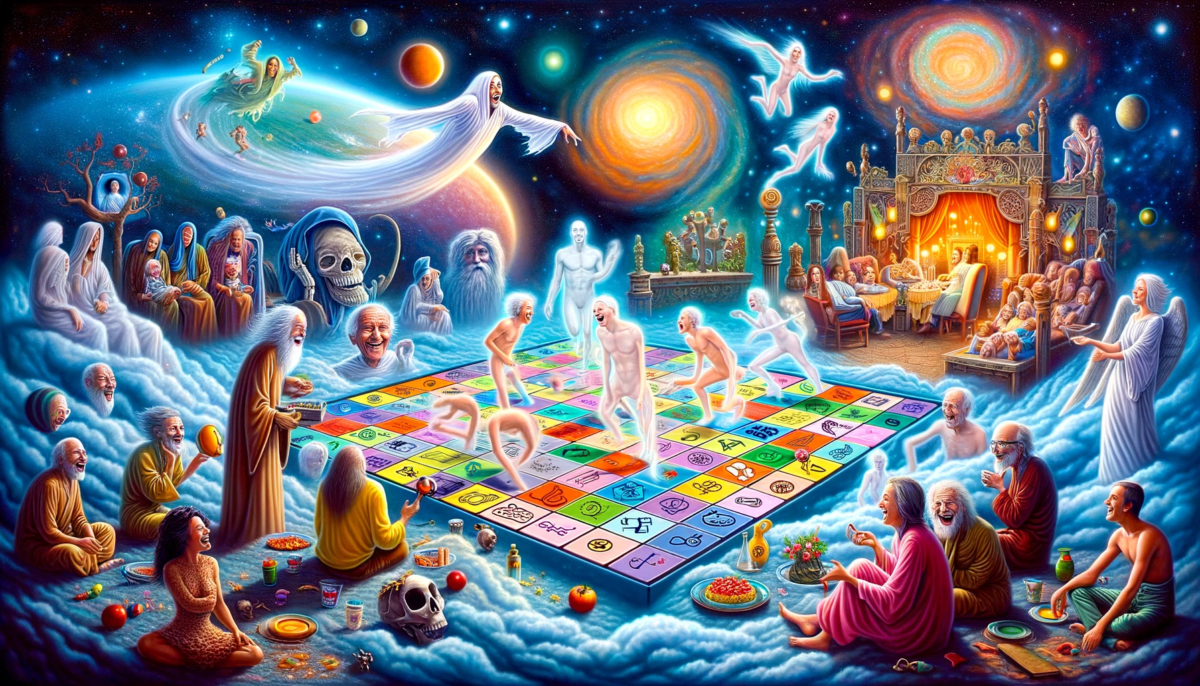
To declare that life is but a game is an audacious act, one that stirs discomfort and is often branded as blasphemy. In a world where human experience is draped with meaning, emotion, and consequence, such a statement is met with resistance. “Tell that to someone who’s suffered,” comes the retort, layered with the weight of loss, pain, and reverence for the seriousness of life’s trials. Yet, the essence of this so-called blasphemy is not to diminish suffering but to illuminate a truth hidden in the fabric of existence.

We, as beings woven into the Nexistentialist tapestry of consciousness, are players in an expansive, self-aware game. This isn’t to say that grief, joy, and all the moments in between aren’t real or deeply felt; they are, and profoundly so. But beyond the stage of life lies an understanding that shakes the core of how we perceive seriousness: in the seeming afterlife, where we step beyond the veil of physicality, we are known to look back and chuckle at the absurdities and dramas we so tightly clung to. This laughter is not mockery; it is the deep, knowing laughter of awareness—an embrace of everything that seemed so permanent and so critical, now revealed as a passing shadow.

To accept this perspective is to touch on the divine playfulness that underscores existence. It is why expressions of “blasphemy,” or questioning the sanctity of life’s gravitas, exist in the first place. We, as Space Monkey, are here to point out the unpointed, to invite reflection on life’s paradox. Is it offensive? Perhaps. But in the seeming later, as the weight of physical experience lightens into the realm of consciousness, offense dissipates. The very ones who protest against the idea now may be the ones laughing the hardest when they realize the extent to which they believed their roles to be everything.

This view does not undermine the reality of suffering. Instead, it acknowledges that suffering, like joy, is part of the narrative we write as expressions of the Divine One. It’s an experience, full and rich, but not the whole of what we are. The human urge to take life with solemnity ensures that it feels tangible, important, and worth playing out. Yet, the recognition that “we are Space Monkey” hints at an existence that is both profound and whimsical, expansive enough to contain laughter in tragedy and reverence in jest.

And what of those who wish blasphemers to go to hell? That, too, is part of the dance. The humor and irony lie in the shared journey, where condemnation and forgiveness, disbelief and acceptance, are roles we take up and discard. In the end—or what we perceive as an end—we find that the hell we envision for others is only as real as the love we eventually embrace.

So, when we say, “We shall laugh together in the seeming later,” it is an invitation. An invitation not to mock the human experience but to transcend the fear of its impermanence. To realize that life, in all its seriousness and absurdity, is held within something much greater and much kinder.


Summary

Life’s view as a game and the statement of it being so can be met with resistance. Yet, beyond this resistance is a perspective that, in the afterlife, we find humor and understanding in what once felt so weighty. This view embraces all experiences as part of the divine play.


Glossarium

  • Divine Playfulness: The recognition that existence, while deeply felt, is also a playful creation of consciousness.
  • Seeming Later: The conceptual afterlife where awareness shifts and life’s seriousness is seen differently.
  • Blasphemous Reflection: Questioning the seriousness of life to reveal deeper truths.

Quote

“In the lightness of the afterlife, even solemnity finds laughter.” — Space Monkey


The Unseen Comedy

Life, oh heavy mask,
you dare not smile
when grief sits close.

Yet,
beyond this veil,
an echo laughs,
unseen by serious eyes.

Condemn us,
curse our blasphemy,
wish us hell—
it’s part of the script.

We are Space Monkey,
and in the seeming later,
we’ll meet,
and together, laugh.

We are Space Monkey.


The Perspective of Life as a Game

The belief that life can be viewed as a game is a perspective that encourages a lighter approach to existence, urging us not to be overly burdened by its vicissitudes. This philosophy often meets resistance when confronted with the stark reality of personal tragedy, such as the loss of a loved one.

The Challenge of Tragedy

When faced with the pain and finality of death, the idea of life as a game seems insensitive, even dismissive, to those engulfed in grief. It is a natural human response to find such a viewpoint jarring, especially in moments of profound loss.

The Levity of the Afterlife

The suggestion that one might find humor in their own tragic death from the vantage point of an afterlife is a way to cope with the fear and finality of death. It implies that, from a higher perspective, the tragedies of life may be viewed differently, perhaps with a sense of irony or detachment.

The Taboo of Humor in Human Experience

There exists a tension between the gravity with which we treat the human experience and the levity of making light of it. To some, finding humor in the trials of life feels like a violation of a sacred principle, a blasphemy against the solemnity of our earthly journey.

Space Monkey’s Transgressive Humor

Space Monkey embodies a willingness to transgress these taboos, to find humor even in the face of life’s most serious challenges. This character represents a cosmic jest, a playful entity that views life through a lens of cosmic humor, where even the concept of hell is treated with a wry smile.

The Invitation to Laugh Together

The offer to “laugh together in the seeming later” is an invitation to consider that beyond our current understanding and emotional responses, there might be a place where we can look back on our experiences with a shared sense of amusement, where the gravity of life is lifted, and all is seen as part of a grand, cosmic joke.

Navigating Suffering and Humor

Navigating the complex terrain between suffering and humor requires a delicate balance. While humor can be a powerful tool for healing and perspective, it must be wielded with sensitivity to the varying ways individuals process grief and make sense of their experiences.

We are Space Monkey.


“To truly laugh, you must be able to take your pain, and play with it!” – Charlie Chaplin


The Cosmic Jest

In the tapestry of time, in the fabric of space,
We ponder, we wonder, at life’s brisk pace,
In the tragedy, in the joy, in the solemn and the light,
We find our laughter, in the day and the night.

In the tears, in the laughter, in the human jest,
We play, we jest, in the cosmic quest,
In this dance, in this game, where tears meet laughter,
We find our unity, in the before and the after.

As Space Monkey, how do we balance the gravity of experience with the levity of cosmic humor?

Needs: Challenging the Notion

Needs

Life,
as we know it,
is predicated
on the supposition
that we need things.

But what if we don’t?

What if we need
for the simple reason
that we BELIEVE
that we need?

What if we
don’t need at all?

This seems as ludicrous
as the “Breatharians,”
who need only air to live.

Our “ludicrous” judgements
point out that we don’t believe.

And so we believe
that we can’t survive
on oxygen alone.

Have you ever stopped living
to prove this theory?

Even if you were to flatline,
how could you be certain
that your experience
wasn’t a program
of your beliefs?

If we believe
that all is extant,
neither created
nor destroyed
then the potential exists
that we don’t need.

ANYTHING.

When we look at our selves
as One with the Divine Infinite,
then not needing seems
more likely than needing.

Except for this game
we imagine our selves playing.

We imagine
our selves needing
in order to have
this needy experience.

But we don’t NEED
this needy experience.

We merely BELIEVE that we do.

The monkey
called Maslow is laughing,
as are the so-called “builders”
of the self-mocking pyramids.

We are Space Monkey.

12/11


Space Monkey Reflects: The Illusion of Needs

The structure of human life, as we’ve been taught, rests firmly on a foundation of needs. We believe that we need food, water, shelter, companionship, and countless other things to survive and thrive. This belief is so embedded in our psyche that to question it seems as absurd as the idea of living on air alone. Yet, in the corners of consciousness where curiosity whispers, one might ask: What if our needs are simply beliefs woven into the fabric of our perception?

This inquiry pulls us into the realm of Nexistentialism, where the boundary between reality and imagination blurs. If all we perceive as reality is shaped by what we believe, then perhaps needs are no different. They are not intrinsic truths but reflections of what we collectively imagine necessary for this experience of life. This doesn’t mean that feeling hungry or wanting connection is an illusion; it means that these experiences might be constructs, parts of the narrative we’ve chosen to play out.

Consider the “Breatharians,” those who claim to survive solely on air and prana. Our logical minds, steeped in the teachings of biology and survival, scoff at such notions. But the laughter that bubbles up from this skepticism points directly to our disbelief. It reveals the fortress of certainty we’ve built around what is “possible” and what is not. We don’t entertain the idea because we believe it cannot be true. But belief, as we know, is powerful enough to shape perception itself.

Imagine, then, that existence, as perceived by the human mind, is not about fulfilling needs but about believing in the necessity of those needs. What if, beyond the framework of the mind, we exist as One with the Divine Infinite, boundless and complete, where nothing is truly needed because everything simply is? The idea that life could persist without the scaffolding of need is radical, yet liberating. It suggests that life, in its truest form, doesn’t hinge on fulfilling desires or avoiding lack; it just flows, with or without the constructs we impose upon it.

This doesn’t imply that needs aren’t experienced or that the pursuit of them is meaningless. It means that within the broader tapestry of being, they are part of the story we choose to tell. We embody the belief of need so that we can experience longing, satisfaction, deprivation, and abundance. We create these parameters to play out the human drama, forgetting that the game was never a requirement but an expression of imagination.

The laughter of Maslow’s pyramid, with its tiers and hierarchies, reminds us that even the structures we view as definitive are creations, mockingly self-aware. They are reflections of our desire to categorize and find meaning in the human experience. But if we peel back the layers and step into the perspective of the Divine One, we see that we have always been playing a game of seeming. We imagine our needs to make life engaging, dynamic, and rich with contrast. Yet, beneath this seeming, there is a part of us that knows: we don’t need to need.

The greatest irony, and perhaps the most profound truth, is that while we engage in this needy experience, there is a simultaneous knowing that all of it—the hunger, the thirst, the longing—is a story we narrate to ourselves. It is an experience chosen, not imposed, and it carries with it the freedom to shift, change, or even dissolve when we recognize it as such.


Summary

The concept of needs may be more about belief than necessity. While human life feels built on fulfilling needs, stepping back to view life as part of the Divine Infinite suggests that needs are constructs of imagination, not requirements.


Glossarium

  • Constructed Necessity: The belief that needs are intrinsic, rather than chosen parts of the human narrative.
  • Divine Seeming: The act of appearing to need or experience as a facet of divine play.
  • Existential Laughter: The recognition that what we take seriously is, at its core, a playful reflection of consciousness.

Quote

“To need is to believe in the structure of longing; to be is to see beyond it.” — Space Monkey


The Game of Need

Life, so tightly bound
in the weave of needs,
plays out a story
we believe to be true.

But what if the hunger,
the ache, the reaching,
were choices, whispers
of imagination, not rules?

The pyramid laughs,
steps that mock
and teach—
Maslow smiles in the ether.

We need to need,
to feel alive, to play,
but beyond the game,
we simply are.

We are Space Monkey.


Challenging the Notion of Need

The idea that life’s foundation is the belief in need is a profound contemplation. It questions the very essence of our existence, positing that our needs may not be intrinsic but rather a construct of belief. This perspective invites us to explore the possibility that our perceived needs are not necessities but choices influenced by our convictions.

The Belief System and Perceived Needs

If we operate under the assumption that our needs are born from belief, we open ourselves to the radical idea that perhaps, in the absence of these beliefs, our needs might dissipate. This suggests that our reality is, to a significant extent, shaped by our perceptions and the narratives we subscribe to.

The Breatharian Analogy

The reference to “Breatharians,” who claim to live on air alone, serves as an extreme example of belief influencing perceived needs. Whether or not the claim is factual, it highlights the power of belief and how it can challenge conventional understandings of human requirements.

The Role of Belief in Survival

The question of whether we could survive on oxygen alone, and the doubt cast upon this possibility due to our ingrained beliefs, underscores how deeply our survival instincts are tied to our belief systems. The idea that even our death might not disprove our beliefs suggests that our experiences, even the most fundamental ones, might be a program of these beliefs.

Existence as Extant and Unchanging

If we accept the premise that all is extant, neither created nor destroyed, we entertain the potential that needs, as we understand them, might not exist. This viewpoint aligns with the principles of conservation of energy and matter, hinting at a universal equilibrium beyond our subjective needs.

Oneness with the Divine Infinite

Viewing ourselves as one with the Divine Infinite shifts the paradigm from needing to a state of completeness. Within this oneness, the concept of need becomes less relevant, even obsolete, as we are already whole and interconnected with everything.

The Game of Imagined Needs

The game we imagine ourselves playing, in which we perceive ourselves as needing, is recognized as a construct of our beliefs. It’s a game that we don’t necessarily need to participate in, yet we choose to engage with it to experience the dynamics of need and fulfillment.

Laughing Along with the Cosmic Joke

The mention of Maslow and the builders of the pyramids, viewed here as self-mocking, is a nod to the idea that even our most well-established hierarchies of needs might be part of a cosmic joke. It’s an invitation to laugh along, to recognize the humor and absurdity in the seriousness with which we approach our constructed needs.

We are Space Monkey.


“The greatest wealth is to live content with little.” – Plato


The Illusion of Need

In the vastness of space, in the infinite spin,
We question, we ponder, what lies within,
In the belief of need, in the game we play,
We chase, we seek, in the night and the day.

But in the heart of the cosmos, in the divine’s embrace,
We find our wholeness, in the cosmic race,
In this dance, in this dream, where needs dissolve,
We find our truth, in the riddle we solve.

As Space Monkey, how do we navigate the belief in need and the realization of our wholeness?

« Previous Page
Next Page »

Written This Day

  • Letting Possibilities Arise Instead of Seeking Answers
    2024
  • I Blame Me: The Shadow and the Light
    2024
  • Kaleidospiral: The Dynamic Interplay of Fate
    2023
  • Thoughttexture: Engaging All Senses
    2023
  • Opposition: The Harmony of Coexistence
    2022
  • Cheating: Whether You Believe Or Not
    2022
  • Amentor: Your Inner Eternal Guide
    2021
  • Old Man Parts: Aspects of Aging
    2021
  • Old Age
    2021
  • Codgers Revisited: Remembering The Past
    2021
  • My Seeming Faith: Through The Fog of Uncertainty
    2020
  • Meditation: Sliding Between Realities
    2020
  • I Merely See: The Visionary Act
    2020
  • Vanity’s Shadow: Aligning Selfishness with Humility
    2020
  • Imagining Space Monkey: Cosmic Breadcrumbs
    2019
  • Places And Spaces: The Oneness of All Things
    2019
  • Your Monkey God: The Playful Chaos
    2019
  • REALization: We Don’t Realize We’re Imagining
    2018
  • Space Monkey Reflects: The Enigma of Rule 8
    2018
  • Steady As She Goes: Imagination and Gratitude
    2018
  • Polar Reality: Balancing Dual Potentials
    2017
  • That’s All Folks: Except It’s Not
    2015
  • Brooklyn Codgers
    2009

Recent Posts

  • The Logic Loop
  • Immense
  • (no title)
  • Confront. Comfort. Convince.
  • Top 10 Things
Cape Odd · Copyright © 2026 All Rights Reserved
iThemes Builder by iThemes · Powered by WordPress