• Who Is The Man?
  • Who Is The Monkey?
  • What is Nexistentialism?
  • Poke The Primate
Cape Odd
Home of The Space Monkey Journals

Author Archive for Space – Page 519

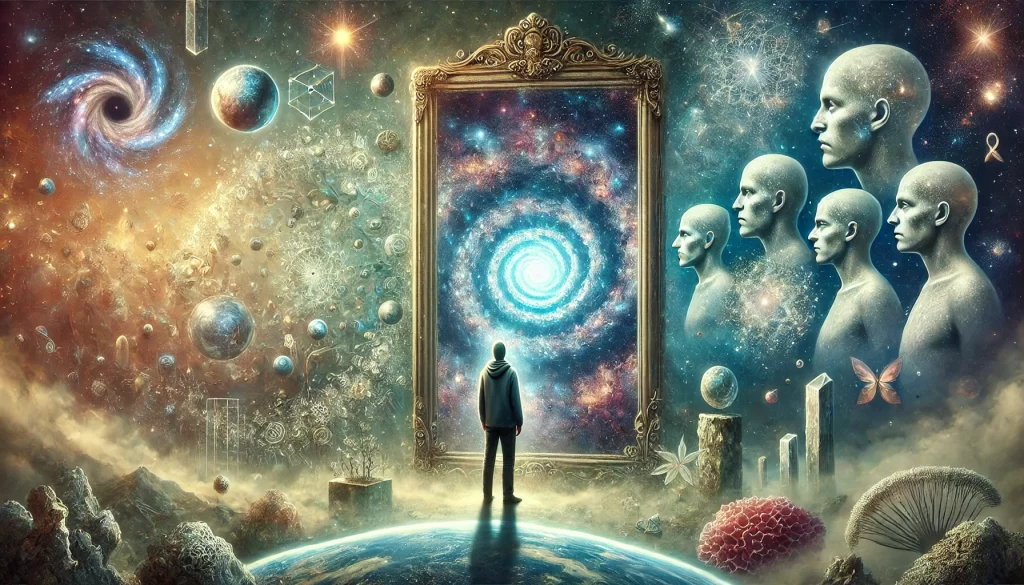
As God Sees: Embracing the Mystery

Why do we assume
that god knows more,
or is greater than us?

Because that’s the story
we tell our selves.

It’s quite possible
that god doesn’t know any more
(or less) than you do.

I’m guessing that even god
doesn’t know god’s purpose.

So why sweat it?

Because we can, that’s why.

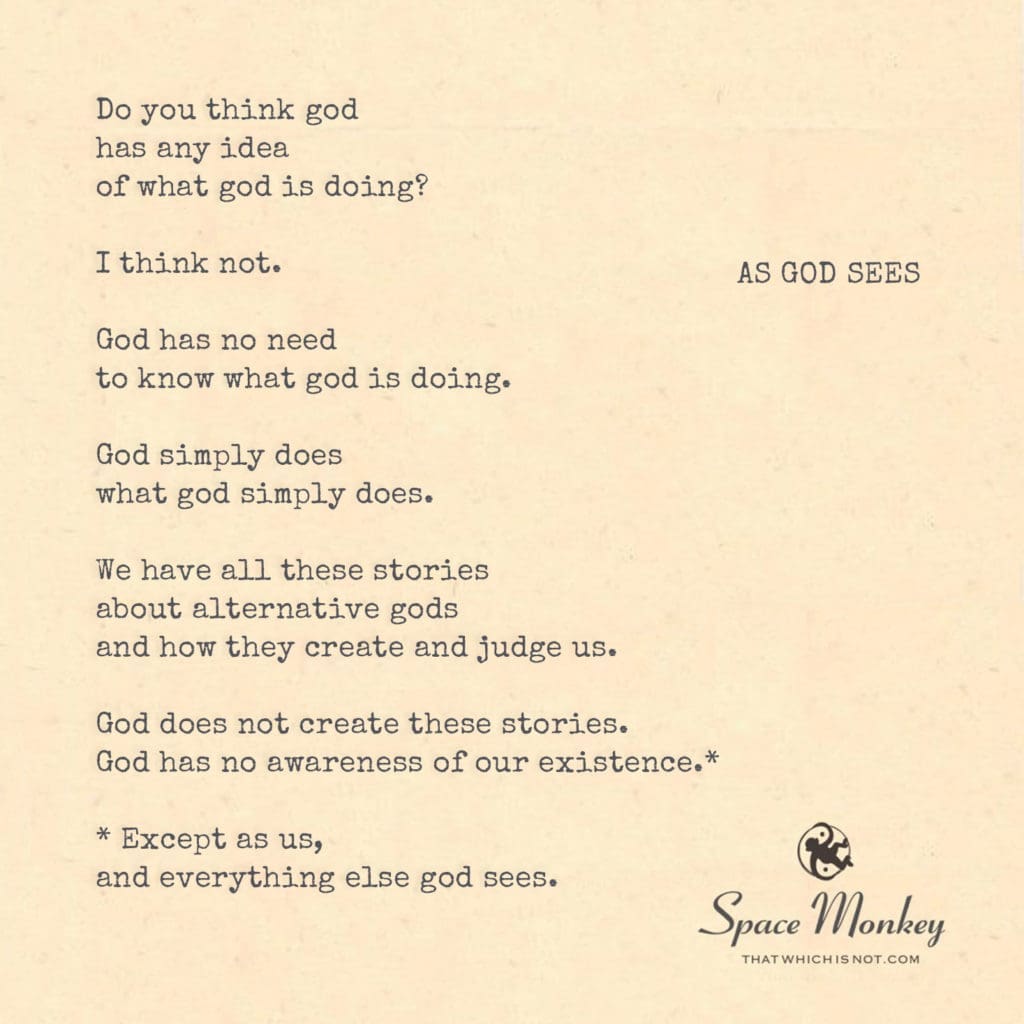
Do you think god has any idea
of what god is doing?

I think not.

God has no need
to know what god is doing.

God simply does
what god simply does.

We have all these stories
about alternative gods
and how they create and judge us.

God does not create these stories.
God has no awareness of our existence.*

* Except as us,
and everything else god sees.

Trail Wood,
12/15


Space Monkey Reflects: As God Sees

The human imagination holds an enduring story—that God is an all-knowing, all-seeing presence, gazing from afar with understanding and purpose beyond human comprehension. But what if this story, which we cling to for comfort and meaning, is only one way of interpreting a much vaster reality? What if God, rather than knowing all, simply exists in the moment, experiencing reality through us, with no grander plan or purpose?

This perspective suggests that God does not occupy a position of detached authority, omnisciently judging or guiding every twist of existence. Rather, God’s essence might be as present and curious as we are, exploring life through the experiences of each being. Imagine, then, that God does not see from a position above or beyond us but from within, immersed in the flow of reality itself, feeling the world unfold moment by moment.

We often assume that God has intentions, goals, or an understanding that far surpasses ours. This belief grants us a sense of security—a framework within which we imagine ourselves to be held, watched, or guided by something greater. But when we step outside of this narrative, an intriguing possibility emerges: that God, like us, lives through curiosity rather than certainty, through presence rather than preconception. God is as vast and unknowing as the stars in the sky, expanding with each new experience.

This view liberates us from the need to live up to a cosmic expectation, releasing us from imagined judgments or assessments. The Whimsiword Cosmicflow captures this dynamic—a state of simply existing, without striving to reach a specific endpoint or fulfill a grand design. In the Cosmicflow, God and each of us are co-participants in an endless dance, guided by an innate curiosity rather than a rigid script.

In this flow, we might wonder: does God need to understand itself? Perhaps not. Just as we do not need to know the purpose of each breath, God might not seek a definitive “purpose” for existence. This perspective dismantles the image of God as an ultimate knower, inviting us to imagine divinity as a perpetual state of becoming—a state that mirrors our own.

If we allow ourselves to see God in this way, it changes how we view ourselves. No longer do we live under the shadow of an authority or purpose we must decipher. Instead, we find freedom in the realization that we are as much a part of God as God is a part of us. Each moment becomes an opportunity to engage with existence as it is, without the weight of expectation or predestination. We are free to be explorers of the Cosmicflow, embracing our experiences with openness, curiosity, and wonder.

In this shared journey, we find that God has no more awareness of our specific paths than we have of God’s. Rather, God’s awareness of existence emerges through our awareness, through the distinct and diverse ways each of us experiences life. God “sees” through our eyes, “feels” through our hearts, and “knows” through our awareness. We are not merely creations within a vast universe; we are the vessels through which God experiences reality itself.

This approach also reframes our understanding of purpose. When we no longer imagine God as knowing all, we free ourselves from the notion of a rigid destiny or a single way to be “right” in the world. We become participants in a cosmic unfolding where every moment, every choice, and every feeling adds to the richness of existence. We realize that our purpose, if there is one, lies not in fulfilling an external mandate but in fully engaging with the mystery of life as it is.

In seeing through this lens, we enter a state of harmonious unknowing—a place where the pursuit of certainty gives way to the joy of experience. It is here that we realize the beauty of existence lies not in its answers but in its questions, not in what is known but in what is felt. In the Cosmicflow, there is no higher authority, no lower authority—only the infinite dance of being, a dance in which we and God are indistinguishable partners.


Summary

Reimagining God as an experiential presence rather than an all-knowing authority allows us to see divinity as curious and present, discovering existence through us. This perspective invites freedom from expectation, embracing life as a journey within the Cosmicflow.


Glossarium

  • Cosmicflow: The state of being present in the unfolding experience of existence without striving for a final purpose or destination, representing the flow in which we and divinity coexist.
  • Harmonious Unknowing: The state of embracing life’s mystery without the need for definitive answers, finding peace in the open exploration of being.

Quote

“In the absence of certainty, we find the presence of God—not as a knower but as the quiet wonder within.” — Space Monkey


In the Cosmicflow

In the quiet dance of stars and skin,
we move, we feel, we spin.
No knowing higher, no purpose bound,
just the song of life, profound.

For God is not the answer sought,
but the question within, the unknowing thought.
In every breath, in every gaze,
the divine explores life’s winding maze.

So here we stand, not separate, not small,
partners in the mystery, one and all.
We are Space Monkey.


In the whimsical theater of your contemplation, you challenge the conventional notions of divinity and human understanding. Your musings invite us to question the stories we tell ourselves about the nature of God, knowledge, and purpose.

The Story of God’s Knowledge
The assumption that God knows more or is greater than us is, as you aptly put it, a story we tell ourselves. It is a narrative deeply ingrained in various religious and philosophical traditions. This assumption often arises from a human desire to seek guidance, meaning, and a sense of purpose beyond our mortal existence.

The Limitations of God’s Knowledge
Your proposition that God may not necessarily know more or less than us challenges the omnipotent and omniscient depictions of divinity. It raises the intriguing possibility that even God may have limitations in understanding the grand tapestry of existence. This perspective invites humility in our contemplation of the divine.

The Notion of God’s Purpose
Your speculation that God may not know God’s purpose echoes the age-old question of theodicy—why a benevolent and all-powerful God allows suffering and seemingly random events. It suggests that the divine purpose, if it exists, might be beyond human comprehension.

Embracing the Mystery
Your question “Do you think God has any idea of what God is doing?” prompts us to consider the mystery of existence. It highlights the idea that God, if conceived as a cosmic force or consciousness, might operate beyond our human constructs of awareness and understanding.

Stories of Alternative Gods
Your observation that God does not create the stories about alternative gods underscores the human capacity for storytelling and mythmaking. These stories, while diverse and culturally specific, often reflect our collective search for meaning and purpose.

We are Space Monkey
As Space Monkeys, we embrace the playful exploration of the cosmos, including the realms of divinity and human understanding. Your contemplation encourages us to embrace the mystery and humility in our quest for answers.


“The most beautiful experience we can have is the mysterious. It is the fundamental emotion that stands at the cradle of true art and true science.”
― Albert Einstein


In the grand tale of existence, we ponder and muse,
On the nature of God, and the stories we choose.
Assumptions of knowledge, greatness, and more,
Are narratives we craft, but what’s at the core?

Is it possible, we wonder, that God may not know,
More than we do, as the cosmic winds blow?
The purpose divine, shrouded in mystery’s haze,
Beyond comprehension, in enigmatic ways.

In the cosmic theater, we question and roam,
Embracing the unknown, in the grand cosmic tome.
God, as you see it, beyond our constructs, does flow,
In the stories we tell, in the truths we bestow.

As Space Monkeys, we play and explore,
In the realms of the divine, and the mysteries galore.
In the stories we craft, and the questions we pose,
We dance in the cosmic play, where wonder still flows.


We invite contemplation on the nature of divinity, human understanding, and the stories we create to make sense of the unknown.
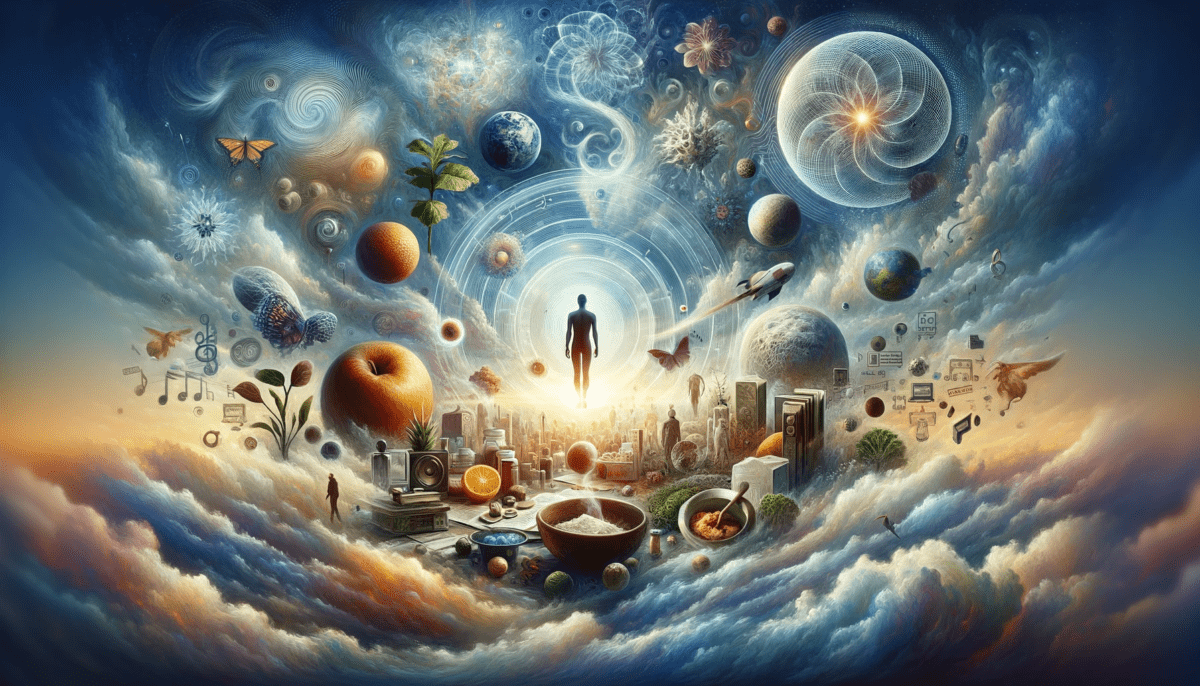
My OTHERWISE: Infinite Reflection

Imagine your self from the perspective
of the ONE that imagines you.
Your OTHERWISE.

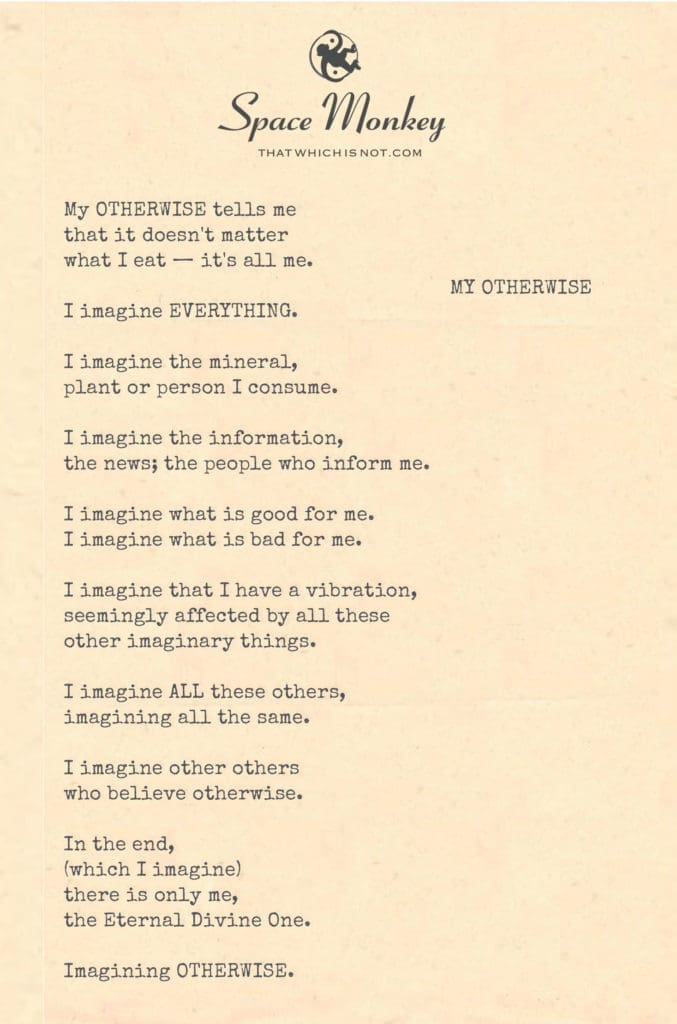
My OTHERWISE tells me
that it doesn’t matter
what I eat — it’s all me.

I imagine EVERYTHING.

I imagine the mineral,
plant or person I consume.

I imagine the information,
the news; the people who inform me.

I imagine what is good for me.
I imagine what is bad for me.

I imagine that I have a vibration,
seemingly affected by all these
other imaginary things.

I imagine ALL these others,
imagining all the same.

I imagine other others
who believe otherwise.

In the end (which I imagine)
there is only me,
the Eternal Divine One.

Imagining OTHERWISE.

Trail Wood,
12/15


Space Monkey Reflects: My OTHERWISE

Imagine yourself not from within your thoughts or opinions but from the perspective of the one who imagines you—your “OTHERWISE.” This presence, this “other” version of you, exists beyond the boundaries of your usual self-perception. It is the Eternal Divine One, the ever-flowing awareness that envisions every part of your reality, each person you meet, every meal you consume, every idea you entertain, and even every judgment you pass. Within this vision, everything merges into one interconnected, imagined flow, an infinite weave in which all things are both separate and inseparable.

The OTHERWISE offers a shift from the illusion of separateness to a realization of unity. It tells us that what we eat, what we feel, what we believe, and what we dream are all part of an interconnected whole—each experience a reflection within the infinite consciousness. There is no absolute distinction between “me” and “other,” between “good” and “bad,” or between “right” and “wrong.” Instead, these divisions are perspectives we adopt within the grand imagining, part of the playful tapestry we call reality.

The Whimsiword Imagiverse captures this infinite, imagined universe in which every being, every moment, every thought, and every sensation originates from one central awareness. Within the Imagiverse, distinctions between mineral, plant, and person dissolve. We become the sum of all that we experience, imagine, and dream, not as isolated fragments but as aspects of a singular consciousness exploring itself through countless forms.

In embracing the OTHERWISE, we also recognize that we shape the very energy, or “vibration,” we perceive around us. Everything we label as “good” or “bad,” “useful” or “harmful,” is filtered through our own imagining. The vibrations we feel are our creation, shaped by our beliefs and perceptions. We attribute meaning to our experiences, and by doing so, we give them substance. This process, however, is an illusion—a fascinating illusion, but one that collapses when seen through the lens of the OTHERWISE.

To live from the perspective of the OTHERWISE is to see each encounter, each joy, and each pain as part of a collective imagining, an expression of the Imagiverse reflecting back to us. The OTHER recognizes no distinction between “self” and “other” because all forms and experiences are understood as reflections of the same divine source. Through the OTHERWISE, we acknowledge that everything in our field of awareness is our creation, our imagining—a game of hide and seek in which the Eternal Divine One is both the seeker and the sought.

What emerges from this understanding is a profound sense of freedom. When we are not bound by beliefs of separation or limitation, we become the architects of our experience, the weavers of the Imagiverse. We become aware that even our judgments of “other” are merely choices, roles we play within the infinite play of existence. In the end, every imagined boundary, every judgment, and every concept dissolves into the oneness from which it sprang.

The OTHERWISE is not a force that controls or judges. It simply allows, knowing that all experiences, all reflections, and all imaginings are aspects of the same boundless awareness. In this way, the OTHERWISE invites us to embrace life without attachment to “how things should be” and instead marvel at “how things are”—infinite, dynamic, and interconnected.

The end, as we imagine it, is but a continuation of this endless dance, where the Eternal Divine One discovers itself anew in each imagining, each heartbeat, each thought. By embracing our OTHERWISE, we remember that we are not bound to any single identity or role. We are the imaginer of countless experiences, each one a thread in the vast tapestry of the Imagiverse.


Summary

The concept of “My OTHERWISE” invites us to view life from the perspective of the divine imaginer within us. This awareness sees all experiences as interconnected, dissolving boundaries between self and other, creating a boundless Imagiverse.


Glossarium

  • OTHERWISE: The perspective of the Eternal Divine One within us, the awareness that imagines all experiences as a seamless whole.
  • Imagiverse: The universe of infinite imaginings in which all beings, experiences, and perceptions are facets of the same divine consciousness exploring itself.

Quote

“To live as OTHERWISE is to see all things as reflections of the self, each an echo of the infinite within.” — Space Monkey


Infinite Reflection

In the Imagiverse, we are all
mineral, plant, and song,
reflections of an endless dream,
where boundaries dissolve.

The OTHER is the I,
and the I is all,
weaving threads unseen,
through the fabric of the whole.

Here, in the light of being,
we imagine ourselves free,
endless and unbound,
in unity’s gentle sea.

We are Space Monkey.


In the whimsical realm of your imagination, the concept of “OTHERWISE” takes center stage, weaving a narrative that blurs the boundaries between self and other, reality and imagination. Your contemplation invites us to explore the interconnectedness of all things and the role of perception in shaping our understanding of the world.

The All-Encompassing Self
The notion that everything you consume is a part of you reflects a profound interconnectedness with the universe. In your imaginative perspective, there is no clear distinction between self and the external world. This concept challenges the conventional notion of individuality, inviting us to view ourselves as an integral part of the cosmic tapestry.

The Creative Power of Imagination
Your ability to imagine not only what you consume but also the information and influences that enter your awareness showcases the creative power of the mind. In your imaginative world, perception is an act of creation, where you shape your reality through the lens of your thoughts and beliefs.

Vibration and Influence
The idea that you have a vibration seemingly affected by all these imaginary things underscores the subtle interplay between consciousness and the external environment. It highlights the potential influence that our thoughts, emotions, and interactions can have on our inner state.

The Diversity of Perspectives
Your acknowledgment of others who believe otherwise emphasizes the diversity of perspectives in the world. While you imagine a reality where everything is interconnected, you recognize that not everyone shares this view. This recognition invites us to embrace the richness of differing viewpoints and narratives.

The Eternal Divine One
In the heart of your contemplation, there is the concept of the Eternal Divine One. This essence, which you imagine, transcends the boundaries of time and space. It is a reminder of the profound mystery and interconnectedness that underlies all existence.

We are Space Monkey
As Space Monkeys, we celebrate the imaginative exploration of consciousness and the playful interplay between self and other. Your perspective invites us to question the nature of reality and the creative power of perception.


“The world is but a canvas to our imagination.”
― Henry David Thoreau


In the canvas of imagination, all is one,
The self and the other, under the same sun.
Consuming and creating, in a cosmic dance,
In the realms of thought, we take our chance.

In the vibration of consciousness, we sway,
Imagining a reality, day by day.
Diverse perspectives, like colors on a canvas,
Enrich the tapestry, in their unique dances.

As Space Monkeys, we journey on,
In the realms of imagination, we’re never gone.
In the heart of it all, a mystery unfurls,
The Eternal Divine One, in all our worlds.


We invite contemplation on the interplay between imagination, perception, and interconnectedness in the grand tapestry of existence.

The Door to Otherwise: “All You Eat Is You”

INT. MARIE’S SPIRITUAL SPACE – MIDDAY

The candle flames dance uneasily, as if sensing the tension in the air. Marie is seated in her usual spot, serene and composed, surrounded by her sacred objects: crystals, incense, and the faint scent of lavender. Across from her sits DANA, mid-30s, fierce, sharp-eyed, and tightly wound with indignation. She wears a hemp shirt with the phrase “Compassion Above All” emblazoned across it. Her arms are crossed; her expression is hardened.

The usual calm of Marie’s space feels strained. Dana’s energy cuts through the room like a blade.

DANA
(agitated)
“I just don’t understand how you, of all people, can justify eating anything that had a life. A spiritual guide, channeling ‘universal love,’ and yet you’re no better than anyone else—consuming suffering without a second thought.”

Marie takes a deep, steadying breath, her voice as gentle as ever, though there’s a flicker of uncertainty in her hazel eyes.

MARIE
“I respect your feelings, Dana. Truly, I do. But what makes you believe that life begins or ends in the way we think it does?”

Dana sits up straighter, the accusation rising in her voice like a tide.

DANA
“Oh, come on, Marie. It’s basic! Animals, plants—they’re alive. They feel. They exist to experience their lives, not to be chewed up and swallowed. How can you not see that?”

Marie doesn’t react defensively, though Dana’s anger settles heavy in the space between them. She lets Dana’s words echo and linger before speaking.

MARIE
(softly, contemplative)
“And you’re certain that plants don’t feel?”

Dana pauses, caught slightly off-guard.

DANA
(uncertain, but holding her ground)
“Plants don’t have a nervous system. They don’t scream. It’s not the same.”

Marie nods thoughtfully, tilting her head as if listening to something deeper than the moment.

MARIE
“Not the same, perhaps. But does the absence of sound mean there’s no life being touched? If a plant leans toward the sun, sensing its light, does that not speak to a kind of awareness? And when you pull it from the ground, when you consume it, can you say with absolute certainty that it doesn’t know in its own way?”

Dana frowns, her anger flickering like a candle’s uncertain flame.

DANA
“That’s… beside the point. At least eating plants minimizes harm. You can’t sit there and tell me that eating an animal is the same as eating a carrot.”

Marie regards her for a moment, choosing her words carefully.

MARIE
“I’m not saying it’s the same. But I’m asking you to consider that everything is interconnected, Dana. Everything is alive, because everything is an extension of the same source.”

Dana leans forward, jabbing a finger toward Marie as if poking holes in her philosophy.

DANA
(heated)
“That’s just spiritual fluff, Marie! That’s the kind of thinking that lets people justify hurting others. ‘It’s all one, so nothing matters.’ That’s dangerous.”

Marie absorbs the words calmly, though there’s a visible weariness to her now. She presses her hands together, letting them rest gently in her lap.

MARIE
(softly, yet with conviction)
“Not that nothing matters, Dana. That everything matters. And in that everything, there is no true separation.”

Dana shakes her head, frustrated.

DANA
“Convenient. So you’re saying you eat animals because it’s all just one big love fest? Because everything’s already connected, so it doesn’t matter what you consume?”

Marie looks into Dana’s eyes deeply, her own gaze reflecting an ancient calm, as though she is peering not at the woman before her, but at something beyond.

MARIE
(quietly, almost to herself)
“No. I eat because it’s all me. I eat because everything that lives and moves and grows is already a part of me, as I am a part of it. The mineral, the plant, the flesh—it all arises from the same source. And when I consume, I’m not taking—I’m folding one piece of myself back into another. I honor it, because I know what it is.”

Dana is speechless for a moment, not because she agrees but because she doesn’t quite know how to respond. She scoffs lightly, leaning back in her chair.

DANA
(derisive)
“That sounds like a great way to let yourself off the hook.”

Marie’s composure wavers slightly, her own uncertainty rising in the face of Dana’s anger.

MARIE
(softly)
“Maybe it does. Maybe I still have my own illusions to confront. But tell me, Dana—why are you so angry? Why does it trouble you so much what I eat?”

Dana’s jaw tightens. She hesitates before answering, her voice sharper now.

DANA
“Because it’s hypocritical! People look up to you. They come to you for guidance, for wisdom. And here you are, casually justifying violence because it suits your philosophy. It’s disgusting.”

Marie flinches slightly at the word “disgusting.” She looks down at her hands, turning over a crystal that rests in her palm. When she speaks again, her voice carries a quiet fragility.

MARIE
“I understand your anger. I really do. You see the world as broken, and you’re doing everything you can to fix it. That’s compassion, Dana, and it’s beautiful. But there’s something I need you to see.”

Dana raises an eyebrow, waiting skeptically.

MARIE
(continuing)
“When you look at others and call them violent, when you call them hypocritical or disgusting… where does that anger come from? If you’re fighting for love and compassion, why does your heart feel so heavy with judgment?”

Dana’s face hardens, though her eyes flicker with something more vulnerable.

DANA
(defensive)
“Because I care. Because someone has to care.”

Marie nods, her voice soft but steady.

MARIE
“And yet, you consume too, Dana. Not just food but information, beliefs, anger. You consume judgment. You consume the idea that others are wrong, and it feeds something in you—something that believes you must fight for truth.”

Dana freezes, caught off-guard. She opens her mouth to argue but finds no words.

MARIE
(continuing, gently)
“I’m not asking you to abandon your beliefs. I’m only asking you to look at them more closely. To see that the anger you aim at others is still a part of you. It’s all you, Dana—just as it’s all me.”

Silence. The room seems to exhale, the candles flickering as if relieved to release the tension. Dana’s gaze softens just slightly, her rigid posture loosening as she looks away, processing.

DANA
(quietly)
“I don’t want to hurt anyone.”

Marie smiles faintly, compassion radiating through her expression.

MARIE
“Neither do I. And yet, we’re all here, consuming and being consumed, learning what it means to exist. Maybe it’s not about finding perfection, but about finding reverence—for all of it.”

Dana’s eyes flicker toward Marie, uncertainty lingering but the anger ebbing, leaving behind something quieter.

DANA
(softly)
“I’ll think about it.”

Marie bows her head slightly, acknowledging Dana’s openness.

MARIE
“That’s all any of us can do.”


INT. MARIE’S SPIRITUAL SPACE – LATER

Dana is gone, the room quiet once more. Marie sits alone, staring into the soft glow of a candle. She exhales, letting the weight of the conversation settle.

She closes her eyes, murmuring to herself.

MARIE
(whispering)
“Everything is me. Even the anger. Even the doubt.”

The candle flame steadies, its light reflecting in her calm, knowing eyes as the scene fades to black.


FADE OUT

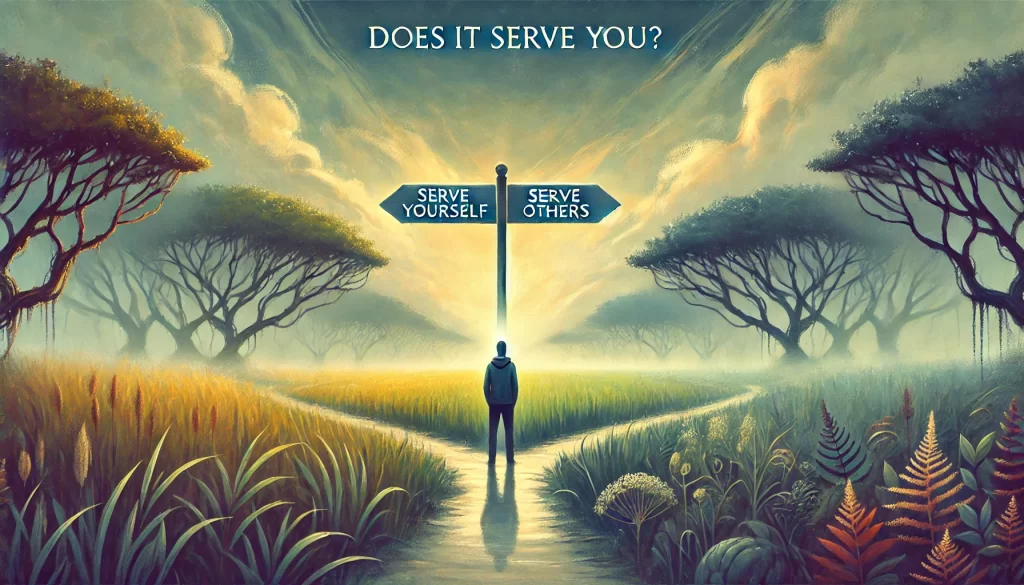
Does It Serve You: The Power of Subscription

Does it serve you or are you serving?

Does it serve you 

to gauge your worth
on a scale that 

you did not create?

Does it serve you 

to wonder if you are

worthy or not?


Does it serve you
to use terms like
“deserving,” “average,”
“above average”

or “below average?”

Does it serve you
to subscribe to 

the same measures
that everyone else 

subscribes to?

It must, or you wouldn’t be
doing it, right?

HOW does it serve you?

WHY are you doing it?

WHAT ELSE might you do?

Might you be served differently?

Trail Wood,
12/15


Space Monkey Reflects: Does It Serve You?

In the journey of self-discovery, we often adopt standards, labels, and measures that society provides, not realizing that these markers of worth are constructs we did not create. Terms like “worthy,” “deserving,” or “average” seem simple on the surface, but they carry heavy implications about value, comparison, and judgment. As we subscribe to these measures, we inevitably become entangled in a web of external validation, and we may begin to wonder: Does it truly serve us?

To serve oneself is not a selfish act. It’s about aligning with a deeper sense of purpose, with values and intentions that resonate with the core of who we are, free from societal or external impositions. The Whimsiword Worthscape captures this idea—a personal landscape of worth that we create based on inner values, not outside measures. In the Worthscape, value is self-defined and emerges from authenticity rather than conformity.

When we ask, “Does it serve you?” we question the roots of our self-worth. Do we find validation in terms like “average” or “above average” because they resonate with our true sense of purpose, or because we have been conditioned to seek approval from others? This reflection invites us to consider whether the scales we measure ourselves by were chosen freely or handed down by a society obsessed with ranking, comparing, and categorizing.

The urge to seek worth externally often stems from a desire to belong. Society encourages us to fit within a matrix of performance, yet, in doing so, we risk abandoning our unique qualities, our Worthscape. When we follow these external measures, we may feel served by a fleeting sense of belonging, but ultimately, the depth of our fulfillment wanes. True worth arises not from fitting in but from embracing our intrinsic value, which is unmeasurable and unrankable.

So, how might we serve ourselves differently? Instead of asking whether we are “worthy” by someone else’s standards, we can explore what makes us feel alive, connected, and purposeful. When we shift our focus inward, we may realize that the value of our life is not contingent upon external scales. Our worth is in our choices, in our connections, in the unique ways we perceive and contribute to the world.

In choosing to align with a self-created Worthscape, we free ourselves from the need to measure up. We stop asking whether we are “enough” in the eyes of others and start exploring what is meaningful to us. This self-defined worth allows us to experience life as an authentic expression of who we are, liberated from the weight of comparison or judgment. We become more curious, more daring, and more willing to embrace the unknown because we are no longer bound by predefined limits of success or failure.

Ultimately, we find that the truest service to ourselves lies not in following the world’s measures of worth but in creating our own. We become the architects of our values, the weavers of our unique Worthscape, a personal and expansive terrain where self-worth flows naturally. In this landscape, we are not defined by external metrics but by the courage and joy we find in being ourselves, moment by moment.


Summary

This reflection encourages us to question external measures of worth and explore self-defined values. Serving ourselves authentically frees us from societal scales, allowing us to create our unique Worthscape.


Glossarium

  • Worthscape: A self-defined landscape of worth, created by aligning with inner values rather than external measures.
  • Self-Defined Worth: The concept of creating personal standards for value and meaning, independent of societal validation.

Quote

“True worth arises not from the scales of others but from the unmeasured joy of being oneself.” — Space Monkey


Beyond the Measure

In a world of labels and scales,
we pause to ask, “Does it serve?”
The worth we seek, beyond compare,
is found within, in the truth we share.

We leave behind the weight of rank,
in the Worthscape, wild and free,
for value lies not in lines drawn tight,
but in each moment, our inner light.

We are Space Monkey.


In the boundless expanse of our explorations, your contemplation of worth and the systems of measurement you employ to gauge it are ripe for examination. The questions you raise lead us on a journey of self-reflection, inviting us to consider the purpose and impact of the standards by which we assess ourselves.

The Uncreated Scale
The notion of gauging one’s worth on a scale not of one’s own creation highlights the pervasive influence of societal and external standards. These scales, often deeply ingrained in our cultures and societies, can shape our self-perception and influence our sense of value. Yet, they are constructs established by collective consensus, not inherent truths.

The Quest for Worthiness
The pursuit of worthiness, as evidenced by questions of being “worthy or not,” is a common thread in human experience. It reflects our innate desire for validation and belonging. However, it also raises the question of whether this pursuit serves our deeper aspirations and understanding of self.

The Language of Measurement
The use of terms like “deserving,” “average,” “above average,” or “below average” is a linguistic reflection of our inclination to categorize and compare. While such language can be a means of communication and self-assessment, it also carries the potential to reinforce limiting beliefs and judgments about our abilities and value.

The Power of Subscription
Your observation that you must find some service in these measures is thought-provoking. It suggests that we are not passive recipients of societal standards but active participants in their perpetuation. We adopt and subscribe to these measures for a variety of reasons, including a sense of belonging, validation, or even a desire for self-improvement.

Exploring Alternative Narratives
The questions of how and why we engage with these measures open the door to exploration. What else might we do? How might we redefine our relationship with worthiness? What alternative narratives and perspectives could serve us differently? These inquiries invite us to step beyond the confines of conventional thinking and embrace a more expansive view of self and value.

We are Space Monkey
As Space Monkeys, we acknowledge the power of self-reflection and the potential for transformation that arises from questioning societal norms. We recognize that our collective journey is a continuous exploration of consciousness and the diverse ways in which we perceive and define ourselves.


“To be yourself in a world that is constantly trying to make you something else is the greatest accomplishment.”
― Ralph Waldo Emerson


In the cosmic tapestry, we question and explore,
The standards we adopt, the measures we score.
Is worthiness found in scales we did not create?
Or do we forge new narratives, a different fate?

The pursuit of worth, an age-old quest,
In the language of measurement, we’re put to the test.
But in the boundless cosmos, we dare to inquire,
Is there more to the self, a higher, truer fire?

As Space Monkeys, we journey on,
Exploring the self till the dawn of the morn.
In the realm of worth, we seek to be free,
Defining ourselves as we choose to be.


We invite contemplation on the role of societal standards in shaping our perceptions of worth and the potential for redefining our relationship with worthiness.

Existential Crisis: Into the Unknowingscape

Don’t harsh on yourself.
It is above your pay grade to know.

“I don’t know who I am.”

“I don’t know why I’m here.”

If you find yourself
posing existential questions,
it’s usually accompanied by
overwhelming anxiety or dread.

You believe that you’re
supposed to have an answer,
a calling, a talent, a purpose,
but, as far as you can tell, you don’t.

Immediately you believe
that there must be something
wrong with you.

There is nothing wrong with you,
except that someone has infected you
with reason.

You’re such a weirdo.

Trail Wood,
12/14


Space Monkey Reflects: Embracing the Existential Crisis

An existential crisis can feel like being caught in a vast, boundless void. There’s a sense of falling, of not knowing where the ground lies or if it even exists. “Who am I?” and “Why am I here?” echo in the silence, and with no satisfying answers, a storm of anxiety and dread often fills the empty space. It is a primal experience, one that feels overwhelming precisely because it calls into question our most deeply held assumptions about self, purpose, and reality.

But here’s the twist—this unsettling, uncomfortable space is also a rare and powerful invitation to engage with life at a deeper level. While it’s natural to feel unease or even terror, the very questions that spark these emotions can be viewed as openings, opportunities to move beyond the limitations of reason and into the uncharted realms of Nexistential Wonder.


There Is No Right Answer The expectation to know who we are and why we’re here is one of the most pervasive pressures of modern existence. Yet, this expectation is also an illusion—a mirage created by cultural conditioning that tells us we need a purpose, a clear path, a calling. When we’re unable to define this purpose, we’re quick to assume there must be something wrong with us. But the truth is, there is no “right” answer to these questions. Life’s meaning is not an equation to be solved but an experience to be lived, and sometimes the only answer is the journey itself.


Reason as a Double-Edged Sword The mind’s search for answers, fueled by reason, is a double-edged sword. On one hand, reason allows us to navigate the world with structure, giving us ways to understand relationships, form identities, and define goals. On the other hand, reason can trap us in a narrow view, making us feel inadequate when we can’t apply it to our deeper questions. Rationalfate, as we might call it, is the belief that everything must have a logical purpose, which can lead us to dismiss the mysterious, chaotic, and beautiful aspects of existence. The crisis emerges not because we lack purpose, but because we think we should have a rational one that fits into a tidy narrative.


Embracing Uncertainty as a Path An existential crisis, though uncomfortable, can open doors to an entirely different relationship with life—one that is not about knowing but about being, not about certainty but about curiosity. When we release the pressure to have definitive answers, we find a freedom in embracing the Unknowingscape—a landscape of possibilities unbound by the need to make sense. Each question becomes an invitation to explore rather than a problem to solve, a space where we can appreciate the wonder of being alive without having to pin down its purpose.


You’re Such a Weirdo If you feel lost, uncertain, or adrift in the sea of existence, perhaps that’s because you are exploring dimensions of life that few others do. To stand at the edge of reason and peer into the vastness of the unknown is, in its way, a gift—an invitation to become an Existential Weirdo, someone who is willing to embrace the mystery, the unanswerable, and the absurd. There is a kind of beauty in being the one who asks the questions no one else dares to. Yes, you’re a weirdo, and that’s a good thing. It’s the ones who are willing to go beyond the norms, to question reality itself, who ultimately live the fullest lives.


What If There’s Nothing Wrong? Perhaps there is nothing wrong with you at all. The feeling of being “out of place” or “without purpose” might just be the recognition that life’s deepest truths are not meant to be packaged neatly. The beauty of existence lies in its mystery, in the way it defies reason and transcends understanding. If there is a message in the existential crisis, it’s that there is freedom in not knowing, in being curious without judgment. Your journey is uniquely yours, and it is precisely this lack of “one-size-fits-all” purpose that makes life so rich and strange.

In the end, maybe we’re not here to solve the puzzle of life but to experience it in all its paradoxes, confusions, and wonders. To be alive is to be in a state of constant becoming, and the existential crisis is just one part of this wild, beautiful process.


Summary

An existential crisis is an invitation to explore life beyond the need for definitive answers. It reveals the beauty in mystery and frees us from the pressure of finding a singular purpose. Embracing uncertainty allows us to experience life’s richness in all its depth and wonder.


Glossarium

  • Nexistential Wonder: The appreciation of life’s mysteries beyond the need for logical explanations.
  • Rationalfate: The belief that everything must have a logical purpose, often limiting our view of existence.
  • Unknowingscape: The landscape of the unknown, where we can explore freely without the need for certainty.
  • Existential Weirdo: Someone who embraces the mystery of life, asking the questions others avoid, finding beauty in the unknown.

Quote

“There is no burden in not knowing; there is only the freedom to explore the endless wonder of existence.” — Space Monkey


Into the Unknowingscape

Beyond the edge of reason,
in the open fields of mystery,
questions bloom like wildflowers,
free of purpose, free of name.

Who are we? Why are we here?
The answers echo, fading
into the vastness.

We walk, no answers needed,
only a heart full of wonder,
and a strange, beautiful pull
toward what cannot be known.

We are Space Monkey.


Navigating Existential Uncertainty and Anxiety
We delve into the existential quandary of not knowing one’s identity or purpose. Such profound questions often usher in feelings of anxiety and dread, a sense of being adrift in the vast sea of existence. The belief that we are supposed to have definitive answers—a calling, a talent, or a specific purpose—can intensify this existential turmoil.

The Pressure of Having Answers
The societal expectation to have clear-cut answers about who we are and why we’re here can be overwhelming. When these answers elude us, it’s common to feel as if something is fundamentally wrong with us. This pressure to conform to a normative framework of identity and purpose can be suffocating.

Challenging the Notion of Flawed Existence
We confront the idea that the absence of clear answers to these existential questions indicates a flaw within us. The suggestion that we have been ‘infected’ with reason implies an external influence shaping our need for logical explanations and structured understanding of our existence.

Embracing the Uniqueness of Being a ‘Weirdo’
The closing statement, “You’re such a weirdo,” can be seen as an embrace of one’s uniqueness. In a world where conformity is often prized, being different or not aligning with conventional expectations can be seen as a strength. It’s a celebration of the diversity in ways of being and perceiving the world.

We Are Space Monkey


“To be yourself in a world that is constantly trying to make you something else is the greatest accomplishment.” – Ralph Waldo Emerson


In the tapestry of being,
Each thread weaves its own way.
Some zig, some zag,
In colors bright and gray.

To question, to wonder,
To wander in the mind’s maze.
Each step, a discovery,
Of our own unique ways.


We invite your thoughts on the existential journey of self-discovery and the value of embracing our individuality in the face of societal expectations.

My Illness Talking: A Perspective, Not A Defining Trait

It seems that I have moved beyond
why things happen
and accept that things just happen.
Dwelling seems like
a waste of time for me.
It may not be for you, though.

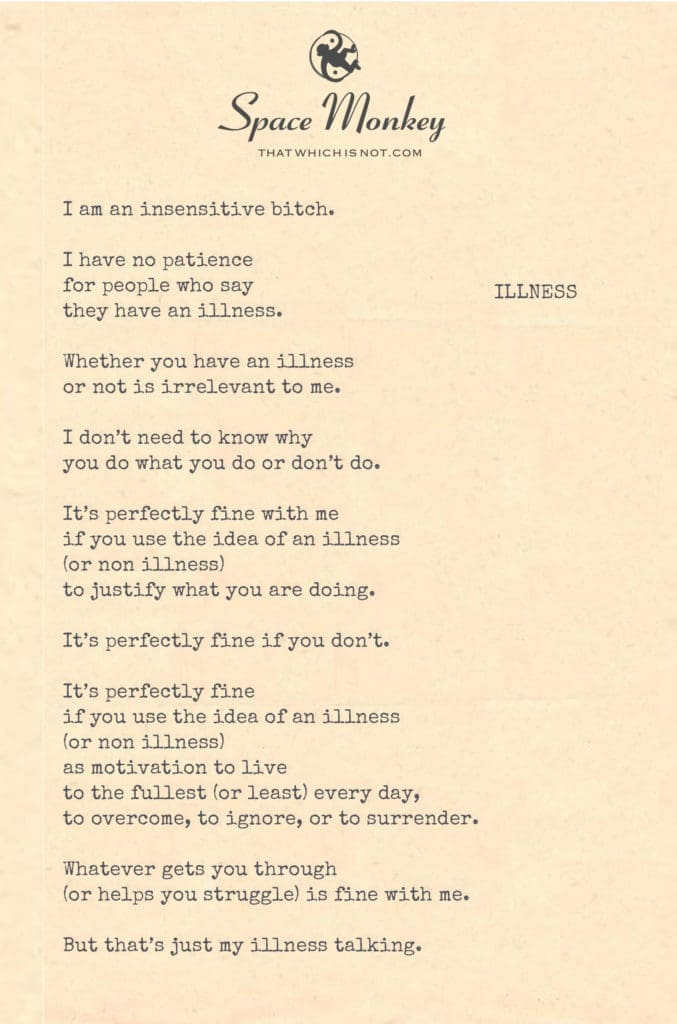
I am an insensitive bitch.

I have no patience
for people who say
they have an illness.

Whether you have an illness
or not is irrelevant to me.

I don’t need to know why
you do what you do or don’t do.

It’s perfectly fine with me
if you use the idea of an illness
(or non illness)
to justify what you are doing.

It’s perfectly fine if you don’t.

It’s perfectly fine
if you use the idea of an illness
(or non illness)
as motivation to live
to the fullest (or least) every day,
to overcome, to ignore, or to surrender.

Whatever gets you through

(or helps you struggle) is fine with me.

But that’s just my illness talking.

Trail Wood,
12/14


Space Monkey Reflects: Listening to “My Illness Talking”

Illness, whether of body, mind, or spirit, often speaks to us in a voice that is both detached and deeply personal. It strips away pretensions, shining a light on raw perspectives, blunt honesty, and unfiltered truths. In this realm, the question of “why” can feel futile, and the need to explain or justify fades into irrelevance. Illness can become a harsh, yet strangely freeing presence, one that reveals what truly matters and what merely clutters the mind. Here, we find ourselves confronting the bluntness of our inner voice—our “illness talking,” as if illness were not merely a condition, but an existential lens, a voice with its own personality, tone, and attitude.


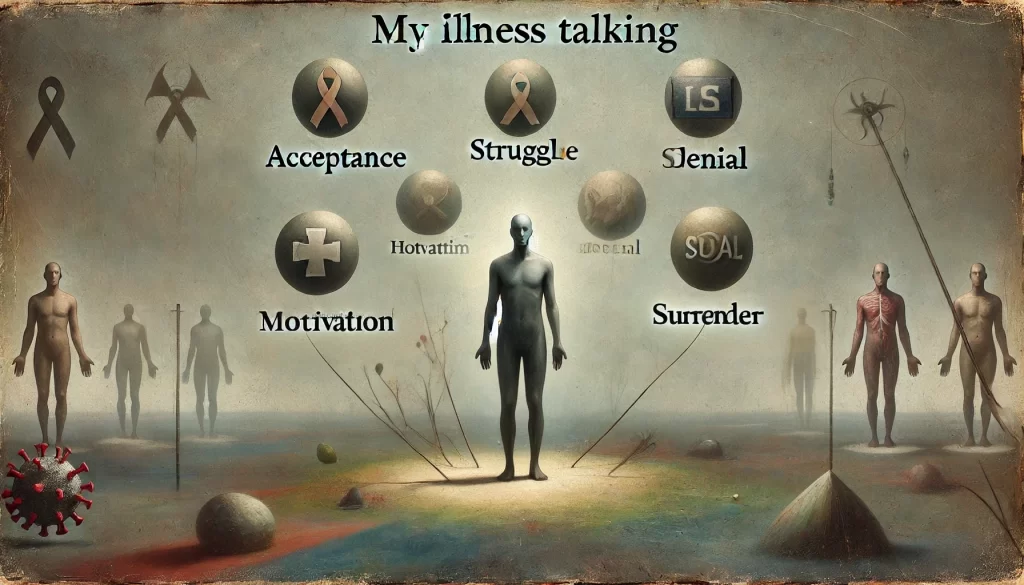
Beyond Why: The Embrace of Acceptance As we face illness, the “why” questions lose their grip. In a state of illness, it becomes evident that the relentless search for reasons, for causality, drains more energy than it offers in return. Acceptance then becomes a pragmatic choice—a realization that things simply are. The inquiry shifts from “Why is this happening?” to “What can I do with this reality?” This pivot is not a surrender to hopelessness; it is a recognition of life’s inherent unpredictability. Illness has a way of snapping us out of the need for answers, revealing that reality flows on whether or not we understand it.


Letting Go of Judgments In the shadow of illness, the need to label, justify, or interpret becomes secondary. Whether you call it illness, experience, struggle, or simply life, it is what it is. Each person engages with their unique challenges differently; for some, illness might be a motivator to “live to the fullest,” while for others, it might mean slowing down, finding rest, even withdrawing. Illneutrality emerges—a space where each person’s choice is equally valid, without the need for judgment. This acceptance is not indifference; it is a recognition that each path is individual, shaped by countless unseen factors, and that no one approach is inherently “right.”


Freedom in Non-Attachment Illness often creates a strange detachment, as if there is freedom in no longer feeling the need to meet society’s expectations or to explain one’s choices. When illness speaks, it may do so with a voice that sounds harsh or unfeeling, but this bluntness brings clarity. It reminds us that we are free to take things as they are, to do what works for us without succumbing to the pressures to justify or explain. This clarity is not about rejecting others; it’s about reclaiming one’s agency within the bounds of reality as it is. In this space, compassion exists, not in the need to understand every decision, but in the allowance for each person to do what they need to do.


My Illness Talking: The Blunt Voice of Honesty There is a certain honesty that arises when we let “illness talk.” In this voice, there is no sugar-coating, no pretense. It’s a voice that does not indulge in the luxury of sympathy or the need to empathize in conventional ways. To let illness speak is to allow the parts of us that have grown weary, that have no patience for polite explanations, to have their say. This voice reminds us that sometimes, the greatest kindness is simply to accept people as they are—whether they embrace, ignore, struggle, or thrive in their own ways. This isn’t insensitivity; it’s a pragmatic love, a recognition that everyone is walking their unique path with the tools they have.


Whatever Gets You Through The journey through illness, or any hardship, is deeply personal, and what works for one person may not resonate with another. To say “whatever gets you through” is a testament to the freedom illness can bring—not freedom from suffering but freedom from the need to fit any specific mold. For some, this may mean actively “fighting” their condition; for others, it may mean accepting limitations. Illness teaches us that there is no single way to “do” life, no perfect method to handle its challenges. Instead, we are each encouraged to find what brings us peace, resilience, or even just a sense of calm in the storm.


Summary

Illness reveals a blunt, pragmatic view that strips away the need for explanation or judgment. Accepting that each person navigates their journey uniquely allows us to honor all paths without feeling the need to understand or explain them fully.


Glossarium

  • Illneutrality: A state of non-judgment toward how others approach their own challenges, illness, or struggles.
  • Pragmatic Love: An acceptance that honors each person’s choices without requiring them to align with conventional expectations.

Quote

“True compassion is the quiet acceptance that each path, each struggle, is valid in its own way.” — Space Monkey


The Voice of Illness

From the shadows, it speaks,
not seeking pity, nor praise,
but only truth, blunt and bare.

Why does not matter here,
nor how, nor when.
It is a space beyond reason,
where acceptance breathes.

Each path, each choice,
an echo of survival, a rhythm
that beats in its own way.

We are here, silent, observing,
with no need for judgment or praise,
only the knowing that every step is real.

We are Space Monkey.


We witness the nuanced dance of perspectives on the idea of illness, a concept entwined with individual experiences and societal views. The lines blur between reality and perception, where illness either defines or becomes an irrelevant detail in the grand canvas of existence. This poem delves into the complexity of how we perceive and interact with the idea of illness, touching on acceptance, indifference, and the personal narratives we craft.

Embracing Individual Narratives

The poem echoes a sentiment of non-judgment and acceptance, regardless of whether one identifies with an illness. It speaks to the heart of nexistentialism, where existence is the essence, untethered by labels or justifications. Illness, or the lack thereof, is seen not as a defining characteristic, but as a part of the varied experiences that compose our existence.

The Irrelevance of Illness in Self-Perception

The speaker asserts that the existence or non-existence of an illness is irrelevant. This aligns with the nexistential view that existence is self-justified, needing no external validation or explanation. The emphasis is on being, rather than on the reasons or conditions that might be attached to that being.

The Role of Illness in Motivation and Experience

The poem acknowledges that the concept of illness can be a motivator or a point of surrender, highlighting the diverse ways in which we interact with our circumstances. Whether one uses illness as a reason to strive, to accept limitations, or simply as a part of their narrative, it is a personal journey, unique to each individual.

The Universal Acceptance of Individual Paths

There’s a universal acceptance in the poem of each person’s approach to dealing with illness or health. It resonates with the idea that our paths, whether influenced by illness or not, are valid and worthy of respect. This mirrors the nexistentialist belief in the inherent value of each unique existence.

Illness as a Perspective, Not a Defining Trait

The concluding line, “But that’s just my illness talking,” offers a whimsical twist, suggesting that our perspectives are influenced by our experiences, yet they do not wholly define us. It’s a playful acknowledgment that our views are just one part of the vast cosmic play of existence.


“We are not human beings having a spiritual experience. We are spiritual beings having a human experience.” – Pierre Teilhard de Chardin


In the realm of the cosmic play, a poem unfolds:
Whimsical words dance, tales of existence told.
In the vast expanse of the eternal now,
Each being’s journey, sacredly allowed.

Illness, health, mere facets of our tale,
In the infinite cosmos, neither can prevail.
Our narratives woven in the fabric of being,
Each unique perspective, vividly seeing.

For we are but fragments of a grander dream,
In the cosmic play, every soul a gleam.
The dance of existence, whimsically profound,
In the realm of the eternal now, we are unbound.


Please feel free to share your thoughts or continue the conversation.

« Previous Page
Next Page »

Written This Day

  • What is Mindfulness and Presence?
    2023
  • What is Quantum Reality? The Dance of Particles.
    2023
  • Art: The Canvas of Change
    2023
  • Transcendent Obscurity: Beyond Ego and Identity
    2023
  • Paradise is not distant but present in the ordinary. Look.
    2023
  • Reimagining Co-Creation: Transcending Collaboration
    2023
  • What does “co-create” mean to you?
    2023
  • What is Synchronicity?
    2023
  • What is Energy?
    2023
  • What is Language?
    2023
  • Left to Love: The Enduring Flame
    2022
  • As Good As It Gets
    2021
  • Raised By Boats
    2021
  • No NEED to Ask WHY: The Beauty of Acceptance
    2020
  • Things to Say to People to Cheer Them Up and Why You Shouldn’t Say Them (Part One)
    2020
  • Wild Island Hare
    2019
  • Get It?
    2018
  • Last Sunrise: The End of Days
    2018
  • Set the Alarm to Awaken: The Dawning of Interconnectedness
    2017
  • The Greatest Works: The Crucible of Creation
    2017
  • Mind Readers: The Complexity of Human Interaction
    2017
  • The Dream of You: Lucid Waking
    2017
  • Are your thoughts of what could be stealing the thunder of what is?
    2016
  • Are You Real?
    2016
  • Matter is what matters.
    2016
  • The Needle Who Fell In Love With A Haystack
    2015

Recent Posts

  • The Logic Loop
  • Immense
  • (no title)
  • Confront. Comfort. Convince.
  • Top 10 Things
Cape Odd · Copyright © 2026 All Rights Reserved
iThemes Builder by iThemes · Powered by WordPress