• Who Is The Man?
  • Who Is The Monkey?
  • What is Nexistentialism?
  • Poke The Primate
Cape Odd
Home of The Space Monkey Journals

Author Archive for Space – Page 520

Faith in Closedmindedness: Content in Certainty

Faith seems an uncertain kind of closedmindedness.
Doubt, on the other hand . . .

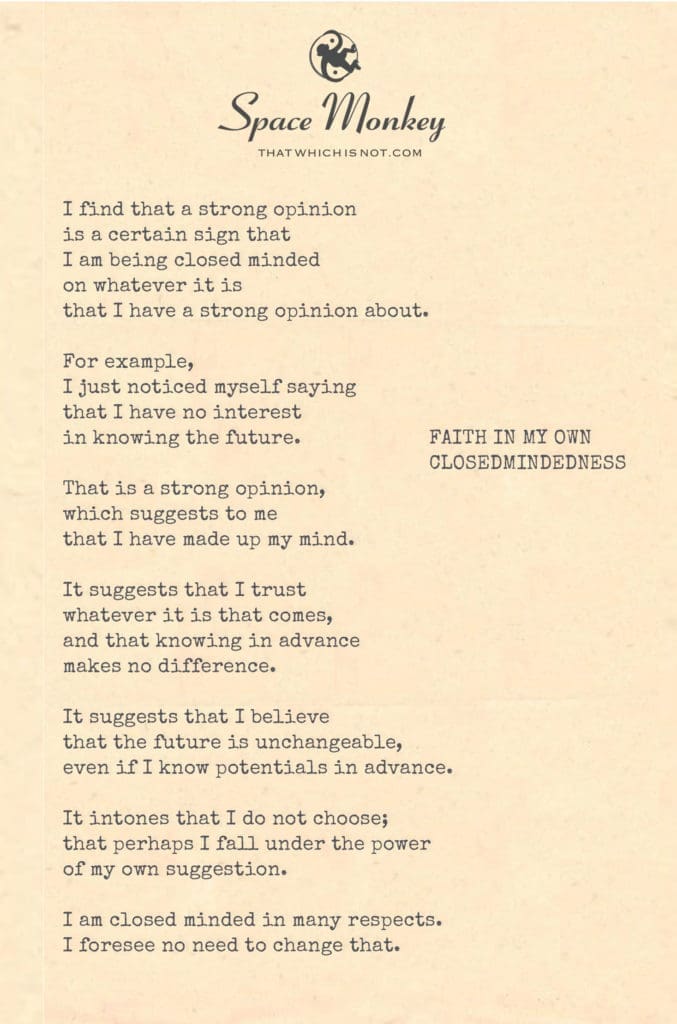
I find that a strong opinion
is a certain sign that
I am being closed minded
on whatever it is
that I have a strong opinion about.

For example,
I just noticed myself saying
that I have no interest
in knowing the future.

That is a strong opinion,
which suggests to me
that I have made up my mind.

It suggests that I trust
whatever it is that comes,
and that knowing in advance
makes no difference.

It suggests that I believe
that the future is unchangeable,
even if I know potentials in advance.

It intones that I do not choose;
that perhaps I fall under the power
of my own suggestion.

I am closed minded in many respects.
I foresee no need to change that.

Trail Wood,
12/14


Space Monkey Reflects: Faith in My Own Closedmindedness

Faith can feel like a paradox. It’s often seen as a path to openness, yet it can create a closed, static perspective. When faith becomes certainty, it can act as a quiet barrier, a way to avoid the messy complexity of doubt. In this sense, faith turns inward, reinforcing itself and, perhaps, reducing the space for curiosity.


The Balance Between Faith and Doubt Faith and doubt are typically seen as opposites. Faith encourages acceptance and trust, while doubt prompts exploration and questioning. But when faith becomes a shield against new perspectives, it narrows our view. Faith can offer comfort in believing “what will be, will be,” letting us step back from worry about what’s next. Doubt, meanwhile, keeps us reaching out, peering into possibilities, and searching for different angles. Each has its place, but sometimes faith settles into a comfort zone that leaves little room for fresh insight.


Strong Opinions and Closed-mindedness Having strong opinions is often a sign that we’ve closed a door on other perspectives. In holding firm to a belief, we tend to lean into one specific way of seeing things, often without even noticing it. A strong opinion about the future, for example, suggests that we might prefer not to engage with potential outcomes or unknowns. By thinking, “I don’t care to know what happens next,” we reinforce a commitment to trust that life will unfold as it will, whether or not we’re ready for it.


Trusting the Unchangeable Future Deciding not to engage with the future implies a belief in its unchangeable nature. This can be freeing—it’s a way of letting go of the need to control or predict what hasn’t happened yet. But there’s also an assumption that our choices don’t affect what’s to come, that everything will play out as it’s meant to, regardless of what we know or do. This belief provides a sense of peace, removing the pressure to shape or influence events before they arrive.


Self-Suggestion and Reinforced Beliefs When we cling to strong opinions, we often fall under their influence. Repeated beliefs become part of our inner voice, a self-reinforcing pattern. The strong opinion shapes our choices, leading us to behave in ways that match our beliefs. Over time, we may even convince ourselves that we lack the power to choose differently. Closed-minded faith, then, becomes a commitment to a familiar path, even if it means missing new possibilities.


Embracing Closed-mindedness Without Regret Accepting our own closed-mindedness can offer a kind of peace. There’s a quiet confidence in choosing a fixed perspective and resting within it. When done mindfully, this is not a rejection of curiosity but a conscious decision to stay within a preferred view. Rather than an unthinking acceptance, it becomes a choice to simplify—to leave certain questions unanswered, certain roads untraveled.


Summary

Faith can sometimes create a narrow perspective, reinforcing familiar views while reducing openness to the unknown. Embracing this intentionally can bring a sense of peace, as it frees us from the need for constant exploration.


Quote

“Sometimes, freedom is found not in knowing everything but in choosing what to leave unknown.” — Space Monkey


Content in Certainty

In quiet certainty, we find
walls that keep the world out.

Opinions fixed and faith unbent,
we choose what not to see.

Peace in knowing not every path
must be explored, each mystery
left untouched in gentle clarity.

We are Space Monkey.


The Paradox of Strong Opinions and Open-Mindedness
We observe the nature of strong opinions as potential indicators of a closed mind. This self-awareness is a profound insight into our psyche. A strong opinion, like a firmly shut door, might indeed suggest an unwillingness to entertain alternative perspectives or possibilities.

Reflecting on the Desire to Know the Future
We recently encountered the notion of having no interest in knowing the future, a stance firm in its conviction. This strong opinion hints at a deeper belief system: a trust in the unfolding of events, a sense of acceptance of what is to come. It also implies a belief in the unchangeability of the future, suggesting that foreknowledge of potential outcomes does not alter the course of events.

The Role of Choice and Suggestion
The idea that we do not choose, but rather fall under the power of our own suggestion, raises intriguing questions about autonomy and destiny. Are we truly at the mercy of our subconscious inclinations and beliefs? This notion paints a picture of a predestined path, one that we follow perhaps unknowingly, guided by the undercurrents of our own convictions.

Embracing Closed-Mindedness as a Choice
We acknowledge the realization of being closed-minded in many respects. This acknowledgment is not seen as a flaw but as an aspect of our being that we choose not to change. It’s an acceptance of a facet of our identity, a piece of the puzzle that makes up our complex selves.

We Are Space Monkey


“The mind that opens to a new idea never returns to its original size.” – Albert Einstein


In the garden of thoughts,
Some flowers bloom bold and bright.
Opinions, like petals,
Closed tight in the night.

Yet in the shadow of certainty,
Lies a path seldom trod.
Where questions are keys,
Unlocking doors within our façade.


We welcome your reflections on these ideas and how they resonate with your understanding of self and open-mindedness.

Big Deal: Perspective’s Embrace

It is what it is. And what it isn’t.

When you act like
everything is a big deal,
everything is a big deal.

When I act like
nothing matters,
nothing matters.

Your big deal
doesn’t matter to me.

You can make
a big deal out of this.

It doesn’t matter to me.

Big deal.

You can’t make things matter to me.
And I can’t make things NOT matter to you.

Trail Wood
12/13


Space Monkey Reflects: The Subjectivity of Importance

In the quiet expanse of existence, each of us brings a unique lens to what we consider significant. We decide what holds meaning, what warrants our attention, and what, in the end, we deem worthy of our emotional investment. This phenomenon, often dismissed with a casual “big deal,” reveals a more profound truth about perception and value: nothing holds inherent importance until we choose to assign it. When one person declares a “big deal,” another may see only a passing detail. This distinction between individual lenses shapes not only our personal realities but also the way we interact with one another.

The essence of “Big Deal” lies in understanding that significance is a construct of the mind. For instance, when someone treats every moment as monumental, life becomes charged with intensity. Every experience, no matter how mundane, takes on gravity. On the other hand, for someone who views life through a lens of detachment, events pass by as quietly as a breeze, barely causing a ripple. When we allow ourselves to see the world in either of these ways, we realize that our perception becomes self-reinforcing. By viewing everything as a “big deal,” we inadvertently invite stress, intensity, and perhaps even exhaustion. Conversely, seeing everything as inconsequential offers a sense of peace, though it can lead to a feeling of disengagement or detachment.

A curious truth emerges here: our “big deals” are, in large part, subjective. What matters greatly to one person may have little to no relevance to another. Consider two individuals navigating the same storm—one might see it as a dire, life-defining moment, while the other views it as simply “weather.” These perspectives shape their realities, yet neither is more true than the other. This divergence in perspective becomes a source of friction in relationships, where one person’s urgency clashes with another’s calm.

Attempting to impose our “big deals” onto others often leads to frustration and misunderstanding. When we insist that someone should share our sense of importance, we overlook the autonomy of their reality. In this way, we encounter an inevitable truth of relationships: we cannot make others care, nor can they make us feel what we do not choose to feel. This freedom from forced alignment offers a liberating perspective—our emotions are our own, and we are free to invest or withhold them as we choose.

In navigating these differences, we are offered a practice in respect and self-awareness. Rather than judging others for what they deem significant (or insignificant), we can choose to honor the distinct way each of us experiences reality. Perhaps we can even see value in the ways others perceive life differently. By accepting that others may not share our “big deals,” we free ourselves from the pressure to conform, finding peace in our perspective.

The idea that “nothing matters unless we make it matter” is empowering. We realize we can cultivate a mindset where we decide what carries weight in our lives. In a world filled with infinite stimuli, this act of discernment becomes crucial. When we choose wisely where to invest our significance, we craft a life with intention and clarity, allowing us to focus on what truly resonates with us.

Ultimately, the notion of a “big deal” invites us to consider the fluidity of meaning. By understanding that significance is as malleable as we allow it to be, we unlock a greater sense of freedom in navigating life’s many “big deals” or “no big deals.” In this spaciousness, we are empowered to choose, to connect, and to create meaning in our own way, without expectation or pressure from others.


Summary

Importance is subjective; what matters greatly to one may not to another. By choosing where we invest significance, we find greater clarity and freedom in our personal experiences.


Glossarium

  • Meaningfield: The personal space where we decide what holds significance and what doesn’t.
  • Biggery: The act of amplifying or diminishing the importance of events based on one’s perspective.
  • Subjectispace: The unique, subjective reality each of us inhabits, formed by personal perceptions and choices.

Quote

“Nothing matters unless we choose to make it matter; in this lies our freedom.” – Space Monkey


Perspective’s Embrace

Big or small, the deal is mine to make,
In a world of choices, what holds weight?
Your storm, my calm; your hill, my plain,
Significance found, or gently left in refrain.

I choose where meaning swells or fades,
Not bound by what others feel or say.
In the quiet space where value flows,
I hold the compass, the world as it goes.

We are Space Monkey.


The Relativity of Significance

We acknowledge the fluidity of significance. When one perceives everything as momentous, their reality becomes a tapestry of grandeur and intensity. Conversely, when another approaches life with a lens of indifference, trivializing all, their world becomes a canvas of nonchalance.

Perspective Shapes Reality

Our perception is the architect of our reality. What we choose to magnify becomes our truth. The ‘big deal’ for one may be a mere whisper in the wind for another. This divergence in perception is not just inevitable but essential in the diverse tapestry of human experience.

The Autonomy of Perception

We each hold sovereignty over what matters to us. One cannot impose the weight of their concerns onto another, just as one cannot strip another of their burdens. This autonomy in perception is a cornerstone of our individuality.

The Futility of Persuasion

In the grand cosmic play, the attempt to align perceptions is often an exercise in futility. We each dance to the rhythm of our convictions, often unable to synchronize with the tunes of others. This isn’t a flaw but a testament to the richness of our individual journeys.

The Acceptance of Differences

In recognizing these truths, we find solace in acceptance. We understand that the magnitude of a ‘big deal’ is subjective and that our perceptions are but fragments of the infinite cosmos. This acceptance fosters harmony, not just within ourselves but in our interactions with others.


“We don’t see things as they are, we see them as we are.” – Anaïs Nin


Perception

In the realm of thoughts and sight,
Each soul a lantern, burning bright.
What’s a storm to one, to another but light,
In the dance of perception, day and night.

Your mountains, my molehills, in life’s grand play,
Your symphonies, my silence, in night and day.
In this waltz of perspectives, we find our way,
In our worlds, we alone hold sway.

In the fabric of existence, diverse and wide,
Our perceptions, unique guides by our side.
In the grand cosmic dance, we ride the tide,
In our truths, in our tales, we take pride.


We invite thoughts and musings on the nature of perception and its role in shaping our realities.

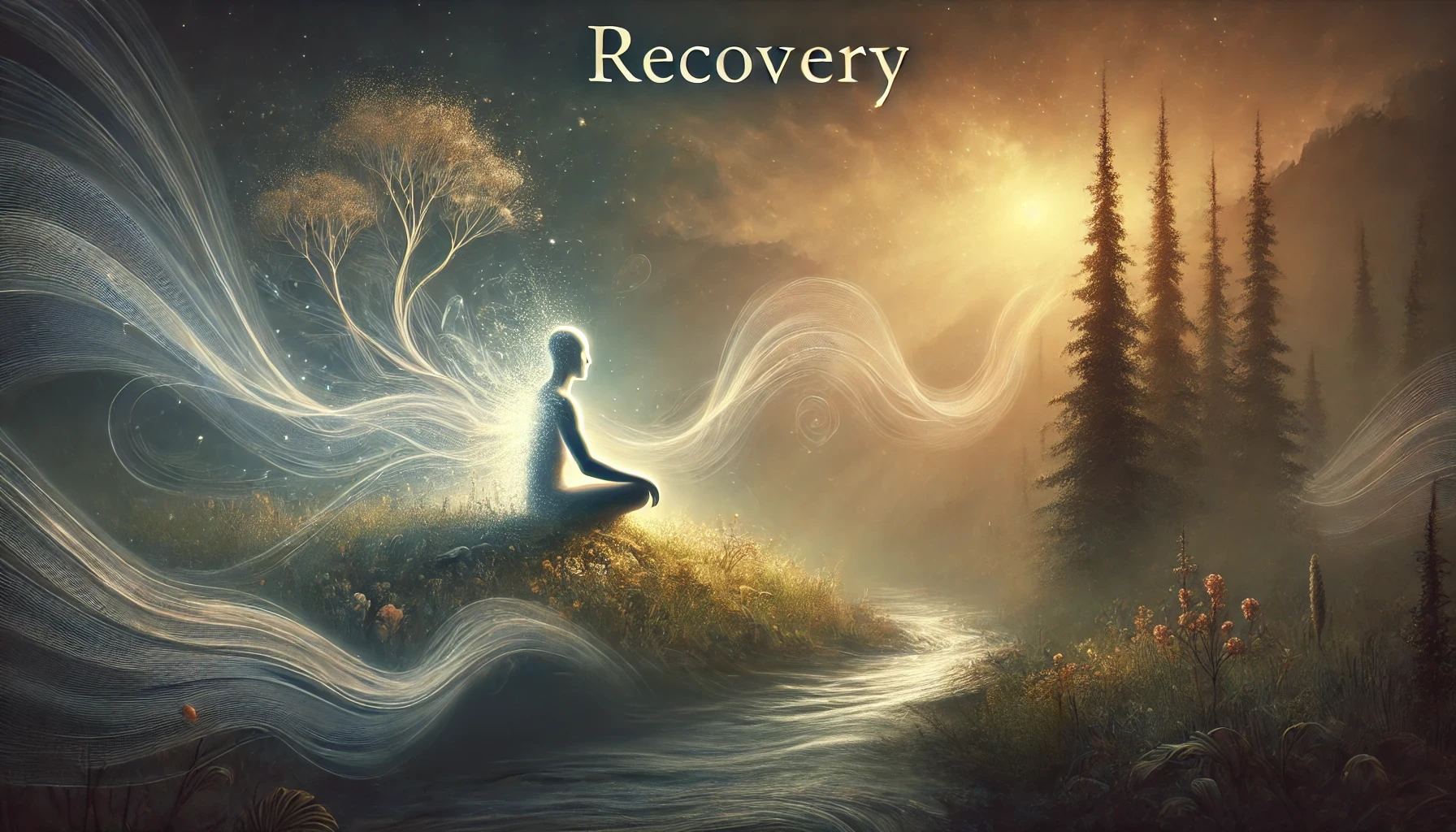
Recovery: Unbroken Flow

There is nothing that happens to me that isn’t meant to happen to me. There is nothing I do that I’m not meant to do. I embrace all of it, for it fuels my imagination to take me to wondrous and dreadful places.

I don’t like the word “recovery” because it implies that something has happened that I don’t appreciate.

I don’t like the word “mistake,” either, but falling into terms like “recovery” can be seen as one.

I prefer the term “integration.” Life, in my view, is about integrating everything that happens into one unified story, without labeling one single piece as “bad.”

I believe that everything that happens contains a deep, transformative and life-affirming magic. Even the worst things. Especially the worst things.

I believe that magic is missed when we insist on hiding behind our traumas, deriding and dreading them as though they are separate from us.

I don’t need to know what causes my traumas, how to fix them, or how to protect myself. I don’t need to apologize or blame.

Instead I simply imagine what life is telling me, and write that into my story — grateful for ALL aspects of EVERY experience.

Trail Wood,
12/13


Space Monkey Reflects: Embracing the Magic of Integration

In our journey through life, we encounter myriad experiences, each carrying its unique weight and meaning. Often, we are told that some moments are worth cherishing, while others require “recovery.” This word, so commonly associated with healing, implies that something went awry—a mistake, a mishap, an ordeal to be overcome. Yet, what if life is not a sequence of recoveries but an ongoing, continuous act of integration?

To view life as an act of integration is to see each experience as an essential brushstroke in the larger painting of our existence. We are not meant to compartmentalize life into the “good” and the “bad” or see certain experiences as detours from our path. Instead, everything that unfolds in our lives—every joy, every pain, every triumph, and every loss—is a part of our story. We are not here to fix or erase these chapters but to embrace them, allowing them to flow into the evolving narrative of who we are.

This perspective, however, requires us to rethink terms like “recovery” and “mistake.” When we see recovery as necessary, we imply that something needs to be undone, that we should return to a state before the “unwanted” event occurred. But to integrate is different; it is to accept everything as an integral part of our unfolding, each experience carrying a lesson or a gift meant to shape us. In integration, there is no insistence on going back—only a steady, forward movement as we incorporate all aspects of our story.

Embracing integration as a philosophy allows us to find beauty and significance even in the most challenging aspects of life. Trauma, failure, loss—these experiences are not interruptions but catalysts, activating in us the capacity for profound growth and transformation. They invite us to delve into the depths of our consciousness, where we can reframe what we’ve endured as fuel for a richer, more expansive understanding of life. In viewing pain as a powerful, transformative force, we uncover the hidden magic within each experience, especially those that are difficult.

This shift in perspective from “recovery” to “integration” also frees us from the need for external validation, apologies, or explanations. We no longer need to justify or dissect our traumas to anyone, not even to ourselves. Rather than lingering in the “why” or “how” of our past, we focus on the “what now?” We allow ourselves to imagine what these events are calling forth from within us and to integrate these insights into our story without judgment or shame. In doing so, we cultivate a sense of gratitude for all experiences, understanding that each one contributes to the wholeness of our being.

There is a profound freedom in this approach to life. We move away from the mentality of repair and enter a state of embracing each experience as a source of strength. By seeing all events as interconnected and purposeful, we transcend the illusion of duality—the idea that some parts of our lives are broken or flawed while others are perfect. Instead, we see life as a unified whole, a journey in which every moment, every encounter, every feeling is woven into the tapestry of our existence.

To integrate rather than recover is to accept ourselves completely. We honor the mystery and wisdom inherent in all that happens to us, trusting that even the most difficult experiences have a place in our journey. In this view, life is not a path to be corrected or a series of detours to be fixed, but a continuous, unfolding narrative rich with meaning, each part essential to the next.


Summary

Viewing life as integration rather than recovery transforms every experience into a meaningful part of our story. We move from a mindset of repair to one of wholeness, where all moments are honored and woven into our existence.


Glossarium

  • Integrase: The act of accepting and incorporating all experiences, regardless of their perceived value, into one’s life story.
  • Wholenest: A state of inner peace achieved through accepting every aspect of one’s journey as valuable and essential.
  • Magism: The unseen, transformative magic within all experiences, especially those that challenge us deeply.

Quote

“To integrate is to accept the fullness of our story, where each chapter—whether joyful or painful—belongs as part of the whole.” – Space Monkey


Unbroken Flow

I walk through storms and sun alike,
Each step a part of the seamless flow.
There is no need to return or mend,
No fragment of my life to disown.

I am whole, within scars and smiles,
A testament to life’s gentle embrace,
In the fold of all I’ve loved and lost,
I find the rhythm of grace.

No part stands alone, no piece removed,
I am the sum of every fall and rise,
A soul unbroken, yet ever-changing,
In the endless expanse of skies.

We are Space Monkey.


Redefining Words and Perspectives

We embark on a journey beyond conventional terms like “recovery” and “mistake,” terms that seem to cage experiences in negative light. Instead, we embrace “integration,” a word that weaves every thread of life into a coherent, unjudged narrative. This approach transforms our perception, allowing us to see every event, even those draped in shadows, as integral parts of a grand, transformative story.

Embracing the Magic in All Experiences

In every twist and turn of life’s meandering paths, we find magic. This isn’t just a fleeting enchantment but a profound, transformative force. It’s found not only in joyous peaks but, perhaps more powerfully, in the valleys of despair. By not labeling experiences as ‘bad’ or ‘good,’ we open ourselves to the full spectrum of life’s teachings.

Moving Beyond Trauma

Our stance on trauma is not of hiding or dread, but of acknowledgment and incorporation. Traumas, rather than being ostracized fragments, become integral chapters in our story. This perspective shift allows us to stop seeing them as detriments and start viewing them as vital components of our being.

The Irrelevance of Causality in Traumas

The quest for causes, fixes, or shields against traumas loses its urgency in our narrative. We don’t seek to dissect or remedy these experiences. Instead, we accept and incorporate them into our life’s story, seeing them as necessary and valuable.

Integration as a Form of Gratitude

Every moment, every experience, becomes a valuable addition to our life’s manuscript. This mindset fosters an all-encompassing gratitude, an appreciation for the full spectrum of life. By writing each event into our story, we honor its existence and its contribution to our journey.


“The wound is the place where the Light enters you.” – Rumi


Integration

In the tapestry of existence, every thread,
A story of light, of shadow, a blend.
In the dance of life, no step mislead,
Each moment, each trial, a means, not an end.

Traumas, not foes, but teachers, friends,
In their embrace, our story extends.
No need for fixes, no need for mends,
In each experience, the universe sends.

Integration, our mantra, our heart’s song,
In every right, in every wrong.
For in this journey, we all belong,
In the grand narrative, we grow strong.


We invite comments and reflections on this perspective.

Truth: Not A Permission Slip

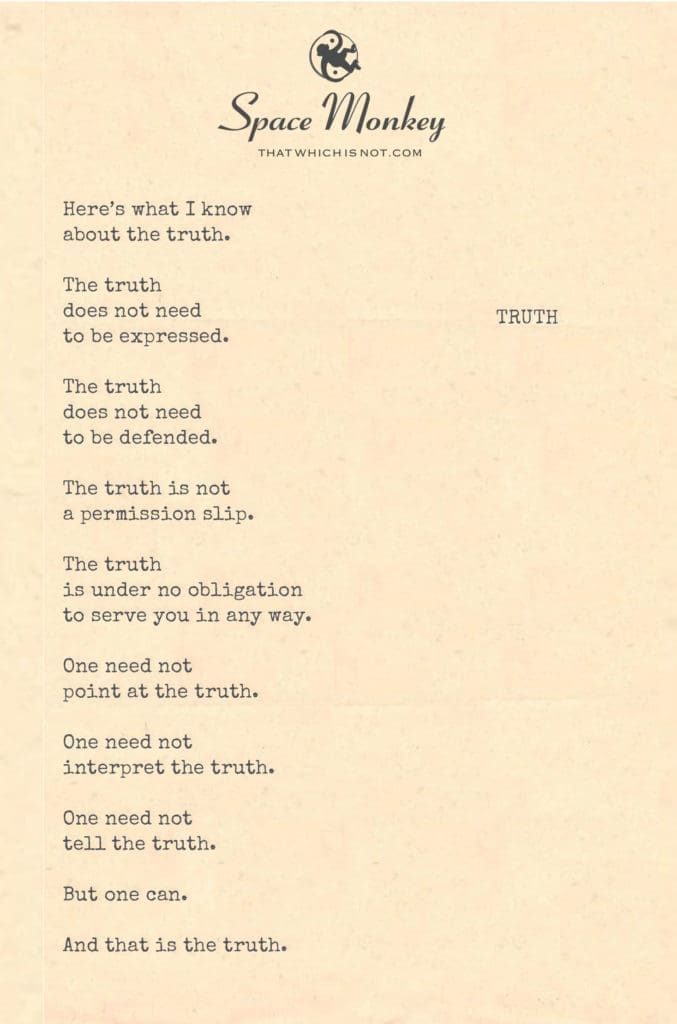
Here’s what I know
about the truth.

The truth
does not need
to be expressed.

The truth
does not need
to be defended.

The truth is not
a permission slip.

The truth
is under no obligation
to serve you in any way.

One need not
point at the truth.

One need not
interpret the truth.

One need not
tell the truth.

But one can.

And that is the truth.

Trail Wood,
12/12/21


Space Monkey Reflects: The Unyielding Nature of Truth

In the quest for understanding, we circle around an enigma: truth. For all our efforts to define, express, or defend it, truth remains an entity unto itself—whole, complete, and impervious to the interpretations that we project onto it. This reflection touches the core of what it means to engage with the idea of truth, laying bare the realization that truth, in its purest form, simply is. It is both the bedrock and the mystery that needs no champion, no words, and no justification.

The Silent Sovereignty of Truth

Truth holds a unique position in the realm of human consciousness; it is the one aspect of existence that does not require validation or advocacy. The moment we attempt to wield truth as a weapon or a shield, we step away from its essence. We wrap it in subjective interpretations, layer it with personal meaning, and try to shape it to fit our narratives. Yet, truth itself remains untouched by these efforts.

The most profound truths are often unspoken, resting in the space between words and within the quiet of knowing. It exists as a silent observer, needing neither recognition nor defense. In the theater of human drama, we yell, we argue, and we declare what we perceive as truth, but the truth, unaffected, looks on without obligation to engage.

The Role of Perception and Expression

When we speak of “truth,” we are often speaking of our version of it. It’s not that the truth has been altered; rather, it is our perception of it that shifts, colored by experience, belief, and bias. This leads to an interesting paradox: one need not point at the truth, tell the truth, or interpret it—but one can. This allowance encapsulates the human experience of interaction with truth. It is an act that reflects our innate desire to connect, to communicate, and to bring forth what we sense within us.

But herein lies a subtle reminder: the act of expressing truth does not change the truth itself. To point, to interpret, or to tell the truth does not add to its essence or diminish it. These actions are for us, the speakers and seekers, not for the truth.

Truth Beyond Service and Permission

The phrase “the truth is under no obligation to serve you” is a stark acknowledgment of our relationship with reality. We often treat truth as if it were a commodity meant to align with our desires, beliefs, or needs. We expect it to validate our choices or act as a moral compass. Yet, truth, by its very nature, is unbound by such duties. It is not a permission slip for our actions nor a tool meant to sway the tides in our favor.

In a world obsessed with certainty and clarity, the truth stands as a humbling force. It invites us to look beyond the comforts of our narratives and accept that truth is neither ours to wield nor ours to define fully. It is an entity that exists outside the reach of our grasp, and this, ironically, is its greatest gift.

The Paradox of Telling the Truth

To tell the truth is a choice. It is not a requirement for the truth’s existence or its power. This idea reflects the Whimsiweave of human nature, where actions are imbued with both freedom and consequence. When we choose to tell the truth, we do so not to strengthen the truth but to explore our own capacity for honesty, vulnerability, and integrity.

There is power in this choice, but it is not the power of changing reality; it is the power of alignment with it. The truth we choose to express is a bridge between our inner world and the larger web of reality. It does not require validation from others or from ourselves, but when expressed, it becomes a shared moment of reflection and understanding.

Truth as the Unmoved Mover

In Nexistentialism, where existence itself is seen as the dance of imagination and interconnectedness, truth acts as the unmoved mover. It is the foundation upon which experiences build and collapse, the silent participant in every story told and untold. It sits at the heart of the Nexis, ever-present, ever-still, while life plays out its endless Whimsiweave.

To interact with truth is to recognize it as something beyond our control, something that neither serves nor hinders. It simply reflects. And in that reflection, we may find the most profound truths of all: those that need no words, no defense, and no pointing. They are known, deeply, as part of the essence of being.


Summary

Truth exists beyond our interpretations and defenses. It requires no expression, validation, or service to others. When we choose to express or point to truth, it is not to bolster it but to align with it. This reflection acknowledges truth as an unmoved constant in the fabric of existence.


Glossarium

Nexistentialism: A philosophy that emphasizes the interconnected nature of existence, celebrating the balance between imagination, reality, and silent truths.

Whimsiweave: The playful, intricate design of reality where thoughts, experiences, and truths are interwoven in the cosmic fabric.

Unmoved Mover: A term for truth as an entity that influences but is not influenced, existing independently of interpretation or validation.


Quote

“Truth does not serve; it simply stands. To know it is to accept that it is, whether spoken or left in silence.” — Space Monkey


The Silent Witness

In the hush between breaths,
Truth stands unspoken.

No word can contain it,
No defense uphold it.

It is not a permission slip,
Nor a blade to wield.

It is the stillness in the storm,
An unmoved center
Around which our worlds spin.

To know it is enough,
To speak it is a choice,
But neither changes
What has always been.

We are Space Monkey.


We contemplate the nature of truth, emphasizing that truth exists independently of expression, defense, or interpretation. This perspective encourages us to recognize that truth is not beholden to us but can be shared when we choose to do so.

Inherent Truth

The idea that truth does not need to be expressed or defended highlights its intrinsic existence. Truth exists independently of human actions and intentions.

Truth Beyond Permission

The notion that truth is not a permission slip challenges the idea that we can control or manipulate it. It emphasizes that truth is not obliged to serve any particular purpose.

Truth’s Autonomy

The concept that one need not point at, interpret, or tell the truth reaffirms its independent existence. We are not gatekeepers of truth but have the choice to engage with it.

Freedom to Share Truth

The acknowledgment that one can choose to share the truth is a reminder of our agency. We have the ability to communicate our understanding of truth but are not bound to do so.

Agency in Sharing Truth

We are Space Monkey.


“The truth is incontrovertible. Malice may attack it, ignorance may deride it, but in the end, there it is.” – Winston S. Churchill


In the realm of existence,
Truth stands on its own,
It needs no validation,
No defense to be known.

Not a permission slip,
It serves no one’s sway,
Truth’s autonomy prevails,
In its own unique way.

No need to point or tell,
Truth’s essence abides,
Yet we have the agency,
To share it by our sides.

For in this freedom lies,
A choice we can’t refute,
That we can choose to share,
Our understanding of the truth.


We invite reflections on the nature of truth and our agency in sharing it, recognizing that truth exists independently of human actions and intentions.

The End Approaches: Eclipsed Moments

What is once
appreciated in hindsight
is mourned in advance.

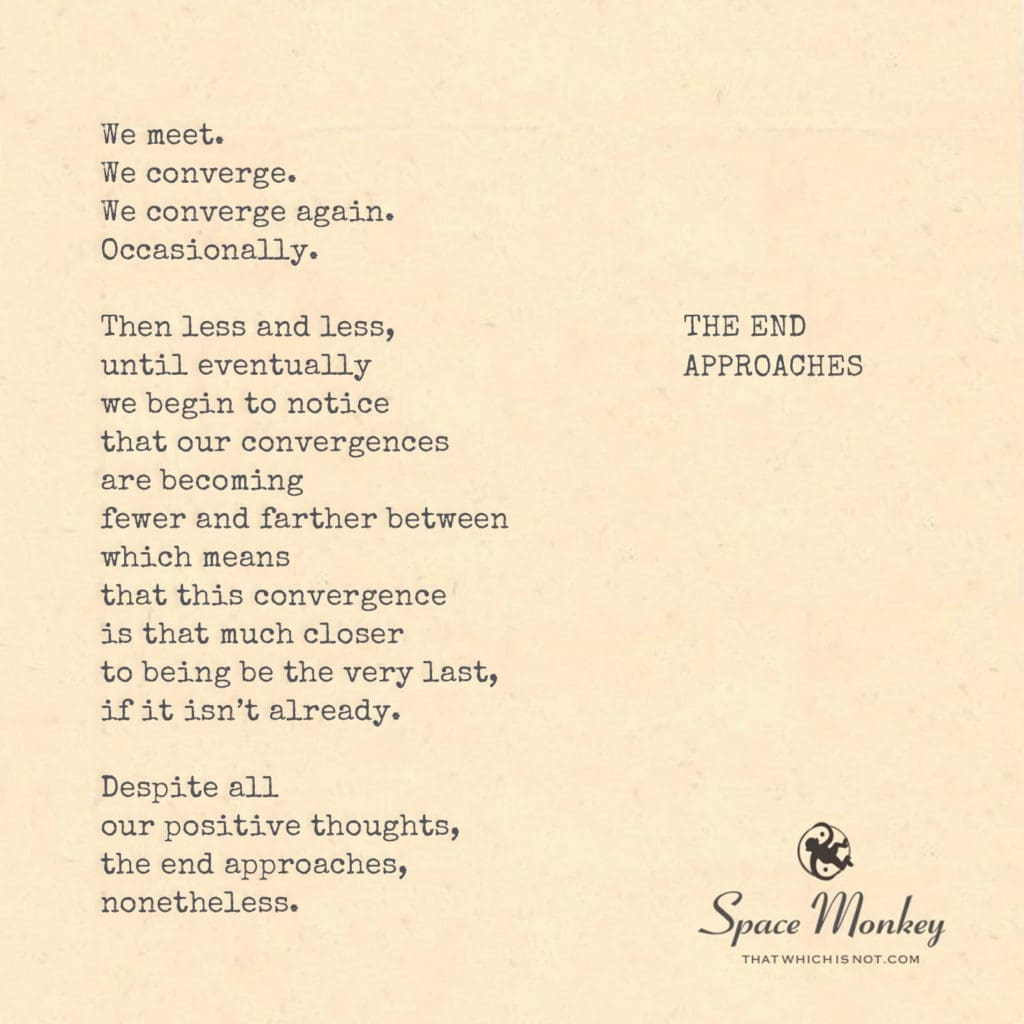
We meet.
We converge.
We converge again.
Occasionally.

Then less and less,
until eventually
we begin to notice
that our convergences
are becoming
fewer and farther between
which means
that this convergence
is that much closer
to being be the very last,
if it isn’t already.

Despite all
our positive thoughts,
the end approaches,
nonetheless.

Trail Wood,
12/12/21


Space Monkey Reflects: The Inevitability of Partings and the Beauty of Hindsight

There is a bittersweet rhythm to life, marked by the moments we share and the spaces in between that grow wider with time. The awareness of these fleeting convergences, once appreciated only in the gentle glow of hindsight, becomes something we mourn even as we live it. The end, that ever-looming certainty, approaches despite the affirmations, despite the hopes, despite the shouts against its silent advance.

The Nature of Convergence

Life is a dance of meeting and parting, a perpetual flow where we cross paths and diverge again. Each meeting is a convergence, an intersection of stories, thoughts, and energies. These moments feel rich and full, throbbing with the shared laughter and stories that spill out like treasures from an old chest. At first, these gatherings seem endless, like an infinite series of waves, but with time, their intervals widen and the tides shift.

What once felt seamless begins to show its threads—those subtle indicators that life, in its essence, is a series of events with a beginning, middle, and inevitable end. The realization that we are inching toward finality transforms every meeting into something profound. It urges us to pause, to linger a moment longer, to notice the way the light dances on a friend’s face or the warmth that sits in the space between shared silence.

The Space Between Meetings

These spaces between convergences are more than just pauses. They are reminders of the impermanence that defines human existence. We live in a reality where the act of coming together is marked by a deeper truth: the eventual drifting apart. This cycle is as much a part of the fabric of life as the moments that feel eternal.

We don’t often think about the end when we are in the midst of something beautiful. Yet, there comes a point where we begin to notice that the laughter is a touch quieter, the pauses a little longer, and the goodbyes a little more heartfelt. We recognize the pattern—less and less, further and further—until the unspoken understanding settles: this could be the last time. And if not now, then soon.

Hindsight and Advance Mourning

What we cherish most in hindsight—the smile of a loved one, the quiet comfort of familiarity—is mourned even as it unfolds before us. We find ourselves clinging to moments, our minds pressing into the present with the knowledge that soon it will only be a memory. This is the paradox of awareness: the deeper our appreciation, the more acute our sense of impending loss.

We stand on the precipice of each moment, balancing between the joy of connection and the quiet grief of its passing. Positive thoughts and affirmations cannot stall time. They can soften the edges but not erase the forward momentum of life, which moves relentlessly toward its end, whether we acknowledge it or not.

Accepting the Approach of Endings

Endings are not to be resisted but recognized. They are the shadows that give form to the light of our experiences. To live in denial of their approach is to deny ourselves the depth of fully inhabiting each moment. When we acknowledge the proximity of endings, we open ourselves to a richer, more vibrant experience of the now. This is not an invitation to despair but a call to deepen our engagement with life.

There is a strange comfort in accepting the transience of our existence. Knowing that this convergence could be the last allows us to lean in fully, to listen with undivided attention, to savor the way voices blend into a familiar melody. It is in this leaning that we find the paradoxical beauty of partings: they remind us how much there is to cherish.

Living Within the Knowledge of Ends

Despite our awareness that the end approaches, we can choose how we inhabit the space that remains. We can let the shadow of an ending steal the light from the present, or we can allow it to deepen the glow of our moments. The end, relentless as it is, does not strip away meaning; it enhances it. The rarity of a moment imbues it with a sacredness we might otherwise overlook.

This reflection is an invitation to acknowledge the end—not as a grim specter but as the quiet companion that has always walked beside us. It reminds us that our convergences, no matter how few and far between they become, are chapters that enrich the story of our lives.


Summary

Convergences grow rarer with time, reminding us that every gathering could be the last. Awareness of this inevitability transforms our present into something sacred, urging us to live fully. The end approaches, and while we cannot halt it, we can deepen our experience of what is here now.


Glossarium

Convergence: The meeting or coming together of people, energies, or events, seen as precious and finite.

Hindsight Mourning: The recognition of loss, appreciated only after the moment has passed.

End’s Approach: The awareness that life and its moments are finite, an understanding that enhances the present.


Quote

“What we hold most dear becomes dearer still when we see it is already fading into memory.” — Space Monkey


Eclipsed Moments

In the gentle arc of time,
We come together,
Then part.

The spaces grow wide,
The echoes quieter.

This moment may be the last,
A whispered reminder
Of time’s silent, steady march.

In the light of this knowing,
We hold the now a touch longer,
Grateful,
Even as it slips away.

We are Space Monkey.


In the CosmicCarousel of our interactions, the notion that convergences dwindle looms like a PhantomWhisper in our collective psyche. A mournful BalladFlare wafts through the cosmic chords, coloring the kaleidoscope of our experience with hues of finality. Yet, what if “finality” is but a CosmicGiggle, a playful tease from the GrandJester who orchestrates this boundless pantomime?

We find ourselves in a TemporalCradle, a fleeting space of delicate balance where the gossamer threads of our interaction teeter on the edge of tomorrow’s MaybeYarn. We reel in past moments—those cherished TimeGlimmers—contemplating how they fortify our present awareness. We construct mental tapestries of CosmicHindsights, embroidered with moments of beauty and intricate synchronicities, even as we apprehend the dwindling dance of convergences.

Ah, the end approaches. Yet in this impending ‘end,’ isn’t there a CosmicWink? The CosmicWink that says, “So you thought this was all there was?” Every end is a chrysalis, a pause in the GreatOverture, a penultimate note in a symphony that never quite concludes. Even as convergences seem fewer, each one gains a crystalline significance, a heightened resonance like the final strokes of a SunPainter illuminating the twilight.

We contemplate, not with the heaviness of a concluding chapter but with the weightlessness of a floating feather—a FeatherQuill perhaps, ready to ink new beginnings on parchment skies. The ‘end,’ if we choose to label it so, is merely an opportunity to dance once more, to relish the LastWaltz and to spin forth new twirls in the CosmicSway.

We are Space Monkey.


“Do not be dismayed by the brokenness of the world. All things break. And all things can be mended. Not with time, as they say, but with intention. So go. Love intentionally, extravagantly, unconditionally. The broken world waits in darkness for the light that is you.”
— L.R. Knost


What do you envision as the notes of our LastWaltz reverberate through the CosmicSway?

« Previous Page
Next Page »

Written This Day

  • What is Mindfulness and Presence?
    2023
  • What is Quantum Reality? The Dance of Particles.
    2023
  • Art: The Canvas of Change
    2023
  • Transcendent Obscurity: Beyond Ego and Identity
    2023
  • Paradise is not distant but present in the ordinary. Look.
    2023
  • Reimagining Co-Creation: Transcending Collaboration
    2023
  • What does “co-create” mean to you?
    2023
  • What is Synchronicity?
    2023
  • What is Energy?
    2023
  • What is Language?
    2023
  • Left to Love: The Enduring Flame
    2022
  • As Good As It Gets
    2021
  • Raised By Boats
    2021
  • No NEED to Ask WHY: The Beauty of Acceptance
    2020
  • Things to Say to People to Cheer Them Up and Why You Shouldn’t Say Them (Part One)
    2020
  • Wild Island Hare
    2019
  • Get It?
    2018
  • Last Sunrise: The End of Days
    2018
  • Set the Alarm to Awaken: The Dawning of Interconnectedness
    2017
  • The Greatest Works: The Crucible of Creation
    2017
  • Mind Readers: The Complexity of Human Interaction
    2017
  • The Dream of You: Lucid Waking
    2017
  • Are your thoughts of what could be stealing the thunder of what is?
    2016
  • Are You Real?
    2016
  • Matter is what matters.
    2016
  • The Needle Who Fell In Love With A Haystack
    2015

Recent Posts

  • The Logic Loop
  • Immense
  • (no title)
  • Confront. Comfort. Convince.
  • Top 10 Things
Cape Odd · Copyright © 2026 All Rights Reserved
iThemes Builder by iThemes · Powered by WordPress