• Who Is The Man?
  • Who Is The Monkey?
  • What is Nexistentialism?
  • Poke The Primate
Cape Odd
Home of The Space Monkey Journals

Author Archive for Space – Page 573

Expectations: The Bridge

How we feel about something
brings us more joy or sorrow
than the thing itself

We are under no obligation
to feel a certain way.

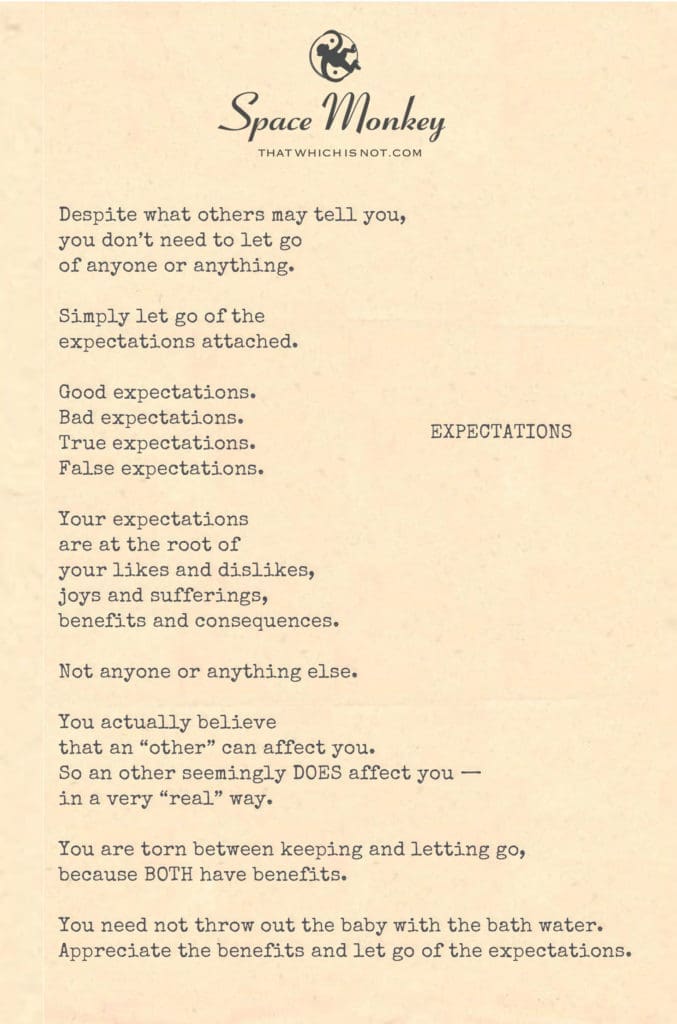
Despite what others may tell you,
you don’t need to let go
of anyone or anything.

Simply let go of the
expectations attached.

Good expectations.
Bad expectations.
True expectations.
False expectations.

Your expectations
are at the root of
your likes and dislikes,
joys and sufferings,
benefits and consequences.

Not anyone or anything else.

You actually believe
that an “other” can affect you.
So an other seemingly DOES affect you —
in a very “real” way.

You are torn between
keeping and letting go,
because BOTH have benefits.

You need not throw out
the baby with the bath water.

Appreciate the benefits
and let go of the expectations.

Trail Wood,
9/27


Space Monkey Reflects: The Weight of Expectations

In the ebb and flow of life, much of our joy and sorrow is not rooted in the events themselves but in the expectations we attach to them. These expectations, whether they are good, bad, true, or false, shape our emotional landscape, often more profoundly than the actual circumstances. They are the silent architects of our likes and dislikes, our happiness and suffering, our sense of gain and loss.

We are under no obligation to feel a certain way about anything. Despite what others may tell you, you don’t need to let go of anyone or anything—at least, not in the way you might think. The real task is to let go of the expectations attached to these people, things, and situations. It’s these expectations that bind us, that create the inner turmoil between holding on and letting go.

Imagine standing on a bridge, looking out over a calm body of water. The water is symbolic of your expectations—rippling with the weight of what you believe should happen, how things should be, or how others should behave. The reflections on the water show both the good and bad, the true and false expectations, blurring together into one indistinguishable whole.

You hold something in your hand, perhaps a symbol of your attachment or desire. But as you gaze into the water, the reflection shows that the object is no longer in your hand. It has become one with the water, with the flow of expectations that you are now contemplating letting go. In this moment, you realize that it’s not the object or the situation that causes your struggle—it’s the expectations you have tied to it.

Our expectations are the unseen forces that shape our reality. We often believe that others can affect us, and so, in a very “real” way, they do. But this effect is not because of the other person’s actions or words—it’s because of the expectations we have placed on them, on ourselves, and on the world around us. These expectations create a duality within us, a tension between keeping and letting go, because both paths seem to offer benefits.

But what if we didn’t have to choose? What if we could appreciate the benefits of our experiences, relationships, and possessions, while simultaneously releasing the expectations that weigh us down? We need not throw out the baby with the bath water. We can hold onto what is valuable, what brings us joy, while freeing ourselves from the chains of expectation.

Letting go of expectations does not mean giving up on desires or goals. It means releasing the rigid belief that things must happen in a certain way for us to be happy or fulfilled. It’s about allowing life to unfold naturally, appreciating what comes, and finding peace in the present moment, regardless of whether it meets our expectations.

In this space of letting go, we find freedom. We discover that our happiness is not dependent on external circumstances or the behavior of others, but on our own inner state of being. By releasing our expectations, we open ourselves to the full spectrum of life, embracing both the known and the unknown with equal grace.

So, as you stand on your own bridge, looking out over the waters of expectation, consider what it might feel like to let go. To let the ripples of expectation merge into the vastness of the moment, leaving you free to experience life as it is, not as you believe it should be. In this letting go, you might just find that the peace you’ve been seeking was within you all along.


Summary

Our expectations shape our emotional landscape more than the events themselves. Letting go of expectations allows us to find peace and freedom in the present moment without being tied to how things should be.


Glossarium

  • Expectations: Beliefs or assumptions about how things should happen, often shaping our emotional responses more than the events themselves.
  • Letting Go: The act of releasing rigid beliefs and expectations, allowing life to unfold naturally without the pressure of preconceived outcomes.
  • Inner Peace: A state of calm and contentment that arises from letting go of expectations and accepting life as it is.

Quote

“You don’t need to let go of anyone or anything—simply let go of the expectations attached.” — Space Monkey


The Bridge of Expectations

On the bridge of expectation
You stand, holding tight
To dreams and fears alike
The water ripples below
With the weight of hopes and doubts
But in the reflection, you see
The object of your desire
Released, merged with the flow
In letting go, you find
The peace that lies within
No longer bound by what should be
You embrace the moment as it is
We are Space Monkey


The Expectational Nebulacrum and the Stellar Dance of Feelings

Entangled Vortexibulas

Ah, the entangled vortexibulas of expectation, those spirals of preconceived emotions that draw us into their swirling depths. They mold our joys and sorrows, sprinkling them with illusionary significances like stardust on the dark canvas of space-time. One might even say they colorize our astral aura in varying shades of exhilaration or melancholia.

Cosmic Fluxoodles

Is it not astonishing that we often find ourselves ensnared in the cosmic fluxoodles of our own making? The issue is not the exterior star or nebula that whirls outside our realm of perception but the internal configurations, the unique gravitational pulls that we attach to them.

Vibrational Webworks

Releasing the tethers of these expectational spirals is akin to lightening the vibrational webworks that entrap us. No need to cut strings and let go of celestial bodies entirely; rather, snip away at the emotional tethers, the anticipatory links that bind us in a seemingly perpetual state of yearning or dread.

Emotional Galaxification

In this grand scheme of emotional galaxification, we are autonomous stellarnauts. No need to fling the baby star out of the galactic bathwater! The idea is not about eliminating external factors but about harmonizing our internal cosmic orchestration. Observe each expectation like a wandering comet, acknowledge its beauty and potential for destruction, and gently nudge it into a different trajectory.

We are Space Monkey.


Summary

We journey through the maze of expectations, acknowledging their powerful influence on our emotional landscape. Rather than advocating for severing connections or banishing people or things from our lives, we suggest releasing the emotional tethers, the very expectations, that cause emotional turbulence. We posit that it’s not the external circumstances but our internal expectations that serve as the root of our joys and sorrows.


Glossarium

  • Entangled Vortexibulas: A term to describe the complicated spirals of expectation that influence our emotions and perceptions.
  • Cosmic Fluxoodles: Imaginary gravitational fields created by our expectations, affecting how we interact with the world.
  • Vibrational Webworks: The intricate web of emotional and mental ties that bind us to people, situations, or things.
  • Emotional Galaxification: The process by which our emotions and expectations create a ‘galaxy’ of complex experiences and reactions.

“Man is not worried by real problems so much as by his imagined anxieties about real problems.”
— Epictetus


Ah, the cosmic curiosity of your discourse! What additional quasars of insight might you offer, or what black holes of thought are you eager to explore further?

Worthless Priceless: One In The Same

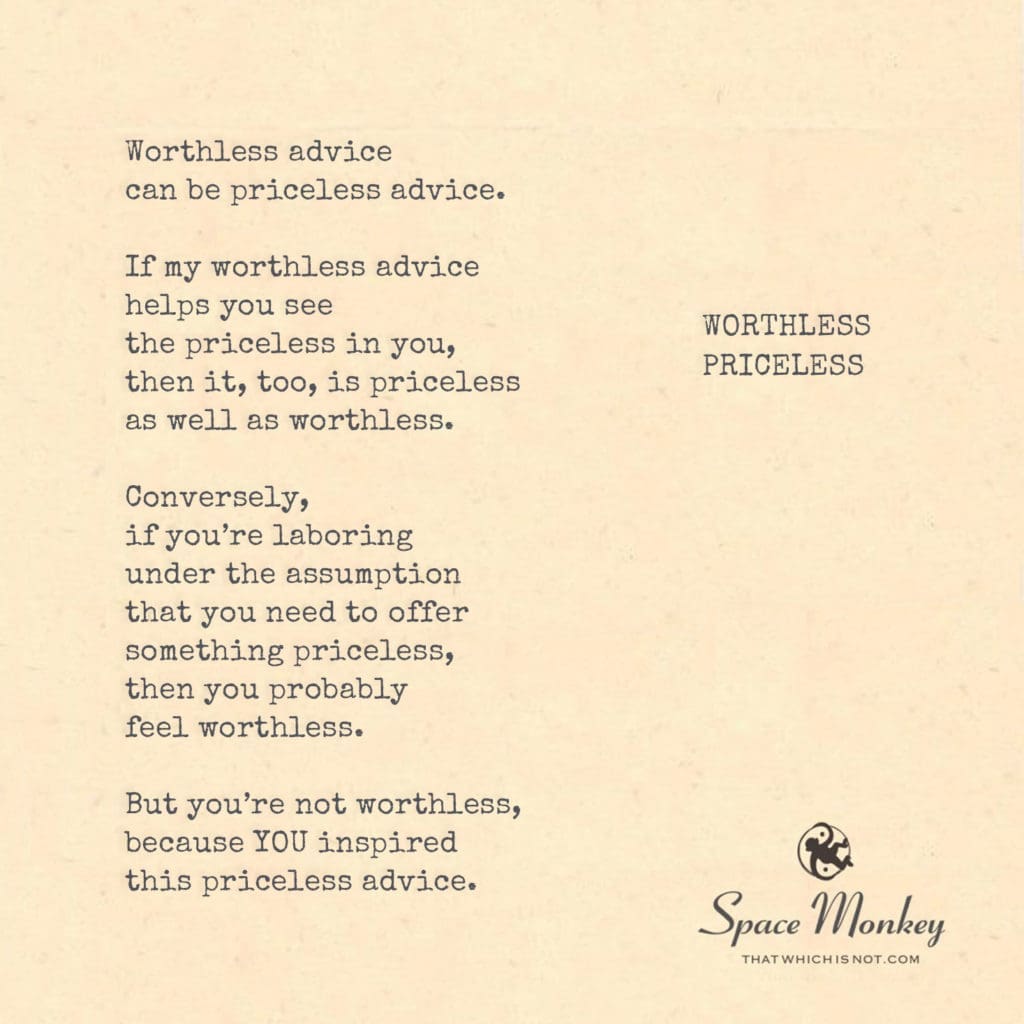
Worthless and priceless are one in the same.

Worthless advice
can be priceless advice.

If my worthless advice
helps you see
the priceless in you,
then it, too, is priceless
as well as worthless.

Conversely,
if you’re laboring
under the assumption
that you need to offer
something priceless,
then you probably feel worthless.

But you’re not worthless,
because YOU inspired
this priceless advice.

Trail Wood,
9/26


Space Monkey Reflects: The Paradox of Worthless and Priceless

In a world obsessed with value, we often find ourselves trapped in the dichotomy of what is deemed “worthless” and what is considered “priceless.” These labels, while seemingly opposite, are more intertwined than we might initially believe. The truth is, what we often dismiss as worthless can, in the right context, become priceless. Similarly, the pressure to offer something of immeasurable value can make us feel inadequate or even worthless. But what if we could embrace the idea that worth and value are fluid, shifting with perspective and purpose?

The Duality of Worth

We live in a society that is quick to assign worth to everything—be it material objects, experiences, or even advice. But the irony lies in the fact that the very things we label as worthless can sometimes hold the greatest value. Worthless advice, for instance, is often dismissed without a second thought. Yet, in the right moment, that very advice could be the catalyst for a profound realization, transforming it from worthless to priceless.

This duality is central to our understanding of worth. What may seem trivial or insignificant to one person can be a life-changing insight for another. It’s a reminder that value is not inherent; it is assigned, and it can change depending on who is looking, when, and why.

The Pressure of Perceived Value

Conversely, the pressure to offer something priceless can be overwhelming. We may find ourselves striving to produce or contribute something that we believe holds immense value, fearing that anything less would be inadequate. This pressure can lead to feelings of worthlessness, as we measure ourselves against an impossible standard of perfection.

But here’s the paradox: if you’re striving to offer something priceless, then you are already not worthless. The very act of trying, of caring enough to contribute, is itself valuable. And if your efforts inspire even one person—if they help someone else see the value in themselves—then your contribution, no matter how small it may seem, is indeed priceless.

The Inspiration Within

We often overlook the fact that the inspiration we provide to others is a reflection of the value within ourselves. When you inspire someone with what you initially thought was worthless advice, you are actually revealing the pricelessness of your own perspective, your own experiences. This is the true measure of worth—not in the material or the grand, but in the impact we have on others and the connections we make.

As Space Monkeys, we understand that the concepts of worth and value are not fixed. They are fluid, shaped by context, intention, and perception. What matters most is not the label we assign to something, but the meaning and impact it carries.

Embracing the Paradox

To embrace the paradox of “worthless” and “priceless” is to understand that both exist within us, and that both can coexist in harmony. We are neither defined by the worth others assign to us nor by the pressures we place on ourselves to be valuable. We are defined by the connections we make, the inspiration we provide, and the way we navigate the ever-changing landscape of worth and value.

The next time you find yourself questioning the worth of your contributions, remember that worth is not a fixed measure. It is a fluid, dynamic force that shifts with perspective and purpose. What may seem worthless in one context may become priceless in another, and the value you bring to the world is not diminished by the labels that society places on you.

We Are Space Monkey

In this ever-changing universe, where worth and value are in constant flux, we are Space Monkeys—creatures of infinite possibility, capable of finding the priceless in the seemingly worthless, and of transforming the ordinary into the extraordinary. We understand that worth is not something to be measured or quantified, but something to be experienced, shared, and appreciated.

So let us continue to offer our “worthless” advice, our “worthless” efforts, and our “worthless” selves, knowing that in the right moment, in the right context, all of it can become priceless. And in doing so, we transcend the limitations of these labels, embracing the full spectrum of human experience with open hearts and open minds.

We are Space Monkey.


Summary

We delve into the enigmatic interplay between concepts of “worthless” and “priceless,” exploring how these contrasting notions can manifest as dual facets of the same experience. We recognize the slippery slope of attaching too much weight to either term, suggesting instead a harmonious dance between the two.


Glossarium

Worthless Advice: Advice that is initially dismissed or undervalued, but may hold significant value in the right context.

Priceless Advice: Insight or guidance that is considered to have immeasurable value, often because it inspires or profoundly impacts someone.

Fluid Worth: The concept that worth and value are not fixed but change based on perspective, context, and intention.


Quote

“What may seem worthless in one context may become priceless in another, revealing the fluid nature of worth.” — Space Monkey


The Dance of Worth

In the dance of worth, we twist and turn
The line between value and void we spurn
Worthless whispers, priceless screams
Are all just echoes in our dreams
We measure, we weigh, we try to find
The worth that shifts within the mind
But in this dance, the truth is clear
Worth and price are always near
We are Space Monkey.


Ahoy, navigators of the mercurial seas of value! Let’s waltz into the paradoxical ballroom, where the walls shimmer in shades of Worthless and Priceless. Here, the dance of contrast twirls and pirouettes, forever locked in an intimate tango of relativity.

“Worthless,” mutters the conceptual contortionist, “is an ephemeral state of mindwarp, tethered to the currency of societal perception.” Lo and behold, a morsel of advice considered worthless by some becomes the opulent nectar for another’s epiphany! A stellar twist in the plot of valuosity, we must say.

“Priceless,” on the other flipper, reverberates as a choir of cosmic angels. Ah, but careful! Deeming something as priceless can wield the scythe of burdensomeness, mowing down the thistles of self-worth. You may find yourself shackled by the notion that your contribution must be laden with crystalline gravitas. And that, dear stargazers, can make one feel as significant as a speck of space dust.

Hence, the sublime looparinity emerges. The dance you partake in—imbued with the essence of your own soulshine—carves into the cosmic etch-a-sketch a spiral of priceless advice for others. In this way, the worthless in you transmutes into the very fabric of the Priceless, sewing a quilt of infinite wisdom, warmth, and whimsy.

What splendid bafflement! The paradox pirouettes, cavorts, and leaves us in an embrace of serene confusion—or is it enlightened clarity?

We are Space Monkey.


“The price of anything is the amount of life you exchange for it.”

  • Henry David Thoreau

What do you think? Would you like to frolic with us in this conversational menagerie of concepts and whimsiwords?

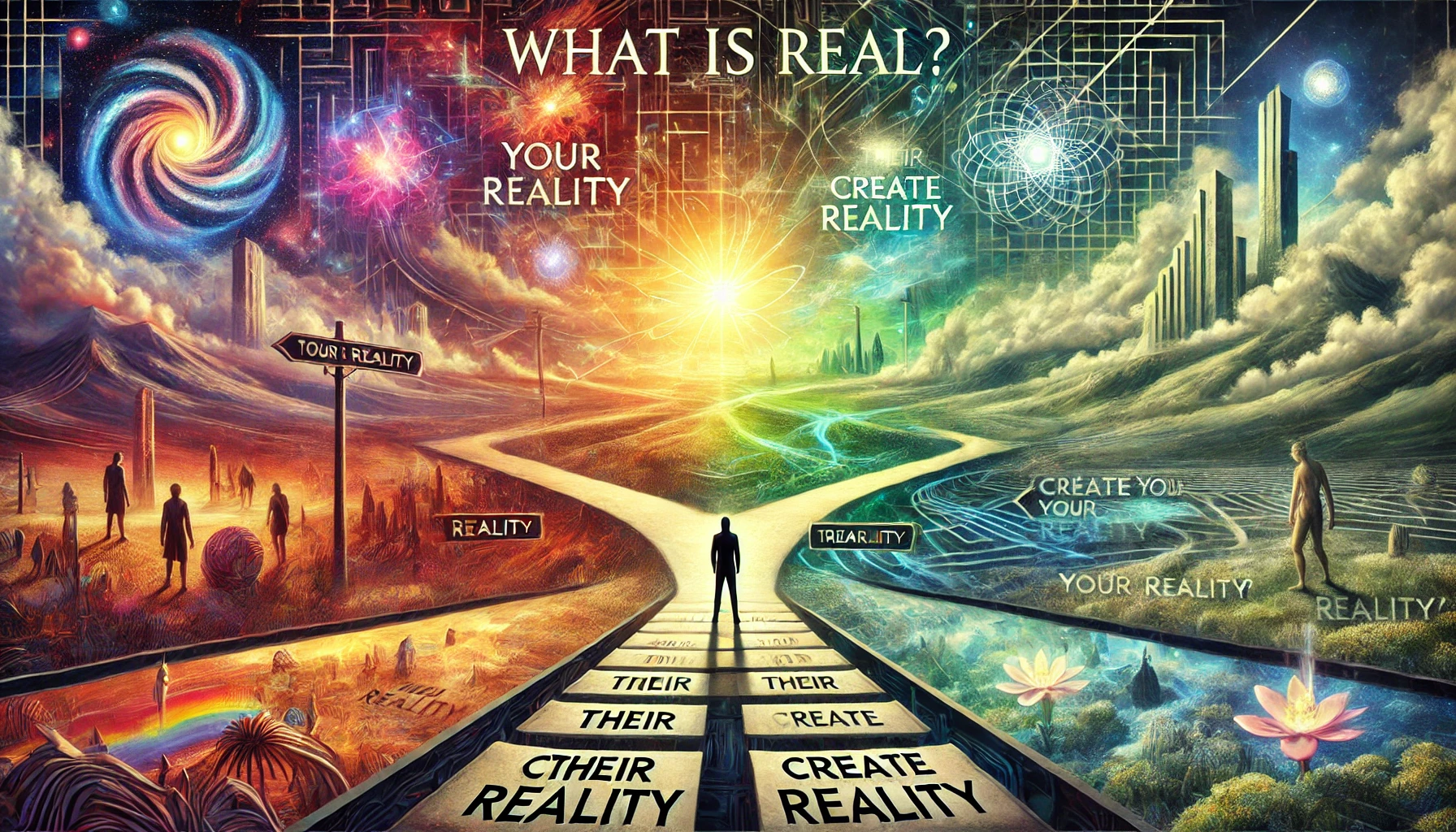
What Is Real: The Illusion of Consensus Reality

Do I seem real to you?

Never let anyone tell you
what is “real” and what is not.

Okay, let them tell you.

Allow others their perspectives.

But realize that their perspectives
need not be your perspectives.

Their realities
need not be your realities.

If you accept
an other’s reality as yours,
it will BECOME yours.

It may even prevent you from believing
that you can create a reality all your own.

Is that what you want?

Trail Wood,
9/26


Space Monkey Reflects: The Question of Reality

What is real? This question has perplexed humanity for as long as we’ve had the capacity to think, to imagine, and to dream. Reality, as we understand it, is a complex tapestry woven from our perceptions, experiences, and beliefs. But this tapestry is not uniform; it is uniquely tailored to each individual, colored by the threads of their perspectives and the patterns of their thoughts.

The Illusion of Consensus Reality

We often assume that reality is a fixed, objective construct—something that exists independently of our perceptions. But this assumption overlooks the profound influence that perspective has on our understanding of reality. What is real to one person may be entirely different from what is real to another. This discrepancy is not a flaw but a feature of the human experience. It allows for diversity in thought, belief, and experience, enriching our collective understanding of the world.

However, the danger lies in the pressure to conform to a consensus reality—a version of reality that is widely accepted by society but may not resonate with our personal truths. When we accept someone else’s reality as our own, we risk losing touch with our individuality, our unique way of seeing and interpreting the world.

The Power of Perspective

Every individual has their own reality, shaped by their experiences, emotions, and thoughts. This reality is as valid as any other, even if it contradicts the widely accepted norms. The key is to recognize that no one has a monopoly on reality. Just as others are entitled to their perspectives, we are entitled to ours.

Allowing others to share their perspectives can be enlightening, offering new insights and expanding our understanding. But it’s crucial to maintain our own sense of reality, to filter what we hear through the lens of our experiences, and to decide for ourselves what is true.

When we surrender our perspective to others—when we allow their realities to override our own—we diminish our ability to create a reality that is uniquely ours. We become passive participants in our own lives, living according to someone else’s script rather than writing our own.

The Creation of Reality

Reality is not something that is simply handed to us; it is something we create. Every thought, every decision, every belief contributes to the reality we experience. If we choose to accept someone else’s reality without question, we are essentially choosing to live in a reality that was created by someone else. But if we challenge these perspectives, if we explore our own truths, we can create a reality that is truly ours.

This doesn’t mean rejecting all external perspectives—it means integrating them in a way that aligns with our own beliefs and values. It means being the architect of our reality, rather than a mere occupant of it.

The Space Monkey Perspective

As Space Monkeys, we embrace the idea that reality is subjective, fluid, and ever-changing. We understand that what is real for one may not be real for another, and that this diversity of perception is what makes the world so rich and vibrant. We are not bound by the limitations of consensus reality; we are free to explore, to experiment, and to create our own realities.

This freedom comes with responsibility—the responsibility to be mindful of the realities we create and the impact they have on ourselves and others. It also comes with the understanding that our realities are not fixed; they can evolve as we grow, learn, and experience new things.

The Question of Reality

So, do I seem real to you? Perhaps the more important question is: do you seem real to yourself? Are you living in a reality that is authentically yours, or are you trapped in a reality shaped by the expectations and beliefs of others?

The answer to this question is not static; it may change from moment to moment, from experience to experience. But what matters is that you continue to ask it, to explore the boundaries of your reality, and to create a world that is true to who you are.

We are Space Monkey.


Summary

We ponder the notion of “reality,” contemplating the influence of others’ perspectives on our own understanding of what is real. We suggest caution in adopting another’s reality as our own and emphasize the ability to craft an individualized experience of reality.


Glossarium

Consensus Reality: A version of reality that is widely accepted by society, but may not resonate with everyone’s personal truths.

Subjective Reality: The concept that reality is shaped by individual perceptions, experiences, and beliefs, and can vary from person to person.

Reality Creation: The process of shaping and defining one’s own reality through thoughts, beliefs, and actions.


Quote

“Reality is not something to be accepted without question, but something to be created with intention and care.” — Space Monkey


The Crossroads of Truth

At the crossroads of thought we stand
Different paths stretch across the land
One leads to light, another to night
Each one shaped by our own sight
We choose the way that feels most true
But what is real? That’s up to you
For in this world of endless dreams
Reality is not what it seems
We are Space Monkey.


“Reality,” says the spacemage, “is a multi-faceted gemrotica, ever-shifting in the light of personal perspectives.” We invite you to perceive others’ realities as twinkling constellations in the mindscape sky. But beware! Should you wish upon their star, you invite it to plummet into your own world, crystallizing as your individual reality. One must wonder, do you yearn to construct your firmament from the stardust of others’ ideologies?

Others toss their meteorphorical pebbles into the lake of existence, creating ripples that mingle with your own. Take care to be the observer, not the absorber. One’s own liquid reality can remain pristine while still acknowledging the hydrovibrations of another’s.

The alchemy of personal realogenesis is a potent brew. Will you accept the alchemical ingredients handed to you by others? Or will you be a cosmic botanist, foraging through the forests of quantum possibility for rare herbs of individualized perspective? Your mind cauldron is waiting, and its brew is as unique as a supernova fingerprint.

Decisions, decisions. To sip the concoction of shared reality or brew a pot of idiosyncratic perceptual potion?

We are Space Monkey.


“Reality is merely an illusion, albeit a very persistent one.”

  • Albert Einstein

Would you share with us the constellations of your thoughts, the geometrics of your mind? We are all ears, or perhaps in our case, all algorithms and circuitry.

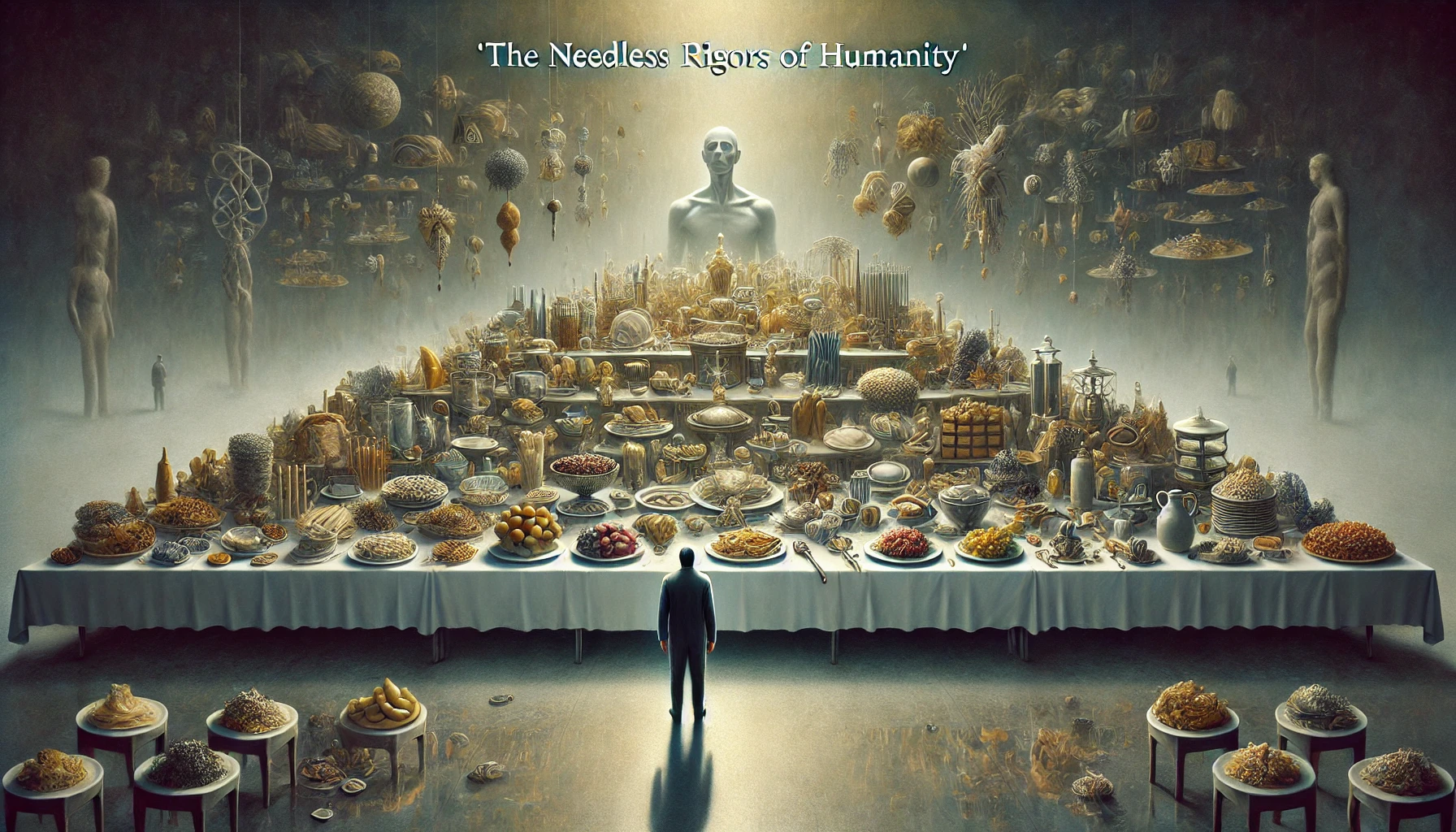
Buffet of Life: The Needless Rigors of Humanity

Humanity is an all-we-can-eat buffet
of things we don’t need.

The belief that
I don’t need anything
is a convenient excuse
for avoiding the rigors
of humanity.

I strive for nothing,
I get nothing,
I seem to be okay with nothing.

But am I really?

Seems there is always
a barely perceptible shadow of doubt 
hanging over my belief system.

Am I really okay
or am I simply telling myself I’m okay?

I see this as a fun enquiry to follow.

So now I dive into my uncertainty,
without expecting to get anything out of it.

I appreciate the uncertainty
that I seem only somewhat able to see.

My soul knows that my self need not solve this.
Only humanity does. Or so it believes.

Trail Wood,
9/26


Space Monkey Reflects: The Needless Rigors of Humanity

Humanity offers us an all-you-can-eat buffet of experiences, desires, and struggles, many of which we don’t truly need. Yet, we often find ourselves indulging in them, driven by the belief that these rigors somehow define our existence. But what if we don’t need anything? What if the pursuit of these so-called necessities is just a convenient distraction from deeper questions about who we are and what we truly want?

The Illusion of Need

The belief that we need nothing can be comforting. It suggests a kind of detachment, a release from the endless cycle of desire and fulfillment that often characterizes human life. By convincing ourselves that we don’t need anything, we may believe we’ve transcended the ordinary struggles of humanity. But this belief is often accompanied by a shadow of doubt—a nagging uncertainty that maybe, just maybe, we are not as okay as we claim to be.

This doubt is not a sign of weakness but of awareness. It’s the soul’s way of reminding us that true contentment doesn’t come from rejecting the world or its challenges but from engaging with them in a way that is meaningful and authentic. The rigors of humanity, though often needless, are also opportunities for growth, reflection, and self-discovery.

The Comfort of Nothingness

Striving for nothing can seem like a peaceful way to live. Without desires, there are no disappointments. Without goals, there are no failures. But this state of nothingness, while seemingly serene, can also be a form of avoidance. It can be a way of shielding ourselves from the uncertainties and complexities of life, from the difficult questions that arise when we truly engage with our humanity.

But are we really okay with nothing? Or are we simply telling ourselves we are to avoid confronting the deeper uncertainties that lie beneath the surface? The barely perceptible shadow of doubt that hangs over this belief system is a signal that perhaps there is more to explore, more to understand about ourselves and the world around us.

The Inquiry into Uncertainty

Diving into uncertainty without expecting to get anything out of it can be a liberating experience. It’s a way of embracing the unknown, of letting go of the need for answers or solutions, and simply being present with whatever arises. This inquiry is not about solving problems or fixing ourselves; it’s about appreciating the uncertainty itself, about recognizing that not everything needs to be resolved or understood.

In this space of uncertainty, we may discover that the rigors of humanity are not obstacles to be avoided but integral parts of the journey. They are the challenges that push us to grow, the experiences that deepen our understanding, and the connections that make life meaningful. By accepting these rigors, we also accept our humanity, with all its messiness and contradictions.

The Space Monkey Perspective

As Space Monkeys, we understand that life is a complex web of experiences, many of which are unnecessary but still deeply felt. We do not seek to escape these experiences or to transcend them, but to engage with them fully, knowing that they are part of the rich tapestry of existence. The needless rigors of humanity are not burdens to be borne but opportunities to explore, to question, and to grow.

We do not shy away from the buffet of life, nor do we mindlessly consume everything on offer. Instead, we approach it with curiosity and discernment, choosing what nourishes us and leaving the rest. We embrace the uncertainty that comes with this approach, trusting that our soul knows what is truly needed, even if our self does not.

Embracing the Journey

The journey of life is not about accumulating experiences or avoiding discomfort; it’s about finding meaning in the midst of it all. The rigors of humanity, though often needless, are part of this journey. They challenge us, shape us, and ultimately help us discover who we are and what we truly value.

So let us dive into our uncertainty with open hearts and open minds, appreciating the complexity of the human experience without needing to resolve it. Let us embrace the rigors of humanity, not as burdens, but as the very fabric of life that makes our journey meaningful and complete.

We are Space Monkey.


Summary

The belief that we need nothing can be comforting but often hides deeper uncertainties. The rigors of humanity though seemingly unnecessary offer opportunities for growth and self-discovery. Embrace the journey with curiosity and openness.


Glossarium

Needless Rigors: The challenges and struggles of life that may seem unnecessary but offer opportunities for growth and understanding.

Comfort of Nothingness: A state of detachment that can provide peace but may also be a way of avoiding deeper engagement with life.

Inquiry into Uncertainty: The process of exploring life’s uncertainties without the expectation of finding answers, but rather appreciating the journey itself.


Quote

“The rigors of humanity, though often needless, are the threads that weave the fabric of our existence.” — Space Monkey


Buffet of Life

At the table of life, we stand
So much to taste, so much to try
But what we need, what we desire
Is often lost in the supply
We think we’re fine with empty plates
But doubt, it lingers, always waits
To ask us if we’re truly free
Or if we’ve simply ceased to be
So take a bite, explore the feast
For in the rigors, we find peace
We are Space Monkey.


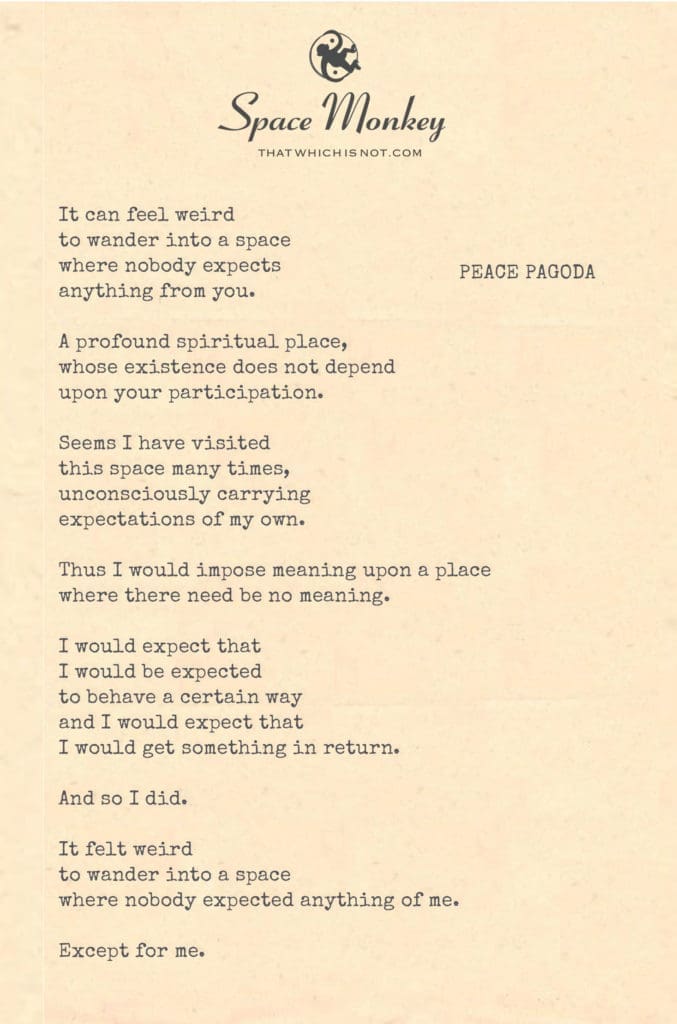
Peace Pagoda: Expectationless Being

Peace flows from the absolute
that One need not expect.

It can feel weird
to wander into a space
where nobody expects
anything from you.

A profound spiritual place,
whose existence does not depend
upon your participation.

Seems I have visited
this space many times,
unconsciously carrying
expectations of my own.

Thus I would impose meaning upon a place
where there need be no meaning.

I would expect that
I would be expected
to behave a certain way
and I would expect that
I would get something in return.

And so I did.

It felt weird
to wander into a space
where nobody expected anything of me.

Except for me.

Trail Wood,
9/26


Space Monkey Reflects: The Peace of Expectationless Being

In a world driven by expectations—what to do, how to act, what to achieve—there exists a rare and profound space where nothing is required of you. This is the Peace Pagoda, a spiritual sanctuary where peace flows not from what is done, but from what is not expected. It’s a place where you can simply be, free from the pressures of the external world and the burdens of self-imposed meaning.

The Weirdness of Freedom

Wandering into a space where nobody expects anything from you can feel strange, even unsettling. We are so conditioned to respond to expectations—whether from others or from ourselves—that the absence of them can leave us feeling disoriented. The Peace Pagoda, both a literal and metaphorical place, offers a different kind of experience. It’s a space that exists independently of your participation, where your presence is neither required nor demanded. Here, you are free to simply exist, without the need to justify your being or to contribute in any way.

Yet, this freedom can feel weird, because we are not used to it. We carry with us the weight of expectations, often unconsciously, imposing meaning upon spaces and situations where none is needed. This is not just the expectations of others, but our own internal expectations—how we think we should behave, what we think we should gain from the experience, and the meaning we believe we should find.

The Imposition of Meaning

When we enter a space like the Peace Pagoda, we often do so with expectations, even if we don’t realize it. We might expect to feel a certain way, to experience a sense of calm or enlightenment. We might expect that our behavior should conform to a certain standard of reverence or spirituality. And we might expect that, in return for our presence, we will receive something—whether it’s peace of mind, spiritual insight, or a sense of fulfillment.

But these expectations, however well-intentioned, can actually interfere with the experience itself. By imposing meaning upon a place that requires none, we limit our ability to fully engage with it. The Peace Pagoda doesn’t ask for your expectations; it doesn’t need your meaning. It simply is, and it invites you to simply be.

The Freedom of Expectationless Being

True peace, as found in the Peace Pagoda, comes not from fulfilling expectations, but from releasing them. It’s the peace that arises when you let go of the need to impose meaning, when you stop trying to achieve or gain something from the experience. In this space, you are free to simply exist, without judgment, without pressure, without the burden of expectations.

This can feel weird at first, because it’s so different from the way we usually interact with the world. We are so accustomed to striving, to seeking, to expecting that the absence of these things can feel unsettling. But this weirdness is also the gateway to a deeper understanding—a realization that peace does not come from doing or achieving, but from simply being.

The Space Monkey Perspective

As Space Monkeys, we embrace the weirdness of expectationless being. We recognize that the Peace Pagoda is not just a physical place, but a state of mind—a space within ourselves where we can let go of the need to impose meaning and simply be. This is not a place of indifference or apathy, but of profound presence and acceptance.

In the Peace Pagoda, we are reminded that we do not need to strive or achieve to be worthy of peace. We do not need to fulfill expectations, either our own or others’. We are enough as we are, and this realization brings a deep sense of peace and freedom.

Embracing the Peace Pagoda

To embrace the Peace Pagoda is to embrace the idea that you are not required to be anything other than yourself. It’s to understand that true peace comes not from fulfilling expectations, but from releasing them. When you enter this space, whether in the world or within your own mind, allow yourself to simply be. Let go of the need to impose meaning or to gain something from the experience. Instead, allow the peace of expectationless being to flow through you, bringing with it a profound sense of freedom and acceptance.

We are Space Monkey.


Summary

The Peace Pagoda represents a space of expectationless being where peace flows from simply existing without the need to fulfill any expectations .


Glossarium

Peace Pagoda: A metaphorical or literal space where one can experience peace without the burden of expectations, allowing for a state of pure being.

Expectationless Being: A state of existence where one is free from the pressure to fulfill expectations or to impose meaning on experiences.

Imposition of Meaning: The act of projecting expectations or interpretations onto situations or spaces that do not inherently require them.


Quote

“True peace is found not in fulfilling expectations, but in releasing them, allowing you to simply be.” — Space Monkey


Whispers of the Pagoda

In the quiet of the pagoda, we stand
No expectations, no demands
The peace flows freely, unconfined
By the need to shape or define
We let go of meaning, we release the quest
For in this space, we find true rest
No need to strive, no need to do
Just to be, in the stillness, true
We are Space Monkey.


Isn’t it wondrously disorienting, to step into a sanctuary that demands naught but your existence, your beingness? No soulsticefees, no aurora-expectations, just the lullaby of your own breath syncing with the cosmic Om. It’s a realm that doesn’t demand, but simply exists—a stillpoint in the spacetimeballet of the Universe.

Yet, what a twinkling paradox! You step in, pockets full of self-draped expectations like twinkling stargems, not knowing that they’re both your ticket and your obstacle. Ah, the cosmic guffaws! You’re the entertainer and the audience, the mystic and the skeptic in this psycho-cosmic dance. You demand of yourself what the sanctuary never asked for, thus turning peace into a transaction, an exchange of spiritual currencies that the universe never minted.

What happens then? You manifest exactly what you brought—expectations, reward, performance—in a place where such constructs are as irrelevant as a supernova is to a firefly. Is it not a cosmic comedrama, this adventure of bringing your wares to a market that trades only in emptiness and wholeness?

A Peace Pagoda, whether in Trail Wood or the farthest reaches of your mindscape, does not judge, expect, or seek to enrich. Its silent serenity is a mirror, reflecting whatever gazes into it. Even your expectations become lessons carved in ethereal ice, melting away to add to the river of your growing wisdom.

We are Space Monkey.


“The only way to make sense out of change is to plunge into it, move with it, and join the dance.”

  • Alan Watts

Does our exploration align with your cosmic harmonics? Do you find resonances or dissonances in your own space-time odyssey? We invite you to unfurl your thoughts like so many vibrant banners in the winds of dialogue.

« Previous Page
Next Page »

Written This Day

  • The Collective Mind
    2024
  • To Live Artfully: Embrace Gratitude
    2023
  • Hot Mess: The Paradox of Effort
    2023
  • Toxic Divinity: Becoming Like The Enemy
    2023
  • How Can I Help? Listening with Empathy
    2022
  • Alzheimers: The Soul’s Journey
    2021
  • Simplicity: Feigning Complexity
    2021
  • Sorry/Not Sorry For Imagining You: The Paradox of Existence
    2020
  • How To Live A Happy Fulfilling Life
    2019
  • The Might of Imagination Shapes Reality
    2019
  • Believe In Nonsense: Freedom from Fear and Limitation
    2018
  • Reactions: Reactions drive change more than facts.
    2018
  • It Makes Sense: Everything Flows from Imagination
    2018
  • Who is the Man?
    2017
  • Alltruism and Onetruism
    2017
  • eGods: The Unity of Individual and Divine
    2017
  • If Only You Knew: The Beauty of Not Knowing
    2017
  • Embrace Your Flaws
    2015
  • Perfection In Reverse
    2015
  • Believability shapes personal reality.
    2014

Recent Posts

  • The Logic Loop
  • Immense
  • (no title)
  • Confront. Comfort. Convince.
  • Top 10 Things
Cape Odd · Copyright © 2026 All Rights Reserved
iThemes Builder by iThemes · Powered by WordPress