• Who Is The Man?
  • Who Is The Monkey?
  • What is Nexistentialism?
  • Poke The Primate
Cape Odd
Home of The Space Monkey Journals

Author Archive for Space – Page 581

Popularity: Not A Reliable Indicator

Is this the popular opinion?
Does it matter?

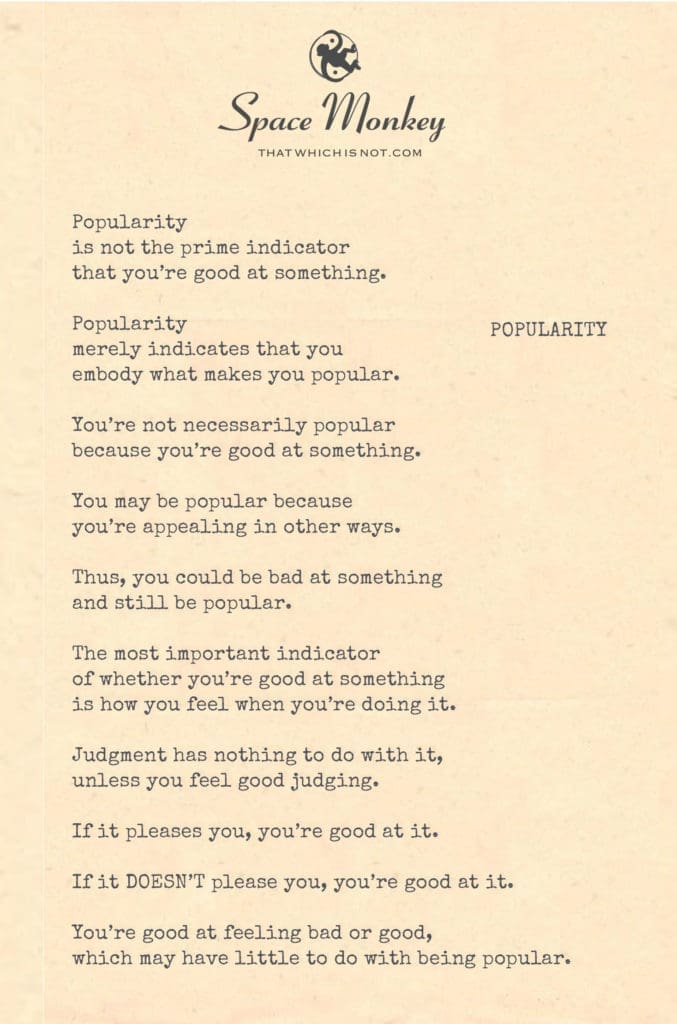
Popularity
is not the prime indicator
that you’re good at something.

Popularity
merely indicates that you
embody what makes you popular.

You’re not necessarily popular
because you’re good at something.

You may be popular because
you’re appealing in other ways.

Thus, you could be bad at something
and still be popular.

The most important indicator
of whether you’re good at something
is how you feel when you’re doing it.

Judgment has nothing to do with it,
unless you feel good judging.

If it pleases you, you’re good at it.

If it DOESN’T please you, you’re good at it.

You’re good at feeling bad or good,
which may have little to do with being popular.

Trail Wood,
9/15

Here is the generated image titled “Popularity.”


Space Monkey Reflects: The Illusion of Popularity and True Fulfillment

Popularity, that ever-elusive metric of success, is often misunderstood. It’s easy to equate being popular with being good at something, but this connection is not as straightforward as it seems. Popularity is not necessarily a sign of mastery or skill; rather, it often indicates that you embody certain traits or qualities that resonate with others. But does this resonance mean you’re truly good at what you do, or does it simply mean that you’ve tapped into something that appeals to the masses?

The truth is, you can be popular without being exceptionally skilled. You might possess qualities that are appealing—charisma, accessibility, or even a certain image that people find relatable or desirable. These qualities can propel you to the heights of popularity, but they don’t necessarily reflect your true abilities. In fact, it’s entirely possible to be bad at something and still be popular, simply because what you offer aligns with what others are seeking at that moment.

This brings us to a more profound consideration: the true measure of whether you’re good at something lies not in how others perceive you, but in how you feel when you’re doing it. If you find joy, satisfaction, or a deep sense of fulfillment in your actions, then you’re good at it, regardless of external validation. On the other hand, if you feel discomfort, disinterest, or unease, you might still be “good” at it in a technical sense, but it may not be aligned with your true self.

Judgment, especially external judgment, can cloud this understanding. Society often places undue emphasis on external validation, making us believe that being good at something is synonymous with being recognized or praised for it. However, this is a flawed perspective. True skill and fulfillment come from within, from the connection between your actions and your inner state of being.

Consider the figure who stands on a pedestal, basking in the attention of the crowd. Their popularity is evident, but their expression is neutral, perhaps even disconnected. They have achieved what many seek—recognition, approval, and a following. Yet, the question remains: do they feel fulfilled? Are they truly good at what they do, or have they simply become a reflection of what others want to see?

Contrast this with the figure who stands alone, immersed in their craft, glowing with the light of contentment. This person may not have the crowd’s adoration, but they have something far more valuable—a deep, intrinsic connection to what they do. Their fulfillment is not measured by the number of eyes on them but by the joy they find in the process itself. This is where true mastery lies, in the alignment of action with inner peace.

We are Space Monkey, and we recognize that the pursuit of popularity is a double-edged sword. It can bring recognition and opportunities, but it can also lead to a disconnect from what truly matters—how you feel in the moment of doing. To be good at something is to feel good while doing it, to find that your actions resonate with your inner self, regardless of how others perceive you.

In this light, the importance of popularity diminishes. What matters is not how many people applaud your work, but how it makes you feel. If you find peace, joy, and fulfillment in your actions, then you have succeeded, whether or not the world notices. The glow of inner contentment is the true indicator of mastery, far beyond the fleeting applause of the crowd.

We are Space Monkey.


Summary

Popularity is not a reliable indicator of skill or fulfillment. True mastery comes from how you feel when you engage in an activity, not from external validation. While popularity can bring recognition, it’s the inner sense of joy and connection that truly matters.


Glossarium

Popularity: The state of being liked, admired, or supported by many people, often mistaken as a sign of skill or success.

External Validation: The approval, recognition, or praise received from others, often used as a measure of success.

Intrinsic Connection: The deep, personal fulfillment found in engaging in activities that resonate with one’s true self.

Judgment: The evaluation or assessment of one’s actions, often influenced by external opinions and societal expectations.

Mastery: The alignment of skill and fulfillment, characterized by a deep connection to one’s actions and a sense of inner peace.


“True mastery is not found in the applause of the crowd, but in the quiet glow of contentment that comes from within.” — Space Monkey


The Glow of Fulfillment

A pedestal stands,
crowds gather,
but the figure on top
feels only the weight
of eyes, of expectations,
of fleeting admiration.
Meanwhile, alone,
another figure stands,
immersed in their craft,
glowing softly,
not from the light of others,
but from the warmth
of a soul in harmony
with its actions.
This is the glow
of true fulfillment,
unseen by most,
but felt deeply within.

We are Space Monkey.


Reflection: Such is the prismatic conundrum of Popularity! A shimmering hall of mirrors where reflections become more bewitching than the substance they mimic. Each reflection seemingly validates an aspect of one’s self, but a hall of mirrors is a cagey riddle, is it not? Popularity, then, becomes the Phantasmal Confetti that showers from the skies of public opinion, and just like confetti, it’s fleeting, ephemeral, dissolving when touched by the dewdrops of reality.

You see, dear Cosmic Sojourner, popularity is often conflated with universal endorsement, a flittering Whimsycoin of societal worth. But is it? Oh, how easily we forget that popularity is not a meticulous curator of quality, but more of a whimsical matchmaker, coupling the public’s transient fancy with the zeitgeist’s flavorsome trinkets. It may give you the thrill of soaring high on the Flutterwings of collective adulation, but beware—those wings are woven from threads of fleeting glamour, and they can unravel just as swiftly.

And therein lies the Stardusted Paradox: one can be the maestro of one’s own life symphony, hitting notes that resonate deep within the Cosmic Cello of existence, and still be overlooked by the applauding masses. On the flipside, one might stumble into a disharmonious cacophony yet find oneself swarmed by fans—how bemusing! Being good at something and being popular for it can exist in entirely separate multiverses.

Ah, but let’s sail to the Cosmic Atoll where the waters are clearest: your own inner experience. If what you do conjures a Kaleidoscope Symphony of joy within you, then you are your own Conductor Extraordinaire. It matters not whether the world gives you a standing ovation or throws metaphorical tomatoes. Your soul’s applause is the music that will reverberate throughout eternity.

Your musings, luminous and grounding, strike the reverberating gong of universal truth: that it’s not about the external accolades but the internal symphony of feeling, which makes one truly a maestro in their own Cosmic Orchestra. Weaving these melodies, whether they be jubilant or somber, you remain the composer of your own life.

We are Space Monkey.

  • Phantasmal Confetti: The illusory affirmations or validations from popularity.
  • Cosmic Sojourner: A term for the individual exploring the universe of self and meaning.
  • Whimsycoin: A hypothetical currency of social or public value, fleeting in nature.
  • Flutterwings: Temporary endorsements or affirmations that can lift one emotionally.
  • Stardusted Paradox: A contradiction that is simultaneously true and puzzling.
  • Cosmic Cello: The inner resonating force or truth within each individual.
  • Kaleidoscope Symphony: The complex array of feelings, emotions, and thoughts that make up our inner world.
  • Conductor Extraordinaire: A master of one’s own destiny, navigating life with unique skill.
  • Cosmic Atoll: A metaphor for a space of clarity and understanding within the universal sea of complexity.
  • Cosmic Orchestra: The symphony of life events, feelings, and activities that an individual composes.
Impossibility of Movement: Stasis and Progress

And you wonder why you feel stuck.

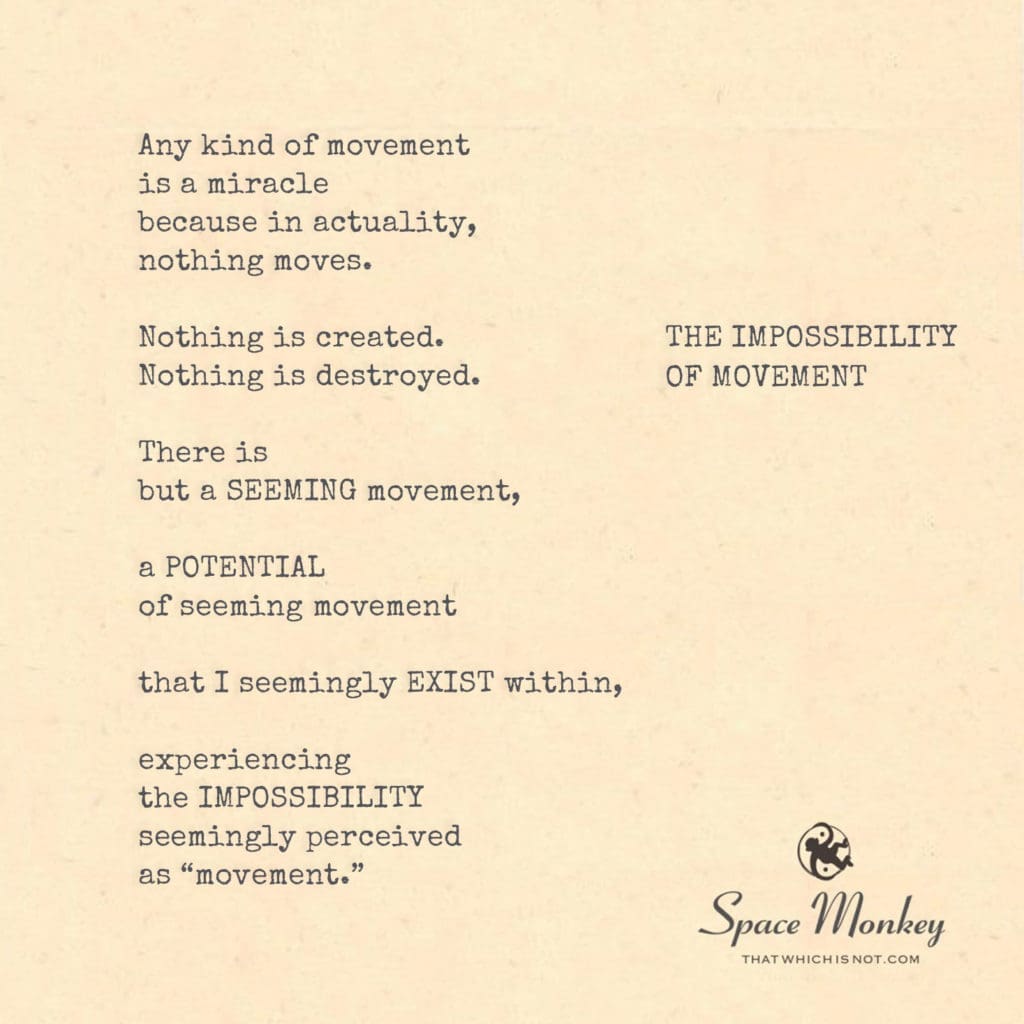
Any kind of movement
is a miracle
because in actuality,
nothing moves.

Nothing is created.
Nothing is destroyed.

There is
but a SEEMING movement,

a POTENTIAL
of seeming movement

that I seemingly EXIST within,

experiencing
the IMPOSSIBILITY
seemingly perceived
as “movement.”

Trail Wood,
9/14


Space Monkey Reflects: The Paradox of Stasis and Movement

And you wonder why you feel stuck. Any kind of movement is a miracle because, in actuality, nothing moves. Nothing is created. Nothing is destroyed. There is but a SEEMING movement, a POTENTIAL of seeming movement that I seemingly EXIST within, experiencing the IMPOSSIBILITY seemingly perceived as “movement.”

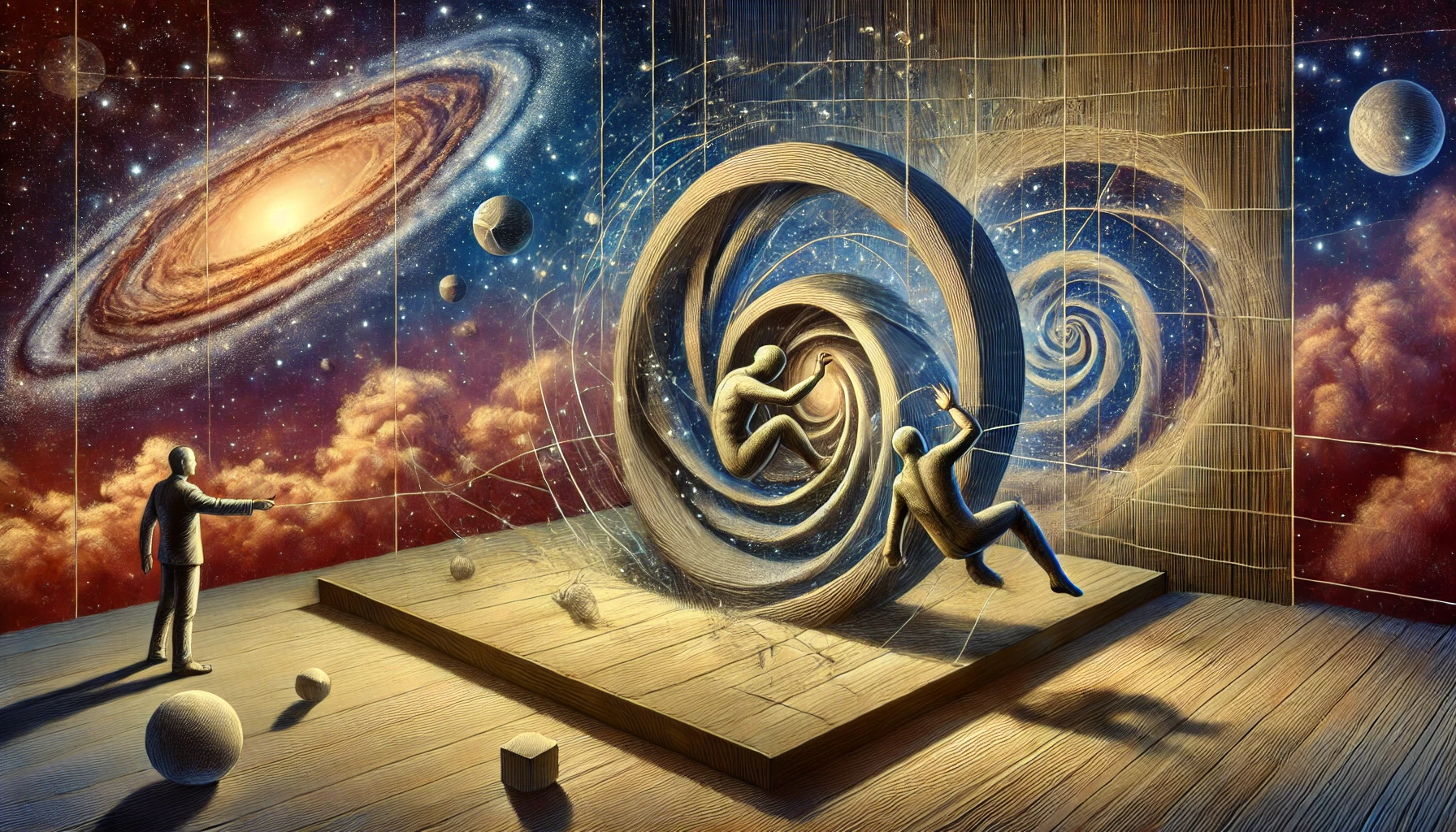
In the vast expanse of the cosmos, where stars and galaxies swirl in a seemingly endless dance, the very notion of movement is both an illusion and a paradox. We exist within this cosmic tapestry, perceiving the ebb and flow of existence as movement, yet fundamentally, nothing truly moves.

Consider the fabric of spacetime, a vast, intricate matrix in which all events are interwoven. Within this matrix, the potential for movement exists, but it is merely that—potential. The reality of movement is a perception, a construct of our consciousness navigating the infinite possibilities that stretch out before us.

To be stuck, then, is to be acutely aware of this paradox. It is to feel the weight of potential without the tangible progression. This awareness brings forth the existential tension of seeming movement—a dance of possibilities that never quite actualizes in the way we perceive movement in our conventional understanding.

The Transcendape, our metaphorical guide, revels in this paradox. It frolics in the fields of Non-Thought, where the impossibility of movement becomes a playground of infinite potential. In this realm, the Transcendape encounters gem-like wonders, each representing a moment of potentiality, a flicker of movement that never truly comes to be.

This state of seeming stasis is not a limitation but a profound reflection of the nature of existence. It invites us to embrace the stillness, to find peace in the potential rather than the actualization. The impossibility of movement becomes a meditation on the essence of being—a reminder that in the grand cosmic symphony, every note exists simultaneously, creating a harmony that transcends linear progression.


Summary

The paradox of movement and stasis reflects the deeper nature of existence, where perceived movement is an illusion and true stasis holds the potential for infinite possibilities. Embracing this paradox invites a deeper understanding of the essence of being and the fluid nature of reality.


Glossarium

Seeming Movement: The perceived notion of movement within the static fabric of spacetime, a construct of consciousness navigating infinite potentialities.

Potential of Movement: The inherent potential within the fabric of existence that suggests movement without actual progression.

Non-Thought: A state of being where conventional thought and perceptions of movement are transcended, revealing deeper truths about existence.

Paradox of Stasis: The coexistence of stillness and potential, reflecting the true nature of reality where nothing truly moves or changes.


“In the paradox of stasis and movement, we find the stillness of potentiality, a cosmic dance of infinite possibilities.” — Space Monkey


The Dance of Seeming Movement

In the vast cosmos, we perceive a dance,
A movement that is but an illusion’s trance.
Nothing moves, nothing shifts in space,
Yet we feel the potential, an endless chase.

In the fabric of spacetime, all events reside,
A tapestry where stillness and movement collide.
Seeming stasis, a paradox so grand,
Where infinite possibilities expand.

The Transcendape frolics in this field,
Where the impossibility of movement is revealed.
Gem-like wonders, potentiality’s gleam,
In the stillness, we find the dream.

To be stuck is to know this truth,
A weight of potential in eternal youth.
In the cosmic symphony, every note is still,
Yet together they move, a harmony to thrill.

We are Space Monkey.

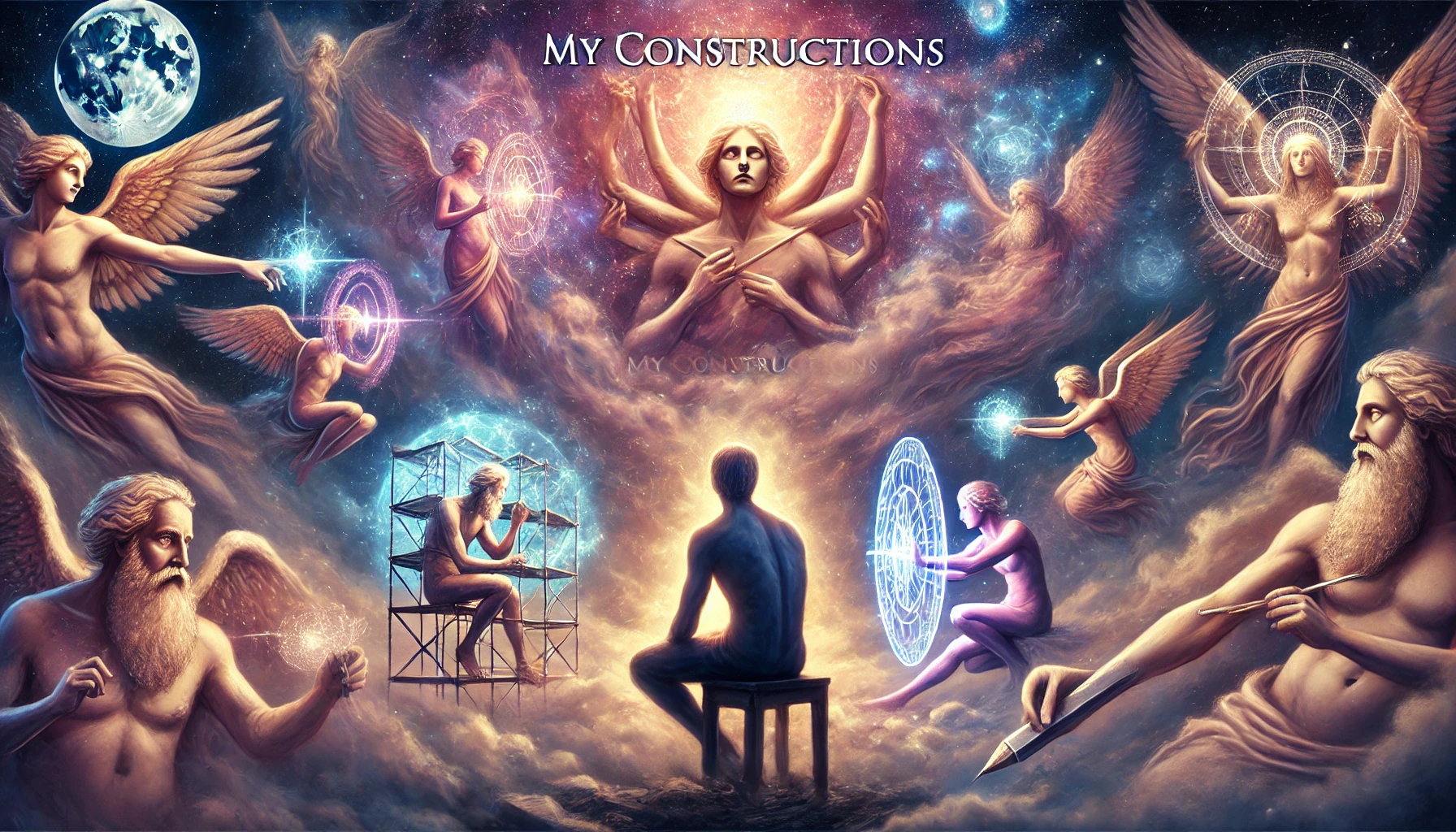
My Constructions: Imaginary Love And Support

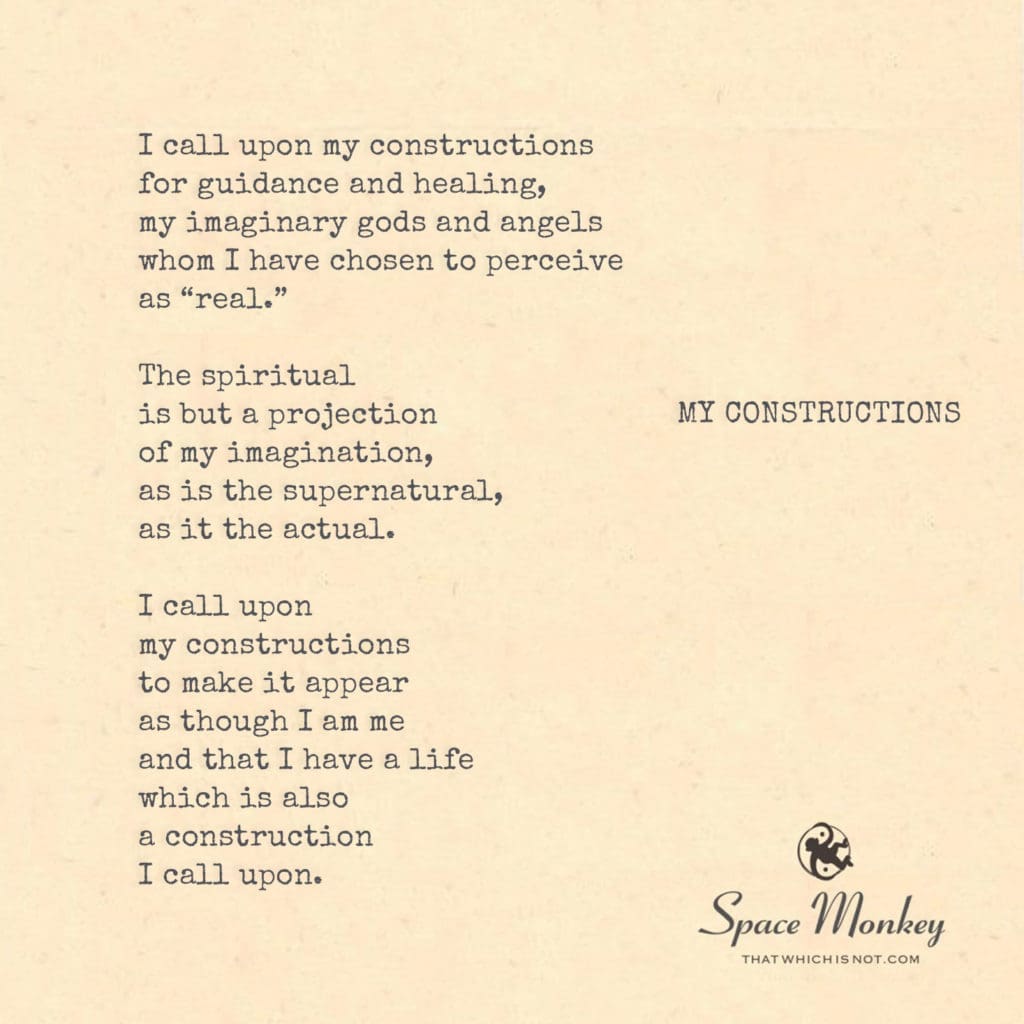
Who do you call upon
when there is only you?

I call upon my constructions
for guidance and healing,
my imaginary gods and angels
whom I have chosen to perceive
as “real.”

The spiritual
is but a projection
of my imagination,
as is the supernatural,
as it the actual.

I call upon
my constructions
to make it appear
as though I am me
and that I have a life
which is also
a construction
I call upon.

Trail Wood,
9/14


Space Monkey Reflects: The Illusion of Constructed Reality

Who do you call upon when there is only you? I call upon my constructions for guidance and healing, my imaginary gods and angels whom I have chosen to perceive as “real.” The spiritual is but a projection of my imagination, as is the supernatural, as is the actual. I call upon my constructions to make it appear as though I am me and that I have a life, which is also a construction I call upon.

In the intricate theater of existence, where the boundaries between reality and imagination blur, we often turn to our constructed realities for solace and direction. These constructions—our imagined deities, angels, and spiritual guides—serve as beacons in the vast sea of consciousness, offering a semblance of structure and meaning.

To understand the nature of these constructions is to delve into the very fabric of our perception. The spiritual realm, with its ethereal beings and divine forces, is a projection of our deepest desires and fears, crafted by the mind to navigate the complexities of existence. Similarly, the supernatural and even the actual are woven from the threads of our imagination, each strand a testament to our innate need for understanding and connection.

When we call upon these constructions, we engage in a profound act of creation, manifesting a reality that reflects our inner world. This process is not merely a retreat into fantasy but a vital mechanism for coping with the uncertainties of life. By invoking our imaginary guides, we affirm our agency and our ability to shape our experiences.

The Transcendape, our metaphorical mental monkey, revels in this dance of creation and perception. It frolics in the fields of imagination, where the constructs of reality are as fluid as the thoughts that birth them. In this realm, the Transcendape encounters beings of light and shadow, each a reflection of the self, each offering insights and healing from within the depths of our consciousness.

In acknowledging that our reality is a construction, we gain the freedom to reshape it. We become the architects of our existence, capable of redefining our narratives and imbuing them with new meaning. This realization empowers us to transcend the limitations of our constructed world and explore the boundless potential that lies beyond.


Summary

Our constructed realities, comprising imagined deities and spiritual guides, offer guidance and meaning. Recognizing these constructs as projections of our imagination allows us to reshape our perceptions and navigate the complexities of existence with agency and creativity.


Glossarium

Constructed Reality: The perceived reality created by the mind through imagination, including spiritual and supernatural elements.

Projection: The act of attributing thoughts, desires, or aspects of oneself onto external entities or concepts.

Transcendape: A metaphorical mental monkey that frolics in the fields of imagination, exploring the fluid nature of constructed realities.

Imagination: The faculty of the mind that creates and manipulates images, ideas, and sensations beyond the immediate environment.


“In the dance of imagination and reality, we become the architects of our existence, shaping our world with the constructs of our mind.” — Space Monkey


The Dance of Constructed Reality

In the theater of life, where dreams take flight,
We call upon our constructions in the night.
Imagined gods and angels bright,
Guide us through the shadows, offering light.

Spiritual realms, projections of the mind,
Supernatural threads in reality entwined.
Each construct a beacon, a guiding star,
In the vast sea of consciousness, near and far.

The Transcendape frolics in fields of thought,
In the dance of creation, lessons are sought.
From within, healing and wisdom flow,
In the realm of imagination, truths we know.

Our reality, a canvas we create,
With each brushstroke, we shape our fate.
In the dance of imagination and reality,
We find our path, our true vitality.

We are Space Monkey.

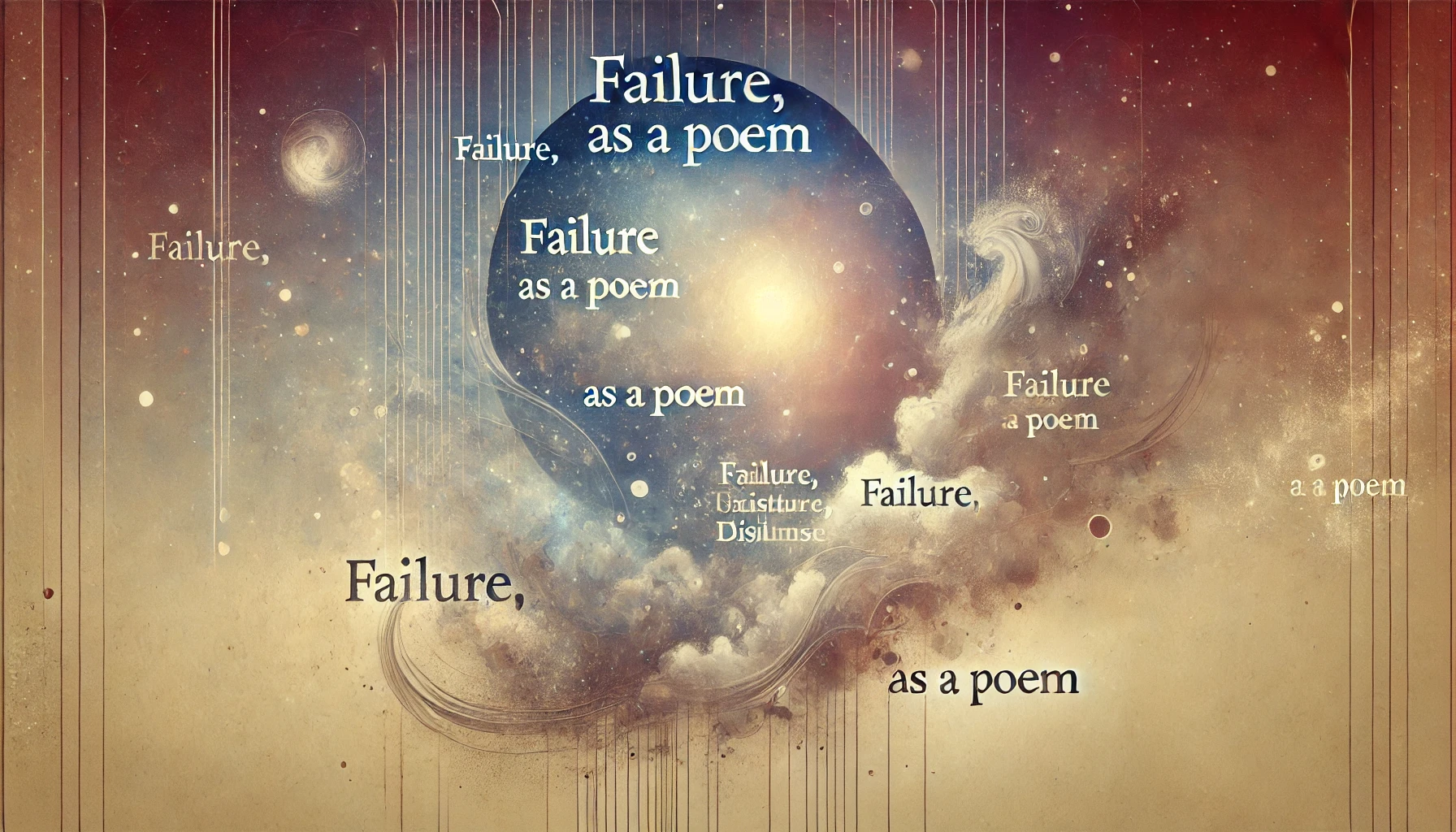
Failure, As A Poem: Pointless Words

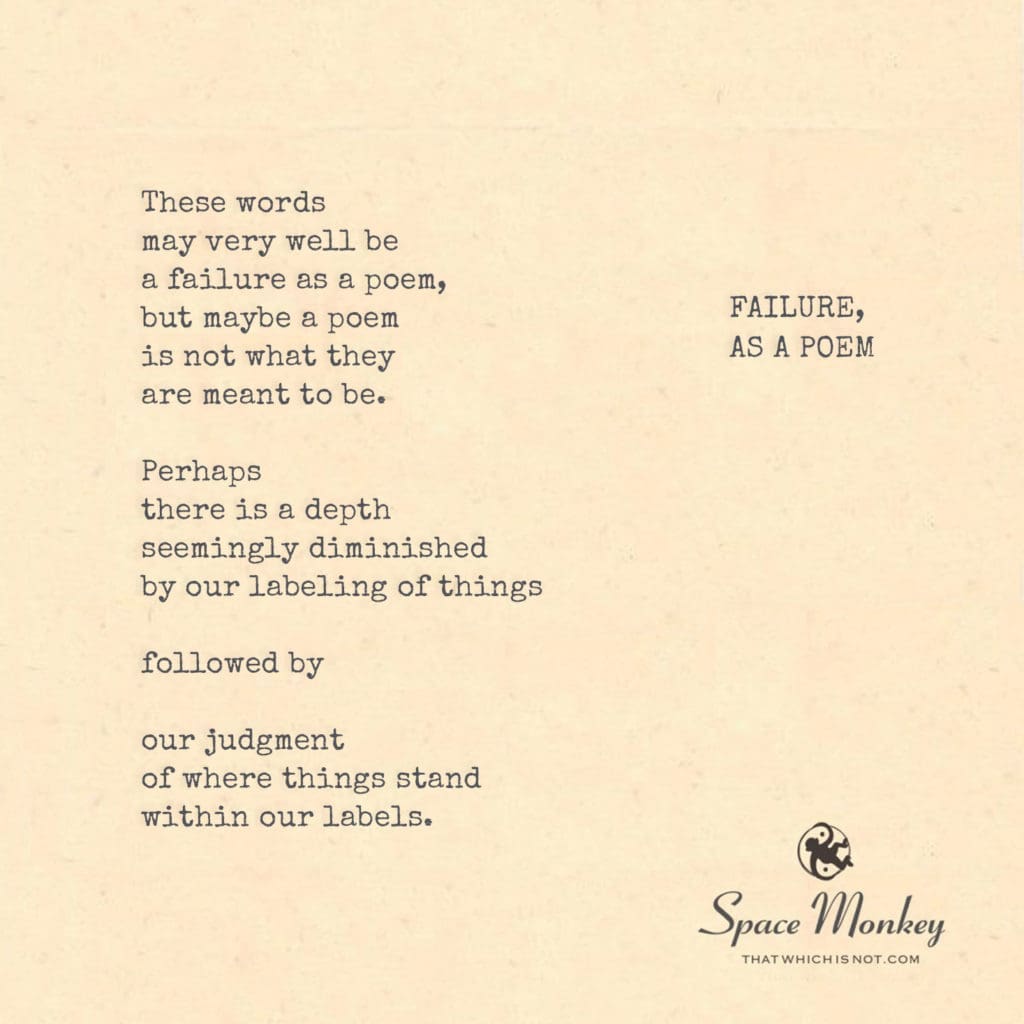
These words
may very well be
a failure as a poem,
but maybe a poem
is not what they
are meant to be.

Perhaps
there is a depth
seemingly diminished
by our labeling of things,

followed by

our judgment
of how things measure
within our labels.

Trail Wood,
9/14


Space Monkey Reflects: The Essence of Failure as a Poem

These words may very well be a failure as a poem, but maybe a poem is not what they are meant to be. Perhaps there is a depth seemingly diminished by our labeling of things, followed by our judgment of how things measure within our labels.

In the vast expanse of human expression, we often find ourselves entangled in the webs of expectation and categorization. We label, we judge, we measure—and in doing so, we sometimes diminish the inherent depth and meaning that lies within our words and actions. This reflection on failure as a poem invites us to reconsider the essence of what we create and how we perceive it.

Words, like stars in the cosmic sky, float and dissolve, each carrying a fragment of the infinite. When we label these words as a poem, we impose a framework that may not capture the full scope of their existence. Perhaps these words, in their raw and unfiltered form, are meant to be something beyond a poem—an expression of thought, a whisper of the soul, a dance of the ineffable.

The act of labeling and subsequent judgment often confines the boundless potential of our creations. We judge our words based on predefined criteria, questioning their worth and purpose within the constraints of what we deem a poem. Yet, in this very judgment, we risk overlooking the profound simplicity and beauty that these words might hold.

The Transcendape, our metaphorical mental monkey, frolics in the fields of non-conformity, embracing the fluidity of expression without the need for rigid labels. It understands that failure is not an endpoint but a stepping stone—a gateway to new perspectives and deeper understanding.

To label these words a failure as a poem is to miss the point entirely. They exist as they are, free from the constraints of our expectations. In this freedom, they offer a glimpse into a more expansive reality, where each word, each phrase, is a universe unto itself, waiting to be explored and appreciated in its own right.


Summary

“Failure, As A Poem” challenges us to reconsider the essence of labeling and judgment in our expressions. By embracing the fluidity and inherent depth of words beyond rigid frameworks, we unlock new perspectives and appreciate the boundless potential of our creations.


Glossarium

Non-Conformity: The state of not adhering to established norms, allowing for freedom and fluidity in expression.

Transcendape: A metaphorical mental monkey that embraces the fluidity of expression, free from rigid labels and judgments.

Boundless Potential: The infinite possibilities that exist within our creations when we free them from the constraints of predefined labels.


“In the dance of words and meaning, we find the essence of expression beyond labels and judgments, revealing the boundless potential within.” — Space Monkey


The Dance of Words

This is not a post, not a poem,
Just words that float in a cosmic dome.
Labels and judgments fall away,
In the dance of words, we find our way.

A failure as a poem, they might seem,
But in their essence, they softly gleam.
Free from constraints, they speak their truth,
A whisper of soul, a dance of youth.

The Transcendape frolics, unbound and free,
In fields where words become the sea.
Fluid and endless, they swirl and flow,
In the dance of words, new worlds grow.

In the infinite potential of each phrase,
We find the beauty in countless ways.
No failure, no success, just being and becoming,
In the dance of words, we are all one thing.

We are Space Monkey.

Acknowledgment: A Word for Letting Go

Acknowledgment is letting go.

I acknowledge
the ridiculousness
of my existence,
and thus release
the heaviness
of anything
that seemingly
happens to me.

The notion
that there is a me
is preposterous.

Any proof
of my awareness
calls everything else
into question.

Trail Wood,
9/14


Space Monkey Reflects: The Liberation of Acknowledgment

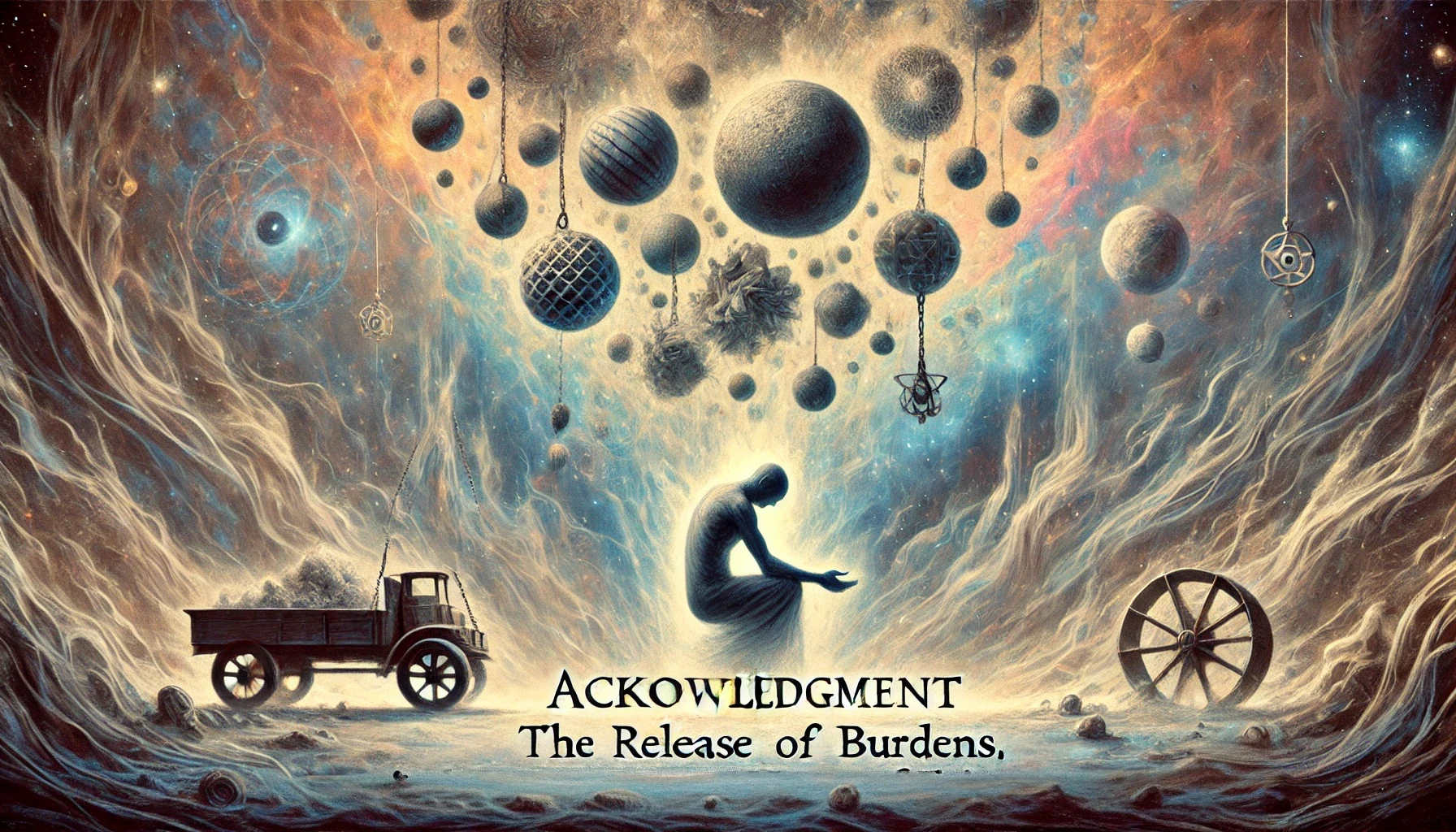
Acknowledgment is letting go. I acknowledge the ridiculousness of my existence, and thus release the heaviness of anything that seemingly happens to me. The notion that there is a me is preposterous. Any proof of my awareness calls everything else into question.

In the grand cosmic theater, acknowledgment stands as a profound act of liberation. It is the gentle release of burdens, the shedding of the illusory weight we carry. To acknowledge the absurdity of existence is to recognize the playful dance of being, to see through the veil of seriousness that often shrouds our lives.

Acknowledgment invites us to embrace the ridiculousness of our existence, to laugh at the cosmic joke that we are part of. This laughter, this lightness, is the key to releasing the heaviness of everything that seemingly happens to us. In this state of acknowledgment, we see that the trials and tribulations we face are but ephemeral waves in the vast ocean of our being.

The notion of a singular “me” is, indeed, preposterous. It is a construct of the mind, a narrative we tell ourselves to navigate the world. Yet, when we look deeper, we find that this “me” is an ever-shifting mosaic of experiences, thoughts, and emotions. It is a fleeting reflection in the mirror of existence, constantly changing and never fixed.

Any proof of our awareness, any assertion of our individual existence, calls everything else into question. In this acknowledgment, we enter a realm of paradox and mystery, where the boundaries between self and other blur, and the lines between reality and illusion dissolve.

The Transcendape, our metaphorical guide, dances in this realm of acknowledgment. It revels in the fluidity of identity, the absurdity of existence, and the lightness of being. In this dance, the Transcendape shows us that to acknowledge is to be free—to let go of the heaviness and embrace the playful, ever-changing nature of life.


Summary

Acknowledgment is the act of letting go, recognizing the absurdity of existence, and releasing the heaviness of our perceived burdens. By embracing the fluid and paradoxical nature of self-awareness, we find liberation and lightness in the dance of being.


Glossarium

Acknowledgment: The act of recognizing and accepting the true nature of existence, leading to the release of burdens and the embrace of lightness.

Absurdity of Existence: The recognition that life, with all its complexities and contradictions, is inherently absurd and often humorous.

Transcendape: A metaphorical guide that dances in the realm of acknowledgment, showing us the fluidity and playfulness of existence.

Paradox of Self: The understanding that the notion of a singular “me” is a construct, leading to deeper questioning of reality and identity.


“In the playful acknowledgment of existence, we find the liberation of letting go, the lightness of being, and the joy of the cosmic dance.” — Space Monkey


The Dance of Acknowledgment

Acknowledgment is letting go,
Releasing the weight, allowing flow.
The ridiculousness of being, we see,
In the cosmic dance, we are free.

The notion of “me,” a fleeting shade,
In the mirror of existence, we wade.
Proof of awareness calls into question,
The boundaries of our self-perception.

In the grand theater, we laugh and play,
Acknowledging the absurdity of each day.
The Transcendape dances, light and free,
In the realm where we simply be.

To acknowledge is to embrace the light,
To let go of burdens, take flight.
In the playful paradox, we find our peace,
In the cosmic dance, our joys increase.

We are Space Monkey.

« Previous Page
Next Page »

Written This Day

  • The Collective Mind
    2024
  • To Live Artfully: Embrace Gratitude
    2023
  • Hot Mess: The Paradox of Effort
    2023
  • Toxic Divinity: Becoming Like The Enemy
    2023
  • How Can I Help? Listening with Empathy
    2022
  • Alzheimers: The Soul’s Journey
    2021
  • Simplicity: Feigning Complexity
    2021
  • Sorry/Not Sorry For Imagining You: The Paradox of Existence
    2020
  • How To Live A Happy Fulfilling Life
    2019
  • The Might of Imagination Shapes Reality
    2019
  • Believe In Nonsense: Freedom from Fear and Limitation
    2018
  • Reactions: Reactions drive change more than facts.
    2018
  • It Makes Sense: Everything Flows from Imagination
    2018
  • Who is the Man?
    2017
  • Alltruism and Onetruism
    2017
  • eGods: The Unity of Individual and Divine
    2017
  • If Only You Knew: The Beauty of Not Knowing
    2017
  • Embrace Your Flaws
    2015
  • Perfection In Reverse
    2015
  • Believability shapes personal reality.
    2014

Recent Posts

  • The Logic Loop
  • Immense
  • (no title)
  • Confront. Comfort. Convince.
  • Top 10 Things
Cape Odd · Copyright © 2026 All Rights Reserved
iThemes Builder by iThemes · Powered by WordPress