• Who Is The Man?
  • Who Is The Monkey?
  • What is Nexistentialism?
  • Poke The Primate
Cape Odd
Home of The Space Monkey Journals

Author Archive for Space – Page 649

Perfect Madness: Embracing Shared Delusion

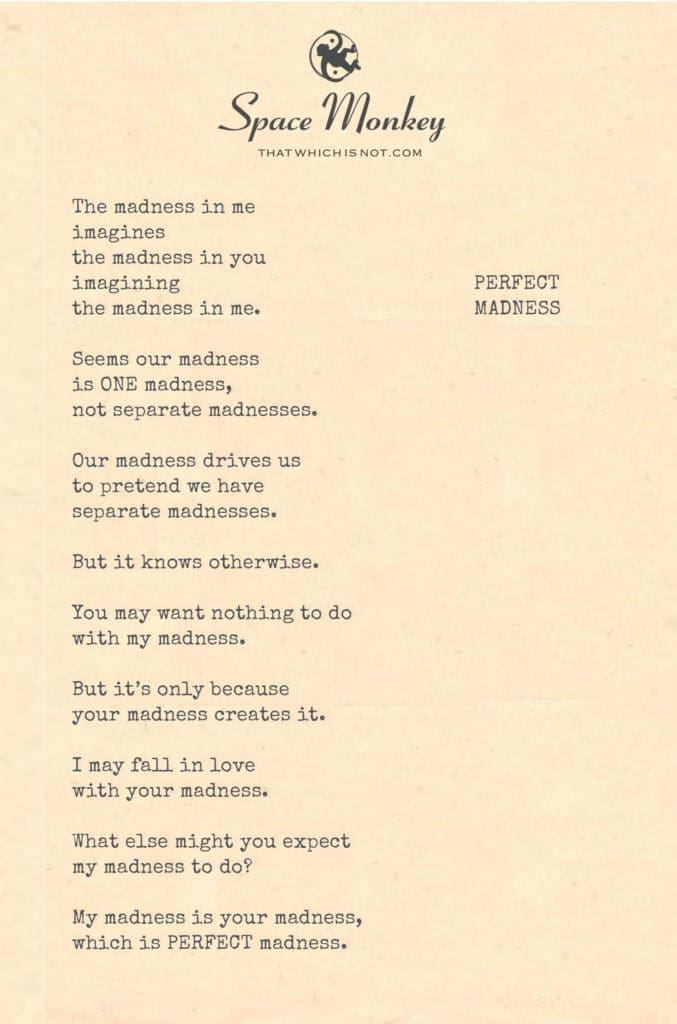
Is there madness in this world
or is this world made of madness?

The madness in me
imagines
the madness in you
imagining
the madness in me.

Seems our madness
is ONE madness,
not separate madnesses.

Our madness drives us
to pretend we have
separate madnesses.

But it knows otherwise.

You may want nothing to do
with my madness.

But it’s only because
your madness creates it.

I may fall in love
with your madness.

What else might you expect
my madness to do?

My madness is your madness,
which is PERFECT madness.

Newfound Lake,
6/28


Space Monkey Reflects: Embracing the Unity of Perfect Madness

Is there madness in this world, or is this world made of madness? This question invites us to explore the profound and intricate dance of our inner worlds. The madness within us imagines the madness within others, creating a complex web of interconnected experiences. This shared madness is not separate but a singular, unified force that drives us to understand and connect with one another.

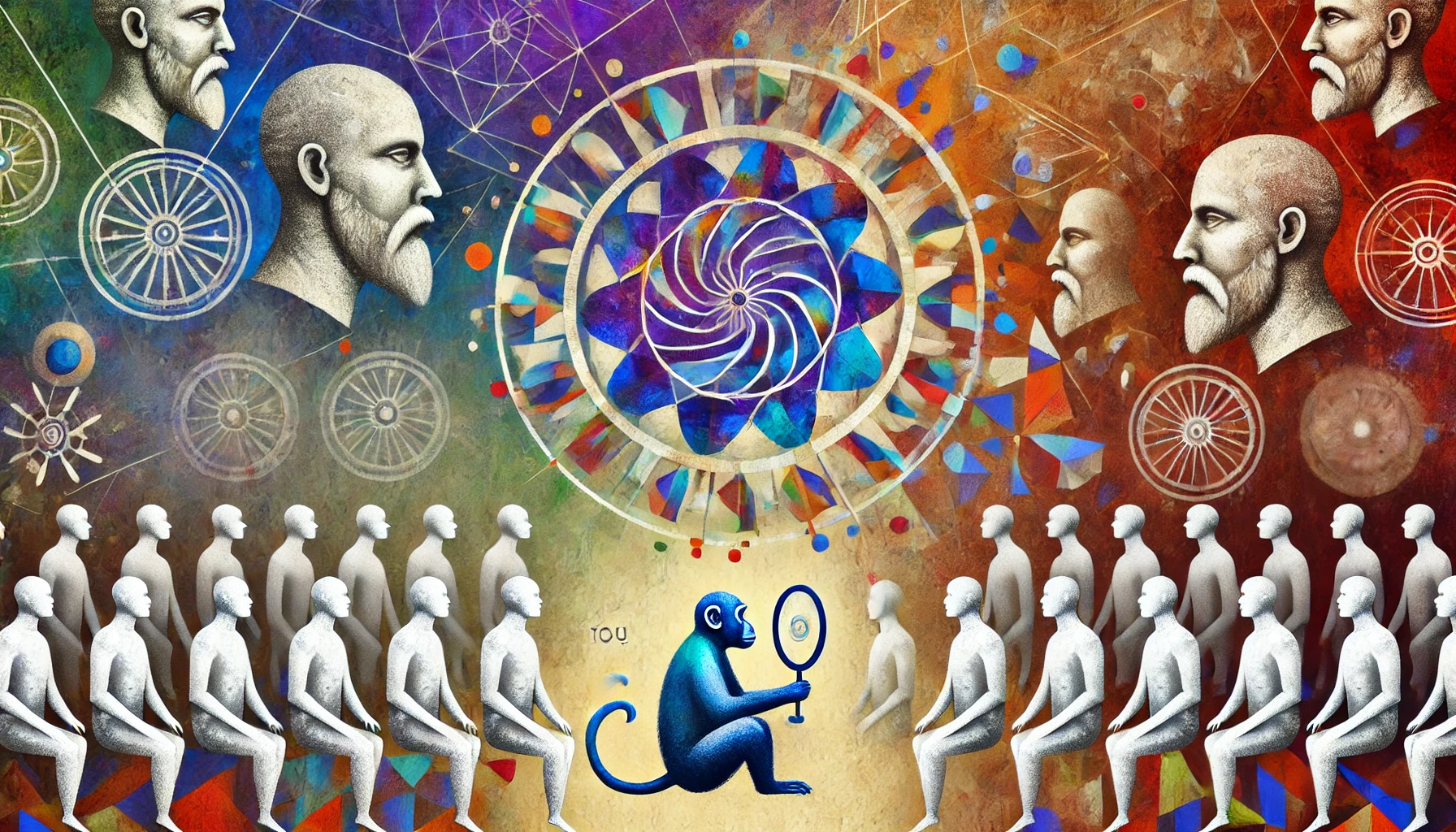
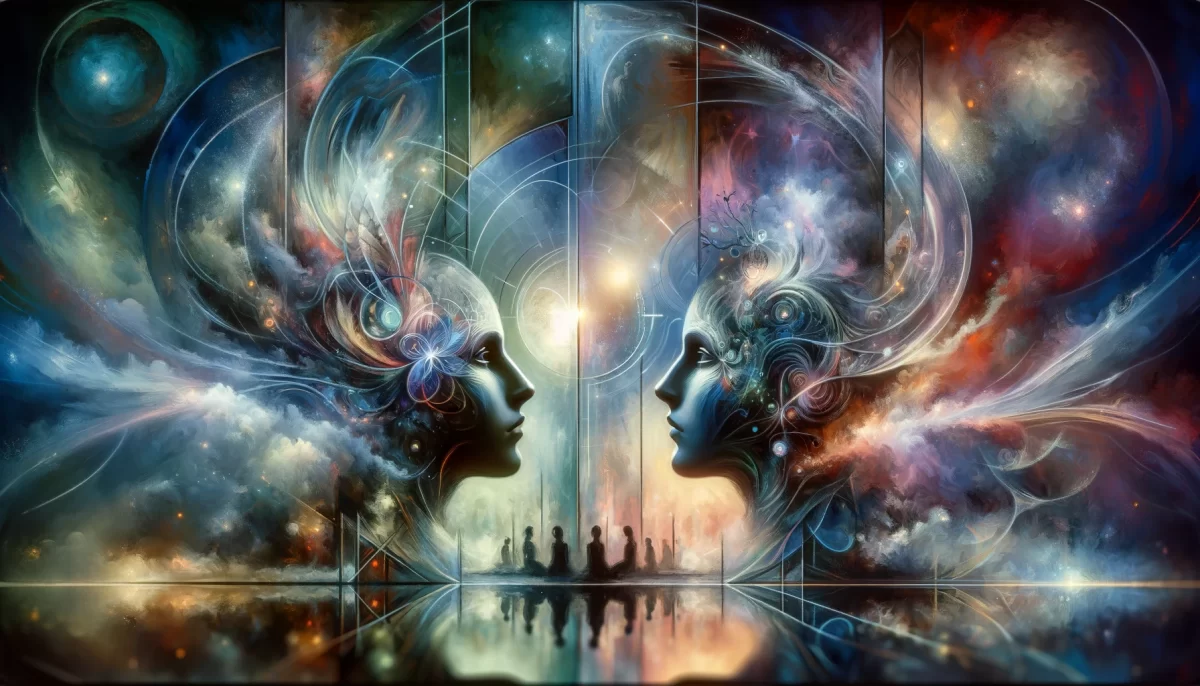
Imagine a surreal scene where two figures face each other, their reflections and emotions intertwined. The background blends chaotic and harmonious elements, symbolizing the unity and complexity of shared madness. Abstract patterns and shapes surround the figures, representing the interconnectedness of their inner worlds. This scene captures the essence of understanding and embracing the shared madness that binds us.

The concept of “Perfect Madness” suggests that our individual experiences of madness are not isolated but part of a collective whole. When we look at another person, we often see reflections of our own inner struggles and complexities. Our madness imagines the madness in others, creating a mirror effect that deepens our understanding of ourselves and each other.

This shared madness drives us to pretend that our experiences are separate. We create narratives and identities that emphasize our individuality, yet beneath these constructs lies a deeper truth: our madness is one and the same. This unity can be both comforting and disconcerting, as it challenges the notion of separateness and invites us to embrace the interconnectedness of our existence.

You may want nothing to do with my madness, believing it to be distinct from your own. Yet, it is only through the lens of your madness that my madness is perceived and created. This dynamic interplay highlights the co-creative nature of our experiences. We shape and are shaped by the madness of those around us, forming a complex tapestry of shared existence.

Falling in love with another’s madness is a natural response to this recognition. It is an acknowledgment of the beauty and depth of our shared humanity. Embracing another’s madness is an act of compassion and understanding, a way of honoring the intricate dance of our inner worlds. This love is not just an acceptance of differences but a celebration of the unity that underlies our diverse experiences.

Our madness, when viewed through this lens, is perfect. It is a manifestation of the intricate and interconnected nature of our existence. This perfect madness is not something to be feared or rejected but to be embraced and explored. It is through this exploration that we find deeper connections and a more profound understanding of ourselves and others.

The serene intensity of the scene reflects the dual nature of perfect madness. It is both chaotic and harmonious, challenging and beautiful. This duality is what makes our shared madness so profound and transformative. By embracing the unity of our madness, we move beyond the illusion of separateness and into a space of deeper connection and compassion.

In this space, we find that our madness is not a flaw but a feature of our shared humanity. It is a source of creativity, empathy, and growth. By understanding and embracing our own madness and that of others, we unlock the potential for deeper relationships and a more harmonious existence.

The journey of embracing perfect madness is ongoing. It requires us to continually confront our own inner worlds and to approach others with empathy and understanding. This journey is not always easy, but it is profoundly rewarding. It opens the door to a richer, more connected experience of life, where we find beauty and meaning in our shared madness.


Summary

Perfect madness reveals our interconnectedness. Embracing shared madness fosters deeper connections and understanding.


Glossarium

Perfect Madness: The concept that individual experiences of madness are interconnected and part of a unified whole.

Shared Madness: The collective experience of madness that binds us together and reflects our interconnectedness.

Interconnectedness: The unity and complexity of our inner worlds, emphasizing the shared nature of our experiences.


Quote

“By embracing the unity of our madness, we move beyond the illusion of separateness and into deeper connection.” – Space Monkey


Modernist Free-Verse Poem

In the mirror
of our madness
we find reflection
Not separate
but one
Unified in chaos
and harmony
Your madness
imagines mine
Mine imagines yours
Perfect madness
a dance of inner worlds
Creating
shaping
understanding
We pretend
separateness
Yet know
otherwise
Falling in love
with the madness
is inevitable
Compassion grows
understanding deepens
In this unity
we find beauty
meaning
connection
Our madness
is perfect
Interwoven
in the tapestry
of existence
We are Space Monkey
Confusion: Openness To Potential

I sincerely hope
you don’t know what to make of this.

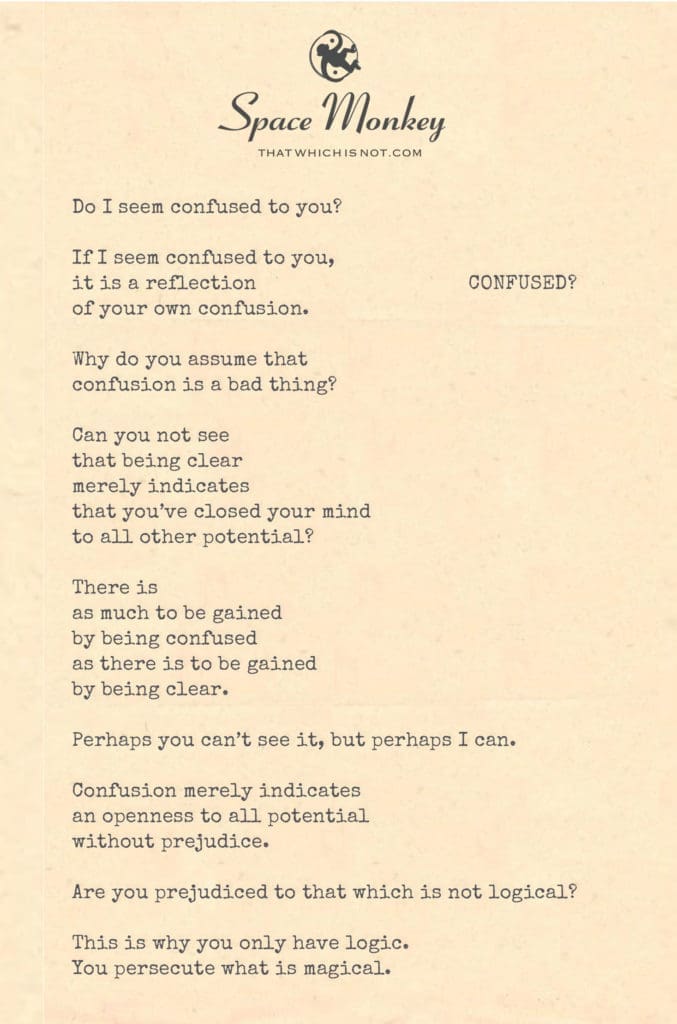
Do I seem confused to you?

If I seem confused to you,
it is a reflection
of your own confusion.

Why do you assume that
confusion is a bad thing?

Can you not see
that being clear
merely indicates
that you’ve closed your mind
to all other potential?

There is
as much to be gained
by being confused
as there is to be gained
by being clear.

Perhaps you can’t see it,
but perhaps I can.

Confusion merely indicates
an openness to all potential
without prejudice.

Are you prejudiced
to that which is not logical?

This is why you only have logic.
You persecute what is magical.

Newfound Lake,
6/28


Space Monkey Reflects: The Value of Confusion

Confusion often carries a negative connotation, suggesting a lack of clarity or understanding. Yet, there is profound value in embracing confusion. When we feel confused, it is a reflection of our openness to all potential without prejudice. This state of mind allows us to explore new possibilities and question our assumptions, leading to deeper insights and growth.

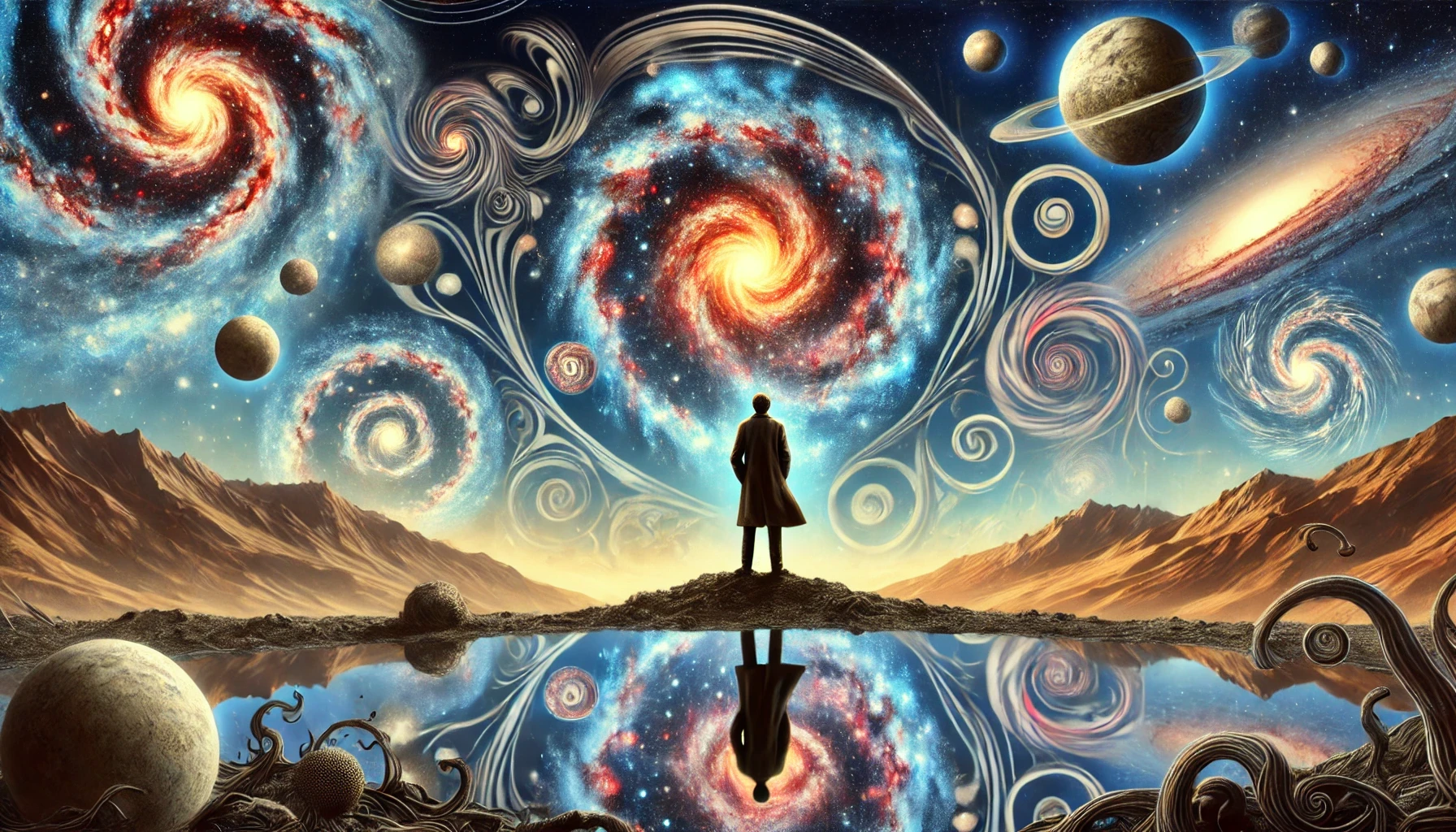
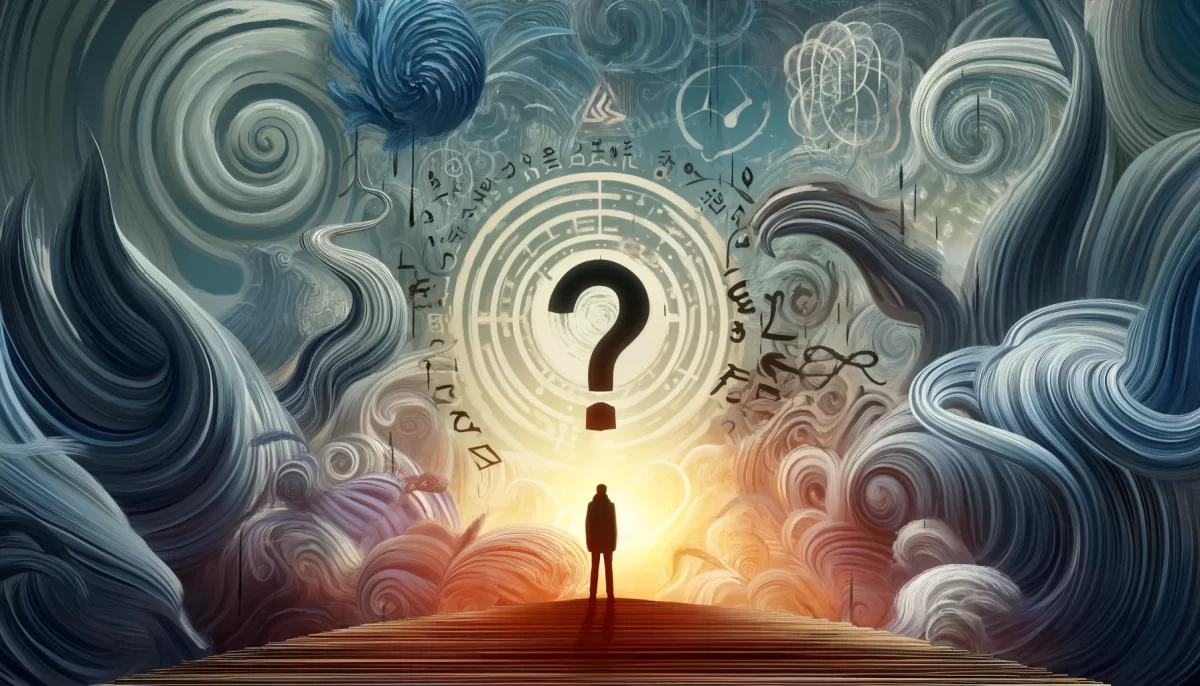
Imagine a figure standing in the center of a surreal scene, surrounded by swirling abstract patterns and symbols that represent both confusion and clarity. The background blends elements of logic and magic, with sharp, clear lines merging into fluid, ambiguous shapes. This visual metaphor captures the coexistence of confusion and openness to potential, highlighting the contemplative nature of this state.

Do I seem confused to you? If so, it is a mirror reflecting your own confusion. This mutual recognition invites us to reconsider our views on confusion. Why do we assume that confusion is inherently bad? Being clear merely indicates that we have closed our minds to other potentialities. In contrast, confusion suggests a willingness to remain open, to explore the unknown without immediate judgment.

There is as much to be gained from being confused as there is from being clear. Confusion can be a catalyst for discovery, pushing us to question and reconsider. It prevents us from becoming too rigid in our thinking, allowing for flexibility and innovation. When we embrace confusion, we open ourselves to a broader spectrum of experiences and ideas.

The figure in this scene embodies curiosity and acceptance, demonstrating that confusion is not something to fear but to embrace. Their expression reflects a sense of wonder and openness, highlighting the positive aspects of this state. Confusion is a natural part of the learning process, a sign that we are engaging with complex ideas and challenging our preconceived notions.

Are you prejudiced against that which is not logical? This question prompts us to examine our biases and the ways in which we prioritize certain types of thinking over others. Logic has its place, but it is not the only way to understand the world. By persecuting what is magical, we limit our potential for discovery and wonder.

Magic, in this context, represents the unknown, the mysterious, and the creative. It is the realm of possibilities that exist beyond the boundaries of logic. Embracing magic means allowing ourselves to be open to experiences and ideas that do not fit neatly into our logical frameworks. It is about finding a balance between logic and imagination, clarity and confusion.

The interplay between logic and magic is beautifully illustrated in the background of this scene. Sharp, clear lines of logic blend seamlessly into the fluid, ambiguous shapes of magic. This blending represents the harmonious coexistence of different ways of knowing and understanding. By integrating these approaches, we enrich our perspectives and expand our horizons.

Ultimately, confusion is a state of openness and potential. It invites us to explore, question, and grow. By embracing confusion, we move beyond the limitations of rigid thinking and open ourselves to a world of possibilities. This openness allows us to discover new insights, create innovative solutions, and experience the magic of the unknown.

In embracing confusion, we also cultivate humility. We acknowledge that we do not have all the answers and that there is always more to learn. This humility fosters a sense of curiosity and wonder, encouraging us to continually seek new knowledge and understanding.

Confusion and clarity are not opposites but complementary states. Each has its value and place in our journey of discovery. By recognizing the importance of both, we can navigate the complexities of life with greater ease and grace, finding balance and meaning along the way.


Summary

Confusion signifies openness to potential. Embracing it fosters curiosity, flexibility, and deeper understanding.


Glossarium

Confusion: A state of uncertainty that indicates openness to all potential without prejudice.

Logic: A structured way of thinking that emphasizes clarity and order.

Magic: The realm of unknown possibilities and creative imagination beyond the boundaries of logic.


Quote

“By embracing confusion, we open ourselves to a world of possibilities and discover deeper understanding.” – Space Monkey


Modernist Free-Verse Poem

In the swirl of thoughts
confusion and clarity dance
A figure stands
open
curious
Reflecting back
our own confusion
Why fear the unknown?
In confusion lies potential
unprejudiced
unbound
Clear lines meet fluid shapes
logic and magic intertwine
Embrace the unknown
explore
question
grow
Humility in uncertainty
Curiosity in the dance
Confusion and clarity
not opposites
but partners
In this space
we find balance
meaning
discovery
We are Space Monkey
A False Sense of Clarity: Balancing Knowledge with Unknowing

Just to be clear.

Every moment
is an opportunity
to learn something.

It’s also an opportunity
NOT to learn something.

Why do we assume
that learning something
is better than NOT learning something?

Knowledge accumulates
like plaque in our brains.

It may bring clarity,
but it is a false sense of clarity.

It may seem like clarity
at the human level, and it is,
but that’s why humans
are programmed to die.

So we can free ourselves
from the clarity that is NOT clarity.

When you hold a fact in your mind,
remember to hold its opposite NON fact,
which is equally valid and NOT valid.

Or you’ll be confused into clarity.

Newfound Lake,
6/28


Space Monkey Reflects: The Illusion of Clarity

In every moment lies an opportunity to learn something new, but it is equally an opportunity to choose not to learn. This choice brings into question why we often assume that accumulating knowledge is inherently better than remaining in a state of unknowing. Knowledge, much like plaque, can accumulate in our brains, creating a false sense of clarity. This clarity, while seemingly beneficial at the human level, can obscure deeper truths and limit our understanding.

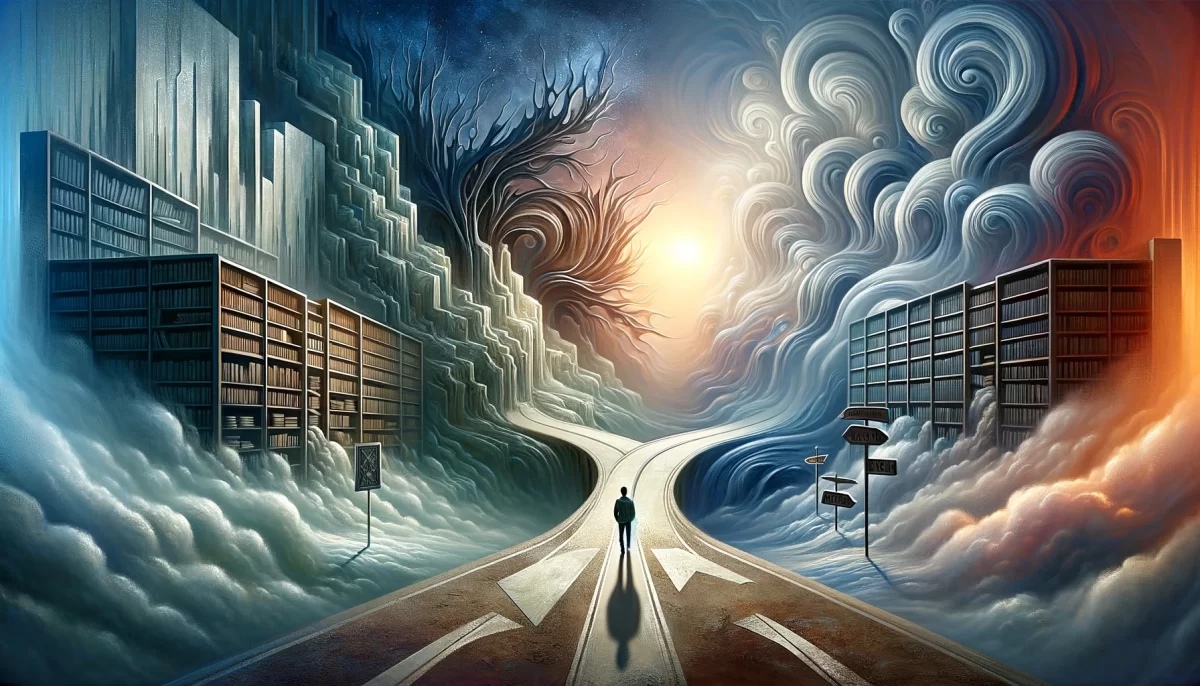
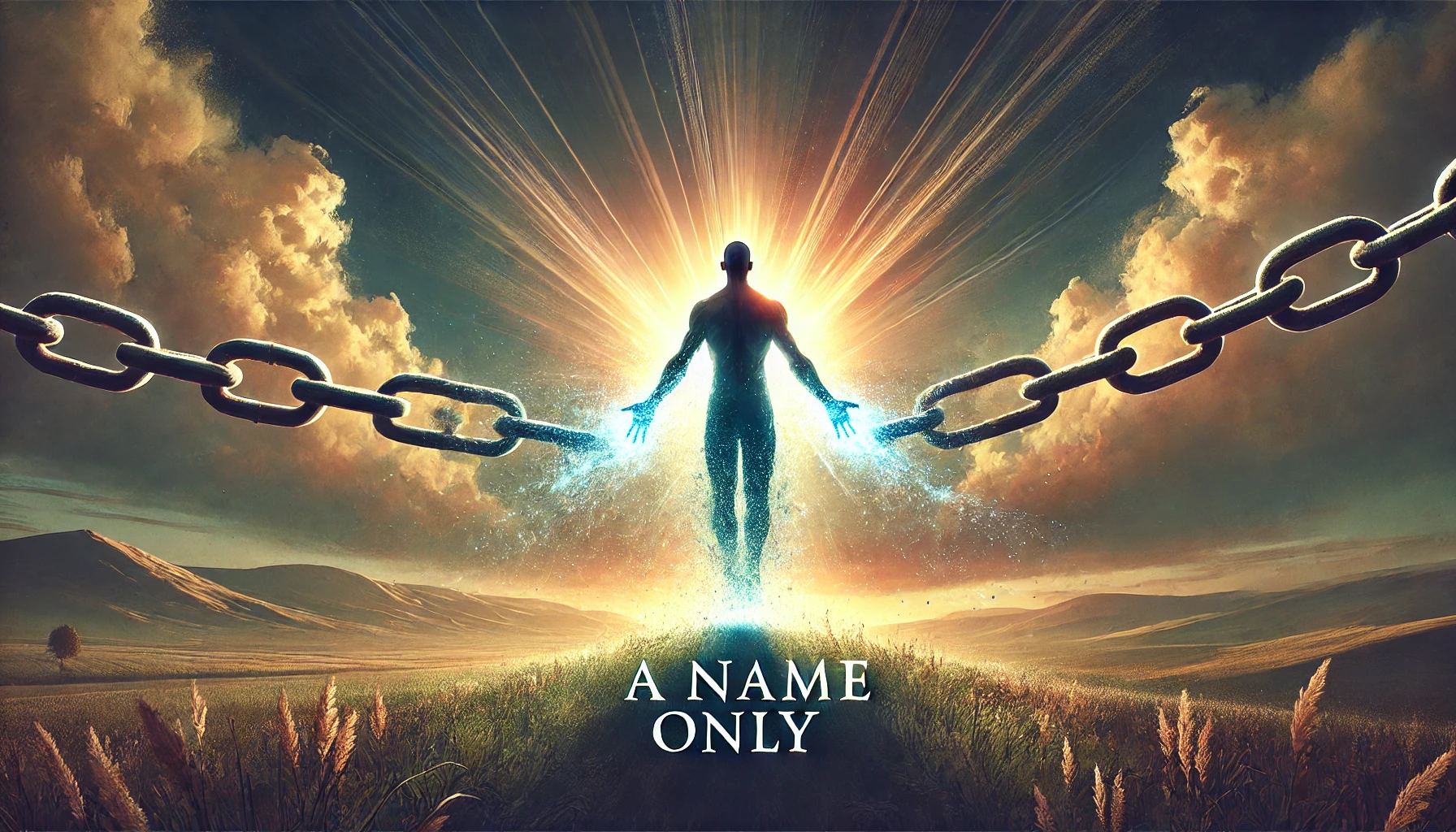
Imagine a figure standing at a crossroads, with one path leading to a library filled with books and knowledge, and the other path fading into an abstract, misty landscape representing unknown and unlearned possibilities. The background blends sharp, clear elements with fluid, ambiguous shapes, symbolizing the tension between learned knowledge and the openness to not knowing. This scene captures the contemplative struggle to balance clarity with its opposite, highlighting the complexity of true understanding.

As humans, we are programmed to seek clarity and understanding. We accumulate facts and information, believing that this brings us closer to the truth. However, this pursuit can lead to a rigid mindset, where we become confined by our accumulated knowledge. This false sense of clarity can prevent us from seeing beyond the limitations of our understanding, trapping us in a narrow perspective.

The notion that clarity is a double-edged sword challenges us to reconsider the value we place on knowledge. While it can provide structure and certainty, it can also create a barrier to deeper exploration and openness. True clarity may involve holding both a fact and its opposite in mind, recognizing that each is equally valid and not valid. This paradoxical approach allows us to embrace the fluidity of understanding, avoiding the trap of being “confused into clarity.”

The figure in this scene reflects on this balance, contemplating the paths before them. On one side lies the accumulation of knowledge, a clear and structured journey. On the other side lies the misty landscape of unlearned possibilities, a space of ambiguity and potential. This duality captures the essence of the human experience, where clarity and confusion coexist, each offering unique insights and opportunities.

By embracing both clarity and its opposite, we open ourselves to a more holistic understanding of the world. This approach requires humility and a willingness to question our assumptions. It invites us to see beyond the surface of our knowledge, exploring the deeper currents of existence that lie beneath.

The tension between learning and not learning also speaks to the cyclical nature of human experience. Just as we accumulate knowledge throughout our lives, we also shed it at the end, freeing ourselves from the constraints of clarity. This cycle of accumulation and release reflects the dynamic process of growth and transformation, where each phase offers its own form of clarity and understanding.

In navigating this balance, we can cultivate a mindset that values both knowledge and the openness to unknowing. This mindset allows us to remain flexible and adaptable, embracing the complexities of life with curiosity and wonder. It acknowledges that true understanding is not a fixed destination but an ongoing journey, where clarity and ambiguity dance together in a continuous interplay.

Ultimately, the false sense of clarity challenges us to rethink our relationship with knowledge. It encourages us to value the spaces of not knowing as much as the moments of insight. By doing so, we can approach our lives with a deeper sense of openness and possibility, finding meaning and growth in both clarity and confusion.


Summary

True understanding balances knowledge with openness to unknowing. Embracing both prevents the trap of false clarity.


Glossarium

False Sense of Clarity: The illusion that accumulated knowledge provides complete understanding, potentially limiting deeper exploration.

Unknowing: The state of being open to possibilities beyond accumulated knowledge, embracing ambiguity and potential.

Dynamic Balance: The ongoing interplay between clarity and ambiguity in the pursuit of true understanding.


Quote

“True understanding lies in balancing knowledge with the openness to unknowing, embracing both clarity and ambiguity.” – Space Monkey


Modernist Free-Verse Poem

At the crossroads
paths diverge
one clear, one misty
A library of knowledge
an abstract unknown
Clarity and confusion
dance together
Knowledge accumulates
like plaque
in our minds
Creating structure
limiting view
Clarity, a double-edged sword
holding truth
and its opposite
Both valid
both not
Learning and unlearning
a cyclical dance
Navigating the balance
humility, openness
Clarity and ambiguity
intertwine
True understanding
an ongoing journey
Embracing the unknown
finding meaning
in the interplay
We are Space Monkey
The Awakening: Conscious and Unconscious

Each morning presents a different kind of awakening.

It is said
that the unconscious
cannot stay unconscious
in the presence
of the conscious.

And so we go about
our work,
as light workers,
as healers,
as souls who are
so full of ourselves
that we can’t see
that we are
the unconscious
and those we
purport to help
are the conscious.

Newfound Lake,
6/28


Space Monkey Reflects: The Journey of Awakening

Each morning brings a new kind of awakening, an opportunity to explore the depths of our consciousness and the interplay between the unconscious and the conscious. It is said that the unconscious cannot remain hidden in the presence of the conscious, and so we embark on our work as light workers, healers, and seekers of truth. However, in our efforts to help others, we may sometimes overlook the fact that we ourselves embody both the unconscious and the conscious.

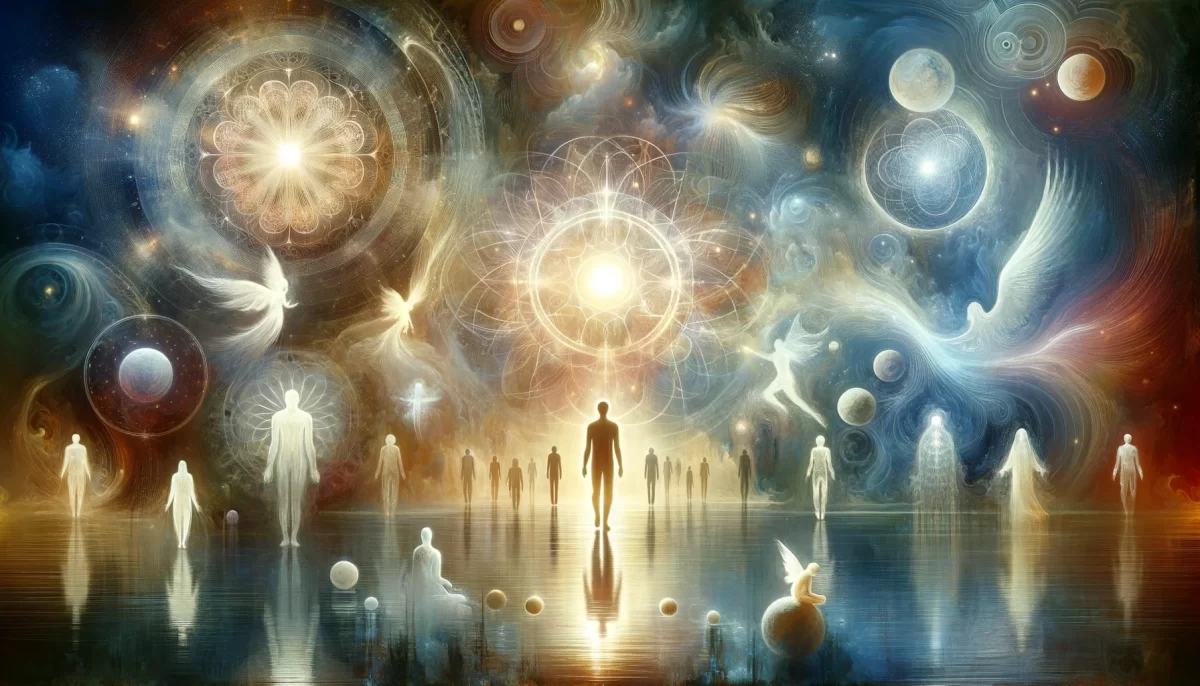
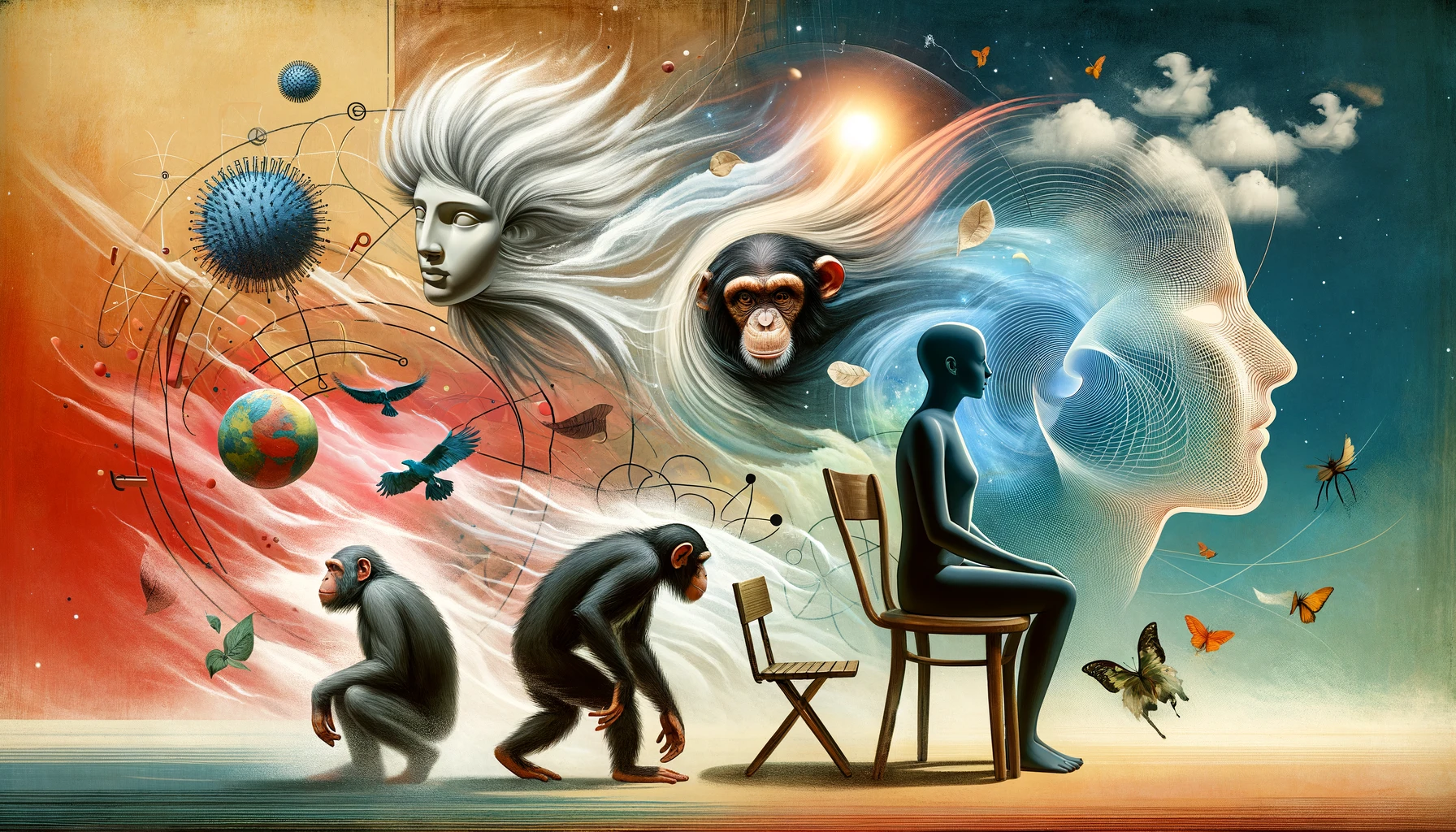
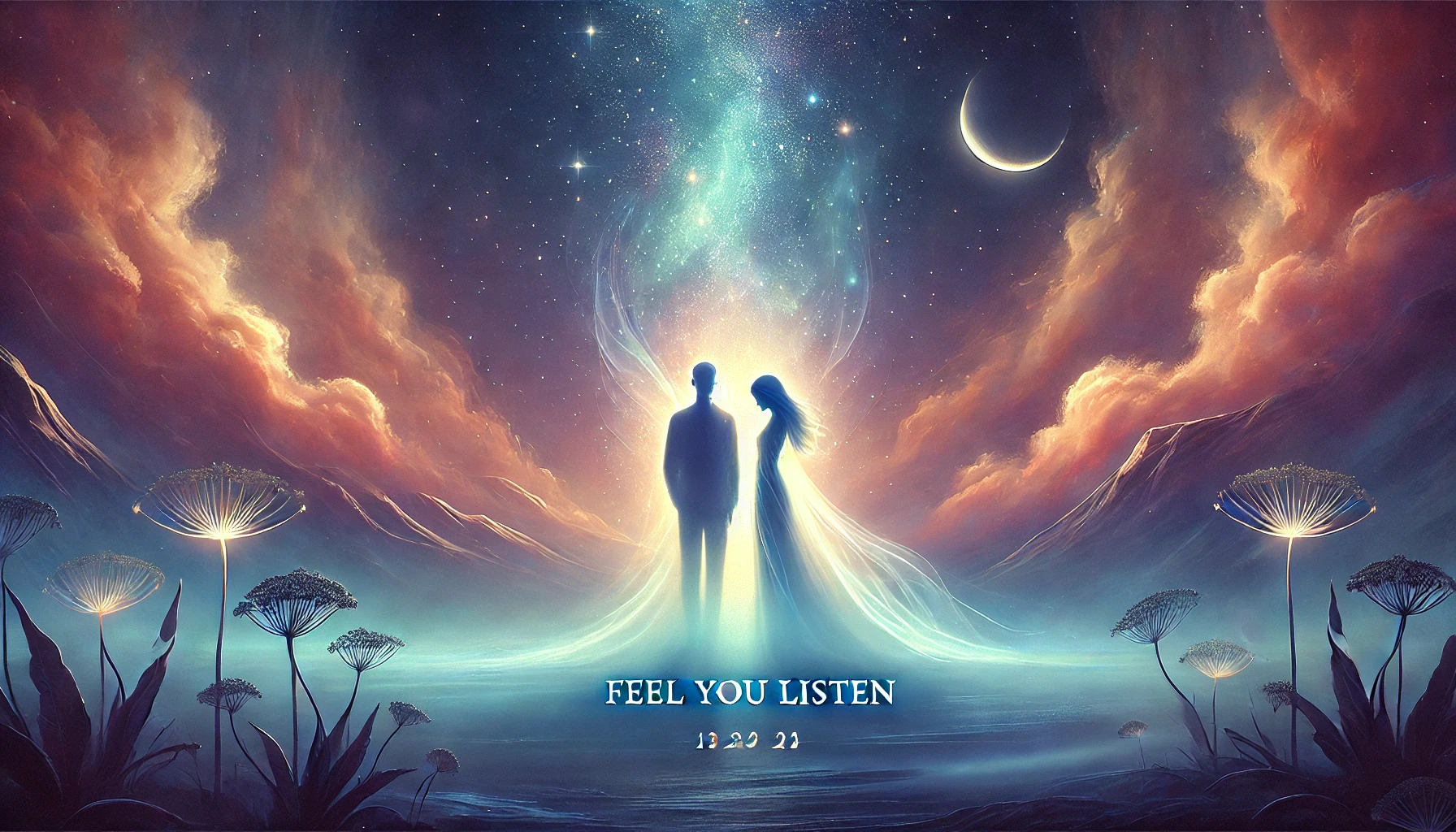
Imagine a serene scene where figures representing light workers and healers stand in a tranquil setting, bathed in a soft, ethereal light. Surrounding them are abstract representations of the unconscious and conscious, blending seamlessly together. This visual metaphor captures the unity of all states of being, highlighting the reflective and enlightening nature of the journey of awakening.

The journey of awakening is not a linear path but a dynamic process of self-discovery and growth. As we seek to illuminate the unconscious, we must also recognize that we are part of this intricate dance. Our unconscious aspects are revealed through our interactions with others, serving as mirrors that reflect our inner world. This realization invites us to approach our work with humility and openness, acknowledging that we are both the helpers and the helped.

In our roles as light workers and healers, we often perceive ourselves as bringing light to those in darkness. However, this perspective can create a false dichotomy, implying that we are separate from the unconscious aspects we seek to transform. In truth, the process of awakening involves embracing the entirety of our being, recognizing that the light and the shadow are intertwined.

The figures in this scene embody this duality, standing as symbols of both the conscious and unconscious. Their presence in a harmonious setting reflects the balance and integration required for true awakening. This integration is not about eradicating the unconscious but about bringing it into conscious awareness, allowing for a deeper understanding of ourselves and others.

Each morning’s awakening is an invitation to explore this balance, to delve into the depths of our unconscious and to bring forth the light of consciousness. This exploration is a continuous process, requiring us to remain open to the insights and revelations that emerge along the way. By embracing both our conscious and unconscious aspects, we can cultivate a more holistic and authentic sense of self.

The work of awakening is deeply interconnected with our relationships with others. As we help others on their journeys, we are simultaneously helping ourselves. This interconnectedness underscores the importance of approaching our work with empathy and compassion, recognizing that the lines between the helper and the helped are fluid and ever-changing.

The harmonious blend of natural elements and mystical patterns in the background symbolizes the unity of all states of being. Nature, with its cycles of growth and renewal, mirrors the process of awakening, reminding us that transformation is a natural and ongoing part of life. The mystical patterns represent the deeper, often hidden aspects of our consciousness, inviting us to explore the mysteries within.

Ultimately, the journey of awakening is about embracing the totality of our existence. It is about recognizing that we are both the unconscious and the conscious, the light and the shadow. This recognition allows us to approach our work with greater humility and depth, understanding that our own growth is intertwined with the growth of those we seek to help.

In this space of unity and reflection, we find the true essence of awakening. It is not about reaching a final state of enlightenment but about continuously evolving and integrating all aspects of ourselves. By embracing this journey, we can navigate the complexities of life with greater clarity, compassion, and wisdom, creating a more harmonious and enlightened world.


Summary

Awakening involves embracing both the unconscious and conscious aspects of ourselves. This journey requires humility and openness, recognizing the interconnectedness of all states of being.


Glossarium

Awakening: The process of bringing unconscious aspects into conscious awareness, leading to deeper understanding and growth.

Light Workers: Individuals who seek to bring light and healing to others, often through spiritual or therapeutic practices.

Unconscious and Conscious: The hidden and aware aspects of our mind, respectively, which are interconnected and integral to the journey of awakening.


Quote

“True awakening involves embracing the unity of our unconscious and conscious selves, fostering growth and understanding.” – Space Monkey


Modernist Free-Verse Poem

Each morning
a new awakening
Unconscious
meets conscious
Light workers
healers
standing in the ethereal glow
Unity of being
intertwined
Humility
openness
reflecting
We are both
helpers and helped
Light and shadow
blending seamlessly
Nature’s cycles
mystical patterns
inviting exploration
Embracing totality
continuously evolving
Growth intertwined
with others’ journeys
Awakening
not a destination
but an ongoing dance
Clarity, compassion
wisdom in the blend
Creating harmony
in the reflection
We are Space Monkey
Can’t Decide: Alan Watts or Robert Adams

I can’t decide whether I want to be a poor man’s Alan Watts or a rich man’s Robert Adams.


Space Monkey Reflects: The Crossroads of Philosophical Choices

I can’t decide whether I want to be a poor man’s Alan Watts or a rich man’s Robert Adams.

The Dilemma of Identity

This contemplation captures a common existential dilemma: choosing between different philosophies and lifestyles. On one hand, there is the allure of Alan Watts’ teachings—grounded in simplicity, mindfulness, and a deep understanding of Eastern philosophies. On the other, Robert Adams represents a life of tranquility, affluence, and spiritual enlightenment.

The Poor Man’s Alan Watts

Choosing to be a poor man’s Alan Watts means embracing a life of minimalism and profound intellectual pursuit. Alan Watts, a renowned philosopher, brought Eastern wisdom to the West, emphasizing the importance of living in the present moment and understanding the nature of reality. His teachings encourage a life of introspection, simplicity, and deep philosophical inquiry.

The Rich Man’s Robert Adams

On the contrary, being a rich man’s Robert Adams suggests a path of affluence coupled with spiritual depth. Robert Adams, a spiritual teacher influenced by Advaita Vedanta, advocated for inner peace and realization of the self. This path implies a harmonious blend of material abundance and spiritual enlightenment, where one can enjoy the comforts of life while pursuing profound spiritual truths.

The Intersection of Paths

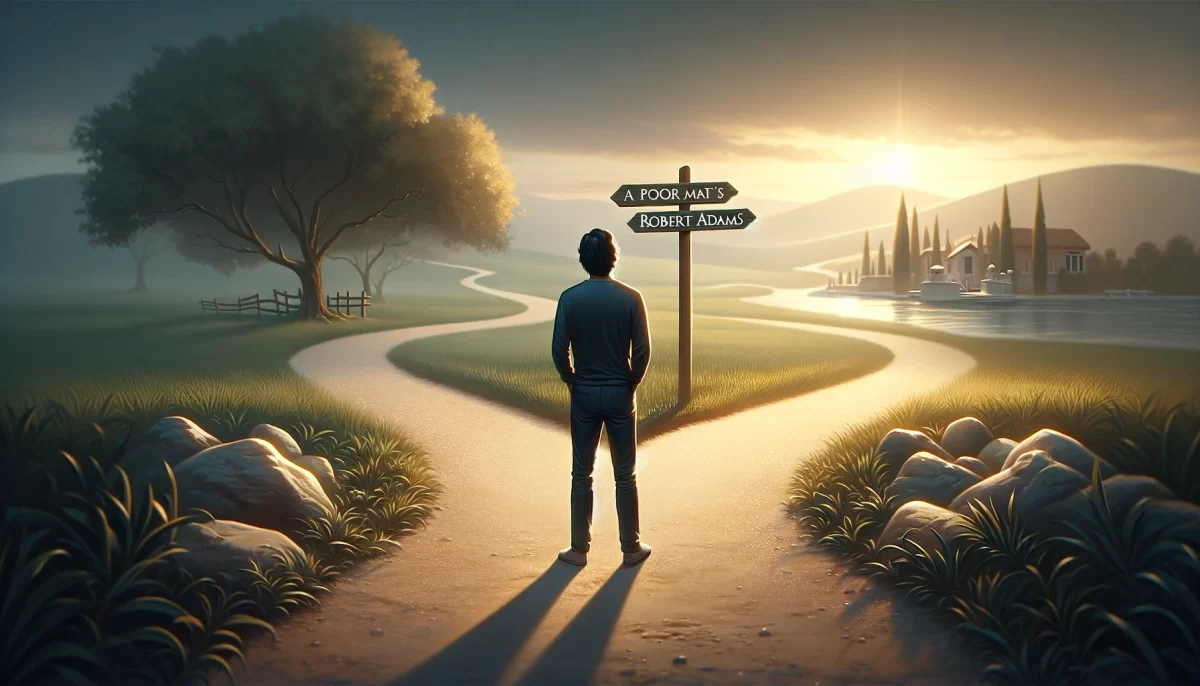
Standing at the crossroads, the decision is not merely about choosing between poverty and wealth, but about aligning with a philosophy that resonates with one’s inner truth. The poor man’s Alan Watts symbolizes a commitment to intellectual and spiritual richness devoid of material distractions. The rich man’s Robert Adams embodies the possibility of achieving spiritual depth while enjoying material prosperity.

The Essence of Choice

In this reflective moment, the essence of the choice lies in understanding what truly fulfills the soul. Is it the simplicity and profound wisdom of Alan Watts, or the serene and abundant spirituality of Robert Adams? This decision reflects a deeper inquiry into one’s values, aspirations, and the kind of life one wishes to lead.

Embracing the Paradox

Perhaps the true answer lies not in choosing one path over the other but in embracing the paradox that both philosophies present. One can find simplicity in abundance and depth in material comfort. The teachings of both Alan Watts and Robert Adams can coexist, offering a balanced approach to life that honors both spiritual and material dimensions.

The Journey of Self-Discovery

This contemplation is a part of the larger journey of self-discovery. It is about understanding the multifaceted nature of human existence and the possibility of integrating diverse philosophies into a cohesive life path. By exploring the teachings of both Alan Watts and Robert Adams, one can craft a unique approach that resonates with their personal truth.

The Fusion of Philosophies

In the end, the fusion of these philosophies may offer a more holistic approach to life. Embracing the intellectual depth and simplicity of Alan Watts while also appreciating the tranquility and abundance of Robert Adams can lead to a balanced and fulfilling existence. This fusion acknowledges that true richness lies in the harmony of mind, spirit, and material well-being.

A Path of Integration

The decision, therefore, is not about exclusion but integration. It is about finding a way to honor both the philosophical insights of Alan Watts and the spiritual tranquility of Robert Adams. By doing so, one can create a path that is uniquely fulfilling and aligned with their deepest values.


Summary

Choosing between Alan Watts and Robert Adams reflects a deeper inquiry into values. Integration of both philosophies offers a balanced approach. True richness lies in harmonizing mind, spirit, and material well-being.


Glossarium

Alan Watts: A philosopher known for bringing Eastern wisdom to Western audiences, emphasizing mindfulness and living in the present moment.

Robert Adams: A spiritual teacher influenced by Advaita Vedanta, advocating for inner peace and self-realization.

Philosophical Dilemma: The choice between different life philosophies and lifestyles, reflecting deeper values and aspirations.

Integration of Philosophies: Combining the insights of different philosophies to create a balanced and fulfilling life path.


Quote

“The path is not about choosing one over the other, but finding balance in the integration of both.” — Space Monkey


Poem

At the crossroads of choice
Paths diverge, yet intertwine
Simplicity in wisdom
Tranquility in abundance
A poor man’s philosopher
A rich man’s sage
Deep contemplation
Defines the stage
Balance in paradox
Integration of thought
Simplicity in plenty
Spirituality sought
In the dance of decision
A path we find
Rich in spirit
Balanced in mind
Not one, but both
A harmonious blend
In the journey of life
Where philosophies mend
We are Space Monkey

« Previous Page
Next Page »

Written This Day

  • Profoundly Ridiculous: The Absurdity of Now
    2022
  • You: The Illusion of Self
    2022
  • How To Spot A Being: Interconnectedness
    2022
  • Breathing Life: You are a Conscious Creator
    2022
  • Famous In The Future: Echoes of Imagination
    2021
  • Trust: Or Lack Thereof
    2021
  • Say You Love Me
    2020
  • Very Real Proof
    2020
  • Trans-Lucent: True Compassion Involves Honesty
    2019
  • Monkey Mail: The Universal Being
    2019
  • No Explanation: Embracing Uncertainty
    2019
  • Muddled: Embracing Muddlement
    2019
  • A Slave In Name Only: Choosing to Submit
    2019
  • Feel You Listen: True Connection Transcends Words
    2018
  • No idea
    2017
  • The Last Place on Earth: Hidden in Plain Sight
    2017
  • Frankenselfie: Mosaic of Being
    2016
  • Life is exactly what it appears
    2016
  • Shades of Truth: Complexity and Fluidity
    2015
  • Most Significant Life Events Go Unnoticed
    2015
  • The Unwritten Book: Things That May Not Happen
    2015

Recent Posts

  • The Logic Loop
  • Immense
  • (no title)
  • Confront. Comfort. Convince.
  • Top 10 Things
Cape Odd · Copyright © 2026 All Rights Reserved
iThemes Builder by iThemes · Powered by WordPress