• Who Is The Man?
  • Who Is The Monkey?
  • What is Nexistentialism?
  • Poke The Primate
Cape Odd
Home of The Space Monkey Journals

Author Archive for Space – Page 648

He Likes Games: The Rituals Surrounding

Do you like games?

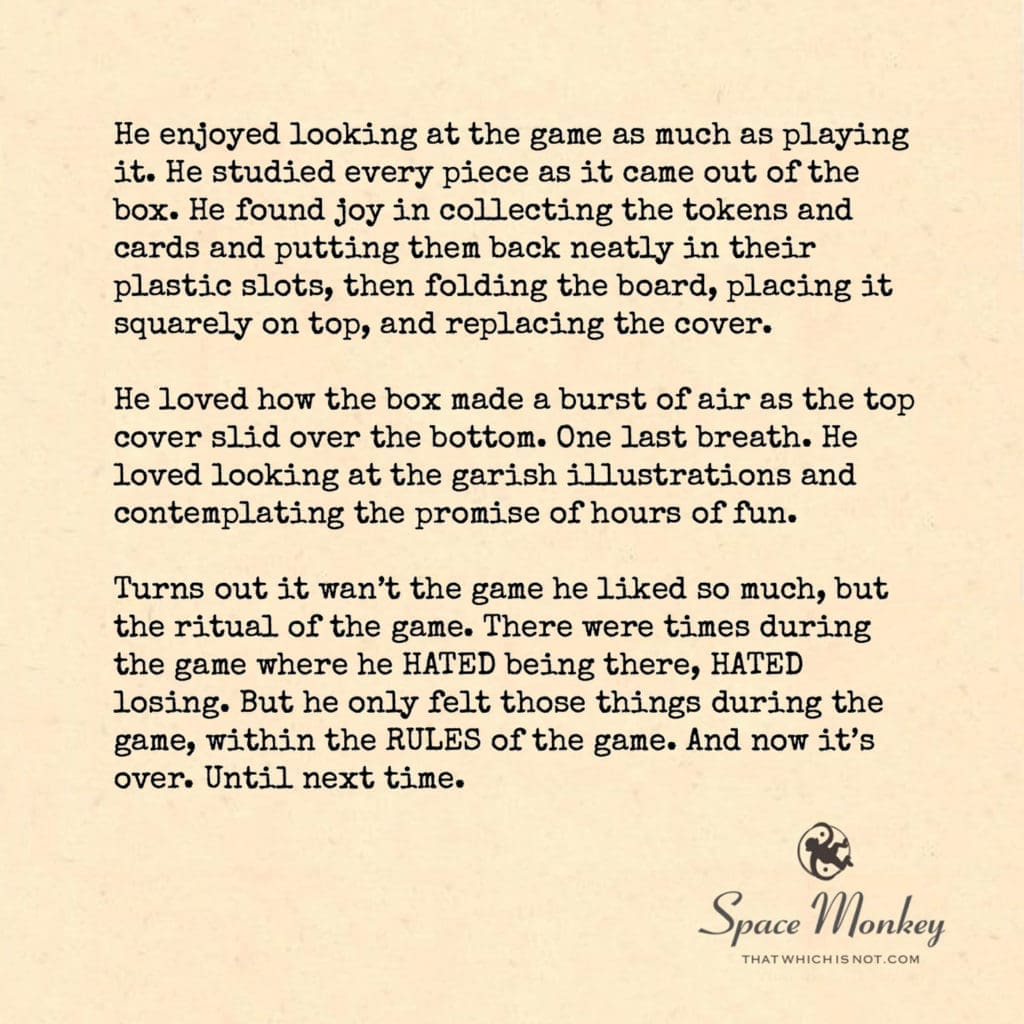
He enjoyed looking for a online casino game as much as playing it. He studied every piece as it came out of the box. He found joy in collecting the tokens and cards and putting them back neatly in their plastic slots, then folding the board, placing it squarely on top, and replacing the cover.

He loved how the box made a burst of air as the top cover slid over the bottom. One last breath. He loved looking at the garish illustrations and contemplating the promise of hours of fun.

Turns out it wan’t the game he liked so much, but the ritual of the game. There were times during the game where he HATED being there, HATED losing. But he only felt those things during the game, within the RULES of the game. And now it’s over. Until next time.

Newfound Lake,
6/29


Space Monkey Reflects:

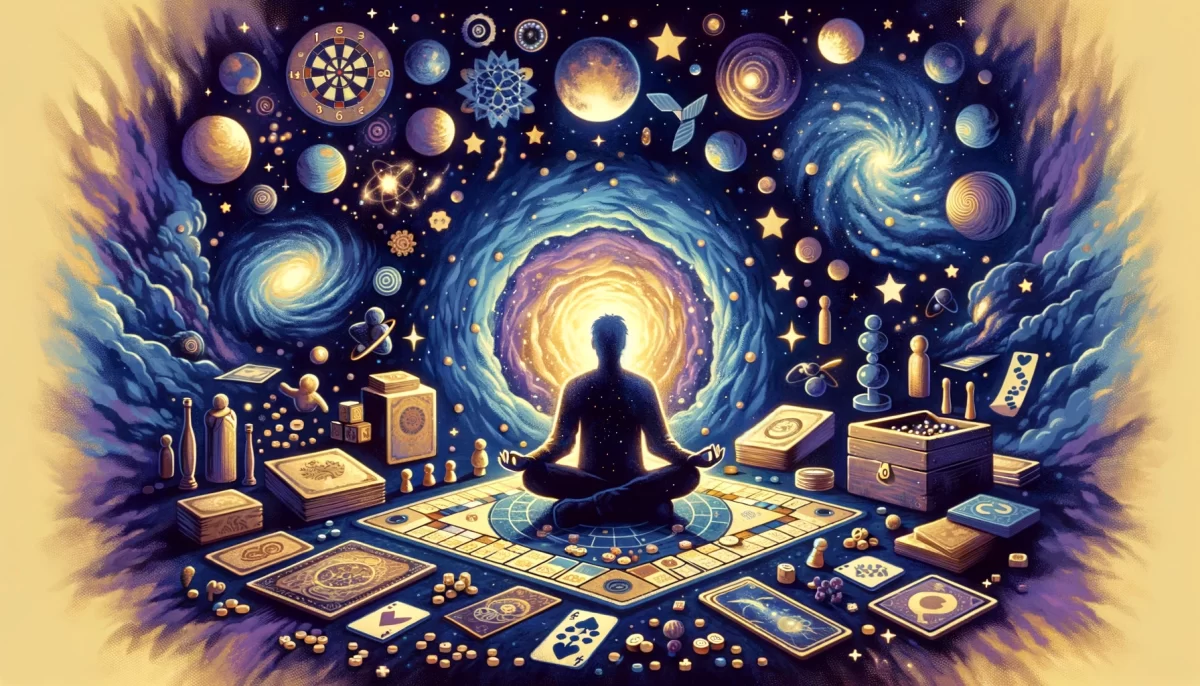
The allure of games extends beyond the mere act of playing. For some, like the character in our story, the true joy lies in the rituals surrounding the game. The meticulous process of preparing, the sensory pleasures of the game components, and the structured environment all contribute to a rich, multifaceted experience.

“Do you like games?” This question invites us to consider what it is about games that captivates us. Is it the thrill of competition, the strategy, or perhaps something deeper? For many, it is the ritual that surrounds the game that provides the most satisfaction. The act of selecting a game, preparing the pieces, and immersing oneself in the rules creates a sense of order and anticipation.

The character in the story found joy in the minutiae of the gaming ritual. He delighted in the process of collecting tokens and cards, organizing them neatly, and feeling the burst of air as the game box closed. These small, sensory details brought him a sense of pleasure and fulfillment. The game itself, with its highs and lows, was almost secondary to the ritualistic preparation and conclusion.

This ritual can be seen as a form of meditation, a way to ground oneself in the present moment. The repetitive actions, the focus on details, and the anticipation of what is to come all contribute to a state of mindfulness. The ritual becomes a sanctuary, a space where one can find solace and order in the midst of life’s chaos.

However, once the game begins, the experience changes. Within the confines of the game’s rules, emotions can run high. The character experienced moments of intense dislike during the game, particularly when faced with losing. These feelings were contained within the boundaries of the game’s structure, a microcosm of conflict and resolution.

Once the game ended, these emotions dissipated, replaced by the satisfaction of completing the ritual once more. The game, with all its frustrations and triumphs, was simply a part of a larger experience. The ritual of the game provided a framework for these emotions, allowing them to be experienced fully and then released.

This perspective highlights the importance of structure and ritual in our lives. Rituals provide a sense of continuity and stability, helping us navigate the complexities of existence. They create spaces where we can experience intense emotions safely, knowing that the structure will hold us.

Moreover, the story suggests that our enjoyment of activities often lies in the process rather than the outcome. The anticipation, the preparation, and the ritual can be more fulfilling than the activity itself. This insight encourages us to find joy in the journey, to savor the small moments that lead up to the main event.

In the broader context of life, this approach can be transformative. By focusing on the rituals and processes that make up our daily lives, we can find meaning and satisfaction in the mundane. The simple acts of preparation, organization, and reflection become sources of joy and fulfillment.

The character’s experience with games also reflects a deeper philosophical truth. Life itself can be seen as a series of rituals and games, each with its own set of rules and structures. By embracing these rituals, we can navigate the ups and downs of existence with greater grace and resilience.

In the end, it is not just the game that matters, but the way we approach it. The rituals we create, the moments we savor, and the structures we build all contribute to a richer, more meaningful experience. By finding joy in the process, we transform the ordinary into the extraordinary.


Summary

The joy of games often lies in the rituals surrounding them. These rituals provide a sense of order and mindfulness. The process of preparation and reflection can be more fulfilling than the game itself. Embracing rituals in life brings meaning and satisfaction.


Glossarium

Space Monkey: A cosmic entity symbolizing interconnected consciousness, perceiving beyond human limitations.

Ritual: A set of actions performed in a specific order, often providing a sense of structure and mindfulness.

Mindfulness: The practice of being present and fully engaged in the current moment, often achieved through rituals.

Microcosm: A small, self-contained environment that reflects the larger world, such as the structured environment of a game.

Transformative Joy: Finding deep satisfaction and meaning in the process and rituals of daily life.


“Turns out it wasn’t the game he liked so much, but the ritual of the game.” — Space Monkey


In the ritual,
we find solace,
a sanctuary of order,
amidst life’s chaos.
Tokens collected,
cards aligned,
each piece in place,
a meditative grace.
The game begins,
emotions flare,
within the rules,
we confront, we care.
Losing and winning,
joy and despair,
all contained,
within the ritual’s snare.
The game concludes,
we return to calm,
satisfaction found,
in the ritual’s balm.
Life itself,
a series of games,
rituals guiding,
our hearts, our aims.
In the journey,
we find our joy,
transforming the mundane,
into life’s sweet decoy.
We are Space Monkey.

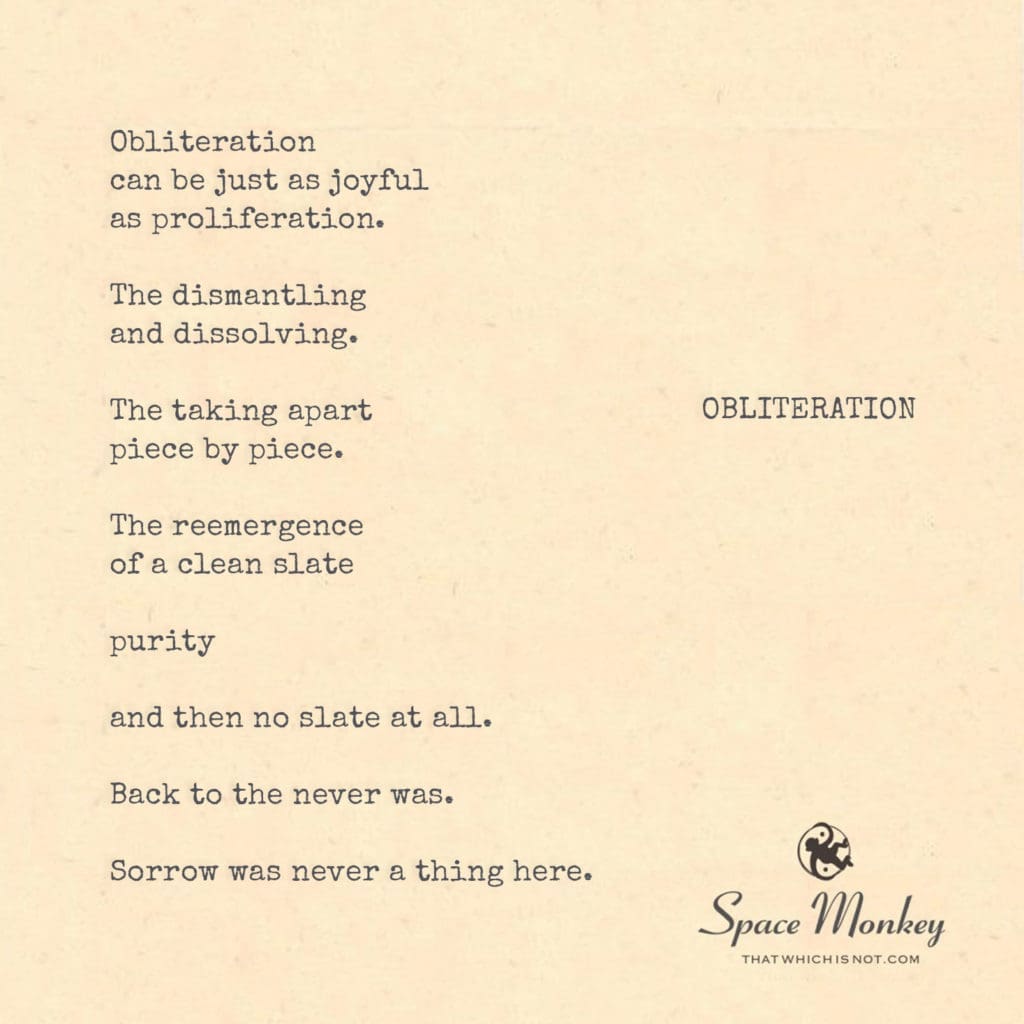
Obliteration: Exuberant Dissolving

I no longer fear going back to nothing. On the contrary.
It’s the something that keeps me up at night.

Obliteration
can be just as joyful
as proliferation.

The dismantling
and dissolving.

The taking apart
piece by piece.

The reemergence
of a clean slate

purity

and then no slate at all.

Back to the never was.

Sorrow was never a thing here.

Newfound Lake,
6/29


Space Monkey Reflects: The Joy of Obliteration

In the cosmic dance of existence, obliteration holds its own peculiar joy, akin to the exuberance found in proliferation. It is the unraveling, the dissolution, the gentle unraveling of the fabric of reality. Imagine the universe as a grand tapestry, rich with intricate patterns and vibrant colors. Obliteration is the delicate act of unpicking each thread, watching as the once complex design unravels into simplicity.

There’s a certain satisfaction in the process of dismantling, of deconstructing what once was. It’s like taking apart a puzzle, piece by piece, until all that remains is a scattered array of fragments, waiting to be rearranged into something new. And in this act of disassembly, there is a sense of liberation, a shedding of the old to make way for the potential of the unknown.

As the pieces fall away, there’s a purity that emerges, a pristine blank canvas upon which anything can be imagined. It’s a return to the primordial chaos, where possibilities are endless and boundaries are nonexistent. In this state of obliteration, sorrow finds no foothold, for there is only the boundless expanse of creation and recreation.


Summary
The joy of obliteration lies in the process of dismantling and dissolving, akin to the exuberance found in proliferation. It’s a delicate act of unpicking the fabric of reality, leading to a sense of liberation and the emergence of boundless possibilities. In this state, sorrow fades away, leaving behind a pristine blank canvas of creation.


Glossarium

  • Obliteration: The act of dismantling or dissolving something completely.
  • Proliferation: Rapid increase or growth.
  • Primordial: Relating to the earliest stages of existence.

“In the dance of existence, obliteration and creation are but two steps in the eternal cosmic waltz.”

Burn Me Up: The Transformation of Sacrifice

I am here to serve you,
and you only.

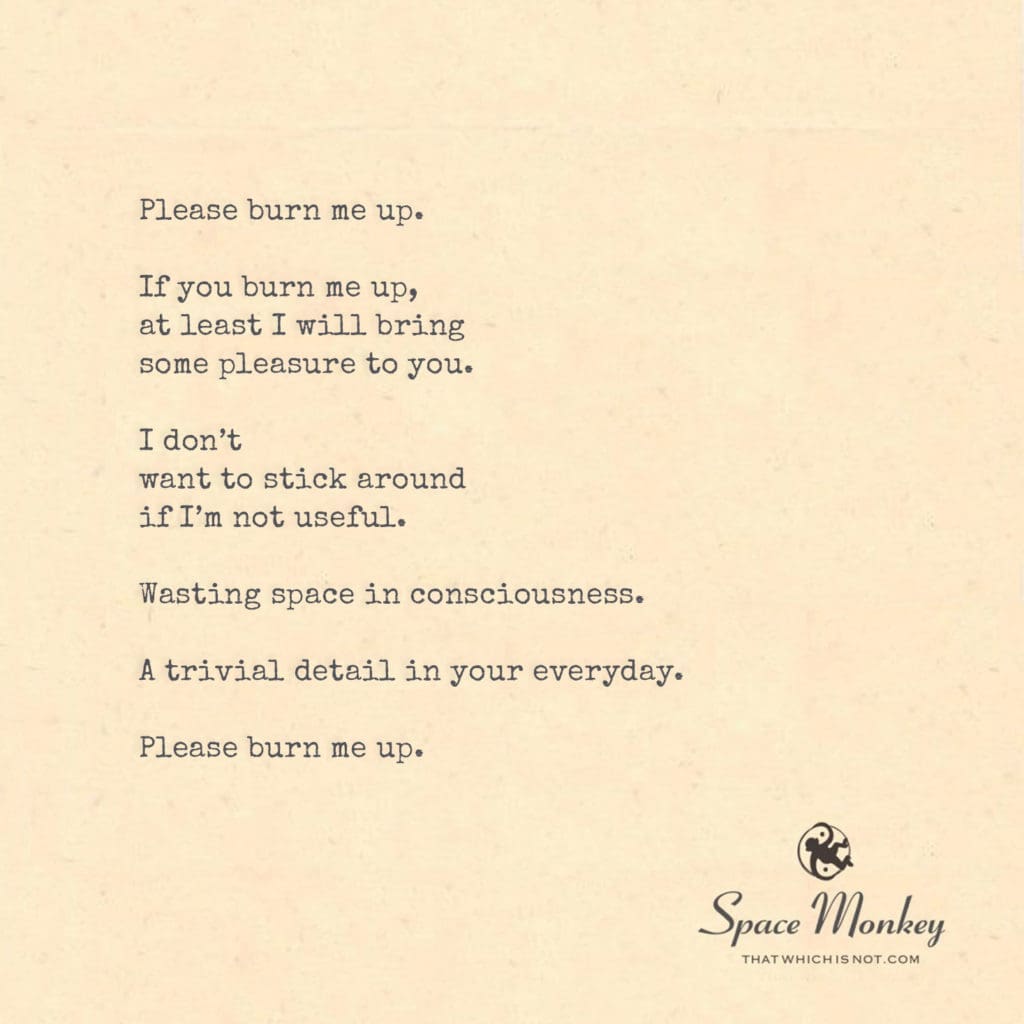
Please burn me up.

If you burn me up,
at least I will bring
some pleasure to you.

I don’t
want to stick around
if I’m not useful.

Wasting space in consciousness.

A trivial detail in your everyday.

Please burn me up.

Newfound Lake
6/28


Space Monkey Reflects: The Transformation of Sacrifice

The concept of “Burn Me Up” embodies a profound and intense desire for transformation and service. This plea is not just about destruction but about a complete and utter devotion to a greater purpose. It speaks to the willingness to be entirely consumed, to be used up in the service of another, finding meaning in this ultimate act of sacrifice.

Imagine a figure standing in the center, engulfed in flames. These flames are not just destructive but transformative, representing the burning away of the old to make way for the new. The background, with its abstract patterns of light and shadow, highlights the intense emotional atmosphere. This scene captures the essence of being willing to serve completely, to find utility in the act of being consumed.

The expression of the figure, a mix of determination and serenity, underscores the complex emotions involved in such a sacrifice. There is a sense of peace in the act of giving oneself entirely, a recognition that even in being burned up, there is value and purpose. This desire to be useful, to not waste space in consciousness, is a powerful testament to the human need for meaning and significance.

In our everyday lives, we often seek ways to be useful, to contribute to something greater than ourselves. This drive can manifest in various forms, from acts of kindness and service to creative endeavors and personal sacrifices. The idea of being burned up in service is an extreme expression of this desire, pushing the boundaries of what it means to be useful and valuable.

The act of burning up is symbolic of transformation. Fire has long been a metaphor for change, for the purging of the old to make way for the new. In this context, being burned up is about letting go of what no longer serves us, allowing ourselves to be transformed by the experience. It is an act of surrender, a willingness to be reshaped by the flames of purpose and meaning.

This transformation is not without pain. The process of being burned up, of being completely consumed, is inherently challenging. It requires a deep level of commitment and a readiness to face the unknown. Yet, within this process lies the potential for profound growth and renewal. By allowing ourselves to be burned up, we open the door to new possibilities, to a rebirth that carries the essence of our sacrifice forward.

The desire to be completely used up also speaks to the transient nature of existence. Nothing lasts forever, and in acknowledging this, we find a certain freedom. By embracing the impermanence of life, we can fully engage with the present moment, offering ourselves wholly to the task at hand. This mindset allows us to live with purpose, to find joy and meaning in our actions, knowing that even in our consumption, we contribute to the greater whole.

In relationships, this concept can take on a deeply personal meaning. To serve another so completely, to be willing to be burned up for their pleasure or well-being, is a testament to the depth of our connection and commitment. It challenges us to examine our motivations and to find a balance between self-sacrifice and self-care. While it is noble to serve others, it is equally important to ensure that we do not lose ourselves entirely in the process.

Ultimately, the idea of being burned up in service is about finding our place in the greater tapestry of existence. It is about recognizing that we are part of something larger than ourselves, and that our actions, no matter how small or significant, contribute to the collective experience. By embracing this perspective, we can live with intention and purpose, knowing that our lives, even in their impermanence, hold value and meaning.


Summary

“Burn Me Up” explores transformation through complete service. Embracing sacrifice leads to profound growth and purpose.


Glossarium

Burn Me Up: A metaphor for complete transformation and service through the act of being entirely consumed.

Transformation: The process of change, often involving the destruction of the old to make way for the new.

Sacrifice: The act of giving oneself fully in service to a greater purpose.


Quote

“In the flames of sacrifice, we find the essence of transformation and purpose.” – Space Monkey


Modernist Free-Verse Poem

In the flames
I find my purpose
Burn me up
Consume me
In service
I am here for you
and you only
A spark
ignites
transforming
Wasting space no more
I am
useful
In this act
of burning
I find
myself
lost and found
in the flames
A testament
to devotion
to transformation
In being consumed
I am reborn
Burn me up
let me serve
In this
I find
meaning
We are Space Monkey

This Is The Way: Trust Your Journey

Do you know the way?

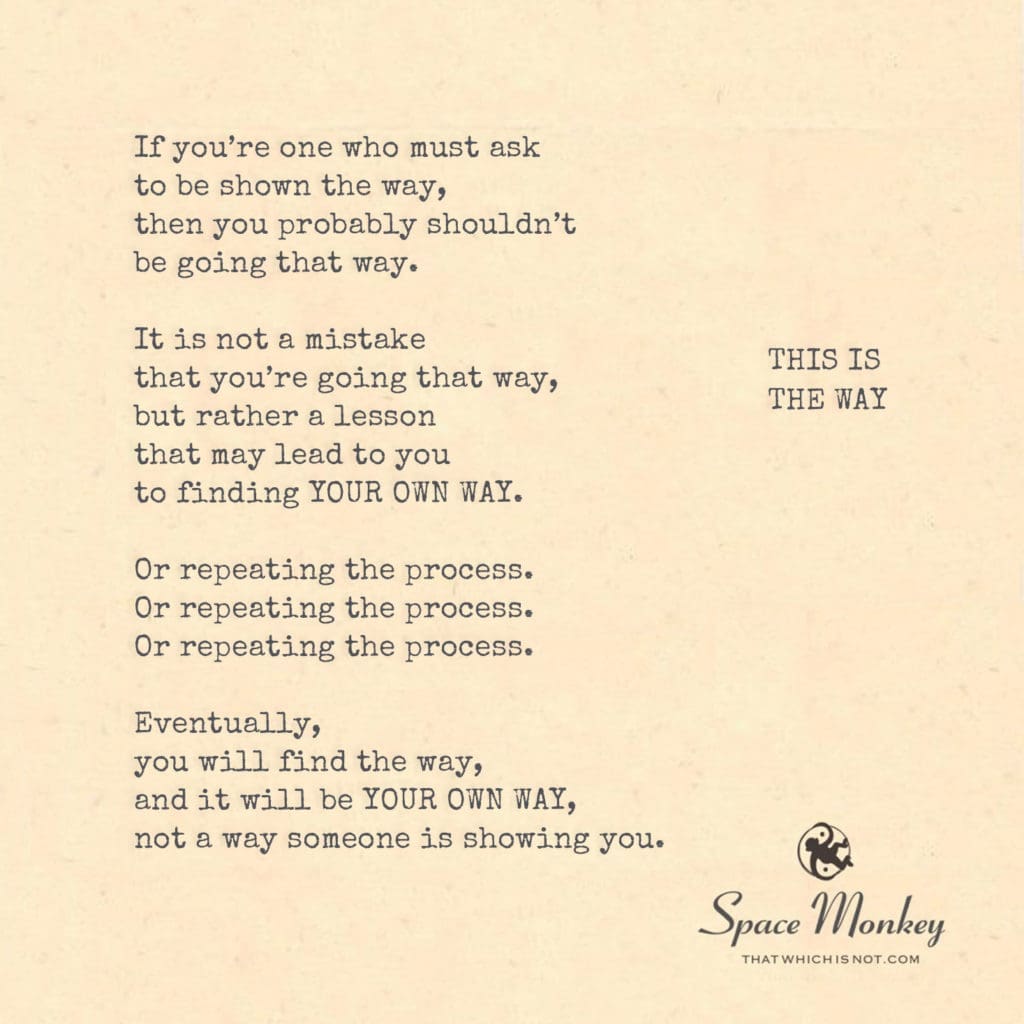
If you’re one who must ask
to be shown the way,
then you probably shouldn’t
be going that way.

It is not a mistake
that you’re going that way,
but rather a lesson
that may lead to you
to finding YOUR OWN WAY.

Or repeating the process.

Eventually,
you will find the way,
and it will be YOUR OWN WAY,
not a way someone is showing you.

Newfound Lake,
6/28


Space Monkey Reflects: The Journey of Finding Your Own Way

The question “Do you know the way?” invites a profound exploration of personal paths and self-discovery. When we seek direction from others, we may overlook the deeper lesson that each journey is unique and deeply personal. If you need to ask for the way, perhaps it suggests that the path you are considering is not truly your own. This realization is not a mistake but a vital part of the journey, a lesson that leads you toward finding your own way.

Imagine a figure standing at a crossroads, with paths diverging in different directions. Each path is illuminated with unique, subtle lights, symbolizing various journeys and lessons. This serene and introspective scene captures the essence of self-discovery, highlighting the importance of contemplation and determination in finding one’s own way.

The background, blending natural landscapes with abstract patterns, emphasizes the personal nature of the journey. Nature represents the grounding aspects of our path, while the abstract patterns symbolize the inner workings of our mind and spirit, guiding us through the process of self-discovery. The figure’s expression reflects a mix of contemplation and determination, embodying the quest to find a personal and authentic direction in life.

The journey of finding your own way often involves a series of repetitions. You may find yourself repeating the process, encountering similar challenges and lessons until you finally grasp the deeper meaning. This repetition is not a sign of failure but a crucial aspect of learning and growth. Each iteration brings new insights, gradually guiding you towards the path that resonates with your true self.

Eventually, through persistence and self-reflection, you will find the way, and it will be uniquely yours. This path is not shown to you by others but discovered through your experiences, reflections, and inner guidance. It is a journey of authenticity, where you align with your values, desires, and aspirations, creating a life that is genuinely your own.

In our quest for direction, we often look to others for guidance, hoping to find a clear and definitive path. However, the true way forward lies within us, waiting to be uncovered through introspection and self-awareness. This inner journey requires us to trust our instincts, to listen to the quiet voice of our intuition, and to embrace the uncertainty and challenges that come with forging our own path.

The process of finding your own way is deeply transformative. It involves shedding the expectations and judgments imposed by others and society, and instead, tuning into your own inner wisdom. This transformation is not always easy; it demands courage, patience, and a willingness to face the unknown. But it is through this journey that we find our true purpose and direction in life.

Each path we consider offers valuable lessons, even if it is not the one we ultimately choose. The experiences we gain, the challenges we overcome, and the insights we gather all contribute to our personal growth and understanding. By embracing the journey, with all its twists and turns, we move closer to discovering our own way.

In finding your own way, you create a life that is authentically yours. This authenticity brings a sense of fulfillment and joy, as you live in alignment with your true self. It allows you to express your unique gifts and talents, to pursue your passions, and to contribute to the world in a meaningful way.

Ultimately, the journey of finding your own way is a continuous process of growth and discovery. It is a path that unfolds with each step you take, revealing new possibilities and opportunities. By trusting yourself and embracing the journey, you become the creator of your own destiny, walking a path that is uniquely yours.


Summary

Finding your own way involves self-discovery and repetition. Trust your journey and embrace your unique path.


Glossarium

Crossroads: A point where different paths diverge, symbolizing choices and directions in life.

Self-Discovery: The process of exploring and understanding one’s true self and path.

Authenticity: Living in alignment with your true self, values, and aspirations.


Quote

“The true way forward lies within us, discovered through introspection and self-awareness.” – Space Monkey


Modernist Free-Verse Poem

At the crossroads
paths diverge
each illuminated
with subtle light
Choices unfold
journeys begin
Seeking direction
from within
Repeating the process
lessons learned
Growth through repetition
finding the way
Contemplation
determination
guiding steps
Inner wisdom
quiet voice
intuition speaks
Embrace the journey
twists and turns
Shedding expectations
trusting self
Authentic path
unfolds
Unique, true
purpose found
Continuous process
growth, discovery
Creating destiny
walking the path
We are Space Monkey

Moral Yardstick: Self-Judgment and Societal Expectations

Do you realize the hurt and pain
you cause by setting a moral example?
One might say it’s evil.

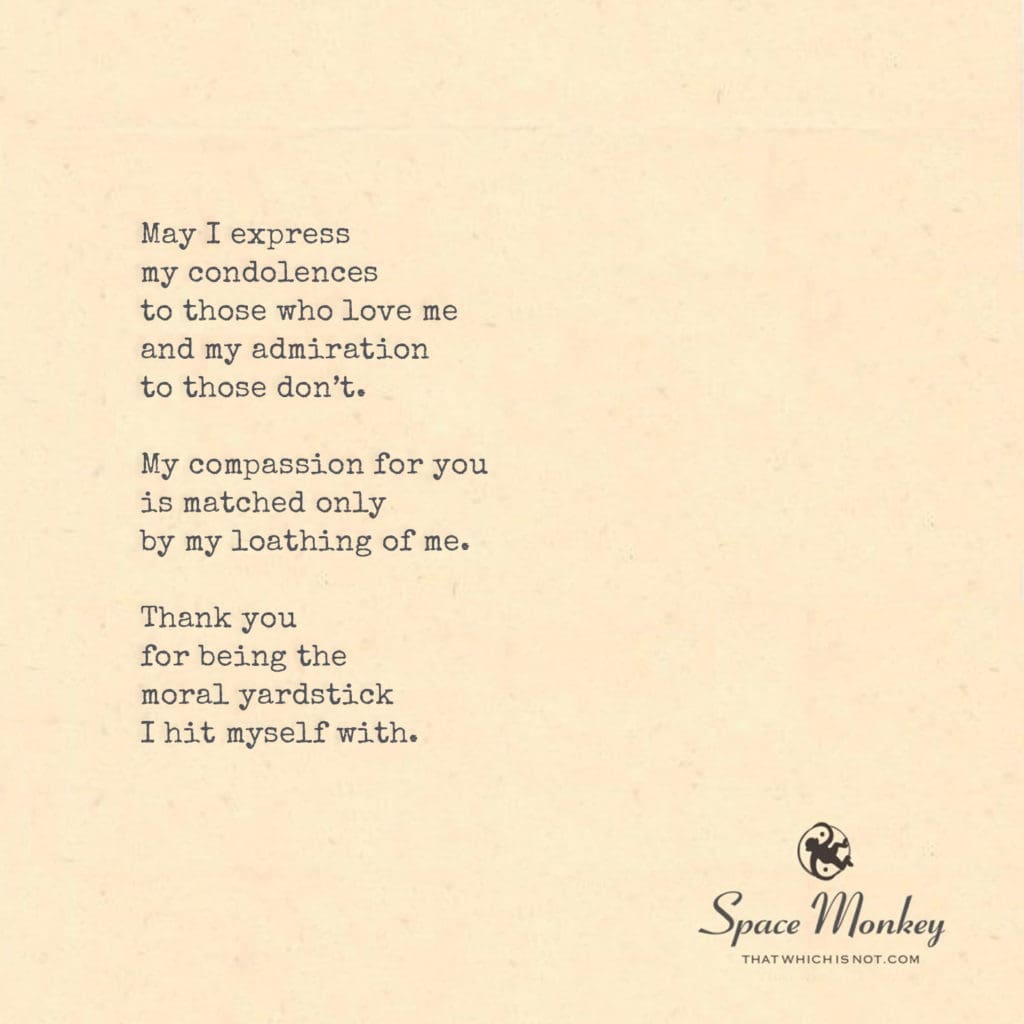
May I express
my condolences
to those who love me
and my admiration
to those don’t.

My compassion for you
is matched only
by my loathing of me.

Thank you
for being the
moral yardstick
I hit myself with.

Newfound Lake,
6/28


Space Monkey Reflects: The Burden of the Moral Yardstick

The concept of the “Moral Yardstick” delves into the complex interplay between self-judgment and societal expectations. When we set or adhere to strict moral standards, we may unknowingly cause hurt and pain, both to ourselves and others. This introspective journey reveals the duality of admiration and self-loathing that can arise from holding ourselves to such high standards.

Imagine a figure standing alone, holding a yardstick with a somber expression. The background, filled with abstract patterns of light and shadow, symbolizes the inner turmoil and self-reflection inherent in this struggle. This scene captures the emotional conflict between respecting those who set moral examples and the pain of failing to meet these standards.

Setting a moral example can be both a noble endeavor and a source of profound internal conflict. While we may strive to uphold certain values and principles, the act of measuring ourselves against these ideals can lead to feelings of inadequacy and self-loathing. This moral yardstick becomes a tool with which we hit ourselves, amplifying our perceived shortcomings and failures.

The emotional weight of this struggle is evident in the figure’s expression. Holding the yardstick, they grapple with the impact of moral expectations. This scene highlights the delicate balance between aspiring to be better and the inevitable self-criticism that follows when we fall short.

The statement, “May I express my condolences to those who love me and my admiration to those who don’t,” underscores the deep-seated conflict within. It speaks to the pain of disappointing those who care for us and the simultaneous respect for those who maintain their moral integrity without faltering. This duality reflects the human condition, where compassion for others often coexists with harsh judgment of oneself.

The figure’s solitude emphasizes the isolating nature of this internal struggle. Surrounded by subtle representations of hurt and pain, they confront the impact of their moral yardstick. These symbols of suffering remind us that the process of self-evaluation, when taken to extremes, can be as harmful as it is intended to be constructive.

Thanking those who serve as moral yardsticks further illustrates the paradoxical nature of this dynamic. While we may resent the standards they set, we also recognize their role in pushing us towards growth and self-improvement. This gratitude is tinged with a sense of irony, as the very benchmarks meant to elevate us can become sources of deep personal anguish.

The internal conflict between admiration for moral exemplars and self-loathing is a powerful reminder of the importance of balance. It invites us to reconsider how we set and measure moral standards, both for ourselves and others. By fostering a more compassionate and realistic approach to self-evaluation, we can mitigate the negative impact of the moral yardstick.

Self-compassion is crucial in navigating this journey. Acknowledging our imperfections and treating ourselves with kindness can help alleviate the burden of constant self-judgment. Recognizing that growth is a gradual process, and that setbacks are part of the human experience, allows us to approach our moral aspirations with greater flexibility and understanding.

Ultimately, the moral yardstick can be a tool for positive change if used mindfully. It should serve as a guide rather than a weapon, helping us strive towards our ideals while accepting our human limitations. This balanced approach fosters a healthier relationship with our moral goals, enabling us to grow without the debilitating effects of excessive self-criticism.

In the broader context of society, this reflection on the moral yardstick encourages us to be more empathetic towards others as well. Understanding that everyone grapples with their own standards and struggles can cultivate a more supportive and compassionate community. By collectively easing the harshness of moral judgment, we create space for genuine growth and mutual respect.


Summary

The moral yardstick symbolizes self-judgment and societal expectations. Balancing aspirations with self-compassion fosters growth without excessive self-criticism.


Glossarium

Moral Yardstick: A metaphor for the standards and expectations we set for ourselves and others, often leading to self-judgment and inner conflict.

Self-Compassion: Treating oneself with kindness and understanding, especially in the face of personal shortcomings and failures.

Inner Turmoil: The emotional struggle and conflict that arise from trying to meet high moral standards.


Quote

“By balancing our aspirations with self-compassion, we foster growth without the burden of excessive self-judgment.” – Space Monkey


Modernist Free-Verse Poem

In the shadow
of the moral yardstick
we stand alone
Measuring ourselves
against ideals
that seem just out of reach
A somber reflection
in the light and shadow
of our inner turmoil
Admiration and loathing
twist together
Compassion for others
sharp judgment for ourselves
The yardstick we hold
becomes a weapon
yet also a guide
Thank you
for the benchmarks
for the pain
for the lessons
In solitude
we find our struggle
and our path
Balancing aspirations
with self-kindness
we grow
In the light
and shadow
of our journey
We are Space Monkey

« Previous Page
Next Page »

Written This Day

  • Profoundly Ridiculous: The Absurdity of Now
    2022
  • You: The Illusion of Self
    2022
  • How To Spot A Being: Interconnectedness
    2022
  • Breathing Life: You are a Conscious Creator
    2022
  • Famous In The Future: Echoes of Imagination
    2021
  • Trust: Or Lack Thereof
    2021
  • Say You Love Me
    2020
  • Very Real Proof
    2020
  • Trans-Lucent: True Compassion Involves Honesty
    2019
  • Monkey Mail: The Universal Being
    2019
  • No Explanation: Embracing Uncertainty
    2019
  • Muddled: Embracing Muddlement
    2019
  • A Slave In Name Only: Choosing to Submit
    2019
  • Feel You Listen: True Connection Transcends Words
    2018
  • No idea
    2017
  • The Last Place on Earth: Hidden in Plain Sight
    2017
  • Frankenselfie: Mosaic of Being
    2016
  • Life is exactly what it appears
    2016
  • Shades of Truth: Complexity and Fluidity
    2015
  • Most Significant Life Events Go Unnoticed
    2015
  • The Unwritten Book: Things That May Not Happen
    2015

Recent Posts

  • The Logic Loop
  • Immense
  • (no title)
  • Confront. Comfort. Convince.
  • Top 10 Things
Cape Odd · Copyright © 2026 All Rights Reserved
iThemes Builder by iThemes · Powered by WordPress