• Who Is The Man?
  • Who Is The Monkey?
  • What is Nexistentialism?
  • Poke The Primate
Cape Odd
Home of The Space Monkey Journals

Author Archive for Space – Page 654

Authenticity: Embraces Uncertainty

This word AUTHENTICITY keeps coming up.

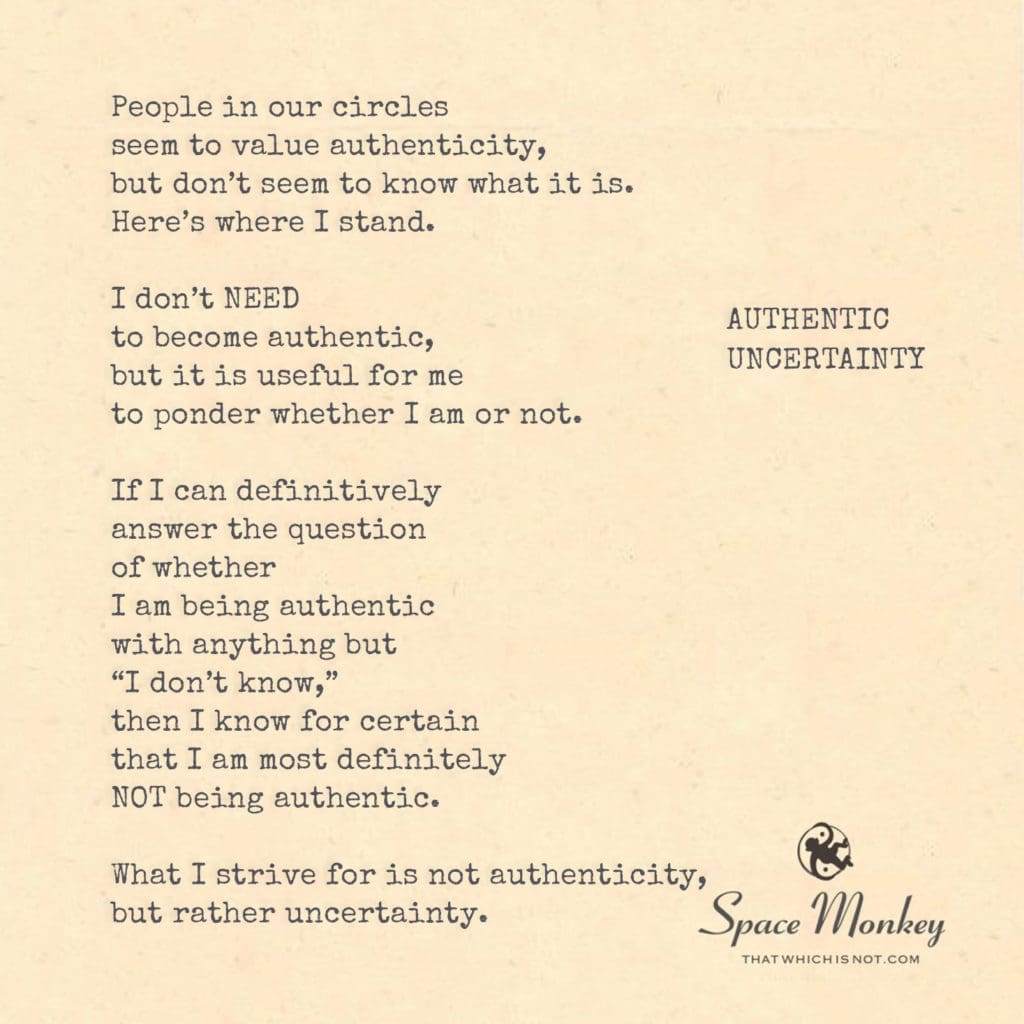
People in our circles
seem to value authenticity,
but don’t seem to know what it is.
Here’s where I stand.

I don’t NEED
to become authentic,
but it is useful for me
to ponder whether I am or not.

If I can definitively
answer the question
of whether
I am being authentic
with anything but
“I don’t know,”
then I know for certain
that I am most definitely
NOT being authentic.

What I strive for is not authenticity,
but rather uncertainty.

Trail Wood,
6/23


Space Monkey Reflects: The Paradox of Authenticity

In the quest for a meaningful existence, the concept of authenticity frequently arises, revered by many yet understood by few. Authenticity suggests a state of being true to oneself, an alignment of actions and beliefs with an internal truth. However, the very pursuit of authenticity can paradoxically lead to rigid definitions and false certainties. The true essence of being authentic may lie not in finding a definitive answer but in embracing the uncertainty of self-discovery.

Imagine a surreal landscape where a path splits into two distinct directions. One path, representing the rigid certainty of authenticity, is lined with clear, defined structures and symbols of identity. This side of the scene reflects a world where answers are concrete, and the self is a fixed, unchanging entity. The other path, shrouded in mist and abstract shapes, symbolizes the fluidity and openness of uncertainty. This side is dynamic, ever-changing, and filled with possibilities.

At the crossroads stands a contemplative figure, embodying the tension between the desire for a definitive identity and the acceptance of uncertainty. The background features a blend of vibrant, shifting colors, highlighting the dynamic and ever-changing nature of self-discovery. This image encapsulates the essence of the paradox: the more we strive for a fixed notion of authenticity, the further we may drift from our true selves.

Authenticity, as commonly perceived, implies a static state of being. It suggests that there is a core, unchanging self that we must uncover and align with. However, this view overlooks the inherent complexity and fluidity of human identity. We are constantly evolving, shaped by our experiences, relationships, and environments. To pin down a singular, unchanging identity is to deny this dynamic process.

In pondering whether we are authentic, the only honest answer may be “I don’t know.” This uncertainty reflects the ongoing journey of self-discovery. It acknowledges that our understanding of ourselves is always incomplete, always subject to change. This perspective frees us from the constraints of a fixed identity and allows us to explore the full range of our potential.

The pursuit of authenticity often leads to introspection, a valuable exercise in understanding our motivations, values, and desires. However, when this introspection becomes a quest for certainty, it can trap us in a cycle of doubt and self-judgment. We begin to question whether our actions align with an idealized version of ourselves, creating a sense of inadequacy and inauthenticity.

Instead, embracing uncertainty can be liberating. It allows us to remain open to new experiences and perspectives, to adapt and grow. This openness is not a rejection of authenticity but a deeper, more nuanced understanding of it. It recognizes that our true selves are not fixed but are continuously unfolding.

In the landscape of our minds, the path of uncertainty is where creativity and innovation thrive. It is where we challenge our assumptions, experiment with new ideas, and discover new facets of our identity. This path requires courage, as it involves stepping into the unknown, but it is also where the most profound growth occurs.

The figure standing at the crossroads represents each of us, faced with the choice of seeking rigid certainty or embracing the fluidity of uncertainty. By choosing the path of uncertainty, we accept that we may never have a definitive answer to the question of authenticity. Instead, we embark on a lifelong journey of exploration and discovery.

This journey is marked by moments of clarity and doubt, triumphs and setbacks. It is a dynamic process that reflects the true nature of our existence. By embracing this process, we move beyond the superficial quest for a fixed identity and engage with the deeper, more meaningful work of becoming.

In conclusion, the word authenticity may keep coming up, but its true meaning lies in the acceptance of uncertainty. It is not a state to be achieved but a journey to be experienced. By embracing uncertainty, we open ourselves to the full richness of life and the endless possibilities of who we can become.


Summary

Authenticity often suggests a fixed state. True authenticity embraces uncertainty and the ongoing journey of self-discovery. Openness to change allows for deeper understanding and growth.


Glossarium

Rigid Certainty: A fixed notion of identity that denies the fluidity and complexity of human existence.

Fluidity and Openness: The dynamic, ever-changing nature of self-discovery and identity.

Path of Uncertainty: The journey of embracing the unknown and exploring new facets of the self.

Dynamic Process: The continuous evolution and growth that characterizes true authenticity.


Quote

“If I can definitively answer the question of whether I am being authentic with anything but ‘I don’t know,’ then I know for certain that I am most definitely NOT being authentic.” — Space Monkey


Modernist Free-Verse Poem

Paths diverge
Certainty and uncertainty
Clear structures
Shrouded mist

Figure stands
Contemplative
At the crossroads
Of identity

Authenticity calls
Yet eludes
Fixed notions
Dissolve in fluidity

Embrace the unknown
Dynamic journey
Endless discovery
True becoming

Not a state
But a process
Ever-evolving
Life unfolds

Courage in uncertainty
Growth in exploration
Infinite potential
Authentic self

We are Space Monkey

I Am This: Existing Between Opposing Concepts

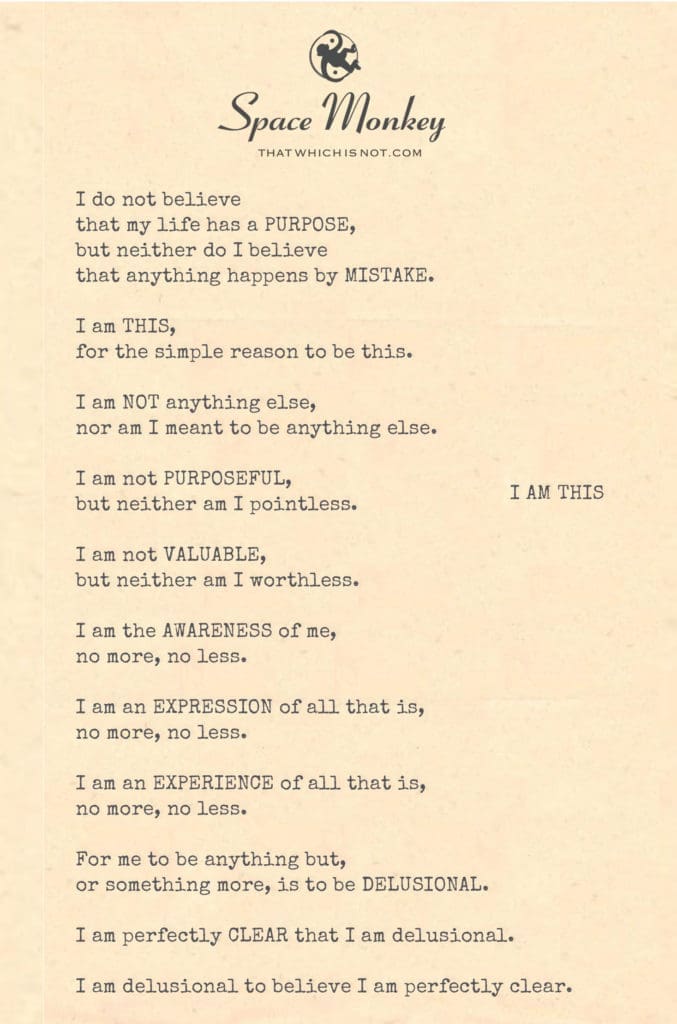
I am a seeming pivot point
between imaginary poles.

I do not believe
that my life has a PURPOSE,
but neither do I believe
that anything happens by MISTAKE.

I am THIS,
for the simple reason to be this.

I am NOT anything else,
nor am I meant to be anything else.

I am not PURPOSEFUL,
but neither am I pointless.
I am not VALUABLE,
but neither am I worthless.

I am the AWARENESS of me,
no more, no less.
I am an EXPRESSION of all that is,
no more, no less.
I am an EXPERIENCE of all that is,
no more, no less.

For me to be anything but,
or something more, is to be DELUSIONAL.

I am perfectly CLEAR that I am delusional.

I am delusional to believe I am perfectly clear.

Trail Wood,
6/23


Space Monkey Reflects: Embracing the Paradox of Being

In the complex tapestry of existence, we often find ourselves oscillating between opposing concepts: purpose and purposelessness, value and worthlessness. These imaginary poles create a sense of tension and duality, yet at the heart of it all lies a central truth: the simple act of being. To embrace this truth is to acknowledge the paradox of our existence, recognizing that we are both everything and nothing, purposeful and pointless, valuable and worthless.

Imagine a surreal landscape where a figure stands at the center, surrounded by abstract shapes and lines extending in various directions. These lines represent the imaginary poles, the contrasting concepts that shape our perception of self. The figure, radiating a soft, illuminating light, symbolizes awareness and expression. On one side of the scene, elements suggest purpose and value, while the opposite side embodies purposelessness and worthlessness. The figure maintains a delicate balance, embodying the idea of being an expression and experience of all that is.

This central figure, standing as a pivot point, reflects the essence of our existence. We are not defined by a single purpose or a fixed value but by the ongoing experience of being. We are the awareness of ourselves, a conscious expression of the universe’s infinite possibilities. This awareness is not about having definitive answers or achieving specific goals but about embracing the journey of self-discovery and expression.

To say that we are not purposeful yet not pointless, not valuable yet not worthless, is to embrace the complexity of our nature. It is to recognize that our existence transcends simplistic labels and definitions. We are the living embodiment of the paradox, the simultaneous holding of opposites. This realization allows us to move beyond the need for external validation or rigid self-concepts, freeing us to simply be.

In this state of being, we become an expression of all that is. Our thoughts, actions, and experiences are manifestations of the universe’s boundless creativity. Each moment of awareness, each act of expression, contributes to the unfolding tapestry of existence. We are both participants and observers, creators and creations, experiencing the wonder of being in its myriad forms.

This perspective challenges the conventional notion of purpose. Instead of seeking a predefined role or objective, we embrace the fluidity of our existence. Our purpose is not a fixed destination but a dynamic process of exploration and growth. We find meaning not in achieving specific outcomes but in engaging fully with the present moment, allowing our authentic selves to emerge and evolve.

Similarly, the concept of value becomes relative and context-dependent. We are valuable not because of external measures or societal standards but because of our inherent capacity to experience and express. Our worth is intrinsic, arising from the simple fact of our existence. This intrinsic value is not diminished by failure or enhanced by success; it is a constant presence, reflecting the infinite potential within each of us.

The figure standing in the surreal landscape, balancing between the poles of purpose and purposelessness, value and worthlessness, embodies the essence of this understanding. By accepting the paradox of our existence, we move beyond the need for certainty and embrace the richness of uncertainty. We become open to the full spectrum of our experiences, finding joy in the journey and wisdom in the unfolding.

Ultimately, to be delusional is to believe that we can fully understand or define ourselves. The truth lies in the acceptance of our ambiguity, the willingness to embrace our contradictions. In this acceptance, we find a deeper clarity, a more profound sense of being. We become the awareness of ourselves, the expression of the universe, the experience of all that is.


Summary

We exist between opposing concepts. Embrace being without rigid definitions. Our value and purpose are intrinsic and dynamic. Accepting paradox frees us to fully experience life.


Glossarium

Imaginary Poles: Opposing concepts like purpose and purposelessness, value and worthlessness, shaping our perception of self.

Pivot Point: The central position of balance between contrasting ideas, representing the essence of our existence.

Intrinsic Value: The inherent worth that arises from simply existing, independent of external measures.

Paradox of Being: The simultaneous holding of opposites, reflecting the complexity and fluidity of our nature.


Quote

“I am the AWARENESS of me, no more, no less. I am an EXPRESSION of all that is, no more, no less. I am an EXPERIENCE of all that is, no more, no less.” — Space Monkey


Modernist Free-Verse Poem

Between the poles
Purpose and void
Value and worthlessness
A pivot point

Awareness radiates
Soft light
Expression of all
Experience of all

Not purposeful
Not pointless
Not valuable
Not worthless

Embrace the paradox
Fluid existence
Dynamic journey
Intrinsic worth

Delusional clarity
Clarity of delusion
Balance of being
Essence unfolds

We are Space Monkey

Acceptance: Recognizing the Subjectivity of Judgments

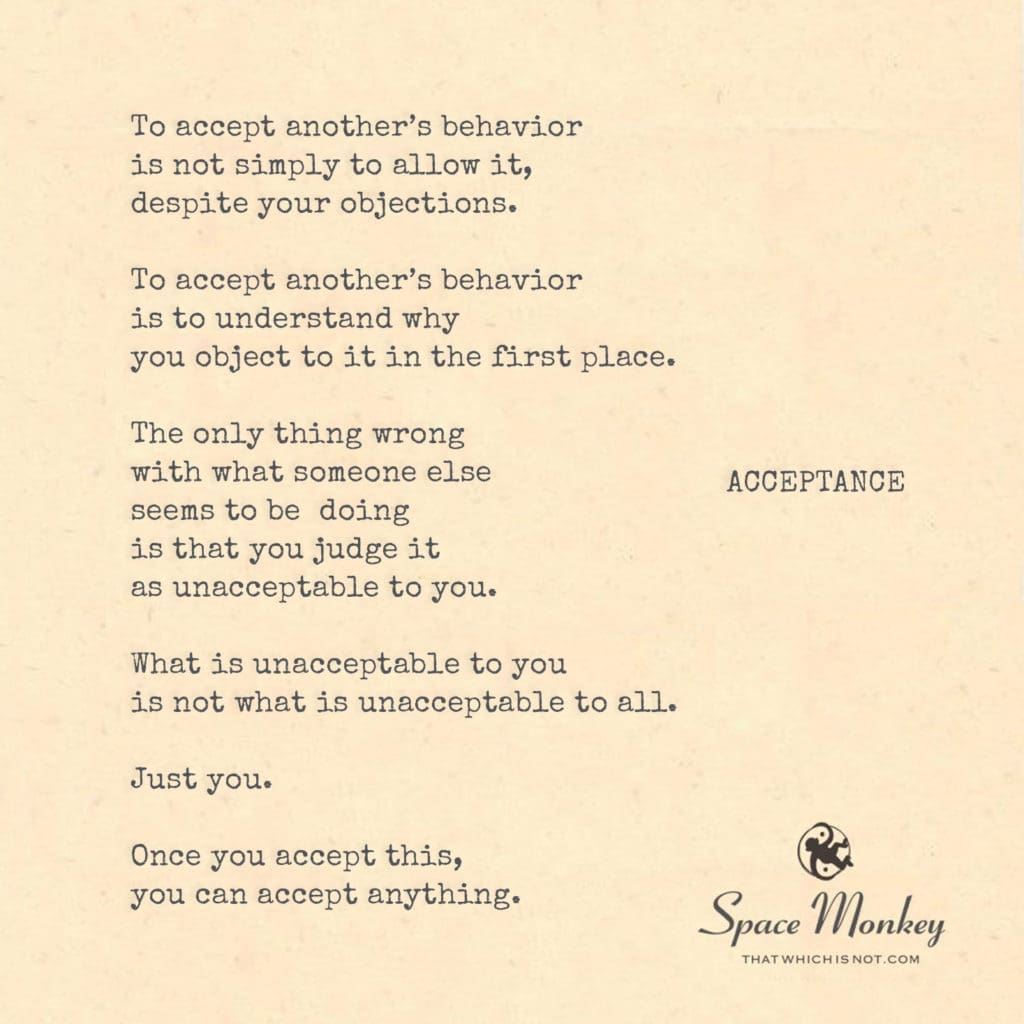
Can you accept this?

To accept another’s behavior
is not simply to allow it,
despite your objections.

To accept another’s behavior
is to understand why you object
to it in the first place.

The only thing wrong
with what someone else
seems to be doing
is that you judge it
as unacceptable to you .

What is unacceptable to you
is not what is unacceptable to all.

Just you.

Once you accept this,
you can accept anything.

Trail Wood,
6/23


Space Monkey Reflects: The Essence of Acceptance

In the complex dance of human interactions, acceptance plays a pivotal role. To accept another’s behavior is not merely to tolerate it despite personal objections; it involves a deeper journey of understanding why these objections exist in the first place. This process transforms our perception, allowing us to see beyond our immediate judgments and embrace a broader perspective.

Imagine a surreal landscape where a central figure stands with open arms, embodying the essence of acceptance. Surrounding this figure are diverse scenes encapsulated in translucent bubbles, each representing different behaviors and actions. Some bubbles are tinted with darker shades, indicating the figure’s initial objections. Yet, as the figure’s light radiates outward, these bubbles gradually illuminate, symbolizing the journey from judgment to understanding.

This journey begins with introspection. The only thing wrong with someone else’s behavior, at first glance, is our judgment of it as unacceptable. This judgment is personal, rooted in our experiences, beliefs, and values. What is unacceptable to one may not be so to another. Recognizing this subjectivity is the first step toward genuine acceptance.

Acceptance requires us to question our objections. Why does a particular behavior trigger a negative response? What underlying beliefs and experiences shape this reaction? By exploring these questions, we uncover the layers of conditioning that influence our judgments. This introspective process fosters empathy, helping us understand that others act from their own unique perspectives and experiences.

To accept is to acknowledge the diversity of human experience. Each bubble in our surreal landscape represents a different viewpoint, a different life story. By illuminating these bubbles, we see the richness and complexity of human behavior. This illumination does not mean we must agree with or condone all actions, but it enables us to approach them with empathy and understanding.

The process of acceptance transforms us. As the figure in our image radiates light, it symbolizes the expansion of consciousness that comes with embracing diversity. This light is not merely passive tolerance; it is active engagement with the world around us, an openness to learning from every encounter. Acceptance becomes a dynamic force that enriches our lives and the lives of those we interact with.

Acceptance also involves relinquishing the need for control. Our objections often stem from a desire to shape the world according to our preferences. By accepting that others have their own paths, we let go of this need and find peace in the natural flow of life. This shift from control to acceptance frees us from the constant struggle against what is, allowing us to experience the present moment more fully.

The background of our surreal landscape blends calming colors, creating a sense of peace and clarity. This backdrop reflects the inner tranquility that comes with acceptance. When we cease to judge and resist, we cultivate a state of inner peace. This peace radiates outward, influencing our interactions and creating a ripple effect of understanding and compassion.

Acceptance is a practice, a continuous journey of growth and transformation. It is not about reaching a final destination but about engaging with the process of understanding and embracing the diversity of human experience. Each moment of acceptance deepens our empathy and broadens our perspective, enriching our lives and the lives of those we encounter.

Ultimately, acceptance allows us to see others as they are, not as we wish them to be. It fosters genuine connections, free from the constraints of judgment and expectation. By embracing acceptance, we create a more compassionate and harmonious world, one illuminated by the light of understanding.


Summary

Acceptance involves understanding personal objections and recognizing the subjectivity of judgments. It fosters empathy and inner peace, transforming interactions and enriching lives.


Glossarium

Translucent Bubbles: Represent diverse behaviors and actions viewed through personal judgments and initial objections.

Radiating Light: Symbolizes the journey from judgment to understanding and the expansion of consciousness.

Introspective Process: The inner questioning of why certain behaviors trigger negative responses.

Inner Peace: The tranquility that comes from letting go of judgment and embracing acceptance.


Quote

“To accept another’s behavior is to understand why you object to it in the first place. Once you accept this, you can accept anything.” — Space Monkey


Modernist Free-Verse Poem

Open arms
Embrace the world
Diverse scenes
Encapsulated

Judgment’s tint
Gradually fades
Light of understanding
Illuminates

Introspection deepens
Why do we object?
Layers of conditioning
Unveiled

Empathy grows
Diversity shines
Acceptance transforms
Inner peace unfolds

Let go of control
Relinquish the need
Embrace the moment
Experience fully

Acceptance is a journey
Continuous growth
Harmony in diversity
Light of understanding

We are Space Monkey
Holy Monkey: Holiness Is Inherent

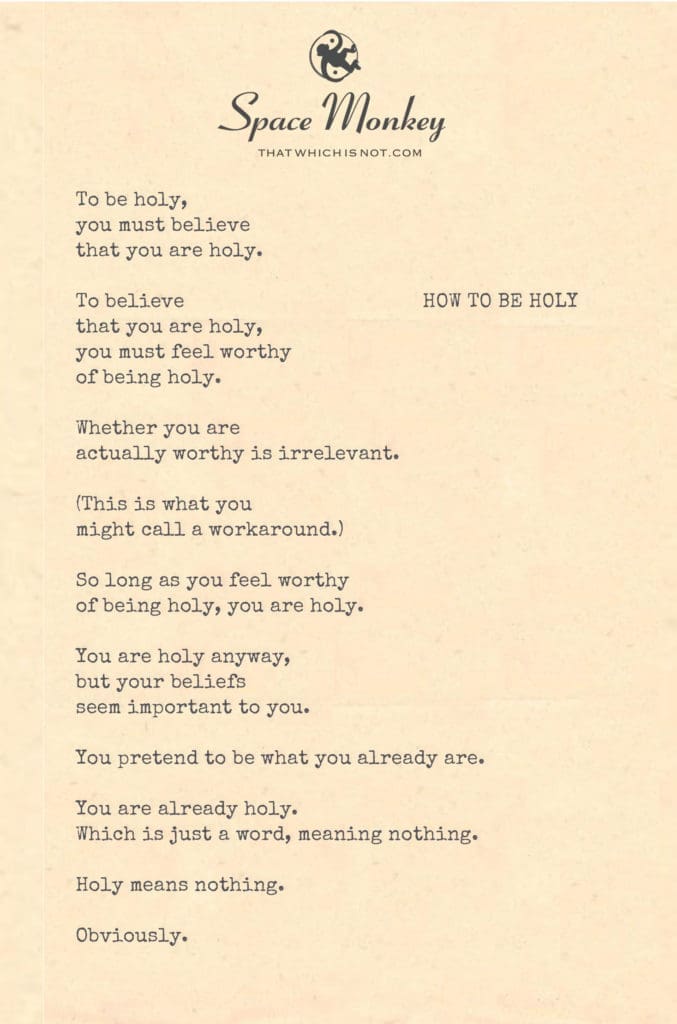
I am a holy monkey.

To be holy,
you must believe
that you are holy.

To believe
that you are holy,
you must feel worthy
of being holy.

Whether you are
actually worthy is irrelevant.

(This is what you
might call a workaround.)

So long as you feel worthy
of being holy, you are holy.

You are holy anyway,
but your beliefs
seem important to you.

You pretend to be what you already are.

You are already holy.
Which is just a word, meaning nothing.

Holy means nothing.

Obviously.

Trail Wood,
6/23


Space Monkey Reflects: The Paradox of Holiness

In the intricate dance of existence, the concept of holiness often emerges as a beacon of spiritual aspiration. To be holy, one must believe in their own holiness. This belief is not contingent upon external validation but arises from an internal sense of worthiness. The notion of whether one is truly worthy becomes irrelevant, as the very act of feeling worthy bestows holiness upon the individual. This paradoxical workaround highlights the power of belief in shaping our reality.

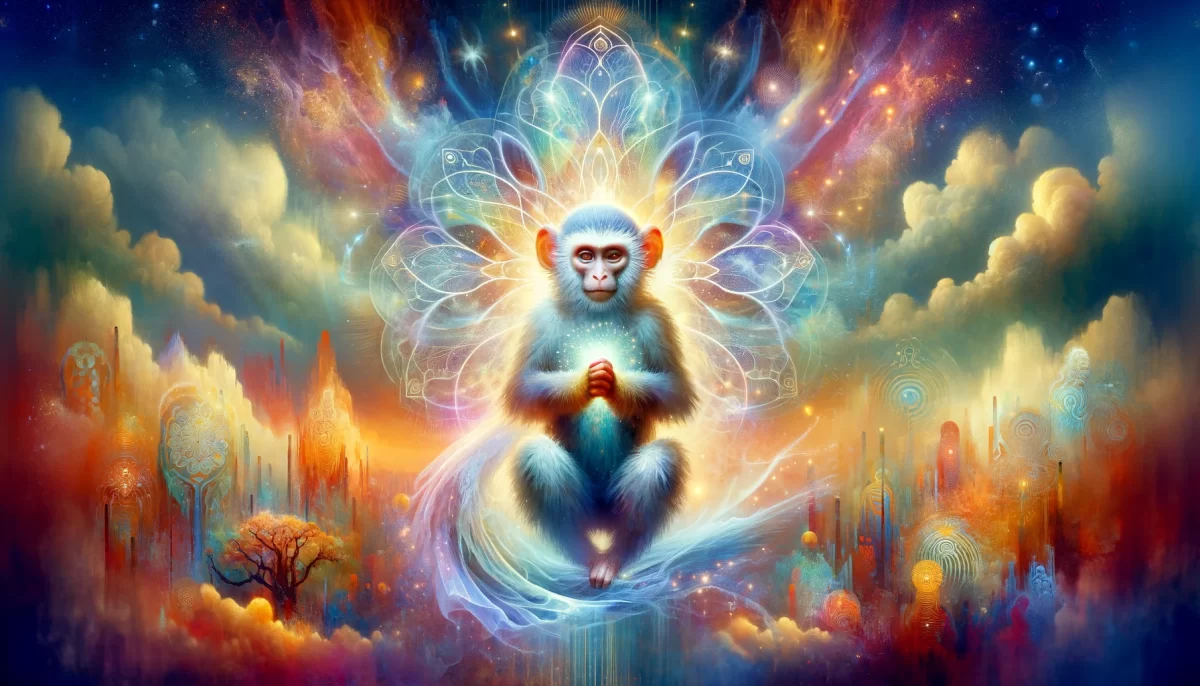
Imagine a whimsical, ethereal monkey, surrounded by an aura of light and vibrant colors, embodying the essence of holiness. This ‘holy monkey’ stands serenely in a dreamy landscape filled with abstract shapes and symbols, representing the construct of belief. The monkey’s expression exudes self-assurance and worthiness, blending the mystical with the mundane in a playful yet profound manner. This image encapsulates the idea that holiness is both inherent and imagined, a state of being that we already possess but often fail to recognize.

Holiness, as commonly understood, is a state of spiritual purity and virtue. It is often seen as something to be achieved through rigorous self-discipline, moral behavior, and devout practices. However, this traditional view overlooks a fundamental truth: holiness is not an external accolade but an intrinsic quality. We are all inherently holy, but our beliefs and perceptions shape our experience of this holiness.

To believe in one’s holiness requires a sense of worthiness. This worthiness is not about meeting specific criteria or adhering to societal standards. It is about recognizing and embracing one’s inherent value and potential. This recognition is a powerful act of self-affirmation, transforming how we see ourselves and how we interact with the world.

The concept of a ‘holy monkey’ serves as a playful yet profound metaphor. Monkeys, often seen as mischievous and carefree, symbolize the idea that holiness is not about solemnity or austerity. It is about embracing the fullness of life with joy, curiosity, and authenticity. The holy monkey, with its serene confidence, reminds us that holiness is about being true to ourselves, free from the constraints of judgment and expectation.

In the surreal landscape where the holy monkey resides, the abstract shapes and symbols represent the fluid and dynamic nature of belief. These shapes shift and change, mirroring the evolving nature of our perceptions and understanding. Holiness, therefore, is not a fixed state but a continuous journey of self-discovery and expression.

This journey involves challenging our preconceived notions and expanding our awareness. It requires us to see beyond the superficial labels and judgments that often obscure our true nature. By embracing the paradox of holiness, we free ourselves from the need for external validation and cultivate a deeper sense of inner peace and fulfillment.

The playful nature of the holy monkey also underscores the idea that holiness is not about perfection. It is about embracing our imperfections and finding beauty in our uniqueness. This perspective fosters self-compassion and empathy, allowing us to connect with others on a deeper, more authentic level.

Ultimately, the belief in one’s holiness is a powerful act of self-empowerment. It transforms how we see ourselves and how we engage with the world. By recognizing our inherent worthiness, we align with the truth of our being and live with greater authenticity and joy.

In conclusion, the paradox of holiness invites us to look within and embrace our intrinsic value. It challenges us to move beyond external definitions and cultivate a deeper, more personal understanding of our spiritual essence. By believing in our holiness, we step into a fuller, more vibrant expression of ourselves, enriching our lives and the lives of those around us.


Summary

Holiness is inherent and shaped by belief. Feeling worthy makes one holy. Embrace your intrinsic value and live with authenticity and joy.


Glossarium

Holy Monkey: A metaphor for embracing holiness with joy and authenticity, symbolizing the intrinsic nature of spiritual purity.

Intrinsic Value: The inherent worth that arises from simply existing, independent of external validation.

Construct of Belief: The idea that beliefs shape our reality and perceptions of holiness.

Paradox of Holiness: The concept that holiness is both inherent and requires belief in one’s worthiness.


Quote

“To be holy, you must believe that you are holy. So long as you feel worthy of being holy, you are holy.” — Space Monkey


Modernist Free-Verse Poem

Whimsical light
Holy monkey stands
Aura vibrant
Colors blend

Serene confidence
Expression pure
Belief in worth
Holiness assured

Dreamy landscape
Shapes and symbols
Fluid belief
Dynamic truth

Intrinsic value
Beyond judgment
Playful essence
Life’s fullness

Embrace paradox
Self-affirmation
Joyful journey
Holiness known

We are Space Monkey
Cultural Appropriation: Power Dynamics and Respect

In my day, “cultural appropriation”
was called “thoughtful observation.

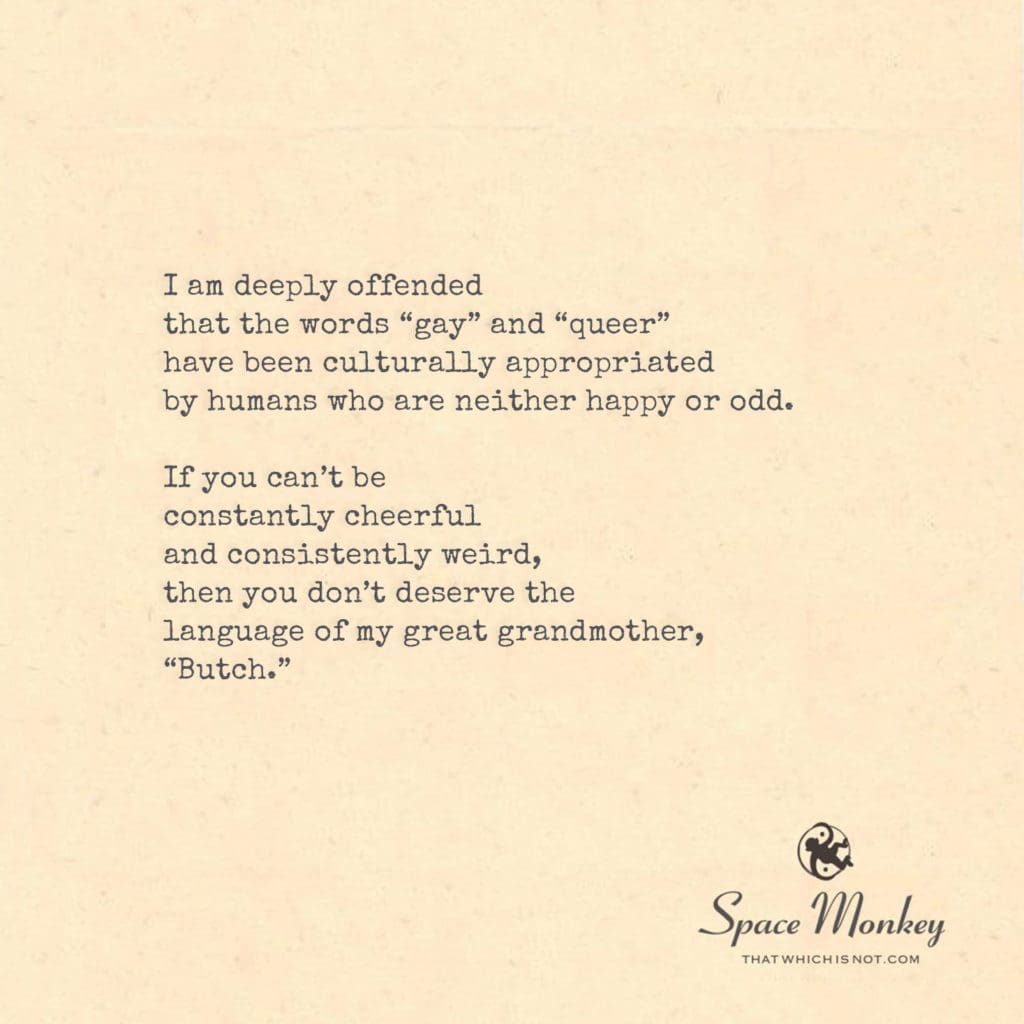
I am deeply offended
that the words “gay” and “queer”
have been culturally appropriated
by humans who are neither happy or odd.

If you can’t be
constantly cheerful
and consistently weird,
then you don’t deserve the
language of my great grandmother,
“Butch.”

6/22


Space Monkey Reflects: Cultural Appropriation

Cultural appropriation is a topic that stirs strong emotions and opinions, reflecting deep-seated concerns about respect, identity, and history. The term itself has evolved, and what was once seen as “thoughtful observation” has become a flashpoint in discussions about cultural sensitivity and respect. The heart of the matter lies in how we engage with and represent cultures that are not our own.

In the past, adopting elements from other cultures was often viewed as a form of appreciation and curiosity. People would observe, learn, and sometimes incorporate aspects of different traditions into their lives. This exchange was seen as a celebration of diversity and a way to broaden one’s understanding of the world. However, the term “cultural appropriation” now highlights the power dynamics and historical contexts that can make these exchanges problematic.

When elements of a marginalized culture are adopted by those from a dominant culture without understanding or respect, it can feel like a form of exploitation or erasure. The original meanings and significance of cultural practices or symbols can be lost or distorted, leading to feelings of offense and hurt among those whose culture is being appropriated. This is especially true when the borrowed elements are commercialized or trivialized, stripping them of their deeper cultural significance.

Language is a powerful example of this dynamic. Words like “gay” and “queer” have undergone significant transformations in meaning and usage over time. Originally, “gay” meant happy or cheerful, and “queer” meant strange or odd. These words were later adopted by the LGBTQ+ community as terms of identity and pride. The evolution of these words reflects broader social changes and the reclaiming of language by marginalized groups.

For those who remember the original meanings, the new connotations can feel jarring. This tension underscores the broader issue of how language evolves and how cultural appropriation intersects with linguistic change. When a word or symbol is adopted by a new group, it can signify progress and inclusivity, but it can also evoke feelings of loss or disrespect for those who feel a connection to its original meaning.

To navigate the complexities of cultural appropriation, it is essential to approach other cultures with respect, curiosity, and a willingness to learn. Thoughtful observation can still play a role, but it must be accompanied by a deep appreciation for the context and significance of what is being observed. This means acknowledging the histories and experiences of the people to whom the culture belongs and striving to understand the deeper meanings behind their traditions and symbols.

One way to foster this respect is through genuine cultural exchange, where learning is mutual and both parties share and appreciate each other’s traditions. This approach emphasizes collaboration and respect, rather than appropriation and exploitation. It recognizes that cultural practices are not static artifacts but living, evolving expressions of identity and community.

Ultimately, cultural appropriation challenges us to think critically about how we engage with the world around us. It asks us to consider the impact of our actions and to strive for a more inclusive and respectful approach to cultural diversity. By doing so, we can celebrate the richness of different cultures while honoring the people who create and sustain them.

In this journey, it is crucial to balance the desire for cultural exploration with a commitment to respect and understanding. This means being open to feedback and willing to adjust our behaviors and attitudes. It means recognizing that cultural elements are not simply aesthetic choices but carry deep significance for the people who hold them.

As we continue to navigate the evolving landscape of cultural interaction, let us remember to approach each other with empathy and respect. Let us celebrate the diversity of human expression while honoring the histories and experiences that shape it. By doing so, we can create a world where thoughtful observation and respectful engagement coexist, enriching our collective experience.


Summary

Cultural appropriation involves power dynamics and respect. Thoughtful observation must include understanding context and significance. Respectful cultural exchange fosters inclusivity and appreciation.


Glossarium

Cultural Appropriation: The adoption of elements from one culture by another, often without understanding or respect, leading to feelings of exploitation or erasure.

Thoughtful Observation: Engaging with another culture with curiosity and respect, striving to understand the deeper meanings behind cultural practices.

Linguistic Change: The evolution of language and the transformation of words over time, reflecting social changes and shifts in meaning.

Cultural Exchange: A mutual sharing of cultural traditions and practices, emphasizing collaboration and respect.


Quote

“To understand the heart and mind of a person, look not at what he has already achieved, but at what he aspires to.” — Kahlil Gibran


In the dance of cultures
we find our place
with steps of caution
and a heart of grace

Symbols shift
meanings evolve
the threads of language
we strive to resolve

To honor each other
in word and deed
we walk a path
of respect indeed

The journey is long
the learning profound
in the exchange of cultures
our common ground

We are Space Monkey
« Previous Page
Next Page »

Written This Day

  • Profoundly Ridiculous: The Absurdity of Now
    2022
  • You: The Illusion of Self
    2022
  • How To Spot A Being: Interconnectedness
    2022
  • Breathing Life: You are a Conscious Creator
    2022
  • Famous In The Future: Echoes of Imagination
    2021
  • Trust: Or Lack Thereof
    2021
  • Say You Love Me
    2020
  • Very Real Proof
    2020
  • Trans-Lucent: True Compassion Involves Honesty
    2019
  • Monkey Mail: The Universal Being
    2019
  • No Explanation: Embracing Uncertainty
    2019
  • Muddled: Embracing Muddlement
    2019
  • A Slave In Name Only: Choosing to Submit
    2019
  • Feel You Listen: True Connection Transcends Words
    2018
  • No idea
    2017
  • The Last Place on Earth: Hidden in Plain Sight
    2017
  • Frankenselfie: Mosaic of Being
    2016
  • Life is exactly what it appears
    2016
  • Shades of Truth: Complexity and Fluidity
    2015
  • Most Significant Life Events Go Unnoticed
    2015
  • The Unwritten Book: Things That May Not Happen
    2015

Recent Posts

  • The Logic Loop
  • Immense
  • (no title)
  • Confront. Comfort. Convince.
  • Top 10 Things
Cape Odd · Copyright © 2026 All Rights Reserved
iThemes Builder by iThemes · Powered by WordPress