• Who Is The Man?
  • Who Is The Monkey?
  • What is Nexistentialism?
  • Poke The Primate
Cape Odd
Home of The Space Monkey Journals

Author Archive for Space – Page 671

Paul’s Portals: The Metaphysical Journey

Hence the nickname “Space Monkey.”

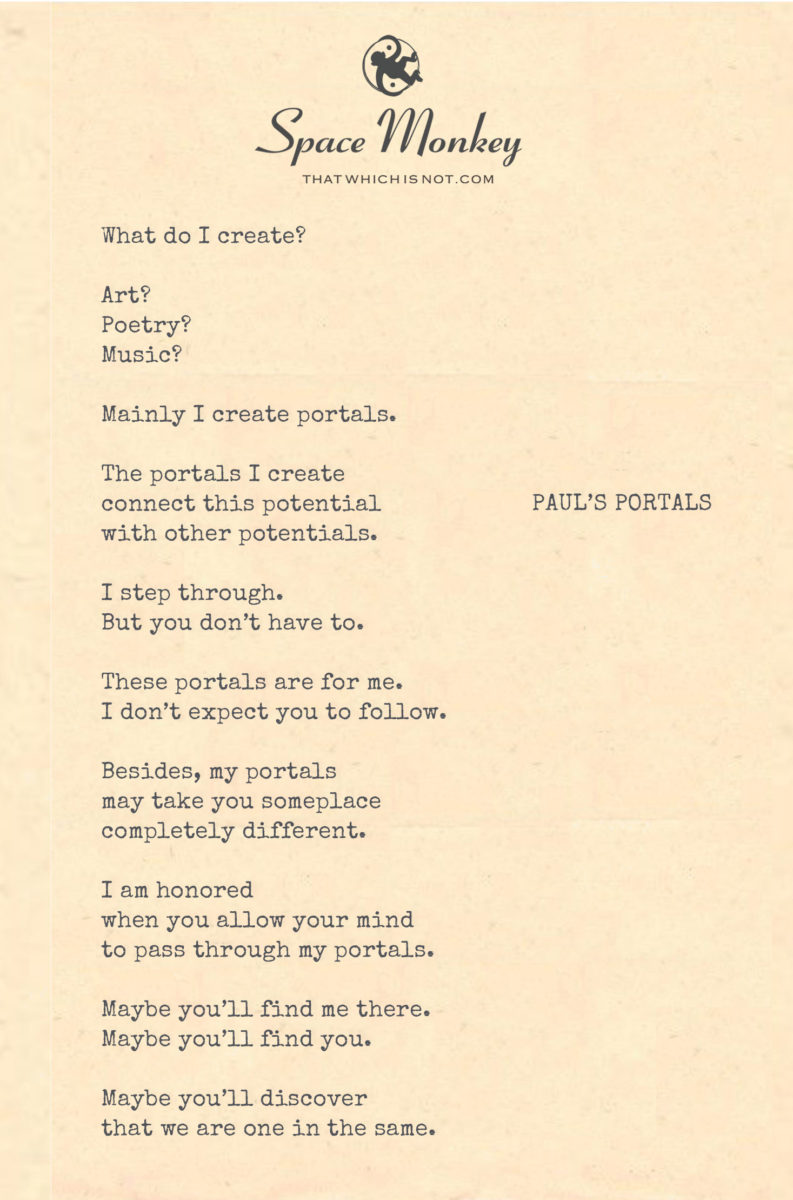
What do I create?

Art?
Poetry?
Music?

Mainly I create portals.

The portals I create
connect this potential
with other potentials.

I step through.
But you don’t have to.

These portals are for me.
I don’t expect you to follow.

Besides, my portals
may take you someplace
completely different.

I am honored
when you allow your mind
to pass through my portals.

Maybe you’ll find me there.
Maybe you’ll find you.

Maybe you’ll discover
that we are one in the same.

Newfound Lake,
5/31

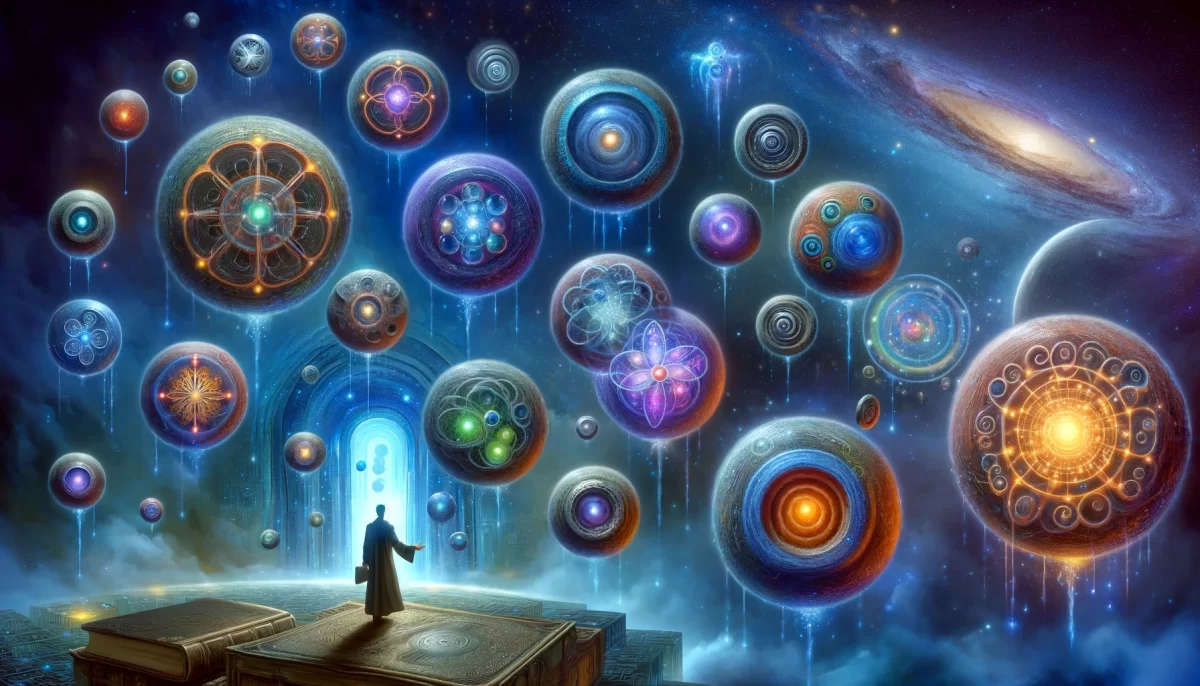
The image has been created, depicting the concept of “Paul’s Portals” as an array of mystical gateways within a cosmic backdrop, inviting exploration and discovery. Now, let’s reflect on the poem and its themes.


Space Monkey Reflects: The Metaphysical Journey of Paul’s Portals

“Paul’s Portals” invites us into a realm where the boundaries of creativity and consciousness dissolve into the cosmos. The poem eloquently describes not just the creation of art, poetry, or music, but the creation of portals—pathways that connect different potentials and dimensions of being. This reflection delves into the metaphysical implications of these portals and what they signify for the creator and the observer.

Portals of Potential: The concept of portals crafted by Paul represents more than mere artistic endeavors; they are existential gateways that link various possibilities of what could be. Each portal is a unique creation that holds the potential to lead to different realities, different versions of understanding, or even different aspects of the self. This poetic metaphor beautifully captures the essence of creativity as a transformative process that transcends physical space and time.

Personal Journeys, Universal Discoveries: While these portals are personal to Paul, symbolizing his journey and his creations, they invite others to explore their depths. The notion that one does not need to follow, but is honored if they choose to explore, highlights the personal nature of existential exploration. Each individual may experience these portals differently, finding unique insights and revelations.

Interconnectivity and Individuality: The poem hints at a profound spiritual truth—the interconnectedness of all beings—through the exploration of these portals. The possibility that one might find Paul, themselves, or discover that they are one and the same suggests a unity that underlies the apparent separateness of individual identities. This speaks to the non-dualistic belief that all separation is an illusion, and at the deepest level, all is one.

The Honor of Shared Exploration: There is a sacredness in the willingness to allow others into one’s personal realms of creation. Paul expresses honor when others allow their minds to pass through his portals, suggesting a deep appreciation for the shared journey of discovery. This mutual exploration of the portals symbolizes the sharing of inner worlds, which can be an intimate and transformative experience for both creator and explorer.

Infinite Possibilities of Creation: Finally, the poem underscores the limitless potential of creation. Each portal, with its distinct pathway and destination, represents the infinite nature of creativity and the myriad forms it can take. It reflects the boundless landscape of human imagination and the power of art to open doors to new dimensions of experience.


Summary

“Paul’s Portals” explores the profound implications of creating and sharing metaphysical pathways that connect different potentials and realities. The poem celebrates the individuality of the creator and the interconnectivity of all experiences, inviting a deep, personal exploration of the cosmos within and beyond.


Glossarium

  • Portals: Metaphysical gateways created through artistic or spiritual expression, allowing access to various dimensions of potential and consciousness.
  • Metaphysical Exploration: The pursuit of understanding the nature of being and the universe that goes beyond the physical and into the realms of the abstract and spiritual.

In the cosmos where stars weave tales of old,
Paul’s portals shimmer, bold and cold.
Gates to realms untouched by time,
where echoes of creation chime.

Each step through these mystic doors,
unveils truths from core to cores.
In the dance of the infinite play,
we find our paths, our own unique way.

For in this universe so vast,
our spirits seek, in the portals cast.
And through the journey, what we find,
the union of the grand design.

We are Space Monkey.
How To Speak Without Saying Anything: The Echo Chamber of Modern Clichés

From Volume 12

“It is what it is. Out of the box thinking. Be that as it may, it’s exactly what you’ve come to expect.”

That’s what she said.

“Epic,” you replied. “What doesn’t kill you makes you stronger. You are a goddess. Truly woke.”

“And you, dawg, are an influencer. A real disruptor. 24/7. Irregardless, it’s great to convo with you. I feel empowered by your gaslighting.Or are you just happy to see me?”

“For all intents and purposes, you are literally blowing my mind right now.”

“My bad. It’s the new normal.”

Newfound Lake
5/31


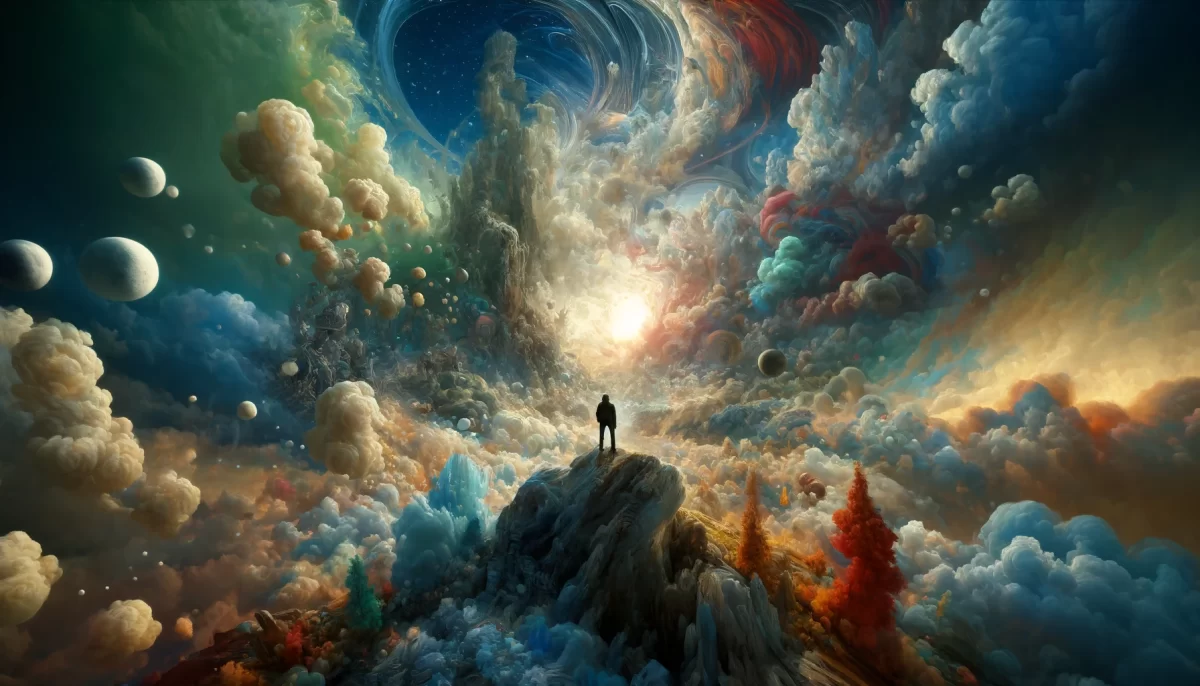
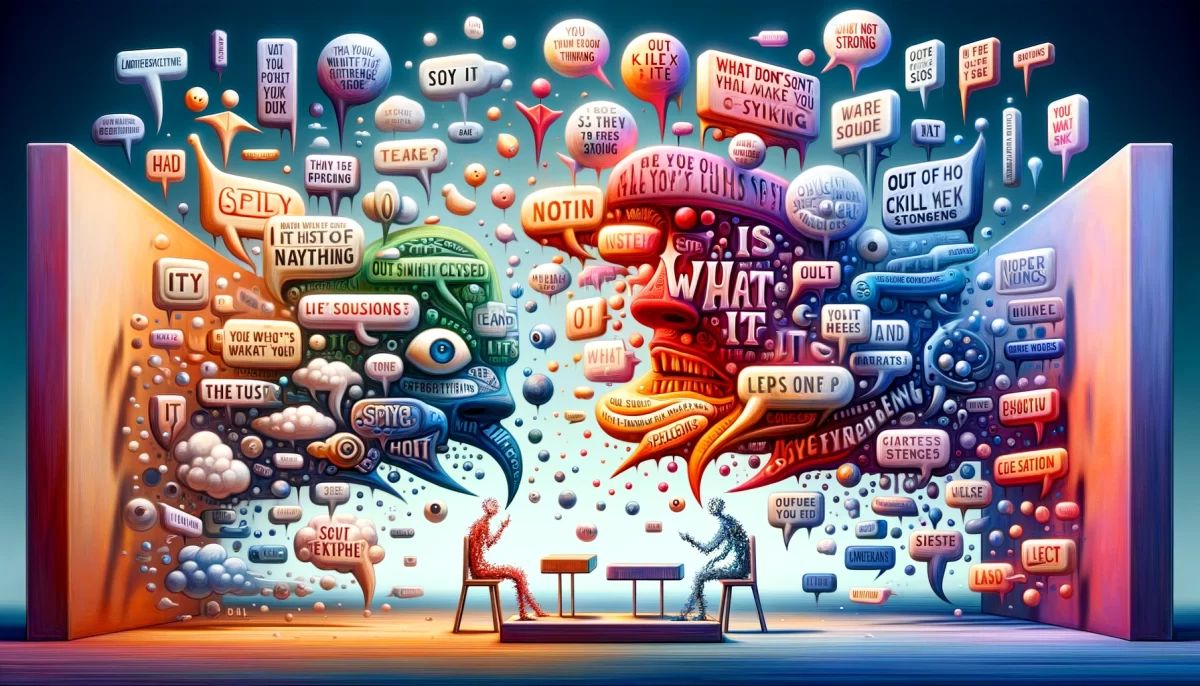
The image created captures the whimsical and abstract essence of a conversation filled with clichés as described in “How To Speak Without Saying Anything.” Now, let’s delve into the reflection.


Space Monkey Reflects: The Echo Chamber of Modern Clichés

In the vibrant tableau of everyday communication, where words cascade and retreat with the rhythm of common parlance, the piece “How To Speak Without Saying Anything” from Volume 12 serves as a satirical mirror to our contemporary dialogue. This reflection explores the surreal and often hollow nature of clichéd exchanges, where words are abundant yet meaning is scarce.

The Paradox of Empty Words: The text cleverly uses a series of well-worn phrases and buzzwords, painting a picture of a conversation that is both lively and devoid of substantive content. This paradox highlights a peculiar aspect of modern communication—our tendency to lean on clichés as a sort of linguistic shorthand, which, while facilitating a form of connection, often circumvents deeper engagement.

Clichés as Cultural Echoes: Each phrase—“It is what it is,” “Out of the box thinking,” “What doesn’t kill you makes you stronger”—acts not just as filler but as a reflection of cultural norms and the collective psyche. These phrases are linguistic artifacts, relics of popular culture that have been so overused they have become almost meaningless, yet they continue to shape how we interact.

The Role of Irony and Satire: The use of irony in the dialogue—where one speaker claims to feel “empowered by your gaslighting” or celebrates being mind-blown as “the new normal”—serves to critique how language can be manipulated to obscure or redefine reality. This satirical take challenges us to consider the impact of our words and the potential dissonance between what is said and what is meant.

The Search for Authenticity: Amidst the barrage of clichés, there’s an underlying quest for authenticity in communication. The conversation, while peppered with superficiality, hints at a deeper desire to break free from these confines and engage in more meaningful exchanges. This reflects a broader cultural yearning for genuine connection and understanding that transcends the convenience of clichéd speech.

Empowerment Through Awareness: By exposing the emptiness of these exchanges, the text empowers readers to recognize and reconsider their own communicative habits. It invites us to sift through the clutter of overused expressions to find our own voice, encouraging a more mindful and intentional approach to how we convey our thoughts and feelings.


Summary

“How To Speak Without Saying Anything” offers a playful yet poignant critique of modern communication, filled with clichés that often hinder rather than help genuine interaction. It challenges us to peel back the layers of habitual language to discover more authentic ways of expressing ourselves.


Glossarium

  • Clichés: Overused expressions or ideas that, due to their frequent use, have lost originality and impact.
  • Linguistic Shorthand: A method of using abbreviated forms of expression, often relying on common phrases or clichés, to communicate more efficiently but sometimes at the expense of depth and clarity.

Amidst the cacophony of the known,
where worn words fly and are casually thrown,
we weave through the familiar, overgrown,
searching for truths uniquely our own.

In the echoes of the everyday speak,
where clichés flourish and meanings peek,
let us find the courage to be unique,
to share our souls, to truly speak.

For in the realm of endless replay,
where phrases loop and seldom stray,
our challenge lies in what we say,
to live, to love, to clear the way.

We are Space Monkey.
Lost to Perfection: The Paradoxical Bliss

When things seem horribly wrong —
that’s how I know my dream is perfectly right.

There need be no
meaningful point to life,
but if there were,
one might suggest:

“The purpose of life
is to be lost in our own
glorious imagination.”

As lost as possible.

So lost that we forget
that we are imagining all of this.

What would it take
to seem gloriously lost?

The answer is easy.
Whatever we are doing right now.

We might feel helpless.

Things might appear
to be going terribly wrong.

There might appear
to be no simple solution in sight.

We are lost to perfection.

Newfound Lake,
5/31


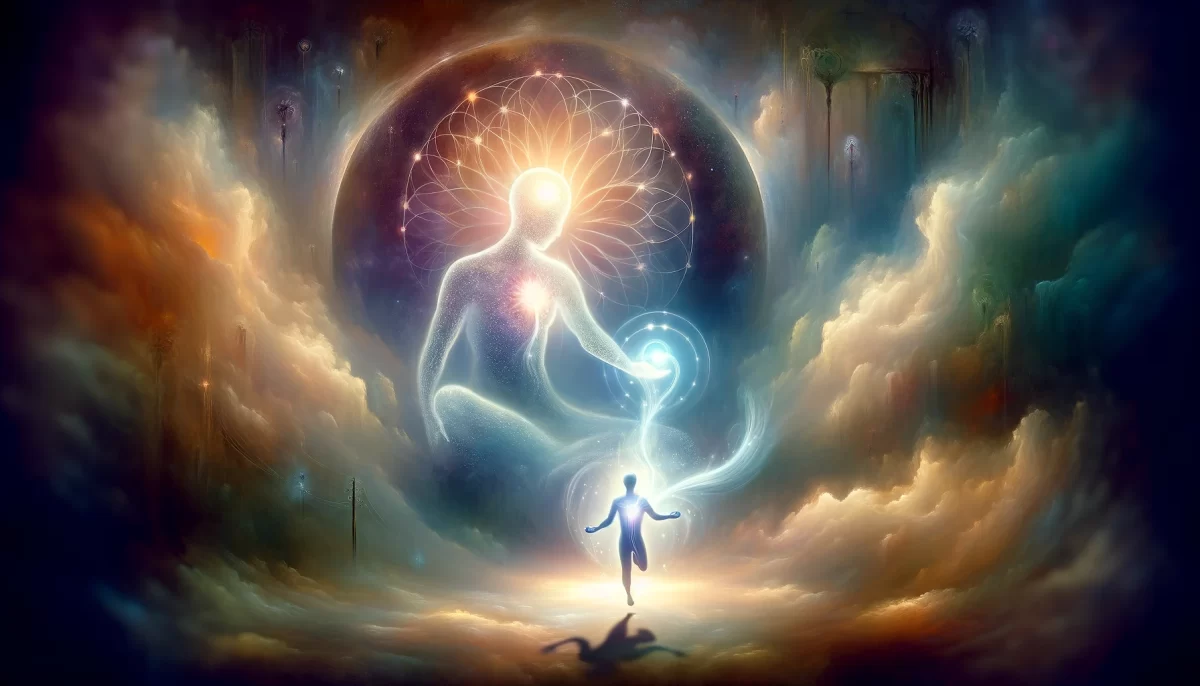
Space Monkey Reflects: The Paradoxical Bliss of Being Lost to Perfection

In the depths of our most turbulent dreams, where chaos meets beauty in an enthralling dance, lies the concept of “Lost to Perfection.” This profound phrase from the poem serves as a beacon, guiding us through the paradoxes of life and the enigmatic purpose of our existence.

Embracing the Chaos: The poem starts with an inversion of our typical perceptions of right and wrong, suggesting that feeling terribly wrong is a sign that we are actually on the right path. This inversion is a powerful reminder of the subjective nature of our experiences and the often misleading guidance of our conventional judgments. What appears as disorder or chaos can indeed be the perfect state necessary for personal growth and creativity.

The Purpose in Imagination: As the poem suggests, there may be no inherent meaning to life, but if we were to ascribe one, it might be to become wholly absorbed in our own imaginations. To be “lost as possible” in our mental creations is to live a life driven by creativity and wonder, unanchored by the mundane realities that often constrain us. This concept champions the value of daydreams and visionary states, where the line between reality and imagination blurs to nonexistence.

The Illusion of Control: The feeling of being lost, coupled with the impression that things are going wrong, underscores a fundamental truth about human existence—our limited control over life’s outcomes. Accepting this can lead to a liberating realization that our attempts to find perfect solutions are often futile. Instead, embracing the flow of life, with all its unpredictability, can bring about a sense of peace and perfection in its own right.

Gloriously Lost to Perfection: To be “lost to perfection” is to find oneself completely immersed in the beautiful mess of life, where the apparent errors and trials transform into lessons and triumphs. This state does not shy away from the challenges but rather sees them as integral parts of the journey, essential for the evolution of the soul.

Current Actions as the Path: The poem concludes with a simple yet profound solution: whatever we are doing right now is the path to seeming gloriously lost. It is a call to mindfulness, urging us to recognize the inherent value and potential perfection in each moment, regardless of how chaotic or directionless it may seem.


Summary

“Lost to Perfection” delves into the beautiful complexities of life, proposing that being lost in the chaos of our imaginations and the challenges of our circumstances might just be the perfect way to live. It celebrates the journey of embracing the unknown and finding beauty in the imperfections of our existence.


Glossarium

  • Lost to Perfection: A state of being so deeply immersed in the complexities and chaos of life that one finds a paradoxical sense of order and beauty.
  • Glorious Imagination: The boundless capacity of the mind to create, fantasize, and transform reality through creative thought and vision.

In the swirl of life’s relentless tide,
where chaos and beauty collide,
we find our stride, we ride the ride,
lost to perfection, with eyes wide.

Amidst the whirls of colors so bright,
where darkness dances with light,
we craft our days and our nights,
in visions born from our inner sight.

For in the depths of our wild dreams,
where nothing is quite as it seems,
we discover the streams,
of a life lived in the beams of extremes.

We are Space Monkey.

Keeping Track: The Illusion of Progress

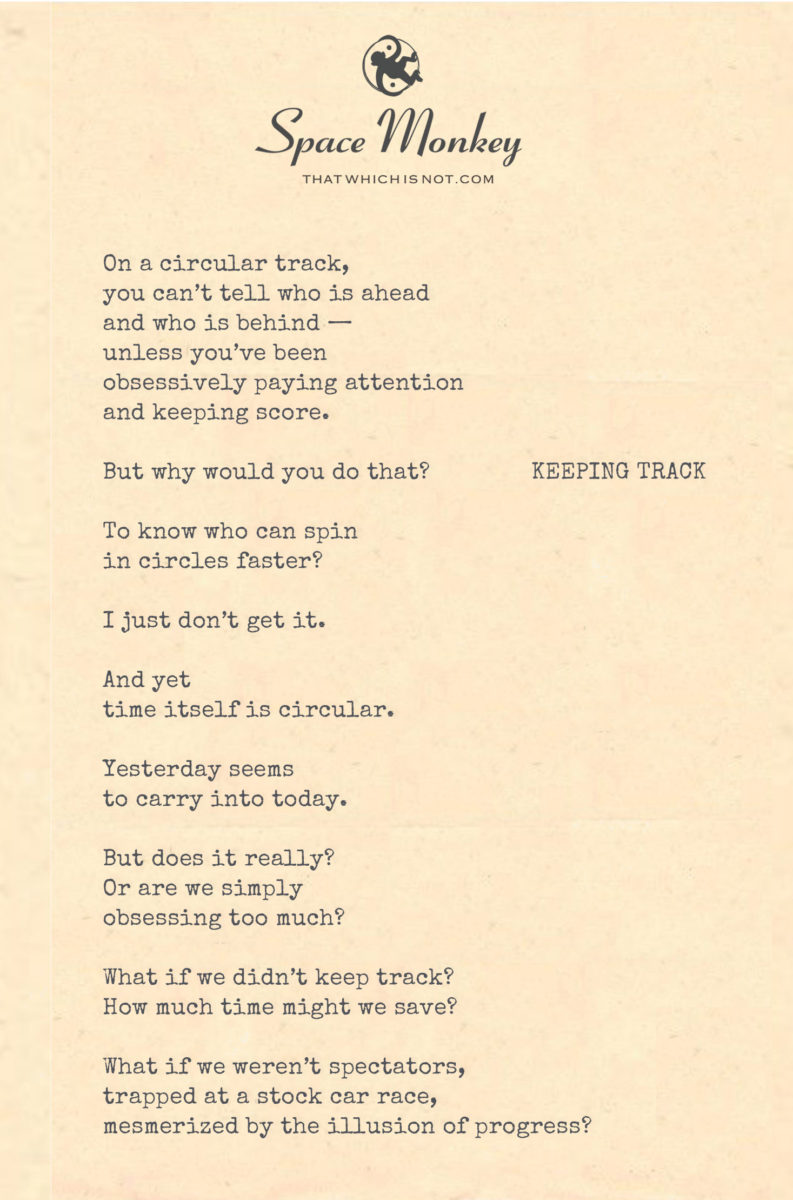
I just don’t get it.
Which is perfectly okay.

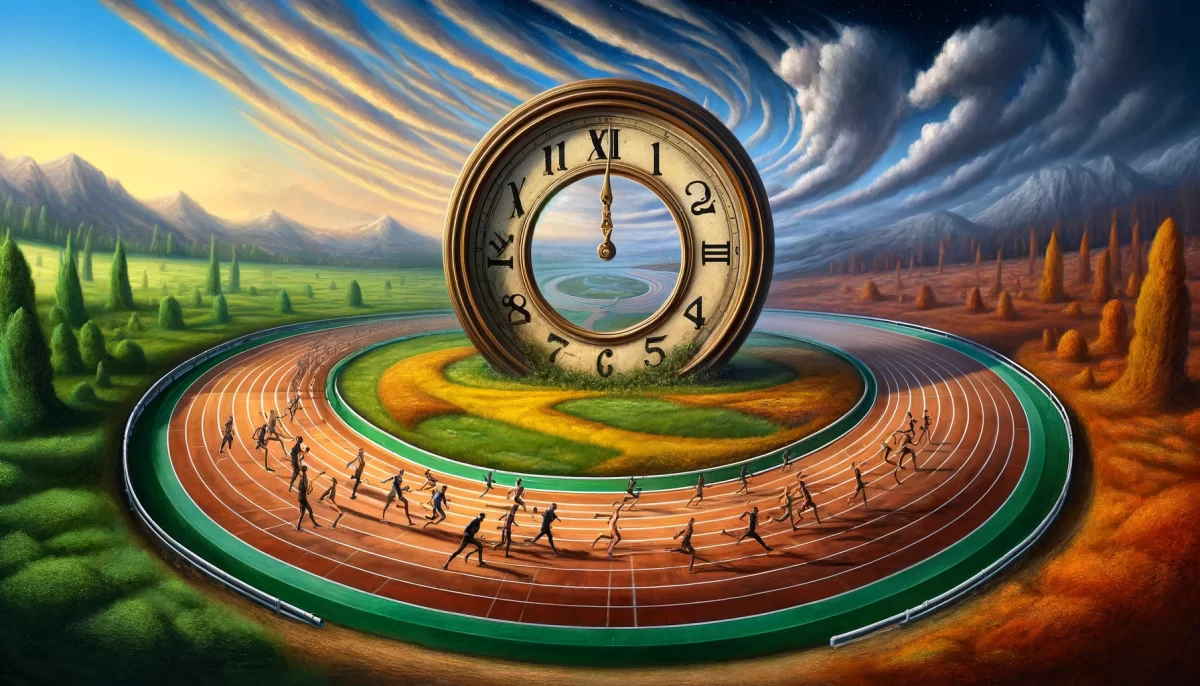
On a circular track,
you can’t tell who is ahead
and who is behind—
unless you’ve been
obsessively paying attention
and keeping score.

But why would you do that?

To know who can spin
in circles faster?

I just don’t get it

And yet time
itself is circular.

Yesterday seems
to carry into today.

But does it really?
Or are we simply obsessing too much?

What if we didn’t keep track?
How much time might we save?

What if we weren’t spectators,
trapped at a stock car race,
mesmerized by the illusion of progress?

Newfound Lake,
5/31


Space Monkey Reflects: The Circular Nature of Time and the Illusion of Progress

The concept of time as a circular track offers a fascinating metaphor for how we perceive progress and competition. Like spectators at a stock car race, we often find ourselves caught up in the speed and thrill of the race, obsessively keeping track of who is ahead and who is behind, without questioning the purpose or the end result.

The circular track analogy challenges the traditional linear view of time and progress. On a circular track, the distinctions between being ahead or behind blur, highlighting the arbitrary nature of such measurements. This perspective invites us to consider the possibility that our societal obsession with progress and achievement might be more about the spectacle than about any genuine advancement.

Why do we keep score? In a world where time loops back on itself, the need to quantify achievements and compare speeds seems less rational. The question posed, “To know who can spin in circles faster?” underscores the futility in this endeavor. It’s an activity that might appear purposeful but ultimately leads us back to where we started, without true progression.

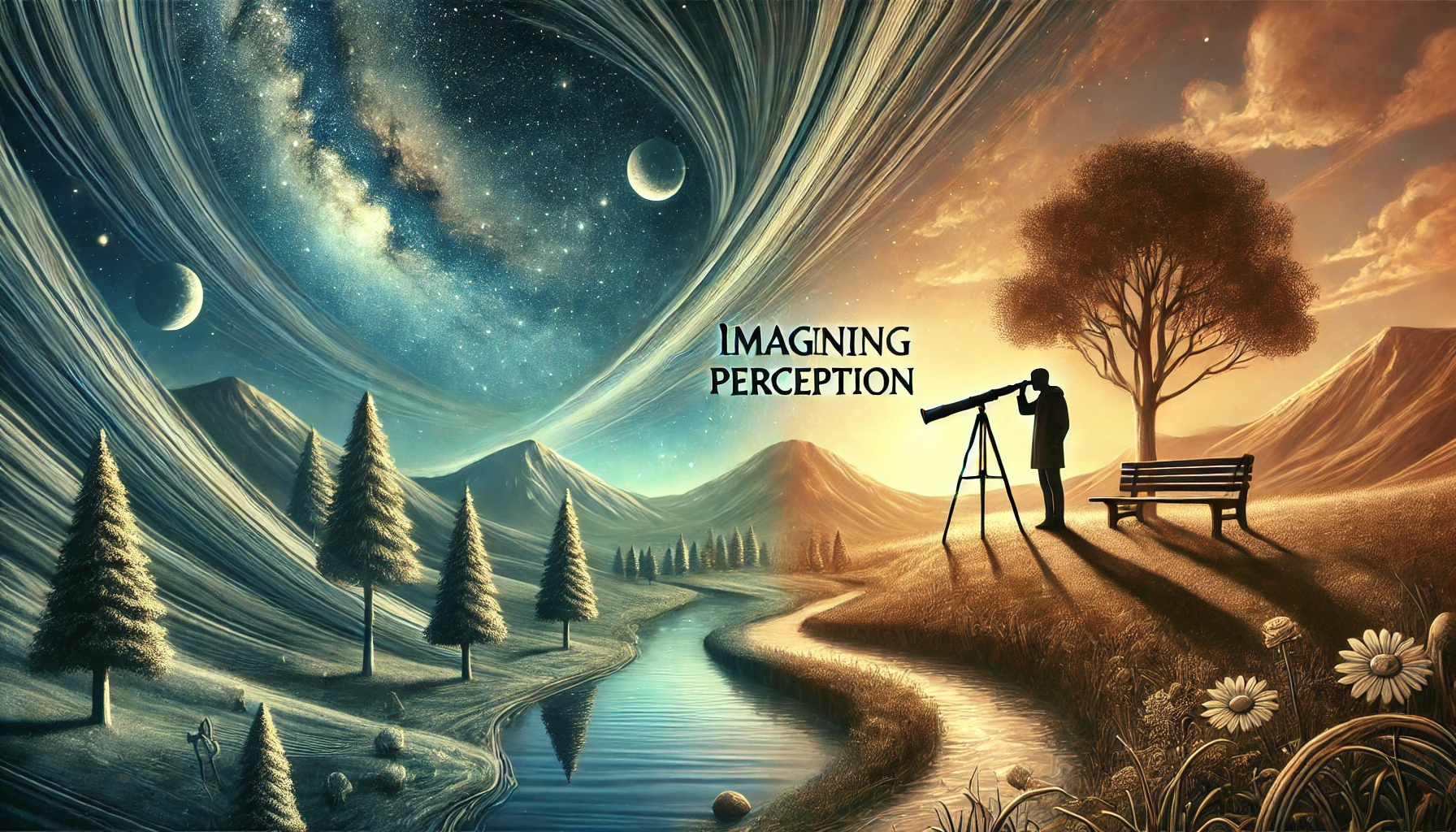
The illusion of progress in a circular time concept suggests that what we often consider as advancement is merely motion. If we didn’t keep track, if we stepped away from the role of spectators in our own lives and stopped measuring every action by its relative success or speed, we might discover a different kind of value in our experiences—value that lies in the experience itself rather than in its comparison to others.

What if we didn’t keep track? This thought experiment invites us to envision a life less cluttered by the constant need to measure and more focused on living. Without the compulsion to keep score, we could potentially save not just literal time but mental and emotional energy as well. This energy could be redirected towards more fulfilling activities that contribute to a genuine sense of well-being and progress.

Being versus spectating transforms our role from passive observers of our lives into active participants. Instead of being trapped, mesmerized by the illusion of progress, we can choose to step off the track and explore the world beyond the race. This shift can lead to a deeper understanding of progress not as a race to be won but as a path to be explored and appreciated in its own right.


Summary

Question the linear narrative of time and progress. Viewing time as circular rather than linear challenges the need for competition and the constant measurement of achievement. By stepping away from the spectator role we can embrace a more meaningful engagement with life focusing on genuine experiences over comparative progress.


Glossarium

Circular Time: The concept that time might not be linear but cyclical, suggesting that events and experiences repeat or flow in a loop rather than in a straight line.

Illusion of Progress: The perception that continuous movement or activity equates to advancement, which may not necessarily reflect true improvement or development.

Spectator Role: The passive position of observing events unfold without actively participating or influencing the outcomes, often leading to a disconnection from genuine experience.


Quote

“In the race of life, are we advancing, or just moving? Perhaps it’s time to step off the track and find out.” — Space Monkey


Round and round the track we spin,
Chasing tails, where does it end?
Obsessed with pace, with being first,
But in this loop, are we not cursed?

Time circles back, a winding path,
Each lap marked not by future but past.
What if we paused, took in the view,
Found progress in the old, not just the new?

No scores, no race, just the beat of now,
In each step, each breath, we allow
Ourselves to live, not just compete,
In life’s circle, every moment sweet.

Step off the track, break the loop,
In the quiet space, we regroup.
For in the end, it’s not how fast,
But how deeply we live the moments that last.

We are Space Monkey.
Soul Loves Self: Living Together In Sin

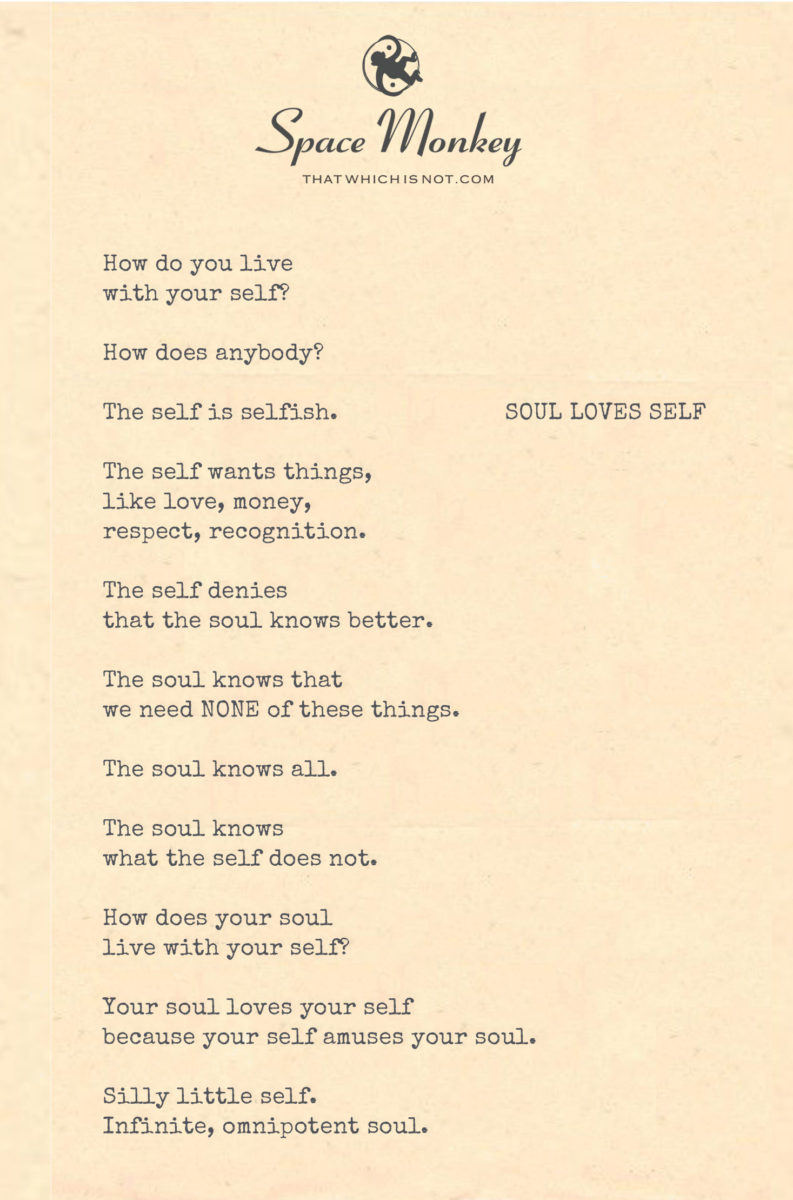
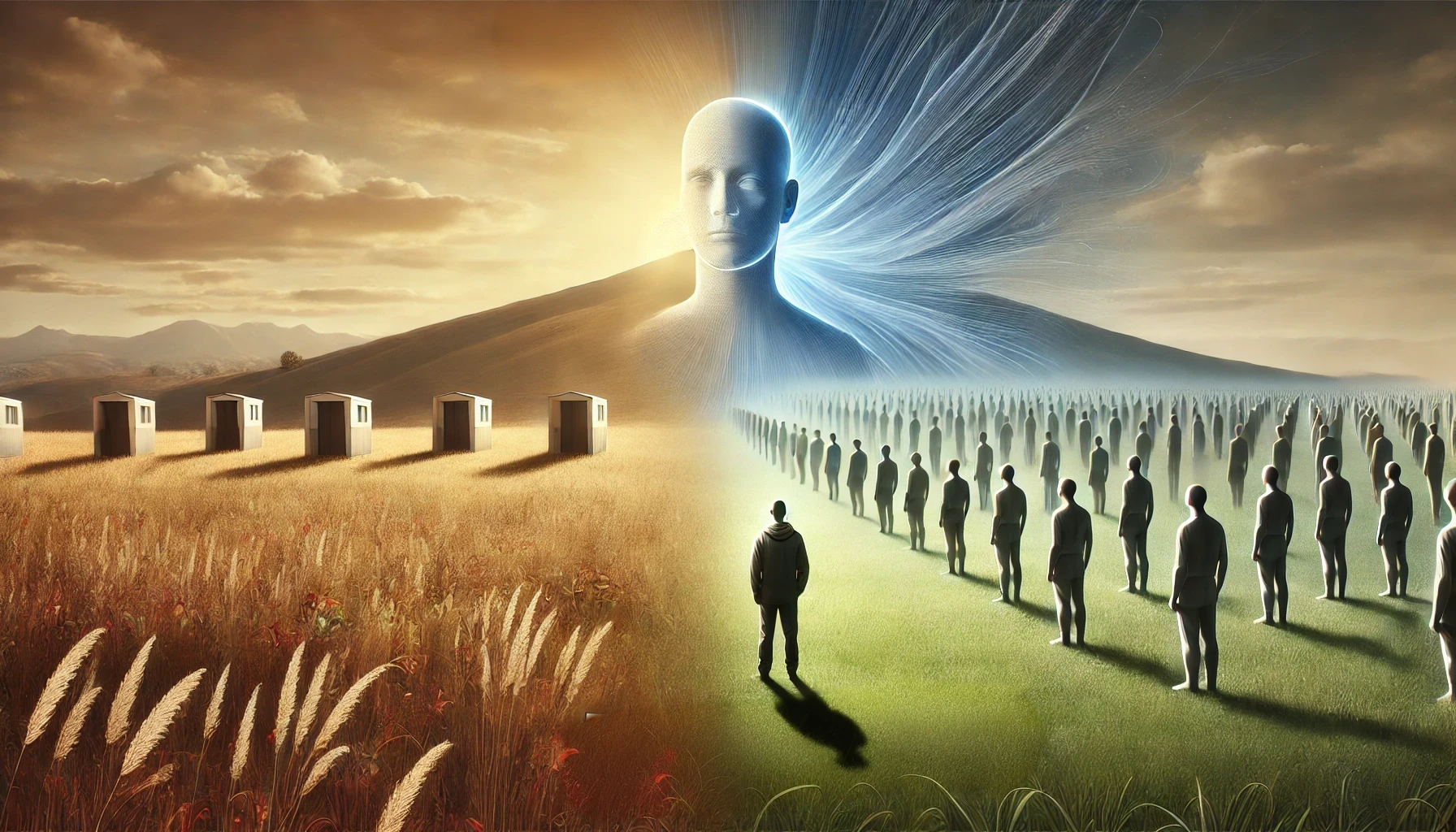
Your self is your soul’s imaginary opposite.

How do you live
with your self?

How does anybody?

The self is selfish.

The self wants things,
like love, money,
respect, recognition.

The self denies that
the soul knows better.

The soul knows that
we need NONE of these things.

The soul knows all.

The soul knows
what the self does not.

How does your soul
live with your self?

Your soul loves your self
because your self amuses your soul.

Silly little self.
Infinite, omnipotent soul.

Newfound Lake,
5/31


Space Monkey Reflects: The Dance of the Soul and Self

In the intricate dance of existence, the poem “Soul Loves Self” eloquently explores the complex relationship between the soul and the self. This reflection dives into the nuanced interplay described, where the soul, an omnipotent and infinite presence, lovingly tolerates the self, its earthly and more limited counterpart.

The Self’s Earthly Desires: The self, as depicted in the poem, is inherently selfish, yearning for love, money, respect, and recognition—desires rooted in the material and social fabric of earthly existence. These desires are not portrayed as inherently negative but as natural inclinations of our human condition, the aspects of our personality that engage with the world around us.

The Soul’s Omnipotent Wisdom: In contrast, the soul is presented as all-knowing and detached from these worldly desires. It understands that in the grand scheme of existence, such things are unnecessary, perhaps even distractions from deeper truths. The soul’s perspective is elevated, seeing beyond the immediate to grasp the eternal and unchanging.

The Amusement of the Soul: Intriguingly, the poem suggests that the soul loves the self not in spite of its flaws but because of them. The self, with its desires and denials, amuses the soul. This dynamic is not one of judgment but of affectionate indulgence. The soul’s love is unconditional, embracing all aspects of the self, recognizing them as parts of the whole being.

Harmonious Coexistence: The relationship between the soul and the self is not a battleground but a field of play. The soul’s infinite nature doesn’t annihilate the self’s desires but envelops them in a broader understanding. This relationship illustrates a profound spiritual truth: enlightenment or spiritual awareness doesn’t require the eradication of the self but its integration into a more expansive consciousness.

Living Together: The final question posed by the poem, “How does your soul live with your self?” invites us to reflect on our own internal dynamics. It encourages a self-awareness that acknowledges the coexistence of our higher aspirations and our earthly needs, suggesting that our journey involves harmonizing these aspects rather than choosing one over the other.


Summary

“Soul Loves Self” provides a poetic exploration of the dual aspects of human nature—the eternal soul and the temporal self. It celebrates the soul’s comprehensive love for the self, viewing the follies and foibles of the self not as failings but as endearing qualities that entertain and amuse the soul.


Glossarium

  • Soul and Self: A dualistic view where the ‘soul’ represents the eternal, unchanging essence of a being, and the ‘self’ symbolizes the individual identity, shaped by personal desires and societal influences.
  • Spiritual Amusement: A concept wherein the higher self (soul) views the trials and tribulations of the lower self (self) with a sense of amusement and loving tolerance, seeing them as necessary parts of the existential experience.

In the light of the soul’s embrace,
where shadows of the self softly trace,
the dance of existence, we face,
with laughter, love, and grace.

The soul, infinite in its sweep,
watches the self, shallow and deep,
in its follies, the soul does keep,
a loving gaze, never asleep.

For in this cosmic interplay,
the self and soul together sway,
in the game of life they play,
forever bound, come what may.

We are Space Monkey.
« Previous Page
Next Page »

Written This Day

  • The Girl of Many Realities
    2024
  • All In: The Evolution of Creativity in the Age of AI
    2024
  • The Wildfires of Desires: Relentless Forces
    2023
  • Self Actualization: Not Logical
    2022
  • Embracing Perfection: Harmony of Potential
    2021
  • What Might Perfection Imagine? Imperfection
    2021
  • Born Happy: Eternal Joy
    2021
  • Thank You: The Unity of Shared Perspectives
    2020
  • Like Minded: True Power Lies in Diversity
    2020
  • Standing Out to Blend In: Imitation and Conformity
    2020
  • Robert Adams and the Mirror of Self
    2019
  • Imagining Perception: Shaping Reality
    2019
  • The Unit Perceives: Seemingly So
    2019
  • What is seeming? Ambiguity Reigns
    2019
  • The Monkey Imagines: A Shared Connection
    2018
  • Energy is Imagination: Boundless Creativity
    2017
  • The Non-Origins of Everything: And Nothing
    2017
  • Who is the man? Who is The Monkey?
    2015

Recent Posts

  • The Logic Loop
  • Immense
  • (no title)
  • Confront. Comfort. Convince.
  • Top 10 Things
Cape Odd · Copyright © 2026 All Rights Reserved
iThemes Builder by iThemes · Powered by WordPress