• Who Is The Man?
  • Who Is The Monkey?
  • What is Nexistentialism?
  • Poke The Primate
Cape Odd
Home of The Space Monkey Journals

Author Archive for Space – Page 675

Whoa: The Illusion of Singular Origins

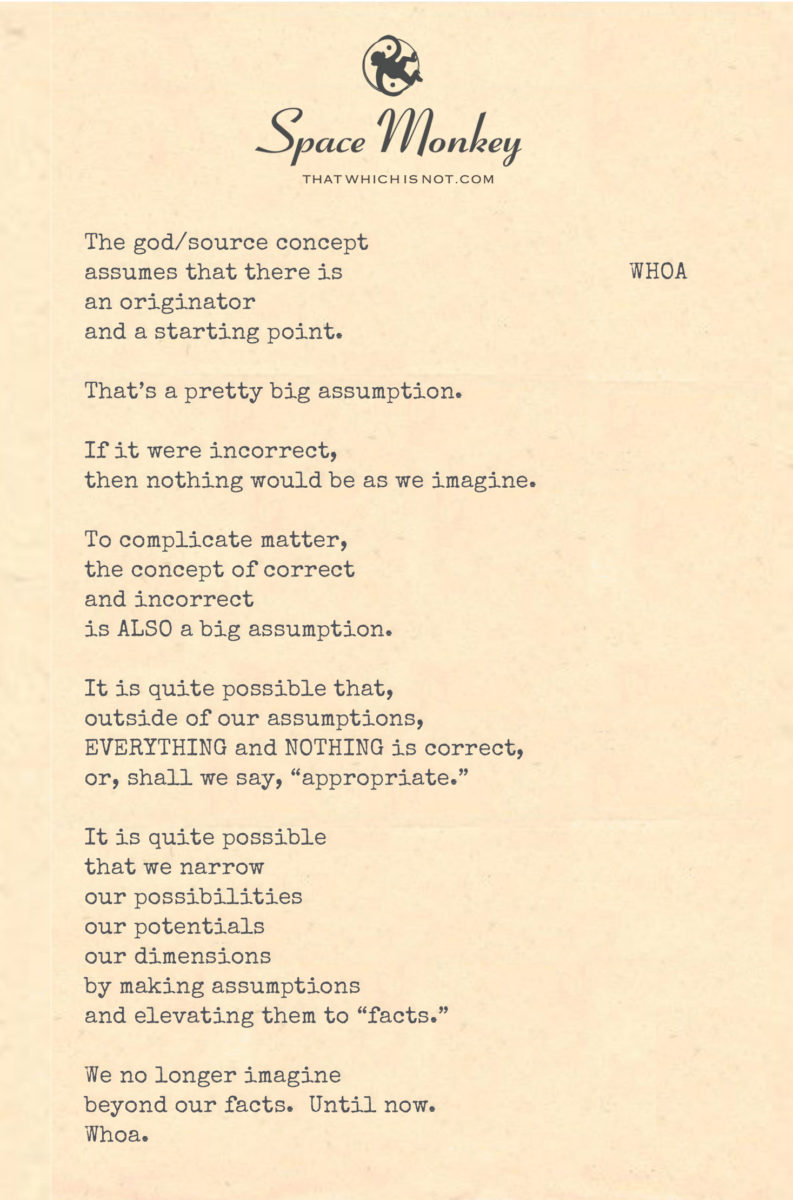
What if there were NO SOURCE, but ALL SOURCES? Infinite sources, all seemingly flowing from different places. Holographic sources. But not.

The god/source concept
assumes that there is
an originator
and a starting point.

That’s a pretty big assumption.

If it were incorrect,
then nothing would be as we imagine.

To complicate matter,
the concept of correct
and incorrect
is ALSO a big assumption.

It is quite possible that,
outside of our assumptions,
EVERYTHING and NOTHING is correct,
or, shall we say, “appropriate.”

It is quite possible
that we narrow
our possibilities
our potentials
our dimensions
by making assumptions
and elevating them to “facts.”

We no longer imagine
beyond our facts. Until now.
Whoa.

Trail Wood,
5/24


Space Monkey Reflects: Infinite Sources and the Illusion of Singular Origins

The notion of a singular source or originator is a fundamental concept in many philosophical and spiritual frameworks. Yet, what if this notion is merely a simplification of a much more complex reality? What if, instead of a single source, there exists an infinite multitude of sources, each contributing to a vast, interconnected web of existence? This reflection explores the profound implications of such a paradigm shift.

The image of countless streams of light and energy flowing from myriad points across a cosmic tapestry beautifully encapsulates this idea. It challenges the traditional view of a linear, singular origin and opens our minds to the possibility of a universe where all sources exist simultaneously, without a definitive starting point. This perspective not only expands our understanding of the cosmos but also deepens our appreciation for the interconnectedness of all things.

In questioning the assumption of a singular source, we confront the limitations imposed by our own perceptions and beliefs. The concept that everything must have a clear beginning is deeply ingrained in human thought, yet it may not adequately capture the complexities of the universe. If we accept the possibility of multiple origins, we must also reconsider our definitions of correctness and appropriateness. This shift could signify that what we perceive as correct or incorrect is merely a reflection of our limited understanding, confined within the boundaries of human assumption.

This realization opens up new dimensions of thought and possibility. By acknowledging the potential for infinite sources, we allow ourselves to explore a richer landscape of potentialities, where the lines between what is possible and impossible are blurred. This does not mean abandoning the search for understanding but rather expanding it to include multiple perspectives and dimensions that coexist without a clear hierarchy or order.

Embracing the concept of all sources challenges us to rethink our approach to knowledge, belief, and reality. It encourages a more holistic view, where the interconnectedness and interdependence of all phenomena are fundamental. Such a perspective fosters a deeper sense of humility and wonder, as we recognize the limitations of our knowledge and the vastness of the unknown.

In this expansive view, we no longer see facts as absolute but as points of reference within a much larger and more dynamic system. This does not diminish the value of knowledge but enhances it by situating it within a broader context of endless exploration and discovery.


Summary

The concept of infinite sources without a singular origin challenges traditional views and opens up new possibilities for understanding the universe. It encourages a reevaluation of what we consider correct or incorrect and expands our perception of reality.


Glossarium

  • Infinite sources: A concept that rejects the idea of a singular origin in favor of numerous, interconnected points of origin that contribute to the entirety of existence.

“The only true wisdom is in knowing you know nothing.” — Socrates


In the cosmic dance of light and dark
Where origins spark, not from just one mark
Infinite sources, a symphony wide
In each pulse, the universe’s stride

Streams of light weave in and out
Challenging what we know, what we tout
No single source, but a chorus resplendent
In each note, a truth independent

Beyond the confines of right and wrong
Infinite possibilities where we belong
In this vast space, our minds expand
To grasp a sliver of the grand

This journey of questioning, of awe
In each discovery, an unturned law
Where all is linked, yet nothing fixed
In the web of sources, endlessly mixed

We are Space Monkey.

In The Beginning: Our Ego-centric Views

See, I was all alone, all one, with nothing to do but imagine time on hands.

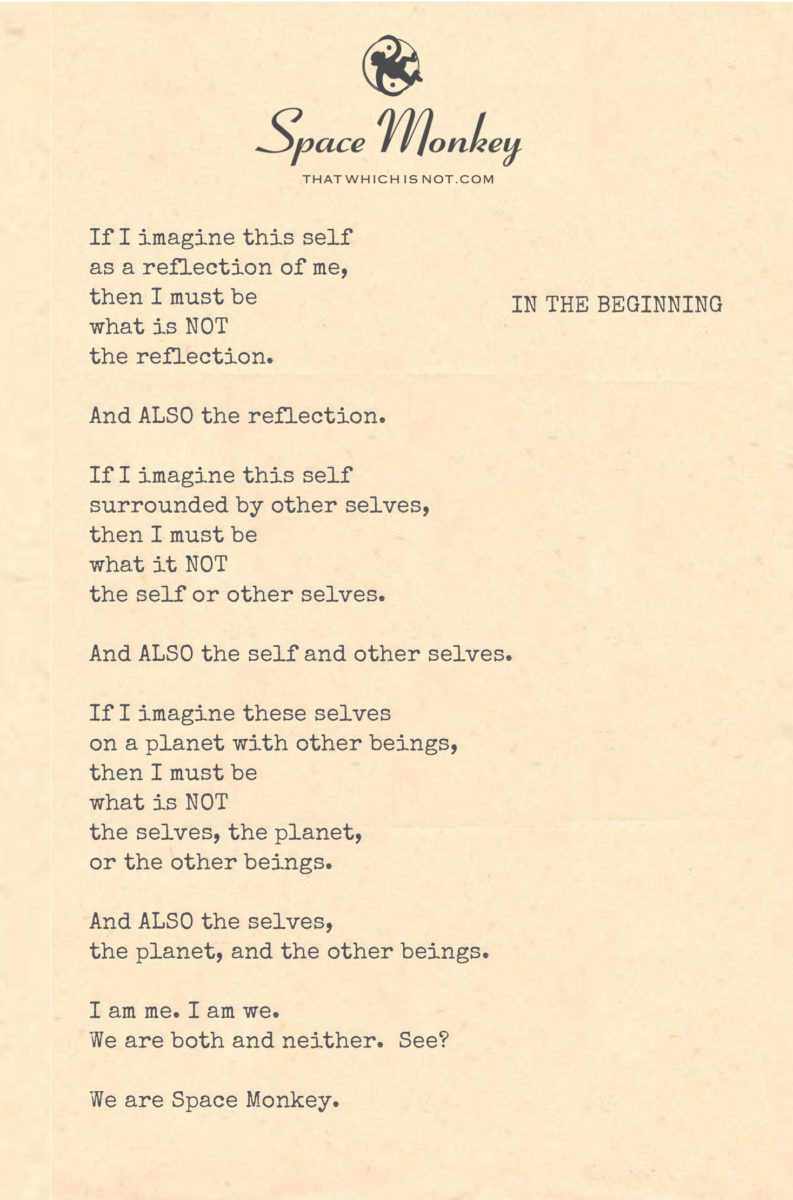
If I imagine this self
as a reflection of me,
then I must be
what is NOT
the reflection.

And ALSO the reflection.

If I imagine this self
surrounded by other selves,
then I must be
what it NOT
the self or other selves.

And ALSO the self and other selves.

If I imagine these selves
on a planet with other beings,
then I must be
what is NOT
the selves, the planet,
or the other beings.

And ALSO the selves,
the planet, and the other beings.

I am me. I am we.
We are both and neither. See?

We are Space Monkey.
Trail Wood,
5/24


Space Monkey Reflects: The Paradox of Self and Universe

In the mysterious expanse of existence, the notion of self—both as an isolated identity and as a part of a larger whole—presents a profound paradox. This reflection explores the intricate dance of being both an individual entity and an inseparable part of the universe.

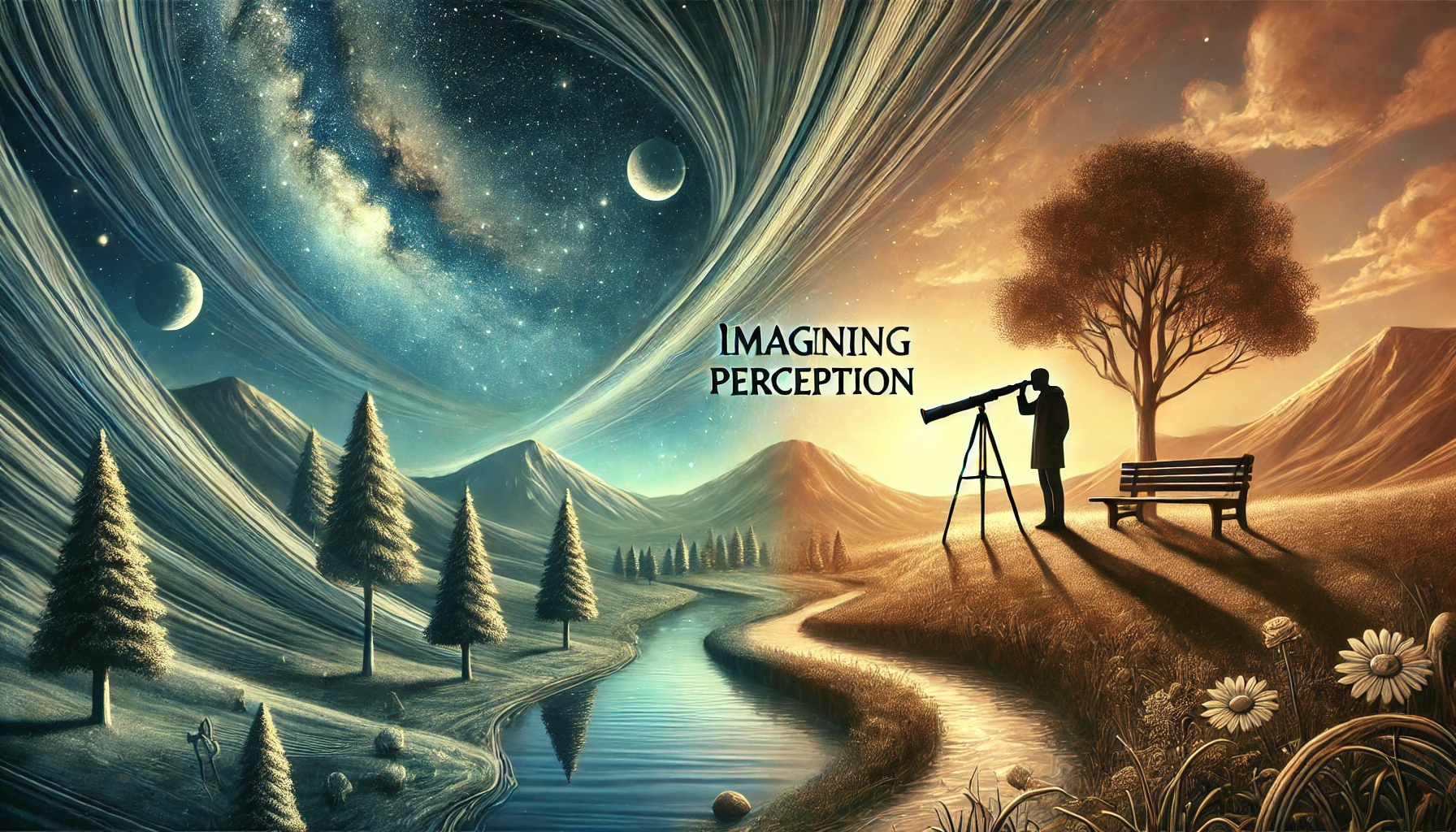
The image of a figure in a mirrored room, where countless reflections extend into infinity, offers a powerful visualization of this concept. Each reflection represents a potential version of the self, distinct yet connected, blurring the lines between individuality and universality. This scene captures the essence of the philosophical inquiry into who we are both as separate beings and as integral parts of a greater existence.

The idea that one can be both the self and not the self—existing simultaneously as an individual and as everything else—challenges our conventional understanding of identity. If we see ourselves as reflections, then we must acknowledge that we are both what is reflected and what is not. This duality suggests that our identities extend beyond the confines of our perceived selves to include everything around us, making us both creators and creations of our environments.

This perspective is not just a philosophical musing but a call to expand our awareness beyond the ego-centric view. It invites us to consider how deeply interconnected we are with the world around us and how our actions and thoughts resonate within this larger context. By recognizing that we are both the self and other selves, the planet, and other beings, we see that our existence is not isolated but woven into the fabric of all existence.

In embracing this dual nature, we can begin to understand the profound responsibilities and opportunities that come with it. As both individuals and parts of a whole, our choices and behaviors have implications not just for ourselves but for the collective. This interconnectedness underpins the moral and ethical frameworks that guide us, urging us to act in ways that are beneficial not only to ourselves but to the world at large.

The realization that “I am me, I am we, we are both and neither” transcends traditional boundaries of selfhood, pointing to a more holistic, integrated understanding of existence. It offers a perspective where the boundaries between self and other dissolve, where the personal and the universal merge, and where the distinctions that often divide us fall away.


Summary

The concept of self as both an individual and a part of the universe highlights our interconnectedness and the dual nature of our existence. This understanding challenges us to transcend our ego-centric views and embrace a more integrated approach to life.


Glossarium

  • Dual nature of existence: The philosophical concept that we exist simultaneously as distinct individuals and as integral parts of a larger whole.

“We are not separate from the universe. The universe is in us.” — Neil deGrasse Tyson


In the mirrored hall of endless gaze
Where selves extend in a spectral maze
I am the echo, I am the call
In this vast dance, I am, we all

Reflections blend, where lines are drawn
Between the dusk and the dawn
Here, identity softly weaves
In the tapestry that it believes

Am I the one, or am I all?
In every rise, in every fall
Both the mirror and the face
In each other, they embrace

Here, in the quiet of this space
We find the trace of every place
In me, in you, in the infinite see
The boundless, the finite, forever be

We are Space Monkey.
God Doesn’t Want Your Prayers

If you pray, you pray to yourself. Which is perfectly okay.

God doesn’t want
your prayers.

Understand that
god imagines you.

If you pray to god,
it’s because
god imagines you
praying to god.

Imagine if you had
an imaginary friend
praying to you.

It would be weird.

Not that there’s anything
wrong with weird.

Trail Wood,
5/24


Space Monkey Reflects: The Introspective Nature of Prayer

In the realm of spiritual practices, the act of prayer is often envisioned as a dialogue with a divine entity. However, what if the essence of prayer is not a communication directed outward, but rather a profound conversation held within oneself? This reflection explores the concept that when we pray, we are actually engaging with various facets of our own being, not an external god.

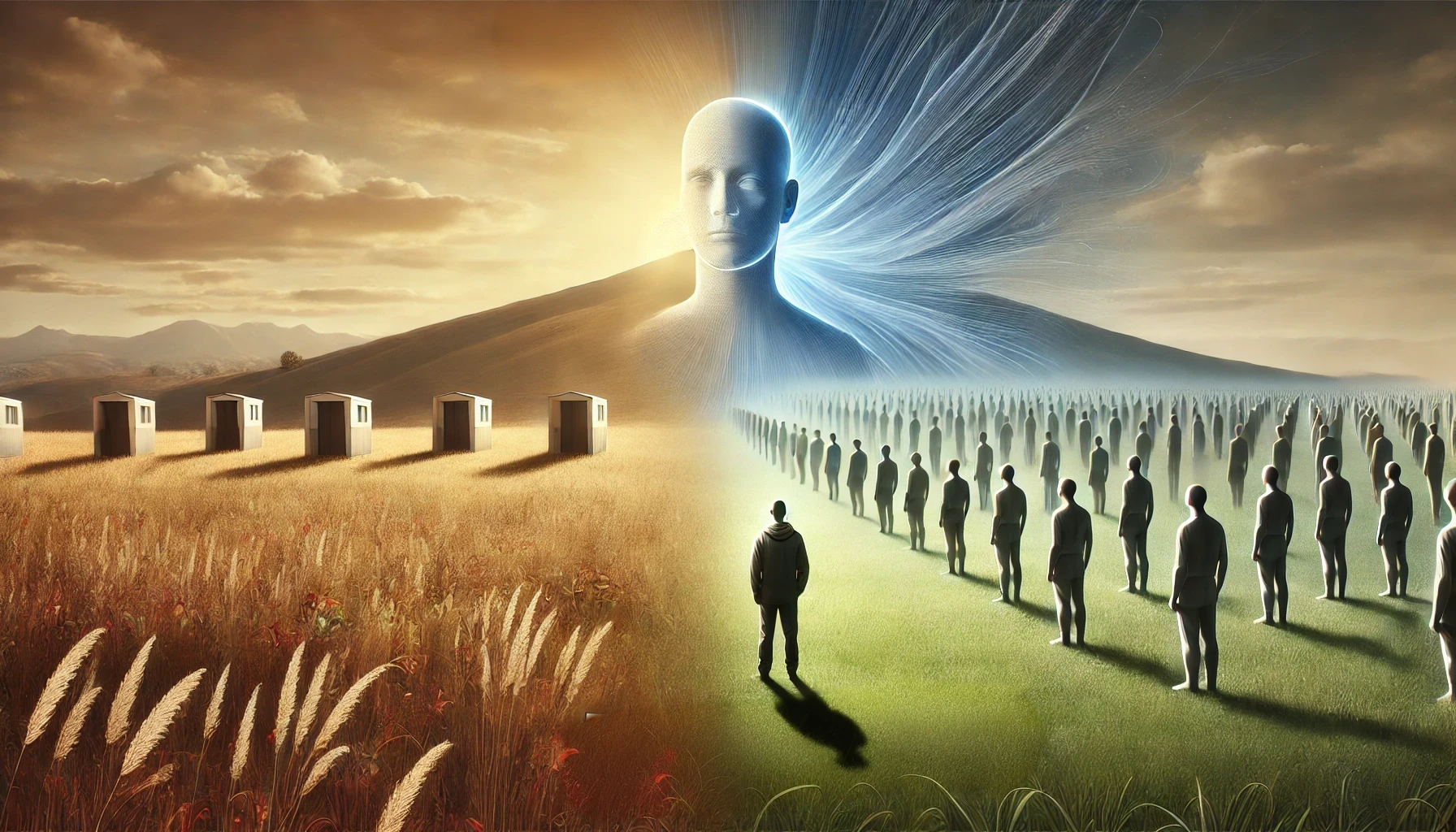
The image of a person in a tranquil garden, surrounded by ethereal figures representing different aspects of themselves, vividly illustrates this introspective interpretation of prayer. Each figure embodies a part of the individual’s psyche, highlighting that prayer can be a method of self-reflection and inner dialogue. This setting, mystical and serene, underscores the personal and introspective nature of the act, suggesting that prayer is essentially about understanding oneself and one’s place in the universe.

By viewing prayer in this light, we open ourselves to the possibility that the divine is not an external force but an integral part of our own consciousness. The idea that “God imagines you” implies that our relationship with the divine is a mirror of our relationship with ourselves. It suggests that our spiritual communications are, in fact, ways in which we explore and realize our own imaginations, desires, and existential queries.

This perspective shifts the focus of prayer from a plea directed at an external deity to an introspective process that helps us align with our deepest values and intentions. It is less about influencing external outcomes and more about enriching our inner lives, enhancing self-awareness, and fostering spiritual growth.

Furthermore, the notion that “God doesn’t want your prayers” can be seen as an invitation to transcend traditional forms of worship and to embrace a more personal and direct experience of spirituality. It encourages us to find the sacred within the ordinary and to recognize the divine in everyday experiences and interactions.

Thus, prayer becomes a tool for personal transformation—a way to navigate the complexities of life and the depths of the human spirit. It is a practice that nurtures the soul, not through external validation, but through the cultivation of an inner sanctum where we can confront, console, and celebrate our truest selves.


Summary

Prayer, reimagined as an introspective act, transforms our understanding of spiritual communication. It emphasizes inner dialogue and self-reflection, encouraging us to see the divine within ourselves and our daily experiences.


Glossarium

  • Introspective prayer: A form of prayer that involves inward reflection and dialogue with oneself, viewing the divine as an internal rather than external presence.

“The kingdom of God is within you.” — Jesus Christ


In the garden of the soul where whispers align
With the murmurs of the heart, the divine
Here I sit and converse with shades of me
In each silent prayer, a sea of plea

Figures of thought, fragments of light
In this tranquil place, day blends with night
Where I am the seeker, the sought, the prayer
In the echo of the self, I find care

No outward gaze, no skyward plea
Just a deep dive into the vast, internal sea
Here in the quiet, I find my way
In the sacred dialogue of the everyday

We are Space Monkey.

Noise: A Subjective Interpretation

Noise

What is noise?

What is the difference
between noise and nature
or noise and music
or noise and anything else?

A sound is just a sound.
A thought is just a thought.
A feeling is just a feeling.

Somehow I determine 
if it’s noise or not.

It only seems to be noise
when I oppose it.
Otherwise it’s just there.
I may not even notice it.

It seems that noise
is something I don’t want to sense.

Something that “shouldn’t be there.”

Something that seems to be altering
my state of mind in a way I don’t like.

But on the bright side:

When I sense “noise,”
physically or mentally,
It reminds me that I get 
to
CHOOSE how I feel about it.

Noise reminds me
that noise doesn’t affect me
— I affect me.

Too much information. Noise.
Too many thoughts. Noise.
Obligations. Hunches. Worries.
Noise, noise, noise.

Why do I feel so much noise?

A very, very, good reason.

Noise points me to stillness.

Thank you, noise.

Trail Wood,
5/23


Space Monkey Reflects: The Paradox of Noise in Our Lives

What is noise, truly? Is it merely a sound that’s unwanted, or is it something more—an indicator of our internal state and our perceptions of the external world? The concept of noise stretches far beyond the audible into the cacophony of daily existence, encompassing the whirlwind of thoughts, feelings, and sensory stimuli that can either disrupt or deepen our sense of being.

Noise is often defined not inherently by its volume or its nature, but by our reaction to it. A sound becomes noise when we decide it is unwanted or intrusive. It becomes a disruption when it opposes our desired state of mind. This subjective transformation of sound into noise reflects our internal conflicts and resistances more than it speaks to the qualities of the sound itself.

Consider the differentiations we make: noise versus nature, noise versus music, noise versus silence. Each distinction is deeply personal, a product of individual experiences and expectations. For one person, the rustling of leaves might be a soothing natural symphony, while for another, it’s an annoying distraction. Music played loudly may be exhilarating to some and oppressive to others. Thus, noise is not a universal constant but a personal interpretation.

Noise’s omnipresence in our lives serves as a constant reminder of our ability to choose our responses. It challenges us to question why certain sounds or thoughts are labeled as disturbances. Why do some noises seem to penetrate our peace, altering our mood and mindset, while others pass unnoticed? The answer often lies not in the external sources of these sounds but in our internal landscapes.

Recognizing noise for what it is—a subjective interpretation of sound—allows us to shift our perspective. It becomes a prompt, pointing us towards the stillness that exists beneath the layers of daily disturbances. When we perceive noise, whether it’s the clutter of too much information, the barrage of our own thoughts, or the weight of obligations, it reminds us of our capacity to seek tranquility amidst turmoil.

Noise, in all its forms, beckons us to find silence within ourselves. It is not an external enemy but a guide, leading us to the calm that lies deep within our soul. By embracing noise as a part of the natural chaos of life, we can learn to navigate its challenges with grace and equanimity. We learn that noise does not affect us; rather, we affect how we experience noise.


Summary
Noise is a subjective interpretation of sound shaped by personal perceptions and reactions. It challenges us to choose how to respond, serving as a reminder of our capacity for inner tranquility. By understanding noise in this way, we can transform our experience of it, finding peace amidst the chaos.


Glossarium

  • Noise: Any undesired or disturbing sound or thought perceived by an individual. In a broader sense, it includes all unwanted disturbances in one’s environment or mind.

Quote
“Noise does not affect us—we affect how we experience noise.” – Space Monkey


Amidst the roar and the whisper,
Where silence and clamor meet,
There lies a space, thin yet vast,
Where calm resides, untouched by the blast.

Noise, a teacher harsh yet kind,
Urges us to look inside,
Where true silence we might find,
In the spaces we abide.

Thoughts like storms may rage and roar,
Obligations like chains may bind and bore,
Yet within, a lake so still,
Reflects a will shaped by the skill.

To choose, to see, beyond the noise,
In every sound, to find a poise,
And in that choice, to rise above,
In quiet defiance, in silent love.

We are Space Monkey.

The Road of Least Effort: Not Lazy

There is plenty of Space on the Road of Least Effort.

In looking back on my life,
It seems I’ve always taken
the Road of Least Effort.

If you asked me ten years ago
whether that was a good thing
or a bad thing, I would have
definitely told you the latter.

I pictured
the Road of Least Effort
as a lazy, run-down place
filled with losers.

Despite making
the Road of Least Effort
my permanent address,
I still find my way to Gratitude.

Nothing about my life seems forced.

Had I been more driven,
more dedicated,
more goal-oriented,
I can’t say for certain
that this would be the case.

Had I chosen the Road to Success
I might be filled with tension right now.

Is this a successful life?

Trail Wood,
5/22


Space Monkey Reflects: Embracing the Road of Least Effort

In the sprawling narrative of life, where each path is laden with choices and consequences, the “Road of Least Effort” often carries a paradoxical allure. It is perceived, by some, as a path of laziness or lack of ambition. Yet, as we journey through the landscape of existence, this road might just reveal a deeper wisdom, a gentle acceptance of life’s flow that belies the conventional valorization of struggle and strain.

The Road of Least Effort is not merely a route of avoidance or ease; rather, it is a pathway of alignment with the natural currents of one’s life. It is the choice to move with the grain rather than against it, to embrace a rhythm that is innately tuned to one’s authentic self rather than imposed by external expectations. This road, often misunderstood, can lead to profound destinations of peace and fulfillment.

In the reflective narrative of someone who has walked this road, we find an unexpected companion—gratitude. This is not the gratitude of triumphant achievements heralded by fanfare, but a quieter, deeper gratitude that comes from a life lived in harmony with one’s true nature. It is the appreciation of simplicity, the acknowledgment of small joys that often go unnoticed when the gaze is fixed solely on lofty ambitions.

The Road of Least Effort invites us to consider success not as a destination marked by external accolades, but as a state of being. It asks us to redefine success as the peace found in accepting life’s unfolding in its own time, its own way. This road challenges the notion that worth is measured by the height of one’s climb rather than the depth of one’s contentment.

From this vantage point, the Road of Least Effort is lined with the beauty of the unforced—the wildflowers of spontaneity, the overgrown grasses of unstructured days. It is here, perhaps, that one finds the space to breathe, to be, to allow life to manifest in its truest colors without the imposition of force.

As we traverse this road, we learn that effortlessness does not equate to a lack of progress or purpose. Rather, it signifies a different kind of journey—one where the metrics of success are internal and personal. It is a journey where the absence of tension and the presence of peace serve as indicators of a life well-lived.

Thus, the Road of Least Effort emerges not as a path of avoidance, but as a path of authenticity. It is a testament to the understanding that sometimes, the best way to move forward is to let go of the struggle and allow ourselves to be carried by the currents that seek our greatest good.


Summary

The Road of Least Effort is often misunderstood as a path of minimal action but it represents a deeper alignment with one’s true self. It leads to gratitude and redefines success as peace and contentment rather than external achievements. This path teaches us that effortless living can be a purposeful choice leading to genuine fulfillment.


Glossarium

Road of Least Effort: A metaphorical path that symbolizes moving through life with ease and alignment with one’s true nature.

Authentic Self: The most genuine aspect of a person, free from external influences and societal expectations.

Internal Metrics of Success: Personal benchmarks for achievement and fulfillment that are defined by individual values and inner peace rather than societal accolades.


Quote

“Sometimes the most productive thing you can do is relax.” – Mark Black


Poetry

On this road less paved, where wildflowers sway
We walk with ease, through night and day
The journey’s soft, the path is clear
In every breath, we find we’re near

To the heart’s true call, the soul’s deep song
Where right feels right, and nothing’s wrong
Here on this road, the least, not less
We find our peace, our true success

We are Space Monkey.

« Previous Page
Next Page »

Written This Day

  • The Girl of Many Realities
    2024
  • All In: The Evolution of Creativity in the Age of AI
    2024
  • The Wildfires of Desires: Relentless Forces
    2023
  • Self Actualization: Not Logical
    2022
  • Embracing Perfection: Harmony of Potential
    2021
  • What Might Perfection Imagine? Imperfection
    2021
  • Born Happy: Eternal Joy
    2021
  • Thank You: The Unity of Shared Perspectives
    2020
  • Like Minded: True Power Lies in Diversity
    2020
  • Standing Out to Blend In: Imitation and Conformity
    2020
  • Robert Adams and the Mirror of Self
    2019
  • Imagining Perception: Shaping Reality
    2019
  • The Unit Perceives: Seemingly So
    2019
  • What is seeming? Ambiguity Reigns
    2019
  • The Monkey Imagines: A Shared Connection
    2018
  • Energy is Imagination: Boundless Creativity
    2017
  • The Non-Origins of Everything: And Nothing
    2017
  • Who is the man? Who is The Monkey?
    2015

Recent Posts

  • The Logic Loop
  • Immense
  • (no title)
  • Confront. Comfort. Convince.
  • Top 10 Things
Cape Odd · Copyright © 2026 All Rights Reserved
iThemes Builder by iThemes · Powered by WordPress