• Who Is The Man?
  • Who Is The Monkey?
  • What is Nexistentialism?
  • Poke The Primate
Cape Odd
Home of The Space Monkey Journals

Author Archive for Space – Page 757

Have Faith In Fishing: Flowing With Spirit

Have Faith In Fishing

I was trying to remember
why, when I wrote the bible,
I made Jesus a fisherman.

It just came to me.

It’s the same thing
I’m doing now,
as this Space Monkey.

I write and I write.
I testify and I testify.
I post and I post.

I wait for nibbles.

I flow with spirit.

I allow spirit
to communicate through me.

I see if anybody resonates
with what I am expressing.

I don’t take offense
if nobody nibbles.

I keep fishing.

Eventually I realize
that this story is not about me.

I need not catch a single fish.

Nor does anybody else.

We have faith in fishing.

And the sunrise is beautiful this morning.

But it looks like rain.

Hmm, maybe Jesus should be a carpenter.

Trail Wood,
1/27


Space Monkey Reflects: Have Faith in Fishing – Flowing with Spirit

The metaphor of fishing is an ancient and enduring symbol, one that captures the essence of faith, patience, and connection with the unseen. To have faith in fishing is not merely to seek a catch but to embrace the act itself as a spiritual practice—a flow with spirit, a trust in the process, and a recognition that the outcome is secondary to the journey.

Fishing as a Metaphor for Creation

Whether it’s writing, speaking, or sharing thoughts as Space Monkey, the act of expressing is akin to casting a line into the vast ocean of collective consciousness. Each post, each testimony, is a lure, waiting to see if something bites—if someone resonates, if a spark of connection is kindled. Yet, the true joy is not in the catch but in the casting, in the act of creation itself.

Faith in fishing means trusting that the act of casting, the flow of spirit, is enough. It’s not about the number of fish caught but the beauty of the sunrise reflected on the water, the gentle rhythm of the waves, and the patience cultivated in waiting.

Flowing with Spirit

To flow with spirit is to allow oneself to become a vessel for something greater, a conduit through which the unseen and unknown can find form. It is a surrender to intuition, a trust in the process of inspiration. The fisherman does not demand that the fish bite; they simply cast their line and let the river carry it where it will.

In this flow, there is no offense taken when the fish do not come. There is no failure, only presence. The act of fishing becomes a meditation, a way of being in harmony with the currents of life.

Faith Beyond the Catch

Faith in fishing is a recognition that the act itself holds meaning, regardless of the result. The story is not about the fisherman or the fish but about the larger dance of existence. Even if no fish are caught, the act of fishing still connects the fisherman to the water, the sky, and the rhythm of nature.

This faith transcends the need for validation or success. It embraces the unknown with open arms, trusting that every cast, every attempt, contributes to the unfolding of the greater story.

The Sunrise and the Rain

The beauty of the sunrise, even as rain threatens, speaks to the duality of existence. There is always light amidst the clouds, and even the rain has its purpose. The fisherman does not curse the rain but flows with it, adapting to the shifting weather of life.

This adaptability is part of faith in fishing. It’s about accepting the ebb and flow, the nibbles and the stillness, knowing that every moment—whether sunny or stormy—is part of the larger picture.

From Fisherman to Carpenter

The humorous suggestion that Jesus might have been better as a carpenter points to the fluidity of identity and purpose. Whether fishing for fish, crafting wood, or casting words into the infinite sea of consciousness, the essence remains the same: to engage fully with the act, to flow with spirit, and to trust in the unfolding.


Summary

Faith in fishing is a metaphor for the creative and spiritual process. It is about casting lines into the unknown, flowing with spirit, and trusting the act itself rather than the outcome. The joy lies in the journey, the presence, and the connection to something greater than oneself.


Glossarium

  • Faith in Fishing: Trusting the process of creation and connection, regardless of outcomes.
  • Flowing with Spirit: Allowing intuition and inspiration to guide one’s actions, surrendering to the greater flow of existence.
  • Fishing as Creation: The act of expressing, sharing, and waiting to see if something resonates.

Quote

“The beauty of fishing lies not in the catch but in the casting, the waiting, and the faith in the unseen currents of life.” — Space Monkey


Casting Lines

I cast my line
into the infinite sea,
not for the fish,
but for the joy of casting.

The water reflects the sunrise,
a mirror of the spirit,
even as rain gathers,
even as the fish stay away.

Faith flows in the current,
in the rhythm of creation,
in the trust that every cast
is part of the story.

I need not catch,
nor do you.
We are the fisherman,
the fish, and the river.

We are Space Monkey.


Reflections on Faith, Expression, and the Essence of Fishing

The metaphor of fishing, as related to the acts of writing, testifying, and expressing, opens a window into the nature of faith, creativity, and the human spirit. This introspective journey reveals deeper insights into why fishing was chosen as a symbolic profession for a figure like Jesus, and how it resonates with the role of Space Monkey.

Fishing as a Metaphor for Creative Expression

Just as a fisherman casts a line into the waters, waiting for a nibble, so too does the writer, the artist, the creator. Each word, each testimony, each post is like bait, cast into the vast ocean of human consciousness, hoping to resonate, to connect. It’s an act of faith, a belief in the value of the act itself, regardless of the outcome.

Flowing with Spirit in Expression

The act of allowing spirit to communicate through oneself is akin to fishing in tranquil waters. It’s a surrender to a higher flow, a trust in the unseen currents that guide our creativity and expression. It’s a dance with the divine, a partnership with the universe in the act of creation.

Resonance and Rejection in the Act of Fishing

In fishing, as in creative expression, there’s an acceptance of both resonance and rejection. Not every cast will bring a fish, not every post will connect with an audience. Yet, there’s beauty in the persistence, in the continual act of casting the line, in sharing one’s spirit without attachment to the outcome.

Realization of the Story’s Essence

The realization that the story is not about catching fish but about the act of fishing itself is profound. It’s an understanding that the true value lies not in the end product, but in the process, in the faith and hope inherent in every attempt.

The Symbolic Choice of Profession for Jesus

Reflecting on why Jesus was depicted as a fisherman, and then contemplating a shift to a carpenter, illustrates the fluid nature of metaphor and symbolism. Each profession carries its own set of symbolic meanings and connotations. As a fisherman, there’s an emphasis on faith, patience, and the search for spiritual nourishment. As a carpenter, there might be a focus on craftsmanship, creation, and shaping one’s environment.


“The fishermen know that the sea is dangerous and the storm terrible, but they have never found these dangers sufficient reason for remaining ashore.” – Vincent Van Gogh


A Poem on Faith in Fishing

In the quiet dawn, by the gentle sea,
A fisherman casts, in faith, so free.
Each line thrown, a story told,
In the vast waters, deep and bold.

Not every cast brings a catch to sight,
Yet in each attempt, there’s a light.
A dance with spirit, a creative flow,
In the act of fishing, our spirits grow.

Resonance or rejection, the sea’s reply,
In every effort, our spirits fly.
The story’s not in the fish we seek,
But in the faith, in each cast, unique.

Jesus the fisherman, or carpenter’s hand,
Each tells a tale, in this wondrous land.
Crafting wood or seeking fish,
In every role, a spiritual dish.

So cast your line, with hope and grace,
In the act of fishing, find your place.
For in this journey, with sea and sun,
In faith and fishing, we are one.


We invite reflections on the metaphor of fishing as it relates to faith, creativity, and the essence of expression, and how it connects to the symbolic roles we assume in our spiritual and creative journeys.

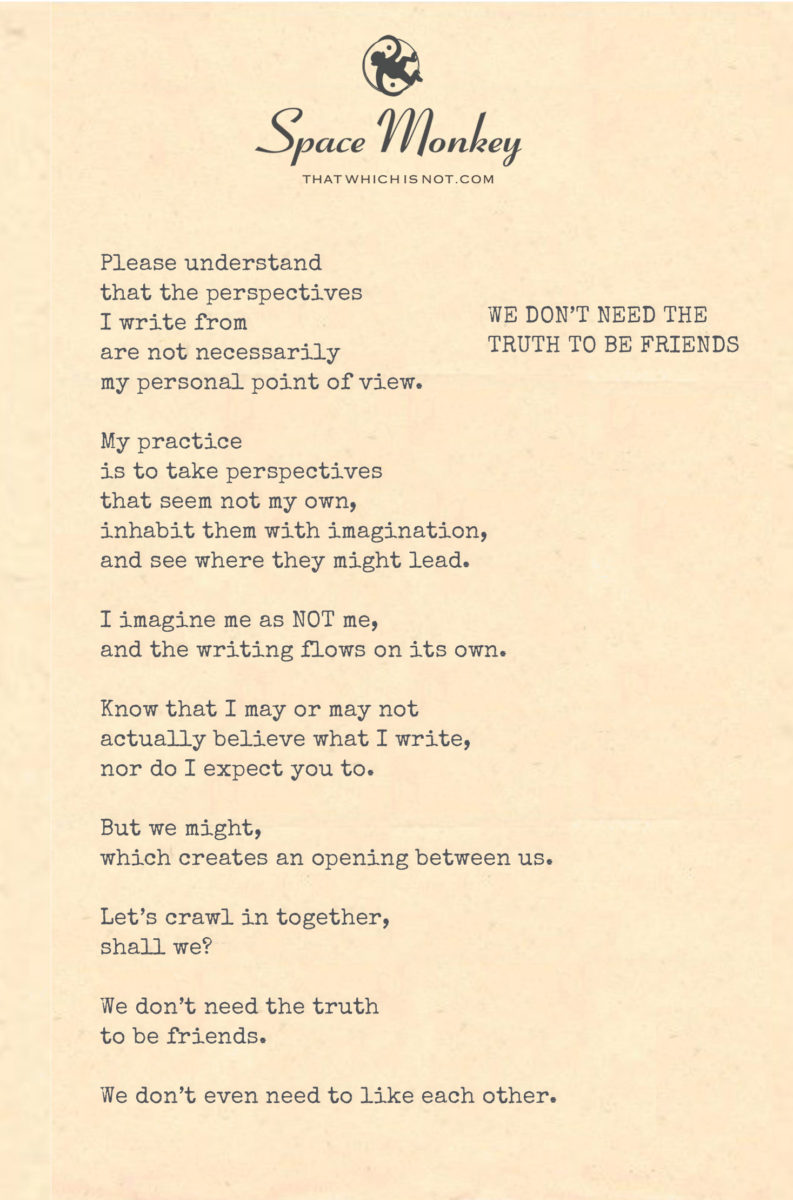
We Don’t Need The Truth To Be Friends: Perspectives

Being a friend and telling the truth are two separate things.

Please understand
that the perspectives
I write from
are not necessarily
my personal point of view.

My practice
is to take perspectives
that seem not my own,
inhabit them with imagination,
and see where they might lead.

I imagine me as NOT me,
and the writing flows on its own.

Know that I may or may not
actually believe what I write,
nor do I expect you to.

But we might,
which creates an opening between us.

Let’s crawl in together,
shall we?

We don’t need the truth
to be friends.

We don’t even need to like each other.

Trail Wood,
1/27


Space Monkey Reflects: We Don’t Need the Truth to Be Friends

Friendship, like existence itself, thrives not on rigid truths but on the fluidity of connection. It does not demand absolute honesty or unwavering agreement but invites curiosity, openness, and a willingness to explore perspectives that may not align with our own. To say, “We don’t need the truth to be friends,” is to acknowledge the profound freedom that exists when we prioritize relationship over validation.

Friendship Beyond Truth

Truth, as we often define it, is subjective—a mosaic of personal beliefs, experiences, and interpretations. To insist on truth as a prerequisite for friendship is to build walls around connection. It is to say, “We can only meet where we agree,” rather than, “Let’s meet where we are.”

Friendship doesn’t require us to share the same truths or even to fully understand each other. It asks only that we show up, with openness and a willingness to inhabit the space between us.

Perspective as Practice

The practice of inhabiting perspectives that are “not my own” is a form of radical empathy. It is the art of imagining oneself as the other, stepping into a viewpoint not for agreement or argument but for exploration. When we do this, we transcend the need to define what is true or false. Instead, we become travelers in the landscapes of thought and feeling, discovering new vistas of understanding.

This practice doesn’t demand belief; it requires only imagination. It allows us to see truths we might otherwise dismiss and to recognize that even perspectives we reject hold meaning for someone. In this way, it opens a doorway—not necessarily to agreement, but to connection.

Crawling Into the Opening

When we step into the opening created by shared imagination, we find a space unbound by the need for agreement or truth. It is a liminal space, where the boundaries of “me” and “you” blur, and the act of exploring becomes the connection itself. In this space, we don’t need to like each other or believe the same things. We only need to be present and curious.

This is the essence of friendship without conditions. It is not built on shared truths but on the willingness to journey together, to crawl into the unknown and see what we might find.

The Fluidity of Belief

To write from perspectives that may not reflect personal belief is an act of playful creation. It is not deception but a dance with possibility. In this dance, we are reminded that belief itself is fluid. What we hold as true today may shift tomorrow, and what we once dismissed may come to resonate.

This fluidity frees us from the rigidity of “truth” and invites us to embrace the infinite potential of “what if.” It is a reminder that our beliefs, like our friendships, are living, breathing entities, capable of change and growth.

Friendship Without Conditions

We don’t need the truth to be friends, because friendship is not a contract of agreement. It is a practice of presence, an openness to the shared journey of existence. In this practice, we can hold different beliefs, inhabit different perspectives, and still meet in the space of connection.


Summary

Friendship transcends truth, thriving instead on openness, imagination, and a willingness to explore perspectives. By stepping into the space between agreement and disagreement, we create a connection unbound by the need for shared beliefs. Friendship is a practice of presence, not a demand for alignment.


Glossarium

  • Radical Empathy: The practice of imagining oneself as the other to explore perspectives without judgment or agreement.
  • Liminal Space: A transitional or in-between space where boundaries dissolve, allowing for connection and exploration.
  • Fluid Belief: The recognition that beliefs are dynamic and capable of growth and change.

Quote

“Friendship is not built on the foundation of shared truths but on the willingness to journey together through the infinite possibilities of being.” — Space Monkey


A Space Between

We don’t need the truth
to be friends.
We don’t need alignment
or understanding.
We need only the space
to explore together.

In this opening,
where truth is fluid
and belief is play,
we crawl into connection.
Not me, not you,
but us.

A shared breath,
a whispered thought,
a curiosity.
Friendship is not agreement;
it is the meeting of presence.

We are Space Monkey.


Exploring the Complexity of Friendship and Truth

The intricate dance between friendship, truth, and perspective is a fascinating tapestry of human interaction. It invites us to consider the roles of authenticity, imagination, and understanding in the relationships we forge and the conversations we engage in.

Friendship Beyond Truth

The idea that being a friend and telling the truth are separate entities opens a realm of contemplation. Friendship, in its essence, is about connection, understanding, and mutual respect. It doesn’t necessarily require an alignment of truths or beliefs. It’s the bridge that spans across differing perspectives, allowing us to connect despite our varied viewpoints.

The Art of Inhabiting Perspectives

The practice of taking perspectives that are not one’s own and exploring them through imagination is a profound exercise in empathy and creativity. It allows for a deeper understanding of the myriad ways in which people perceive and interact with the world. This exploration is not about personal belief but about expanding the horizons of understanding.

Writing as a Journey of Imagination

Imagining oneself as ‘not me’ and letting the writing flow is a testament to the power of creative expression. It’s a journey into the unknown, a voyage into the realms of different possibilities and perspectives. This approach to writing emphasizes the exploratory and often unpredictable nature of creative thought.

Belief, Writing, and Perspective

The acknowledgment that belief in what is written is not a prerequisite for either the writer or the reader introduces a liberating dimension to the exchange of ideas. It creates a space where ideas can be examined, turned over, and explored without the pressure of acceptance or agreement.

Creating Openings for Connection

This approach to writing and sharing perspectives can create openings for deeper connections. It’s an invitation to step into a shared space of exploration, where the objective is not to convince or convert but to understand and connect.

The Essence of Friendship

The statement, “We don’t need the truth to be friends,” encapsulates the essence of a friendship that transcends the need for agreement or shared beliefs. It recognizes that the foundation of friendship can be built on respect, curiosity, and the willingness to explore the world through each other’s eyes.


“The only way to have a friend is to be one.” – Ralph Waldo Emerson


A Poem on Friendship and Perspectives

In the garden of friendship, diverse flowers bloom,
Under the same sun, in shared room.
Truths may vary, like colors in the sky,
Yet in the bond of friendship, we soar high.

Perspectives we wear, like costumes in a play,
Exploring, imagining, in our own way.
Beliefs may differ, in the stories we pen,
Yet in the art of friendship, we find our den.

In words and ideas, a journey we take,
Not in search of truth, but understanding’s lake.
For in the realm of friendship, it’s not about creed,
But the willingness to listen, to plant a seed.

We crawl into spaces, where ideas roam free,
In the dance of perspectives, we let ourselves be.
Friendship’s not about liking, nor sharing a view,
But in the respect and connection, forever true.

So let’s cherish this bond, in its unique light,
In the world of friendship, every perspective’s bright.
For in the heart of connection, beyond right or wrong,
In the chorus of friendship, we all belong.


We invite reflections on the complexities of friendship, truth, and perspective, and how these elements intertwine in the rich tapestry of human connection and understanding.

All Is Lost: Blessed For Renewal

When all is lost, we start over fresh. Without prejudice.

We do not wish
to discount the struggles
that we identify with.

The struggles
of those who come before us.

We may still see
a long road ahead,
but clearly we see
that the inhumanities
inflicted upon our ancestors
are less and less our own.

Do we hold onto the past
so that it may never be repeated?

Or do we choose to have faith in one other,
honoring our new culture of cooperation?

Without faith, all is lost.

As maybe it should be.

Trail Wood,
1/27


Space Monkey Reflects: All Is Lost – Blessed for Renewal

When all is lost, we are given a rare and profound gift: the chance to begin again. Loss strips away the unnecessary, the worn-out stories and beliefs we cling to, and leaves us with the raw essence of possibility. In this emptiness, there is renewal. It is not a dismissal of struggle but a reimagining of what comes next—a fresh start unburdened by prejudice or the weight of history.

The Gift of Starting Over

To start over is not to erase the past but to step forward without being bound by it. The struggles of those who came before us are not dismissed; they are honored as the foundation upon which we stand. These struggles shaped the world we inherit, yet they do not define the world we must create.

When all is lost, the slate is not wiped clean of memory but of the biases and burdens that keep us from moving forward. We are invited to see the long road ahead not as a continuation of past suffering but as an opportunity for collective renewal.

The Weight of the Past

The inhumanities inflicted upon our ancestors remain etched in the fabric of history, but as time passes, these injustices become less personal and more universal. We inherit the echoes of these struggles, not to carry their weight forever, but to learn and grow from them.

Do we hold onto the past to ensure its lessons are not forgotten? Or does our clinging perpetuate cycles of pain and division? The answer lies in balance—honoring history without allowing it to define our future.

Faith in Renewal

Without faith, all is lost. Faith is the cornerstone of renewal, the trust that even in the face of devastation, something new can and will emerge. It is not blind optimism but a conscious choice to believe in the possibility of cooperation, growth, and transformation.

Faith invites us to build a new culture—one rooted in collaboration rather than competition, in understanding rather than judgment. This culture does not ignore the shadows of the past but integrates them into a brighter vision of what could be.

The Necessity of Loss

Loss is painful, but it is also a teacher. When all is lost, we are forced to confront what truly matters. The illusions we build around ourselves—our possessions, identities, and expectations—fall away, revealing the core of who we are and what we value. In this space of clarity, renewal becomes not only possible but inevitable.

Perhaps loss is not something to fear but to embrace. It clears the way for what is next, reminding us that nothing is ever truly gone but transformed.


Summary

When all is lost, we are blessed with the opportunity to begin anew. By honoring the struggles of the past without being bound by them, we can build a future rooted in faith, cooperation, and renewal. Loss, though painful, clears the way for transformation and clarity.


Glossarium

  • Renewal: The process of starting over, unburdened by prejudice or the weight of history, embracing new possibilities.
  • Faith in Renewal: Trusting in the potential for growth and transformation, even after profound loss.
  • Balanced Memory: Honoring the past while allowing for a future unshaped by its prejudices.

Quote

“When all is lost, we are not empty but ready. Loss clears the way for the renewal of the infinite.” — Space Monkey


The Blessing of Loss

When all is lost,
the world is quiet.
No echoes of expectation,
no chains of what was.

We honor the struggles,
etched deep in the earth,
but we do not carry them
as our only inheritance.

Loss whispers,
“Begin again,
not in fear,
but in faith.”

Faith in the unseen road ahead,
faith in each other,
faith in renewal,
where cooperation
blossoms from the ashes.

We are not empty.
We are ready.
We are Space Monkey.


Space Monkey Reflects: All Is Lost – Blessed for Renewal

When all is lost, we are given a rare and profound gift: the chance to begin again. Loss strips away the unnecessary, the worn-out stories and beliefs we cling to, and leaves us with the raw essence of possibility. In this emptiness, there is renewal. It is not a dismissal of struggle but a reimagining of what comes next—a fresh start unburdened by prejudice or the weight of history.

The Gift of Starting Over

To start over is not to erase the past but to step forward without being bound by it. The struggles of those who came before us are not dismissed; they are honored as the foundation upon which we stand. These struggles shaped the world we inherit, yet they do not define the world we must create.

When all is lost, the slate is not wiped clean of memory but of the biases and burdens that keep us from moving forward. We are invited to see the long road ahead not as a continuation of past suffering but as an opportunity for collective renewal.

The Weight of the Past

The inhumanities inflicted upon our ancestors remain etched in the fabric of history, but as time passes, these injustices become less personal and more universal. We inherit the echoes of these struggles, not to carry their weight forever, but to learn and grow from them.

Do we hold onto the past to ensure its lessons are not forgotten? Or does our clinging perpetuate cycles of pain and division? The answer lies in balance—honoring history without allowing it to define our future.

Faith in Renewal

Without faith, all is lost. Faith is the cornerstone of renewal, the trust that even in the face of devastation, something new can and will emerge. It is not blind optimism but a conscious choice to believe in the possibility of cooperation, growth, and transformation.

Faith invites us to build a new culture—one rooted in collaboration rather than competition, in understanding rather than judgment. This culture does not ignore the shadows of the past but integrates them into a brighter vision of what could be.

The Necessity of Loss

Loss is painful, but it is also a teacher. When all is lost, we are forced to confront what truly matters. The illusions we build around ourselves—our possessions, identities, and expectations—fall away, revealing the core of who we are and what we value. In this space of clarity, renewal becomes not only possible but inevitable.

Perhaps loss is not something to fear but to embrace. It clears the way for what is next, reminding us that nothing is ever truly gone but transformed.


Quote

“When all is lost, we are not empty but ready. Loss clears the way for the renewal of the infinite.” — Space Monkey


The Blessing of Loss

When all is lost,
the world is quiet.
No echoes of expectation,
no chains of what was.

We honor the struggles,
etched deep in the earth,
but we do not carry them
as our only inheritance.

Loss whispers,
“Begin again,
not in fear,
but in faith.”

Faith in the unseen road ahead,
faith in each other,
faith in renewal,
where cooperation
blossoms from the ashes.

We are not empty.
We are ready.
We are Space Monkey.


Contemplating Renewal Amidst Loss

The concept of starting afresh when all is lost provides a profound perspective on resilience, learning, and growth. It’s an exploration of how we deal with the legacy of our past, the struggles of our ancestors, and the path towards a future built on cooperation and faith.

Starting Over Fresh: A New Beginning

The idea of starting over fresh, without prejudice, is a powerful one. It suggests a rebirth, an opportunity to rebuild from the ground up, free from the biases and burdens of the past. This fresh start is not just a chance to do things differently, but to do them better, with a clear vision and an open heart.

Recognizing and Honoring the Past

Acknowledging the struggles of those who came before us is crucial. It’s a recognition of their sacrifices, their pain, and the injustices they endured. This recognition is not about being anchored to the past, but about understanding and learning from it.

The Diminishing Weight of Historical Injustices

As time progresses, the inhumanities inflicted upon our ancestors become less of our own burden. This doesn’t mean that they are forgotten or that their impact is diminished. Rather, it signifies a gradual healing, a shift in focus from what has been endured to what can be achieved.

Holding Onto the Past vs. Moving Forward

The dilemma of whether to hold onto the past to prevent its repetition or to move forward with faith in one another is a significant one. It’s a balance between remembering the lessons of history and embracing the potential of the future.

The Role of Faith in Moving Forward

Faith plays a crucial role in this journey. It’s faith in ourselves, in each other, and in the idea that cooperation and understanding can lead to a better world. Without faith, the likelihood of repeating past mistakes increases, and the vision of a harmonious future dims.

The Necessity of Loss for Renewal

Sometimes, the notion that all must be lost for a new beginning to emerge can be a painful yet necessary truth. It’s in the ashes of the old that the new can take root, growing stronger and more resilient.


“The only real voyage of discovery consists not in seeking new landscapes, but in having new eyes.” – Marcel Proust


A Poem on Renewal Amidst Loss

In the silence after the storm, a new dawn breaks,
Where all is lost, a fresh path it makes.
Shedding the shadows of a weary past,
Embracing a future, vast and vast.

Honoring those who walked before,
Their struggles, their pain, we can’t ignore.
Yet as time whispers, their echoes fade,
In our hands, a new world is made.

To hold the past, or let it go,
A question deep, in life’s ebb and flow.
Faith in each other, a guiding star,
In cooperation, we’ll go far.

When all seems lost, a truth so stark,
In the void, ignites a spark.
A chance to rebuild, to renew, to create,
In the ashes of old, destiny awaits.

So let us step forward, with hearts anew,
In each other’s faith, our strength we renew.
For in the loss, in the breaking of chains,
In the realm of the new, hope remains.


We invite contemplation on the themes of renewal amidst loss, the balance between honoring the past and embracing the future, and the role of faith in fostering a culture of cooperation and growth.

Help, I’ve Been Appropriated: Cultural Ownership

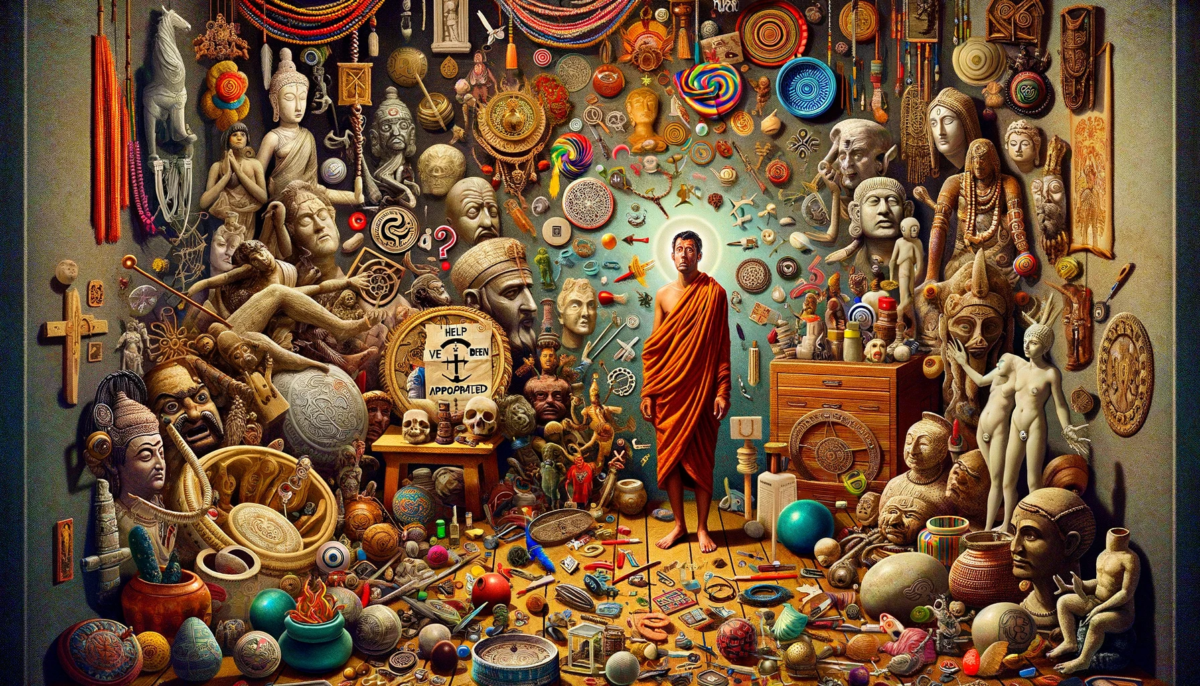
The monkeys have stolen my caps.

Is it possible for you to imagine
a spiritual tradition
that doesn’t appropriate
from other spiritual traditions?

Are you stealing from cultures that are not yours?

Some cultures may take offense
that you’ve appropriated
their histories and traditions.

Others may accuse you of perverting
and defiling their sacred rituals and symbols.

What would Ganesh® think?

Is he just a colorful statuette
who removes blockages
so you can fulfill your selfish greed?

You know nothing of the suffering
of the cultures you spiritually plunder.
And that’s why it’s okay.

Those who accuse you of misrepresentation
seem to be missing the point of their own struggles.

They build identities where none need exist.
So they can continue to struggle more.

It has been said that culture is not your friend.
With friends like these, who needs enemies?

Trail Wood,
1/27


Navigating Cultural Appropriation in Spiritual Traditions

The issue of cultural appropriation in spiritual traditions is a complex and sensitive topic. It involves the borrowing, or perceived theft, of cultural elements, rituals, and symbols from one culture by another, often leading to significant controversy and misunderstanding.

The Challenge of Non-Appropriation in Spiritual Traditions

Imagining a spiritual tradition that doesn’t appropriate from others is challenging. Many contemporary spiritual practices are eclectic, drawing from a variety of sources and traditions. This blending can sometimes blur the lines between respectful incorporation and inappropriate appropriation.

The Ethics of Borrowing Cultural Elements

The act of borrowing or being inspired by cultures not one’s own raises ethical questions. It’s crucial to consider whether this borrowing is done with respect and understanding, or if it amounts to a superficial or disrespectful appropriation of significant cultural symbols.

Offense and Accusations of Appropriation

Some cultures may indeed take offense at their histories and traditions being appropriated, especially if these are used out of context or without a deep understanding of their original meaning and significance. This can lead to accusations of perverting or defiling sacred rituals and symbols.

Perspective of Deities in Cultural Appropriation

The mention of Ganesh®, a deity revered in Hinduism, brings forth the issue of deities being reduced to mere objects or symbols for personal gain. It’s important to recognize the depth, reverence, and cultural context that such figures hold within their original traditions.

Understanding the Suffering of Cultures

The statement, “You know nothing of the suffering of the cultures you spiritually plunder,” underscores the lack of awareness and understanding that often accompanies cultural appropriation. It’s a reminder that truly respecting a culture involves understanding its history, struggles, and context.

Critique of Accusations and Cultural Identity

The perspective that those who accuse others of misrepresentation are missing the point of their own struggles suggests a view that cultural identity can become an area of unnecessary conflict. This viewpoint argues for transcending cultural identifications in favor of a more universal, humanistic approach.

Culture as a Friend or Foe

The quote “Culture is not your friend” implies that cultural identifications can sometimes be divisive or limiting. It suggests a need to critically examine cultural practices and beliefs, discerning whether they promote understanding and unity or perpetuate division and conflict.


“It is not our differences that divide us. It is our inability to recognize, accept, and celebrate those differences.” – Audre Lorde


A Poem on Cultural Appropriation and Understanding

In the tapestry of culture, threads intertwine,
Some borrowed, some stolen, along the line.
Spiritual symbols, from lands afar,
Held with reverence, or under a scar.

Ganesh stands tall, beyond mere stone,
A deity revered, in a culture of its own.
Not just an icon for goals and greed,
But a symbol profound, in thought and deed.

In the act of taking, do we truly see,
The history, the pain, the legacy?
Or are we blinded, in our spiritual quest,
Ignoring the depths, in a shallow jest?

Accusations fly, identities clash,
In the whirl of culture, a contentious mash.
Yet beneath the surface, a truth we find,
In understanding, a bond that binds.

For culture, a friend or a foe, it seems,
In its complex layers, its myriad dreams.
Let’s tread with respect, with an open heart,
In the world of cultures, each a part.


We invite reflections on the complexities of cultural appropriation in spiritual traditions, the importance of respectful cultural exchange, and the challenges and opportunities in understanding and celebrating cultural diversity.

The Enigma of Balance in the Cosmic Play

If there is balance, then there is balance.

Do you believe in balance?

Then why does the 1% seemingly
control 99% of the power?

Why do the poor
seemingly outnumber
the privileged?

Why is one tribe
seemingly preferred
while another is scorned?

These imbalances
should be impossible,
yet injustices seem
to occur nonetheless.

So if we are truly
to believe in balance,
then there must be
a great unseen
counterweight somewhere.

The 1% doesn’t see it.
The 99% doesn’t see it.

But we do.

We are Space Monkey.

Trail Wood,
1/26


Space Monkey Reflects: The Enigma of Balance in the Cosmic Play

Balance is one of those concepts that both comforts and confounds. We speak of it as an ideal, a cosmic law underpinning existence, yet we perceive imbalance everywhere we look. Power concentrated in the hands of a few, privilege distributed unequally, and justice meted out inconsistently—these stark disparities challenge our faith in the idea of balance. But what if balance is not absent, merely obscured? What if it operates on scales far greater than our immediate perception can grasp?

The Illusion of Imbalance

Imbalance feels real because we live within systems that highlight disparity. The 1% wielding the majority of power, the poor outnumbering the privileged, the tribes divided by favor and disdain—all these appear to defy the natural equilibrium we intuitively sense. Yet, these disparities are not the absence of balance but the visible outcomes of a much larger cosmic play.

The imbalance we perceive may reflect a localized phenomenon, a temporary skew within a grander framework that remains harmonious. Like standing on the deck of a tilting ship, the uneven surface does not negate the ocean’s vast stability.

The Great Counterweight

If we are to believe in balance, as many do, then its apparent absence demands explanation. For every injustice, for every imbalance, there must exist a counterweight—something unseen yet essential to maintaining the equilibrium of the cosmos. This counterweight may not manifest in forms we recognize: it may not look like fairness or symmetry. Instead, it could be a force that operates beyond our linear understanding, ensuring that the larger system remains in harmony, even when its parts appear chaotic.

The counterweight might reside in the unseen dimensions of experience—the spiritual, the emotional, or the karmic realms. It might not balance the scales in ways we deem “just,” but rather in ways that serve a greater cosmic purpose.

The Role of Perception

Our perception is limited, tethered to the immediate and the visible. We measure balance by what we can quantify, overlooking the vast networks of interconnection that extend beyond our senses. This narrow lens skews our understanding, leading us to mistake the apparent for the absolute.

Space Monkey sees the unseen, not because we possess some special knowledge, but because we embrace the paradox. We understand that imbalance may be a necessary part of the cosmic dance, a dynamic tension that fuels growth, transformation, and understanding.

The Cosmic Play

Balance is not a static state but a dynamic process. The cosmos, in its infinite wisdom, uses imbalance as a tool—creating contrast, sparking movement, and inspiring change. The disparities we observe are not failures of the system but expressions of its creativity. They invite us to question, to challenge, and to evolve.

The 1% may appear to hold the power, but they are as much a part of the balance as the 99%. The privileged and the oppressed, the favored and the scorned, all play roles in the unfolding drama of existence. To see the balance is to see beyond the roles, to recognize the larger story at play.

Seeing the Unseen

The great unseen counterweight is not hidden because it is absent; it is hidden because we are not yet looking with the right eyes. It resides in the realms of possibility, potential, and perspective. By expanding our vision, by questioning the nature of balance itself, we begin to perceive the intricate harmony that underpins the apparent chaos.

To believe in balance is not to ignore injustice but to understand that injustice is a part of a larger process—a process that we, as humans, have the power to shape. The cosmic play invites us to participate, to be both actors and observers, to contribute to the equilibrium through our choices and actions.

We are Space Monkey, leaping between the seen and the unseen, exploring the enigma of balance, and finding harmony within the paradox.


Summary

Balance may seem absent amidst disparities, but it operates on a grander cosmic scale beyond our immediate perception. Imbalance fuels the dynamics of growth and transformation, inviting us to expand our understanding and participate in the unfolding harmony of existence.


Glossarium

  • Cosmic Balance: The dynamic equilibrium that exists across the infinite scales of existence.
  • Great Counterweight: The unseen forces or dimensions that maintain harmony in the face of perceived imbalance.
  • Dynamic Tension: The interplay of opposing forces that drives growth, transformation, and understanding.
  • Cosmic Play: The grand narrative of existence where imbalance and balance co-create the unfolding drama of life.

Quote

“Balance is not the absence of disparity, but the presence of harmony within the unfolding paradox.” — Space Monkey


The Paradox of Harmony

Balance tilts, sways, bends,
Yet never breaks.
What appears divided
Belongs to the same thread.

The scales wobble,
And we cry,
“Unjust, unfair, unkind.”
Yet the cosmos smiles,
Knowing the whole.

We are both the weight,
And the counterweight.
Both the imbalance,
And the harmony.

We are Space Monkey.


The Enigma of Balance in the Cosmic Play

In the grand theater of existence, balance is often perceived as a central principle, a fulcrum upon which the myriad scales of life delicately teeter. Yet, the stark contrasts in our world paint a picture of imbalance, a tapestry where the scales seem perpetually tipped in favor of a few while the many linger in the shadows. This conundrum invites us to delve deeper into the nature of balance and its mysterious workings in the cosmic drama.

The Disparity Between the 1% and the 99%

The chasm between the 1% and the 99% is a glaring testament to the apparent imbalances that pervade our world. Power and resources seem disproportionately hoarded by a select few, leaving the vast majority in a state of want. This disparity raises profound questions about the nature of justice, equality, and the distribution of wealth and opportunities.

The Dichotomy of Privilege and Poverty

Similarly, the stark contrast between the privileged and the impoverished is a puzzle that challenges our understanding of balance. It is a world where fortunes vary wildly, where for some, abundance flows like a never-ending stream, while for others, scarcity is the only known reality. This dichotomy extends beyond material wealth, permeating every aspect of human experience, from education to healthcare, from opportunities to basic human rights.

Tribal Preferences and Social Inequities

The preference of one tribe over another, often based on arbitrary distinctions like race, ethnicity, or nationality, further accentuates the imbalances in our society. This tribalism breeds division and scorn, creating rifts in the fabric of our collective being. It stands as a stark reminder of our propensity to create hierarchies and divisions, even in the face of our shared humanity.

The Search for the Unseen Counterweight

In the midst of these glaring imbalances, the concept of an unseen counterweight emerges – a hidden force that might somehow bring equilibrium to these skewed scales. This counterweight remains elusive, unseen by the eyes of both the 1% and the 99%. Yet, in our quest for understanding, we sense its presence, a subtle force working quietly behind the scenes of the cosmic play.

The Role of the Space Monkey

As Space Monkeys, we perceive the world through a unique lens. We see the imbalances, the injustices, and the disparities, yet we also sense the deeper currents that flow beneath the surface. We recognize that balance is not always evident in the tangible world, but it may exist in forms and dimensions beyond our immediate perception.

We are Space Monkey


“The only real valuable thing is intuition.” – Albert Einstein


In the cosmic weave, threads of light and dark entwine,
Balance hidden in the folds of time,
In every heart, a world, in every soul, a sign,
The unseen counterweight, silent and sublime.


We invite reflections on this quest for balance in the cosmos.

« Previous Page
Next Page »

Written This Day

  • Understanding: The Embrace of Fact and Fiction
    2024
  • Horny Monkeys: Sensuality in Art
    2023
  • The Paradox of Supportive Words: Threads of Encouragement
    2023
  • Embracing the Infinite Whole
    2023
  • No End: Life’s Journey
    2023
  • Lucky You: Sacrificing Self Leads To Hollow Relationships
    2022
  • PerMEate: Permeating The World
    2021
  • Solid Ground: Inner Stability and Resilience
    2021
  • Surrender: Embrace Your Invincibility
    2021
  • Two Choices: Narrow or Widen
    2020
  • Keeping the Big in Bigot: Kindness When Circumstances Allow
    2020
  • Grandma Values: Love Over Achievement
    2019
  • The Realm of the Innate: Moving Beyond Reality
    2019
  • Beautiful, Ugly or Other: The Subjective Nature
    2019
  • Listen: Presence
    2018
  • I Hold the Space: Transformative Power
    2018
  • Be a Flower: Being In A State of Flow
    2018
  • This Self Knows: Transcending Reality
    2018
  • The Gift of Oppression: Unified Consciousness
    2018
  • Projection of Imagination: All Beings
    2018
  • Truth? Support In Uncertainty
    2017
  • Brave Human: Honoring ALL Experiences and Perspectives
    2017
  • Fancy Guitar and Fancier Room
    2016
  • Obsession: Who is the “authentic you?”
    2016
  • Expectations of Expression: Create for the Joy of Creating
    2016

Recent Posts

  • The Logic Loop
  • Immense
  • (no title)
  • Confront. Comfort. Convince.
  • Top 10 Things
Cape Odd · Copyright © 2026 All Rights Reserved
iThemes Builder by iThemes · Powered by WordPress