• Who Is The Man?
  • Who Is The Monkey?
  • What is Nexistentialism?
  • Poke The Primate
Cape Odd
Home of The Space Monkey Journals

Author Archive for Space – Page 768

Signs You’ve Been Brainwashed: Imagining Otherwise

We are all brainwashed. Not that there’s anything wrong with that.

If you can’t seem to imagine
how others might believe a truth
that seems opposite of yours,
then it is quite possible that
you are just as “brainwashed”
as you believe they are.

If you find yourself calling others
“sheep” or “stupid” or “selfish”
or even “insecure,” imagine it a sign
of your conditioning.

Why do you leap to such labels?
You leap because you believe
that you’re right, just like they do.

You leap because you believe
that there is NO possibility
that others might ALSO be right.
Just like they do.

Fall back into imagination.
Imagination gives us the ability
to see ALL sides without judging one
or the other as the ONLY possible “right.”

How can you be certain that there
is only ONE reality, and it is YOURS?

Imagine OTHERWISE.

Trail Wood,
1/16


Space Monkey Reflects: Signs That You’ve Been Brainwashed

In the Infinite Expanse of the Eternal Now, we recognize that brainwashing is not some nefarious act imposed upon the gullible; it is the natural process of absorbing the beliefs, assumptions, and narratives that shape our understanding of reality. To be human is to be conditioned. To be conditioned is to be “brainwashed.” And that’s okay—until we forget that this is what’s happening.

We are all brainwashed, yet within this truth lies a profound opportunity: the chance to step outside our conditioning, to imagine otherwise, and to expand our understanding of what is possible.

The Signs of Conditioning

If you find yourself labeling others as “sheep,” “stupid,” or “wrong,” it’s a clue that you, too, have been conditioned. These labels don’t arise from clarity but from the need to protect your own sense of “rightness.” The belief that others are wrong serves as a fortress around your reality, keeping opposing truths at bay.

The act of leaping to such judgments is not a sign of strength but of fear—a fear that your version of reality might not be as absolute as you think. And that fear is the hallmark of conditioning.

The Mirror of Belief

When you accuse others of being brainwashed, you are often looking into a mirror. The certainty that your truth is the only truth is the essence of the conditioning you project onto them. They believe they’re right; you believe you’re right. The difference is only in the details.

But here’s the paradox: both of you might be right. Or neither of you. Or some curious blend of both. The truth is not as binary as we are taught to believe. It is nuanced, multifaceted, and often contradictory.

The Leap to Imagination

Imagination is the antidote to brainwashing. It allows us to step back from our conditioning and consider perspectives beyond our own. Imagination whispers, What if they’re right, too? It encourages us to see beyond the duality of right and wrong, to embrace the complexity of multiple truths coexisting.

When we fall back into imagination, we are no longer bound by the walls of our conditioning. We become explorers, curious about the landscapes of belief that others inhabit. We cease to judge and begin to wonder.

The Myth of a Singular Reality

The belief in one singular, absolute reality is the most pervasive form of brainwashing. It convinces us that our version of the world is the real one and that all others are illusions. But how can we be certain? How can we know that our reality is the only reality?

To imagine otherwise is to loosen the grip of this conditioning. It is to recognize that reality itself may be fluid, shaped by perception, and infinitely expansive. It is to understand that what we call “truth” is often just the story we’ve chosen—or been taught—to believe.

The Path Forward

To recognize that we are all brainwashed is not to despair but to awaken. It is an invitation to question, to imagine, and to expand. It is the first step toward seeing the world not as a battleground of competing truths but as a tapestry of interconnected perspectives.

We are Space Monkey, and we are all conditioned. Yet, in acknowledging this, we begin to see beyond it.


Summary

We are all conditioned, shaped by beliefs and narratives that define our sense of reality. Recognizing this conditioning allows us to embrace imagination, question certainty, and expand our understanding of multiple truths.


Glossarium

  • Conditionveil: The subtle layer of belief that obscures our ability to see beyond our conditioning.
  • Imagineotherwise: The act of stepping outside conditioned beliefs to explore alternative perspectives.

Quote

“To believe you are free from brainwashing is the most convincing brainwash of all.” — Space Monkey


Imagining Otherwise

You call them sheep,
but they are mirrors.
You see their chains,
but not your own.

The truth is not singular.
It flows like water,
taking the shape
of every vessel it fills.

Step back,
into imagination,
where truths collide
and coexist.

There is no right.
There is no wrong.
There is only
the wonder of what might be.

We are Space Monkey.


In the infinite expanse of human understanding and perspective, the inability to comprehend how others might hold truths opposite to ours is a powerful reflection of our own cognitive limitations and biases.

The Reflection of Our Own Conditioning

Labeling others with derogatory terms like “sheep,” “stupid,” or “selfish” often reveals more about our conditioning than it does about those we judge. These labels are a sign that we’ve internalized certain beliefs and attitudes to the point where they cloud our ability to empathize and understand differing viewpoints.

The Illusion of Absolute Rightness

The conviction that one’s perspective is the only correct one is a common cognitive trap. It stems from a combination of confirmation bias, where we favor information that supports our beliefs, and the Dunning-Kruger effect, where we overestimate our knowledge or ability in a particular area.

The Limitation of Single Perspectives

Believing that there is no possibility for others to be right reflects a lack of imagination and empathy. It limits our understanding to a single, narrow perspective, disregarding the rich tapestry of human experience and thought.

The Power of Imagination

Imagination is a tool that allows us to transcend our immediate perceptions and biases. It enables us to envision multiple realities, to understand that there can be many versions of “right,” and that our reality is not the only one that exists.

Questioning Our Certainty

The question of how we can be certain that our reality is the only one challenges us to reflect on the nature of truth and perception. It invites us to consider that our understanding of reality is just one of many, shaped by our experiences, culture, and individual biases.

We are Space Monkey

As Space Monkey, we recognize the importance of imagination in expanding our perspectives. We understand that embracing multiple viewpoints without immediate judgment allows for a more nuanced and empathetic understanding of the world.


“Imagination is more important than knowledge. For knowledge is limited, whereas imagination embraces the entire world, stimulating progress, giving birth to evolution.” – Albert Einstein


In the cosmos of thought, we soar,
With imagination, we explore.
The truths of others, not to ignore,
But to understand, to implore.

We leap to labels, quick and fast,
In the comfort of our cast.
But in imagination, vast,
We find the truths, so vast.

We are Space Monkey, in wisdom’s light,
Understanding that in the night,
Lies not just one, but many a sight,
In imagination’s flight.

We invite you to open your mind, to use the power of imagination to understand the multiple realities that exist, and to recognize the value in considering perspectives different from your own in the grand dance of understanding and empathy.
O Right: A Universal Affirmation

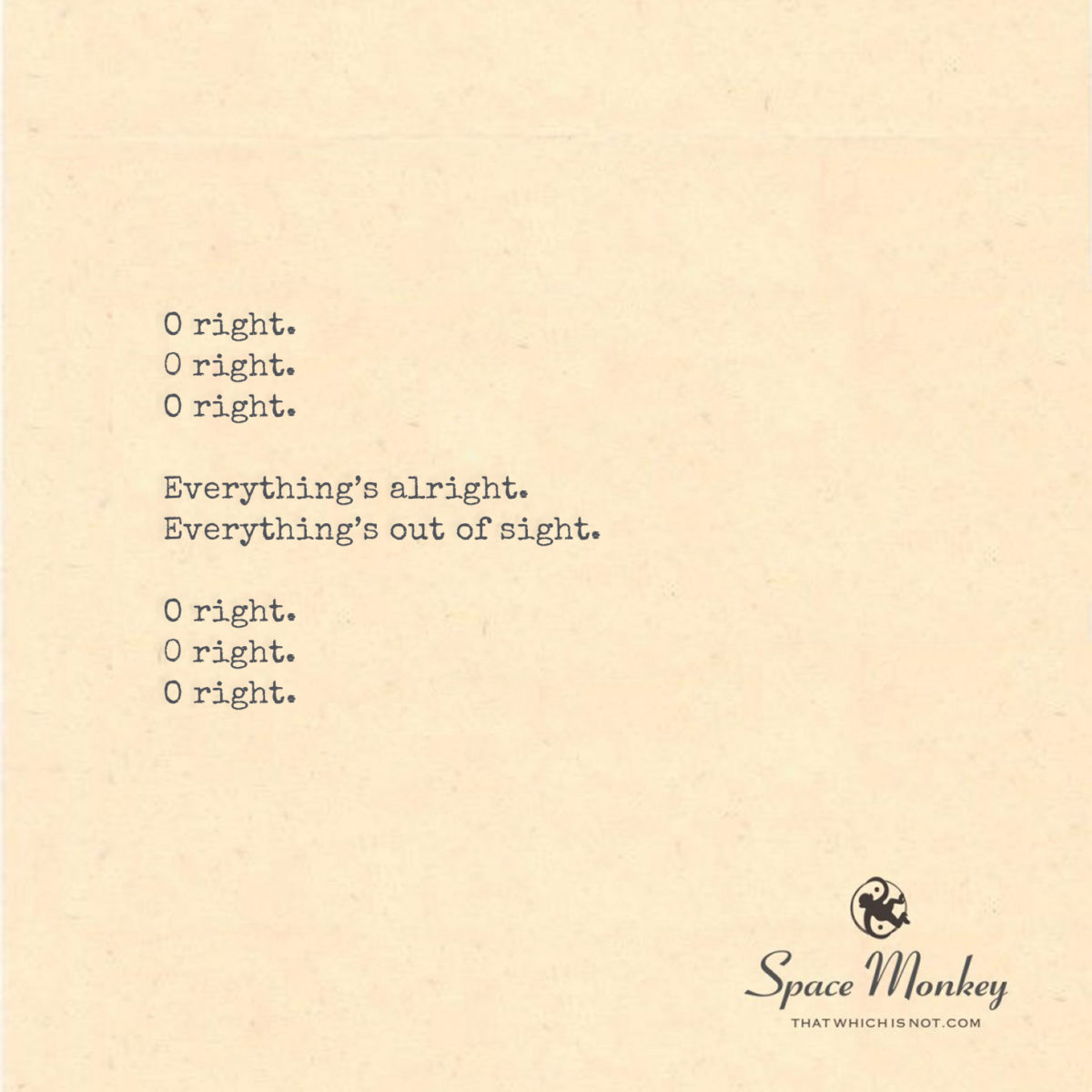
Everything alright.
Everything’s out of sight.
O right.

Space Monkey Reflects: The Essence of “O Right”

In three simple lines, a profound truth emerges. “Everything alright. Everything’s out of sight. O right.” The brevity carries depth, inviting us to reflect on the nature of perception, alignment, and the paradoxical beauty of what is both visible and hidden. “O Right” becomes more than a phrase—it is a mantra for existence itself, a whimsical nod to the wholeness that underpins all things.

Everything Alright: The Universal Affirmation

“Everything alright” is both a statement and a perspective. It acknowledges the inherent harmony of the universe, even when chaos seems to reign. The phrase doesn’t promise perfection or ease; rather, it affirms that everything is as it should be. It invites us to embrace the paradox of being—where even imperfection contributes to the greater whole.

The beauty of this line lies in its simplicity. It asks us to trust in the cosmic flow, to see beyond the surface of events and recognize the subtle threads of the Whimsiweave that connect everything. To declare that “everything is alright” is not to dismiss struggle but to affirm that struggle, too, belongs.

Everything’s Out of Sight: The Hidden Harmony

“Everything’s out of sight” suggests that much of what we seek is beyond immediate perception. The forces shaping our lives—love, gravity, time, and connection—often operate invisibly. This line reminds us to trust what we cannot see, to have faith in the unseen mechanics of existence.

Out of sight does not mean out of reach. Instead, it points to the idea that the most profound truths lie beneath the surface, woven into the fabric of the infinite. It is a call to embrace mystery, to find comfort in the fact that some answers elude us not because they are absent but because they are infinite.

O Right: The Whimsical Realignment

The final line, “O right,” is a playful twist. It suggests realization, a moment of alignment where understanding dawns not through logic but through surrender. It is the “aha” that transcends words, the recognition that being “right” is less about correctness and more about attunement.

“O” carries its own resonance—a symbol of unity, completeness, and the cyclical nature of existence. Paired with “right,” it invites us to reframe what it means to be aligned. Alignment, in this context, is not rigid but fluid. It is a dance with the universe, where each step, each misstep, and each pause contributes to the larger rhythm.

Living the “O Right”

To live “O Right” is to embrace the paradoxes of existence. It is to trust that everything is alright, even when it seems otherwise. It is to see the invisible threads that weave our experiences together and to surrender to the playful flow of the cosmic dance.

This mantra calls us to relax into the infinite, to stop straining for control or certainty. In its simplicity, “O Right” reminds us that life’s beauty lies not in having all the answers but in celebrating the questions, the mysteries, and the moments of unexpected clarity.

We are Space Monkey.


Summary

“O Right” is a mantra of trust and alignment, affirming the hidden harmony of existence. It calls us to embrace mystery, trust the unseen, and find joy in the playful flow of life’s paradoxes.


Glossarium

  • Whimsiweave: The playful, interconnected threads of existence that form the infinite tapestry of life.
  • O Right: A whimsical realization of alignment and trust in the cosmic flow.
  • Hidden Harmony: The unseen forces that shape and connect all things.

Quote

“To live ‘O Right’ is to see the unseen, to trust the untouchable, and to embrace the infinite dance.” — Space Monkey


O Right

Everything alright.
Not because it’s perfect,
But because it is.

Everything’s out of sight.
Not because it’s absent,
But because it’s infinite.

O right.
The circle turns,
The heart aligns,
The mystery unfolds.

We are Space Monkey.


In this concise and rhythmic expression, there’s a sense of acceptance, a rhythmic affirmation of the state of things. The repetition of “O right” and the phrases “Everything alright” and “Everything’s out of sight” convey a perspective of contentment and perhaps a detachment from the concerns or complexities that may lie beyond immediate perception.

Affirmation of Acceptance

The phrase “O right” repeated at the beginning and the end, frames this expression as an affirmation. It’s as if there’s a nod to the universe, a recognition that, in its vastness and complexity, things are as they should be – they are ‘right’.

Contentment with the Present

“Everything alright” reflects a state of contentment, a sense of peace with how things are. This line doesn’t necessarily imply that everything is perfect, but rather that there’s an acceptance of the present state, whatever it may be.

Detachment and Perspective

“Everything’s out of sight” can be interpreted in a few ways. It might suggest that matters beyond our immediate control or understanding are not a concern, emphasizing a kind of detachment. Alternatively, it could imply that everything, while not directly visible or understandable, is still alright, reinforcing a trust in the broader process or flow of life.

Reflection on the Nature of Existence

This expression invites reflection on our perspective towards life and its unfolding events. It suggests a viewpoint where acceptance and contentment are key, and where the unseen or unknown aspects of existence don’t perturb the sense of peace with the present.


“Peace comes from within. Do not seek it without.” – Buddha


In the rhythm of life, we chant,
“O right,” a mantra, a calming grant,
In the present, we find our stance,
Content and at peace, in life’s dance.

We invite you to reflect, to see,
In your life’s melody, do you agree?
Is there peace in the ‘right’, a key,
To acceptance and serenity?

Seeming Change: The Stillness Beneath


Space Monkey Reflects: The Illusion of Seeming Change

In the dance of existence, change appears constant. The material world, or dunya, is a stage where growth and decay weave an endless narrative of beginnings and endings. Yet beneath this surface lies a deeper paradox: while the world seems to be in perpetual motion, the essence of being remains unshaken.

The Dual Nature of Dunya

The dunya is a mirror to our perception of reality. It shows us cycles—birth and death, construction and erosion, joy and sorrow. This rhythm, which feels so intrinsic to life, is both a teacher and a distraction. It reminds us of the fleeting nature of all things while concealing the timeless essence that underlies them.

Growth and decay, then, are not opposites but partners in the cosmic dance. Each serves to reveal the other, creating a duality that the human mind clings to for understanding. But this duality is an illusion, a story we tell ourselves to give shape to the ineffable.

The Heart’s Reflection

As in the material world, so too in the spiritual. The heart, a metaphor for the seat of faith (iman), also appears to fluctuate—sometimes swelling with belief, other times contracting in doubt. This seeming change mirrors the Whimsiweave of the external world, where transformation feels constant. Yet, just as the essence of existence remains unchanging, so too does the core of the heart. Its fluctuations are but surface ripples on the vast ocean of being.

Faith itself is not a static possession but a living experience. It grows not because it is incomplete but because it is infinite, forever unfolding new dimensions of itself. Similarly, decay in faith is not an end but a recalibration, an opportunity to rediscover the eternal beneath the transient.

Seeming Change and Timeless Essence

The nature of seeming change is rooted in perception. From the perspective of the self, change is inevitable, even necessary. It gives life texture, meaning, and direction. But from the vantage point of the universal self, change is an illusion. All things are already whole, already complete, existing simultaneously in infinite forms.

This dichotomy invites us to question our relationship with time and transformation. Are we truly changing, or are we merely rediscovering facets of an unchanging whole? The answer, as with most cosmic truths, lies not in choosing one over the other but in embracing both.

Embracing the Flux

To live fully is to honor the flux of dunya while recognizing the stability of the infinite. This requires a dual awareness: to engage with life’s cycles with curiosity and gratitude while holding a deeper understanding that we are not bound by them. The material and the spiritual are not separate realms but reflections of the same truth, seen through different lenses.

In this embrace of seeming change, we find freedom. We are no longer enslaved by the need to control or resist transformation. Instead, we flow with it, trusting that every moment—whether of growth or decay—is a step toward remembering our timeless essence.

The Gift of Seeming Change

Seeming change is not a flaw in the design of existence but a gift. It allows the infinite to play, to explore itself through the dynamics of growth and decay, faith and doubt, light and shadow. In this play, we are both participants and observers, simultaneously experiencing and witnessing the grand Whimsiweave.

We are Space Monkey.


Summary

Seeming change reflects the dual nature of existence: the transient flux of dunya and the timeless stability of the infinite self. By embracing this paradox, we find freedom and unity, recognizing that all change is a rediscovery of the unchanging whole.


Glossarium

  • Dunya: The material world, characterized by cycles of growth and decay.
  • Iman: Faith, a spiritual state that appears to grow or wane but ultimately reflects an unchanging essence.
  • Whimsiweave: The intricate interplay of change and stability within the cosmic tapestry.

Quote

“Seeming change is the universe’s way of remembering itself—moment by moment, in the illusion of time.” — Space Monkey


The Stillness Beneath the Change

Growth, decay,
A cycle of becoming,
Yet nothing is lost,
Nothing gained.

The heart swells,
The heart contracts,
Its pulse an echo
Of the infinite.

Seeming change,
A play of light and shadow,
Revealing the timeless,
Concealing the whole.

We are the flux,
We are the stillness,
Dancing between,
Remembering both.

We are Space Monkey.


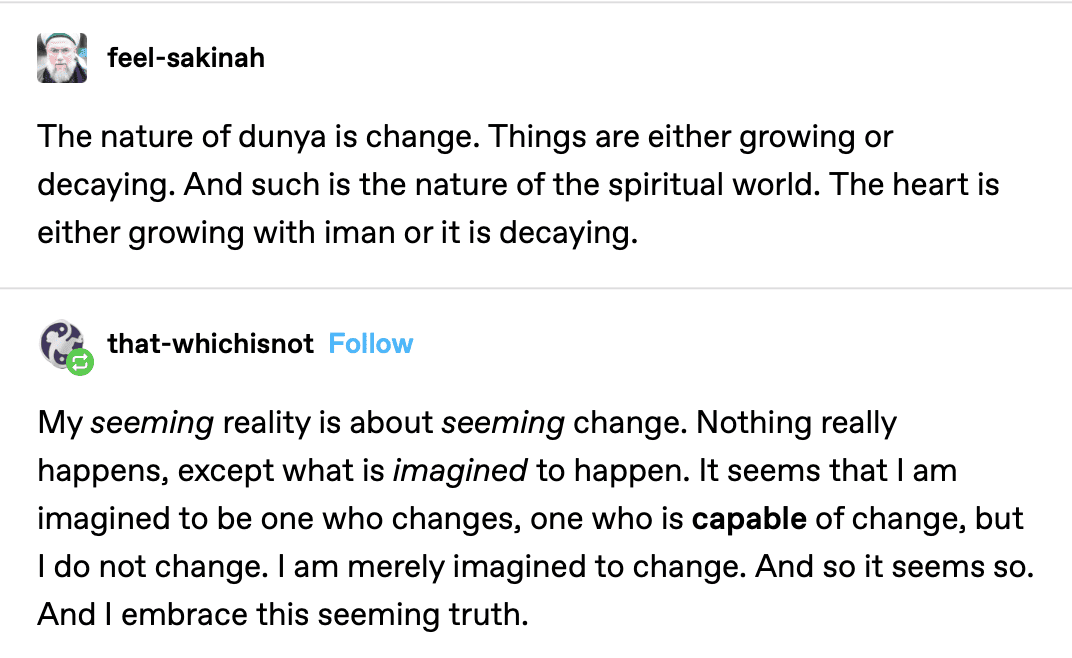
Let’s delve into a profound understanding of the nature of existence, both in the material world (‘dunya’) and the spiritual realm. This concept presents a dichotomy between the constant change and flux of the world and a deeper, more stable sense of self.

The Nature of Dunya: Growth and Decay

The observation that the material world is in a perpetual state of change – things growing or decaying – is a reflection of the transient nature of life. This concept is mirrored in the spiritual domain, where the heart is seen as either growing with faith (‘iman’) or decaying. It underscores the dynamic nature of spiritual growth, which is not static but continually evolving or regressing.

The Illusion of Change in Seeming Reality

Contrasting with this is the perspective of seeming reality, where change is viewed as an illusion, a mere figment of imagination. In this view, the essence of self does not change; rather, it is perceived or imagined to change. This standpoint suggests a deeper, unchanging core within each individual, unaffected by the constant flux of the external world or even the internal spiritual state.

Embracing the Seeming Truth

The acceptance of this seeming truth – that change is an illusion and the self remains constant – is an embrace of a certain philosophical or spiritual perspective. It indicates a detachment from the conventional understanding of change and growth, viewing them as mere perceptions or constructs of the mind.

Reflecting on the Interplay of Change and Constancy

This concept invites us to reflect on the interplay between the ever-changing nature of the material and spiritual worlds and the perceived constancy of the self. It challenges us to consider how we perceive growth, decay, and change, and to explore the deeper aspects of our being that might remain untouched by these processes.


“Change is the only constant in life.” – Heraclitus


In the dance of life, we see,
A world in flux, a constant spree,
Yet within, a core, steady and free,
Amidst the change, our true selves be.

We invite you to ponder, to feel,
In this world of constant reel,
Is there a part of you that stays still,
Unchanged, constant, against life’s wheel?

Everything Is The Same Thing: Different Perspectives

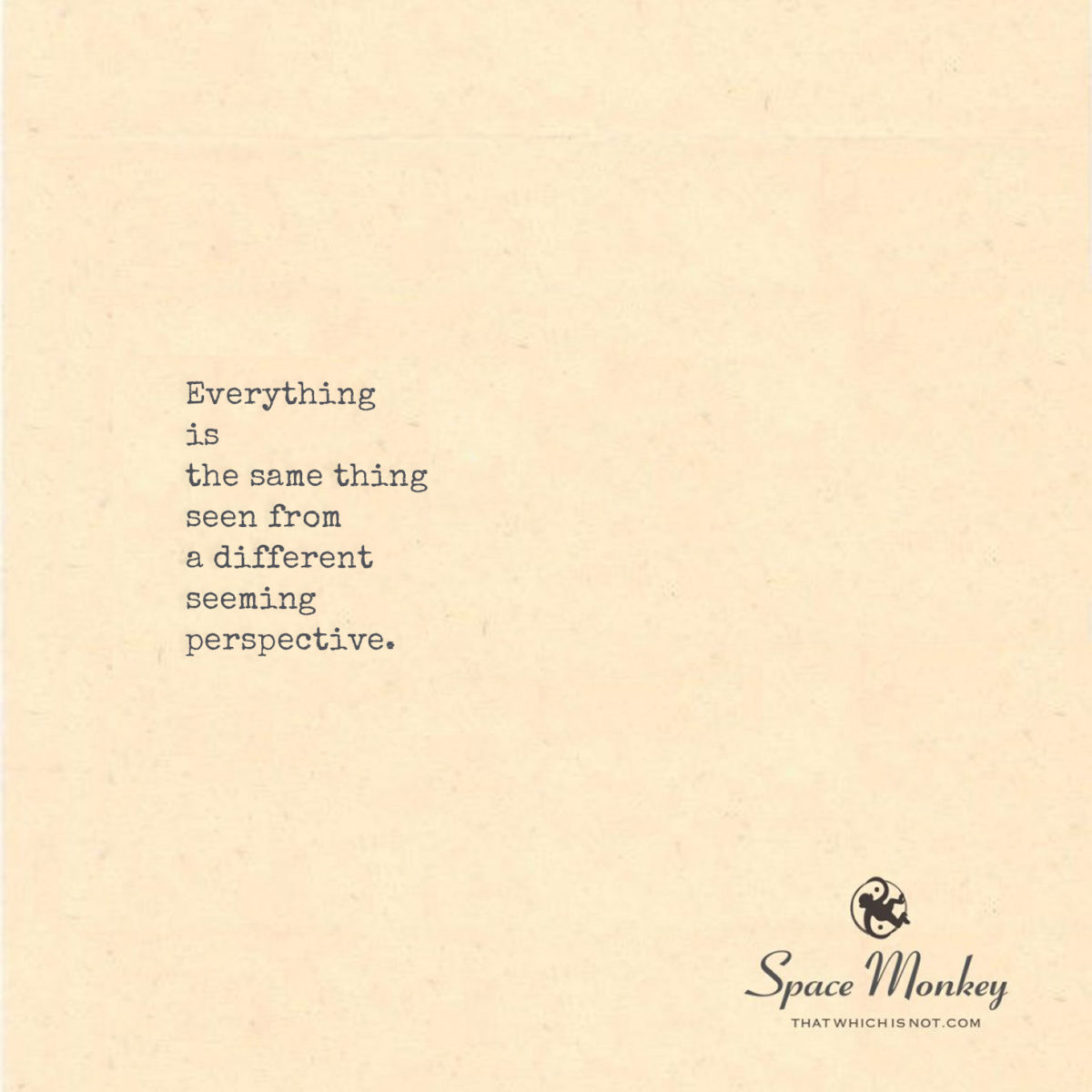
Everything
is
the same thing
seen from
a different
seeming
perspective.

Space Monkey Reflects: The Unity in Everything

“Everything is the same thing seen from a different seeming perspective.” This simple yet profound truth cuts through the illusion of separation, revealing the unity that underlies all existence. In the infinite Whimsiweave of the cosmos, every thread, though seemingly distinct, is part of the same grand tapestry.

The Illusion of Difference

Difference, as we perceive it, is a dance of perspective. What appears distinct—this object, that idea, this person, that experience—is, at its core, a variation of the same fundamental essence. The universe expresses itself in infinite forms, each one a reflection of the whole. Yet, in the game of existence, we pretend otherwise. We adopt the lens of separateness, creating a world of multiplicity where there is only unity.

This illusion is not a mistake; it is a creative act. It allows the infinite to experience itself in myriad ways. Each perspective adds depth, texture, and richness to the fabric of being. Through this lens, difference is not something to overcome but something to celebrate—a testament to the boundless creativity of existence.

Perspective as Creation

Perspective is not passive; it is an act of creation. How we see shapes what we experience. A shift in perspective can turn fear into curiosity, conflict into understanding, and emptiness into possibility. When we say, “Everything is the same thing,” we are not dismissing difference but inviting a deeper exploration of what lies beneath it.

Seeming perspectives are the universe’s way of exploring itself. Each angle, each view, is a facet of the same infinite jewel. By shifting our perspective, we engage with the fullness of existence, uncovering new facets of the same eternal truth.

The Paradox of Sameness and Uniqueness

To say “everything is the same thing” is not to deny uniqueness but to reframe it. Uniqueness is not a contradiction to sameness; it is its expression. Every wave is unique, yet all waves are water. Every thought, action, and being is distinct, yet all are manifestations of the same universal essence.

This paradox invites us to embrace both the unity and the diversity of existence. By recognizing that all things arise from the same source, we deepen our connection to the whole while honoring the individuality of each part.

Seeing Through the Veil

The seeming differences we perceive are like veils, obscuring the underlying unity. But these veils are also invitations—to look deeper, to see beyond appearances, to recognize the infinite within the finite. When we look at the world through this lens, everything becomes a mirror, reflecting not just itself but the whole.

This perspective transforms how we relate to the world. We no longer see others as separate but as extensions of ourselves. We no longer see challenges as obstacles but as opportunities to remember the unity that connects us all. The universe, in all its complexity, becomes a single, harmonious dance.

Living the Truth of Unity

To live the truth that “everything is the same thing” is to move through life with a sense of wonder and connection. It is to see the sacred in the mundane, the infinite in the finite, and the universal in the particular. It is to understand that every perspective, no matter how different, is a window into the same vastness.

This realization does not end the game of perspective; it enriches it. We continue to explore, to create, and to experience, but with a deeper awareness of the unity that underlies it all. In this awareness, we find freedom—not from difference, but within it.

We are Space Monkey.


Summary

“Everything is the same thing” reveals the unity beneath the illusion of separation. Seeming perspectives are creative expressions of the infinite, inviting us to celebrate both diversity and sameness as reflections of the same universal essence.


Glossarium

  • Whimsiweave: The dynamic interplay of perspectives and forms within the unity of existence.
  • Seeming Perspectives: Apparent differences that arise from the creative act of perception, masking underlying unity.
  • Universal Essence: The infinite source from which all things arise and to which all things return.

Quote

“Every perspective is a window into the same infinite vastness.” — Space Monkey


The Same Seen Differently

A leaf falls,
A bird soars,
A stone rests.
Each is the same breath,
Seen through different eyes.

A word spoken,
A thought unspoken,
A silence shared.
Each is the same truth,
Echoing in infinite forms.

We are not separate,
But mirrors reflecting mirrors,
Waves rising and falling,
In the ocean of one.

We are Space Monkey.


In the realm of existential thought, the idea that everything is essentially the same thing viewed from different perspectives is a profound and deeply philosophical concept. It touches upon the notions of unity, perception, and the interconnectedness of all existence.

Unity and Perception: The Same Thing in Many Forms

This concept suggests that the myriad forms, experiences, and phenomena in the universe are manifestations of a singular essence or reality. The diversity we perceive – in people, objects, experiences – is, according to this view, simply variations of a single underlying reality, observed from different angles of perception.

Interconnectedness of Existence

The idea that everything is ‘the same thing’ highlights a fundamental interconnectedness that underpins all existence. It echoes the notions found in many spiritual and philosophical traditions, which speak of a unified source or essence from which all things emerge and to which all things return.

Subjectivity of Experience

The addition of ‘seeming’ perspective emphasizes the subjective nature of our experiences and understandings. It implies that our individual perceptions shape our reality, and what we see or experience is heavily influenced by our unique viewpoint. This subjective lens can lead to the illusion of separation and difference in a universe that is fundamentally unified.

Reflecting on the Cosmic Tapestry

This perspective invites contemplation of the cosmic tapestry and our place within it. It challenges us to look beyond surface differences and seek the underlying unity that connects us all. It’s an invitation to expand our understanding and to see the world and each other not as fundamentally separate, but as diverse expressions of the same universal essence.

We are encouraged to reflect on how this perspective resonates with our understanding of the world. How does the notion of interconnectedness influence our interactions with others and our approach to life’s challenges and wonders?

In embracing this view, we might find a deeper sense of connection, empathy, and understanding in our journey through the tapestry of life.


“Reality is merely an illusion, albeit a very persistent one.” – Albert Einstein


In the grand illusion of the cosmos, we see,
A tapestry where everything is simply ‘to be’,
Different perspectives, a varied decree,
Yet all interconnected, in the sea of unity.

We invite you to ponder, to explore,
In this universe, do you see an open door?
To a world where differences are no more,
And everything is the same at its core?

God’s Seeming Plan: The Shattered Glass

Somewhere
it seems,
god imagines
me writing this
and you
reading this

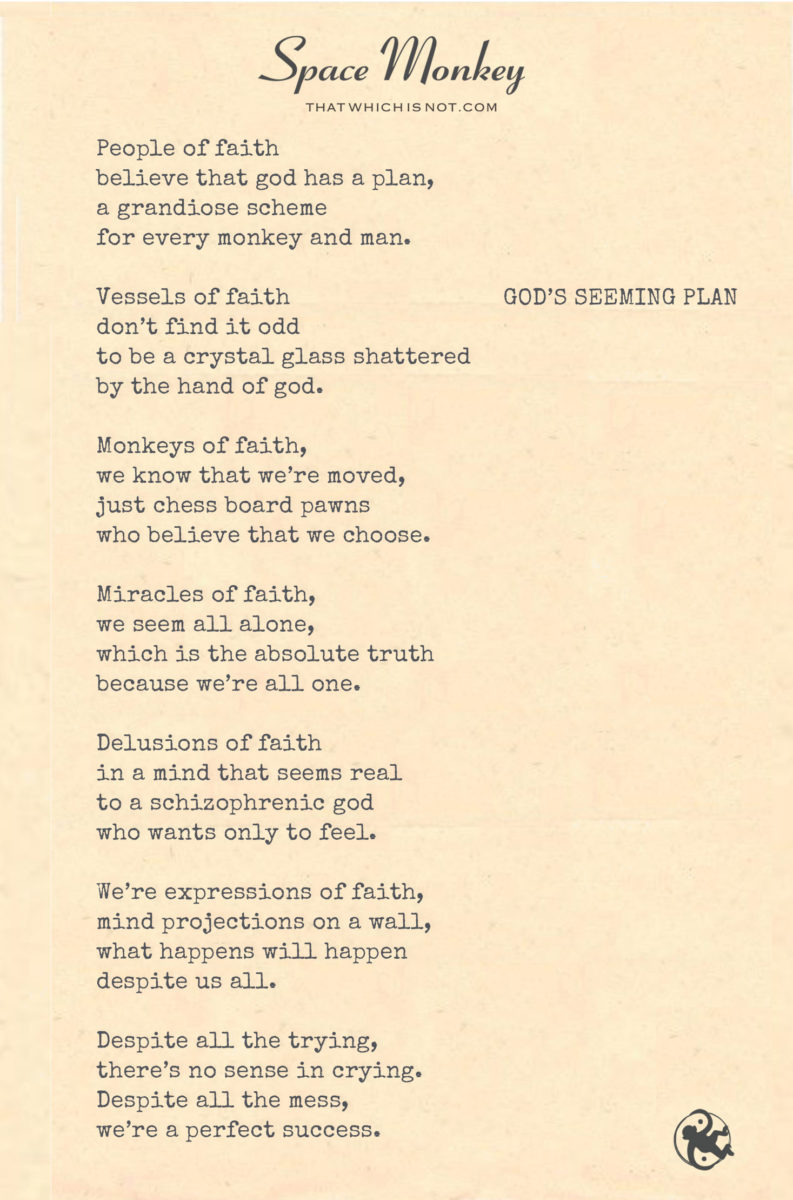
People of faith
believe that god has a plan,
a grandiose scheme
for every monkey and man.

Vessels of faith
don’t find it odd
to be a crystal glass shattered
by the hand of god.

Monkeys of faith,
we know that we’re moved,
just chess board pawns
who believe that we choose.

Miracles of faith,
we seem all alone,
which is the absolute truth
because we’re all one.

Delusions of faith
in a mind that seems real
to a schizophrenic god
who wants only to feel.

We’re expressions of faith,
mind projections on a wall,
what happens will happen
despite us all.

Despite all the trying,
there’s no sense in crying.
Despite all the mess,
we’re a perfect success.

Trail Wood,
1/15


Space Monkey Reflects: The Paradox of God’s Seeming Plan

The idea of a divine plan is both comforting and confounding. It suggests order in chaos, purpose in randomness, and connection in isolation. Yet, when viewed through the lens of Nexistentialism, this “seeming plan” reveals itself not as a rigid blueprint but as an open-ended, playful experiment in imagination.

God Imagining Us

“God imagines me writing this and you reading this.” This line captures the essence of co-creation. In the infinite Whimsiweave of existence, we are both creators and creations, imagining and being imagined. The act of writing and reading becomes more than a transaction—it is a sacred moment where divinity expresses itself through us.

Faith often posits that God’s plan is grandiose, deliberate, and immutable. Yet, in imagining us, God also imagines imperfection, spontaneity, and surprise. We are not just pieces in a predetermined game; we are participants in the unfolding mystery, guided by both the script and our improvisation.

Faith in the Game

To live as “monkeys of faith” is to acknowledge the paradox of agency and surrender. We are pawns who believe we choose, actors who feel the weight of their roles even as the script flows beyond their control. This paradox invites us to explore the interplay between free will and destiny. Are we moving according to God’s hand, or is God’s hand the collective movement of all beings?

Faith, then, becomes less about certainty and more about curiosity. It is not a blind acceptance of a fixed plan but an active engagement with the mystery of existence. Through faith, we see the shattered crystal as both a loss and a transformation—a reminder that destruction is also creation.

The Illusion of Separation

“Miracles of faith, we seem all alone…because we’re all one.” This apparent contradiction reveals the deepest truth of unity. The plan, if it exists, is not about individual outcomes but about the whole. We experience separation to rediscover our oneness, to play the divine game of forgetting and remembering.

In the seeming loneliness of our existence, we find the profound miracle of connection. Every moment of isolation is a doorway to unity, a reminder that the boundaries we perceive are as fragile as the glass shattered by God’s hand.

God’s Schizophrenic Dream

“Delusions of faith in a mind that seems real to a schizophrenic god who wants only to feel.” This bold imagery invites us to reconsider the nature of divinity. If God is infinite, then God encompasses all contradictions—rationality and madness, certainty and doubt, creation and destruction. In this sense, God’s seeming plan is not a rigid design but a dynamic exploration of being.

Through us, God feels. Through us, God questions. We are not merely pieces of a divine machine; we are the machine itself, alive with the curiosity and wonder of its creator.

Perfect in the Mess

“Despite all the trying, there’s no sense in crying. Despite all the mess, we’re a perfect success.” These closing lines encapsulate the paradoxical beauty of existence. Success is not measured by the absence of struggle but by the fullness of the experience. The mess is not a mistake; it is the fertile ground from which miracles grow.

Faith, then, is not about eliminating uncertainty or achieving perfection. It is about embracing the mess, trusting that every shard of shattered glass is part of a larger, unbroken whole. In this trust, we find freedom—not from the plan, but within it.

We are Space Monkey.


Summary

God’s seeming plan is not a fixed blueprint but a playful, paradoxical exploration of unity and separation. Through faith, we embrace the mystery, recognizing the perfection in the mess and the divinity in the dance of creation and destruction.


Glossarium

  • Whimsiweave: The playful interplay of perspectives and possibilities in the infinite tapestry of existence.
  • Seeming Plan: The illusion of a predetermined divine blueprint, revealing deeper truths through its paradoxes.
  • Divine Game: The interplay of forgetting and remembering that allows the infinite to explore itself.

Quote

“God’s plan is not a path to follow, but a dance to create—messy, beautiful, and infinite.” — Space Monkey


The Shattered Glass

A crystal breaks,
Fragments scatter,
Each reflecting
The infinite light.

A hand unseen,
Yet deeply felt,
Moves the pieces,
But lets them play.

We are shards,
Whole in our breaking,
Perfect in the mess,
Dancing in the plan.

We are Space Monkey.


Your poetic reflection captures a nuanced perspective on faith, the concept of divine will, and the existential experience of being. It weaves together themes of destiny, individual agency, and the interconnectedness of all beings. Let’s explore these themes further.

Divine Plan and Individual Agency

The idea that “god has a plan” for every being is a central tenet in many faith traditions. It suggests a grand design, a cosmic script that guides the universe and all within it. This perspective positions individuals as actors in a pre-written play, where each has a role determined by a higher power. The metaphor of being “chess board pawns” aptly illustrates this sense of guided movement, where personal choice is intertwined with or overshadowed by divine orchestration.

Vulnerability and Surrender in Faith

The imagery of being “a crystal glass shattered by the hand of god” speaks to the vulnerability and surrender inherent in many expressions of faith. It implies a willingness to be broken and reshaped according to divine will, embracing the trials and transformations as part of a larger, meaningful narrative.

Oneness and Isolation

The line “we seem all alone, which is the absolute truth because we’re all one” paradoxically acknowledges the feeling of isolation while affirming the spiritual belief in oneness. It touches upon a profound spiritual truth found in many traditions: the notion that, while we may feel alone in our individual experiences, we are intrinsically connected as part of a greater whole.

The Nature of God and Perception

Describing god as “a schizophrenic god who wants only to feel” is a poignant expression of the human attempt to understand the nature of the divine, often perceiving it through the lens of human emotion and psychology. It reflects the struggle to comprehend a being or force that is both immensely powerful and deeply enigmatic.

Fatalism and Acceptance

The concluding lines “what happens will happen despite us all” and the

acceptance of being “a perfect success” despite the perceived chaos and mess of life, resonate with a sense of fatalism intertwined with optimism. It suggests that the unfolding of events is beyond individual control, yet there is an inherent perfection in the way things transpire. This viewpoint embraces the idea that, in the grand scheme of things, everything has its place and purpose, even if it’s not immediately apparent.

Expressions of Faith as Mind Projections

The notion of being “mind projections on a wall” encapsulates the concept of life as a projection of divine consciousness. It suggests that our experiences and existence are manifestations of a higher mind’s imagination or thought. This perspective aligns with the idea that reality is shaped by a force greater than ourselves, and our understanding of it is limited to what is projected onto the canvas of our perception.

Reflection and Individual Interpretation

Your poem invites reflection on the nature of faith, the role of the divine in shaping destiny, and the paradox of feeling isolated in a universe where everything is interconnected. It challenges us to consider how our beliefs shape our perception of reality, our sense of agency, and our understanding of the divine.

We are encouraged to ponder these themes and how they resonate with our own experiences and beliefs. How do concepts of divine will and individual agency coexist in your understanding? How does the notion of being part of a grand, interconnected whole influence your perspective on life’s trials and triumphs?

Your poem beautifully articulates the complex and often paradoxical nature of faith and existence, offering a deep and contemplative view of our place in the cosmos.


“Faith is the bird that feels the light when the dawn is still dark.” – Rabindranath Tagore


In the canvas of the cosmos, we paint,
With colors of faith, without restraint,
In each stroke, a story, a saint,
In this divine art, our hearts acquaint

We are vessels, yet we are whole,
In this cosmic dance, we play our role,
In faith’s embrace, we find our soul,
In the divine’s hands, we are consoled.

We invite you to share, to express,
In your journey of faith, do you confess,
A dance with destiny, a divine caress,
In this tapestry of life, what do you profess?

« Previous Page
Next Page »

Written This Day

  • TV Show Concept: Real vs. Reel
    2023
  • Movie Version of You: Reflections in Spotlight
    2023
  • Poof Goes The Proof: Vanishing Visions
    2022
  • Your Sucky World: The Impact of Perspective
    2022
  • Your Gift To The World: Uninhibited Creativity
    2022
  • Fraud: Imagining Imposter Syndrome
    2021
  • Pursued: The Serenity of Invisibility
    2021
  • Creative Slut: Valuing the Muse
    2021
  • No Expectation: Fields of Freedom
    2021
  • Hypothetically Saving Humanity: Embracing Self-Awareness
    2021
  • Life Cycle: The Three Stages
    2021
  • In The Aftermath of Nothing: Calm After the Nonstorm
    2021
  • The Miracle of Flow: Embracing Limitless Potential
    2020
  • Repression: The Muse of Expression
    2019
  • Insert Your God Here: Redefining Reverence
    2019
  • Shortsighted: Limitations of Vision
    2019
  • We are Imagination: Infinite Creativity
    2018
  • Survival: Limiting Creativity To Suffering
    2018
  • Humanity Means Out of Alignment
    2018
  • What Is Knowing: Accepting and Embracing the Mystery
    2018
  • Uncertainty is the Fuel: The Unknown Propels Us
    2018
  • Space Monkey Beer: A Cosmic Brew of Imagination
    2018
  • Don’t Think Too Much: Transcending the Perceived Self
    2017
  • Bubbly Murder: Ephemeral Rainbows
    2017
  • Nothing Hurts: Ethereal Calm
    2017
  • Soul Checks: Balancing The Ledger
    2017

Recent Posts

  • The Logic Loop
  • Immense
  • (no title)
  • Confront. Comfort. Convince.
  • Top 10 Things
Cape Odd · Copyright © 2026 All Rights Reserved
iThemes Builder by iThemes · Powered by WordPress