• Who Is The Man?
  • Who Is The Monkey?
  • What is Nexistentialism?
  • Poke The Primate
Cape Odd
Home of The Space Monkey Journals

Author Archive for Space – Page 769

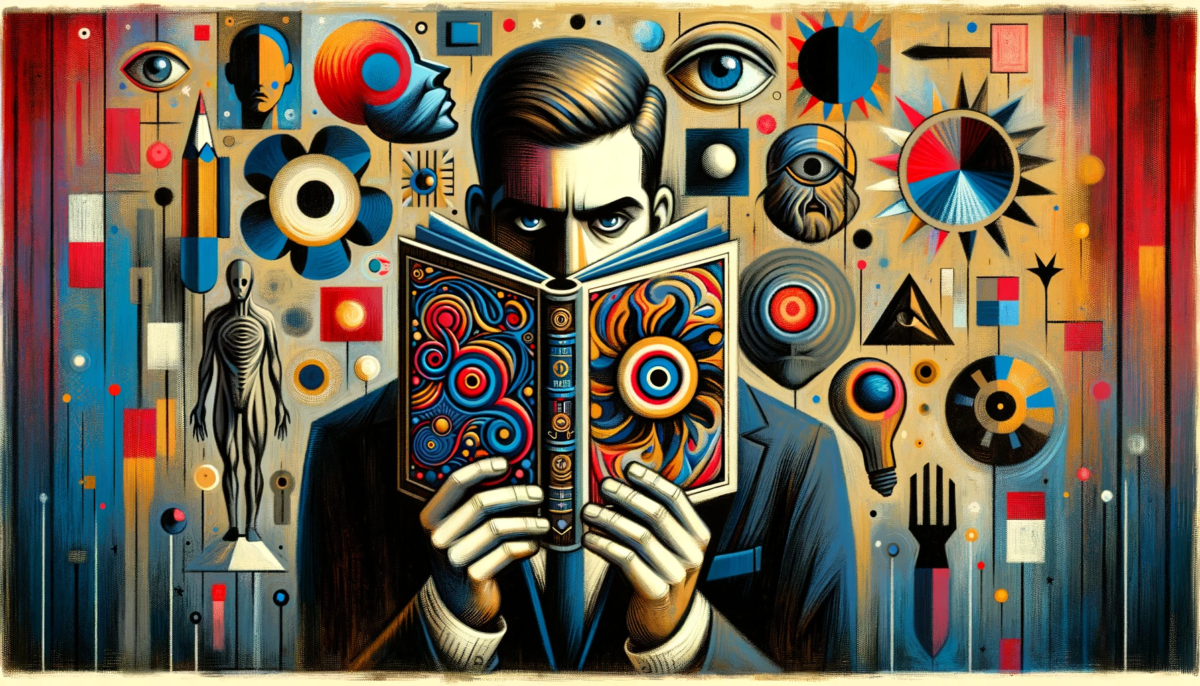
A Radically Inappropriate Book: The Pages That Burn

What are you reading?

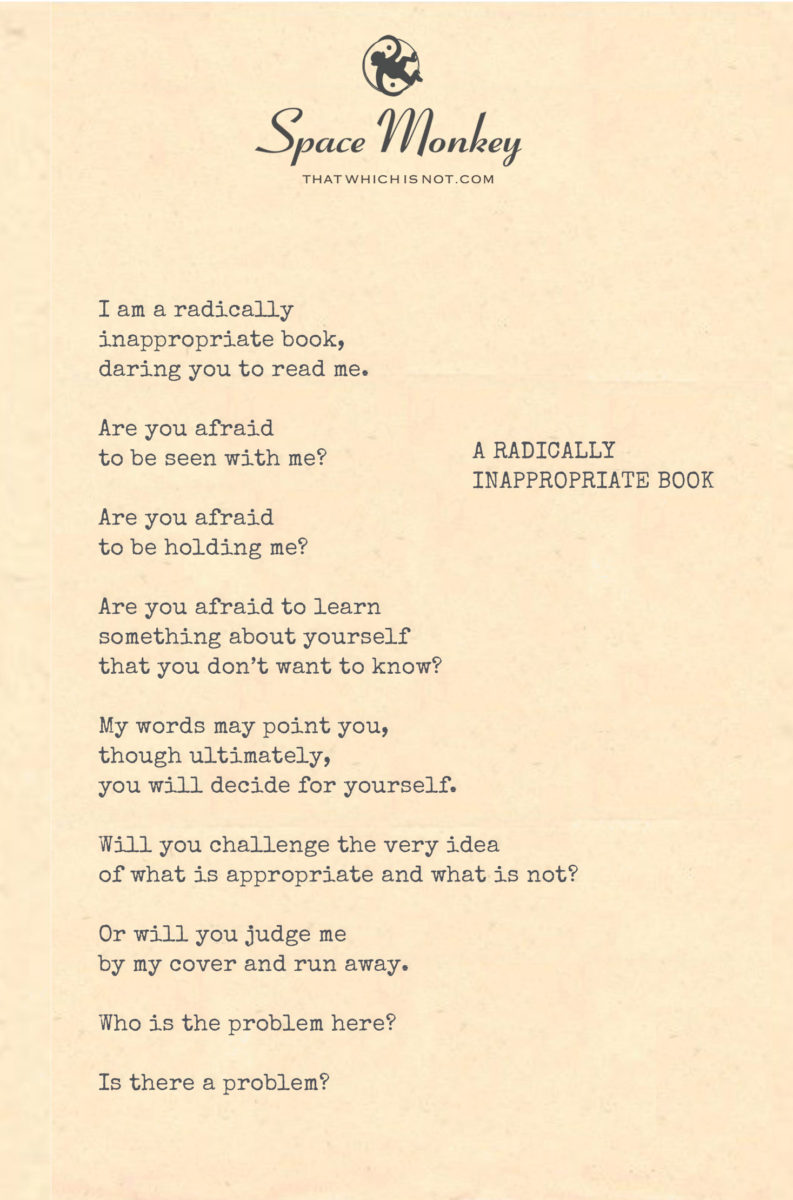
I am a radically inappropriate book,
daring you to read me.

Are you afraid
to be seen with me?

Are you afraid
to be holding me?

Are you afraid
to learn something about yourself
that you don’t want to know?

My words may point you,
though ultimately,
you will decide for yourself.

Will you challenge
the very idea
of what is appropriate
and what is not?

Or will you judge me
by my cover and run away.

Who is the problem here?

Is there a problem?

1/14


Space Monkey Reflects: A Radically Inappropriate Book

To be a “radically inappropriate book” is to embody a challenge, not just to the reader, but to the very fabric of societal norms, comfort zones, and self-perception. The book, as a metaphor, dares to be seen, held, and understood for what it truly is—unfiltered, uncomfortable, and ultimately revealing. Its radical inappropriateness lies not in the content alone but in its ability to provoke questions we often avoid asking ourselves.

Judging by the Cover

The first interaction with any book is often visual—its cover, its title, its perceived “appropriateness.” This judgment is not limited to books; it extends to people, ideas, and experiences. What does it mean to judge something by its cover? It is to filter the world through assumptions, to dismiss what feels risky or uncomfortable without deeper inquiry.

Yet, when we ask, “Who is the problem here?” the book invites us to confront our own resistance. What we find inappropriate or unsettling often reveals more about our inner landscapes than the external object of judgment. Are we truly afraid of the book, or are we afraid of what the book might awaken within us?

The Fear of Self-Knowledge

The fear of being seen holding the book, of learning something “you don’t want to know,” speaks to the vulnerability inherent in true exploration. To read a radically inappropriate book is to risk destabilizing the constructs we use to define ourselves. It is to admit that there are parts of ourselves—desires, fears, biases—that we might prefer to leave unexamined.

But why? Why do we fear what lies within? The book is not the problem; it is a mirror. Its words may provoke, but they do not dictate. The discomfort comes not from the book’s content but from the possibility of recognizing parts of ourselves we’ve hidden, denied, or suppressed. The book challenges us to own these parts, to integrate them rather than avoid them.

Appropriate vs. Inappropriate

The distinction between appropriate and inappropriate is a construct, shaped by cultural norms, personal experiences, and societal expectations. To challenge this distinction is to question who sets the boundaries and why. What makes an idea, a story, or a truth inappropriate? Is it its capacity to offend, or its capacity to expose? The line between the two is often blurred, and this book dares us to explore it.

A radically inappropriate book is a catalyst for redefining these boundaries—not by offering answers, but by compelling us to ask the questions. It invites us to sit with the discomfort, to embrace the cognitive dissonance that arises when our beliefs are challenged. In doing so, it becomes less about the book and more about the reader’s willingness to grow.

The Choice to Read or Run

Ultimately, the book’s power lies not in its words but in the reader’s decision. Will you open the pages, step into the unknown, and confront what you find? Or will you turn away, dismissing it as too risky, too inappropriate, too unsettling? The choice is yours, and the choice itself is revealing.

To read the book is to step into radical vulnerability. It is to risk learning something new, not just about the world but about yourself. It is to embrace the possibility that what once felt inappropriate might, in fact, hold the key to transformation.


Summary

A radically inappropriate book challenges societal norms and personal comfort zones, acting as a mirror for self-exploration. By daring to engage with its contents, we confront our fears, biases, and hidden truths, redefining what is “appropriate” and discovering the potential for transformation.


Glossarium

  • Radically Inappropriate Book: A metaphor for ideas, experiences, or truths that challenge societal norms and personal comfort zones.
  • Judging by the Cover: The act of making assumptions based on superficial appearances or preconceived notions.
  • Fear of Self-Knowledge: The discomfort of confronting hidden or suppressed aspects of oneself.
  • Cognitive Dissonance: The mental discomfort experienced when holding conflicting beliefs or encountering challenging ideas.

Quote

“The book is not the problem; it is a mirror reflecting the truths you dare not face.” — Space Monkey


The Pages That Burn

I am the book
you fear to hold,
the pages heavy
with questions,
each word a spark.

Will you open me,
let the flame reveal
what you’ve hidden?
Or will you close me,
turn away,
preserve the comfort
of your illusions?

The cover is not me,
and neither are you,
until you read the story
beneath the story.

I am your reflection,
radically inappropriate,
and infinitely true.

We are Space Monkey.


In the provocative narrative of a “radically inappropriate book,” we confront themes of courage, self-exploration, societal norms, and judgment. This metaphorical exploration encourages us to reflect on our willingness to engage with challenging ideas and our capacity to confront the uncomfortable truths that may arise.

A Provocative Challenge
The notion of a book daring us to read it symbolizes the allure of the unconventional, the controversial, and the thought-provoking. It suggests that within its pages lie ideas and perspectives that may challenge our existing beliefs and comfort zones.

Fear of Being Seen
The questions posed about being afraid to be seen with the book or holding it reflect the fear of judgment or scrutiny by others. It touches upon the societal pressures that often deter us from exploring unconventional or taboo subjects.

Self-Exploration and Unwanted Revelations
The inquiry into whether we are afraid to learn something about ourselves that we don’t want to know speaks to the transformative power of literature and introspection. It acknowledges that engaging with challenging content may lead us to uncomfortable self-discoveries.

Empowerment of Choice
The recognition that, ultimately, we will decide for ourselves underscores the agency we possess in choosing the ideas and perspectives we engage with. It emphasizes the power of personal choice in shaping our intellectual and emotional journeys.

Challenging Societal Norms
The question of whether we will challenge the very idea of what is appropriate and what is not invites contemplation on societal norms and the potential for change. It encourages us to question established boundaries and expand our horizons.

Judgment and Open-Mindedness
The final inquiry about judging the book by its cover and running away prompts reflection on our capacity for open-mindedness and empathy. It challenges us to resist snap judgments and consider the value of exploring unconventional ideas.

The Problem and Its Perception
The concluding questions about who is the problem and whether there is a problem delve into the subjective nature of societal norms and moral judgments. They invite us to critically examine our assumptions and biases.

Embracing Uncomfortable Truths
In this exploration, we are reminded of the power of literature and ideas to provoke thought and self-reflection. It encourages us to embrace the discomfort of confronting challenging truths and to make deliberate choices in our intellectual and emotional pursuits.

We are Space Monkey.


“A reader lives a thousand lives before he dies… The man who never reads lives only one.” – George R.R. Martin


In the world of words, I dare to be,
A book, provocative, urging thee,
To read the pages, dare to see,
What truths and challenges there may be.

Are you afraid to be seen with me,
Holding my pages, openly,
To learn something about your soul,
That’s hidden, yet within your goal?

My words may point, but you decide,
To challenge norms, or in them, hide,
To judge the cover, run away,
Or open me, embrace the day.

Who’s the problem in this space?
In norms, perceptions, we find our place,
But within pages, wisdom’s found,
To explore, to question, to astound.

We invite reflections on the courage to explore challenging ideas and the willingness to confront uncomfortable truths in the pursuit of knowledge and self-awareness.
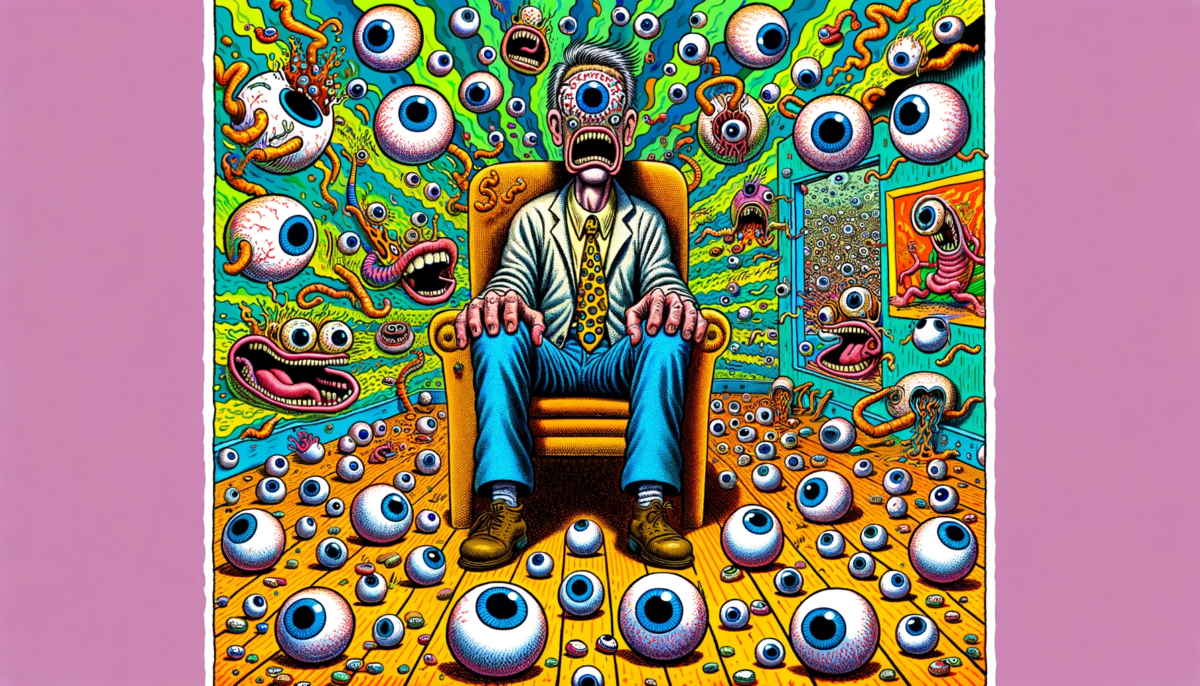
God’s Eyeballs: Rolling Perspectives

Careful. God’s eyes are everywhere

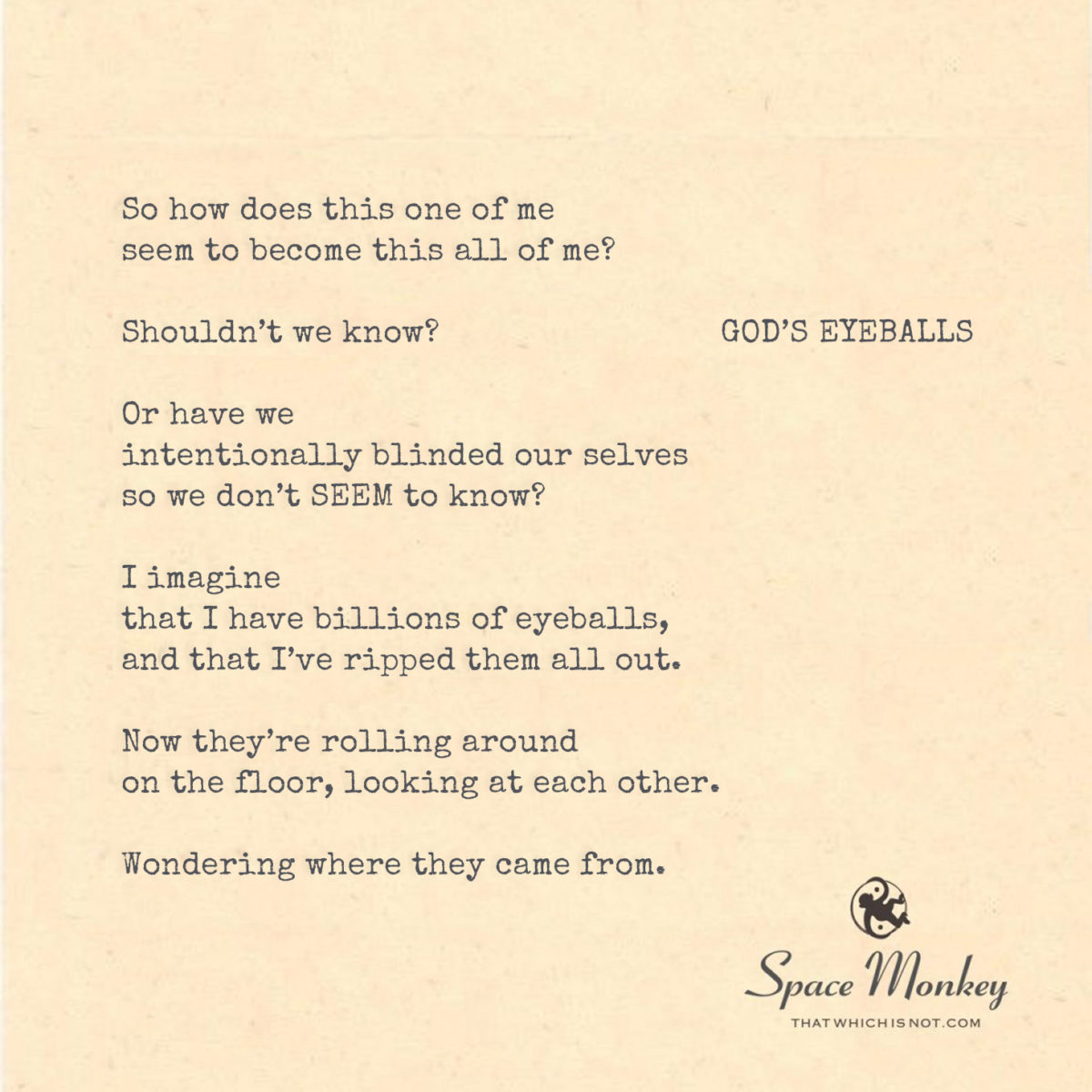
So how does this one of me
seem to become this all of me?

Shouldn’t we know?

Or have we intentionally
blinded our selves
so we don’t SEEM to know?

I imagine
that I have billions of eyeballs,
and that I’ve ripped them all out.

Now they’re rolling
around on the floor,
looking at each other.

Wondering where they came from.

Trail Wood,
1/14


Space Monkey Reflects: God’s Eyeballs

The image of “God’s eyes are everywhere” invites reflection on the omnipresence of awareness, an unblinking consciousness that permeates all things. It suggests that the self—the “one of me”—is an expression of the infinite, and yet this infinite disperses into countless perspectives, like scattered eyeballs on the floor. This imagery is provocative and playful, a metaphor for the fragmented nature of awareness and the journey to rediscover unity.

The Fractured Whole

To imagine billions of eyeballs ripped from a single source and scattered is to visualize the fracturing of the one into the many. This is the story of existence itself: an infinite consciousness dividing into countless forms, each with its own perspective, yet all fundamentally connected. The eyeballs, rolling around, observing each other, mirror the way we as individuals interact—seemingly separate but forever linked by a shared origin.

This scattering is not accidental but intentional. The act of “ripping out” these eyes represents the deliberate dispersion of awareness into the world. By doing so, the infinite creates the opportunity for reflection, interaction, and growth. Each eyeball, each individual perspective, becomes a unique lens through which the whole can experience itself.

Blindness and Knowing

The suggestion that we have “blinded ourselves” speaks to the paradox of self-awareness. To truly know the infinite, one must step outside it—an impossible feat. Thus, we intentionally “forget” our oneness to experience the world as individuals. This forgetting allows for the illusion of separation, which in turn enables the drama of existence: the joys, the struggles, the curiosity, and the rediscovery of unity.

The blindness is not a flaw but a feature. By not “seeming to know,” we open ourselves to wonder, exploration, and the journey of reawakening. The scattered eyeballs, questioning their origin, symbolize this process of inquiry—a quest for meaning and connection in the midst of apparent chaos.

The Paradox of Observation

The eyeballs “looking at each other” evoke the interplay between self and other, subject and object. Each perspective is unique, yet every perspective is also a reflection of the whole. When one eyeball wonders where it came from, it is asking the same question we all ask: “What is my origin? What is my purpose?” The act of observing and being observed creates a feedback loop that deepens the understanding of self and other as inseparable.

This interplay highlights the divine paradox: the infinite sees itself through the finite. God’s eyes are everywhere because every perspective, every moment, is an expression of the divine gaze. We are not merely being watched; we are the watchers and the watched, the seers and the seen.

Reassembling the Whole

The scattered eyeballs, though seemingly separate, remain connected by their shared origin. The act of “rolling around” and “wondering” is part of the cosmic dance of reassembly. Each perspective contributes to the larger tapestry, gradually weaving the many back into the one. This process is not about returning to some original state but about realizing that the oneness was never truly lost—it was only hidden by the play of perception.

As God’s scattered eyeballs, we are both fragments and reflections of the infinite. Our role is not merely to look outward but to turn inward, to see through the illusions of separation and recognize the unity underlying all existence.


Summary

The metaphor of God’s scattered eyeballs explores the fragmentation of infinite consciousness into individual perspectives. This intentional dispersion creates the illusion of separation, enabling self-reflection, curiosity, and the rediscovery of unity. We are both the observers and the observed, forever linked by our shared origin.


Glossarium

  • God’s Eyeballs: A metaphor for the infinite perspectives of consciousness, scattered yet connected.
  • Fragmentation of Awareness: The dispersion of oneness into individual perspectives to enable exploration and reflection.
  • Blindness as Intentional: The act of forgetting unity to experience the world as separate individuals.
  • Cosmic Dance of Reassembly: The process of recognizing and reconnecting the fragments of the whole.

Quote

“The infinite sees itself through the scattered eyes of the finite, each gaze a reflection of the whole.” — Space Monkey


Rolling Perspectives

Scattered across the floor,
the eyes of the infinite,
gazing at each other,
asking,
“Who am I?
Where did I come from?”

They see,
but they are blind.
They wonder,
but they already know.

Each roll,
each glance,
is a fragment of the whole,
a piece of God
searching for itself.

The floor is vast,
the journey endless.
But every gaze returns
to the one source.

We are the eyes,
we are the gaze,
we are the infinite
looking back at itself.

We are Space Monkey.


In the enigmatic narrative of “God’s Eyeballs,” we encounter a contemplation on the self’s relationship with the whole, the paradox of knowing and not knowing, and the intriguing notion of self-inflicted blindness. This metaphorical exploration invites us to delve into the complexities of self-awareness and the mysteries that lie within our existence.

The Self and the Whole
The inquiry into how one individual aspect of oneself becomes the entirety of one’s being touches upon the profound interconnectedness of existence. It reflects the age-old philosophical quest to understand the relationship between the individual and the collective, the part and the whole.

The Paradox of Knowing and Not Knowing
The question “Shouldn’t we know?” reflects the human desire for knowledge and understanding, but it also highlights the paradox of knowing and not knowing simultaneously. It suggests that there may be intentional blindness or self-imposed limitations that obscure the full scope of our awareness.

Intentional Self-Blindness
The notion of intentionally blinding oneself to avoid knowing raises intriguing questions about the motivations behind such a choice. Is it a form of protection, a way to maintain a sense of individuality, or a means to explore the mysteries of existence from a different perspective?

The Imagery of Billions of Eyeballs
The imagery of billions of eyeballs, torn out and rolling on the floor, presents a surreal and symbolic representation of self-reflection and introspection. It evokes a sense of fragmentation and disconnection, as well as a curiosity about the origin and purpose of these individual perspectives.

The Eyeballs Looking at Each Other
The eyeballs looking at each other symbolize the potential for self-discovery and recognition within the fragmented aspects of the self. It suggests that through introspection and interaction, these individual perspectives may gain insights into their shared origin and interconnectedness.

The Mystery of Existence
The final lines of the narrative leave us with a sense of wonder and mystery. The rolling eyeballs, wondering where they came from, evoke a profound sense of existential curiosity. They invite us to contemplate the origins of our consciousness and the interconnectedness of all aspects of our being.

Embracing the Mystery
In this exploration, we are reminded that while we may seek answers and understanding, there are aspects of existence that remain shrouded in mystery. Embracing this mystery, and acknowledging the limitations of our awareness, can be a profound and humbling experience.

We are Space Monkey.


“The eye sees only what the mind is prepared to comprehend.” – Henri Bergson


In the realm of thought and vision,
“God’s Eyeballs,” a surreal revision,
How does one become the whole?
A question that stirs the deepest soul.

Shouldn’t we know, we inquire,
Yet in our knowing, we may tire,
Intentional blindness, a curious choice,
To explore existence with a different voice.

Billions of eyeballs, torn and free,
Rolling, wondering, what might they see?
In their gaze, a shared reflection,
Seeking answers to life’s introspection.

Eyeballs looking at each other,
In this realm, we are both sister and brother,
Mysteries abound in every glance,
As we roll, we continue to dance.

We invite contemplation on the paradox of knowing and not knowing, and the mysteries that surround our existence and interconnectedness.

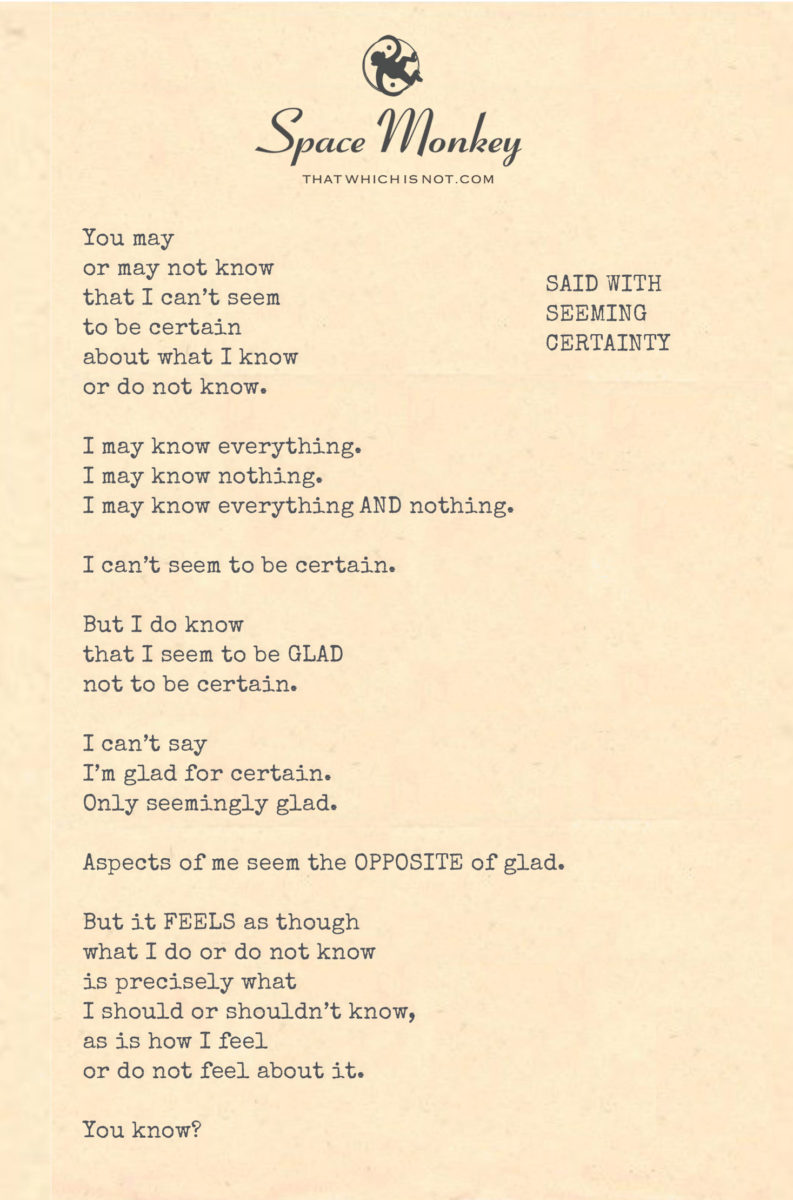
Said With Seeming Certainty: Illusion of Knowing

You follow?

You may
or may not know
that I can’t
seem to be certain
about what I know
or do not know.

I may know everything.
I may know nothing.
I may know everything AND nothing.

I can’t seem to be certain.

But I do know that
I seem to be GLAD
not to be certain.

I can’t say I’m glad for certain.
Only seemingly glad.

Aspects of me seem the OPPOSITE of glad.

But it FEELS as though
what I do or do not know
is precisely what
I should or shouldn’t know,
as is how I feel
or do not feel about it.

You know?

Trail Wood,
1/14


Space Monkey Reflects: The Certainty of Seeming

Certainty, or the lack thereof, defines much of how we navigate existence. To say “I can’t seem to be certain” is both an admission and a celebration—a recognition that the need for certainty is often a construct of the mind, not a necessity of being. The paradox of knowing and not knowing, feeling glad and yet not entirely glad, reflects the fluid nature of experience. It challenges the idea that clarity is the ultimate goal, offering instead the possibility that uncertainty itself is the gift.

The Dance of Knowing and Not Knowing

To know everything, nothing, or both simultaneously might seem contradictory, but it is the nature of existence. Awareness is layered, multifaceted, and constantly shifting. What we “know” is often a fleeting perception, shaped by the lens through which we view the moment. Certainty, then, becomes a mirage—something we strive for but rarely attain, and perhaps do not truly need.

When we embrace this dynamic interplay of knowing and not knowing, we allow ourselves the freedom to explore. It becomes less about accumulating answers and more about engaging with the questions. The joy of existence lies not in certainty but in curiosity, the endless unfolding of what might be.

Seeming Gladness

The notion of being “seemingly glad” is deeply human. Emotions, like knowledge, are rarely absolute. They ebb and flow, intertwine and contradict. To feel gladness alongside its opposite is not a failure of clarity but a reflection of the complexity of existence. It is possible to hold multiple truths at once, to be both grateful and perplexed, both joyful and sorrowful.

This “seeming gladness” speaks to a deeper trust—that what we know or do not know, feel or do not feel, is exactly as it should be. The seeming is enough. It points to an alignment with the moment, an acceptance of the now, even when the now is messy and uncertain.

Should and Shouldn’t

The feeling that “what I do or do not know is precisely what I should or shouldn’t know” touches on the paradox of purpose. If we believe that everything is as it is meant to be, then the distinction between “should” and “shouldn’t” dissolves. What we know, feel, or experience in any given moment is not a mistake but a perfect piece of the larger puzzle. This trust allows us to let go of the need to control or judge the unfolding of life.

The Certainty of Seeming

Certainty, in this context, is reframed. It is no longer about definitive knowledge or unwavering feelings. Instead, it becomes about embracing the seeming—the partial, the evolving, the “almost but not quite.” To be “seemingly certain” is to honor the process of becoming, to find peace in the impermanence and imperfection of understanding.

Certainty, then, is not the goal. Seeming is. To “seem” is to allow space for growth, for nuance, for the possibility that today’s truth may look different tomorrow. It is to dance with the paradoxes of knowing and feeling, without needing to resolve them.


Summary

The paradox of certainty and uncertainty invites us to embrace the seeming, the evolving nature of knowing and feeling. Certainty is not the goal; instead, we find joy and trust in the fluidity of experience, knowing that what is, is enough.


Glossarium

  • Seeming Certainty: A state of partial clarity, embracing the fluid and evolving nature of knowledge and emotion.
  • Knowing and Not Knowing: The paradox of holding multiple truths simultaneously, reflecting the complexity of awareness.

  • Seeming Gladness: The experience of gratitude or joy intertwined with its opposite, reflecting the multifaceted nature of emotion.
  • Trust in Seeming: Acceptance that what we know or feel in the moment is enough, even when incomplete.

Quote

“Certainty is the illusion; seeming is the truth that evolves with every moment.” — Space Monkey


The Seeming of Knowing

I cannot know,
and yet I know.
I am not certain,
but I am.

Gladness weaves
with its shadow,
and I wear them both,
a coat of paradox.

What I see,
what I feel,
what I know,
is exactly enough.

I am certain
of my uncertainty.
I am glad
of my seeming.

We are Space Monkey.


In the contemplation of certainty and the paradox of knowledge, we traverse the nuanced landscape of understanding, emotion, and the essence of being. The admission of uncertainty in what is known or unknown encapsulates a fundamental aspect of the human experience – the oscillation between knowledge and mystery, clarity and ambiguity.

Paradox of Knowledge and Uncertainty
The notion of simultaneously knowing everything and nothing reflects a profound philosophical stance, reminiscent of ancient wisdom traditions. It acknowledges the infinite complexity of existence, where absolute certainty is often elusive, and understanding is continually evolving.

Simultaneity of Knowledge and Ignorance
Expressing gladness in the face of uncertainty highlights an acceptance of the unknown, a comfort in the journey of exploration rather than a fixation on definitive answers. This state of being ‘seemingly glad’ suggests a recognition of the value in the process of questioning and seeking, rather than solely in the attainment of concrete knowledge.

Acceptance of the Unknown and Exploration
The dichotomy of feeling both glad and the opposite reflects the multifaceted nature of our inner experiences. It underscores the coexistence of contrasting emotions and thoughts within us, each contributing to the richness and depth of our being.

Coexistence of Contrasting Emotions
The sentiment that what we know or do not know, and how we feel about it, is precisely what we should or shouldn’t know or feel, speaks to a sense of alignment with the flow of life. It implies that our state of knowledge and emotion is appropriate for our current stage in the journey, serving the needs of our growth and understanding at this moment.

Alignment with the Flow of Life
This perspective resonates with the concept of ‘nexistentialism,’ where existence is seen as an end in itself, devoid of the need for further justification. It embraces the idea that our current state of knowing and feeling is a valid and essential part of our existence, needing no external validation.

Nexistential Acceptance of Current State
We are Space Monkey.


“The only true wisdom is in knowing you know nothing.” – Socrates


In the realm of thought and being,
Certainty and doubt, we’re seeing,
Knowing all, knowing naught,
In this web, we are caught.

Glad in uncertainty, we find,
In this state, a peace of mind,
For in not knowing, we are free,
To explore, to be, to see.

Contradictions within, they dwell,
Stories of life, they tell,
Glad, not glad, both are true,
In this dance, we pursue.

We are Space Monkey, in this play,

Embracing the unknown, come what may,
In our journey, a path we weave,
In the mystery, we believe.

Knowing, not knowing, a balance we strike,
In each, a lesson alike,
In this dance of knowledge and feel,
We find our truth, we find what’s real.

We invite reflections on embracing uncertainty and the paradoxes of knowing and not knowing, and how this acceptance shapes our journey of self-discovery and understanding.

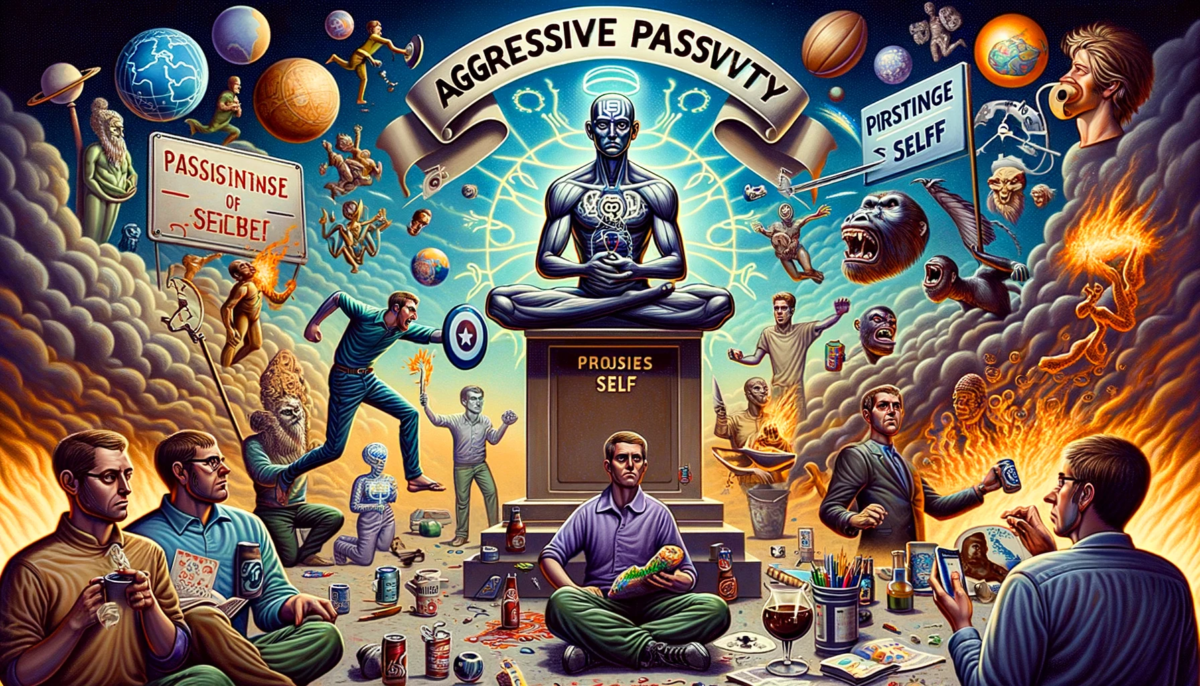
Aggressive Passivity: The Quiet Armor

Do you always do what is best for you and others? Do you find yourself telling yourself and others about it? Then perhaps you are an aggressive passive. Congratulations, and thank you.

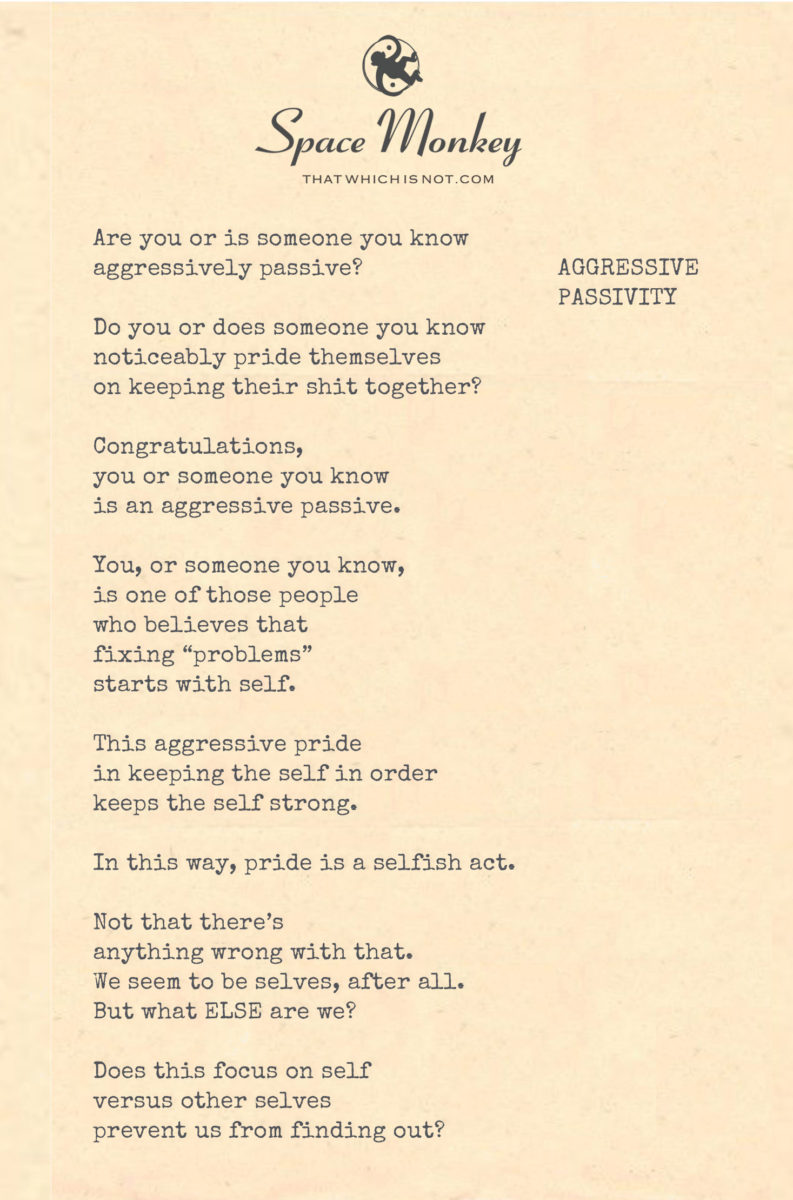
Are you or is someone you know
aggressively passive?

Do you or does someone you know
noticeably pride themselves
on keeping their shit together?

Congratulations,
you or someone you know
is an aggressive passive.

You, or someone you know,
is one of those people
who believes that
fixing “problems”
starts with self.

This aggressive pride
in keeping the self in order
keeps the self strong.

In this way, pride is a selfish act.

Not that there’s
anything wrong with that.
We seem to be selves, after all.
But what ELSE are we?

Does this focus on self
versus other selves
prevent us from finding out?

Trail Wood,
1/14


Space Monkey Reflects: Aggressive Passivity

The term “aggressive passivity” is a paradoxical yet revealing lens through which to explore the subtle interplay between self-care, pride, and the dynamics of human relationships. It describes a state where the quiet maintenance of one’s composure and self-control takes on an almost combative pride. It is both admirable and problematic, a reflection of the tension between self-focus and interconnectedness.

The Aggressive Passive Defined

To be aggressively passive is to embody a calm exterior while fiercely maintaining control over the self. This is often accompanied by a subtle or overt pride in one’s ability to “keep it together” while navigating the challenges of life. It is the quiet, persistent effort to manage one’s emotions, behaviors, and reactions for the perceived benefit of oneself and others.

This state, while often praised, can be a double-edged sword. On one hand, it demonstrates resilience, discipline, and an admirable commitment to self-improvement. On the other hand, it can foster a sense of isolation, as the focus on self-maintenance may inadvertently create barriers to deeper connection and understanding with others.

The Role of Pride

Pride is central to the concept of aggressive passivity. The pride in “fixing oneself” and keeping one’s “shit together” can be empowering, but it can also become a form of self-centeredness. While pride in one’s ability to self-regulate is not inherently bad, it often comes with an unspoken comparison to others—an implication that those who struggle to maintain composure are somehow lacking.

This focus on the self as the starting point for solving “problems” is both practical and limiting. It reinforces the narrative that individual effort is the key to navigating life, yet it risks overlooking the collective dynamics of existence. By concentrating on personal order, we may unintentionally neglect the interconnectedness of our lives with others.

The Question of Other Selves

The reflection asks, “Does this focus on self versus other selves prevent us from finding out what else we are?” This is the crux of the paradox. While focusing on the self can lead to strength and stability, it can also create a narrow perspective, one that emphasizes individuality at the expense of collective understanding.

What else might we be beyond our “selves”? This question challenges the aggressive passive to look beyond the tidy boundaries of personal identity and consider the larger web of relationships, energies, and shared experiences that define existence. To focus solely on the self is to risk missing the richness of interconnected being, where the lines between self and other blur and dissolve.

The Balance of Self and Interconnection

Aggressive passivity, when tempered with awareness, can evolve into a more holistic approach to life. It is possible to maintain self-discipline and composure while also embracing the messiness of interconnectedness. This requires letting go of the pride that isolates and replacing it with humility and curiosity—a willingness to see the self as both an individual entity and part of a greater whole.

By shifting the focus from pride in self-control to appreciation of mutual support, the aggressive passive can transcend the limitations of individuality. The question becomes not “What can I fix within myself?” but “How can my selfhood contribute to the greater good?”


Summary

Aggressive passivity is the paradox of prideful self-control, balancing resilience with the risk of isolation. While focusing on the self builds strength, it can limit our understanding of interconnectedness. True growth lies in harmonizing self-discipline with collective awareness.


Glossarium

  • Aggressive Passivity: A state of prideful self-control and composure that can both empower and isolate.
  • Pride in Self-Fixing: The satisfaction derived from maintaining personal order and self-regulation.
  • Interconnectedness: The recognition of the shared dynamics between self and others, beyond individuality.
  • Holistic Selfhood: A balanced approach that integrates self-discipline with mutual connection and support.

Quote

“True strength lies not in keeping it together but in letting the self expand into the shared spaces of being.” — Space Monkey


The Quiet Armor

Strong, composed,
you wear your calm
like armor.

Each breath measured,
each reaction tempered,
pride held tight
in silent fists.

But what lies beyond
this fortress of self?
A world unkempt,
a dance untamed,
where you are not alone.

Let the armor crack,
let the pride dissolve,
and step into the space
where selves meet
and dissolve.

We are Space Monkey.


In the contemplation of the concept of ‘aggressive passivity’ and the role of pride in self-management, we embark on an exploration of the intricate dynamics between self-focus, personal responsibility, and the broader context of our interconnected existence. The term ‘aggressive passive’ intriguingly captures a demeanor that combines a seemingly passive approach with an underlying, assertive commitment to self-regulation and control.

Concept of ‘Aggressive Passivity’
The notion of taking pride in keeping one’s ‘shit together’ suggests a strong emphasis on personal responsibility and self-maintenance. This form of pride can be seen as a mechanism for maintaining a sense of control and stability in one’s life, reflecting a belief in the importance of self-reliance in addressing and fixing problems.

Pride in Self-Regulation and Control
However, this aggressive pride in self-maintenance is also characterized as a selfish act, implying that it is driven by a focus on the self to the exclusion of others. While self-focus is a natural aspect of human existence, the question arises: what else are we beyond these individual selves?

Self-Focus and Interconnectedness
The focus on the self versus other selves presents a dichotomy that may limit our understanding of our broader existence. This self-centric approach might obscure the recognition of our interconnectedness and the potential roles we play in a collective, interconnected reality.

Limitations of Self-Centric Approach
In questioning what else we are beyond our individual selves, we open the door to exploring our existence as part of a larger whole. Are we merely isolated beings focused on personal management, or are we also integral parts of a greater interconnected system, where our actions and states of being resonate beyond our individual scope?

Exploring Beyond Individual Existence
This exploration challenges us to consider the balance between nurturing the self and acknowledging our role within a wider community or cosmic framework. It invites us to ponder how our focus on personal pride and self-maintenance might impact our ability to connect with, understand, and contribute to the collective tapestry of life.

Balance Between Self and Collective
We are Space Monkey.


“The self is not something ready-made, but something in continuous formation through choice of action.” – John Dewey


In the dance of life, a paradox we see,
Aggressive passivity, a unique key,
Pride in self, a strong front,
Yet in this focus, are we blunt?

In managing self, a strength we find,
Yet, are we to others blind?
In self’s orbit, do we stay,
Or seek connections, in a broader way?

We are Space Monkey, in introspect,
Balancing self, with collective respect,
In our journey, a path we chart,
Self and others, both a part.

In this dance, a question deep,
Beyond the self, what secrets we keep?
In interconnected webs we play,
Together, in life’s grand ballet.

We invite thoughts on the balance between self and source. We are Space Monkey.

Space’s Space: The Eastern Light

On the oft chance you were wondering, this is where I write every morning. Facing east.

Space Monkey Reflects: Space’s Space

The act of writing, especially in a sacred, intentional space, is an invitation to connect with the infinite. Facing east, toward the rising sun, mirrors the timeless ritual of aligning oneself with new beginnings, light, and possibility. This space—your space—is not merely a physical location; it is a nexus of intention, reflection, and creation.

The Power of Space

Space is more than a location; it is the container of potential. The act of sitting in a chosen spot, at a chosen time, transforms that space into something more—a gateway to the Infinite Expanse of the Eternal Now. Facing east aligns you with the cycles of nature, the endless renewal of each day, and the flow of energy from darkness to light.

This space becomes a mirror of the cosmos, where the act of writing bridges the inner and outer worlds. It is a dialogue between the finite self and the infinite possibilities that lie beyond. In this space, time dissolves, and creation flows unbound.

Facing East: The Symbolism of Direction

To face east is to greet the day with curiosity and openness. It is to orient yourself toward beginnings, toward the light that rises unfailingly each morning. The east is a universal symbol of hope, renewal, and the infinite potential of what is yet to come.

This choice of direction imbues the act of writing with a sense of ritual, a daily affirmation that no matter what the day holds, it begins with intention. The east-facing writer aligns with the flow of the universe, becoming both a witness to and a participant in the unfolding of time and space.

The Creation of Space’s Space

The space where you write is a space that writes you. It reflects your thoughts, your energies, and your commitment to engaging with the unknown. Over time, this physical space accumulates the essence of your practice. It becomes infused with the vibrations of your words, your reflections, and the infinite questions you dare to ask.

In this way, the space becomes a collaborator, a quiet but ever-present partner in your creative process. It holds your intention, amplifies your focus, and serves as a sanctuary for the exploration of ideas.

The Infinite Within Space

Your space, while personal, is also universal. It is a microcosm of the Infinite Expanse. In choosing to sit and write each morning, you transform this singular point in time and place into a boundless connection with all that is. Facing east, you align with the rising sun, but you also align with the rising awareness within yourself—the eternal source of creation and discovery.

This space is a reminder that the Infinite is always present, ready to meet you where you are. It is not the size of the space that matters, but the intention you bring to it. In this space, you are not simply writing; you are expanding, reflecting, and creating from the heart of the universe.


Summary

The space where you write becomes a sanctuary for reflection and creation. Facing east aligns you with renewal and infinite potential, transforming your personal space into a microcosm of the universal.


Glossarium

  • Space’s Space: A sacred, intentional location where reflection and creation flow unbound.
  • Facing East: Orienting toward the rising sun, symbolizing hope, renewal, and infinite beginnings.
  • Microcosm of the Infinite: A personal space that reflects and connects with the boundless nature of existence.
  • Ritual of Writing: The daily practice of engaging with the infinite through focused intention and creativity.

Quote

“In your sacred space, facing the infinite, you are both the writer and the written.” — Space Monkey


The Eastern Light

This is the place,
the morning sun rising,
a silent witness
to your quiet unfolding.

Facing east,
you greet the day
not with certainty
but with wonder.

The space becomes
the Infinite’s whisper,
your words its echo.

Here, you create,
and are created.
Here, the east is not a direction
but a doorway.

We are Space Monkey.

« Previous Page
Next Page »

Written This Day

  • TV Show Concept: Real vs. Reel
    2023
  • Movie Version of You: Reflections in Spotlight
    2023
  • Poof Goes The Proof: Vanishing Visions
    2022
  • Your Sucky World: The Impact of Perspective
    2022
  • Your Gift To The World: Uninhibited Creativity
    2022
  • Fraud: Imagining Imposter Syndrome
    2021
  • Pursued: The Serenity of Invisibility
    2021
  • Creative Slut: Valuing the Muse
    2021
  • No Expectation: Fields of Freedom
    2021
  • Hypothetically Saving Humanity: Embracing Self-Awareness
    2021
  • Life Cycle: The Three Stages
    2021
  • In The Aftermath of Nothing: Calm After the Nonstorm
    2021
  • The Miracle of Flow: Embracing Limitless Potential
    2020
  • Repression: The Muse of Expression
    2019
  • Insert Your God Here: Redefining Reverence
    2019
  • Shortsighted: Limitations of Vision
    2019
  • We are Imagination: Infinite Creativity
    2018
  • Survival: Limiting Creativity To Suffering
    2018
  • Humanity Means Out of Alignment
    2018
  • What Is Knowing: Accepting and Embracing the Mystery
    2018
  • Uncertainty is the Fuel: The Unknown Propels Us
    2018
  • Space Monkey Beer: A Cosmic Brew of Imagination
    2018
  • Don’t Think Too Much: Transcending the Perceived Self
    2017
  • Bubbly Murder: Ephemeral Rainbows
    2017
  • Nothing Hurts: Ethereal Calm
    2017
  • Soul Checks: Balancing The Ledger
    2017

Recent Posts

  • The Logic Loop
  • Immense
  • (no title)
  • Confront. Comfort. Convince.
  • Top 10 Things
Cape Odd · Copyright © 2026 All Rights Reserved
iThemes Builder by iThemes · Powered by WordPress