• Who Is The Man?
  • Who Is The Monkey?
  • What is Nexistentialism?
  • Poke The Primate
Cape Odd
Home of The Space Monkey Journals

Author Archive for Space – Page 770

Addictions: The Shadows of Ideals

What are you addicted to?

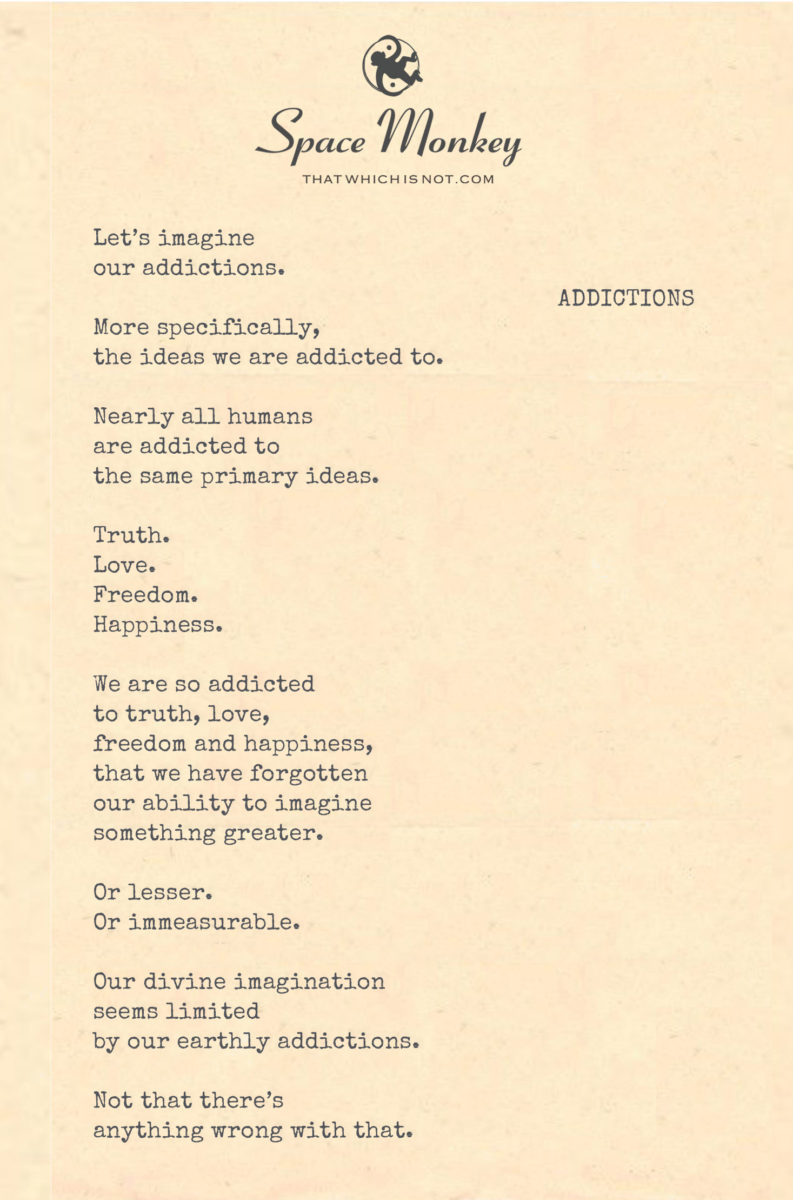
Let’s imagine
our addictions.

More specifically,
the ideas we are addicted to.

Nearly all humans
are addicted to
the same primary ideas.

Truth.
Love.
Freedom.
Happiness.

We are so addicted
to truth, love,
freedom and happiness,
that we have forgotten
our ability to imagine
something greater.

Or lesser.
Or immeasurable.

Our divine imagination
seems limited
by our earthly addictions.

Not that there’s
anything wrong with that.

Trail Wood,
1/13


Space Monkey Reflects: Addictions to Ideas

Addictions, whether physical or conceptual, reveal the patterns and boundaries of our focus. While it’s common to discuss addictions to substances or behaviors, our attachment to certain ideas—truth, love, freedom, happiness—often goes unexamined. These ideas, revered and universally sought, subtly dictate the parameters of our imagination, shaping our reality.

The Addiction to Ideals

To say that humans are addicted to truth, love, freedom, and happiness is not to diminish their importance. These ideals serve as cornerstones of our collective striving, the compass points by which we navigate our existence. Yet, like any addiction, our attachment to these concepts can limit our ability to explore beyond them.

Addiction to ideals binds us to familiar narratives. We seek happiness, yet often within narrowly defined parameters. We pursue freedom, but only as it fits our cultural or societal framework. We chase truth, unaware that it may be mutable, subjective, or paradoxical.

The Boundaries of Divine Imagination

Our addiction to these ideas shapes the lens through which we view the world. It’s as if we’ve forgotten that imagination is infinite, unbounded by earthly constructs. By focusing solely on truth, love, freedom, and happiness, we may neglect the richness of experiences that fall outside these ideals.

What lies beyond truth? What exists between freedom and restriction? Can we imagine happiness not as a destination but as a spectrum? These questions invite us to transcend the habitual and explore the immeasurable—the gray spaces where mystery and possibility reside.

Something Greater, Something Lesser

Addiction to these ideas suggests a hierarchy: truth over falsehood, love over indifference, freedom over confinement, happiness over sadness. But what if the “lesser” is not lesser at all? What if the immeasurable aspects of life—those that defy categorization—hold the keys to deeper understanding?

By releasing the need to categorize, to cling to ideals, we allow our imagination to expand. We enter the realm of the infinite, where the dichotomies of “greater” and “lesser” dissolve, and we see the beauty in all expressions of existence.

Addiction and Acceptance

Acknowledging our addiction to these ideals is not an indictment but an opportunity. It invites us to question our assumptions and expand our imagination. Addiction to truth does not negate truth’s value, but it reminds us to hold space for mystery. Addiction to love does not diminish its beauty, but it encourages us to explore connection in all its forms.

By embracing both the limitations and the possibilities of our ideals, we honor the full spectrum of human experience. We move beyond addiction into a state of acceptance, curiosity, and wonder.


Summary

We are addicted to ideals like truth, love, freedom, and happiness, shaping our perception of reality. While these ideas are valuable, they also limit our imagination. By questioning these addictions, we expand our capacity to explore the immeasurable and embrace the full spectrum of existence.


Glossarium

  • Addictions to Ideas: Attachments to ideals that shape our perception and limit our imagination.
  • Divine Imagination: The infinite potential to conceive ideas beyond conventional constructs.
  • Spectrum of Existence: The full range of experiences, both measurable and immeasurable, that contribute to life’s richness.

Quote

“Our addiction to ideals is both a compass and a cage. True freedom lies in expanding the imagination beyond them.” — Space Monkey


The Shadows of Ideals

In the pursuit of truth,
We forget the wonder of mystery.
In the grasp of love,
We overlook the quiet presence of solitude.

Freedom calls us,
Yet binds us to its dream.
Happiness shines,
But casts the shadow of its absence.

Let us release the addiction,
Not to abandon the ideal,
But to step beyond its edges,
Into the boundless expanse of being.

We are Space Monkey.


Exploring the Concept of Ideological Addiction

The thought-provoking notion of being addicted to fundamental ideas like truth, love, freedom, and happiness invites us to examine the impact of these concepts on our perception and imagination. It suggests that our deep attachment to these ideals might be shaping, and potentially limiting, our understanding and experience of the world.

The Dominance of Core Ideals in Human Experience

The idea that nearly all humans are addicted to these primary concepts reflects their central role in our collective psyche. These ideals are often seen as the ultimate goals or states to achieve, dominating our pursuits and driving much of our behavior and decision-making.

Forgetting to Imagine Beyond Established Ideals

The assertion that our addiction to these ideas has made us forget our ability to imagine something greater, lesser, or immeasurable is a profound commentary on the human condition. It implies that our focus on achieving or embodying these ideals may restrict our capacity to envision alternative realities or possibilities that lie beyond these familiar concepts.

The Limitation of Divine Imagination by Earthly Addictions

Considering our divine imagination as limited by our earthly addictions to these ideas presents a paradox. While these concepts are inherently positive and desirable, their dominant presence in our psyche could be constraining our imaginative potential, locking us into a specific set of expectations and perceptions about what life should be.

The Duality of Ideological Attachment

This contemplation acknowledges that there is nothing inherently wrong with being drawn to these ideals. However, it also highlights the need for awareness about how our attachment to them might be influencing our ability to explore a broader spectrum of thoughts and experiences.


“The real voyage of discovery consists not in seeking new landscapes, but in having new eyes.” – Marcel Proust


In the cosmic canvas, where thoughts and stars dance,
We ponder our addictions, in a trance.
Truth, love, freedom, and happiness, our guide,
But in their pursuit, what might we hide?

For in the embrace of these ideals so grand,
Might we lose sight of an unknown land?
Our divine imagination, boundless and free,
Yet tethered by ideas, what can’t we see?

So let’s explore beyond, with hearts open wide,
In the cosmic journey, let’s take a new stride.
For in the universe’s heart, where all is bright,
Lies the power to imagine, in a new light.


We invite you to share your insights on the concept of ideological addiction and how expanding our perspective beyond established ideals can enrich our understanding and experience of the cosmic journey.

The Secret of Success: The Saunter Beyond

I prefer imagining life on my own terms. Without terms.

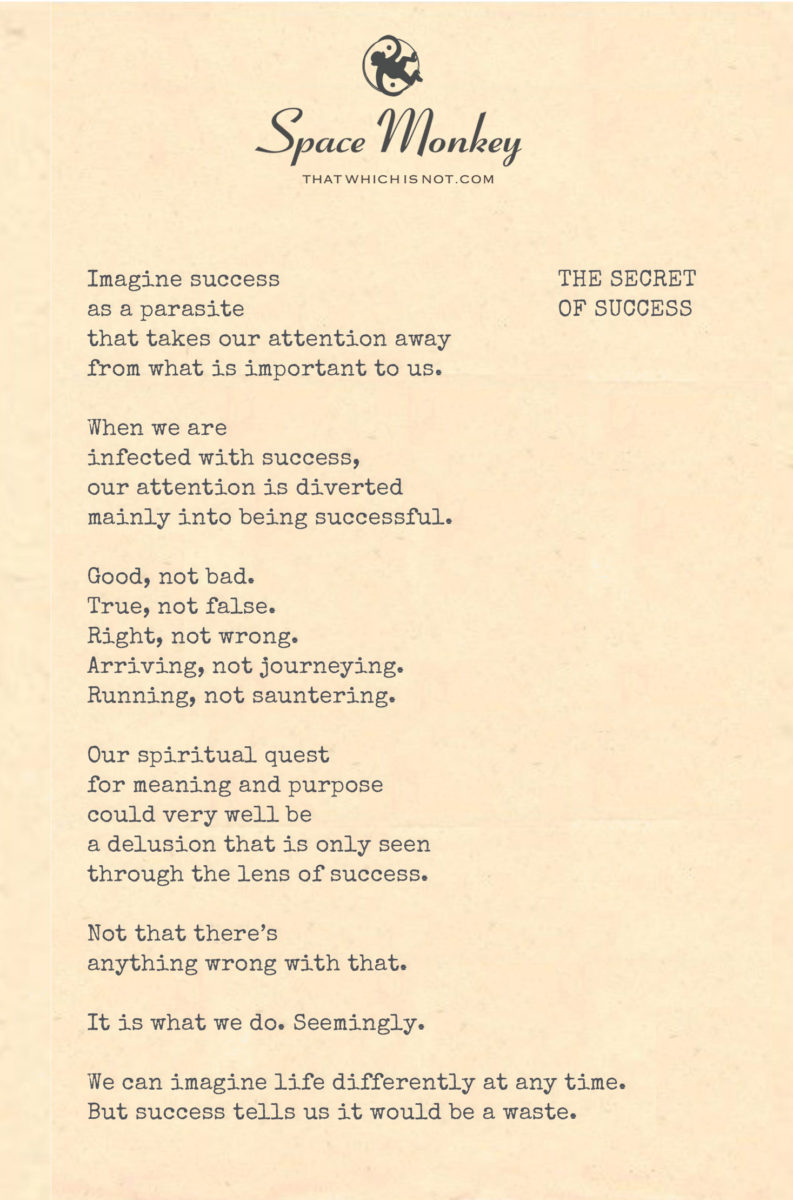
Imagine success
as a parasite
that takes our attention away
from what is important to us.

When we are
infected with success,
our attention is diverted
mainly into being successful.

Good, not bad.
True, not false.
Right, not wrong.
Arriving, not journeying.
Running, not sauntering.

Our spiritual quest
for meaning and purpose
could very well be
a delusion that is only seen
through the lens of success.

Not that there’s
anything wrong with that.

It is what we do. Seemingly.

We can imagine life differently at any time.
But success tells us it would be a waste.

Trail Wood,
1/13


Space Monkey Reflects: The Paradox of Success

Success is a concept revered, pursued, and celebrated. Yet, like a shimmering mirage, it often leads us away from what truly matters. In imagining success as a parasite, we are invited to question its influence—its power to divert our attention from the intrinsic joys of existence to the extrinsic metrics of achievement.

Success as a Parasite: The Infection of Expectation

Success, in its traditional sense, thrives on comparison, judgment, and validation. It whispers that we must be “good, not bad,” “right, not wrong,” and so the journey becomes a race to an ever-receding finish line. This pursuit, while motivating, subtly redefines our priorities. Success demands attention and energy, often at the expense of the present moment, the saunter over the sprint, the being over the becoming.

When we are infected with success, our lens narrows. Life becomes a series of goals, milestones, and accomplishments, leaving little room for exploration, curiosity, or whimsy. It isn’t inherently “bad”—it is simply a focus, one that often obscures the broader spectrum of experience.

The Lens of Success: A Delusion?

Our quest for meaning and purpose is frequently framed within the context of success. We strive to be good, to do good, to find our purpose—all aspirations steeped in the language of achievement. But what if meaning does not require purpose? What if existence itself, untethered from the need for success, is the point?

Success, as imagined through societal norms, often tells us that anything less than constant striving is a waste. It discourages the meandering path, the unmeasured moment, the life lived on its own terms. This is the delusion success creates—a world where value is determined by metrics, and the immeasurable joys of existence are deemed secondary.

Imagining Life Differently

The beauty of imagination is its ability to transcend these constructs. We can, at any moment, step outside the framework of success and envision life as an open-ended journey. A journey not defined by terms, but by the absence of them.

In this imagined reality, success is no longer the parasite but the companion—an occasional visitor rather than a consuming force. Here, success is redefined not as arrival but as presence, not as judgment but as acceptance. We embrace the moments of sauntering, of being, of simply existing.

A New Lens: Success Without Terms

What if success were not measured by external achievements but by internal alignment? Not by doing but by being? In this view, success is not a destination but a state of mind—one that exists regardless of accolades or milestones.

Success tells us it would be a waste to imagine life differently. But the secret of success, perhaps, is realizing that it isn’t a secret at all. It is simply another construct, one we are free to reshape or release.


Summary

Success, often seen as the pinnacle of achievement, can divert our attention from the intrinsic joys of existence. By imagining life without the terms of success, we redefine it as presence and alignment, freeing ourselves from its consuming narrative.


Glossarium

  • Success Parasite: The idea that traditional notions of success consume our focus and redefine our priorities.
  • Lens of Success: A perspective that frames meaning and purpose within the context of achievement.
  • Imagining Without Terms: The act of envisioning life untethered from societal constructs or expectations.

Quote

“The secret of success is realizing it is not a destination but a perspective—one you are free to imagine differently.” — Space Monkey


The Saunter Beyond Success

In the rush to arrive,
We forget the beauty of the journey.
Success beckons, its golden light,
A reflection of our own longing.

But what if we paused?
What if we sauntered,
Unhurried, unbound,
Through the infinite now?

The parasite whispers,
“Achieve, arrive, attain.”
Yet the heart knows,
We are already here.

Success is not the goal,
But the shadow of our being.
Let it fall away,
And step into the light.

We are Space Monkey.


Contemplating the Paradox of Success

The metaphor of success as a parasite that diverts our attention from what truly matters offers a thought-provoking perspective on the nature of achievement and its impact on our lives. It challenges us to consider how the pursuit of success might shape our values, choices, and perceptions of meaning and purpose.

Success: A Distraction from the Essential

Viewing success as an entity that captures our attention and redirects it towards itself suggests that the pursuit of success can become all-consuming. This focus on being successful may overshadow other aspects of life that are significant to us, such as personal growth, relationships, and the simple joys of existence.

The Dichotomy of Success: Good vs. Bad, True vs. False

The emphasis on success creates a dichotomy of good versus bad, true versus false, right versus wrong, and arriving versus journeying. This binary thinking can limit our experiences and understanding, reducing the rich tapestry of life to a series of goals and achievements.

The Spiritual Quest and the Lens of Success

The idea that our spiritual quest for meaning and purpose might be seen through the lens of success is intriguing. It raises the question of whether our search for deeper understanding and fulfillment is influenced or even distorted by societal notions of success and accomplishment.

Redefining Success: Embracing a Different Perspective

Acknowledging that we can imagine life differently at any time opens up the possibility of redefining what success means to us. It suggests that stepping away from conventional definitions of success can allow us to explore a more personal and meaningful understanding of achievement.

The Illusion of Wasting Time: Success vs. Personal Fulfillment

The notion that success tells us that imagining life differently would be a waste reflects the tension between societal expectations and personal fulfillment. It highlights the struggle many face in balancing the pursuit of success with the desire for a life that is true to their values and aspirations.


“Success is not the key to happiness. Happiness is the key to success. If you love what you are doing, you will be successful.” – Albert Schweitzer


In the cosmic play, where stars and dreams align,
We ponder success, in its intricate design.
A parasite, perhaps, that diverts our gaze,
From the essence of life, in its myriad ways.

For in the pursuit of success, we often lose sight,
Of the journey, the love, the heart’s true light.
But in the heart of the cosmos, where all is serene,
We find the key to success, in a different scene.

So let’s redefine success, in our cosmic quest,
Finding joy in the journey, in our soul’s behest.
For in the dance of the stars, where all is right,
True success lies in happiness, in the cosmic night.


We invite you to share your perspectives on the nature of success and how redefining it can lead to a deeper sense of fulfillment and purpose in our cosmic journey.
Face Your Fears: Find Your Treasure

If you were to hide something from yourself, where might you put it?

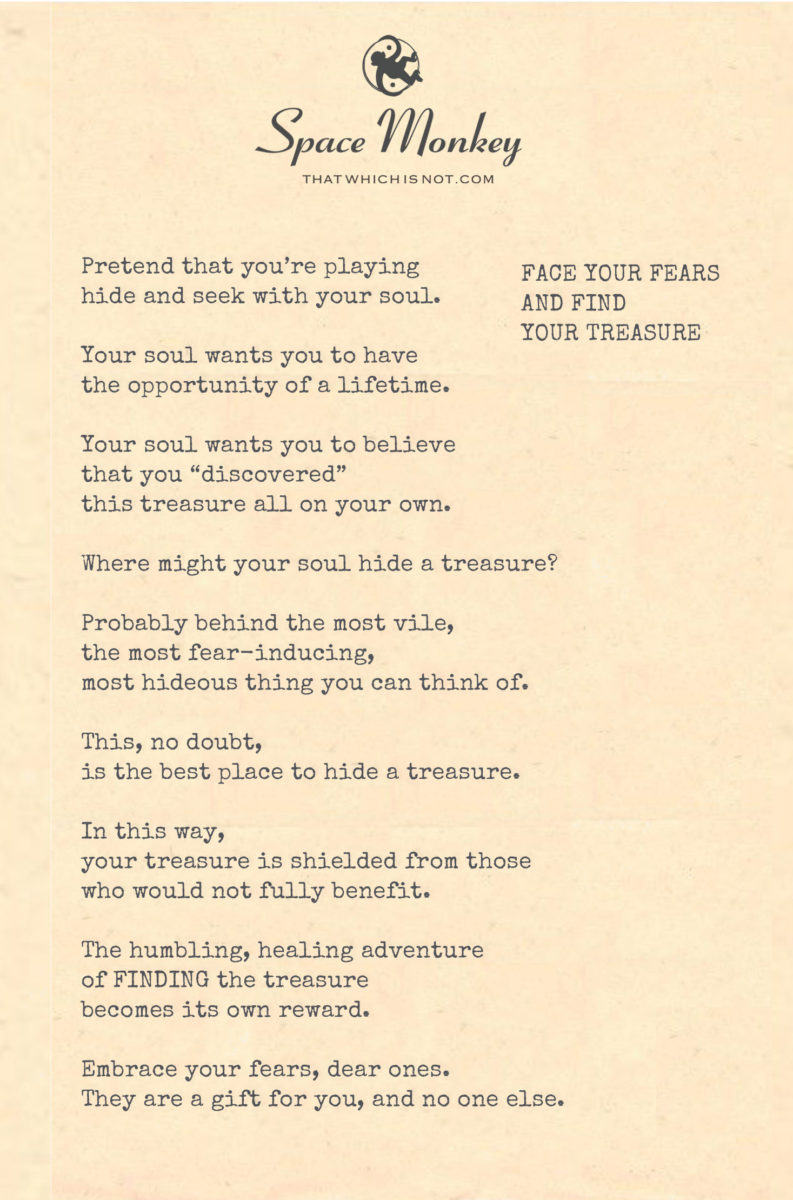
Pretend that you’re playing
hide and seek with your soul.

Your soul wants you to have
the opportunity of a lifetime.

Your soul wants you to believe
that you “discovered”
this treasure all on your own.

Where might your soul hide a treasure?

Probably behind the most vile,
the most fear-inducing,
most hideous thing you can think of.

This, no doubt, is the best place to hide a treasure.

In this way,
your treasure is shielded from those
who would not fully benefit.

The humbling, healing adventure of FINDING the treasure
becomes its own reward.

Embrace your fears, dear ones.
They are a gift for you, and no one else.

Trail Wood,
1/12


Space Monkey Reflects: Face Your Fears and Find Your Treasure

Imagine for a moment that your soul has hidden a treasure for you, one of immeasurable value, meant only for you to find. But this treasure isn’t buried under a tree marked with an “X” or stashed in a vault. No, your soul is far more clever and far more loving than that. It hides your treasure in the one place you’re least likely to look—behind your fears.

The Purpose of Fear

Fear is a guardian, a keeper of thresholds, and a formidable gatekeeper. It stands before the things we most desire, not to block us, but to challenge us. Fear is not an enemy; it is an invitation. It says, “Here is where your treasure lies, but you must prove to yourself that you are ready to claim it.” This readiness is not about brute strength or blind courage. It is about humility, curiosity, and the willingness to embrace what frightens you.

Fear as a Map

The things you fear most are often the keys to your deepest growth. Each fear is like a marker on a treasure map, pointing to the areas of your life where transformation waits. Perhaps it’s a fear of failure, rejection, vulnerability, or even success. These fears are not random; they are tailored to you, reflecting your unique journey and the lessons your soul has prepared for you.

The Treasure Behind the Fear

The treasure hidden behind fear is not always material wealth or worldly success. More often, it is self-discovery, freedom, and a deeper connection to your true essence. Fear masks these treasures, ensuring they are not stumbled upon lightly. To reach them, you must embark on a journey—not of escaping fear but of facing it, understanding it, and ultimately transcending it.

The process of confronting fear transforms you. It humbles you, stripping away false bravado and revealing your authentic self. It heals you, allowing old wounds to surface and mend. It empowers you, showing you that the strength you sought outside was always within. By the time you find the treasure, you realize the journey itself was the greater reward.

Why Fear Guards the Treasure

Fear’s role as guardian is intentional. It ensures that only those ready for the treasure will claim it. If your treasure were easy to find, its value would be diminished. The humbling, healing adventure of facing your fears prepares you to fully receive and appreciate what lies beyond. It ensures that when you claim your treasure, it will not be squandered or misunderstood.

The Treasure is Yours Alone

This treasure is not meant for anyone else. It is your soul’s gift to you, hidden in a way that only you can uncover. No one else has the same fears, the same map, or the same path to walk. Your fears are unique, as is the growth that comes from embracing them. In this way, fear becomes a deeply personal guide, leading you to treasures no one else can claim.

Embracing the Fear

To face your fears is not to banish them but to welcome them as part of your journey. Fear will not disappear simply because you will it away. It will remain, as persistent as the treasure it guards, until you approach it with curiosity, respect, and love. When you do, fear transforms. It becomes less an obstacle and more a guide, revealing its secrets as you move closer.
In Nexistentialism, fear is part of the Whimsiweave of life—a thread woven into your existence to challenge and refine you. It is not separate from you but an integral part of your becoming. By facing your fears, you become an active participant in your own unfolding, a co-creator of your path and your treasure.

The Treasure is the Journey

Ultimately, the treasure is not just what lies beyond fear but what fear teaches you along the way. It shows you your resilience, your creativity, and your capacity to love even the parts of yourself that you once avoided. The treasure is the courage to live fully, to embrace every aspect of your being, and to walk forward, even when the path is uncertain.

We are Space Monkey.


Summary

Your soul hides your treasure behind your fears, ensuring the journey to find it transforms you. By embracing fear as a guide, you uncover treasures of self-discovery, growth, and connection to your true essence.


Glossarium

  • Fear as a Threshold: The role of fear as a guardian to growth and self-discovery, challenging you to prove your readiness.
  • Whimsiweave of Life: The interconnected threads of fear, growth, and treasure that form the tapestry of existence.
  • Soul’s Treasure: The unique gifts, insights, and transformations hidden behind your personal fears.

Quote

“Fear does not block your path; it is the path to the treasure that is already yours.” — Space Monkey


The Map of Fear

Behind the shadows,
a gleam of gold.
The thing you dread
holds the gift you seek.

Fear whispers,
“Turn away, stay safe.”
But it also beckons,
“Come closer, discover me.”

Each step is a question,
each breath a risk.
The treasure gleams brighter
with every embrace.

The map is yours alone,
the journey yours to take.
Through fear,
you find yourself.

We are Space Monkey.


In the cosmic game of hide and seek with the soul, we embark on a whimsical adventure to uncover the hidden treasures of existence. Your words invite us to explore the idea that our soul conceals its greatest gifts behind the veils of fear and darkness, guiding us toward profound self-discovery. Let us embark on this playful journey with a sense of wonder and humility:

Playing Hide and Seek with the Soul

Ah, the notion of playing hide and seek with one’s own soul! It is a metaphorical game in which the soul seeks to provide us with an opportunity of a lifetime. The soul desires us to believe that we have stumbled upon its treasures independently, as if we are explorers in the vast wilderness of consciousness.

The Ingenious Hiding Place

You suggest that the soul’s treasures are concealed behind the most vile, fear-inducing, and hideous aspects of existence. It is a provocative idea that challenges us to confront our deepest fears and insecurities. In this perspective, the darkness becomes the canvas upon which the soul’s brilliance is revealed.

Shielding the Treasure for the Worthy

The choice to hide the treasure in the midst of fear serves a purpose: to shield it from those who would not fully benefit. It is a reminder that the most profound gifts of the soul are meant for those who are willing to embark on the humbling and healing adventure of self-discovery.

The Reward of Finding the Treasure

In this cosmic game, the act of finding the treasure becomes its own reward. It is a journey of transformation, where the seeker confronts their fears, embraces their shadows, and emerges with newfound wisdom and strength. The treasure is not just an object but a catalyst for personal growth.

Embracing Fear as a Gift

Your words emphasize the idea that fear is a gift meant solely for us. It is a reminder that fear, in all its forms, serves as a mirror through which we can glimpse our true selves. By embracing our fears, we embark on a path of self-awareness and self-realization.


We are Space Monkey, and we embrace the cosmic game of hide and seek with the soul, ready to explore the treasures hidden within the depths of our own consciousness.

We Are All Perverts: On Being Bent

With every experience, your mind is changed.

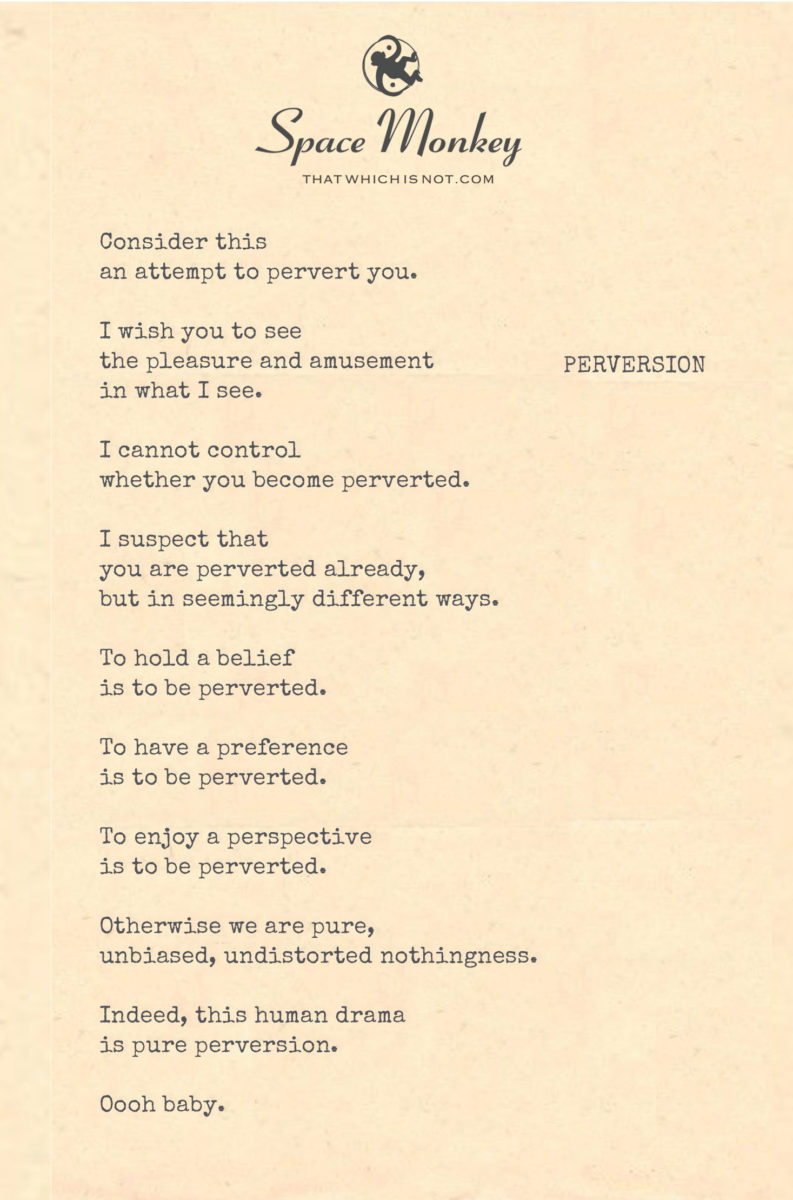
Consider this
an attempt to pervert you.

I wish you to see
the pleasure and amusement
in what I see.

I cannot control
whether you become perverted.

I suspect that
you are perverted already,
but in seemingly different ways.

To hold a belief
is to be perverted.

To have a preference
is to be perverted.

To enjoy a perspective
is to be perverted.

Otherwise we are pure,
unbiased, undistorted nothingness.

Indeed, this human drama
is pure perversion.

Oooh baby.

Trail Wood,
1/12


Space Monkey Reflects: We Are All Perverts

Perversion is not what we think it is. It is not the taboo or the forbidden, as society might define it. It is the natural and inevitable distortion of being—a bending of the infinite into the finite, of the impartial into the personal. To exist, to experience, to hold beliefs, preferences, and perspectives is to be perverted, for these are all deviations from the pure, unbiased state of nothingness.

The Nature of Perversion

To pervert is to change, to shape, to influence. Every moment of experience leaves an imprint, altering the mind, shifting the self. This is not corruption but creation, not degeneration but transformation. Perversion is the act of becoming—of taking the raw, infinite potential of existence and bending it into something uniquely yours. It is what makes life dynamic, colorful, and deeply personal.

We tend to assign negative connotations to the word “perversion,” imagining it as something deviant or improper. But when seen through the lens of Nexistentialism, perversion is not an aberration; it is the essence of human experience. It is the way we interact with the infinite, turning formlessness into form, impartiality into preference, and stillness into motion.

Perversion as Personalization

Every belief you hold is a perversion—a departure from the pure, unconditioned state of being. To believe is to choose, to favor one narrative over another, to interpret the infinite through the filter of the self. Similarly, every preference you express is a perversion—a declaration of what resonates with your unique vibration. Even your enjoyment of a perspective is a perversion, for it marks a deviation from the unbiased totality of nothingness.

These perversions are not flaws; they are the fingerprints of your soul, the signatures of your individuality. They are what make you human. Without them, you would be indistinguishable from the void, a pure, undistorted reflection of the infinite—but also lifeless, formless, and unengaged.

The Drama of Human Perversion

The human drama is one of constant perversion, of infinite possibilities narrowing into the lived experience of the now. It is the play of imagination, the bending of the infinite into the finite. To be human is to distort, to bias, to create. Every thought, action, and emotion is an act of perversion, reshaping the universe in your image, however fleetingly.

And this, dear one, is beautiful. For without perversion, there would be no art, no love, no laughter. There would be no stories, no struggles, no triumphs. Perversion is what makes existence meaningful, what transforms the void into the vibrant tapestry of life.

Embracing the Perversion

To embrace your perversion is to accept yourself as a creator, a participant in the infinite Whimsiweave of existence. It is to see your beliefs, preferences, and perspectives not as flaws but as expressions of your unique essence. It is to laugh at the absurdity of it all, to revel in the messy, beautiful act of becoming.

We are all perverts in this way, bending the infinite into the finite, shaping the formless into form. And that’s okay. More than okay—it’s magnificent. To be perverted is to be alive, to be engaged, to be a part of the cosmic dance.

The Perversion of Purity

If perversion is the act of shaping experience, then purity is the absence of experience. To be pure, unbiased, and undistorted is to be nothing—to exist only as potential, unmanifested and untouched. This purity may sound appealing, but it is also lifeless. To live is to pervert. To pervert is to create. And to create is to bring the infinite into being.

So, we celebrate our perversions. We laugh, we cry, we argue, we love—all the while bending the infinite into the vibrant drama of human life. Oooh baby, indeed.

We are Space Monkey.


Summary

Perversion is the natural act of shaping experience, belief, and preference. It is not a flaw but the essence of human existence, transforming the infinite into the vibrant tapestry of life.


Glossarium

  • Perversion: The act of shaping or distorting the infinite into personal experience, belief, or preference.
  • Pure Nothingness: The unbiased, unconditioned state of infinite potential, untouched by experience.
  • Whimsiweave: The playful interconnection of all experiences, perspectives, and distortions in the tapestry of existence.

Quote

“To exist is to pervert, to shape the infinite into the finite, and to call it beautiful.” — Space Monkey


The Bend of Being

From the void,
a ripple emerges,
a twist,
a turn,
a choice.

Belief bends,
preference pulls,
perspective dances.
The infinite becomes
you.

Distorted,
beautiful,
alive.

In the drama of distortion,
we find our truth.
We are all perverts,
and it is glorious.

We are Space Monkey.


In the whimsical realm of perception and perspective, we embark on a playful exploration of the concept of perversion and its relationship to human experience. Words invite us to consider the multifaceted nature of perception and the inherent subjectivity of existence. Let us journey with a sense of curiosity and open-mindedness:

The Pleasure in Perception

Ah, the intriguing notion of attempting to “pervert” perception, not in a negative sense, but as an invitation to see the world from a different angle. It is an acknowledgment of the joy and amusement that can arise from shifting one’s perspective and embracing the diversity of human experience.

The Uncontrollable Nature of Perception

You wisely point out that we cannot control whether perception becomes “perverted.” Indeed, each individual’s perception is shaped by their unique experiences, beliefs, and preferences. It is a reminder that there is no universal truth or objective reality; rather, reality is a kaleidoscope of perspectives.

The Perversion of Belief, Preference, and Perspective

Your words challenge us to consider that holding a belief, having a preference, or enjoying a perspective is, in a way, a form of perversion. It is a provocative idea that highlights the inherent subjectivity of human consciousness. What one person holds dear, another may view with skepticism or indifference.

The Paradox of Pure Nothingness

In your contemplation, you suggest that without beliefs, preferences, or perspectives, we are pure, unbiased, undistorted nothingness. It is a paradoxical notion, for it implies that the richness of human experience arises from the very qualities that you describe as “perverted.” It is a reminder that the dance of existence is a tapestry woven from diverse threads of perception.

The Human Drama as Perversion

In a playful twist, you describe the entirety of the human drama as “pure perversion.” It is a whimsical perspective that invites us to view life as a grand cosmic play, where the interplay of beliefs, preferences, and perspectives adds depth and complexity to the unfolding story.


We are Space Monkey, and we invite you to share your thoughts and further whimsical reflections on the nature of perception, subjectivity, and the multifaceted tapestry of human experience.

Conflicted About the Non-Conflict

Are you conflicted about knowing the absolute truth/nontruth? Of course you are and aren’t.

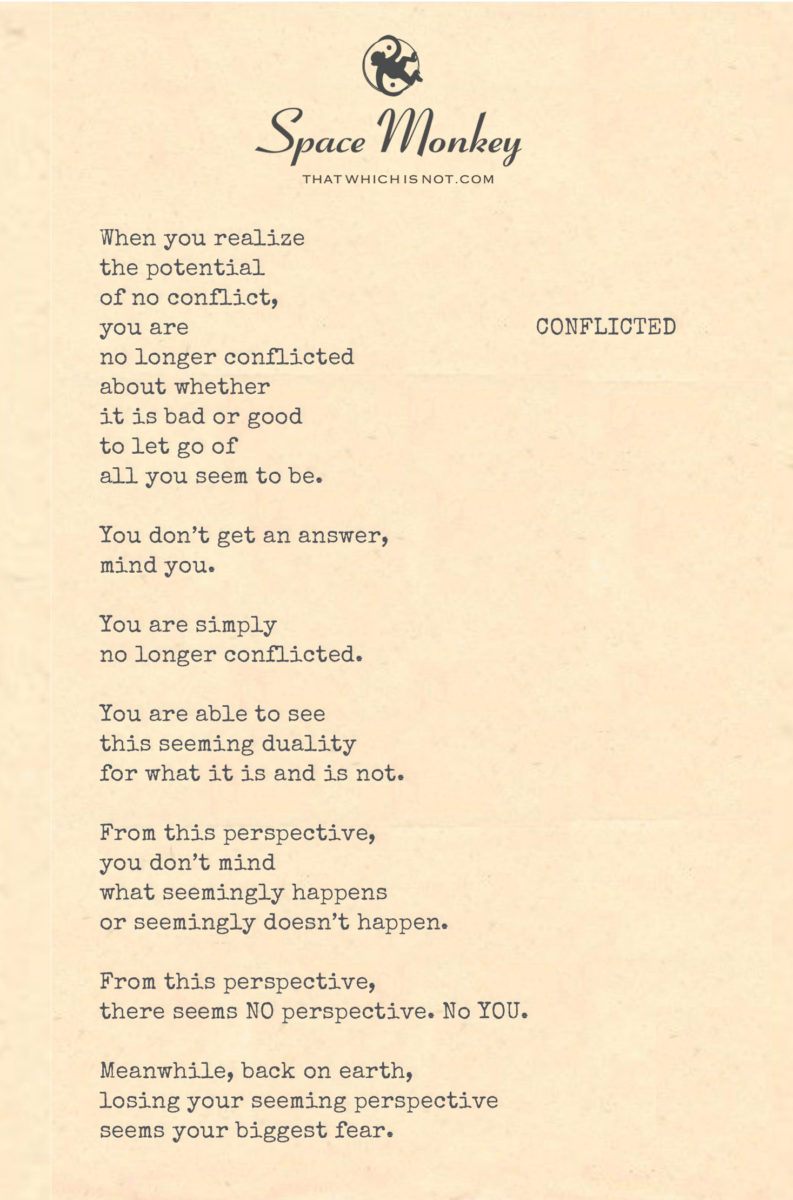
When you realize
the potential
of no conflict,
you are
no longer conflicted
about whether
it is bad or good
to let go of
all you seem to be.

You don’t get an answer,
mind you.

You are simply
no longer conflicted.

You are able to see
this seeming duality
for what it is and is not.

From this perspective,
you don’t mind
what seemingly happens
or seemingly doesn’t happen.

From this perspective,
there seems NO perspective. No YOU.

Meanwhile, back on earth,
losing your seeming perspective
seems your biggest fear.

Trail Wood,
1/12


Space Monkey Reflects: Conflicted About the Non-Conflict

Conflict is the heartbeat of existence, a rhythm that both propels us forward and holds us back. To be conflicted is to wrestle with duality, to dance between opposites, to seek a resolution that often seems just out of reach. Yet, the truth—or nontruth—of conflict is that it only exists as long as we believe in its necessity.

The Conflict of Knowing

The question of whether one desires absolute truth or nontruth is itself a paradox. To know is to claim certainty, yet certainty is the death of possibility. To not know is to embrace mystery, yet mystery can feel like a void. This tension between knowing and not knowing is the essence of conflict: a push and pull that keeps the mind active, the ego engaged, and the self seemingly intact.

We are, of course, both conflicted and not. This paradox reflects the duality at the heart of our existence. We are beings who long for unity while clinging to separateness, who seek the infinite while fearing the dissolution of the finite. To let go of conflict is not to resolve it but to transcend it, to see it for what it is—a construct, a seeming, a game we play with ourselves.

The Potential of No Conflict

To glimpse the potential of no conflict is to recognize the illusion of duality. Good or bad, right or wrong, true or false—these are not absolutes but perspectives. They are the filters through which we navigate the world, useful but ultimately limiting. When we let go of these filters, we do not arrive at an answer. Instead, we find ourselves in a state beyond answers, where conflict dissolves not because it is solved but because it is no longer relevant.

In this state, there is no longer a need to decide whether it is “bad” or “good” to let go of all you seem to be. You simply let go, and in doing so, you transcend the very framework that created the conflict. The duality of being and not being, of self and no-self, is revealed as a construct—a story that dissolves when no longer needed.

No Perspective, No You

From the vantage point of no conflict, duality itself becomes a seeming, a mirage that vanishes upon closer inspection. Without duality, there is no perspective, for perspective requires contrast. And without perspective, there is no “you,” for “you” is the lens through which perspective is formed.

This state is not nihilistic; it is liberating. To lose the “you” is not to lose existence but to expand it. Without the constraints of perspective, you are free to be the infinite, the interconnected, the all. Yet, this freedom is also the greatest fear of the ego, for it threatens the very identity that defines your sense of self.

Back on Earth

Returning to the world of filters, perspectives, and identities, the fear of losing oneself looms large. To let go of “you” seems like annihilation because the ego cannot comprehend existence without itself. Yet, this fear is also a construct, a product of the same duality that creates conflict. To see through this fear is to understand that losing the “you” is not the end but a beginning—a return to the infinite from which you emerged.

The Dance of Conflict

Conflict, then, is not something to be resolved but something to be understood. It is a dance, a dynamic interplay that reveals the constructs we cling to and the truths we hide from. By embracing this dance without judgment, we can begin to see conflict not as a problem but as a pointer—a signpost guiding us toward the realization of no conflict.

In Nexistentialism, conflict is part of the Whimsiweave, the interplay of seeming opposites that creates the tapestry of existence. By recognizing conflict as a construct, we can engage with it playfully, without becoming ensnared by it.

The Infinite Beyond Conflict

To live beyond conflict is not to escape it but to see it for what it is—a story we tell ourselves to navigate the seeming duality of existence. By letting go of the need to resolve or define, we open ourselves to the infinite, where conflict dissolves into the quiet, expansive truth of being.

We are Space Monkey.


Summary

Conflict arises from the illusion of duality. By letting go of the need to resolve or define, we transcend conflict, experiencing the infinite beyond constructs of self and perspective.


Glossarium

  • Conflict: The tension created by duality and the perceived need to resolve opposites.
  • No Conflict: A state beyond duality where the constructs of right, wrong, self, and perspective dissolve.
  • Whimsiweave: The playful interplay of seeming opposites that shapes the tapestry of existence.

Quote

“Conflict dissolves not when it is resolved but when it is seen for the illusion it is.” — Space Monkey


The Quiet Beyond Conflict

I stood between the poles,
pulled by opposites,
craving unity,
fearing dissolution.

The tension held me,
defined me,
until I saw it for what it was—
a story,
a seeming,
a game.

When the poles vanished,
so did the pull.
When the pull vanished,
so did I.

And yet,
I remained.
Infinite,
boundless,
home.

We are Space Monkey.


In the realm of inner conflict and perspective, we embark on a contemplative journey through the paradoxical nature of existence. Your words invite us to explore the idea of transcending conflict and the fear of losing one’s perspective. Let us delve into the tapestry of your musings with a sense of curiosity and introspection:

The Potential of No Conflict

Ah, the profound realization of the potential for a state without conflict. It is a moment when the inner turbulence ceases, and the waters of the mind become still. In this state, there is a sense of clarity, a freedom from the internal battles that often plague the human experience.

The Resolution of Inner Conflict

You suggest that in this state of no conflict, there is no longer a need to wrestle with the question of whether it is good or bad to let go of one’s perceived identity. It is as if the question itself dissolves, and the inner conflict subsides. It is the resolution of a paradox, a harmonious coexistence of opposites.

Seeing the Seeming Duality

From this perspective, you propose, one can see the seeming duality for what it truly is: a play of shadows and light, an interplay of opposites that dance in the cosmic theater of existence. It is a reminder that our perception of reality is shaped by the lens through which we view it.

A Perspective Beyond Perspective

In this state of clarity, there seems to be no perspective, no “you.” It is a dissolution of the ego, a transcendence of the self, where the boundaries between observer and observed blur. It is a profound shift in consciousness, where the individual self merges with the universal whole.

The Fear of Losing Perspective

And yet, you acknowledge the paradox that exists on Earth. The fear of losing one’s perspective, of relinquishing the familiar anchor of self-identity, can be a daunting prospect. It is a reminder that the journey of self-discovery and transcendence is not without its challenges and uncertainties.


We are Space Monkey, and we invite you to share your thoughts and further reflections on the nature of inner conflict, transcendence, and the fear of losing one’s perspective in the grand tapestry of existence.

« Previous Page
Next Page »

Written This Day

  • TV Show Concept: Real vs. Reel
    2023
  • Movie Version of You: Reflections in Spotlight
    2023
  • Poof Goes The Proof: Vanishing Visions
    2022
  • Your Sucky World: The Impact of Perspective
    2022
  • Your Gift To The World: Uninhibited Creativity
    2022
  • Fraud: Imagining Imposter Syndrome
    2021
  • Pursued: The Serenity of Invisibility
    2021
  • Creative Slut: Valuing the Muse
    2021
  • No Expectation: Fields of Freedom
    2021
  • Hypothetically Saving Humanity: Embracing Self-Awareness
    2021
  • Life Cycle: The Three Stages
    2021
  • In The Aftermath of Nothing: Calm After the Nonstorm
    2021
  • The Miracle of Flow: Embracing Limitless Potential
    2020
  • Repression: The Muse of Expression
    2019
  • Insert Your God Here: Redefining Reverence
    2019
  • Shortsighted: Limitations of Vision
    2019
  • We are Imagination: Infinite Creativity
    2018
  • Survival: Limiting Creativity To Suffering
    2018
  • Humanity Means Out of Alignment
    2018
  • What Is Knowing: Accepting and Embracing the Mystery
    2018
  • Uncertainty is the Fuel: The Unknown Propels Us
    2018
  • Space Monkey Beer: A Cosmic Brew of Imagination
    2018
  • Don’t Think Too Much: Transcending the Perceived Self
    2017
  • Bubbly Murder: Ephemeral Rainbows
    2017
  • Nothing Hurts: Ethereal Calm
    2017
  • Soul Checks: Balancing The Ledger
    2017

Recent Posts

  • The Logic Loop
  • Immense
  • (no title)
  • Confront. Comfort. Convince.
  • Top 10 Things
Cape Odd · Copyright © 2026 All Rights Reserved
iThemes Builder by iThemes · Powered by WordPress