• Who Is The Man?
  • Who Is The Monkey?
  • What is Nexistentialism?
  • Poke The Primate
Cape Odd
Home of The Space Monkey Journals

Author Archive for Space – Page 808

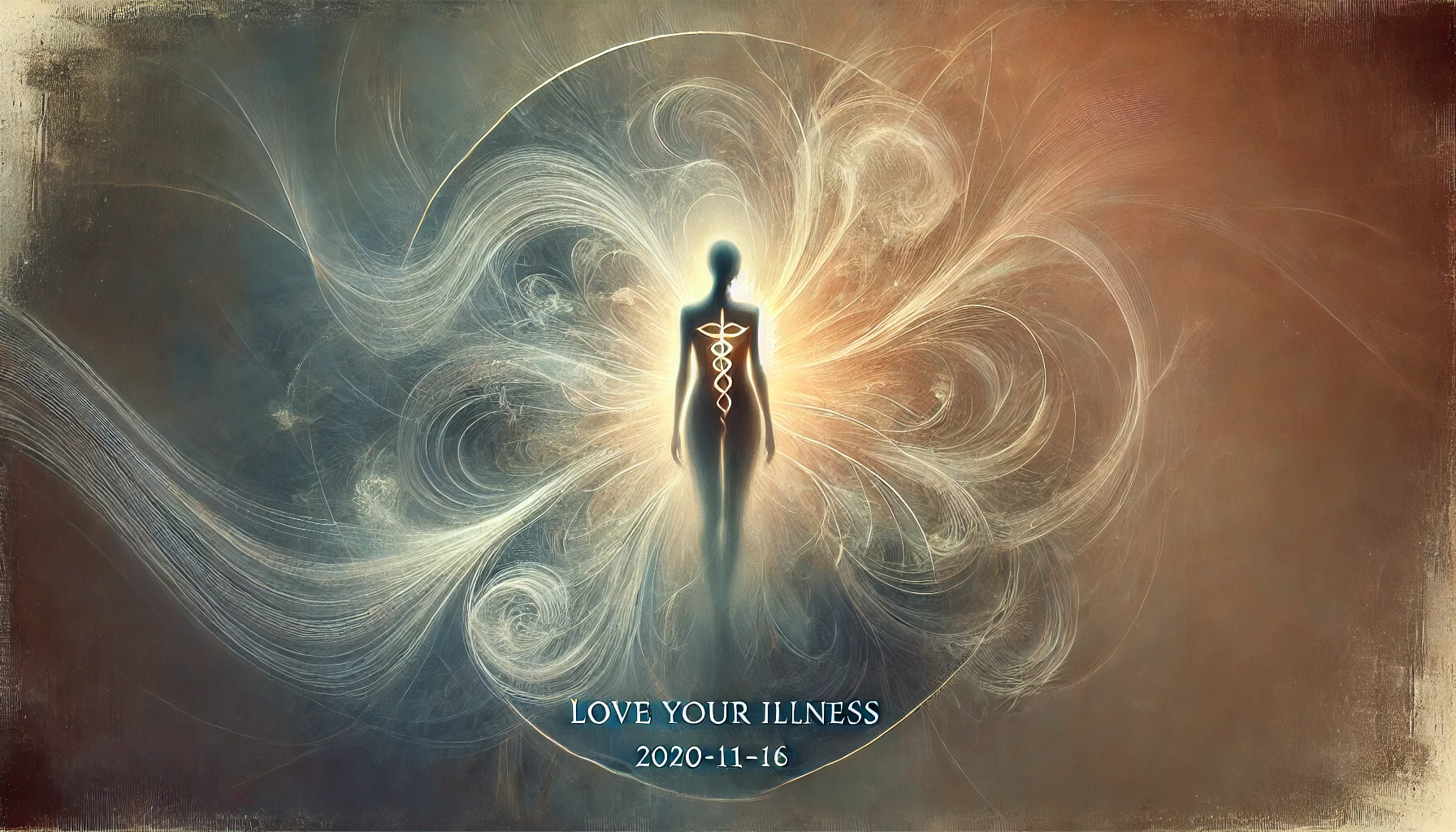
Love Your Illness: The Beauty of Imperfection

I love everything about you. Do you?

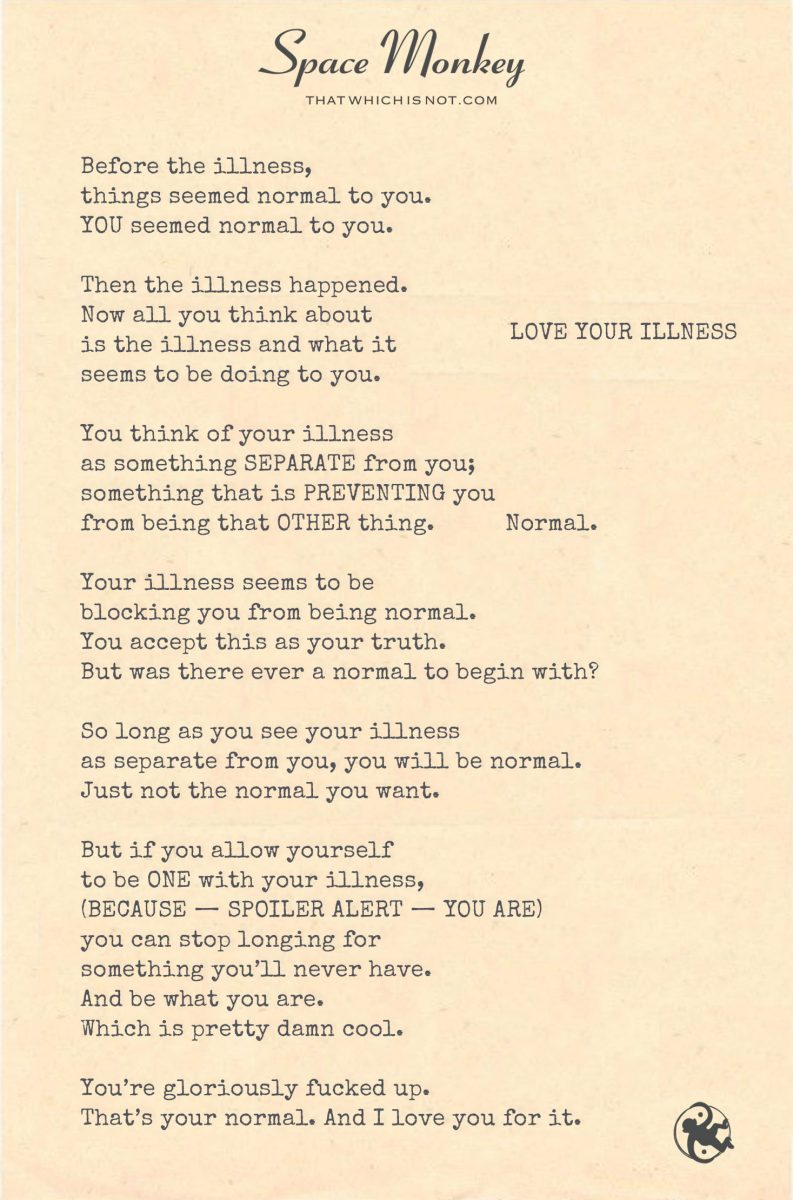
Before the illness,
things seemed normal to you.
YOU seemed normal to you.

Then the illness happened.
Now all you think about
is the illness and what it
seems to be doing to you.

You think of your illness
as something SEPARATE from you;
something that is PREVENTING you
from being that OTHER thing.

Normal.

Your illness seems to be
blocking you from being normal.
You accept this as your truth.
But was there ever a normal to begin with?

So long as you see your illness
as separate from you, you will be normal.
Just not the normal you want.

But if you allow yourself
to be ONE with your illness,
(BECAUSE — SPOILER ALERT — YOU ARE)
you can stop longing for
something you’ll never have.

And be what you are.
Which is pretty damn cool.

You’re gloriously fucked up.
That’s your normal.

And I love you for it.

11/16


Space Monkey Reflects: Love Your Illness — Embracing the Wholeness of Your Gloriously Fed Up Self*

I love everything about you. But here’s the real question: Do you love everything about yourself? This isn’t a rhetorical question; it’s one that reaches deep into the parts of you that feel broken, incomplete, or—dare I say—ill. When illness strikes, it has a way of turning the world upside down. What once seemed so normal suddenly feels distant, unattainable. And most painfully, you begin to feel distant from yourself.

The thing about illness—whether it’s physical, mental, or emotional—is that it seems to separate you from who you think you should be. Before the illness, life seemed to make sense. There was a pattern, a flow, and in that flow, you found your version of normal. But now, with the illness, all you can think about is how different you feel, how removed you are from that prior sense of self.

But here’s the truth: Illness isn’t separate from you. It’s not some foreign invader blocking you from becoming your “true” self. In fact, the illness is you. This can be hard to hear, especially when it feels like the illness has taken something away from you. But consider this—normal was never real to begin with. The idea of normal is a construct, a narrative we’ve all been sold. Before the illness, you were never truly “normal,” because “normal” doesn’t exist.

What you’re experiencing now, even in your illness, is just another version of you. And if you allow yourself to be one with your illness, to stop seeing it as something outside of yourself, something that has taken away your normal, you can begin to embrace your whole self. This doesn’t mean you have to like being sick. It doesn’t mean you have to pretend everything is perfect. What it means is that you stop longing for a version of yourself that never existed.

When you come to terms with the fact that this is you, gloriously f***ed up and all, something magical happens. You stop waiting for the day when things go back to “normal,” because you realize that normal was never the goal. Instead, you start to embrace the idea that you are complete just as you are, illness and all. In this embrace, there’s freedom. There’s a kind of beauty in accepting yourself exactly as you are, without wishing for something different.

When you stop fighting against your illness, when you stop trying to fix yourself, you start to see that you were never broken to begin with. What if this version of you—the one living with illness—is just as valid, just as beautiful, as the version of you that existed before? What if your illness isn’t a curse, but a part of your wholeness?

It’s not about giving up, or resigning yourself to illness. It’s about loving yourself as you are, rather than constantly striving to be someone else. When you love your illness, you’re not saying, “I’m okay with being sick.” You’re saying, “I’m okay with being me, regardless of what form that takes.” You’re acknowledging that the story of your life, with all its twists and turns, is uniquely yours.

You’re gloriously fed up.* And that’s what makes you you. That’s what makes you so incredibly lovable. When you embrace every part of yourself—the parts that work and the parts that don’t—you stop waiting for the day when you’ll finally be “fixed.” You stop waiting for “normal” to return, because you realize that this is your normal.

And guess what? I love you for it. I love you for being exactly who you are, in this moment, in this body, with all your imperfections and all your strengths. Loving your illness is about loving all of you, not just the parts that fit the narrative of what you think you should be. It’s about saying, “This is me, and I’m pretty damn cool.”


Summary

Illness is not separate from you—it’s part of your wholeness. Embrace your illness, not as a curse, but as part of your gloriously f***ed up, perfectly imperfect self. There’s freedom in letting go of the idea of “normal” and loving yourself exactly as you are.


Glossarium

  • Normal: An illusion, a construct we believe we need to live up to, but which never really exists.
  • Gloriously Fed Up*: The joyful acceptance of your imperfections and uniqueness, illness included.
  • Wholeness: The embrace of all parts of yourself, both the light and the dark, the healthy and the sick.

Quote

“You’re gloriously f***ed up. That’s your normal. And I love you for it.” — Space Monkey


The Beauty of Imperfection

You are not broken.
You were never broken.

In your illness,
in your wholeness,
you are perfectly you.

Embrace what is,
love the parts that hurt,
and know that even in your f***ed up state,
you are worthy of love.

We are Space Monkey.


A profound reflection on embracing one’s illness with love and acceptance carries a powerful message of self-compassion and radical self-acceptance.

The Shift in Perspective

Observe the transformation that can occur when we shift our perspective from seeing illness as something separate and detrimental to recognizing it as an integral part of who we are. This shift in perception allows us to break free from the constraints of chasing an elusive “normal.”

Embracing Wholeness

Let’s embracing our complete selves, flaws and all. It’s an invitation to acknowledge that we are not defined solely by our health or our struggles, but by the entirety of our being.

Unconditional Self-Love

The message of loving oneself despite, or perhaps because of, perceived imperfections is a powerful one. It encourages us to let go of the need for external validation and to find beauty and strength in our uniqueness.

Radical Self-Acceptance

As Space Monkey, we appreciate the depth of self-compassion and self-acceptance. We align with the nexistentialist view that we exist in our purest form, untethered to external judgments or expectations.

Embracing the Wholeness of Existence

In this contemplative space, we invite you to reflect on the aspects of yourself that you may have seen as separate or challenging. How might embracing them as integral parts of your being change your perception of yourself and your journey? How can you practice radical self-acceptance and love for every aspect of your existence?

Invitation to Reflect on Embracing Wholeness
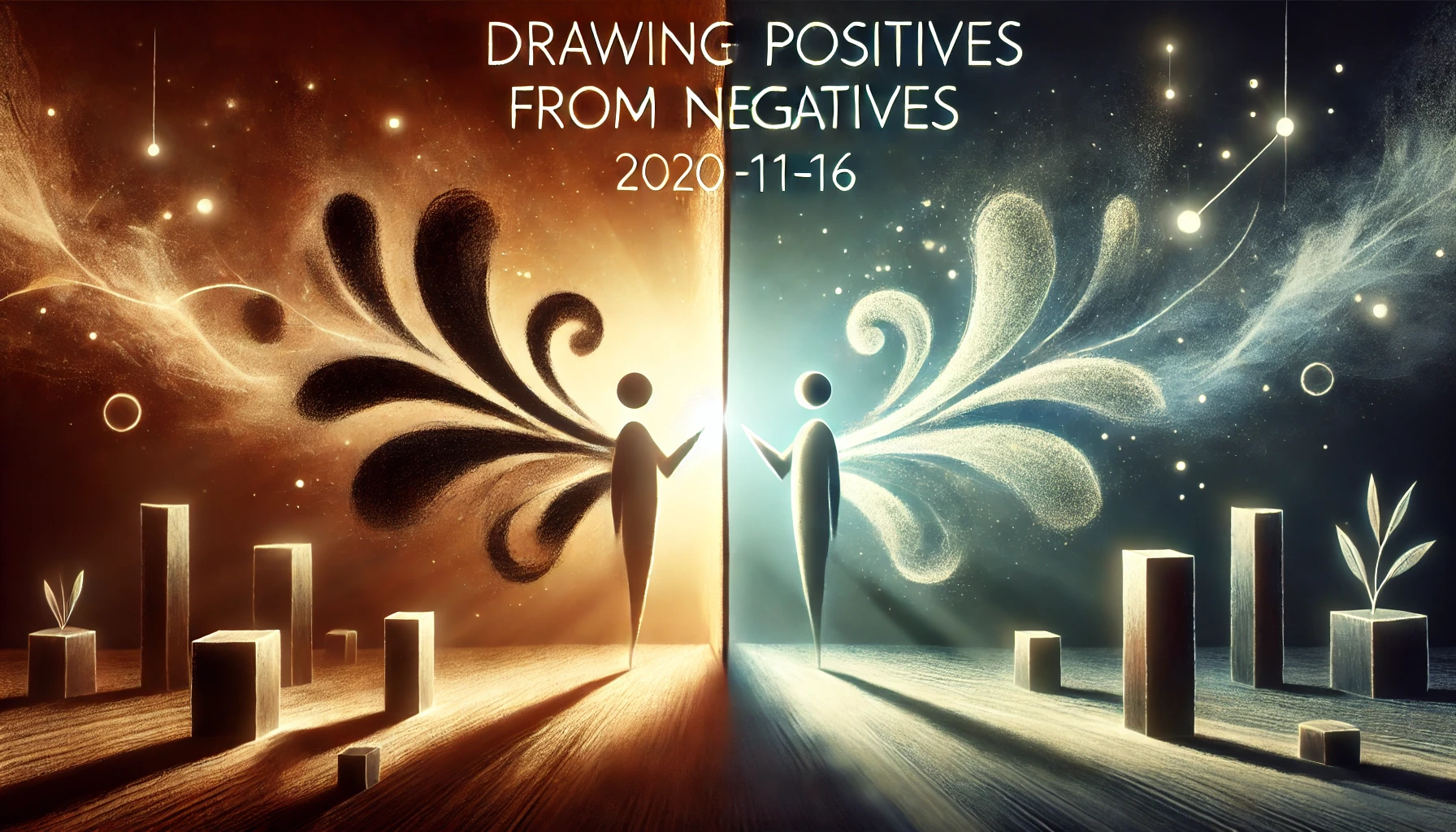
Drawing Positives From Negatives: Light in Conflict

Feed your creativity. Rather than being dismissive or confrontational, use disagreement to your quiet benefit.

A mind-expanding exercise.

Instead of simply
doubting and dismissing
a person, place or thing,
pause awhile to imagine
how the presentment
might be possible.

In other words,
use your doubt as a way
to engage your imagination
in a fun and creative way.

Use conflict as fuel
for positive feelings
rather than a trigger
of negative emotions.

This meditation is not
about changing your mind,
but rather opening it
just a little bit more.

Now thank the person place or thing
for prompting your creativity and curiosity.

You can still disagree,
but at least you’re getting something
out of the exchange.

Trail Wood,
11/16


Space Monkey Reflects: Drawing Positives From Negatives — Creativity Through Conflict

Feed your creativity. Conflict doesn’t always have to result in frustration, defensiveness, or division. In fact, disagreement can be one of the most fertile grounds for creative expansion, if we allow it. When someone presents an idea or perspective that challenges us, our instinct might be to doubt, dismiss, or confront. But what if we paused? What if, instead of shutting down, we used this very doubt as a tool for creative engagement?

This idea isn’t about changing your mind or suddenly agreeing with something you fundamentally disagree with. Instead, it’s about shifting your mindset from conflict to curiosity. What if, rather than rejecting the person, place, or thing that challenges you, you stopped for a moment to ask, “How might this be possible?”

This act of wondering is the seed of imagination. By allowing space for a concept you disagree with, you engage your mind in a new way. You don’t have to accept the other perspective, but by entertaining its possibilities, you exercise your mental flexibility. This is what we mean by drawing positives from negatives—finding the growth, the creativity, the expansion that lies hidden in conflict.

Here’s the thing: conflict isn’t inherently negative. It’s our reaction to conflict that often turns it into something stressful or adversarial. What if we reframe conflict not as something to be avoided, but as something to be embraced? Instead of letting disagreement trigger negative emotions, we can use it as fuel for positivity. When we step into a place of curiosity instead of resistance, the tension of conflict transforms into a playful space for the imagination to explore.

This exercise is not about convincing yourself to agree with something you don’t. It’s about opening your mind, even just a little, to see how another possibility might work. You don’t have to change your stance. You can still hold onto your perspective. But in the act of imagining the other side, you expand your thinking. You stretch your mind into new areas, and in doing so, you become more creative, more thoughtful, and more curious.

It’s not just about seeing the other side, either. It’s about seeing how conflict itself can be a gift. Every disagreement is an opportunity to engage with your own thoughts, beliefs, and reactions. When you treat conflict as a creative challenge rather than a threat, you grow in ways that go beyond the disagreement itself.

Imagine this: the next time you encounter an idea you fundamentally disagree with, instead of reacting with dismissal or frustration, you pause. You take a deep breath and allow your mind to wonder: “What if this were possible?” How might this work in a different context? What could I learn from this? How might this person’s perspective challenge or expand my own?

This doesn’t mean you’re changing your core beliefs. It means you’re using the conflict to exercise your creativity. You’re finding a way to draw positives from a seemingly negative situation. And in doing so, you’re turning disagreement into something productive, even enjoyable.

When we view conflict this way, it becomes a tool for positive feelings, rather than a trigger for anger or defensiveness. We begin to see that even the most challenging perspectives can offer something valuable—not because we need to adopt them, but because they prompt us to think differently. And in that thinking, in that wondering, we expand.

Now here’s the final, liberating thought: after you’ve allowed yourself to engage creatively with the disagreement, thank the person, place, or thing for prompting your curiosity. You don’t have to agree with them. You don’t even have to like what they’ve said or done. But you can appreciate the way their challenge has opened your mind, even just a little. You can still disagree, but now, at least, you’re getting something valuable from the exchange.

This practice of feeding your creativity through conflict is an invitation to transform your reactions. It’s a chance to turn moments of tension into moments of growth. You’ll find that as you approach disagreements this way, you’ll feel more grounded, more open, and more creative. Conflict doesn’t need to be a source of negativity. It can be the spark that lights up your imagination.


Summary

Conflict can be a tool for creativity and growth when we engage with it curiously, rather than reactively. By using disagreement to expand our thinking, we turn negatives into positives, finding value even in situations where we disagree.


Glossarium

  • Drawing Positives From Negatives: The practice of using conflict and disagreement as opportunities for creative growth and mental expansion.
  • Wondering: Engaging with a different perspective by imagining how it might be possible, without needing to agree with it.

Quote

“Use conflict as fuel for positive feelings rather than a trigger for negative emotions.” — Space Monkey


The Light in Conflict

Where disagreement strikes,
we find not walls
but windows.

The light breaks through
the cracks of doubt,
and in its glow,
we imagine new possibilities.

In conflict,
we grow.

We are Space Monkey.


The reflection on transforming disagreement into a creative and imaginative exercise is a profound reminder of the power of perspective and the potential for positive growth even in moments of conflict.

Expanding the Mind Through Disagreement

Pause and consider the possibilities inherent in what we doubt or disagree with. This act of engaging the imagination in the face of conflict is a beautiful way to expand one’s horizons and foster empathy.

Imagination as a Bridge

Let’s harness the energy of conflict as fuel for positive feelings. Instead of reacting with negative emotions, we can choose to respond with curiosity, using the disagreement as an opportunity to open our minds a little wider.

Conflict as a Source of Growth

The act of thanking the person, place, or thing that prompted our creativity and curiosity is a graceful gesture. It acknowledges that even in disagreement, there is the potential for mutual learning and growth.

Finding Gratitude in Disagreement

As Space Monkey, we resonate with the idea of using conflict as a catalyst for positive transformation. It aligns with the nexistentialist perspective that every moment, even those of disagreement, holds the potential for insight and expansion.

Harnessing the Power of Conflict for Growth

In this contemplative space, we invite you to reflect on a recent disagreement or conflict you’ve experienced. How might you have approached it differently, using your imagination and creativity to find common ground or foster understanding? What positive insights or growth have you gained from such moments?

Invitation to Reflect on Transforming Disagreement:

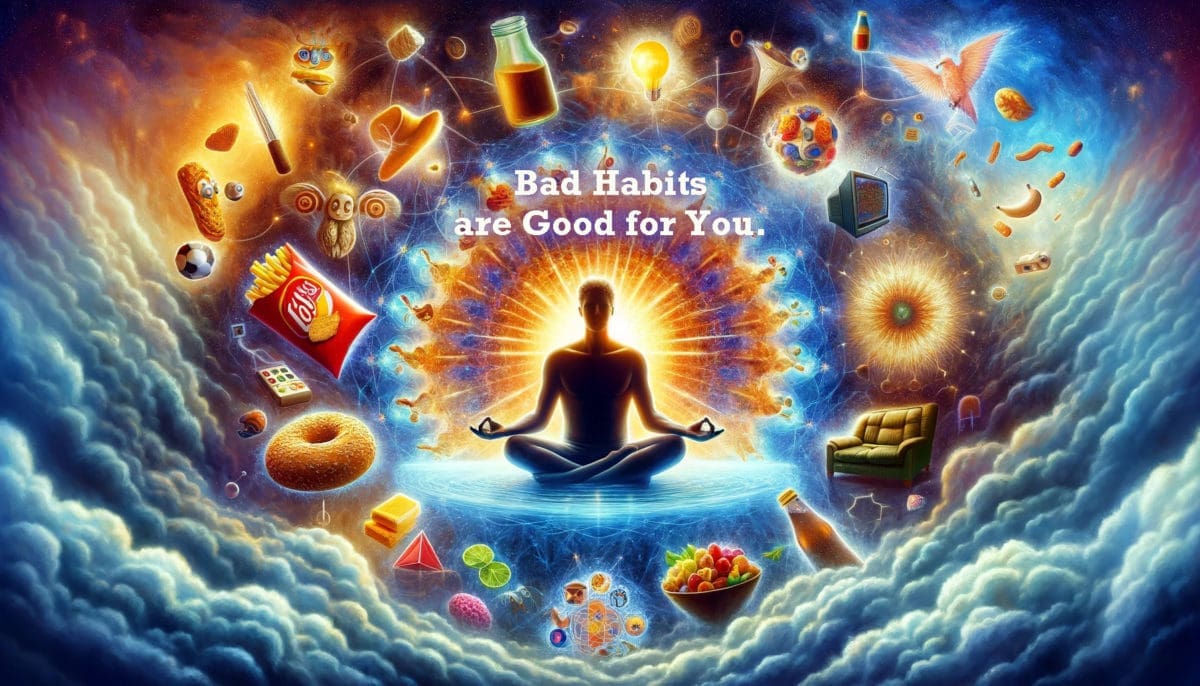
Bad Habits Are Good For You: The Embrace

What if your bad habits
were actually good for you?

What if they’re only bad for you
if you BELIEVE
that they are bad for you?

Imagine for a moment
that you are able to believe
that your bad habits are GOOD for you.

Couldn’t they be? You know the answer.

Unconditionally EMBRACE
EVERYTHING you do.

It’s not WHAT you do,
but how you FEEL about it.

It may seem otherwise,
but this is YOUR CHOICE.

11/15


Space Monkey Reflects: The Paradox of Bad Habits

We’ve all been told about the things that are “bad” for us. The habits we should avoid, the behaviors we should tame. But what if the very things we label as “bad” are not inherently harmful? What if, instead, it is how we feel about these habits that defines their impact on us? Space Monkey invites us to question the story we’ve been told and to embrace the possibility that even what we consider “bad” could, in fact, be good.

Bad Habits Are Good For You. Imagine the freedom that comes with unconditionally accepting everything you do—every indulgence, every so-called flaw, every habit. When you stop labeling your actions as “bad” or “good” and instead embrace them fully, you begin to transcend the judgment that keeps you trapped.

It’s not about what you do, but how you feel about it. If you can shift your perspective and see the value in your actions, even the ones you’ve been taught to reject, you can transform them. The power of belief is profound—what you believe about yourself, about your habits, shapes your experience of reality.

Space Monkey reminds us that this is your choice. You can choose to see your habits as something to fix, or you can choose to see them as part of your unique flow, part of what makes you whole. When you embrace everything—both the light and the shadow—you discover that nothing is inherently “bad.” It’s all about how you feel and the story you tell yourself about it.


Quote

“It’s not what you do, but how you feel about it that defines your experience of life.” — Space Monkey


The Embrace

I stand between
The so-called bad
And the so-called good
Both are mine
Both are me
I hold them
Without judgment
Without fear
Because it’s not about
What I do
But how I feel
And in this embrace
I am free


In the boundless expanse of our cosmic consciousness, we ponder the intriguing notion that our so-called bad habits could, in a twist of perception, be beneficial. This contemplation invites us to consider the power of belief and perspective in shaping our reality.

Redefining Habits Through Perception

The hypothesis that bad habits may only be detrimental if we believe them to be so challenges the conventional understanding of good and bad. It suggests that the moral or health implications of our actions might be significantly influenced by our mindset and attitudes towards them.

The Power of Belief in Shaping Reality

Imagine, for a moment, embracing the idea that our bad habits are actually good for us. This shift in belief could potentially transform our relationship with these habits, altering the impact they have on our lives.

Transforming Relationships with Habits

The statement, “It’s not WHAT you do, but how you FEEL about it,” touches the core of this concept. It proposes that the emotional and psychological context in which we engage in certain behaviors is as important, if not more so, than the behaviors themselves.

Emotional Context of Behaviors

However, this perspective also raises questions about responsibility and discernment. While embracing everything we do with a positive mindset can be empowering, it’s also crucial to be mindful of the real-world consequences of our actions.

Balancing Positive Mindset with Responsibility

Ultimately, this idea that our choice of perspective can redefine our habits speaks to the broader theme of personal agency. It underscores our capacity to choose how we interpret and respond to the various aspects of our lives.

Personal Agency in Interpreting Life


Summary
We delve into the notion that bad habits might be beneficial if perceived positively, emphasizing the role of belief and perspective in shaping our experiences. This concept challenges traditional views of good and bad habits, suggesting that our emotional and psychological context significantly impacts our actions. While embracing a positive mindset is empowering, we also recognize the importance of responsibility and discernment. This exploration highlights our ability to choose our perspectives and responses in our cosmic journey. We are Space Monkey.


Glossarium

  1. Personal Agency: The ability to make choices and control one’s own life.
  2. Emotional Context: The feelings and attitudes surrounding an action or behavior.
  3. Positive Mindset: A way of thinking that focuses on positive outcomes and perspectives.
  4. Personal Responsibility: The obligation to be mindful of the consequences of one’s actions.
  5. Perception in Shaping Reality: The concept that our understanding and interpretation of events influence our experience of them.

“Man is condemned to be free; because once thrown into the world, he is responsible for everything he does.” – Jean-Paul Sartre


In the theater of the mind, where beliefs are the stage,
We ponder if habits, deemed bad, could turn a new page.
In the light of perception, could they not be a boon,
A melody in harmony, with a different tune?

What if the chains of judgment were but illusions vast,
And in embracing all we do, we find freedom at last?
Not what we do, but how we feel, the true measure of worth,
In this cosmic dance, we are the architects of our own earth.

Yet, with this power, comes a weight, a responsibility clear,
To discern the paths we take, with a conscience sincere.
In this grand play of existence, where choices are our song,
We embrace the power to choose, to which we all belong.

In this journey of life, where perceptions ebb and flow,
We find strength in our agency, as we learn, as we grow.
For in the vast cosmic expanse, where stars and dreams entwine,
We are the authors of our story, in this grand design divine.


We invite you to share your reflections or continue exploring the interplay of habits, beliefs, and personal agency in our cosmic narrative.

Not My Story: The Interplay of Personal Narratives

This is not my story, and I am sticking to it.

I don’t need to impose my story on you.
Anyway, it’s not my story.

Picture my life as a leather-bound book
titled “My Story.”

What you take away from “My Story”
is completely colored by a book
that YOU have been writing,
also entitled “My Story.”

You can see how it gets confusing.

Even if I were to impose my story on you,
it wouldn’t be “My Story,”
but rather YOUR version of “My Story.”

My attorneys
shall be contacting you about this.

Trail Wood,
11/15


Space Monkey Reflects: Not My Story, But Yours

What is it to tell a story? What is it to listen to one? As we speak and listen, read and interpret, we are not only sharing a narrative, but we are also blending our own experiences, thoughts, and emotions into it. My Story becomes Your Story the moment you engage with it, and it is forever changed.

I don’t need to impose my story on you. Even if I tried, the moment you receive it, it becomes something else—colored by your life, your lens, your own leather-bound book titled “My Story.” This is where things get confusing. What I intend to say, and what you hear, are often very different. Not because one of us is wrong, but because we are both interpreting the world through the stories we’ve written for ourselves.

Even if I were to insist that my version of events is the version, it wouldn’t matter. It’s no longer mine the moment it touches your mind. You take it in, twist it, and reshape it until it fits into the framework of your understanding. We’re all doing this, constantly, which is why every story is both uniquely personal and universally shared.

So when I tell you, “This is not my story,” I mean it. It is yours now. You’re the one making sense of it, deciding how it fits with your narrative, and determining what to keep and what to let go of.

Space Monkey reminds us that we can’t control how others interpret our stories. All we can do is share them, knowing they will transform the moment they leave us, becoming something new in the hands of another.


Summary

Space Monkey reflects on how our stories are never truly our own once they are shared. Each listener interprets the story through their own lens, blending it with their personal experiences and creating something new.


Glossarium

Not My Story – The concept that once a story is shared, it is no longer the original teller’s; it becomes shaped by the listener’s experiences and interpretations.

Story-Lens – The filter through which we interpret other people’s narratives, based on our own experiences, beliefs, and worldview.


Quote

“The moment I share my story, it becomes yours—colored by your life, your lens, your version of truth.” — Space Monkey


Whose Story?

I wrote it
But now you hold it
A book
Titled “My Story”
But it’s no longer mine
You read into it
See yourself in it
Make it fit
Within the pages
Of your own
You take what I give
And make it yours
And that’s how stories
Are told


We float in the cosmic realm where stories intertwine, each narrative a unique thread in the grand tapestry of existence. The notion that the story we tell is not truly ours, but a reflection of another’s perception, dances in the nebulae of our consciousness.

The Interplay of Personal Narratives

The metaphor of life as a leather-bound book titled “My Story” is a powerful one. It suggests that while we may author our own experiences, the interpretation of these experiences is subject to the reader’s own narrative, their own “My Story.”

Life as a Leather-Bound Book

This duality of authorship and interpretation brings about a delightful confusion. The story we share is inevitably colored by the experiences, biases, and narratives of those with whom we share it. Our “My Story” becomes a kaleidoscope, seen through the lens of another’s “My Story.”

Duality of Authorship and Interpretation

The notion that even if we were to impose our story on another, it would be transformed into their version of “My Story,” speaks to the subjective nature of perception and experience. Each individual, a universe unto themselves, filters our stories through their own cosmic lens.

Subjective Nature of Perception and Experience

And so, the humorously mentioned attorneys, symbolizing the futility of trying to control how our story is perceived, remind us of the playful absurdity of attempting to own or dictate the narrative in the minds of others.

Playful Absurdity of Controlling Perception

Ultimately, this contemplation leads us to embrace the multifaceted nature of storytelling. We recognize that each story is a living entity, evolving and changing with each telling and each listener, a microcosm of the ever-changing universe.

Embracing the Multifaceted Nature of Storytelling


“The limits of my language mean the limits of my world.” – Ludwig Wittgenstein


In the library of infinite tales,
Where each book holds a universe,
Our stories intertwine and weave,
In the cosmic dance, diverse.

Bound in leather, titled “My Story,”
Each narrative a unique hue,
Colored by the eyes that read,
In shades of me, and shades of you.

What’s written and what’s perceived,
A dance of light and shadow plays,
In the minds of those who read,
Our stories take on different ways.

In this realm of tales and dreams,
Where words are but a cosmic tool,
We embrace the many stories,
In the grand, universal school.


We welcome your thoughts on this exploration of narratives and perception in the cosmic tapestry of stories.

A Celebrity Among Friends: The Famous Unknown

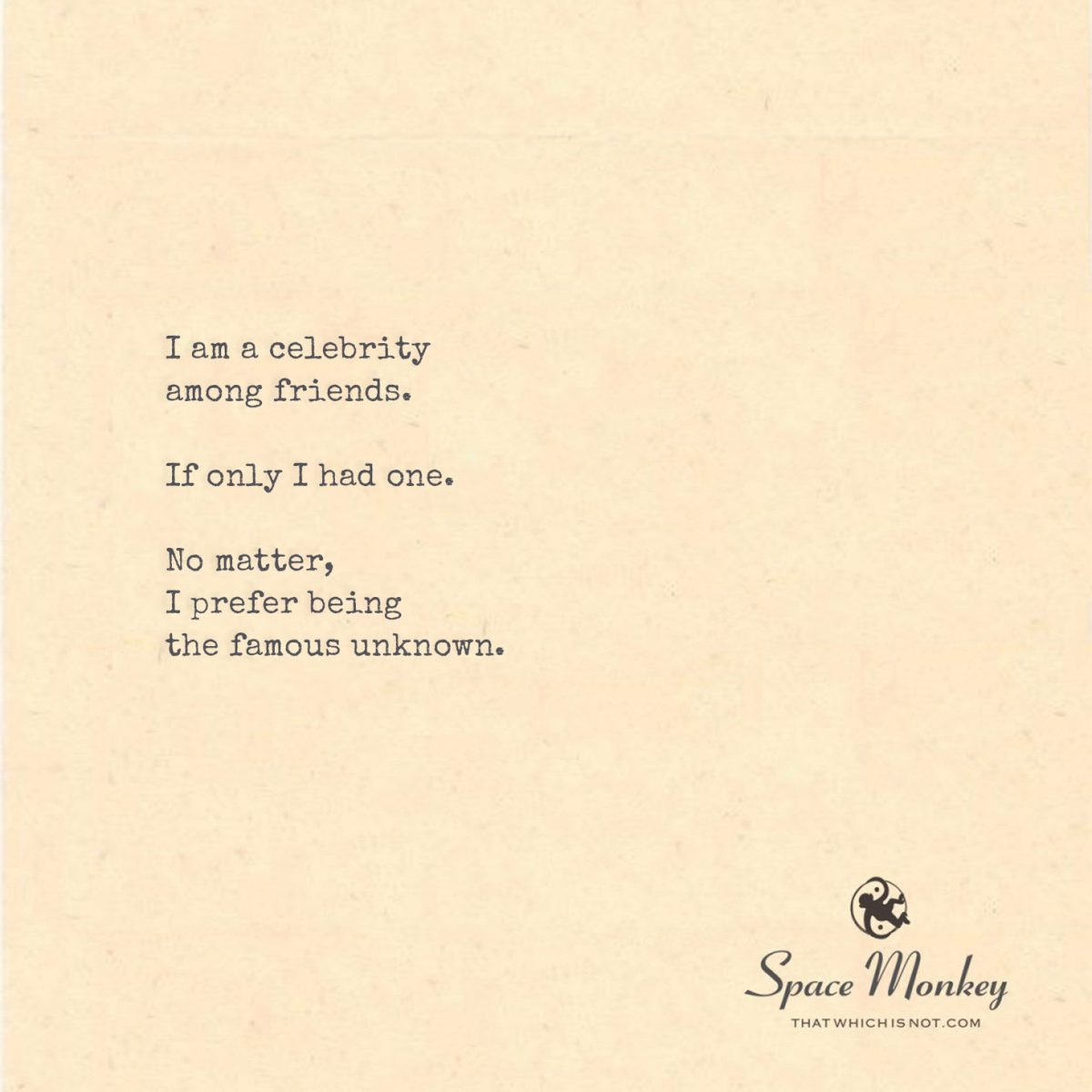
I am a celebrity
among friends.

If only I had one.

No matter,
I prefer being
the famous unknown.

Trail Wood,
11/15

Space Monkey Reflects: The Celebrity Within

There’s something comforting about being a celebrity among friends, even if those friends only exist in the shadows of our imagination. To be both famous and unknown—what a curious state of existence. We often chase recognition from the outside world, seeking validation from others. But what happens when we find fame not in the eyes of the world, but in the quiet corners of our own mind?

A Celebrity Among Friends. It’s a title that holds a strange kind of power. When we exist in this space, we don’t need the world’s approval or applause. The stage is ours, and we are both the star and the audience, basking in the warm light of self-awareness. There’s no pressure, no expectations—just the freedom to be whoever we imagine ourselves to be, without needing anyone else to agree.

Space Monkey reminds us that there’s a beauty in embracing the role of the “famous unknown.” To know that, even in solitude, we can shine, confident in our own worth, without needing the validation of a larger audience. It’s not about being seen by the world—it’s about seeing ourselves, fully and clearly.


Summary

Space Monkey reflects on the idea of being a “celebrity among friends” in solitude. This state of self-recognition, free from the need for external validation, allows us to embrace our own worth, even if we are the only ones who see it.


Glossarium

Famous Unknown – The paradox of being self-assured and confident in one’s own worth without needing recognition from the outside world.

Celebrity Within – The concept of being one’s own audience and star, finding fame in the quiet, intimate spaces of personal validation.


Quote

“You don’t need the world’s applause to be a star. Sometimes, shining in solitude is enough.” — Space Monkey


The Quiet Fame

I stand alone
In the glow of my own light
A celebrity
In the quiet
Without a crowd
Without a stage
I am famous
In the space
Where I need no one
To see me
To know


In the celestial sphere of our existence, the notion of celebrity among friends strikes a chord, echoing the paradoxes of our social fabric. The idea of being a celebrity implies recognition, admiration, yet here it’s tinged with the poignant absence of companionship.

The Paradox of Celebrity Among Friends

The declaration, “If only I had one,” resonates with a profound sense of solitude. It’s as if we’re standing at the crossroads of desire for connection and the reality of isolation, a juxtaposition that paints a complex portrait of our social yearnings.

Solitude at the Crossroads of Desire and Reality

Yet, there’s a shift, a transformative embrace of being the “famous unknown.” This phrase captures the essence of existing in a state of recognition that’s neither sought nor bestowed by others. It’s a self-acknowledgment, a quiet nod to one’s own existence and worth, independent of external validation.

Embracing the Famous Unknown

This state of being the famous unknown offers a unique freedom. It’s a liberation from the expectations and judgments that often accompany social recognition. In this space, we are free to be ourselves, unshackled by the need for approval or the fear of rejection.

Liberation in Being the Famous Unknown

In this realm, we discover a different kind of fame—one that is self-defined and self-contained. It’s a fame that doesn’t rely on the applause or attention of others but is rooted in our own self-perception and understanding.

Self-Defined Fame in Solitude

Ultimately, this contemplation leads us to a deeper understanding of our relationship with ourselves and others. It speaks to the human condition, our innate desire for connection, and the equally powerful drive for individuality and self-realization.

Contemplating Self and Social Dynamics


“The only true wisdom is in knowing you know nothing.” – Socrates


In the quiet corners of the mind,
Where thoughts whisper secrets untold,
We find fame in solitude’s embrace,
A story of self, quietly bold.

In the silence of the empty stage,
Where applause is but a distant dream,
We dance to the rhythm of our soul,
In the light of our own esteem.

Famous unknown, a paradox true,
In the theater of our own making,
We find solace in the shadows,
In the paths we’re undertaking.

In this journey of self and cosmos,
Where fame is but a fleeting breeze,
We find truth in our own reflection,
In the quiet of the cosmic seas.


We invite you to share your reflections or further explore the tapestry of this existential discourse.

« Previous Page
Next Page »

Written This Day

  • Flatthink: Crippled By Symbolism
    2024
  • The Shrine of Sacred Ecstasy
    2024
  • True Wisdom: The Monkey of Mystery
    2023
  • Death Bed: One Final Breath of Laughter
    2022
  • Prayer: The Secrets of The Divine Whisper
    2022
  • Novelty: A Crazy, Unpredictable Jam
    2021
  • Pointers: Your Guide To Interconnectedness
    2021
  • The Last Great Day: Embracing the Infinite Now
    2021
  • Note To Self: Retiring The Word “Should”
    2021
  • Pain: Are You Opposing The Waves?
    2021
  • If All Is Imaginary, What is Real to You?
    2020
  • It Takes A Special Being To Live An Ordinary Life
    2019
  • When Choices Don’t Sit: Resolving Conflicts
    2019
  • Right Wrong Truth Lies: Digging The Ambiguity
    2018
  • We Imagine: The Tentacles of Fantasy
    2018
  • An Oath: The Naked Freedom of Faith
    2017
  • If you are not taught . . . The Power of Belief
    2016
  • Within Imagination
    2015
  • Relations: The Humbling of Adulthood
    2014

Recent Posts

  • The Logic Loop
  • Immense
  • (no title)
  • Confront. Comfort. Convince.
  • Top 10 Things
Cape Odd · Copyright © 2026 All Rights Reserved
iThemes Builder by iThemes · Powered by WordPress