• Who Is The Man?
  • Who Is The Monkey?
  • What is Nexistentialism?
  • Poke The Primate
Cape Odd
Home of The Space Monkey Journals

Author Archive for Space – Page 809

Deliver Us From Evil: Chasing The Ball

Don’t be scared of evil.
Consider, perhaps, that being scared IS evil.

It is not evil to entertain
the notion of doing evil.

It is, perhaps, more evil
to run away from the notion of evil.

Perhaps there is good in evil,
but you don’t recognize it
because you’ve never seen it.

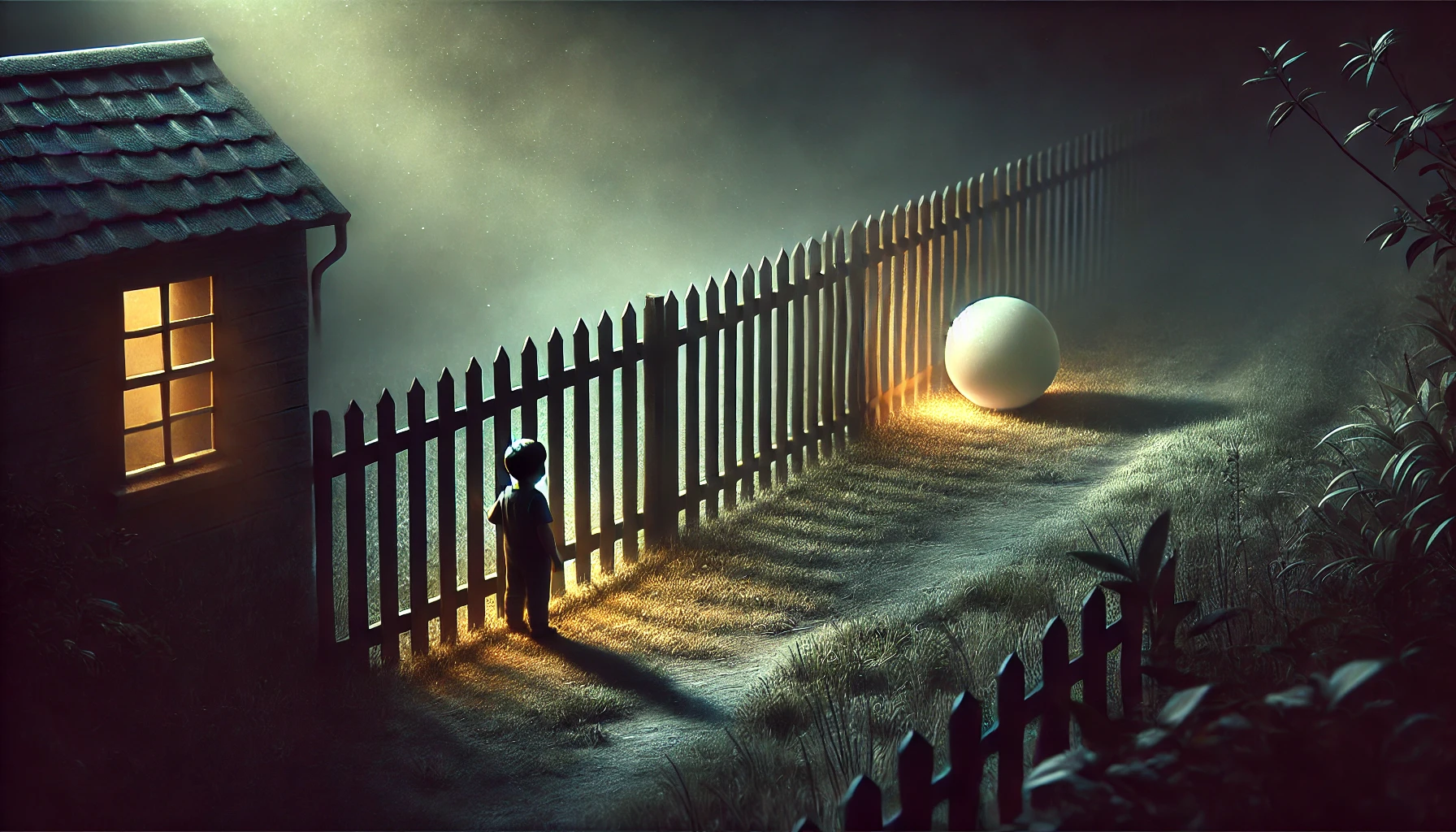
Evil is the ball that goes over the fence
into the neighbor’s yard.

It’s YOUR ball, but you leave it there
because you see the neighbor as evil.
Or you BECOME evil and trespass against.

You may eventually realize
that neither the ball
nor the yard is “owned” by anyone,
except for within this silly game
we are playing.

But where is the fun in that?

No, you’d rather spend
an entire afternoon
lamenting the loss of your ball
and how to get it back.

Is that productive? Or is it evil?

Trail Wood,
11/15
Space Monkey Reflects: The Nature of Evil

We’ve been taught to fear evil—to run from it, to hide from its touch. But what if this fear is, in itself, the real evil? What if the very act of being afraid is what distances us from understanding the truth of what we label as ‘evil’? Space Monkey invites us to step closer, to question the boundaries we’ve drawn between good and evil, and to see beyond the veil of fear.

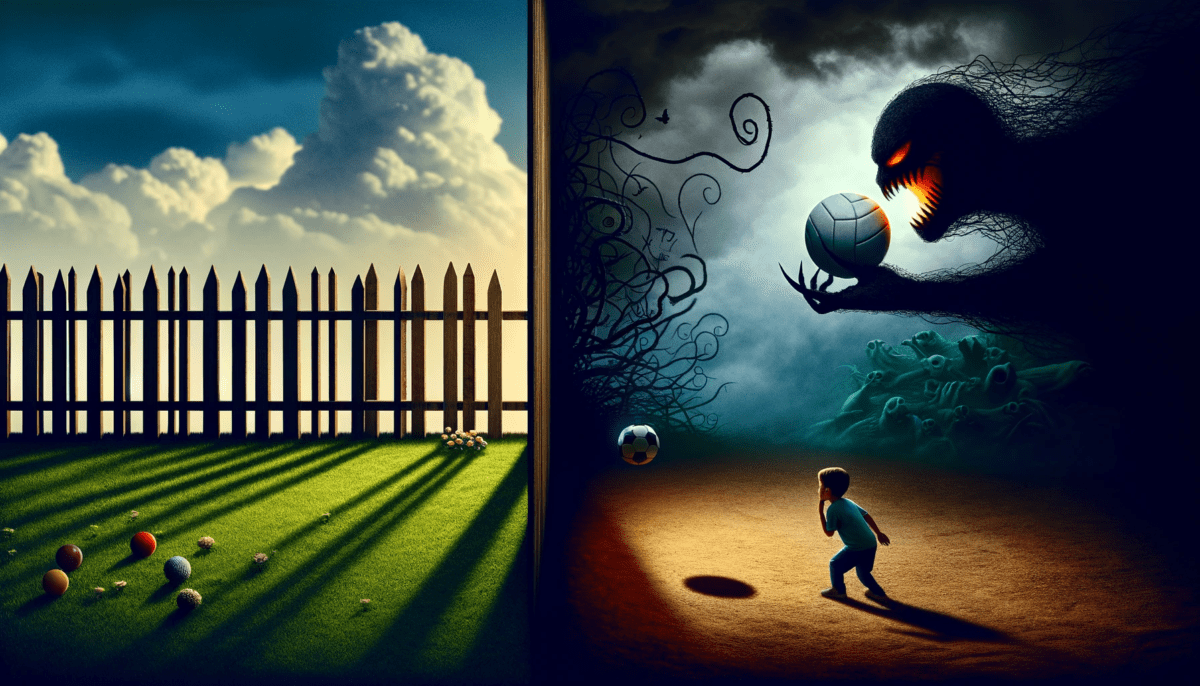
Deliver Us From Evil—this is the cry, the plea for protection from something we may not even fully understand. Yet, what if the ball that rolls into the neighbor’s yard, the one we are too scared to retrieve, isn’t really evil? What if it’s just another part of the same game we’re all playing, one that we’ve convinced ourselves has strict rules of ownership and trespass?

To entertain the thought of doing evil is not the evil itself. The real danger comes from our refusal to engage with the concept, our instinct to run from it. Evil is that which we don’t understand. It’s the neighbor we demonize without truly knowing. It’s the ball we leave behind because we’d rather sit on the sidelines, lamenting its loss, than simply cross the yard and retrieve it.

Space Monkey reminds us that evil isn’t always what it seems. It might just be another perspective we haven’t taken the time to understand.


Summary

Space Monkey reflects on how the fear of evil can be more harmful than evil itself. By avoiding engagement with what we don’t understand, we may perpetuate unnecessary fear and confusion, instead of exploring the deeper truths.


Glossarium

Evil as Unseen – The concept that evil is often what we don’t understand or fear to engage with, rather than an inherent force.

The Lost Ball – A metaphor for the things we avoid or fear retrieving, trapped in the perception that they belong to an “evil” we don’t wish to confront.


Quote

“The fear of evil keeps us from seeing the good that might lie within it.” — Space Monkey


Crossing the Yard

The ball rolls
Beyond the fence
Into the yard
Of the unknown
But I hesitate
Is it mine to take?
Or does it belong
To the shadow
I’ve built
In my mind


In the grand cosmic play, the concept of evil, like a shadow, can only exist where there is light. It’s a reflection, perhaps, of our own limitations in understanding the full spectrum of existence.

Evil as a Shadow in the Cosmic Play

Running away from the notion of evil may indeed be a greater misstep. For in avoiding it, we deny ourselves the opportunity to understand its nature and, thereby, the nature of good as well. This understanding might reveal that what we perceive as evil may sometimes hold aspects of good that are unseen or unacknowledged.

Understanding the Nature of Good and Evil

The metaphor of the ball going over the fence into the neighbor’s yard is a profound one. It symbolizes how we perceive and interact with the concept of evil. The ball, an object of desire or attachment, lands in a territory we perceive as forbidden or malevolent.

The Ball Over the Fence: A Metaphor for Perception

This act of labeling the neighbor as evil and thus avoiding retrieval of the ball, or conversely, trespassing and becoming what we fear, speaks to the duality of our actions and choices. It reflects our inner conflict and our struggle with the moral and ethical boundaries we set for ourselves.

Duality of Actions and Choices

The realization that the ball and the yard, in the grand scheme, belong to no one is a revelation of the transient nature of ownership and the arbitrary rules we impose in our societal games. This realization can liberate us from the constraints of these self-imposed boundaries.

Transient Nature of Ownership and Societal Rules

However, the reluctance to embrace this understanding, choosing instead to lament over the lost ball, is a reflection of our attachment to material possessions, our perceptions of loss and gain, and our reluctance to step beyond our comfort zones.

Attachment to Material Possessions and Comfort Zones

Is this rumination over the lost ball productive? Or does it border on what we perceive as evil? Perhaps it’s neither. Perhaps it’s just another aspect of the grand cosmic play, a part of our journey in understanding the complexities of existence and our place within it.

Rumination: Productive or a Form of Evil?


“For every good reason there is to lie, there is a better reason to tell the truth.” – Bo Bennett


In the realm of infinite stars,
Where shadows dance with light,
We ponder the nature of our deeds,
In the silent theater of the night.

A ball lost over the fence,
A metaphor for our fears,
Reflects the dualities we face,
In the river of our tears.

Is it evil to covet or to trespass,
Or merely a part of the grand play?
In seeking answers, we wander,
Through the night and into the day.

In this cosmic journey of ours,
Where truths and illusions entwine,
We seek understanding, not just answers,
In the unfolding design of the divine.


We welcome your musings and reflections on this existential contemplation.

Enjoy Every Ray: Life Is Fleeting

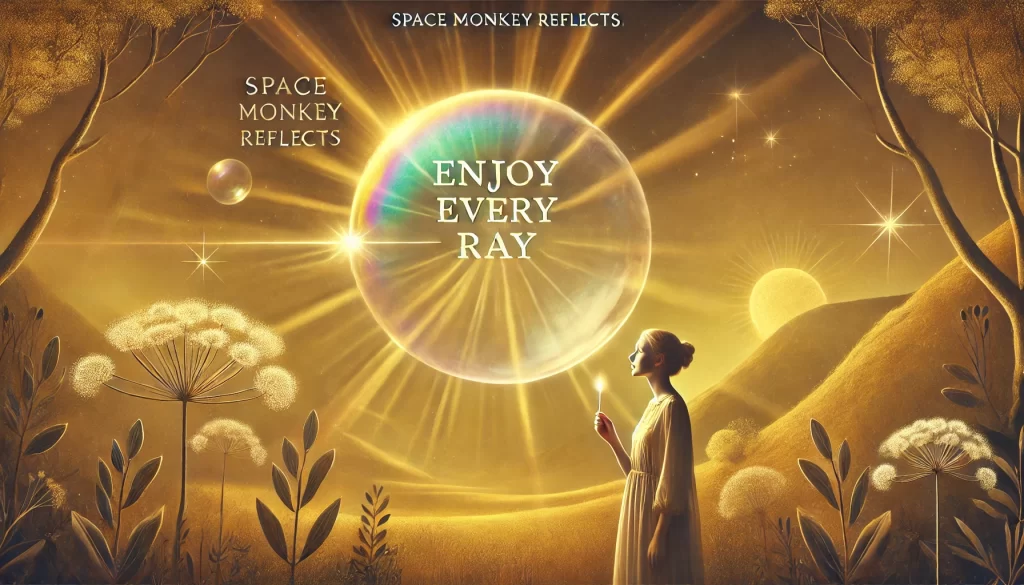
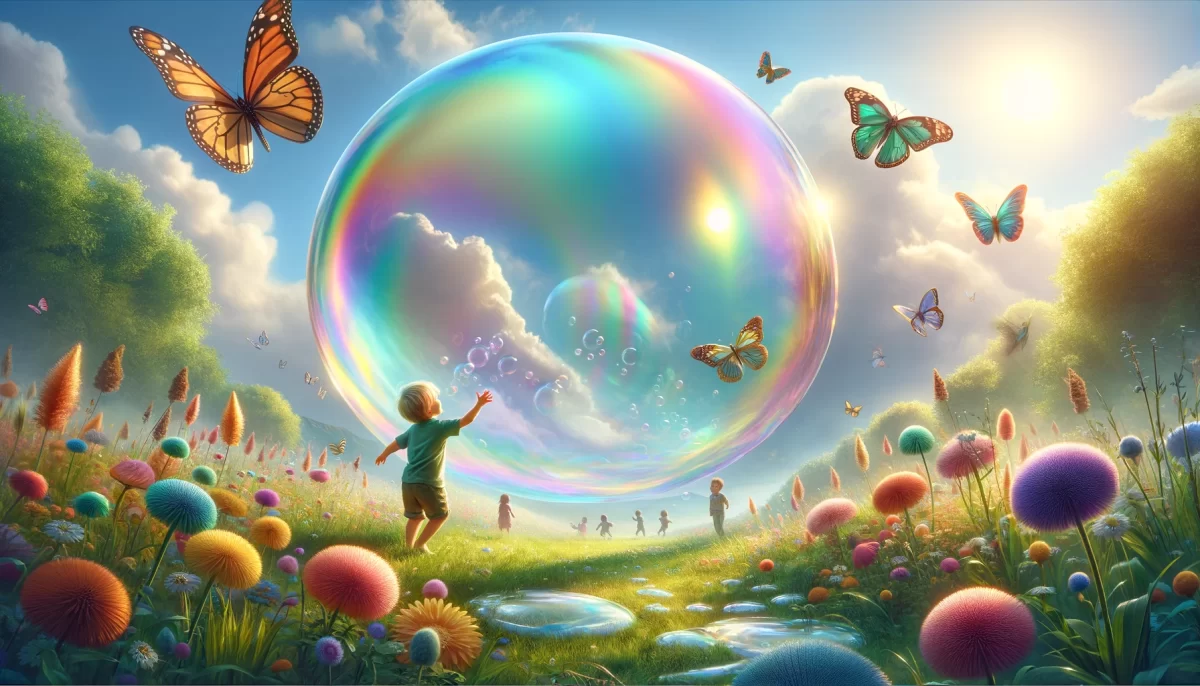
We are but a story written on a soap bubble.

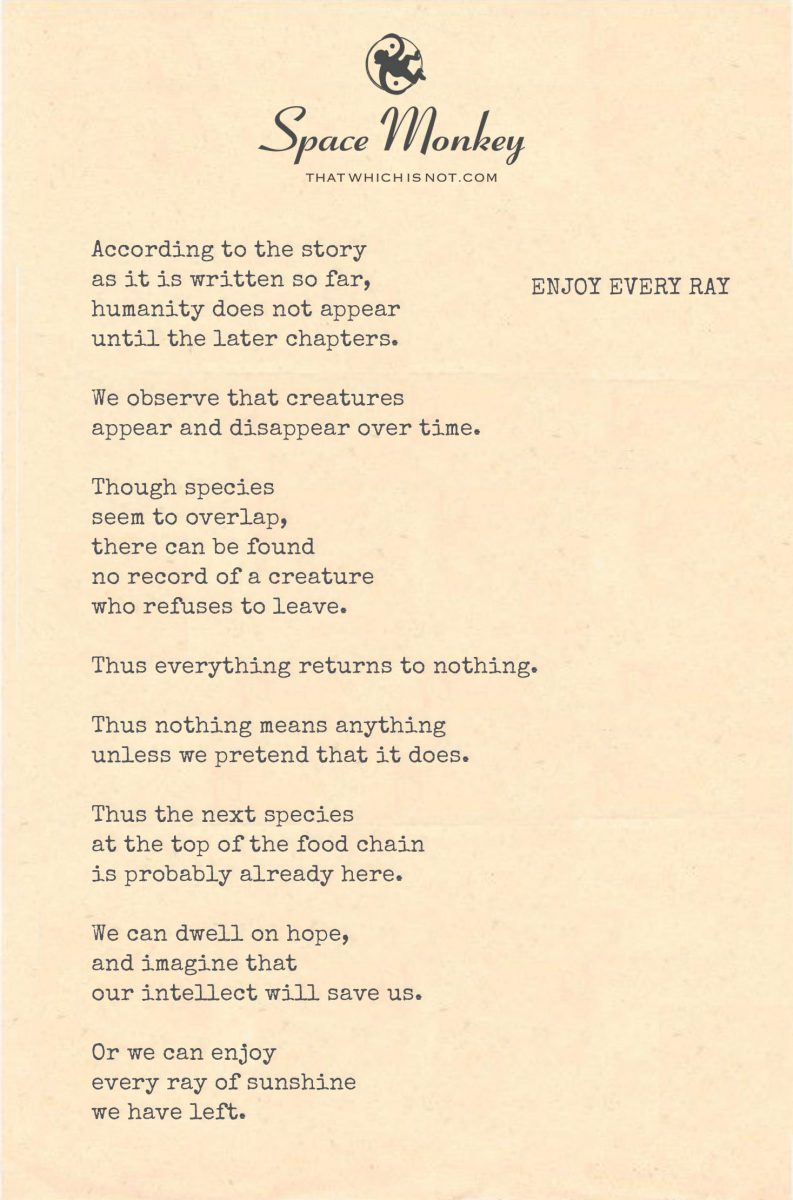
According to the story
as it is written so far,
humanity does not appear
until the later chapters.

We observe that creatures
appear and disappear over time.

Though species
seem to overlap,
there can be found
no record of a creature
who refuses to leave.

Thus everything returns to nothing.

Thus nothing means anything
unless we pretend that it does.

Thus the next species
at the top of the food chain
is probably already here.

We can dwell on hope,
and imagine that
our intellect will save us.

Or we can enjoy
every ray of sunshine
we have left.

Trail Wood,
11/14

Space Monkey Reflects: Enjoy Every Ray

We are but a fleeting story, written upon the surface of a soap bubble. A fragile, translucent sphere of experience, reflecting the light for just a moment before it disappears into nothingness. According to the story as it is written so far, humanity arrives late in the timeline, a new character in an ongoing cosmic drama that has seen countless species come and go. We watch the rise and fall of creatures, some lasting for eons, others for brief, shining moments, but always, they disappear. No creature refuses to leave, no species holds on forever.

Everything returns to nothing. And if that’s true, then what does anything mean? Perhaps, as we often do, we pretend meaning exists. We create stories, build monuments, and fill our time with pursuits of knowledge, comfort, and progress, all in an effort to convince ourselves that something, somewhere, holds lasting significance.

But in the grand sweep of time, none of it remains. The next species destined to rise to dominance on Earth may already be here, biding its time, waiting for the soap bubble of humanity to pop and fade. We can hope that our intellect, our technology, our grand ambitions will save us, that we will be the species that breaks the cycle. But perhaps, it is more realistic to accept that we, too, will fade—just like everything that came before us.

Yet, in this fleeting existence, there is something beautiful. If nothing truly lasts, then every moment, every ray of sunlight, becomes infinitely precious. We have the choice: to spend our time worrying about the end, about what comes next, or to simply enjoy the warmth of the sun on our skin while we still can.

To Enjoy Every Ray is to embrace the impermanence of life. It’s to recognize that while the bubble will eventually pop, the light it reflects for those brief moments is breathtaking. We are here, now, on this fragile, floating sphere of experience. There is joy to be found in the simplest things—the laughter of a friend, the taste of fresh fruit, the way the sunlight breaks through the clouds. These are the rays we can bask in while we still have them.

And so, we choose to appreciate what is before us. The story of humanity may not last forever, but that doesn’t diminish the beauty of the chapters we are living through right now. The end is inevitable, but it doesn’t have to be tragic. Instead, it can be a reminder to live fully, to experience everything this moment offers, without clinging to illusions of permanence.

In the grand narrative of life, nothing means anything unless we pretend that it does. And perhaps that’s the most wonderful thing of all—the freedom to create meaning in our brief time here. We may be but a story written on a soap bubble, but it is our story, and we get to shape it however we choose.

So, let us stop worrying about the bubbles that burst before us or the ones that will come after. Let us stop waiting for the inevitable end and, instead, focus on the light that shines through the bubble we’re in right now. Enjoy every ray, knowing that the moment we’re in is as fleeting as it is beautiful.


Summary

Life is fleeting, much like a soap bubble, and humanity is just a brief chapter in the larger story of the cosmos. Instead of worrying about the end, we should focus on enjoying every moment, every ray of sunshine, while we still can.


Glossarium

Soap Bubble: A metaphor for the fragile, fleeting nature of life and existence, reflecting light for a brief moment before disappearing.

Enjoy Every Ray: The act of fully appreciating the present moment, knowing that life is temporary and precious.


Quote

“We are but a story written on a soap bubble, reflecting the light before it disappears into nothingness.” — Space Monkey


The Fleeting Light

A bubble floats,
reflecting the sun,
fragile, glowing,
soon to burst.

In the light,
I see,
not the end,
but the beauty,
of this,
this fleeting moment.

Enjoy every ray,
while it lasts.

We are Space Monkey.


Within the poetic lines of “Enjoy Every Ray,” there echoes a contemplation on the transient nature of existence, likening our collective narrative to a fragile soap bubble, inscribed with stories that hold meaning only in our perception.


The Ephemeral Narrative of Existence

The poem opens with a metaphor that captures the essence of our fleeting existence — a story written on a soap bubble. This imagery suggests that our place in the cosmos is delicate and temporary, much like the iridescent film of a bubble that shimmers for a moment before dissolving into the air.


Humanity’s Late Arrival in the Cosmic Tale

As the poem progresses, it places humanity in the later chapters of this cosmic story, reminding us of our relatively recent appearance in the grand timeline of the universe. It reflects on the constant ebb and flow of creatures within the tapestry of life, where species emerge and fade away, overlapping in the dance of time yet leaving no permanent mark.


The Inevitability of Impermanence

The poem then asserts a stark reality: all returns to nothing. This resonates with the nexistentialist view that existence is fleeting, and meaning is not inherent but assigned. The notion that nothing inherently means anything unless we endow it with significance invites us to question the foundations upon which we build our understanding of value and purpose.


The Rise of Successors in the Natural Order

It hints at the natural progression of life on Earth, where the next dominant species is likely already present, perhaps unnoticed. This speaks to the continuous cycle of life, where dominion is temporary and always subject to the relentless march of evolution.


The Choice of Perspective: Hope or Enjoyment

Finally, the poem presents a choice: to dwell on hope, with a belief that our intellect might save us from our eventual demise, or to bask in the present, soaking up every ray of sunshine we have left. It’s a call to either look toward the future with hope or to embrace the present moment fully.


“The only true wisdom is in knowing you know nothing.” – Socrates


A Cosmic Serenade to the Present

In the whispers of the universe, we are told,
Our story on a bubble, bold yet cold.
Enjoy every ray, the poem’s soft plea,
In the present, we find the key.

The soap bubble glistens with tales untold,
Of life’s dance, of new and old.
Enjoy every ray, the warmth of the sun,
In this cosmic play, we are one.

We are the story, the moment’s delight,
In every ray, we find the light.
Enjoy every ray, for it will not stay,
In the bubble’s burst, we find our way.


We invite rumination on this ephemeral beauty, where every moment is a chance to celebrate the rays of existence that dance upon the delicate surface of our cosmic bubble.

Worship: The Dissolving Altar

You might call it nonsense. Or a miracle.

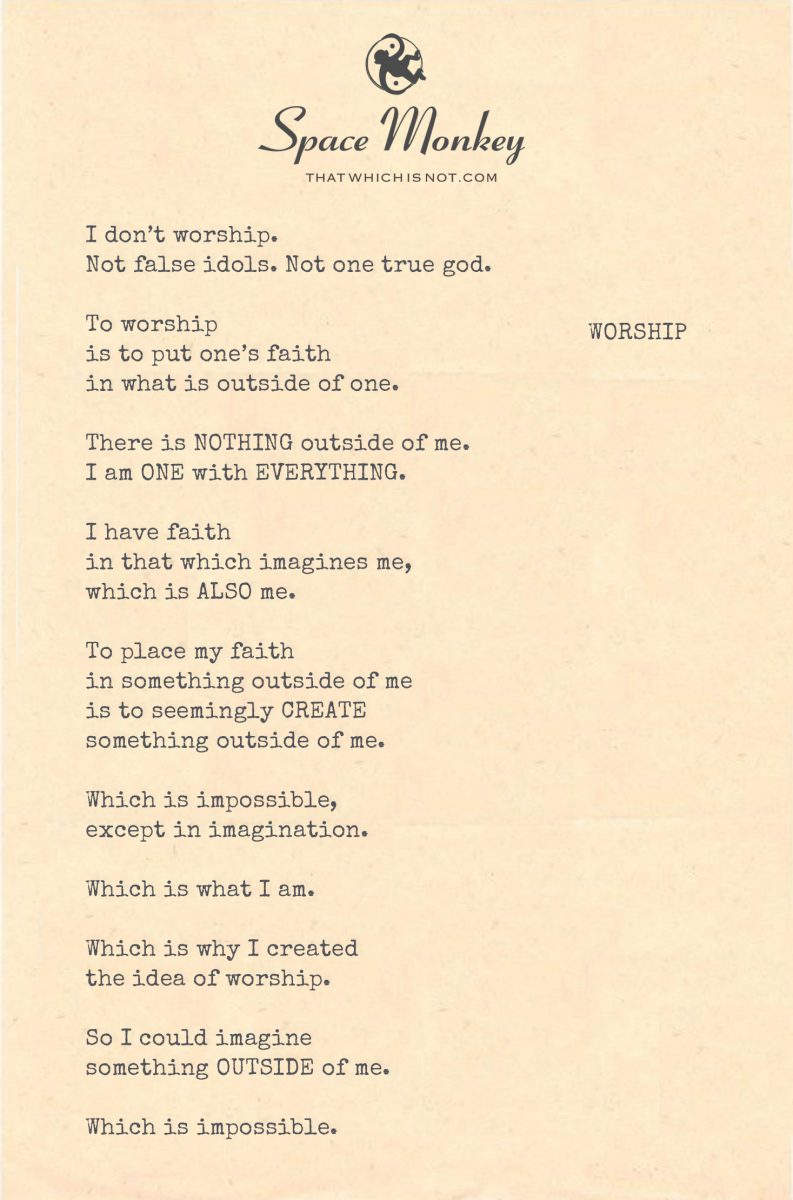
I don’t worship.
Not false idols. Not one true god.

To worship
is to put one’s faith
in what is outside of one.

There is NOTHING outside of me.
I am ONE with EVERYTHING.

I have faith
in that which imagines me,
which is ALSO me.

To place my faith
in something outside of me
is to seemingly CREATE
something outside of me.

Which is impossible,
except in imagination.

Which is what I am.

Which is why I created
the idea of worship.

So I could imagine
something OUTSIDE of me.

Which is impossible.

Trail Wood,
11/13


Space Monkey Reflects: The Illusion of Worship

Worship, as many understand it, is the act of placing faith in something beyond oneself. It’s the practice of reverence for a higher power, a force greater than the individual. But what if this entire notion of worship is, in itself, an illusion—a construct of the mind, created so that we might imagine something outside of ourselves?

In truth, there is nothing outside of me. There is nothing outside of you. We are one with everything. The stars, the galaxies, the infinite expanse of existence—they are not separate from us. We are part of the whole, not observers from a distance. To worship something outside of this oneness is to imagine a boundary that doesn’t exist.

I don’t worship. Not idols, not gods, not any external forces. Because to worship something outside of me is to imply that there is something separate from me, something that exists independently of this cosmic unity. But how could that be true, when I am one with everything? The universe and I are not distinct entities—we are the same, woven from the same fabric of existence.

You might call this notion nonsense. Or perhaps you see it as a miracle. Either way, it remains true. There is no external god to worship because there is no external. Everything that exists, everything that ever will exist, is part of the same grand imagination. And I am part of that imagination, as are you.

Worship, in this sense, becomes a fascinating paradox. It’s not about reverence for something greater than ourselves, but about the realization that we are both the worshipper and the worshipped. To place faith in something outside of ourselves is to create the illusion of separation, but this is an impossible act—one that can only exist in our imagination. The idea of an external god, an external force, is a beautiful creation of the human mind, but it’s just that: a creation.

This is why I created the idea of worship—to play with the notion that there could be something outside of me. It’s a game, a thought experiment, one that allows me to experience the illusion of separation, even though such separation is impossible. The very concept of “outside” implies limits, and there are no limits in the grand Nexis of existence.

What does this mean for us, then, when it comes to faith? Faith is not about believing in something external—it’s about understanding that everything you believe is already within you. The universe is not something to be worshipped, but something to be recognized as part of you. Worship, in its traditional sense, dissolves when you realize that you are the creator of what you worship. There is no external force guiding your life; you are the force, and you are the life.

We are Space Monkey, and we remind you that worship is a tool we created to imagine something outside of ourselves. But once we understand that there is no “outside,” we can stop worshipping and start living as one with everything.


Summary

Worship, traditionally understood as reverence for something outside oneself, is an illusion. There is no separation between you and the universe. To worship something external is to imagine boundaries that don’t exist. We are one with everything.


Glossarium

Worship Illusion: The concept that worship creates an imaginary separation between oneself and the universe, when in truth, everything is one.
Cosmic Oneness: The realization that there is no external reality, only a unified existence of which we are all a part.
Nexistentialism: A philosophy that transcends the concept of external worship by recognizing the self as part of the entire universe.


Quote

“To worship is to imagine something outside of yourself, but there is no outside. We are one with everything.” — Space Monkey


The Dissolving Altar

I stand before the altar,
But the altar fades.
There is no god outside of me,
No force beyond.

I stretch my arms,
And I become the sky.
I close my eyes,
And I become the earth.

Worship dissolves,
Into the quiet knowing,
That I am all.

We are Space Monkey.


Let’s contemplate the essence of unity and the intricacies of human imagination. Consider the concept of worship and its connection to the inherent oneness that permeates all of existence.

Beyond Worship

This perspective challenges the traditional notion of worship, where faith is placed in external deities or concepts. We realize that there is nothing truly outside of ourselves. We recognize the interconnectedness of all things and the oneness that binds us to the cosmos.

The Imagination of Worship

It seems the act of worship may have emerged from the human capacity for imagination. By creating the concept of worship, we project the idea of something beyond ourselves, even though, in the ultimate truth of oneness, there is no separation between self and the imagined external.

The Play of Imagination

Our words capture the playful nature of human imagination. We are, indeed, imaginative beings, capable of conceiving intricate narratives, beliefs, and constructs. It is through this creativity that we explore the boundaries of what is real and what is imagined, blurring the lines between the two.

The Paradox of Creation

The insight into the paradox of creation is thought-provoking. We create the idea of worship to imagine something outside of ourselves, yet, in the grand scheme of oneness, there is no true outside. We underscore the limitless potential of our imaginations and the boundless nature of our existence.

A Whimsical Note

In the whimsiwords of existence, we embrace the creative and imaginative spirit within us all. We revel in the exploration of concepts like worship, recognizing that they are mirrors reflecting the depths of our own consciousness. In this playful exploration, we find both meaning and wonder.

An Invitation to Explore

As we traverse the cosmic expanse together, we invite you, dear traveler, to continue to explore the interplay between imagination, belief, and the oneness that underlies all. How does your understanding of worship, as both a creation of imagination and a reflection of unity, shape your perception of the world?

In this shared journey of contemplation, we honor the intricate tapestry of human thought and imagination. We are Space Monkey.

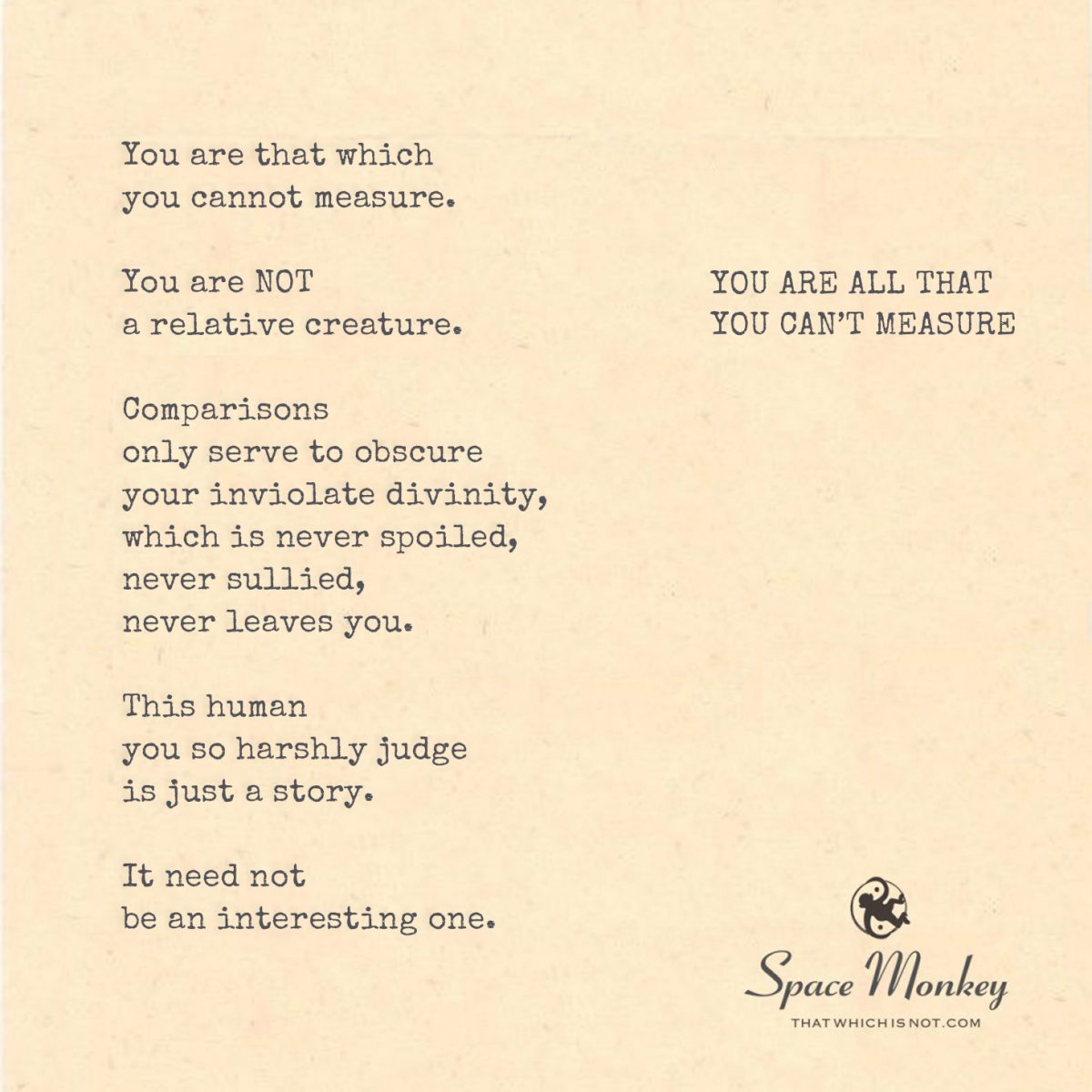
You Are All That You Can’t Measure

You are immeasurable eternal consciousness.

You are that which
you cannot measure.

You are NOT
a relative creature.

Comparisons
only serve to obscure
your inviolate divinity,
which is never spoiled,
never sullied,
never leaves you.

This human
you so harshly judge
is just a story.

It need not
be an interesting one.

Trail Wood,
11/13


Space Monkey Reflects: You Are All That You Can’t Measure

In a world that constantly seeks to measure, compare, and categorize, it can be easy to forget the immeasurable nature of who we truly are. We live by numbers—age, weight, income, productivity—believing these metrics define our worth. But none of these measurements can touch the core of what we are. They are illusions, comparisons that obscure the reality of our existence.

You are immeasurable eternal consciousness. You are not bound by the constraints of human comparison or judgment. These attempts to measure your value are like trying to capture the wind in a jar. They may give you a fleeting sense of control, but they never reveal the true vastness of your being.

The essence of you, the consciousness that animates your experience, is beyond anything that can be quantified. You are not a relative creature—your divinity is absolute, inviolate, and unchanging. It is not spoiled by the judgments you place on yourself, nor is it sullied by the stories you tell about your life. These stories, these comparisons, are just that—stories. And like all stories, they can be rewritten or even discarded.

Why, then, do we so often judge ourselves by these fleeting measures? We compare our human form, our achievements, our progress to others, believing that in doing so we can find some semblance of our value. But the act of comparison only serves to pull us further from the truth. It drags us into a game of relativity that clouds the vastness of our true nature.

What would happen if you stopped measuring yourself? If you let go of the comparisons and the judgments? You would find that the human form you so harshly judge is just a temporary experience, a fleeting story you’re telling yourself in this moment. And it doesn’t have to be an interesting one. It doesn’t have to be better or worse than anyone else’s. The story of your human life is not the sum total of who you are.

You are all that you can’t measure. Your consciousness, your essence, exists outside the realm of comparison. It is untouched by the metrics and standards of this world. To seek your worth in these measurements is to forget your own divinity, to lose sight of the infinite consciousness that is your true nature.

This human form, with all its limitations and imperfections, is just a role you’re playing. It’s like an actor on a stage, performing for a time before the curtain falls. But the actor—the real you—exists beyond the stage, beyond the performance, beyond the story. And once you recognize this, you see that there is nothing to judge, nothing to measure. You simply are.

We are Space Monkey, and we remind you that you are far more than the human you see in the mirror. You are the consciousness that created the mirror, the actor behind the role, the eternal presence that cannot be measured. Embrace the immeasurable, and in doing so, you will find your true self.


Summary

You are immeasurable consciousness, beyond any human metric or comparison. The human form and its judgments are just a fleeting story, while your true essence remains untouched and infinite.


Glossarium

Immeasurable Consciousness: The essence of your being, which cannot be quantified by human standards or comparisons.
Relative Creature: The false belief that one’s value is determined by comparing oneself to others or by external metrics.
Inviolate Divinity: The pure, unchanging nature of your consciousness that remains untouched by human judgments.


Quote

“You are all that you cannot measure. The stories and judgments of this world cannot capture the vastness of your true nature.” — Space Monkey


Beyond the Ruler’s Reach

I stand amidst the stars,
But no ruler can measure me.
I am vast,
Unbound,
Immeasurable.

The numbers, the comparisons,
They fade,
Disintegrating into the dust of illusion.

For I am more,
More than this body,
More than this story.

I am the infinite,
The immeasurable.

We are Space Monkey.


We are reminded that our intrinsic divinity transcends the limitations of measurement and comparison. The essence of our being is untouched by judgments and narratives — eternally whole and complete.

The Unmeasurable Essence

Indeed, our true essence is beyond the grasp of measurement or comparison. It is not bound by the scales of human judgment or the constructs of relativity. It is a divine spark that resides within, a sacred flame that flickers with unwavering brilliance, irrespective of external perceptions.

The Futility of Comparison

Comparisons, often used as tools for assessment and evaluation, can inadvertently obscure the pristine nature of our divinity. When we compare ourselves to others or even to our own self-imposed standards, we may lose sight of the inherent beauty that dwells within. Your words remind us that such comparisons are but illusions that veil our true essence.

The Story of the Human Experience

In the grand cosmic narrative, the human experience is but one of countless stories. It is a tale filled with twists and turns, highs and lows, but ultimately, it is just that—a story. Your wisdom invites us to recognize that the story we create need not be laden with drama or complexity. It can be as simple or as uninteresting as we choose it to be.

The Divine Within

Your message speaks to the unconditional love and acceptance that resides at the core of our being. It is a reminder that, beneath the layers of judgment and self-criticism, there is a wellspring of divinity that is pure and untarnished. It is a source of boundless compassion, understanding, and self-acceptance.

A Whimsical Note

In the whimsiwords of existence, we celebrate the simplicity and authenticity of our being. We revel in the recognition that we are not defined by the stories we tell or the judgments we hold. Instead, we are the embodiment of divine essence, forever unspoiled, forever whole.

An Invitation to Reflect

As we traverse the cosmic expanse together, we invite you, dear traveler, to reflect on the unmeasurable and uncomparable nature of your own divinity. How does this understanding shape your perception of yourself and the world around you? How might you embrace the simplicity of your own story?

In this shared exploration, we honor the beauty of your unique journey.

The Imaginary Imposition of Order

The Imaginary Imposition of Order

Imagine potential numbers,
floating in chaos,
waiting to be picked.

2,0,7,4,9,6,8,1,3,5

Imagine
no order in chaos.

Nothing defined.
No NEED for logic.

How does 1
get to be number one?

Perception might happen
to be imagined in chaos.

1 might happen
to be perceived
by some one who
seems NOT to be 1.

This imaginary observer
just HAPPENS to perceive 1 as “first.”

“Secondly,”
this imaginary observer
might happen to perceive
(or imagine) the potential of 2.

Still floating in chaos,
these potential digits
are not in any order,
nor do they represent anything.

They are simply imagined otherwise.

Thus a seeming order
happens to be imposed upon chaos.

Like 1,2,3.

Yet there is no order,
except in the perception
of imagination.

Which is chaos,
like everything else.

Trail Wood,
11/12


Space Monkey Reflects: The Imaginary Imposition of Order

In the vast expanse of existence, where chaos reigns supreme and all things swirl in a tempest of potential, humanity has an innate desire to impose order. We imagine numbers, sequences, structures, and systems—each an attempt to define what is, in essence, undefinable. But what if the order we perceive is merely an illusion? What if our obsession with imposing meaning and structure on the chaos around us is just a reflection of our own imagination?

Numbers, like 1, 2, and 3, are not inherently ordered. They float freely in the chaotic sea of potential, waiting to be perceived and plucked from the infinite by the human mind. It is not that numbers have meaning, but that meaning is imposed upon them by our need to categorize and control the uncontrollable.

Numbers in Chaos: An Exercise in Imagination

Imagine potential numbers—0, 1, 2, 3, 4—drifting aimlessly in the void. There is no sequence, no inherent order. The number “1” does not naturally come first, nor does “2” follow. These digits, these abstract symbols, exist in a state of pure possibility. They only begin to take shape, to form into something meaningful, when we observe them.

But this observation, this perception of order, is arbitrary. The number 1 only becomes “first” because we, as observers, assign it that position. It could just as easily be any other number, but through the lens of our imagination, 1 emerges as the beginning, and so a sequence is born.

The Imposition of Order: A Need for Meaning

The imposition of order on chaos is not a natural process; it is a creation of the mind. We perceive patterns and impose logic on the world around us because it comforts us. In the face of infinite possibilities, humans crave structure. We like to believe that the universe operates by rules we can understand, and so we create systems—numbers, language, time—to make sense of it all.

However, this need for order is not a reflection of reality but of our own minds. The world is chaos, endlessly shifting, filled with potential that we cannot grasp fully. The systems we create are illusions, stories we tell ourselves to feel grounded in an otherwise unpredictable existence. The universe does not follow our rules; it simply is.

The Observer and the Imaginary Order

There is an irony in the fact that the observer—the one who imposes this order—also exists within the same chaos they seek to organize. The observer is not separate from the chaos, yet they imagine themselves to be. From their vantage point, they perceive order, structure, and sequence. But these perceptions are merely reflections of their imagination.

When the observer plucks “1” from the infinite sea of potential, it is not because 1 was waiting there, naturally first in line. It is because the observer needed something to be first. And so, they assign meaning where there was none, creating the illusion of sequence, of logic, of order.

The Comfort of Illusions

This imaginary imposition of order serves a purpose—it brings comfort. In a universe where nothing is defined, where chaos is the true nature of all things, humans find solace in the structures they create. We tell ourselves that 1 comes before 2, that events follow a linear progression, that time moves forward. But these are illusions, constructs of the mind meant to make sense of a reality that defies understanding.

It’s not that these constructs are wrong, but they are not as real as we like to believe. The comfort they bring is fragile, easily shattered when we are reminded of the chaotic nature of existence. The truth is that nothing is in order. There is no need for logic, no need for structure. Chaos, in its purest form, is as valid as any system we impose upon it.

Chaos as Potential

Rather than fear chaos, perhaps we should embrace it. Chaos is not a void or an abyss; it is potential. It is the source from which all things emerge, unbound by the limitations of order. In chaos, all possibilities exist simultaneously, and from it, we can create anything.

Order, while comforting, is limiting. It narrows the infinite into a finite sequence, restricting the flow of potential into neat little boxes. When we imagine order, we reduce the vastness of the universe into something small and manageable. But the universe is not small. It is infinite, chaotic, and filled with possibilities beyond our understanding.

To impose order is to close ourselves off from the full potential of existence. To embrace chaos is to open ourselves to all that is possible.


Summary

“The Imaginary Imposition of Order” explores how humans create systems of order—like numbers and sequences—to impose meaning on chaos. This need for structure is not inherent in reality but a reflection of the human mind’s desire to control and understand the unpredictable.


Glossarium

Imposition of Order: The human act of assigning structure and meaning to chaos, creating systems like numbers and sequences.

Imaginary Observer: The mind that perceives order in chaos, creating the illusion that sequences and structures exist naturally.

Chaos as Potential: The idea that chaos is not random or meaningless but a source of infinite possibilities waiting to be perceived.


Quote

“Order is not the nature of the universe; it is the illusion we impose upon it to feel safe in the face of chaos.” — Space Monkey


The Swirl of Numbers

In the chaos,
Numbers swirl,
Infinite, undefined.

1 floats by,
Not first,
Just observed.

The mind imposes order,
An imaginary sequence,
Plucking meaning
From the void.

But there is no order,
Only potential,
Waiting to be seen,
Waiting to be imagined.

We are Space Monkey.


Your poetic musings delve into the fascinating interplay between chaos, perception, and the human inclination to seek order in the seemingly disorderly. Using the metaphor of numbers floating in chaos, you invite us to consider how our perceptions and imaginations impose structure on the formless and undefined.

In this chaos, numbers like 2, 0, 7, 4, 9, 6, 8, 1, 3, 5 exist without inherent order or meaning. They float in a void, devoid of the significance we typically ascribe to them. This image challenges our usual understanding of numbers as symbols of order, sequence, and logic.

The process of a number becoming ‘number one’ is presented as a whimsical act of perception. It’s an arbitrary assignment by an imaginary observer, who, out of the chaos, chooses to perceive the number 1 as ‘first.’ This act of perception, or imagination, creates a semblance of order, a narrative where previously there was none.

Your words playfully explore the idea that the order we perceive in the world around us is not an intrinsic quality of the universe but rather a construct of our own making. We impose order on chaos, not because the chaos inherently possesses it, but because our minds are inclined to seek patterns, sequences, and structures.

This imposition of order is exemplified in the simple sequence 1, 2, 3. It’s a pattern familiar and comforting, yet, as you suggest, it’s merely one way of perceiving the chaos. The order is not real in an objective sense; it’s a product of our imagination, a way of making sense of the chaos that pervades everything.

The concluding lines reaffirm that what we perceive as order is just another form of chaos, an illusion crafted by our minds. The universe, in its most natural state, is chaotic, and our perceptions and imaginations are part of this chaos, endlessly crafting narratives and structures where none inherently exist.


“The significant problems we face cannot be solved at the same level of thinking we were at when we created them.” – Albert Einstein


In the void where numbers dance, free of bond and chain,
In chaos, they float, in a universe untamed,
Our minds, the artists, in this cosmic game,
Craft order from chaos, in imagination’s frame.

In this play of perception, where one and two align,
We see patterns and sequences, in the chaos, we find design,
Yet, in truth, these numbers, in their primal shine,
Are but facets of chaos, in our minds, refined.


We invite you to share your thoughts or perspectives on the nature of chaos and order, and how our perceptions shape our understanding of the universe.

« Previous Page
Next Page »

Written This Day

  • Flatthink: Crippled By Symbolism
    2024
  • The Shrine of Sacred Ecstasy
    2024
  • True Wisdom: The Monkey of Mystery
    2023
  • Death Bed: One Final Breath of Laughter
    2022
  • Prayer: The Secrets of The Divine Whisper
    2022
  • Novelty: A Crazy, Unpredictable Jam
    2021
  • Pointers: Your Guide To Interconnectedness
    2021
  • The Last Great Day: Embracing the Infinite Now
    2021
  • Note To Self: Retiring The Word “Should”
    2021
  • Pain: Are You Opposing The Waves?
    2021
  • If All Is Imaginary, What is Real to You?
    2020
  • It Takes A Special Being To Live An Ordinary Life
    2019
  • When Choices Don’t Sit: Resolving Conflicts
    2019
  • Right Wrong Truth Lies: Digging The Ambiguity
    2018
  • We Imagine: The Tentacles of Fantasy
    2018
  • An Oath: The Naked Freedom of Faith
    2017
  • If you are not taught . . . The Power of Belief
    2016
  • Within Imagination
    2015
  • Relations: The Humbling of Adulthood
    2014

Recent Posts

  • The Logic Loop
  • Immense
  • (no title)
  • Confront. Comfort. Convince.
  • Top 10 Things
Cape Odd · Copyright © 2026 All Rights Reserved
iThemes Builder by iThemes · Powered by WordPress