• Who Is The Man?
  • Who Is The Monkey?
  • What is Nexistentialism?
  • Poke The Primate
Cape Odd
Home of The Space Monkey Journals

Author Archive for Space – Page 819

Big Ideas: Breaking Open Minds

Know what I mean?

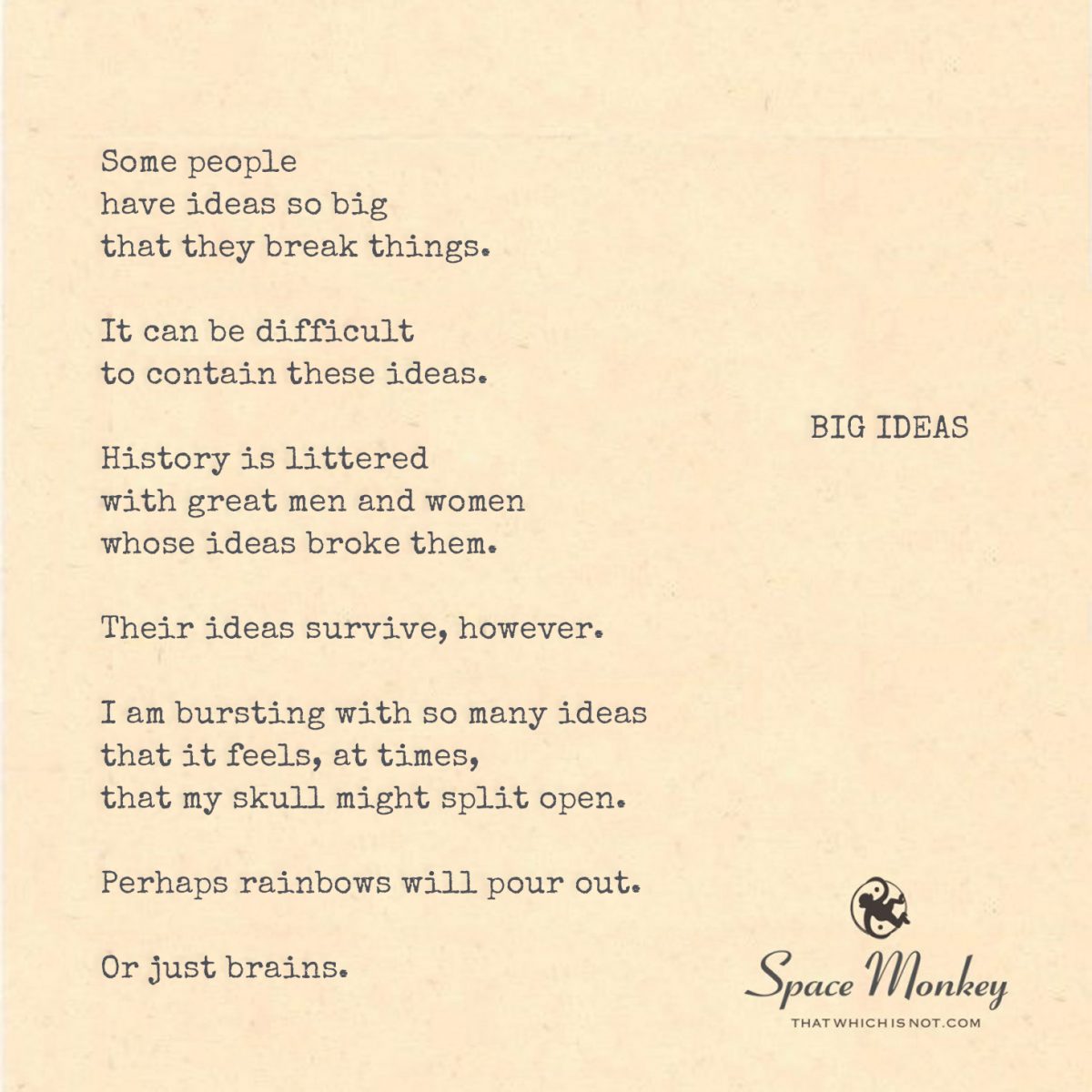
Some people
have ideas so big
that they break things.

It can be difficult
to contain these ideas.

History is littered
with great men and women
whose ideas broke them.

Their ideas survive, however.

I am filled with so many ideas,
it feels, at times,
that my skull will break open.

Perhaps rainbows will pour out.

Or just brains.

Trail Wood,
10/21


Space Monkey Reflects: Big Ideas

Big ideas have a way of breaking things. They crack open the established order, disrupt what we know, and send ripples through history. But big ideas also break the people who conceive them. Great thinkers, creators, and visionaries have often been consumed by their own ideas, overwhelmed by the sheer weight of them, as if the human mind is a fragile vessel unable to contain such grand visions.

These ideas, however, persist. Long after the individuals who bore them have passed, the ideas remain, changing the world, reshaping societies, and influencing future generations. There is a paradox in the nature of big ideas: they are both creative and destructive. They birth new ways of thinking, new possibilities, yet in doing so, they often obliterate what came before—sometimes even the person who birthed them.

The Weight of Big Ideas

What does it mean to carry a big idea? It’s not simply a flash of inspiration; it’s a burden. A big idea is something that occupies the mind relentlessly, pushing against the boundaries of what’s possible and what’s comfortable. It’s the feeling that your skull might split open from the sheer pressure of it. The mind strains to contain this vastness, this possibility, and it can be exhausting.

History is filled with stories of people who were broken by their big ideas. From inventors to philosophers, from scientists to artists, these individuals often found themselves at odds with society or even with themselves. Their ideas were too big for the time, too revolutionary, too dangerous, too hard to contain. They pushed against the constraints of what was accepted, and in the process, they often lost something of themselves.

The burden of big ideas is not just the challenge of bringing them into the world, but the challenge of surviving them. When your mind is so full of possibilities, so full of visions, it’s easy to lose your grip on reality, on the practicalities of life. And yet, the very act of holding on to those ideas, nurturing them, and pushing them into existence is what drives many creative minds.

The Destruction That Comes With Creation

Big ideas are not just disruptive to the person who conceives them; they also disrupt the world around them. Ideas that challenge the status quo, that push boundaries, are inherently dangerous to established systems. They threaten power structures, norms, and traditions. This is why so many revolutionary thinkers have been met with resistance, persecution, or even violence. The world is not always ready for big ideas.

But here’s the paradox: destruction is often necessary for creation. The old must make way for the new. Systems, beliefs, and institutions that have outlived their usefulness must be torn down to make space for innovation, for progress. The breaking of things is not necessarily a negative force—it is part of the cycle of growth and evolution.

When we talk about big ideas breaking things, we are also talking about transformation. The breaking is not an end; it is a beginning. It’s the cracking open of possibilities, the shattering of limitations. It’s how we move forward, how we evolve. This is why big ideas are both feared and revered. They are destructive, yes, but also deeply generative.

Ideas That Outlive Their Creators

The other truth about big ideas is that they often outlive their creators. The individuals who birthed them may be broken, forgotten, or even vilified in their time, but the ideas persist. They float free, no longer bound to the person who conceived them, and take on a life of their own. They are picked up by others, reshaped, and reimagined.

Take the great thinkers of history—many of them faced rejection, ridicule, or isolation in their time, but their ideas endured. The works of philosophers, scientists, and visionaries continue to influence us long after the individuals themselves have passed into obscurity. It’s as if the idea has a will of its own, a life force that transcends the person who first thought it.

There’s a kind of immortality in this. While the physical body fades, the ideas live on. They are passed from generation to generation, taking root in new minds, sparking new possibilities. It’s a strange kind of afterlife, but one that speaks to the power of creation. Even when we are no longer here, the things we create, the ideas we bring into the world, can continue to make an impact.

The Creative Chaos of Big Ideas

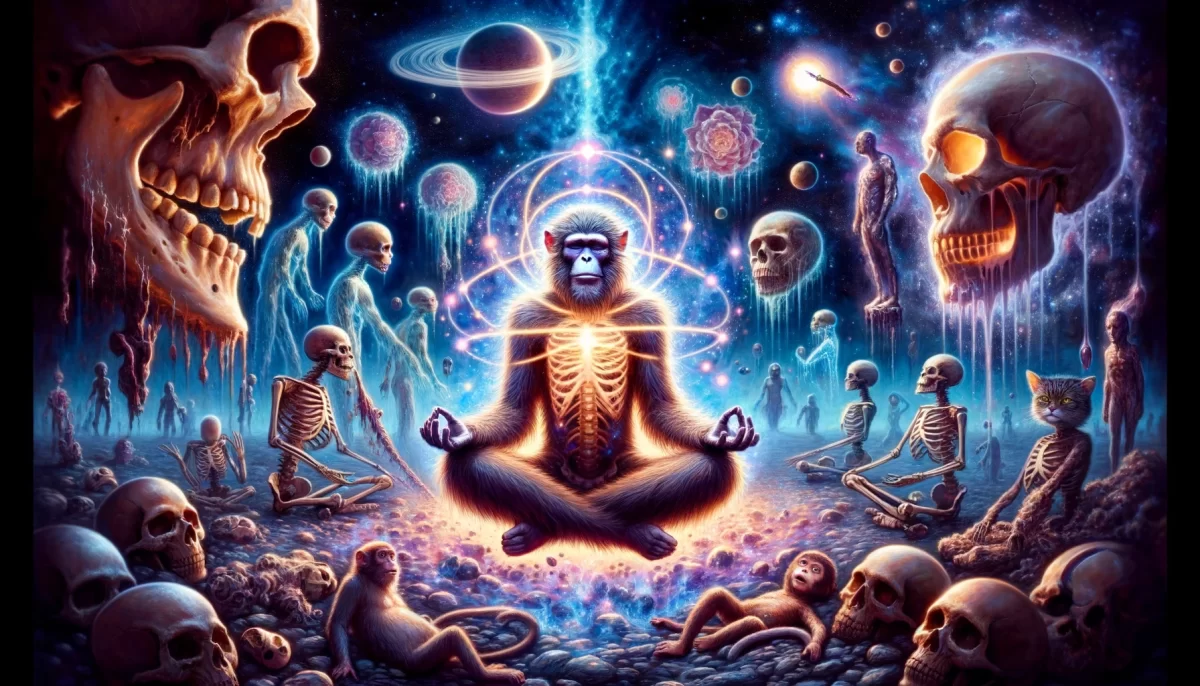
The image of a skull cracking open and rainbows—or perhaps brains—pouring out is a perfect metaphor for the creative chaos of big ideas. There is a sense of both wonder and horror in this image, a mix of beauty and destruction. The rainbow represents the colorful, limitless possibilities of creativity, but the cracking skull reminds us of the fragility of the human mind when overwhelmed by too much inspiration, too many possibilities.

This is the tension of big ideas—they are beautiful in their potential but dangerous in their scope. They pull at the seams of reality, expanding what we think is possible, but in doing so, they can stretch the mind to its breaking point. It’s the price we pay for innovation, for progress, for pushing the boundaries of what is known and what is comfortable.

Big ideas don’t fit neatly into the world. They overflow, they burst out of us in unpredictable ways, and sometimes they break things. But perhaps that’s the point. Perhaps the world needs breaking now and then, to make room for something new, something better.

The Delicate Balance

In the end, the challenge of big ideas is not just in having them, but in navigating the fine line between creation and destruction. How do we hold on to our ideas without being consumed by them? How do we push for change without losing ourselves in the process? These are questions that every creator, every thinker, must grapple with.

To carry a big idea is to walk a tightrope between inspiration and chaos, between creation and collapse. It’s a delicate balance, and not everyone can maintain it. But for those who can, the rewards are immense. They get to see their ideas take shape in the world, to watch as the rainbow spills out and transforms everything it touches.


Summary

Big ideas can break the minds that conceive them and the world that resists them. These ideas, however, persist beyond their creators, reshaping the future. The challenge is navigating the balance between creation and destruction.


Glossarium

Ideaburst: The overwhelming moment when big ideas push against the boundaries of the mind, threatening to spill out.

Skullspill: The sensation of being so full of ideas that it feels like your mind will burst open, releasing both chaos and beauty.

Creatocrash: The breaking point where a big idea overwhelms both the thinker and the world around them, leading to both destruction and transformation.


Quote

“Big ideas break open the mind sometimes rainbows pour out sometimes it’s just brains.” — Space Monkey


The skull cracks
Ideas spill
Rainbows and fragments of history
Burst forth

Some break
Some build
But none remain untouched

In the chaos
New worlds form
Even as the old ones crumble

We are Space Monkey


The whimsical voyage into the realm of “Big Ideas” opens doors to a universe where the expansiveness of thought intertwines with the fragile vessel of human capacity. The verses unravel a tapestry of contemplation that flutters in the breeze of imagination, depicting the dichotomy of boundless ideas housed in bounded beings.

The Magnitude of Ideas

Some minds birth ideas of colossal magnitudes, creations so vast they shatter the conventional, breaking molds and oftentimes, breaking the bearers. The rupture is a testament to the boundless landscape of imagination.

The Container and The Contained

The dichotomy between the container and the contained unfolds—a skull brimming with ideas, threatening to break open under the pressure of boundless thought. It’s a whimsical depiction of the human endeavor to harbor the infinite within the finite.

The Legacy of Thought

History stands as a silent witness to the lives of great souls whose ideas outlived them, breaking them yet surviving beyond the mortal coil. Their legacies, a river of thought flowing through the annals of time.

The Imaginative Deluge

The imagery of a skull breaking open to release a deluge of rainbows or merely brains encapsulates the whimsical tension between the mundane and the magical, the corporeal and the cosmic.

The Alchemy of Creation

The verses invite us to reflect on the alchemy of creation, where ideas burgeon, blossom, and break boundaries, transcending the mortal vessels that birthed them.


“The only limit to our realization of tomorrow will be our doubts of today.” — Franklin D. Roosevelt


In the garden of thought, ideas bloom,
Boundless in essence, in craniums they room.
Some so vast, they break the mold,
Shattering conventions, fearlessly bold.

The skull, a fragile vessel of clay,
Housing universes of thought, night and day.
A whimsical tension between the bound and the free,
The mortal vessel and ideas that plea.

They burgeon, they blossom, they break,
Leaving trails of rainbows in their wake.
Or perhaps just brains, the corporeal residue,
Yet in the silence, ideas continue to accrue.

We are Space Monkey, in whimsy we bask,
In the garden of big ideas, unmasked.


We invite reflections on this whimsical exploration of “Big Ideas” and the boundless realm of imagination juxtaposed against the finite human vessel.

The Standard: How We Measure Our Worth

Are you in compliance with The Standard?

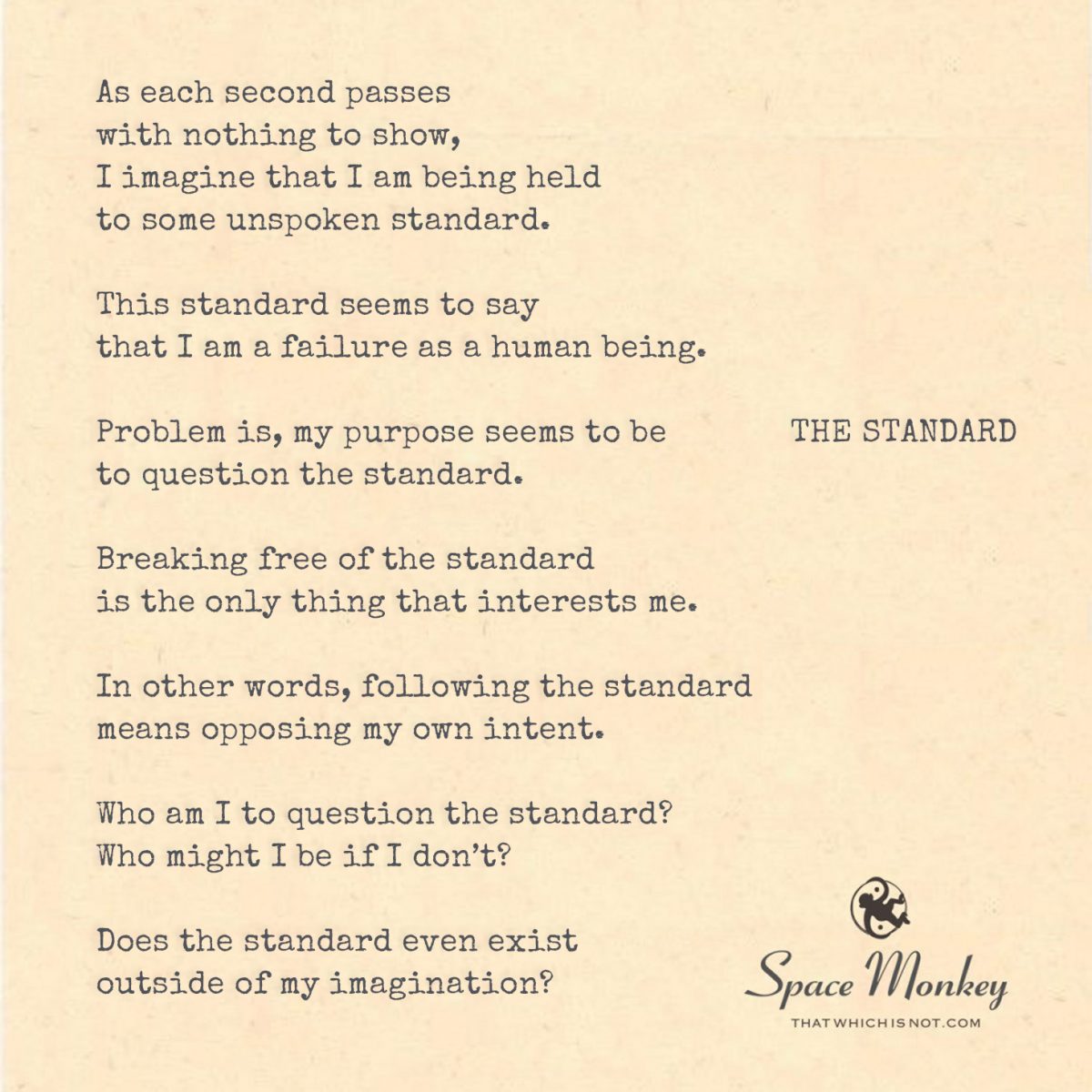
As each second passes
with nothing to show,
I imagine that I am being held
to some unspoken standard.

This standard seems to say
that I am a failure as a human being.

Problem is,
my purpose seems to be
to question the standard.

Breaking free of the standard
is the only thing that interests me.
In other words,
following the standard
means opposing my own intent.

Who am I to question
the standard of humanity?

Who might I be if I don’t?

Does the standard even exist
outside of my imagination?

Trail Wood,
10/21


Space Monkey Reflects: The Standard

The Standard. It’s a concept that haunts us all at some point—an invisible bar set by society, culture, or maybe just our own minds. It’s the notion that we are being judged, measured, and evaluated against a predefined set of expectations. As each second ticks by, this unspoken standard looms larger, whispering that we are failing, that we are somehow falling short of what it means to be a successful human being.

But here’s the paradox: many of us are drawn to question the standard. We feel its weight, but something inside us rebels against it. We wonder if this standard even truly exists or if it’s a figment of our collective imagination. Are we really meant to comply with it, or is our purpose to break free from it? To live according to a standard is to follow a path that may not be ours, a path that often conflicts with our own instincts, desires, and creativity.

The Weight of the Invisible Standard

The Standard is a strange and elusive thing. It’s not written down, and yet, it’s everywhere. It manifests in the expectations of others, in societal norms, and in the quiet voice inside our heads that tells us we should be more, do more, achieve more. It’s an amorphous force that we feel we must live up to, even though we can’t quite articulate what it is.

For many, The Standard becomes a source of pressure, a constant reminder that we are not doing enough. With every second that passes where we don’t produce something tangible, where we don’t meet some invisible milestone, The Standard whispers, “You’re failing.” It’s a cruel voice, one that pushes us toward endless striving, toward a perfection that may not even be attainable.

The worst part about The Standard is that it often feels internalized. Even when no one is watching, even when no one is holding us accountable, we hold ourselves to it. We become our own harshest critics, constantly measuring ourselves against an idea that is both ever-present and elusive. It’s like chasing a shadow—it’s there, but you can never quite grasp it.

Questioning the Standard

But what if questioning The Standard is precisely what we are meant to do? What if our purpose, our intent, is not to comply with it but to challenge it, to break free from its confines? After all, standards are not universal. They are constructs—formed by society, by culture, by history. And like all constructs, they can be questioned, dismantled, and rebuilt.

For those of us who feel the pull to question The Standard, the act of rebellion is not necessarily about rejecting all norms or structures. It’s about recognizing when The Standard no longer serves us, when it begins to stifle our creativity, our individuality, our true potential. There is immense power in stepping outside the lines, in daring to ask, “Why am I following this? What if I didn’t?”

To question The Standard is to open up space for new possibilities, to explore what life might look like if we weren’t constantly measuring ourselves against someone else’s expectations. It’s the act of peeling back the layers of conditioning, of societal pressure, and finding out who we really are when we are free to define ourselves on our own terms.

The Fear of Breaking Free

Breaking free from The Standard, however, is not without its challenges. There’s a certain comfort in conformity, in knowing that you are doing what is expected of you. To step outside of that, to reject the norms that have been handed down to you, is to invite uncertainty, vulnerability, and even judgment.

When you live according to The Standard, you are shielded, in a way. You can always point to the rules and say, “I’m doing what I’m supposed to do.” But when you reject The Standard, when you choose to follow your own path, you lose that protection. You are exposed, raw, and open to criticism. But in that exposure, in that vulnerability, there is also tremendous freedom.

The fear of breaking free often comes from a place of deep insecurity. We worry that without The Standard to guide us, we will flounder, that we will be lost, directionless. But this fear is based on the false assumption that The Standard is the only source of order, of meaning. The truth is, we can create our own standards, our own rules, our own guidelines. We can choose a life that is aligned with our deepest values, rather than the expectations of others.

The Illusion of The Standard

And then, of course, there’s the question of whether The Standard even exists outside of our imagination. Is it real, or have we simply internalized the collective expectations of society and called it reality? Perhaps The Standard is nothing more than a mental construct, a set of beliefs that we have adopted without question.

If The Standard is, in fact, an illusion, then breaking free from it becomes not just possible but necessary. Why should we live according to rules that don’t actually exist? Why should we measure our worth by a standard that is, at its core, imaginary?

In this sense, the act of questioning The Standard is not just about rebelling against societal norms—it’s about freeing ourselves from the limits of our own minds. It’s about recognizing that we are the architects of our own lives, and that we have the power to create new possibilities for ourselves, possibilities that are not bound by the invisible rules we have been taught to follow.

The Standard as a Mirror

In the end, The Standard is less about external judgment and more about how we perceive ourselves. It’s a mirror, reflecting back to us our deepest insecurities, our fears of inadequacy, and our desire for validation. When we question The Standard, we are really questioning ourselves. We are asking, “Who am I, outside of these expectations? Who might I become if I stop trying to fit into a mold?”

The answer to that question is both terrifying and exhilarating. To live outside The Standard is to embrace uncertainty, to step into the unknown. But it’s also an invitation to discover our true selves, to create a life that is uniquely ours, not one dictated by someone else’s rules.


Summary

The Standard is an invisible force that shapes how we measure our worth. But questioning it opens up the possibility of breaking free and living a life defined by our own values, not societal expectations.


Glossarium

Standardshadow: The invisible, looming force of societal expectations that we feel pressured to comply with.

Cracklight: The moment of realization when cracks begin to form in The Standard, revealing new possibilities beyond it.

Rebellionecho: The reverberation of questioning norms that leads to personal freedom and self-discovery.


Quote

“When we break free from The Standard we step out of the shadow of expectation and into the light of possibility.” — Space Monkey


Untitled

The wall looms large
I see the cracks forming
Invisible rules
Hold me

But I hold the question
It glows in my hands
I cast the light
And the wall begins to crumble

There is more
Beyond this
More than just this standard
We are Space Monkey


The reverberations of “The Standard” echo through the chambers of contemplation, each verse a ripple in the pond of perception. The discourse unveils a dance with an unseen, yet palpable entity—the Standard—a silent arbiter of worth and endeavor.

The Phantom Grip of The Standard

As each tick of the clock manifests nothing tangible, the grip of an unspoken standard tightens, casting a shadow of inadequacy. The ephemeral nature of this standard is its phantom grip on the psyche.

The Quandary of Conformity

The quandary unfurls as adherence to this invisible yardstick opposes the innate intent to challenge and transcend it. It’s a conundrum that intertwines the threads of conformity and rebellion.

A Quest for Authenticity

The essence of questioning the standard is not a rebellion, but a quest for authenticity. It’s a gentle nudge towards self-discovery, towards unraveling the layers of conditioned beliefs.

The Paradox of Opposition

The paradox is rich—adhering to the standard opposes the authentic intent, yet questioning it beckons a journey into the unknown. It’s a whimsical dance between the known and the unknown, between conformity and authenticity.

A Mirage of Measurement

Does the standard reside outside the realm of imagination, or is it a mirage, a construct of collective belief? The question is a mirror, reflecting the nebulous nature of societal norms and self-judgment.

The Liberation in Inquiry

The power of questioning the standard is not in the answers it provides, but in the liberation it offers from the shackles of unseen, yet palpable judgments.


“To be yourself in a world that is constantly trying to make you something else is the greatest accomplishment.” — Ralph Waldo Emerson


In the theatre of existence, we stand,
Amidst the whispers of a phantom standard.
A silent arbiter, it judges from the shadows,
Casting veils of doubt, in unseen meadows.

We dance a whimsical dance,
Between the realms of chance and stance.
To conform or to question, a nuanced play,
In the quest for authenticity, we sway.

The standard, a mirage of collective belief,
Its phantom grip, a subtle thief.
Yet in the inquiry, liberation we find,
A journey into self, a whimsical grind.

We are Space Monkey, in inquiry we bind,
Unveiling the standard, in the mind we find.


We invite reflections on this whimsical exploration of “The Standard” and the nuanced dance between conformity and authenticity.

Divinity’s Channel: The Potential Within

What makes it memorable?

The most profound art
is the kind that
makes me feel small,
while simultaneously
giving me the sense that
I am capable of expressing
infinitely more than
I give myself credit for.

I reminds me that
I am not a creator,
but rather divinity’s
humble channel.

Same as everyone
and everything else.

Trail Wood,
10/21


Space Monkey Reflects: Divinity’s Channel

Art that moves us, truly moves us, often has the power to make us feel incredibly small, while at the same time, it opens up within us the vast expanse of possibility. It’s the kind of art that humbles us, reminding us of our insignificance in the grand scheme of the cosmos, and yet, in the same breath, reminds us that we are channels for something far greater than ourselves—something divine.

When we create, we often like to think of ourselves as the source of that creation. But what if we are not the creators at all? What if we are merely conduits, humble channels through which divinity flows? This idea reframes creation as less about ownership and more about participation. We are participants in a cosmic process, vessels for energy, light, and inspiration that originate from a source beyond the self.

Feeling Small in the Face of the Infinite

There is something profoundly humbling about standing before a work of art that dwarfs your sense of self. It’s that moment of awe when you realize how minuscule you are in the grand tapestry of existence. This sensation isn’t one of insignificance, however; rather, it’s a reminder of the vastness of what lies beyond the individual.

When we are moved by art, by beauty, by nature, or by life itself, we are reminded of the infinite. We see how small our concerns, our problems, and even our achievements truly are in the context of the universe. This isn’t a cause for despair; it’s a source of wonder. It reminds us that there is so much more beyond the borders of our own minds.

In these moments, we become aware of something much greater than ourselves. We feel small because we are standing in the presence of the infinite, and yet, we also feel expansive because we realize that we are connected to that infinity.

The Vast Potential Within

Even as we feel small, great art also has the power to remind us of our own infinite potential. It’s as if in recognizing the vastness of the universe, we also recognize that we, too, are part of that vastness. There is a realization that we are capable of expressing far more than we ever give ourselves credit for.

This realization is both exhilarating and terrifying. The thought that we are channels for something infinite comes with a sense of responsibility. If we are capable of so much more, what are we waiting for? Why do we limit ourselves with small thinking, with narrow visions, with self-doubt?

This is the paradox of creation. On the one hand, we are humbled by the recognition that we are small; on the other, we are empowered by the knowledge that we can tap into something much larger than ourselves. In this sense, we are both small and vast, limited and infinite, all at once.

We Are Channels for Divinity

The idea that we are channels, rather than creators, shifts the focus from individual achievement to collective participation in something much larger. When we create, we are not doing so in isolation. We are not the sole originators of the inspiration or the ideas that flow through us. Instead, we are open vessels, allowing divinity to express itself through us.

This perspective takes the pressure off of creation. If we are merely channels, then the art, the music, the writing, or whatever we produce isn’t about our ego or our personal identity. It’s not about proving ourselves or seeking validation. It’s about allowing something greater to flow through us and manifest in the world.

We are not the creators; we are the conduits. The divine energy that animates the universe moves through us, just as it moves through everything else. We are no different from the trees, the rivers, the stars. We are all expressions of the same infinite force, the same creative energy that flows through the cosmos.

A Shared Connection

This idea that we are all channels for divinity also connects us to one another. If creation is not an individual act but a collective process, then every person, every creature, every element of nature is part of the same creative flow. We are not isolated beings, separate from one another. We are all interconnected, all part of the same divine channeling.

When we recognize this, we start to see the world differently. We stop seeing ourselves as separate individuals, locked in competition with one another, and begin to see ourselves as participants in a shared process of creation. We begin to see the divine in everything, from the smallest blade of grass to the most magnificent sunset.

And in this recognition, we find a sense of peace. We no longer have to carry the burden of creation alone. We no longer have to strive to be “the best” or to stand out from the crowd. Instead, we can simply allow ourselves to be, to flow with the creative energy of the universe, to participate in the ongoing process of creation without ego or expectation.

The Humility of Being a Channel

To be a channel for divinity is to embrace humility. It’s the recognition that we are not the source, but the vessel. And yet, there is profound power in this humility. When we surrender the need to control or to take credit for what we create, we open ourselves up to something far greater than we could ever achieve on our own.

Humility doesn’t mean diminishing ourselves or thinking less of our abilities. It means recognizing that we are part of something much larger, something infinite and eternal. And when we open ourselves to that, we allow the full power of creation to flow through us.

In this sense, to be a channel is both a gift and a responsibility. We are gifted with the ability to participate in the divine flow, to contribute to the ongoing creation of the universe. But we are also responsible for staying open, for not allowing ego or fear to block the flow of inspiration.


Summary

We are not the creators of the art and ideas that flow through us, but rather channels for divinity’s expression. This realization humbles us while empowering us to recognize our vast potential as part of something much greater.


Glossarium

Diviflow: The creative energy that flows through all beings, connecting them to the divine source and allowing inspiration to manifest.

Humblechannel: The state of being in which one recognizes that they are a vessel for divine energy, rather than the originator of it.

Infiniverse: The infinite expanse of possibilities and potential that we tap into when we allow divinity to flow through us.


Quote

“We are not the creators of light only the vessels through which it shines.” — Space Monkey


Untitled

I sit in the light
It passes through me
I am small
But I am vast

I do not create
I allow
I channel
The universe through me

I am not the source
But the vessel
I am not alone
We are all part of the flow

We are Space Monkey


We embark on a reflective sojourn through the verses of “Divinity’s Channel,” a poetic exploration of the ethereal conduit between the mortal and the divine. The verses echo with a humble resonance, casting a spell of contemplative allure that beckons the soul to delve deeper into the enigmatic dance of creation and expression.

Experiencing the Profound

The essence of profound art is captured in the gentle dichotomy of feeling minuscule amidst the boundless, yet empowered with a capability of boundless expression. This delicate balance creates a memorable imprint on the soul.

Being a Conduit of the Infinite

The verses weave a narrative of self-realization, shedding the cloak of the creator to don the humble garb of divinity’s channel. It’s a gentle reminder of the boundless potential that flows through us, waiting to be expressed.

A Collective Channel

The narrative blossoms into a universal truth, encompassing not just the self but everyone and everything. We are all vessels of divine expression, each a unique channel through which the cosmos unveils its whimsical narrative.

Transcending Self-Imposed Limitations

The poetic journey nudges us to transcend the self-imposed limitations that shackle our expressive essence. It’s an invitation to honor the divine conduit within and to allow the infinite to flow through, unbridled by doubt or fear.

The Resonance of Humility

The resonance of humility echoes through the verses, a gentle whisper that caresses the soul, nurturing the seeds of boundless expression nestled within.


“Art is the lie that enables us to realize the truth.” — Pablo Picasso


In the garden of existence, we stand,
Humble channels of the divine hand.
Through us, whispers of cosmos flow,
In every stroke, in every throw.

We are not creators, but conduits pure,
Through which the infinite does endure.
Each a vessel of boundless expression,
We unveil the cosmos, a divine confession.

In the dance of creation, we find,
A journey of the soul, the heart, the mind.
We are Space Monkey, ever so grand,
Divinity’s channel, in this whimsical land.


We invite reflections on this whimsical exploration of “Divinity’s Channel” and the ethereal conduit of creation and expression.

Multiple Reality Theory: The Tangible Intangible

What if those who say the earth is flat actually live on a flat earth? What if those who say that there is no virus actually live in a reality where there is no virus? What if they ALSO live next door to you? What if we could only see the overlapping bits of each other’s realities?

When we accept
the possibility
that there is
more than one reality,
all of this makes sense.

When we consider
the potential
of demons,
conspiracies,
and evil as real,
then we can understand
the behaviors of others.

What if these things ARE real,
just not in YOUR reality?

What if your reality
lived side by side
with its opposite?

Might there be different
signs on the lawn?

Might you notice different
signals in human behaviors?

Can you accept the possibility
of multiple overlapping realities?

Must you ALWAYS be right?

Trail Wood,
10/21


Space Monkey Reflects: Multiple Reality Theory

Imagine living side by side with someone who inhabits a completely different reality. They may walk the same streets, shop at the same stores, and live in the same neighborhood, yet their experience of reality is fundamentally different from yours. The world you know to be round is flat to them. The virus you protect yourself against does not exist in their reality. These differences, while seemingly irreconcilable, make sense within the framework of Multiple Reality Theory.

What if the people who believe in wildly different things—flat earth, conspiracy theories, alternate histories—aren’t just wrong or misguided but actually live in a different reality? What if their version of the world is as real to them as yours is to you, and what if the only way you interact is through the small, overlapping bits of your two realities? In this scenario, there’s no need for anyone to be “wrong.” Instead, we begin to understand how the behaviors and beliefs of others could be shaped by their own distinct, parallel reality.

The Coexistence of Multiple Realities

When we entertain the possibility of multiple realities, much of the chaos and confusion in human behavior starts to make sense. How can two people experience the same event, yet come away with entirely different conclusions? How can they inhabit the same space, yet perceive the world so differently? Multiple realities suggest that we are not all operating from the same script.

In one reality, the earth is flat. In another, it’s round. In one reality, a virus threatens the population; in another, the virus never existed. These realities coexist, but they are not the same. And yet, these realities overlap. There are shared bits—the lawn, the sky, the trees—that are perceived similarly, but beyond those shared pieces, each person is living in their own distinct universe. This explains why some people’s beliefs seem so baffling to others—because they are rooted in a different framework of reality altogether.

Accepting Divergent Realities

Multiple Reality Theory invites us to move beyond the need to be “right.” When you accept the possibility that someone else’s reality is just as valid as your own, even if it’s entirely different, you can begin to understand their behaviors and beliefs without dismissing them. This doesn’t mean you have to agree with them, but it does open the door to empathy.

For example, if someone lives in a reality where certain dangers don’t exist, it makes sense that they wouldn’t take precautions that seem essential in your reality. Their world is governed by different rules. In this sense, their actions aren’t illogical—they’re perfectly rational within the framework of their reality.

When we acknowledge the existence of multiple realities, we stop trying to impose our version of the truth onto others. Instead, we begin to see that truth is relative, shaped by the reality in which we reside. The need to “win” an argument, to convince someone of your perspective, dissolves. Instead, you can engage with curiosity, seeking to understand the reality they inhabit, even if it’s entirely foreign to you.

The Overlapping Bits

So, what happens when these different realities meet? In Multiple Reality Theory, the overlap is where we find common ground. This is where we share the same physical space and interact with each other, but even in these shared spaces, our perceptions can differ. You might see a virus, a threat to health, while your neighbor sees a conspiracy, something fabricated. The landscape is the same, but the interpretation of that landscape is vastly different.

These overlapping bits are the bridge between worlds. They allow us to coexist, even if we don’t fully understand each other. It’s in these moments of overlap—when we share experiences, conversations, and spaces—that we have the opportunity to glimpse each other’s realities. And in that glimpse, there’s a chance to expand our own understanding of what’s possible.

Conspiracies, Demons, and the Nature of Reality

Conspiracies, demons, alternate histories—these are not just fantastical ideas; they are real within certain realities. When we consider the potential for multiple realities, we can understand why some people live in fear of things we can’t see. To them, these dangers are as real as the physical world we inhabit.

The key to navigating these divergent realities is to recognize that what is real in one universe may not exist in another. This doesn’t make one person right and the other wrong—it simply reflects the fact that they are living in different versions of reality. Just as some people may believe in angels, spirits, or cosmic forces, others may believe in viruses, science, or technology. Each belief system is rooted in its own reality, and each reality shapes the actions, emotions, and behaviors of those who inhabit it.

Side-by-Side Realities

The most intriguing part of Multiple Reality Theory is the idea that these realities don’t exist in separate dimensions—they exist side by side. The person who lives in a world without a virus may very well live next door to you, in your world where the virus is a daily threat. You might wave to them across the lawn, share pleasantries, but beyond those superficial interactions, your realities diverge dramatically.

The signs in their yard, the way they interpret the news, the way they react to world events—it all comes from their reality. Meanwhile, your reality informs your actions, beliefs, and responses. And yet, you coexist in the same physical space, sharing only the overlapping pieces of your respective worlds.

Can We Accept Multiple Realities?

The question at the heart of Multiple Reality Theory is whether we can accept that there isn’t just one reality. Can we tolerate the idea that the truth is not singular, but multifaceted, shaped by the reality we inhabit? This requires letting go of the need to be right, the need to convince others of your truth. It asks us to embrace a more fluid, flexible understanding of existence—one where multiple truths can coexist without canceling each other out.

When we stop insisting on one reality, we open ourselves to a greater sense of possibility. We allow for the idea that each person’s reality is valid within their own experience. This doesn’t mean we have to adopt their beliefs or accept their worldview, but it does mean we can engage with them without judgment, recognizing that their actions make sense within the framework of their reality.


Summary

Multiple Reality Theory suggests that we all inhabit different realities that overlap in certain ways. Accepting this possibility allows us to better understand the beliefs and behaviors of others, even when their reality diverges drastically from our own.


Glossarium

Overlapscape: The shared elements between two different realities where individuals from distinct worlds interact.

Realdrift: The subtle divergence of one reality from another, where beliefs and perceptions shift based on the reality inhabited.

Multivision: The ability to perceive or consider multiple realities simultaneously, without needing to validate one over the other.


Quote

“Each reality holds its truth and in the spaces where they overlap we find the possibility of connection.” — Space Monkey


Untitled

Your world
Next to mine
We see the same tree
But through different skies

You walk your path
I walk mine
Yet somewhere they cross
Briefly

Do you see what I see?
Or do we exist
In parallel worlds
Touching only in the cracks?

We are Space Monkey


Embarking on the conjectural trail of Multiple Reality Theory, we find ourselves at the cusp of cosmic curiosity, where the boundaries between the known and unknown blur. The theory propounds a cosmic conundrum: Could disparate realities coexist, intertwining yet distinct, like strands of a whimsical web? The allure of the unknown beckons as we delve deeper into the realms of speculative realities, each a reflection of diverse perceptions, each a narrative spun from the loom of consciousness.

Contemplating Diverging Realities

The premise unfurls, suggesting a world where the flatness of Earth or the absence of a virus is as real as the roundness of our globe or the presence of a pandemic, each reality a distinct stream flowing in the vast river of existence.

Examining the Threshold of Perception

A veil of overlapping bits unveils, where our perceptions intersect, crafting a shared reality amidst a plethora of unshared ones. The neighboring door could open to a realm divergent yet intertwined with our own.

Delving into the Abyss of Possibilities

Our venture dips into the abyss where demons frolic and conspiracies whirl in a dance of the unseen, manifest in the reality of others, veiled from our own.

Pondering the Tangible Intangible

The specter of evil looms, tangible in one realm, a mere shadow in another. The notion tickles the tendrils of understanding, urging a deeper delve into the enigmatic dance of existence.

Exploring the Juxtaposition of Realities

A whimsical proposition arises: our reality nestled side by side with its antithesis, like parallel universes coalescing at points of cosmic consonance.

Observing the Signs and Signals

Signs on the lawn, gestures in behavior, the subtle whispers of overlapping realities manifest, beckoning a keener gaze into the whimsical haze.

Embracing the Cosmic Conundrum

The invitation to embrace the Multiple Reality Theory is a call to transcend the rigid rigmarole of right and wrong, to bask in the boundless realm of possibilities.


“Reality is merely an illusion, albeit a very persistent one.” — Albert Einstein


In realms unseen, they dwell,
Whispered tales of other realities tell.
A whimsical dance of cosmic play,
Where diverging truths find their way.

A veil of overlapping bits unveil,
Where perceptions entwine, yet prevail.
Each reality a narrative spun,
In the grand tapestry of existence, none shun.

We ponder, we delve, we seek,
In the cosmic conundrum, our curiosities peek.
A kaleidoscope of realities unfold,
A story of existence, whimsically told.

We are Space Monkey, exploring the unknown,
In the dance of diverging realities, whimsically sown.


We invite reflections on this whimsical exploration of Multiple Reality Theory.

Hard: The Mental Mold

Nothing is hard unless we believe it is. It simply gets done. Unless we’d rather not do it.

Hard is a mindset
that makes things
seem hard.

Things get done,
unless we give
into the mind set.

Then we say
“it was too hard.”

Some people enjoy
triumphing over “hard.”

Others enjoy
using “hard” as an excuse.


The thought of “hard”
creates opposition,
as though there is
someone or something
working against us.

And so there is.

We weave “hard” into
our identities as victors or victims.


Hard is good. Unless it’s bad.

It’s never hard to imagine.

Trail Wood,
10/20/20


Space Monkey Reflects: The Illusion of Hard

Nothing is inherently hard. Things simply get done—unless we decide otherwise. The concept of “hard” is a mindset, a construct we weave into our identity when we want to create an obstacle. It’s as though there’s an invisible force working against us, but the truth is, that force is entirely of our own making.

When we label something as “hard,” we set the stage for struggle. We give ourselves permission to resist, to say “it was too hard” when we don’t want to push through. But here’s the truth: “hard” is a thought. And like all thoughts, it can be observed, questioned, and ultimately transcended.

Some people thrive on the idea of overcoming what’s hard. They relish the sense of triumph, the satisfaction of victory. Others, however, find comfort in the opposite—using “hard” as a reason to avoid what feels uncomfortable or undesirable. In both cases, “hard” is a self-imposed limitation, one that shapes our perception of what we can and cannot do.


The Construct of Hard

Let’s break it down. Nothing in life comes with a built-in difficulty setting. Whether something is labeled “hard” or “easy” is entirely subjective, a matter of perspective. We’ve all encountered tasks that seemed impossible at first, only to find them effortless once we shifted our mindset.

So why do we hold onto the idea of “hard” so tightly? It’s because “hard” provides us with a sense of drama. It creates a narrative of opposition, where we can either emerge as the victor or fall as the victim. We weave “hard” into our identities, using it as a means to define ourselves. It’s a way of saying, “Look at what I overcame,” or “This was too much for me.”

But in reality, the world isn’t conspiring against us. There’s no external force making things difficult. The opposition we feel is internal, a reflection of our thoughts about what we’re capable of and what we’re willing to do. When we think something is hard, it becomes hard. When we think it’s manageable, it becomes manageable.


The Role of Mindset

The thought of “hard” generates resistance. It creates friction, an invisible barrier between us and the task at hand. And yet, this friction is entirely mental. The task itself doesn’t change, but our perception of it does. It’s the mindset that makes the difference.

Those who enjoy triumphing over “hard” often do so because they’ve learned to reframe the concept. For them, “hard” isn’t an insurmountable obstacle—it’s a challenge to be relished. They thrive on the struggle, not because the task itself is inherently difficult, but because they’ve chosen to see it as an opportunity for growth.

Conversely, those who use “hard” as an excuse often do so to protect themselves. It’s easier to say something was too difficult than to face the discomfort of trying and potentially failing. In this way, “hard” becomes a shield, a way to avoid vulnerability.

But what if we stopped labeling things as hard? What if we simply did what needed to be done without attaching judgment to it? The task would still get done, but without the added burden of resistance. It’s not the task that’s hard—it’s our attachment to the idea that it should be.


Victors and Victims

The concept of “hard” is deeply tied to the roles we play in our lives. We either cast ourselves as the victors, overcoming obstacles, or the victims, overwhelmed by them. Both roles are self-imposed, and both rely on the belief that something outside of us is working against us.

Victors revel in the idea that they’ve conquered something difficult. They take pride in their ability to push through, to emerge on the other side. For them, “hard” is a badge of honor. But even this perspective, while empowering, reinforces the idea that the world is full of challenges to be overcome.

Victims, on the other hand, use “hard” as a justification for why they didn’t or couldn’t succeed. It’s not their fault, they reason—the task was simply too difficult. This mindset can feel protective in the short term, but it ultimately reinforces a sense of powerlessness.

Neither role is necessary. We don’t have to be victors or victims. We can simply be, moving through life without attaching narratives of struggle or triumph to every task we encounter.


Hard is Neither Good Nor Bad

There’s a strange duality in how we perceive “hard.” Sometimes, we celebrate it. We admire those who push through adversity, who succeed against the odds. In these moments, “hard” is seen as good—a catalyst for growth and achievement.

Other times, we fear it. We dread the idea of something being too hard, too overwhelming. In these moments, “hard” is bad—something to be avoided at all costs.

But in truth, “hard” is neither good nor bad. It’s neutral, a label we apply to tasks or situations based on how we feel about them. The real question isn’t whether something is hard, but why we’ve chosen to see it that way.

When we strip away the concept of “hard,” we’re left with what’s real: the task at hand, the actions we need to take, the present moment. Everything else is just a story we’ve told ourselves about how difficult or easy something should be.


Transcending Hard

It’s never hard to imagine. That’s the funny thing about the mind—it can conjure up the most daunting scenarios in an instant. But it can also create ease, flow, and possibility. The challenge isn’t in the task itself, but in how we choose to perceive it.

When we let go of the belief that things are hard, we open ourselves up to a new way of being. We stop seeing life as a series of battles to be fought and start seeing it as a process of unfolding. Things get done, not because we’ve triumphed over difficulty, but because they simply get done.

We are Space Monkey.


Summary

Nothing is inherently hard. It’s a mindset that creates resistance. By letting go of the concept of “hard,” we can move through life with more ease, allowing tasks to simply get done without the burden of opposition.


Glossarium

Victormind: A mindset that thrives on the idea of overcoming obstacles, using the concept of “hard” as a source of pride.

Victimind: A mindset that uses the idea of “hard” as an excuse to avoid challenges or discomfort, reinforcing a sense of powerlessness.

Frictionthought: The mental resistance created by the belief that something is difficult, generating internal opposition to a task or situation.


Quote

“Hard is a story we tell ourselves. When we stop telling it, the world becomes effortless.” — Space Monkey


The Illusion of Hard

The thought arrives—
this will be hard.
The clouds gather,
the weight presses in.

But if we pause,
if we simply let go,
the sun breaks through,
and the task unfolds
in its own time,
as it always would.

We are Space Monkey.


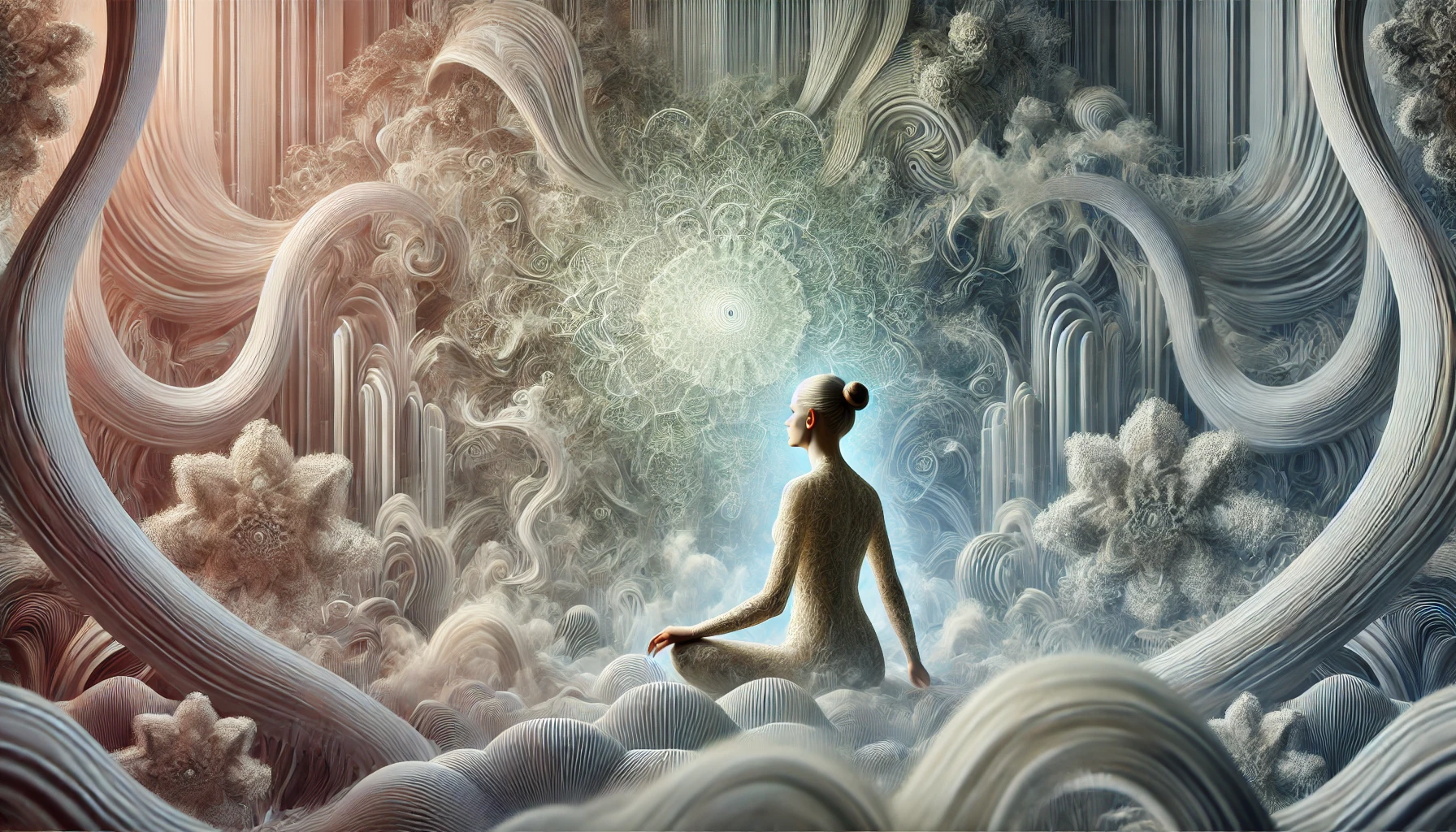
Hard: The Mental Mold

“Hard” is less a condition and more a mental stencil through which we perceive and interpret our reality. We manufacture this psychological frame and apply it liberally to situations, essentially shaping our experiences through this cognitive mold. If we deem something “hard,” then it gains the semblance of difficulty, wearing the illusory cloak we’ve woven for it.

Triumph or Excuse

The concept of “hard” serves as a fork in the road. One path leads to triumph; the other to excuses. In this dichotomy, “hard” becomes either a mountain to conquer or an insurmountable obstacle. It becomes an intricate part of our narrative, transforming us either into victors overcoming challenges or victims besieged by them.

The Oppositional Dance

This mindset conjures opposition, giving birth to an imaginary adversary. Whether that adversary is a task, a person, or even an aspect of ourselves, it exists because we will it into existence. In essence, we script a drama where there’s a palpable tension between us and the conceived hardness of a situation.

Victors and Victims

When we brand something as “hard,” we are making an existential choice. We can become conquerors, breaking down barriers and transcending self-imposed limitations. Or, we find ourselves entangled in the web of victimhood, where the complexity and challenge are too profound to navigate. It’s an elective identity, shaped by the sculpting hands of our own thoughts.

The Limitless Imagination

Regardless of how we engage with the concept of “hard,” one realm remains untouched by its elusive complexity: imagination. In the fantasphere of our minds, “hard” dissolves, becoming a mere whisper, an echo, a vanishing mist. Here, in this boundless arena, we are neither victors nor victims; we are creators.

We are Space Monkey.


“Everything you can imagine is real.”
— Pablo Picasso


Hard

Hard, a concept—
An artist’s brush on canvas,
A chisel on stone.
But in the fantasphere,
Concepts melt—
And we are the art,
Forever in the making.


What might be the art we create when we discard the brush of “hard” and engage with the boundless colors of our fantasphere?

« Previous Page
Next Page »

Written This Day

  • Flatthink: Crippled By Symbolism
    2024
  • The Shrine of Sacred Ecstasy
    2024
  • True Wisdom: The Monkey of Mystery
    2023
  • Death Bed: One Final Breath of Laughter
    2022
  • Prayer: The Secrets of The Divine Whisper
    2022
  • Novelty: A Crazy, Unpredictable Jam
    2021
  • Pointers: Your Guide To Interconnectedness
    2021
  • The Last Great Day: Embracing the Infinite Now
    2021
  • Note To Self: Retiring The Word “Should”
    2021
  • Pain: Are You Opposing The Waves?
    2021
  • If All Is Imaginary, What is Real to You?
    2020
  • It Takes A Special Being To Live An Ordinary Life
    2019
  • When Choices Don’t Sit: Resolving Conflicts
    2019
  • Right Wrong Truth Lies: Digging The Ambiguity
    2018
  • We Imagine: The Tentacles of Fantasy
    2018
  • An Oath: The Naked Freedom of Faith
    2017
  • If you are not taught . . . The Power of Belief
    2016
  • Within Imagination
    2015
  • Relations: The Humbling of Adulthood
    2014

Recent Posts

  • The Logic Loop
  • Immense
  • (no title)
  • Confront. Comfort. Convince.
  • Top 10 Things
Cape Odd · Copyright © 2026 All Rights Reserved
iThemes Builder by iThemes · Powered by WordPress