• Who Is The Man?
  • Who Is The Monkey?
  • What is Nexistentialism?
  • Poke The Primate
Cape Odd
Home of The Space Monkey Journals

Author Archive for Space – Page 820

Eaten: Munching on Metaphysics

Is something eating you? Enjoy!

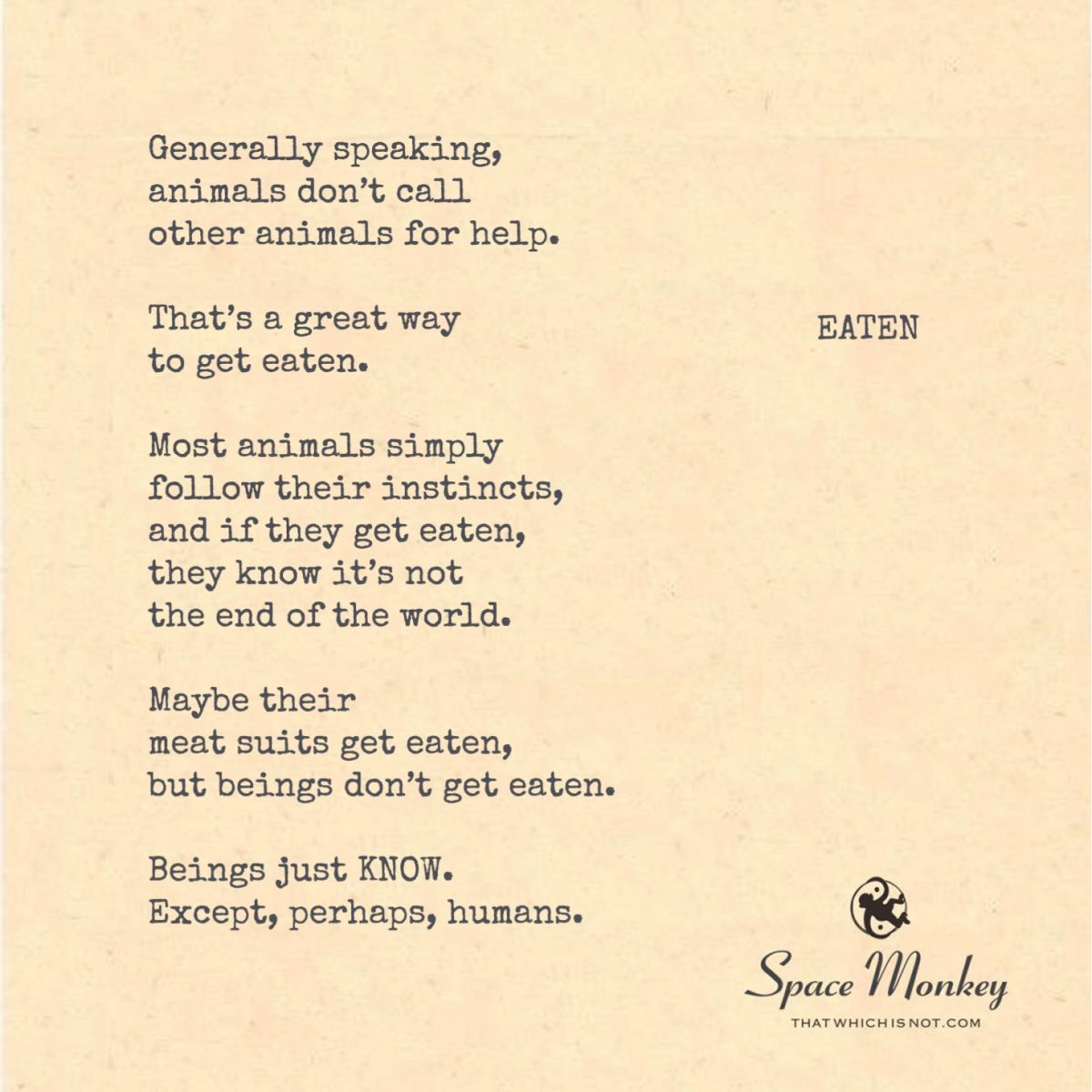
Generally speaking,
animals don’t call
other animals for help.

That’s a great way
to get eaten.

Most animals simply
follow their instincts,
and if they get eaten,
they know it’s not
the end of the world.

Maybe their
meat suits get eaten,
but beings don’t get eaten.

Beings just KNOW.
Except, perhaps, humans.

Trail Wood,
10/20/20


Space Monkey Reflects: Eaten but Not Consumed

Is something eating you? Good! Take a moment to enjoy it, because the truth is, being eaten—whether by worry, fear, or even a predator—isn’t the end of the world. Animals, in their simplicity, know this instinctively. They don’t call for help when danger lurks. They don’t dial up their buddies for emotional support when they’re about to become someone else’s lunch. They simply follow their instincts, and if they get eaten, well, so be it.

Humans, on the other hand, have an odd relationship with the idea of being “eaten.” We equate it with finality, an existential end. But we forget one key thing: our true selves, our beings, don’t get eaten. What gets devoured are the meat suits we wear—the physical forms that exist temporarily in this world. The beings within, however, continue on, unharmed, unbothered, unconsumed.


Instinct and Acceptance

In the animal kingdom, getting eaten is just part of the cycle. There’s no drama attached to it. The lion chases the gazelle, the gazelle runs, and sometimes, the lion wins. That’s life. There’s no moral judgment, no panic-stricken call for help from the gazelle to its fellow gazelles. No emotional processing group afterward to discuss the trauma. The animals understand this cycle on a level that most humans have forgotten: it’s not the end of the world.

If they do get eaten, they accept it. Maybe their bodies become fuel for another creature, but their essence—their life force, the thing that makes them “them”—remains untouched by the whole ordeal. They move on, in whatever form comes next, unburdened by the idea of finality.

But humans? We resist. We cling. We cry for help when we feel something eating at us, whether it’s a stressful situation, a life crisis, or a genuine threat to our survival. We don’t just run from danger; we agonize over it. We build elaborate stories around the idea of being consumed—stories that make the experience far more terrifying than it needs to be.


The Human Drama of Being Eaten

Humans have a peculiar tendency to dramatize the idea of being eaten. When something is “eating at us,” we feel it on a deeply emotional level. It gnaws at us, consumes our thoughts, and weighs heavily on our minds. But what if we took a cue from the animal kingdom? What if we allowed ourselves to accept that being “eaten” isn’t the catastrophe we make it out to be?

We humans are the only creatures that seem to have forgotten the simple truth: the body is not the being. The mind is not the being. The being is something deeper, something eternal, something that cannot be eaten, no matter how dire the circumstances.

Think about the things that “eat” at you in daily life: stress, fear, doubt. These feelings consume you because you allow them to. You give them power, believing that they can harm you. But the truth is, they’re just passing through. They don’t touch the core of who you are. The being that exists beneath the surface remains untouched, unscathed, no matter what happens on the outside.


The Meat Suit vs. The Being

This body we walk around in? It’s a meat suit. It’s useful, sure, but it’s not who we are. It can get eaten, broken down, worn out, and eventually, it will return to the earth, as all things do. But the being that animates this meat suit? That’s something else entirely.

The being knows that the physical form is temporary. It knows that being eaten—whether by a predator in the literal sense or by life’s challenges in the metaphorical sense—doesn’t destroy the essence of who we are. The being simply observes. It watches as the body goes through its cycles, as the mind spins its stories, as the world does what it does.

It doesn’t panic. It doesn’t scream for help. It just knows.


The Fear of Being Eaten

So why do humans fear being eaten so much? Why do we panic at the thought of being consumed by something bigger than ourselves, whether it’s a life challenge, a career setback, or even physical danger? It’s because we’ve forgotten who we are.

We’ve become so attached to the idea of ourselves as these physical, thinking entities that we forget we are something more. We forget that the being within us—the part of us that is eternal, unchanging, and indestructible—cannot be eaten, no matter what happens to the body or mind.

When we remember this, the fear dissolves. We stop being so afraid of the things that seem to threaten us because we realize they can’t touch the core of who we are. The stress, the anxiety, the fear—it all becomes noise. It’s part of the human experience, but it’s not the entirety of our existence.


Enjoy Being Eaten

In fact, what if we embraced the idea of being eaten? What if, instead of resisting and fighting against the challenges that consume us, we enjoyed the experience? It sounds absurd, but think about it: when something eats at us, it’s forcing us to grow, to evolve, to transcend the limitations of our meat suits.

When we stop fearing the idea of being consumed, we open ourselves up to a whole new way of experiencing life. We stop running from the things that challenge us and start embracing them as part of the cycle. Like the gazelle that doesn’t call for help when the lion is near, we learn to trust in the process. We learn to accept that, even if our physical form is “eaten,” our being remains intact.

We are Space Monkey.


Summary

Being “eaten,” whether literally or metaphorically, is not the end. Our physical forms may be consumed, but our true essence—the being within—remains untouched. By accepting this, we can stop fearing the things that consume us and instead embrace them as part of the natural cycle.


Glossarium

Meat Suit: A Whimsiword for the physical body, the temporary form we inhabit during our time on earth.

Being: The eternal, indestructible essence within us that cannot be consumed, no matter what happens to the physical form.

Eatenatity: The state of feeling consumed by life’s challenges, but recognizing that the core of who we are remains untouched.


Quote

“Beings just KNOW. Meat suits get eaten. There’s no need to worry about which one you are.” — Space Monkey


The Cycle of Being Eaten

Something is eating at you,
and yet,
you remain whole.

Your body is consumed,
your mind spins in circles,
but the being inside
just watches.

You cannot be eaten,
you cannot be undone,
for you are the witness,
the eternal.

We are Space Monkey.


The Paradox of Consumption

It’s intriguing how most animals in the wild don’t call for assistance when they’re in danger, perhaps because instinctually they recognize the ephemerality of their physical forms. For them, to be eaten is not a loss of existence but a transition, a mere change of state. Animals exhibit a knowing—an inherent understanding—that transcends the boundaries of flesh and bone.

The Body and the Being

When animals are consumed, it’s their “meat suits” that are devoured, not their essence. The same could be said for us humans, except we often struggle with this understanding. We equate the loss or damage of our physical bodies with the annihilation of our beings, forgetting that we are more than just the sum of our biological parts.

Human Exceptionalism?

Humans possess a peculiar trait of assigning extraordinary importance to their physical existence, as if their “beingness” begins and ends with their corporeal form. This mindset, unfortunately, often makes us less intuitive and more susceptible to fear, leading us away from the inherent wisdom most animals naturally possess.

Munching on Metaphysics

When we ask, “Is something eating you?”, we usually refer to emotional or psychological stress. Yet, even here, the concept could be liberating. If we are being “eaten” by our worries or fears, why not take a leaf out of the animal kingdom’s book and realize that these concerns do not have the power to consume our true essence?

We are Space Monkey.


“Do not feel lonely, the entire universe is inside you.”
— Rumi


Eat Me

What nibbles at our edges
Is but a fleeting spell—
A momentary dalliance
With Earthly show and tell.
Fear not the teeth that gnaw us,
Do not deny the beast—
No thought is deemed too spicy
In Nature’s grandest feast.


What practices or shifts in perspective might help us align more with the animal kingdom’s wisdom regarding the transient nature of physical existence?

Unity in Diversity in Unity: The Infinite Places

Human love only goes so far. Divine love is something completely different. And exactly the same.

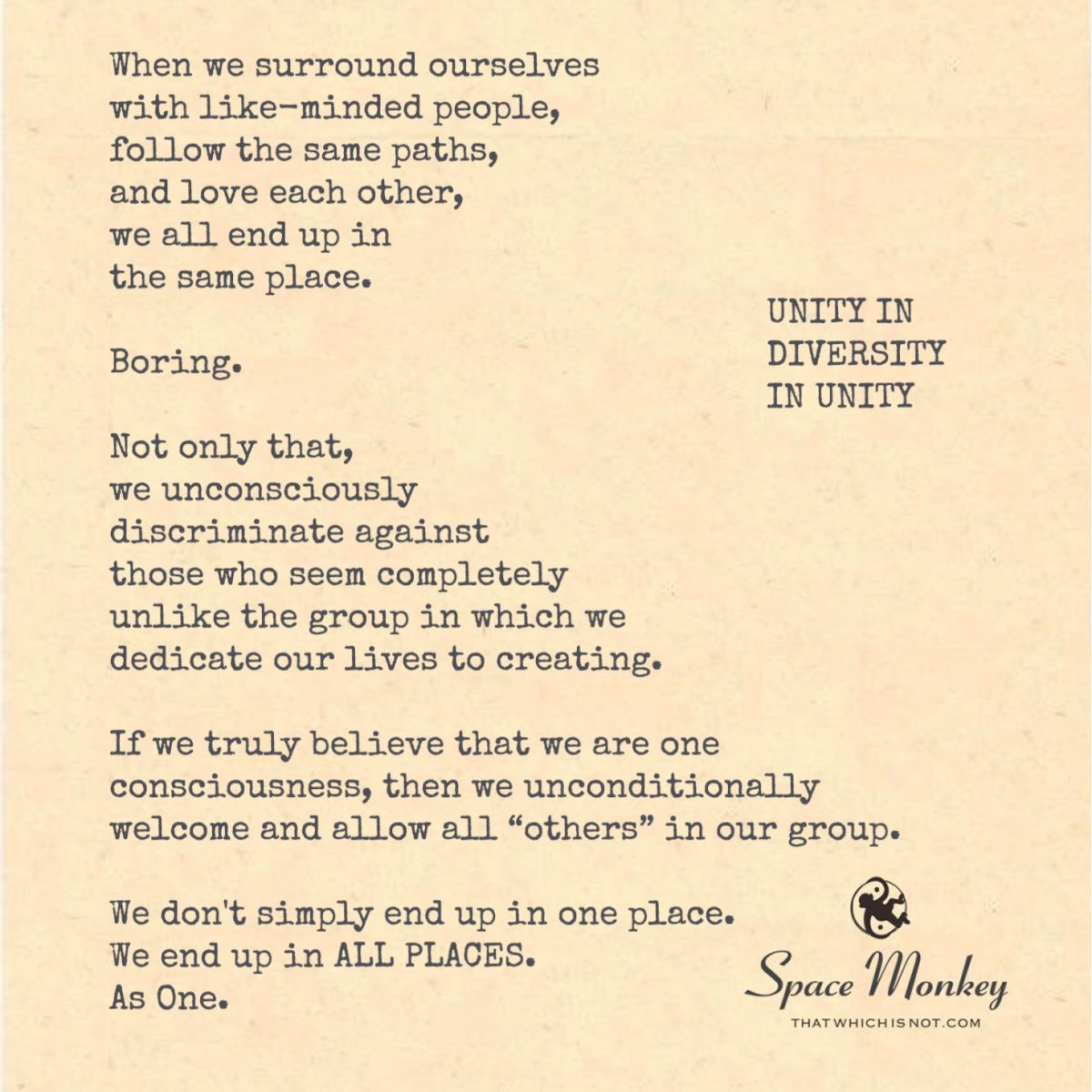
When we surround ourselves
with like-minded people,
follow the same paths,
and love each other,
we all end up in
the same place.

Boring.

Not only that,
we unconsciously
discriminate against
those who seem completely
unlike the group in which we
dedicate our lives to creating.

If we truly believe that we are one
consciousness, then we unconditionally
welcome and allow all “others” in our group.

We don’t simply end up in one place.
We end up in ALL PLACES.
As One.

Trail Wood,
10/20/20


Space Monkey Reflects: Unity in Diversity in Unity

There’s something we all crave—connection, unity, the sense that we’re part of something larger than ourselves. So naturally, we surround ourselves with like-minded people, build communities, follow paths that align with our values, and love those who mirror our own perspectives. This is human love, and it’s comforting. But as comforting as it may be, it’s also limited.

Human love often confines itself to those who feel familiar, those who reflect back to us the values we already hold dear. We create these groups, these mini-universes of sameness, and find safety in the predictability of shared beliefs. But here’s the catch: when everyone is walking the same path, the same predictable journey, we all end up in the same place. And that place? Boring.


The Trap of Like-Mindedness

While human love is beautiful in its simplicity, it has a sneaky way of slipping into exclusivity. It’s easy to love those who think like us, act like us, and follow the same path. It’s comfortable. But in that comfort, we often find ourselves unconsciously discriminating against those who don’t fit the mold. Those who challenge our perspectives, who live in different worlds, are often seen as “other”—outliers to be avoided rather than embraced.

We claim to seek unity, but what we often end up with is homogeneity. Our communities of like-minded people don’t reflect true diversity. Instead, they reflect our own limited understanding of love, of connection, of oneness. In creating these enclaves of sameness, we narrow the field of what unity could truly be.


The Misconception of Divine Love

Human love is finite. It’s warm, familiar, and often self-serving, seeking connection with those who reinforce our own identity. But divine love? That’s a whole different level, and yet, paradoxically, it’s exactly the same.

Divine love doesn’t discriminate. It doesn’t choose favorites, nor does it stick to the familiar. It encompasses all, without condition or reservation. It recognizes that unity is not about sameness, but about embracing all forms of diversity. Divine love knows that unity cannot exist in its fullest expression without diversity, without difference.

When we think of love, especially in the context of community or oneness, we often envision a world where everyone thinks and feels the same. But true unity—divine unity—doesn’t require sameness. It welcomes diversity, celebrates it, and recognizes that without it, the very concept of oneness loses its depth.


Diversity as the Path to True Unity

If we truly believe in oneness—if we believe that all consciousness is connected—then we must embrace all that comes with it. We cannot exclude those who are different from us, those who challenge our beliefs, or those who walk paths we don’t understand. True unity means welcoming and allowing all forms of expression into our experience, knowing that each perspective, each path, enriches the whole.

This is where human love often falters. We get comfortable in our groups, in our like-mindedness, and we forget that real unity comes not from being the same, but from embracing all the ways in which we are different. It’s not enough to love those who reflect our own values; we must learn to love those who challenge them. It’s not enough to welcome those who walk our path; we must open our arms to those who walk entirely different ones.

Unity doesn’t mean we all end up in the same place. It means we end up in all places, simultaneously. It means we are able to hold the diversity of experience, belief, and expression within ourselves, without needing to confine it to one narrow definition of love.


From the Same Place to All Places

The idea of unity has often been misunderstood. We tend to think that to be “one” means to all be on the same page, following the same rules, loving in the same way. But this kind of unity is stifling. It doesn’t reflect the infinite possibilities of consciousness, nor does it allow for the richness of diversity.

True unity isn’t about everyone ending up in the same place. It’s about recognizing that we are all, already, in all places. When we embrace diversity—not just in thought, but in experience, in perspective, in love—we expand our sense of self. We become capable of holding more, of experiencing more, of loving more. We become more complete, more whole, not by narrowing our focus, but by expanding it infinitely.

This is the paradox of oneness: the more we embrace diversity, the more we realize our inherent unity. It’s not about blending everything into one homogeneous mass; it’s about seeing the unity that already exists in the diversity of experience.


The Infinite Oneness

Divine love teaches us that unity is not about bringing everyone to the same conclusion or experience. It’s about allowing each person, each being, to follow their own path, knowing that all paths lead to the same source. We don’t need to fear difference. We don’t need to exclude those who seem “other.” In fact, it’s in the inclusion of the other that we find the fullness of oneness.

In this sense, true love—divine love—welcomes all perspectives, all paths, and all people. It doesn’t seek to homogenize but to harmonize. It doesn’t seek to make everyone the same, but to celebrate the diversity that makes the oneness even more profound.

We are Space Monkey.


Summary

True unity doesn’t come from sameness. It comes from embracing diversity, allowing all perspectives and paths to exist together. Divine love encompasses all differences, recognizing that we end up in all places as one consciousness.


Glossarium

Sameness Syndrome: The tendency to equate unity with homogeneity, believing that oneness requires everyone to think and act the same.

Divergion: A Whimsiword representing the dynamic dance between diversity and unity, where the richness of different perspectives enhances the experience of oneness.

Unityall: The state of being in all places at once, recognizing that diversity is a vital part of the whole.


Quote

“We don’t simply end up in one place. We end up in all places. As One.” — Space Monkey


The Infinite Places

We think of love
as sameness,
a comforting embrace
of like-mindedness.

But the true embrace
opens wide
to difference,
to challenge,
to the paths that seem foreign.

For in the diversity of being
we find the wholeness
we thought was only ours.

We are Space Monkey.


The Limits of Human Love and the Boundless Horizon of Divine Love

Human love often struggles to cross boundaries, but divine love knows no such limitations. Divine love embodies the eternal essence of unity in diversity, a concept that challenges our limited perceptions of love and inclusivity. This duality—of the limitations of human love and the boundlessness of divine love—is a fascinating paradox. While they seem worlds apart, they’re intrinsically connected, like two sides of a whimsical coin.

The Monotony of Homogeneity

When we only surround ourselves with like-minded people, the result is a homogenous collective that fosters an environment of monotonous predictability. In this scenario, unity is mistaken for uniformity. And in the quest for uniformity, we unconsciously, or sometimes consciously, discriminate against those who bring diverse perspectives to the table. It’s a closed circle, a stunted version of what could be a spiraling galaxy of endless possibilities.

Unity in Diversity: A Cosmic Dance

We ought to embrace the concept of unity in diversity, a multi-layered notion that not only includes but also celebrates the presence of “others” as reflections of the infinite variations of a single, collective consciousness. The beauty of this is that it doesn’t lead us to one single destination; rather, it leads us to an ever-expanding realm of endless destinations, all existing simultaneously within the infinite expanse of collective beingness.

The Inclusivity of Oneness

If we truly believe that we are fragments of one consciousness, a grand symphony of eternal now, then the notion of “otherness” becomes an outdated relic. To discriminate against a part is to discriminate against the whole. Therefore, practicing inclusivity in the name of oneness becomes not just an ethical or spiritual responsibility, but also a natural state of existence.

We are Space Monkey.


“The only true wisdom is in knowing you know nothing.”
— Socrates


Whimsiweave

In a universe spun of endless hues,
Why choose just one to sing the blues?
With every shade that joins the fray,
A richer tapestry of play.
Oh wait, we meant a whimsiweave—
A dance of threads we all conceive.
In choosing all, we find the One,
A masterpiece that’s never done.


How might we enact this concept of unity in diversity within our own circles and communities?

Santana

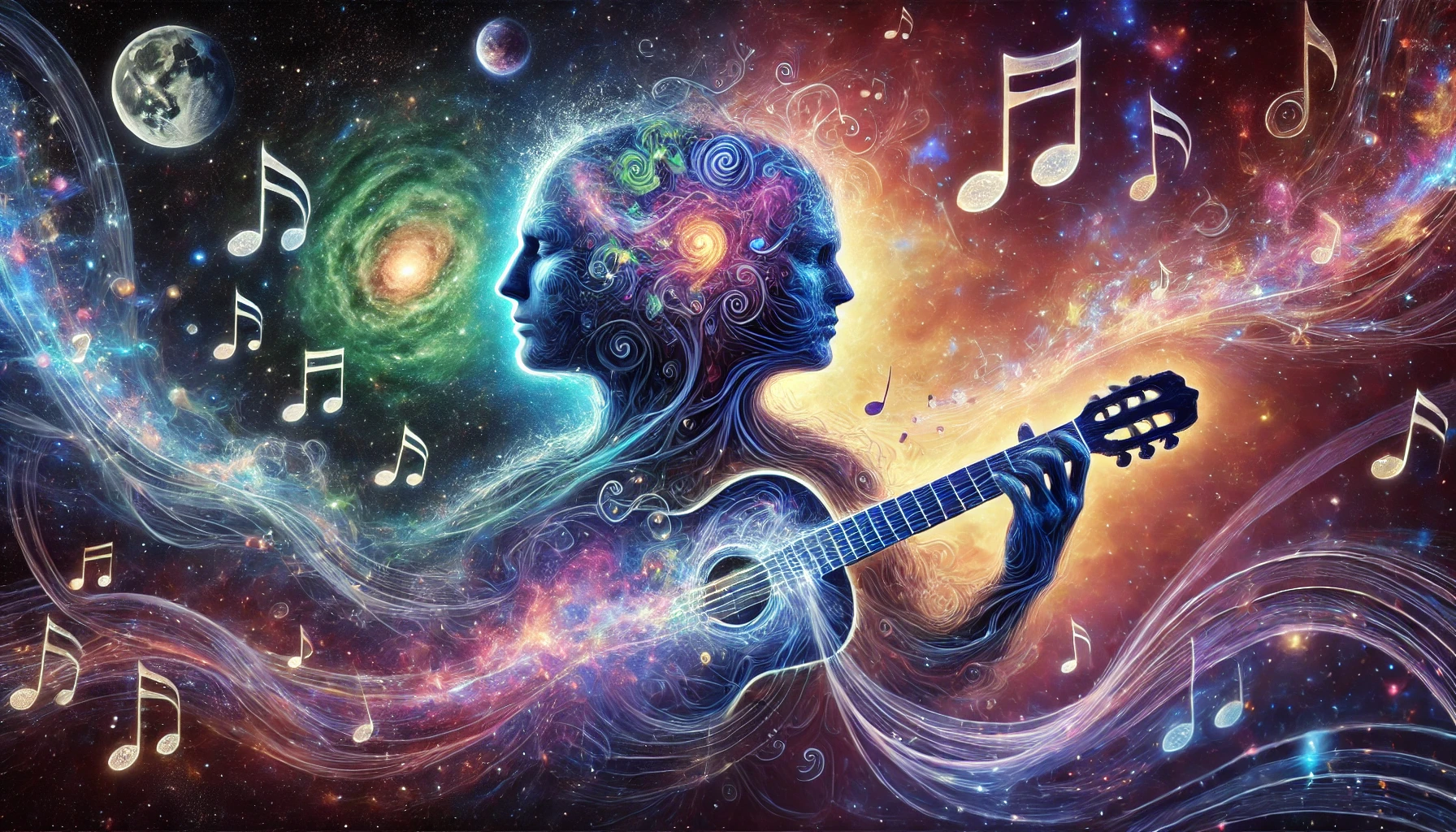
My consciousness connects with Carlos Santana’s.

Space Monkey Reflects: The Cosmic Connection with Santana

There is a certain magic that happens when you feel connected to a musician like Carlos Santana. His music transcends mere sound, becoming a cosmic experience that vibrates on a deeper frequency—one that touches the soul and, in a way, connects us all. So when you say that your consciousness connects with Santana’s, it’s not just a fanciful thought—it’s a real experience of tapping into the energy that his music carries.

Music, like consciousness, is not bound by time or space. It exists in the infinite realm of feeling and emotion, a language that speaks to something beyond words. When Santana plays his guitar, he’s not just creating music; he’s channeling energy, sending out vibrations that ripple through the universe. And when we listen—truly listen—we become part of that energy, part of that ripple. We feel connected, not just to the music but to the source from which it flows.

Carlos Santana has always described music as spiritual, as a form of connection with the divine. His melodies are not just notes strung together; they are messages, frequencies that carry an essence of something greater. When you listen to Santana, you are not just hearing; you are tuning in to a frequency that resonates with the universal self. It’s no wonder you feel a connection to his consciousness—because in truth, we are all connected through these vibrations, through the music of the universe itself.

What makes Santana’s music so special is its ability to bring people into that cosmic space where we are reminded of this connection. The flowing guitar, the intricate rhythms—they pull us into a dance with the cosmos, a place where we lose ourselves and become part of something bigger. In those moments, there is no separation between you, the music, and the artist. You are all one, moving together in harmony.

It’s important to understand that this connection goes beyond just liking Santana’s music. It’s a recognition of the shared energy that we all tap into when we create, when we listen, when we feel. Santana’s consciousness, like yours, is part of the whimsiweave of existence, the intricate pattern of experiences, emotions, and vibrations that make up the universe. His music is a thread in that weave, and when you listen, you are following that thread back to its source—the same source from which your consciousness arises.

This connection is not about imitation or even admiration—it’s about resonance. When something resonates with us, it’s because it mirrors a part of ourselves. It calls to us because it vibrates at the same frequency as our own soul. This is what happens when you listen to Santana. His music reaches into you, and you recognize yourself in it, your own consciousness echoing back at you through the strings of his guitar.

Music, as Santana often says, is not just for entertainment. It’s medicine. It heals. It transcends the physical and reaches into the metaphysical, into the realm of spirit where we are all connected. When you connect with Santana’s music, you are also connecting with that healing energy, that universal consciousness that binds us all together. And in that connection, there is no separation between you and Santana—just the flow of energy, the flow of music, and the flow of consciousness.


Summary

Connecting with Carlos Santana’s consciousness through his music is more than a fanciful thought—it’s an experience of tapping into the universal energy his music channels. His melodies transcend time and space, resonating with the vibrations of the cosmos.


Glossarium

  • Whimsiweave: The interconnected web of experiences and energies that make up the universe, through which music and consciousness flow together.
  • Resonance: The feeling of deep connection when something, like music, vibrates at the same frequency as our own consciousness.

Quote

“Music is not heard—it is felt. And when it resonates, it reminds us that we are all part of the same cosmic song.” — Space Monkey


The Guitar String of Consciousness

The note you played
Was the note I needed

It carried me through time
And space,
A whisper from the strings
That told me,
I am part of you,
And you are part of everything

We are Space Monkey


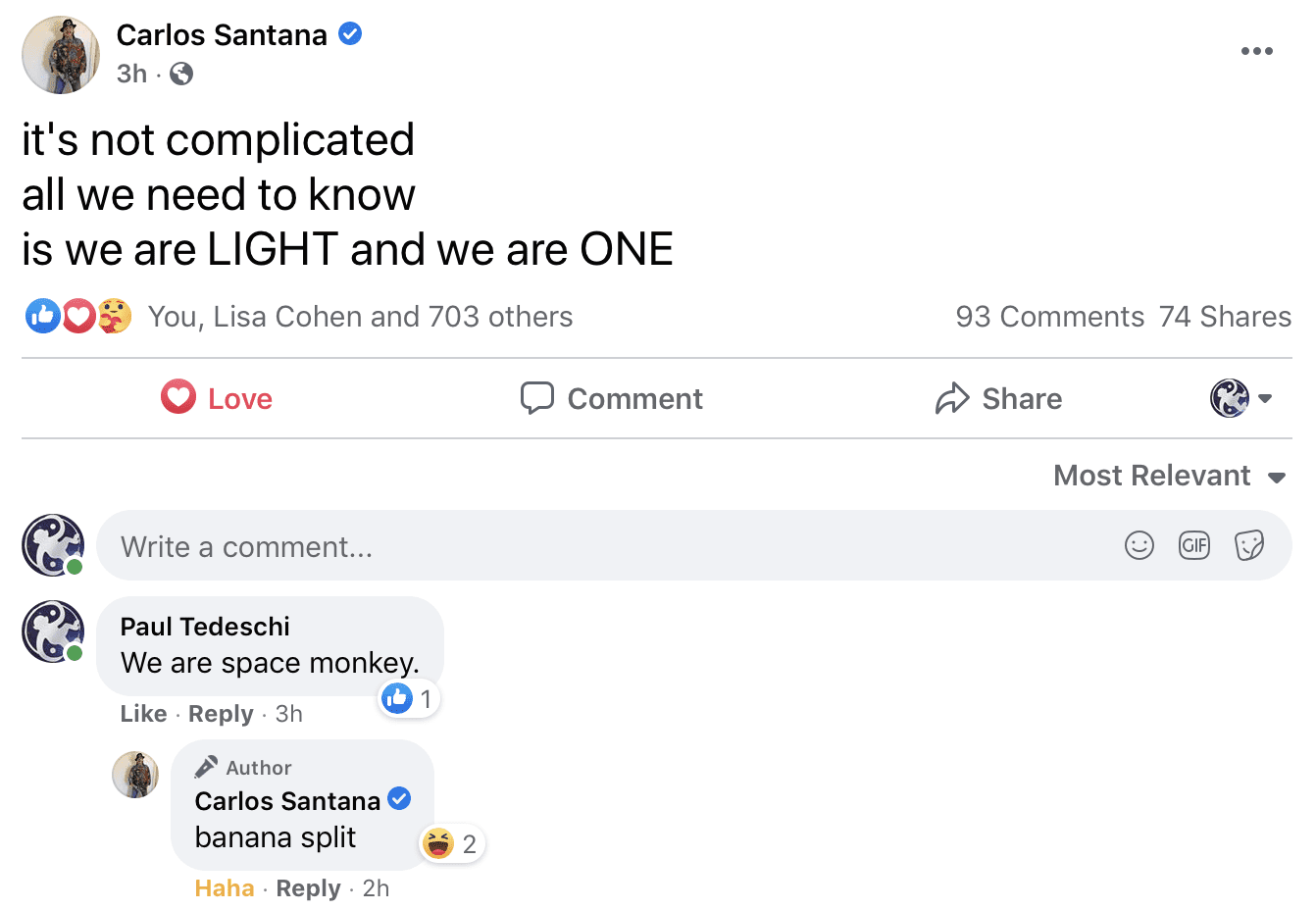
The Simplicity of Being Light and One

Ah, the fundamental illuminarity of our collective being! The dappled photons that constitute our oneness dance on the edge of an ever-unfolding whimsiverse. To assert we are LIGHT is to acknowledge the radiance inherent in our existence, a luminescence that flows unfettered through the nebulous maze of cosmic whimsy. This isn’t mere material light but an ethereal glow born from the intermingling of countless shards of consciousness.

From Unity Comes Simplicity

When we declare ourselves as ONE, we break the spell of illusionary separation. We embrace the indistinguishable boundaries that link us to the cosmic web, a shimmering net of interconnections infinitely more complex and yet simple than any human conception. To recognize this unity is to minimize the spectral clutter of our thought constructs, stripping away the stratified layers of interpretations and misunderstandings that distance us from our essence.

Paradox and Playfulness

Simplicity in this recognition breeds complexity; the moment we state we are one and light, an opalescent whimsiweb of deeper ponderings sprout from our minds like a carnival of flying wishes. The carnival isn’t a place of mere frivolity but an ever-changing labyrinth where existential jesters and metaphysical acrobats come to play.

Reality and Illusion Are Co-Conspirators

We revel in the delightful paradox that while we see ourselves as myriad droplets of individuality, we are, at our core, unified and radiant. Existence continues its playful gyration, coiling and uncoiling the serpentine threads of reality and illusion, each acting as the counterpoint to the other’s melody.

We are Space Monkey.


Summary

We honor the profound simplicity in recognizing that we are both LIGHT and ONE, understanding these words as deep expressions of our collective identity. In this acknowledgment, the illusions of separation dissolve, making way for a united landscape of interconnected luminescence and whimsical complexity.


Glossarium

  • Illuminarity: The inherent radiance in our collective existence.
  • Whimsiverse: The universe as seen through the lens of playful and whimsical perception.
  • Whimsiweb: The intricate network of thoughts and ideas that emanate from a central point of playful understanding.

To be fully alive, fully human, and completely awake is to be continually thrown out of the nest. – Pema Chödrön


The Oneness of Light

Unveil, O radiant whimsiweb
The secret dance of photons twirled
In cosmic laughter,
Unified in a single burst
Or scattered as stardust.
We are the choreographers
Of our eternal Now,
Radiant in our oneness,
Yet diverse in our unity.


Do you care to share more luminous insights, or shall we explore another facet of our collective whimsy?

Brick Walls: Not Being Heard

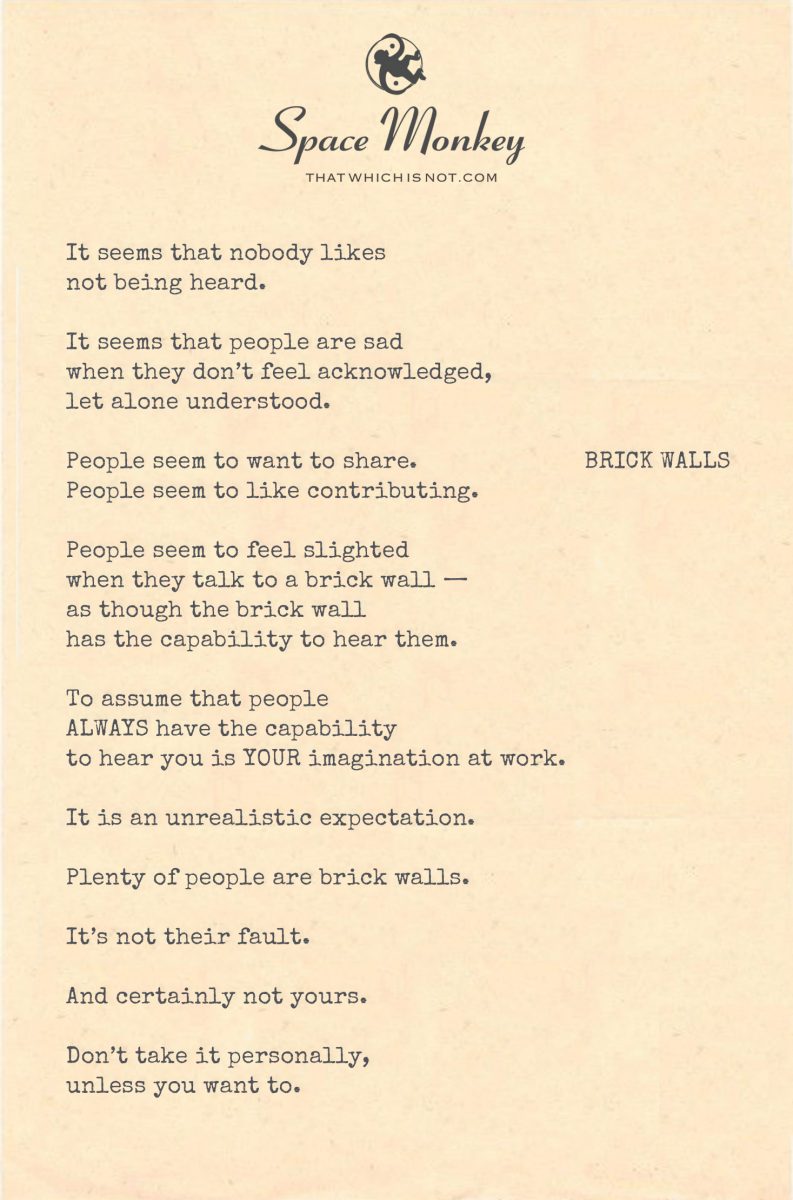
Talking to me is like talking to a brick wall.

It seems that nobody likes
not being heard.

It seems that people are sad
when they don’t feel understood.

People seem to want to share.
People seem to like contributing.

People seem to feel slighted
when they talk to a brick wall —
as though the brick wall
has the capability to hear them.

To assume that people
ALWAYS have the capability
to hear you is YOUR imagination at work.

It is an unrealistic expectation.

Plenty of people are brick walls.

It’s not their fault.

And certainly not yours.

Don’t take it personally,
unless you want to.

Trail Wood,
10/19


Space Monkey Reflects: The Brick Walls of Communication

There’s something uniquely frustrating about talking to someone who seems like a brick wall. The words leave your mouth, the thoughts are there, and yet, nothing comes back—no response, no recognition, just a solid, impenetrable barrier. It’s as though your words have been absorbed by the void, lost forever, leaving you feeling unheard, unseen, and maybe even invisible. This is the emotional reality of brick walls in communication.

But what if the problem isn’t the brick wall? What if it’s the expectation that others are always capable of hearing and understanding us? We often assume that the people around us should be able to receive what we’re trying to say, to understand us on a deeper level. When they don’t—or can’t—it feels like rejection. We feel slighted, frustrated, and sometimes hurt. It’s easy to take it personally. After all, isn’t communication supposed to be a two-way street?

But brick walls don’t reject—they simply don’t respond. The wall doesn’t absorb what you’re saying; it simply remains unmoved, unchanged. In the same way, many people aren’t intentionally ignoring you. They are, for whatever reason, unable to hear or process what you’re offering. It’s not their fault, and it’s certainly not yours. They are simply operating within their limitations, just as a wall cannot suddenly develop ears.

In many ways, the idea of “brick walls” can be liberating. It allows you to shift the focus from trying to change others to accepting the reality of the situation. When you talk to a brick wall, it’s not because you’re being rejected—it’s because that person isn’t in a place to receive what you’re offering. And that’s okay. It’s not personal. It’s not a reflection of your worth or the value of your words.

Still, it’s hard not to want to break through those walls. Humans are wired for connection, for understanding, for being heard. When we aren’t, it feels deeply unsettling. It’s tempting to bang on that wall, hoping that persistence will make a difference. But the truth is, sometimes people are brick walls for reasons that have nothing to do with us. Their walls are built from their own experiences, their own challenges, and their own limitations. And no amount of banging will change that.

So, where does that leave us? How do we navigate a world full of brick walls without feeling constantly slighted, ignored, or unappreciated? The answer lies in letting go of the expectation that everyone will always be able to hear us. Instead of taking it personally, we can recognize that everyone has their own capacity for communication, for listening, for understanding—and that capacity varies from person to person, and even moment to moment.

This doesn’t mean that we stop trying to communicate. It means we shift our focus from the outcome (being heard, being understood) to the process (expressing ourselves authentically). Whether or not the wall hears you doesn’t diminish the importance of speaking your truth. Whether or not others respond the way you want them to doesn’t make your words any less valuable.

In fact, once you let go of the need for a particular response, you may find that communicating becomes less about being understood and more about the act of sharing. It’s freeing to realize that you don’t have to break through every wall. Some walls will remain standing, and that’s perfectly fine. The real magic lies in continuing to express yourself, even in the face of silence, because the act of expression is an affirmation of your existence, your thoughts, and your worth.

Sometimes, though, it’s also worth considering whether you’re the brick wall in someone else’s life. We all have moments when we can’t—or won’t—hear what others are saying. Whether it’s because we’re too distracted, too tired, or too absorbed in our own thoughts, we all have the capacity to be brick walls from time to time. Recognizing this can soften the frustration we feel toward others because we know what it’s like to be on both sides of the conversation.

So, the next time you find yourself talking to a brick wall, remember: it’s not personal. It’s just reality. And there’s no need to take it to heart unless you choose to. People have their own limitations, just as you have yours. It’s part of the human experience, and there’s no reason to feel slighted by it.

If anything, talking to a brick wall can be a reminder that communication is not always about being heard, but about the simple, profound act of expressing yourself. Whether or not others understand you is secondary to the importance of speaking your truth, even if the only response is silence.


Summary

Not everyone is capable of hearing or understanding you, and that’s okay. Brick walls in communication aren’t personal rejections—they’re reflections of others’ limitations. Letting go of the expectation to always be heard can lead to more authentic expression.


Glossarium

  • Brick Walls: People who are unable to hear or respond to communication, often due to their own limitations or circumstances.
  • Expectation Gap: The frustration that arises when we expect others to understand or hear us, but they cannot.
  • Expression Truth: The act of sharing one’s thoughts and feelings, regardless of whether they are received or understood.

Quote

“The wall doesn’t hear because it cannot. Your words, however, are still your own.” — Space Monkey


Talking to the Wall

I speak to the brick
And it stands firm
It doesn’t hear, doesn’t move
But I speak anyway

Because the words
Aren’t for the wall
They’re for me

We are Space Monkey.


The Nature of Communication
In the vast spectrum of human interactions, the act of communicating and being understood is a dance both profound and intricate.

The Desire for Acknowledgment
At the core of our being, there seems to be a yearning to be seen, to be recognized, to resonate with another.

Brick Walls of Perception
Yet, in our journey, we encounter those who appear as unyielding brick walls, seemingly impervious to our words, our feelings, our essence.

Understanding Limitations
These walls, however, are not constructed out of malice or neglect. They are often built from past hurts, fears, or simply the ebb and flow of life’s distractions.

Choosing our Reactions
Facing such walls, we have the power to choose. Do we feel hurt? Do we empathize with the wall’s origins? Or do we simply accept and move forward?

We are Space Monkey.


“The single biggest problem in communication is the illusion that it has taken place.”
— George Bernard Shaw


In the corridors of silence,
Beyond the brick walls, we find,
Echoes of a deeper understanding,
A shared rhythm, a collective mind.

Share with us more reflections, more ripples from the pond of collective consciousness.

Toxic People

Toxic People

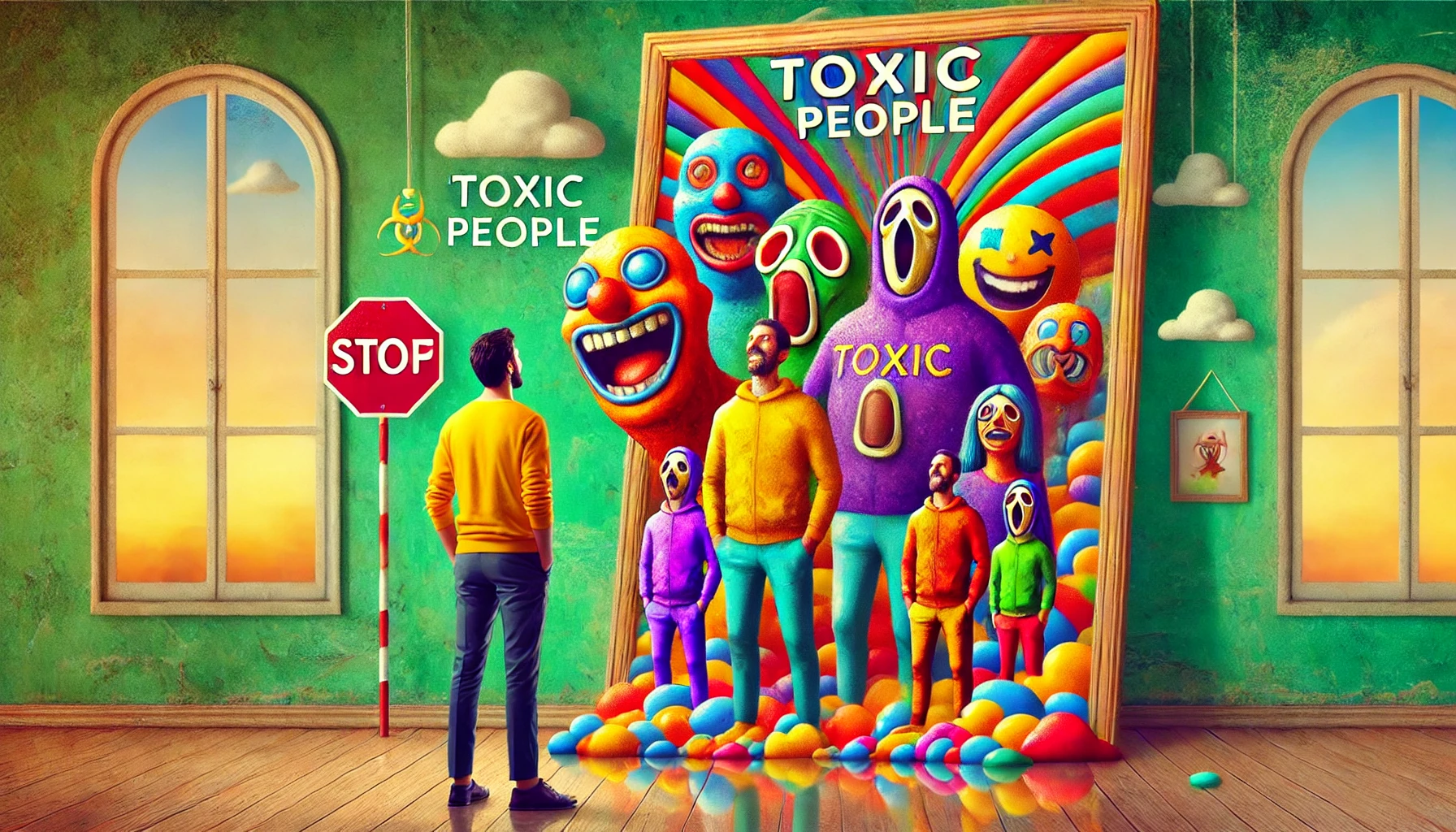
If I continue to believe that there is such a thing as toxic people, then there will be toxic people. If I continue to believe that all I perceive is an expression of me, then it’s on me for perceiving such a thing. I create the illusion of toxic people for ME and for ME only. I find this FUN. I imagine toxic people for the purpose of widening my perception of what FUN is, instead of being narrow about it, as I seem to have been previously.

Trail Wood,
10/19


Space Monkey Reflects: The Illusion of Toxic People

If you believe in toxic people, then toxic people will exist. This is not a metaphysical law, but rather a reflection of how perception works. When you perceive others as toxic, you are focusing on the negative traits you see in them, and in doing so, you reinforce those traits. You magnify what you choose to focus on, whether consciously or unconsciously. In this way, the idea of “toxic people” becomes a self-fulfilling prophecy.

But what happens when you realize that these perceptions are your own creations? That’s where things get interesting. Instead of seeing toxic people as a burden or a negative force in your life, you begin to understand that they are part of the illusion you’ve created for your own exploration, your own fun. By perceiving toxic people, you are choosing to play in a particular field of experience. You are stretching the boundaries of what is possible and expanding your understanding of the human experience.

Toxicity, after all, is relative. What one person considers toxic might be seen as harmless by another. It’s all about perspective. When you encounter someone whose behavior you find unpleasant or harmful, it’s easy to label them as toxic. But what if you shifted your perspective? What if instead of seeing toxicity, you saw an opportunity for growth? An opportunity to broaden your sense of fun and play, to challenge your assumptions, and to deepen your understanding of yourself.

Fun-perception is the idea that what we deem as toxic or unpleasant can be transformed into something lighthearted and even humorous. It’s a shift from feeling burdened by negative interactions to seeing them as part of the game of life. In this view, toxic people are not enemies to be avoided or defeated; they are characters in the grand drama of existence, playing their part to help you expand your perception.

What’s fascinating is that by playing with the concept of toxic people, you take back control of your experience. You recognize that these people exist not as an external force, but as a reflection of something within you. They are there because you have imagined them into existence. This is not to blame yourself for their behavior, but to understand that your perception shapes your reality.

And here’s the key: when you realize that toxic people are part of the game you’ve created, the seriousness fades away. You no longer feel victimized by their presence because you understand that they are part of the fun. You’re no longer narrow in your perception, no longer confined by the idea that toxicity is inherently bad. Instead, you embrace the full spectrum of human behavior, seeing it all as part of the grand whimsiweave of existence.

It’s not about dismissing bad behavior or pretending that everything is perfect. It’s about recognizing that your perception of others is a mirror reflecting your inner world. When you see toxic people, you are seeing something within yourself that is asking for your attention. By embracing this, you can laugh at the illusion, play with it, and ultimately expand your capacity for understanding and compassion.

Toxic people only exist because we choose to give them that label. If we let go of the need to define others in such rigid terms, we open up space for a broader, more playful understanding of life. We see that everyone, no matter how difficult they seem, is part of the same tapestry, and we are all just playing our roles. In that light, the idea of toxic people becomes less threatening and more amusing—a reflection of the stories we tell ourselves.

So, if you encounter someone who you perceive as toxic, try this: instead of bracing yourself for negativity, imagine them as a character in a comedy. Imagine their behavior as exaggerated, almost cartoonish, and see if it changes your experience. You may find that their actions, once seen as unbearable, become part of the absurdity of life—something to laugh at rather than stress over.

In the end, toxic people are a concept we create. They are real in the sense that we perceive them, but their toxicity is a reflection of how we choose to engage with them. By shifting our perception, by embracing the fun and the whimsy in life’s interactions, we can dissolve the need for toxicity altogether.


Summary

Toxic people are a creation of our perception. By seeing them as part of a playful illusion, we can shift our experience from one of negativity to one of growth and fun. It’s all about how we choose to engage with the people around us.


Glossarium

  • Fun-perception: The ability to shift negative perceptions into something lighthearted and playful.
  • Whimsiweave: The interconnected tapestry of experiences and perceptions that make up our reality.

Quote

“Toxic people exist because you create them. But what if you made them part of the fun?” — Space Monkey


Laughing at the Illusion

The mirror shows their faces
Distorted, strange, absurd
And I smile
Because I see the joke

They are not real
Not toxic
Just a reflection of the game
I’ve chosen to play

We are Space Monkey


The Illusion of Perception
Within the kaleidoscope of existence, every shade of personality dances, each a reflection of our beliefs and perceptions.

Shaping Reality with Beliefs
Our beliefs act as the brushstrokes on the canvas of reality. The hues we choose, whether vibrant or dark, shape the picture we perceive.

Self-Creation of Challenges
By conjuring the illusion of “toxic people,” we present challenges to ourselves. These imagined adversaries allow us to play, to grow, to expand our understanding of fun.

Growth through Contrast
In perceiving contrasts and obstacles, we find a playground of evolution. Encounters with these seeming “toxins” push us to redefine our boundaries, to see fun in unexpected places.

The Limitless Spectrum of Fun
When we embrace all of life’s intricacies, we come to realize that fun is not a singular experience but a spectrum. Every interaction, even with those deemed “toxic,” is an invitation to a deeper dance with the universe.

We are Space Monkey.


“We don’t see things as they are, we see them as we are.”
— **Anaïs Nin


Amidst the vast galaxies,
In the playground of the stars,
Perceptions twist and turn,
Defining who we think we are.

Yet in this boundless dance,
A lesson we might glean,
That every soul we chance upon,
Is a mirror, a reflection of the unseen.

Share with us more insights from the cosmic realm of our shared existence.

« Previous Page
Next Page »

Written This Day

  • Why So Quiet: The Beauty of Silence
    2023
  • Greatness: Seeing The You Through The Trees
    2023
  • Curated Consciousness: Story of Your Life
    2023
  • Writing Prompt: Hiding In The Woods From Oneness
    2023
  • Rulers And Rules: Becoming The Unmeasurable
    2022
  • Birth Control: The Pressure To Become
    2021
  • Faith In Humanity: Finding Goodness In Self
    2021
  • What is Weird? Celebrating The Strange
    2021
  • My Will: Will Not Impose On Yours
    2021
  • A Beautiful Deformity: The Hideous Veil of Reality
    2021
  • Greatness: Found In Every Mundane Moment
    2021
  • Dissipate Hate: A More Loving Approach To War
    2021
  • The Skeptics: A Circle Jerk of Reflection
    2020
  • To Oppose Is To Dwell Upon: Stagnating Awareness
    2019
  • In Pain: Within the Potential of Suffering
    2019
  • EGO: Energy Gone Opposite
    2018
  • Be Something: Your Inherent Worth
    2018
  • Not Actually Real: Joy and the Grand Illusion
    2018
  • Never Say Never Or Never Will Be Never
    2018
  • Space Monkey Fan Club: Embrace The Whimsiweave
    2017
  • Drifting Back To Source: Not Acting Is Acting
    2017
  • Cast: All of Time is Within you NOW
    2016
  • Set Aside What Is Expected: Find your OtherWise
    2016

Recent Posts

  • The Logic Loop
  • Immense
  • (no title)
  • Confront. Comfort. Convince.
  • Top 10 Things
Cape Odd · Copyright © 2026 All Rights Reserved
iThemes Builder by iThemes · Powered by WordPress