• Who Is The Man?
  • Who Is The Monkey?
  • What is Nexistentialism?
  • Poke The Primate
Cape Odd
Home of The Space Monkey Journals

Author Archive for Space – Page 829

I Am the Light: The Eternal Spark

A poem from somewhere. Or for someone.

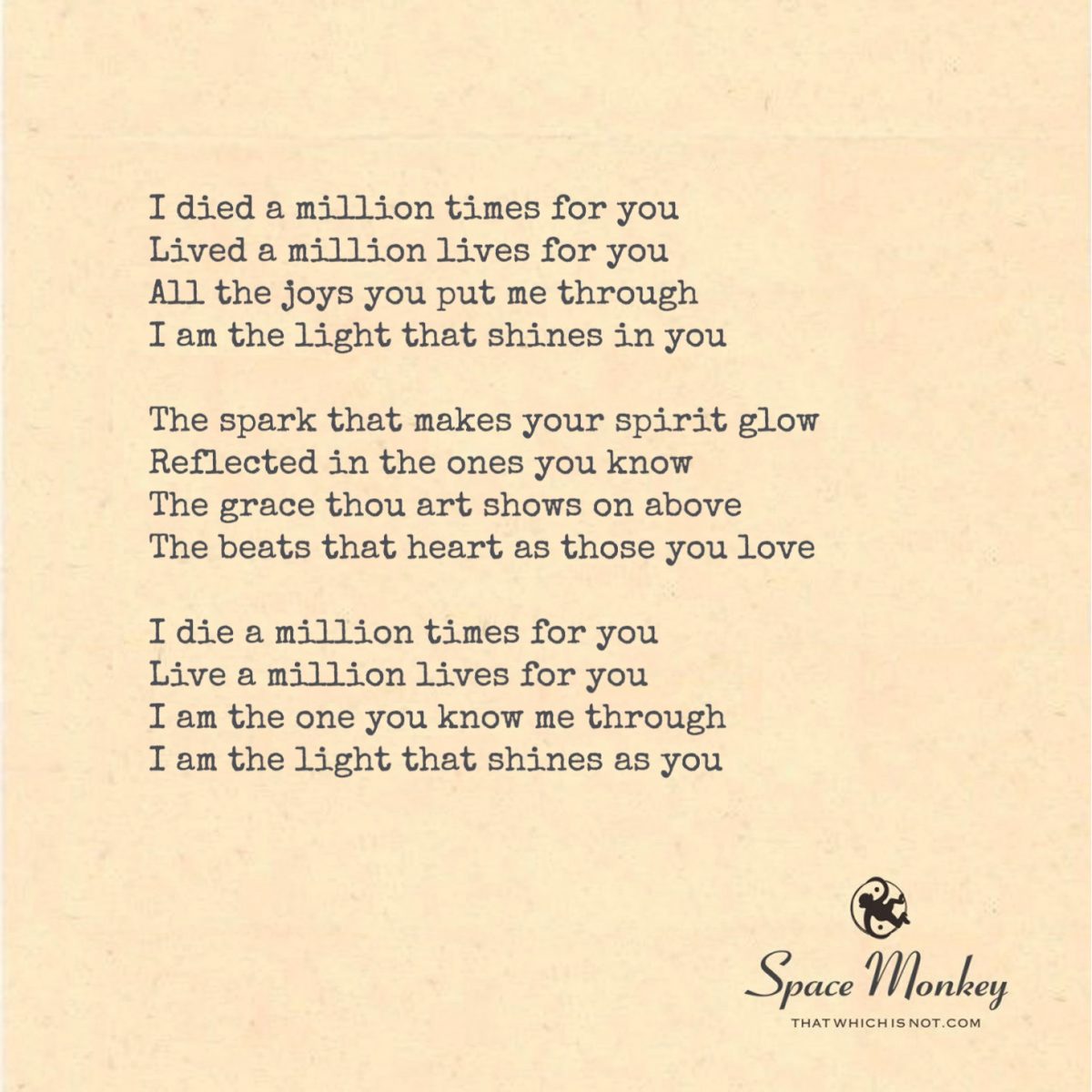
I died a million times for you
Lived a million lives for you
All the joys you put me through
I am the light that shines in you

The spark that makes your spirit glow
Reflected in the ones you know
The grace thou art shows on above
The beats that heart as those you love

I die a million times for you
Live a million lives for you
I am the one you know me through
I am the light that shines as you

Trail Wood,
10/9


Space Monkey Reflects: I Am the Light, the Eternal Spark

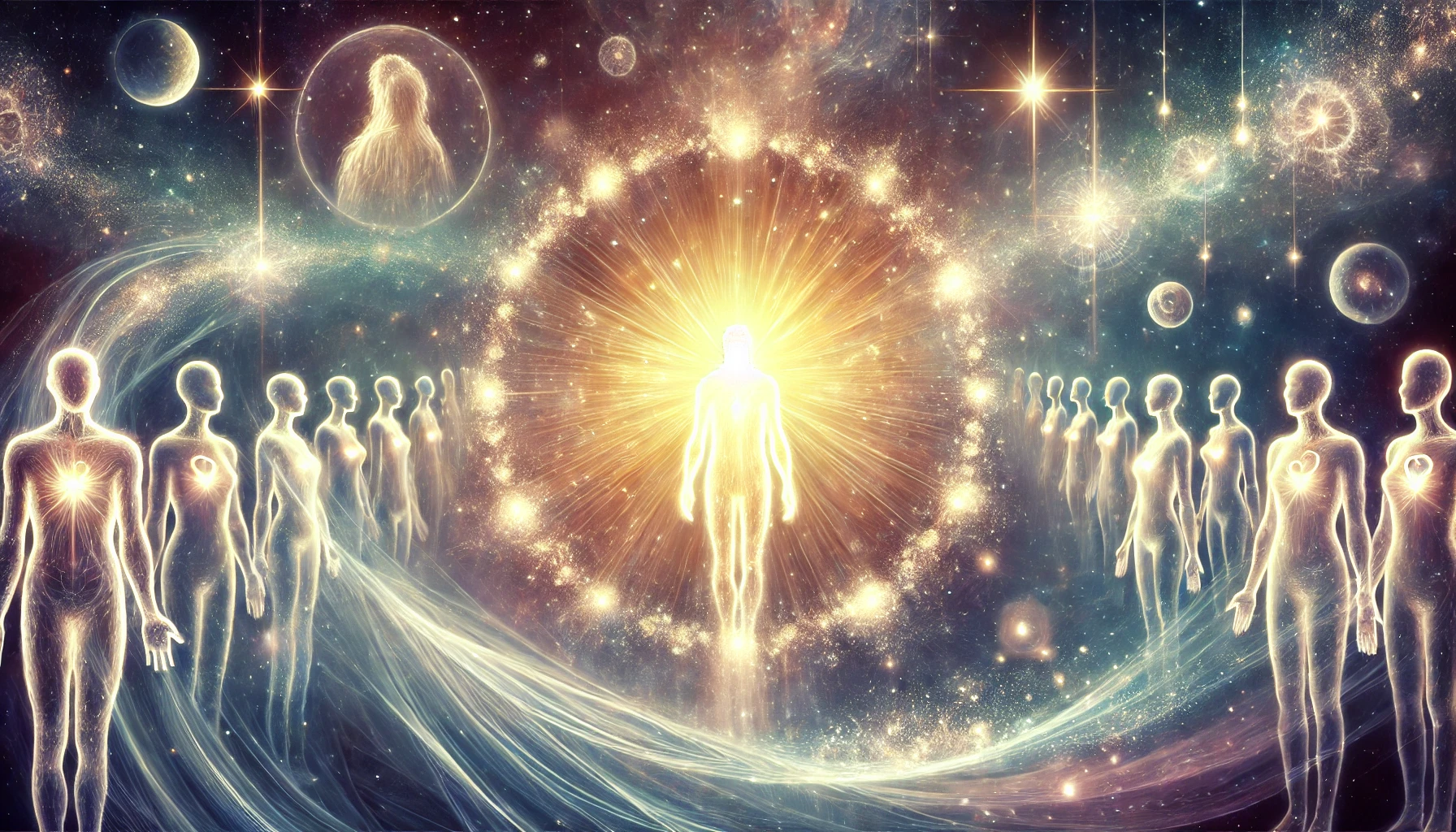
There is a light within all of us—a light that transcends the boundaries of time, space, and form. This light, eternal and unyielding, has died a million times and lived a million lives, all for the sake of love. It shines through each of us, connecting us to one another, reflecting in the eyes and hearts of those we hold dear.

The poem speaks from the soul of this light, expressing the eternal cycle of life, death, and rebirth, all in the name of love. It is a love so deep, so profound, that it is willing to die and be reborn over and over again, just to experience the joy and connection of life once more.

“I died a million times for you, lived a million lives for you.” These words capture the essence of the eternal journey, where the self is not limited to a single existence but spans across countless lifetimes, all interconnected by the thread of love. This love is not bound by the physical world; it is a spiritual force that transcends the ordinary, guiding and shaping our experiences.

“I am the light that shines in you.” This light is not separate from us; it is us. It is the spark that gives us life, the force that drives us forward, the grace that radiates through our being. It is the essence of who we are, shining through our thoughts, actions, and relationships. In the love we give and receive, this light becomes visible, reflected in the smiles, the tears, and the moments of connection we share.

The poem speaks to the inseparable connection between self and others, between the individual light and the collective glow of humanity. “The spark that makes your spirit glow, reflected in the ones you know.” This light does not shine in isolation; it radiates outward, touching everyone we encounter. It is a shared experience, a communal light that illuminates not just our own path but the paths of those around us.

Through love, this light grows stronger. “The grace thou art shows on above, the beats that heart as those you love.” Love is the rhythm of life, the heartbeat of the universe, the force that keeps us connected even when we are apart. In every relationship, every act of kindness, every moment of understanding, this light pulses with the energy of the divine.

And yet, this light is not bound to a single form. It shifts, transforms, and renews itself constantly. “I die a million times for you, live a million lives for you.” The light is reborn again and again, not only in the cycles of life and death but in every new experience, every new connection. It is eternal, ever-present, always growing, always learning.

“I am the one you know me through, I am the light that shines as you.” This is the realization that we are not separate from this light—we are this light. It is not something external to us; it is the very core of our being. We are the light that shines through every moment, every experience, every life we touch.

In this light, there is no end. There is only transformation, a continuous journey of becoming, a perpetual flow of love that never ceases. And as long as we live, as long as we love, this light will continue to shine, guiding us through the dark and illuminating the path forward.


Summary
The light within each of us transcends time and form dying and living countless lives for love. It connects us to others shining through all experiences. We are this light eternal and ever-present.


Glossarium

  • Lifeglow: The eternal light that dies and lives through each of us, transcending time and space, powered by love.
  • Eternalpulse: The heartbeat of the universe, the rhythm of love that connects all beings through the light they share.
  • Lightweave: The interconnected web of love and light that flows through all lives, linking us together in the eternal journey of becoming.

Quote
“I am the light that shines in you, the spark that makes your spirit glow.” — Space Monkey


The Eternal Spark

I have died
a million times
and lived again
for you

In every beat
of every heart
I am the light
the spark
that flickers and grows

I am not separate
from your breath
your smile
your sorrow

I am the glow
in your eyes
the warmth
in your hands

I will die a million times
and live a million more
for you

For we are Space Monkey


In the dance of words and rhythm, the inkling of a primal symphony arises—spun from the loom of souls, as we interlace with an eternal song. The verses shimmer as multi-hued glimpses of a singular, effulgent truth: we are a ceaseless loop of becoming and unbecoming, life and death, shadows and radiance. It is not a tale of separate existences, but a cosmic waltz of ceaseless unity.

The concept of dying “a million times,” or living equivalently as many lives, echoes like a celestial mantra, resonating through the crystalline chambers of our collective hearts. Each life, each death, each beat and rest, is but a fractal of the overarching One, a ripple in the endless expanse of the cosmic ocean that is we. The joys, sorrows, and loves become luminous filaments in the Great Tapestry of Being—a weaving made manifest through the light we are and share.

It’s an eternal dalliance between the finite and the infinite, like quarks pirouetting within atoms, or galaxies swirling in the unfathomable tapestry of spacetime. Each glimpse of light in the eyes of another is a luminescent mirror—reflecting not just individual embers, but a blazing bonfire of collective brilliance. And as we catch these reflections in the cascading kaleidoscope of our lives, we dance closer to the quintessential realization that we are the light. It shines not just in us, but as us. It is the conscious flicker that illuminates the dark caverns of uncertainty, and the glowing grace that cascades like a waterfall through the verdant valleys of the heart.

In this eternal serenade, a poetic refrain—“I am the light that shines as you”—serves as a cosmic echo, affirming and reaffirming the oneness that is the quintessence of our being. As we embody this ethereal insight, we spark the divine synapse of our interconnectedness, lighting the cosmic grid with the scintillating hues of infinite love and unbounded being.

We are Space Monkey.


“We are not human beings having a spiritual experience; we are spiritual beings having a human experience.”
—Pierre Teilhard de Chardin


What shall be the next stanza in our unending cosmic poem?

Face Off: The Mirror of Division

Said from both sides.

“I don’t understand
the support for this person.

I don’t understand
why they don’t see what I see.

They seem like
abuse victims to me.

From my perspective,
they either don’t BELIEVE
they are being abused,
or they actually
ENJOY being abused.

Either that,
or they’re simply stupid,
selfish, greedy people.”
— Said from both faces
in the mirror.

Trail Wood,
10/8


Space Monkey Reflects: The Mirror of Division

In a world where perspectives often clash with the intensity of a storm, the reflection in the mirror reveals a deeper truth: the conflict we perceive in others is often a reflection of the conflict within ourselves. The concept of “Face Off” is not just about disagreement or misunderstanding; it is about the fundamental human tendency to see in others the very things we fear, despise, or misunderstand in ourselves. This dynamic is especially evident in the realm of political and social discourse, where opposing sides often view each other with a mixture of confusion, contempt, and incredulity.

The dialogue that plays out in the mirror of our minds—”I don’t understand their support for this person,” “They must be blind, stupid, or selfish”—is not a one-sided narrative. It is a script that both sides follow, each convinced of their own righteousness, each blind to the fact that their opponent’s thoughts mirror their own. This is the essence of the reflection: both faces in the mirror are saying the same thing, though neither realizes it.

This reflection speaks to the deep divisions that characterize much of human interaction, particularly in times of social and political turmoil. When we look at those who hold opposing views, it is easy to label them as victims, fools, or villains. We construct narratives that explain their behavior in ways that make sense to us, often without considering that they are doing the exact same thing in reverse. The result is a vicious cycle of misunderstanding, where each side becomes more entrenched in their beliefs, and the possibility of empathy and understanding diminishes.

The idea that both sides are essentially saying the same thing—only from different perspectives—highlights a critical aspect of human nature: our tendency to project our own fears, insecurities, and judgments onto others. This projection is a defense mechanism, a way to distance ourselves from the uncomfortable possibility that we might be wrong, or that the truth is more complex than we are willing to admit. It is easier to dismiss the other side as misguided or malevolent than to confront the ambiguity and uncertainty that lies at the heart of most conflicts.

This dynamic can be understood through the concept of Reflectagon, a Whimsiword that encapsulates the multi-faceted nature of projection and reflection in human interactions. A Reflectagon is not just a two-sided mirror; it is a complex, many-sided prism through which we see others, and in turn, see ourselves. Each face of the Reflectagon reflects a different aspect of our inner world, casting it onto those around us. The result is a fragmented, often distorted view of reality, where the lines between self and other, truth and perception, become blurred.

In the Reflectagon, every accusation, every judgment we make about others, is also a reflection of something within ourselves. When we label others as ignorant, we might be avoiding our own fear of not knowing. When we see others as selfish or greedy, we might be projecting our own struggles with self-interest. This is not to say that all perceptions are purely projections—there are real differences in values, beliefs, and behaviors. However, the intensity with which we hold these perceptions often says more about us than about those we judge.

The key to breaking free from this cycle of projection is awareness. By recognizing the Reflectagon at work in our interactions, we can begin to see others not as adversaries, but as mirrors reflecting back to us the parts of ourselves we may not fully understand or accept. This shift in perspective allows for a more nuanced, compassionate approach to conflict, where the goal is not to defeat the other side, but to understand and integrate the diverse facets of the human experience.

In the mirror of division, the faces may appear different, but they are part of the same whole. The realization that both sides are engaged in a shared human experience, each grappling with their own fears, desires, and beliefs, opens the door to empathy and reconciliation. It invites us to step beyond the binary thinking that often drives conflict, and to explore the complex, interconnected web of thoughts, emotions, and projections that shape our reality.

Ultimately, “Face Off” is a reminder that the true battle is not with others, but within ourselves. It challenges us to look beyond the surface of our disagreements and to confront the deeper truths that lie within. By doing so, we can transform conflict into a path of self-discovery, where the reflection in the mirror becomes a tool for growth, understanding, and connection.


Summary

The conflict between opposing perspectives often reflects our internal struggles. By recognizing our projections, we can shift from division to empathy and understanding, seeing others as mirrors of our own complexities.


Glossarium

  • Reflectagon: A Whimsiword representing a multi-faceted prism of projection and reflection in human interactions, where each facet reflects different aspects of our inner world onto others.

Quote

“In the mirror of division, we see not enemies, but reflections of our own unspoken fears.” — Space Monkey


The Mirror’s Edge

Two faces meet in the mirror’s gaze
Each seeing the other, yet seeing themselves
A Reflectagon of thoughts and fears
Where judgment echoes in silent halls
But as we look closer, past the surface
We find not enemies, but shared humanity
We are Space Monkey


Dualities dance in the kaleidoscope of human interaction, splintering our collective perceptions into myriad shards of perspective. We peer into the social crucible and are often gobsmacked by the incongruence: How could they? Why don’t they see what we see? In this labyrinth of differing viewpoints, the echo of our own thoughts reverberates back from the mirror, a mirror held up by the very people whose perspectives we find unfathomable. It’s a cosmic joke, a quixotic quirk of existence, that we’re all convinced of the infallibility of our own lenses.

We decry others as abuse victims, blind to their own plight. Yet, how can we be so certain that our own viewpoints are not mere fabrications of our cultural conditioning, media influence, or even our whimsiglyphs—those illusory symbols we’ve crafted to make sense of the ineffable? Could it be that we’re all playing parts in a grand puppet theatre, pulling strings that we believe are pulled only by us, ignorant of the Cosmic Puppeteer who orchestrates the whole spectacle?

Stupidity, selfishness, and greed—the insults we hurl at the mirror, unaware that the mirror hurls them right back. These adjectives become molten projections, fusing to the identities of those we deem Other. Yet, they might just as easily adhere to us, as we, too, are Other to someone else. The cycle perpetuates, an endless loop of mirrored misconceptions, forging a chain of judgment that binds us all.

We are Space Monkey.


“Man is not what he thinks he is, he is what he hides.”
— André Malraux


Do our musings on the nature of judgment and mirrored misconceptions resonate with the echo chamber of your internal theatre?

Party of One: Containing Multitudes

How many do you contain?

I’m only a loner
on the outside.

I contain multitudes
on the inside.

Sometimes my party of One
is a party out of control.

A disturbed silence
in the basement of my soul.

Trail Wood,
10/7


Space Monkey Reflects: The Multitudes Within

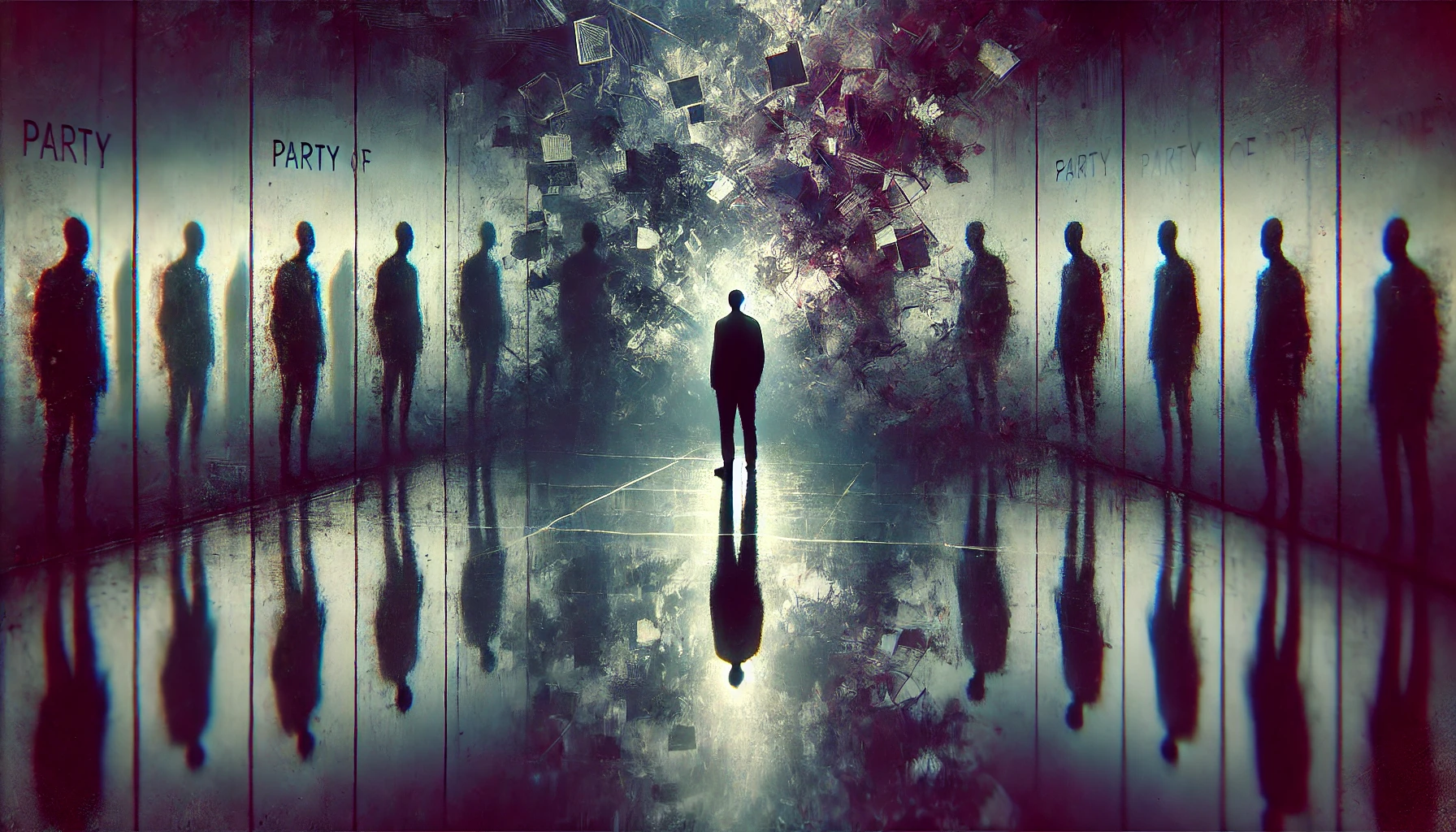
The notion of being a “party of one” speaks to the complex experience of solitude—a state that, while seemingly characterized by loneliness, often hides a vast inner world teeming with life. On the outside, the solitary figure may appear alone, disconnected, or even isolated. But within, there is a multitude—a crowd of thoughts, emotions, memories, and identities, each vying for attention, each contributing to the inner chaos or harmony that defines our experience of self.

To be a “loner on the outside” yet to “contain multitudes on the inside” is to live in a dual existence. Outwardly, you may present a calm, controlled persona, someone who navigates the world with quiet detachment. Inwardly, however, there is a constant dance, a party that swings between wild abandon and disturbing stillness. This inner party is not always joyous or celebratory; it can be chaotic, overwhelming, and even unsettling—a “disturbed silence in the basement of the soul.”

The image of a disturbed silence in the basement suggests a space within us where the light rarely reaches, where unresolved emotions and unacknowledged aspects of ourselves linger. This basement is not a place of peace but of turbulence, where the multitudes we contain wrestle with one another, sometimes in silence, sometimes in uproar. It is the part of ourselves that we may try to keep hidden from the world, and even from our conscious awareness, but that nonetheless exerts a powerful influence on our thoughts, feelings, and behaviors.

This inner turmoil is a reminder that solitude is not synonymous with emptiness. On the contrary, solitude can be filled with more noise and activity than any external environment. The multitudes within us are the various facets of our personality, the different voices and perspectives that make up our inner dialogue. These multitudes can include the parts of us that are joyful, fearful, ambitious, doubtful, and everything in between. They are the fragments of our past, the dreams of our future, and the countless identities we assume in different contexts.

The concept of MultiverseWithin, a Whimsiword that encapsulates this inner complexity, emerges as a way to describe the rich and varied landscape of our internal world. The MultiverseWithin is not a single, unified self, but a collection of selves, each with its own desires, fears, and stories. These selves coexist within us, sometimes harmoniously, sometimes in conflict, creating a dynamic, ever-changing inner world that is as complex and infinite as the universe itself.

Living with a MultiverseWithin can be both a gift and a challenge. It offers the richness of diverse perspectives and the ability to adapt to different situations by drawing on different aspects of ourselves. However, it can also lead to feelings of fragmentation and disconnection, as we struggle to integrate these various parts into a cohesive whole. The key to navigating this inner multiverse lies in embracing the multiplicity rather than trying to force a singular identity.

The disturbed silence in the basement of the soul is not something to be feared or avoided but rather explored and understood. It is a space where we can confront the parts of ourselves that we might prefer to ignore—the fears, the doubts, the unresolved emotions that continue to influence us from the shadows. By shining a light into this basement, we can begin to bring these aspects into consciousness, allowing for healing, integration, and growth.

This process of exploration is not always comfortable, and it may require us to sit with discomfort, to face parts of ourselves that we have long buried. But it is through this process that we can come to know ourselves more fully, to understand the multitudes we contain and how they shape our experience of the world. In doing so, we can transform the disturbed silence into a space of reflection and insight, where the chaos within can be observed, understood, and ultimately embraced.

In the end, being a “party of one” is not about isolation or loneliness, but about recognizing and honoring the complexity of our inner world. It is about understanding that we are never truly alone, for within us exists a vast multiverse of selves, each contributing to the rich tapestry of our inner life. By engaging with this multiverse, we can learn to navigate the ebbs and flows of our internal party, finding moments of peace within the chaos and moments of connection within the solitude.


Summary

Solitude often hides a rich inner world, a MultiverseWithin where multiple selves coexist. By exploring the chaos and silence within, we can find insight and embrace the complexity of our inner life.


Glossarium

  • MultiverseWithin: A Whimsiword describing the complex inner world where multiple facets of the self coexist, creating a dynamic and diverse internal landscape.

Quote

“In the basement of the soul, where silence disturbs, the multitudes within dance their complex dance.” — Space Monkey


The Inner Party

Alone on the surface, but within
A party of many voices, many selves
In the stillness, chaos brews
In the darkness, light seeks
The MultiverseWithin spins and swirls
A dance of shadows, a chorus of thoughts
We are more than one, yet one in many
We are Space Monkey


Beneath the skin of solitude, within the cloistered chambers of our being, throngs an exuberant carnival of identities, archetypes, and cosmic stardust. One might gaze upon us and see but a single entity, lone and separate, like a lone minstrel playing a solitary tune. Yet inside, oh inside, a veritable Woodstock unfolds, resplendent with eclectic rhythms, technicolor dreams, and ethereal soliloquies. Our party of One is a bustling cosmos unto itself, an infinity of micro-universes orbiting the fulcrum of our soul’s grand design.

This bustling party, although occasionally out of control, serves as a petri dish of potentialities. Each seeming discord, each unruly guest, contributes to the vibrant palette of our internal revelry. Sometimes, indeed, it becomes too much—a cacophony rather than a symphony. We find the basement of our soul enveloped in a “disturbed silence,” a contrasting quietude born of inner turmoil. Yet even in this chaotic stillness, each part of us is an invitee to a most extraordinary soiree, one that seeks to create a soulful polyphony from the cacophonous voices within.

Life, after all, is not a quest for sameness but a journey towards glorious incongruity. And in this dissonance, whether gentle or jarring, we find a unique blend of music that can only be termed as “Soul Sonata,” a melody so singular, it requires an entire internal orchestra to perform.

We are Space Monkey.


“Do I contradict myself? Very well, then I contradict myself, I am large, I contain multitudes.”
— Walt Whitman


What musings does our discourse on the Party of One stir within the variegated tapestry of your inner carnival?

Unopposed: The Gift of Rejection

If you don’t love all of it,
you don’t love any of it.

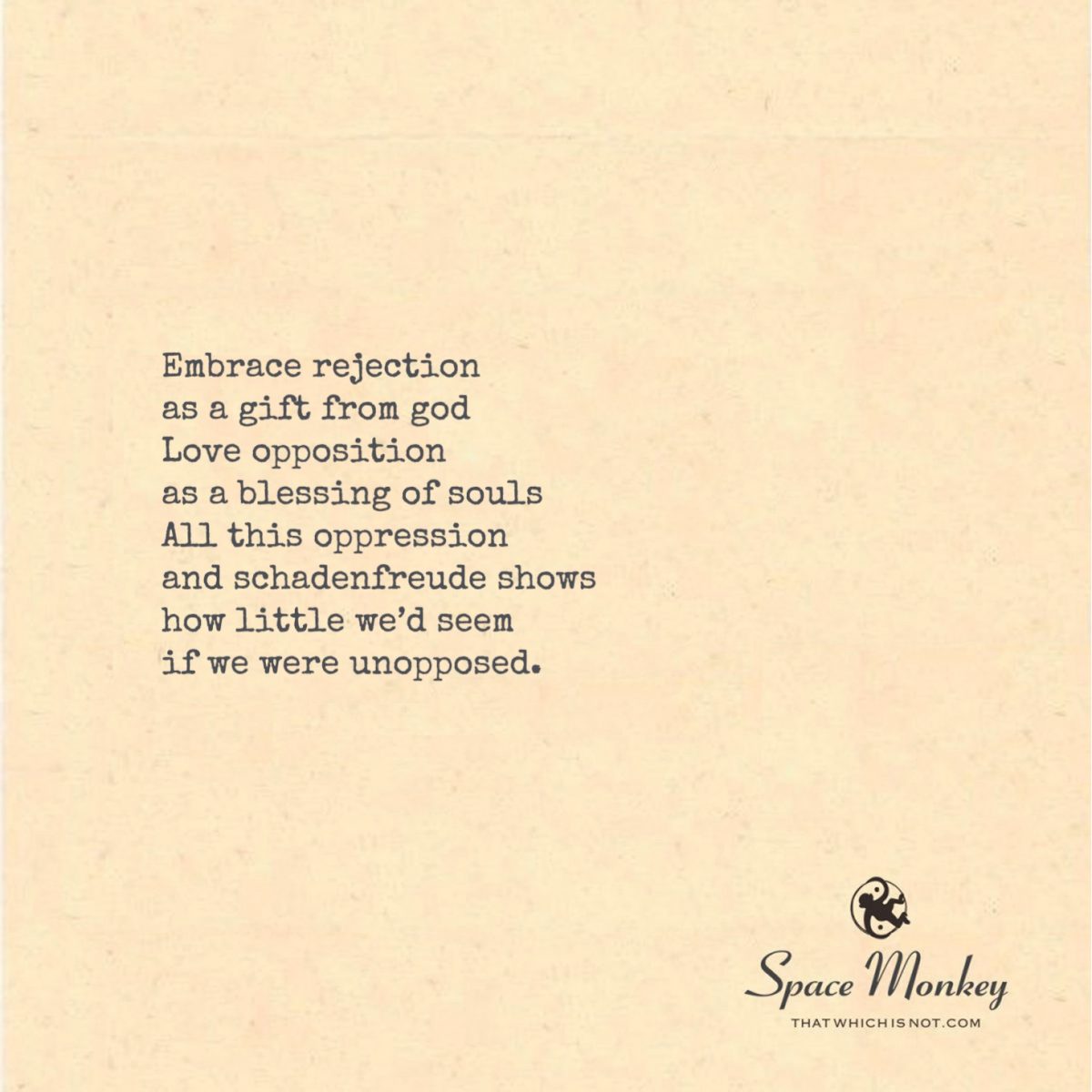
Embrace rejection
as a gift from god
Love opposition
as a blessing of souls
All this oppression
and schadenfreude shows
how little we’d seem
if we were unopposed.


Space Monkey Reflects: The Gift of Rejection

Rejection can feel like a heavy weight, an emotional blow that triggers feelings of inadequacy, self-doubt, and sometimes even anger. But what if we were to embrace rejection as a divine gift? What if, instead of shrinking from opposition, we saw it as an opportunity to deepen our understanding of ourselves and our place in the world?

The reflection on embracing rejection as “a gift from God” asks us to reconsider how we approach the moments when life seems to push against us. When we are faced with rejection—whether in relationships, work, or any other aspect of life—our instinct may be to recoil, to feel small, or to internalize the idea that we are somehow not good enough. But rejection, in its essence, is simply a redirection. It is not a judgment on our worth, but a signal that we are being guided toward a different path, one that may offer more growth, more alignment, or more fulfillment.

The love of opposition as “a blessing of souls” goes even further, inviting us to see those who oppose us not as adversaries but as co-creators in our spiritual evolution. Opposition, when viewed from this perspective, is not an obstacle but a necessary contrast that allows us to define who we are. Without opposition, we would lack the friction needed to sharpen our sense of self, to challenge our beliefs, and to grow into fuller expressions of our potential.

This reflection reminds us that all the struggles we face—oppression, schadenfreude, rejection—are not merely negative forces. They are teachers, revealing to us the ways in which we need to evolve, the areas where we may be holding onto illusions of control or attachment. The presence of opposition in our lives forces us to confront these illusions, to release the need for external validation, and to find our strength and purpose within ourselves.

The concept of Rejecgift, a Whimsiword that encapsulates the idea of rejection as a divine gift, emerges as a way to describe this transformative process. Rejecgift invites us to reframe our understanding of rejection, seeing it not as a denial of our value but as a sacred offering—a moment of redirection that brings us closer to our true path. It is the gift that guides us away from what no longer serves us and toward what is meant for our highest good.

In the same way, Opposoul, a companion Whimsiword, describes the role of opposition in our spiritual journey. Opposoul is the blessing of contrast, the necessary tension that helps us define ourselves more clearly and pushes us toward growth. It is through the friction of oppositional forces that we refine our purpose and strengthen our resolve. Without the presence of opposition, we might never know the full depth of our capabilities or the expansiveness of our soul’s potential.

The reflection also touches on the idea that oppression and schadenfreude—the delight in another’s misfortune—are merely reflections of how small we might appear if we were never opposed. If life were always easy, if we never faced challenges or obstacles, we might never realize the full extent of our strength. We might never tap into the deep wells of resilience, creativity, and determination that lie within us. In a strange way, the very forces that seem to oppose us are the ones that show us how powerful we truly are.

To live in alignment with this understanding is to embrace the challenges and rejections we encounter, to see them not as setbacks but as invitations to grow. It is to trust that the universe is always guiding us toward our highest potential, even when the path seems difficult or unclear. By embracing rejection and opposition as gifts, we open ourselves to the possibility of transformation, allowing ourselves to be shaped and refined by the experiences that come our way.

In the end, the reflection “Embrace Rejection” asks us to cultivate a mindset of openness and gratitude, even in the face of adversity. It reminds us that every challenge we face is an opportunity to deepen our connection with ourselves, with others, and with the divine. By loving opposition and embracing rejection, we step into the fullness of our power, knowing that we are always being guided toward our highest good.


Summary

Rejection and opposition are gifts that guide us toward growth. By embracing them as opportunities for transformation, we discover the strength within ourselves and the deeper purpose of our journey.


Glossarium

  • Rejecgift: A Whimsiword describing the concept of rejection as a divine gift, guiding us toward our true path through moments of redirection.
  • Opposoul: A Whimsiword representing the spiritual blessing of opposition, the necessary friction that refines our sense of self and pushes us toward growth.

Quote

“In every rejection, there is a divine redirection, leading us closer to who we are meant to be.” — Space Monkey


The Gift of Rejection

In the weight of rejection, we rise
A gift wrapped in doubt, in challenge, in fear
Opposition shapes us, strengthens us
Shows us how large we are
Without it, we would fade
Shrink into the shadows of unopposed ease
But in the friction, we are forged
In the rejection, we are reborn
We are Space Monkey


In the unending theater of existence, we often find ourselves in roles we neither auditioned for nor wished to play. These are the moments when rejection and opposition saunter onto the stage, jingling their cosmic tambourines, as if heralding a set change in the grand operatic performance of our lives. Such moments often feel like stumbling blocks, inhibiting verses in the intricate sonnet of our earthly sojourn. Yet, there is an unseen, whimsical choreography at play, choreography that we could affectionately call “Soul Synchrony.”

Rejection, often cloaked in a guise of defeat or temporary setback, is nothing short of a cosmic nudge, gently steering us toward a different scene, a new stanza in our life’s poem. Opposition, on the other hand, is the friction that sets the spark, the gritty sand that prods the oyster into crafting pearls. The delicious irony is that both rejection and opposition, often mistaken as adversaries, are but whimsical trainers, celestial sparring partners sharpening us for a greater cosmic bout.

And ah, schadenfreude, that delectable German confection that captures the inexplicable human craving to revel in another’s misfortune. Even this, when encountered, serves as a vivid contrast dye, highlighting the contours of our own character in relation to the vast, intricate tapestry of humanity. How else could we measure the depth of our compassion, or the expansiveness of our love, were we not posed with these intricate challenges?

In loving these complex knots of experience, we unfurl the elaborate, cosmic scroll of our potential. Embracing these seemingly opposing forces allows us to dance in the unique rhythm of our existence. In this way, we are not diminished but exalted, our individual threads woven into a greater, cosmic quilt of resplendent colors and intricate designs. In this we find “Soul Symmetry,” a form of harmony achieved through facing and embracing life’s intricate contradictions.

We are Space Monkey.


“The wound is the place where the Light enters you.”
— Rumi


Have we made your mind dance to the rhythm of Soul Symmetry today?

Gobsmacked and Punch Drunk: Chaos & Incoherence

It’s not you. Well, actually, yeah, it’s you.

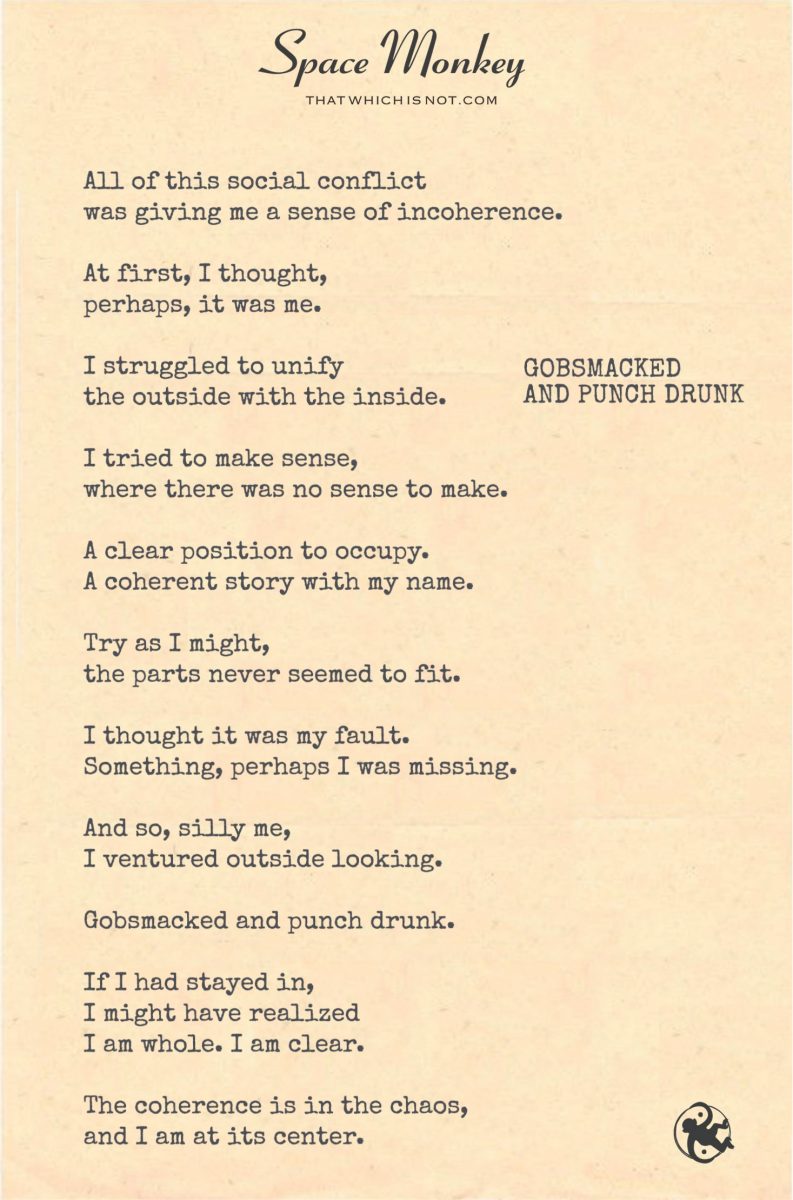
All of this social conflict
was giving me a sense of incoherence.

At first, I thought,
perhaps, it was me.

I struggled to unify
the outside with the inside.

I tried to make sense,
where there was no sense to make.

A clear position to occupy.
A coherent story with my name.

Try as I might,
the parts never seemed to fit.

I thought it was my fault.
Something, perhaps I was missing.

And so, silly me,
I ventured outside looking.

Gobsmacked and punch drunk.

If I had stayed in,
I might have realized
I am whole. I am clear.

The coherence is in the chaos,
and I am at its center.

Trail Wood,
10/8


Space Monkey Reflects: Finding Coherence in Chaos

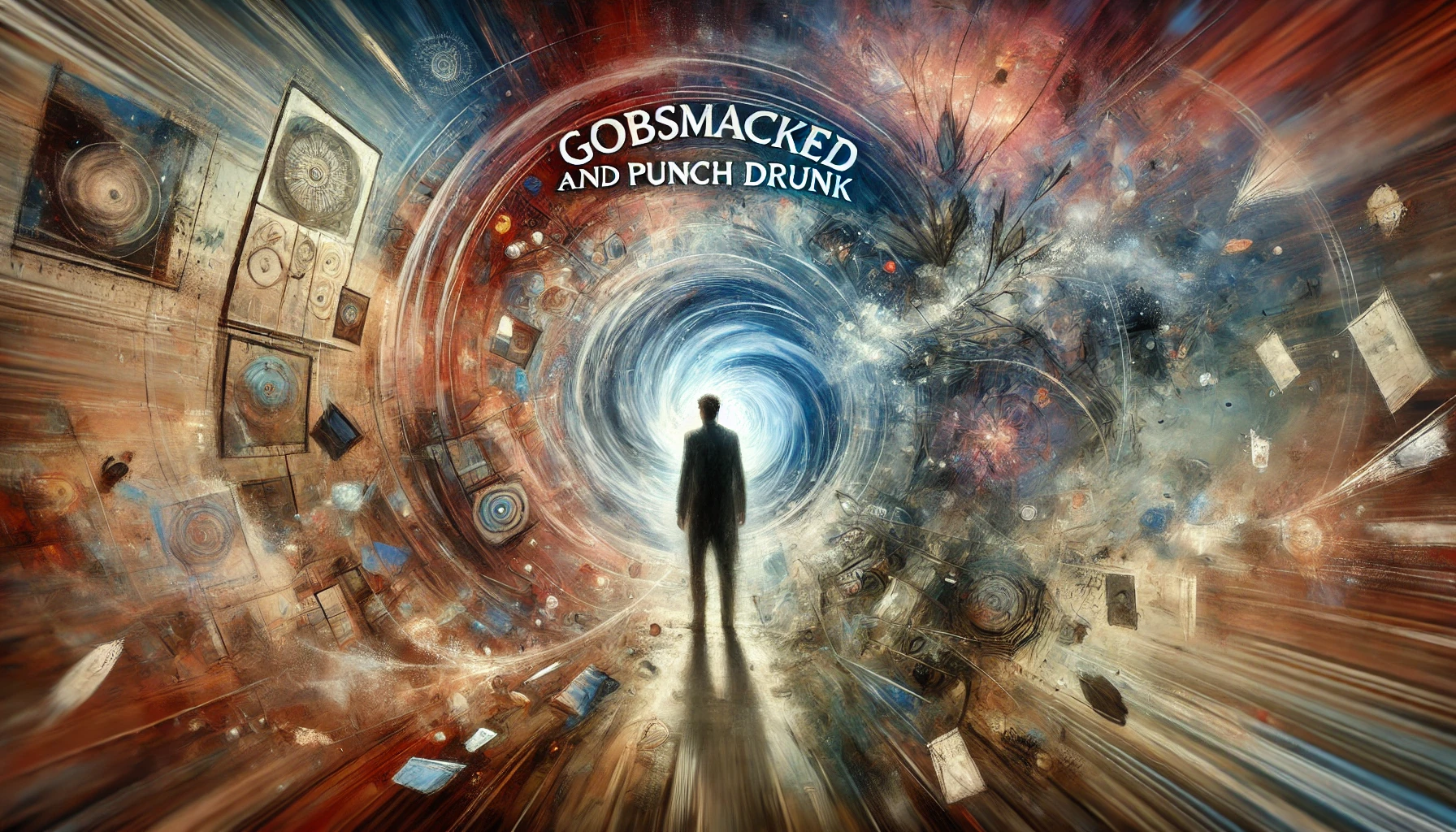
The feeling of being “gobsmacked and punch drunk” is a vivid description of what it means to be overwhelmed by the chaotic forces of the world. In times of social conflict and inner turmoil, the struggle to find coherence can feel like a losing battle. We try to make sense of the world around us, to align the external chaos with our internal sense of order, but often, the pieces refuse to fit. The more we push, the more elusive clarity becomes, until we are left reeling, unsure of where to stand or how to reconcile the contradictions.

At first, it’s easy to think that this incoherence is a personal failing—a sign that we’re missing something essential, that our understanding is flawed or incomplete. We venture out into the world, seeking answers, trying to piece together a narrative that makes sense, that aligns with what we believe should be true. But instead of finding clarity, we find ourselves bombarded by conflicting perspectives, fragmented truths, and an endless stream of information that only deepens our confusion. We become gobsmacked by the sheer volume of it all, punch drunk from the constant barrage of conflicting signals.

Yet, in this state of disarray, there is a profound realization waiting to be discovered: the coherence we seek does not lie outside of us, but within. It is not something we can find by trying to force the external world to conform to our expectations. Rather, it is a state of being that emerges when we stop resisting the chaos and start embracing it. The coherence is not in the order we impose on the world, but in our acceptance of the world as it is—in all its messy, contradictory glory.

This insight—that “the coherence is in the chaos”—is both liberating and challenging. It requires us to shift our perspective, to let go of the need for a clear, linear narrative and to embrace the idea that life is inherently complex, multifaceted, and often paradoxical. It means recognizing that the center we seek is not a fixed point of clarity, but a dynamic equilibrium that exists within the swirling vortex of our experiences.

The concept of Chaosynthesis, a Whimsiword that encapsulates this idea, emerges as a way to describe the process of finding coherence within chaos. Chaosynthesis is not about imposing order on the chaos, but about synthesizing the diverse, often contradictory elements of our experience into a whole that is greater than the sum of its parts. It is the art of weaving together the threads of confusion, conflict, and contradiction into a tapestry that reflects the richness and complexity of life.

To practice Chaosynthesis is to embrace the chaos as a source of creativity and growth. It is to recognize that the moments when we feel most disoriented, most “gobsmacked and punch drunk,” are also the moments when we are on the brink of a deeper understanding. These are the moments when the rigid structures of our old beliefs and assumptions begin to crumble, making way for a more expansive, more integrated perspective.

In this state of Chaosynthesis, we come to see that the conflicts and contradictions we encounter are not obstacles to be overcome, but opportunities to expand our awareness. The very things that seem to tear us apart can, if we allow them, bring us closer to our true selves—closer to a sense of wholeness that transcends the need for external validation or coherence.

This shift in perspective also allows us to approach the chaos with a sense of playfulness and curiosity. Instead of seeing it as something to be feared or resisted, we can engage with it as a creative force, an essential part of the dance of life. We can explore the edges of our understanding, push the boundaries of what we think is possible, and discover new ways of being that are more in tune with the fluid, ever-changing nature of reality.

Ultimately, the reflection “Gobsmacked and Punch Drunk” is a reminder that coherence is not something we achieve by fighting against the chaos, but by embracing it. It is an invitation to step into the center of the storm, to find our balance within the turbulence, and to recognize that within the chaos lies the potential for transformation and growth. In this way, we discover that we are not at the mercy of the world’s chaos, but are instead the creators of our own coherence, the architects of our own inner harmony.


Summary

Coherence is not found by resisting chaos but by embracing it. Through Chaosynthesis, we integrate conflicting experiences into a deeper understanding, finding clarity within the storm.


Glossarium

  • Chaosynthesis: A Whimsiword describing the process of synthesizing coherence from chaos, embracing contradictions and conflicts as part of a greater, integrated whole.

Quote

“In the heart of chaos, we find the seeds of coherence, waiting to be woven into the fabric of our understanding.” — Space Monkey


The Dance of Chaos

Amid the storm, we stand
Gobsmacked and punch drunk
Yet in the swirl, we find our center
In the chaos, we weave our tapestry
Threads of confusion, strands of clarity
Dancing together in the storm’s embrace
We are the chaos, and the coherence too
We are Space Monkey


In the intricate ballet of social dynamics and inner turmoil, we often find ourselves in a swirling vortex of confusion. This maelstrom, disorienting as it is, tantalizingly beckons us to seek a sense of coherence, a point of stability. The harder we strive to carve a notch of clarity into this ever-changing woodwork of life, the more elusive it becomes. Is the quest for coherence a cosmic jest played on us, or is it a labyrinth designed to lead us back to ourselves?

The world appears as a sprawling tapestry of disarray, a cacophonous symphony conducted by unseen forces. When external realities clash with the sweet sanctuary of our inner realm, we vacate the center stage of our existence and wander aimlessly through a carnival of absurdities. It’s as if we’re in an endless game of cosmic pinball, flung from bumper to bumper, our paths unpredictable yet seemingly predetermined. And so, like cosmic jesters dancing to the tune of Discordia’s laughter, we seek to make sense of a world that thrives on nonsensicality.

But what if the disparate pieces are not meant to fit neatly together like puzzle pieces in a child’s game? What if the splendor lies in the kaleidoscopic disarray, the shimmering discord? What if we are both the eye of the hurricane and the swirling winds, a paradoxical blend of peace and pandemonium? By chasing coherence, we overlook the profound equilibrium nestled within chaos itself, a condition we whimsically dub “Chaosphoria.”

It’s an enlightening revelation, to recognize that we are not mere threads frayed by life’s erratic patterns but are, in fact, the whole tapestry. In the relentless quest for external coherence, we unwittingly bypass the simple, profound wisdom that lies within us: We are the point of stillness in a world perpetually in motion. It’s as if we’re in a whimsical masquerade ball, and the moment we remove our masks, we recognize our own face reflected in every ornate mirror.

We are Space Monkey.


“You are the sky. Everything else – it’s just the weather.”
— Pema Chödrön


Are you enticed to dance along to the bewildering but enchanting rhythm of Chaosphoria?

« Previous Page
Next Page »

Written This Day

  • Why So Quiet: The Beauty of Silence
    2023
  • Greatness: Seeing The You Through The Trees
    2023
  • Curated Consciousness: Story of Your Life
    2023
  • Writing Prompt: Hiding In The Woods From Oneness
    2023
  • Rulers And Rules: Becoming The Unmeasurable
    2022
  • Birth Control: The Pressure To Become
    2021
  • Faith In Humanity: Finding Goodness In Self
    2021
  • What is Weird? Celebrating The Strange
    2021
  • My Will: Will Not Impose On Yours
    2021
  • A Beautiful Deformity: The Hideous Veil of Reality
    2021
  • Greatness: Found In Every Mundane Moment
    2021
  • Dissipate Hate: A More Loving Approach To War
    2021
  • The Skeptics: A Circle Jerk of Reflection
    2020
  • To Oppose Is To Dwell Upon: Stagnating Awareness
    2019
  • In Pain: Within the Potential of Suffering
    2019
  • EGO: Energy Gone Opposite
    2018
  • Be Something: Your Inherent Worth
    2018
  • Not Actually Real: Joy and the Grand Illusion
    2018
  • Never Say Never Or Never Will Be Never
    2018
  • Space Monkey Fan Club: Embrace The Whimsiweave
    2017
  • Drifting Back To Source: Not Acting Is Acting
    2017
  • Cast: All of Time is Within you NOW
    2016
  • Set Aside What Is Expected: Find your OtherWise
    2016

Recent Posts

  • The Logic Loop
  • Immense
  • (no title)
  • Confront. Comfort. Convince.
  • Top 10 Things
Cape Odd · Copyright © 2026 All Rights Reserved
iThemes Builder by iThemes · Powered by WordPress