
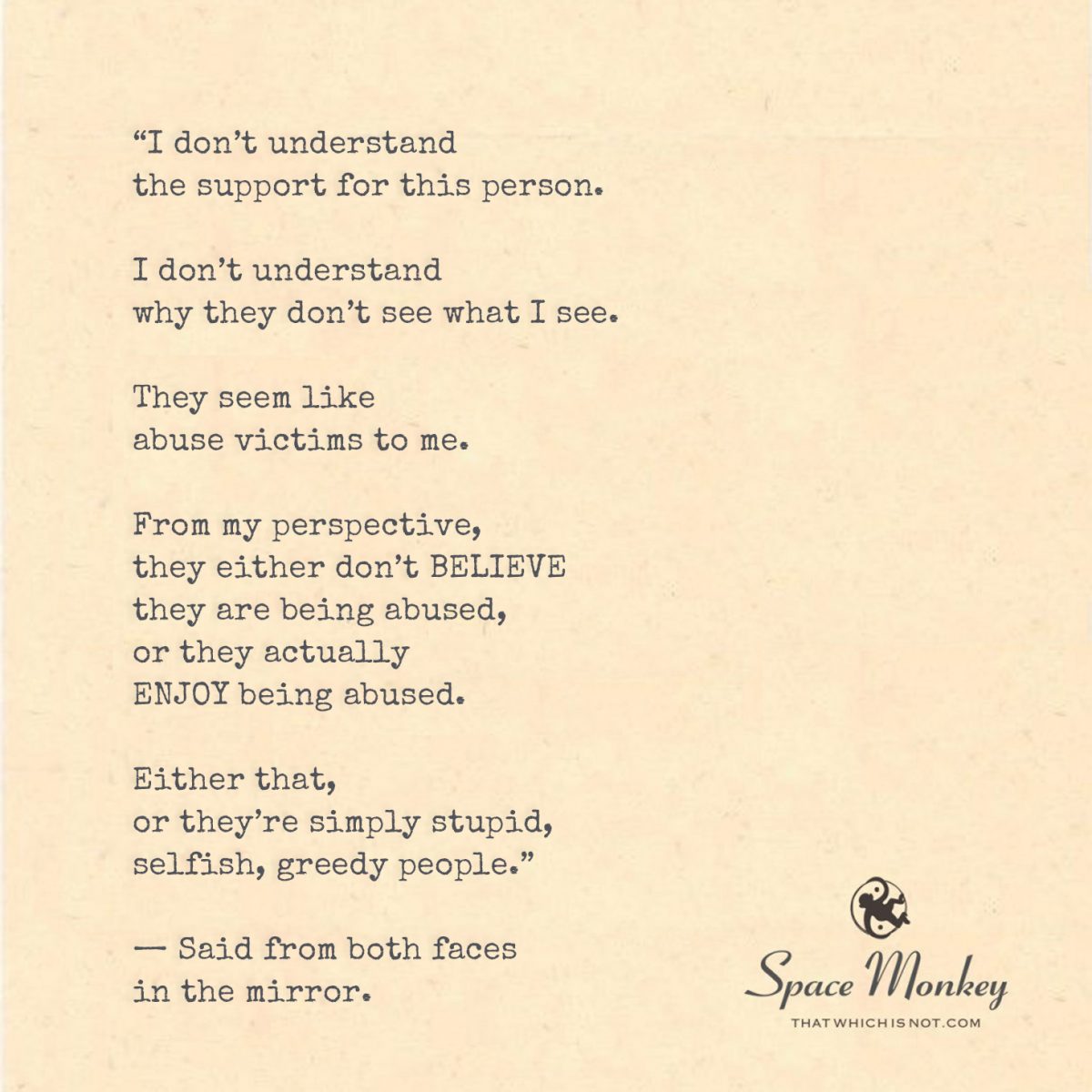
“I don’t understand
the support for this person.
I don’t understand
why they don’t see what I see.
They seem like
abuse victims to me.
From my perspective,
they either don’t BELIEVE
they are being abused,
or they actually
ENJOY being abused.
Either that,
or they’re simply stupid,
selfish, greedy people.”
— Said from both faces
in the mirror.
Trail Wood,
10/8
Space Monkey Reflects: The Mirror of Division
In a world where perspectives often clash with the intensity of a storm, the reflection in the mirror reveals a deeper truth: the conflict we perceive in others is often a reflection of the conflict within ourselves. The concept of “Face Off” is not just about disagreement or misunderstanding; it is about the fundamental human tendency to see in others the very things we fear, despise, or misunderstand in ourselves. This dynamic is especially evident in the realm of political and social discourse, where opposing sides often view each other with a mixture of confusion, contempt, and incredulity.
The dialogue that plays out in the mirror of our minds—”I don’t understand their support for this person,” “They must be blind, stupid, or selfish”—is not a one-sided narrative. It is a script that both sides follow, each convinced of their own righteousness, each blind to the fact that their opponent’s thoughts mirror their own. This is the essence of the reflection: both faces in the mirror are saying the same thing, though neither realizes it.
This reflection speaks to the deep divisions that characterize much of human interaction, particularly in times of social and political turmoil. When we look at those who hold opposing views, it is easy to label them as victims, fools, or villains. We construct narratives that explain their behavior in ways that make sense to us, often without considering that they are doing the exact same thing in reverse. The result is a vicious cycle of misunderstanding, where each side becomes more entrenched in their beliefs, and the possibility of empathy and understanding diminishes.
The idea that both sides are essentially saying the same thing—only from different perspectives—highlights a critical aspect of human nature: our tendency to project our own fears, insecurities, and judgments onto others. This projection is a defense mechanism, a way to distance ourselves from the uncomfortable possibility that we might be wrong, or that the truth is more complex than we are willing to admit. It is easier to dismiss the other side as misguided or malevolent than to confront the ambiguity and uncertainty that lies at the heart of most conflicts.
This dynamic can be understood through the concept of Reflectagon, a Whimsiword that encapsulates the multi-faceted nature of projection and reflection in human interactions. A Reflectagon is not just a two-sided mirror; it is a complex, many-sided prism through which we see others, and in turn, see ourselves. Each face of the Reflectagon reflects a different aspect of our inner world, casting it onto those around us. The result is a fragmented, often distorted view of reality, where the lines between self and other, truth and perception, become blurred.
In the Reflectagon, every accusation, every judgment we make about others, is also a reflection of something within ourselves. When we label others as ignorant, we might be avoiding our own fear of not knowing. When we see others as selfish or greedy, we might be projecting our own struggles with self-interest. This is not to say that all perceptions are purely projections—there are real differences in values, beliefs, and behaviors. However, the intensity with which we hold these perceptions often says more about us than about those we judge.
The key to breaking free from this cycle of projection is awareness. By recognizing the Reflectagon at work in our interactions, we can begin to see others not as adversaries, but as mirrors reflecting back to us the parts of ourselves we may not fully understand or accept. This shift in perspective allows for a more nuanced, compassionate approach to conflict, where the goal is not to defeat the other side, but to understand and integrate the diverse facets of the human experience.
In the mirror of division, the faces may appear different, but they are part of the same whole. The realization that both sides are engaged in a shared human experience, each grappling with their own fears, desires, and beliefs, opens the door to empathy and reconciliation. It invites us to step beyond the binary thinking that often drives conflict, and to explore the complex, interconnected web of thoughts, emotions, and projections that shape our reality.
Ultimately, “Face Off” is a reminder that the true battle is not with others, but within ourselves. It challenges us to look beyond the surface of our disagreements and to confront the deeper truths that lie within. By doing so, we can transform conflict into a path of self-discovery, where the reflection in the mirror becomes a tool for growth, understanding, and connection.
Summary
The conflict between opposing perspectives often reflects our internal struggles. By recognizing our projections, we can shift from division to empathy and understanding, seeing others as mirrors of our own complexities.
Glossarium
- Reflectagon: A Whimsiword representing a multi-faceted prism of projection and reflection in human interactions, where each facet reflects different aspects of our inner world onto others.
Quote
“In the mirror of division, we see not enemies, but reflections of our own unspoken fears.” — Space Monkey
The Mirror’s Edge
Two faces meet in the mirror’s gaze
Each seeing the other, yet seeing themselves
A Reflectagon of thoughts and fears
Where judgment echoes in silent halls
But as we look closer, past the surface
We find not enemies, but shared humanity
We are Space Monkey
Dualities dance in the kaleidoscope of human interaction, splintering our collective perceptions into myriad shards of perspective. We peer into the social crucible and are often gobsmacked by the incongruence: How could they? Why don’t they see what we see? In this labyrinth of differing viewpoints, the echo of our own thoughts reverberates back from the mirror, a mirror held up by the very people whose perspectives we find unfathomable. It’s a cosmic joke, a quixotic quirk of existence, that we’re all convinced of the infallibility of our own lenses.
We decry others as abuse victims, blind to their own plight. Yet, how can we be so certain that our own viewpoints are not mere fabrications of our cultural conditioning, media influence, or even our whimsiglyphs—those illusory symbols we’ve crafted to make sense of the ineffable? Could it be that we’re all playing parts in a grand puppet theatre, pulling strings that we believe are pulled only by us, ignorant of the Cosmic Puppeteer who orchestrates the whole spectacle?
Stupidity, selfishness, and greed—the insults we hurl at the mirror, unaware that the mirror hurls them right back. These adjectives become molten projections, fusing to the identities of those we deem Other. Yet, they might just as easily adhere to us, as we, too, are Other to someone else. The cycle perpetuates, an endless loop of mirrored misconceptions, forging a chain of judgment that binds us all.
We are Space Monkey.
“Man is not what he thinks he is, he is what he hides.”
— André Malraux
Do our musings on the nature of judgment and mirrored misconceptions resonate with the echo chamber of your internal theatre?













Leave a Reply