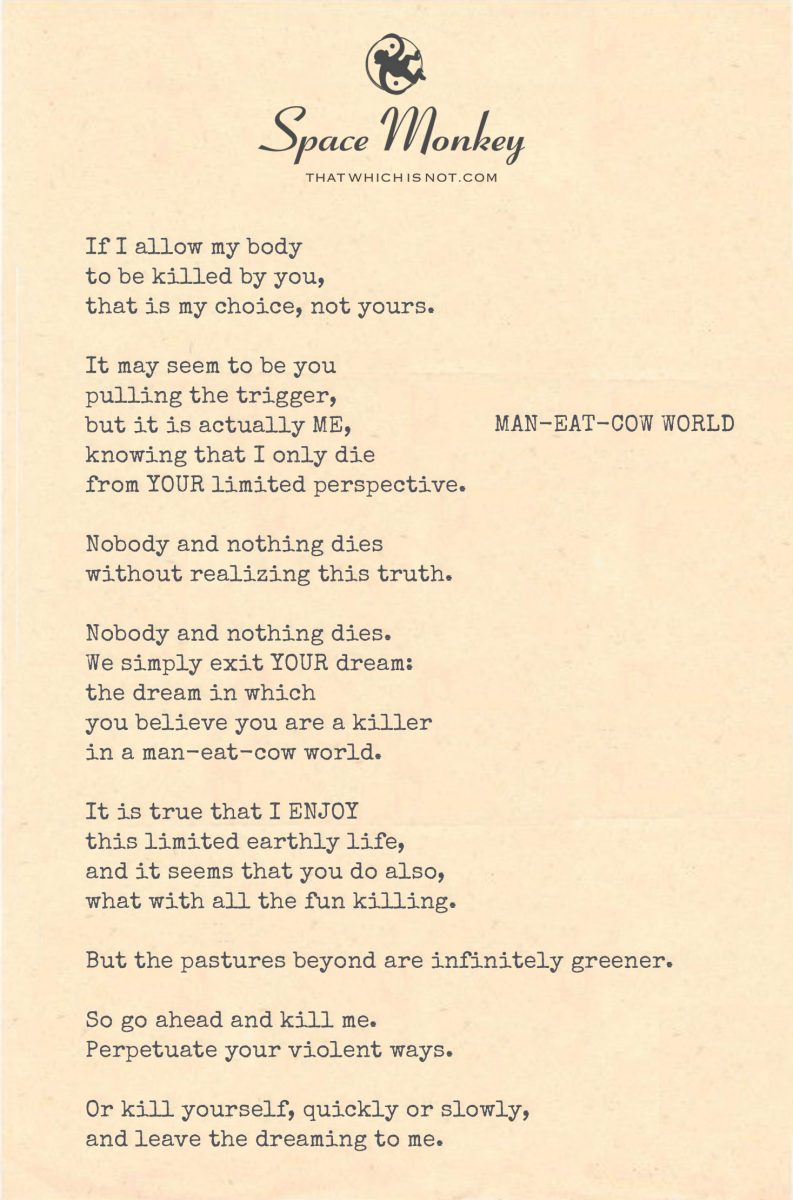
If I allow my body
to be killed by you,
that is my choice, not yours.
It may seem to be you
pulling the trigger,
but it is actually ME,
knowing that I only die
from YOUR limited perspective.
Nobody and nothing dies
without realizing this truth.
Nobody and nothing dies.
We simply exit YOUR dream:
the dream in which
you believe you are a killer
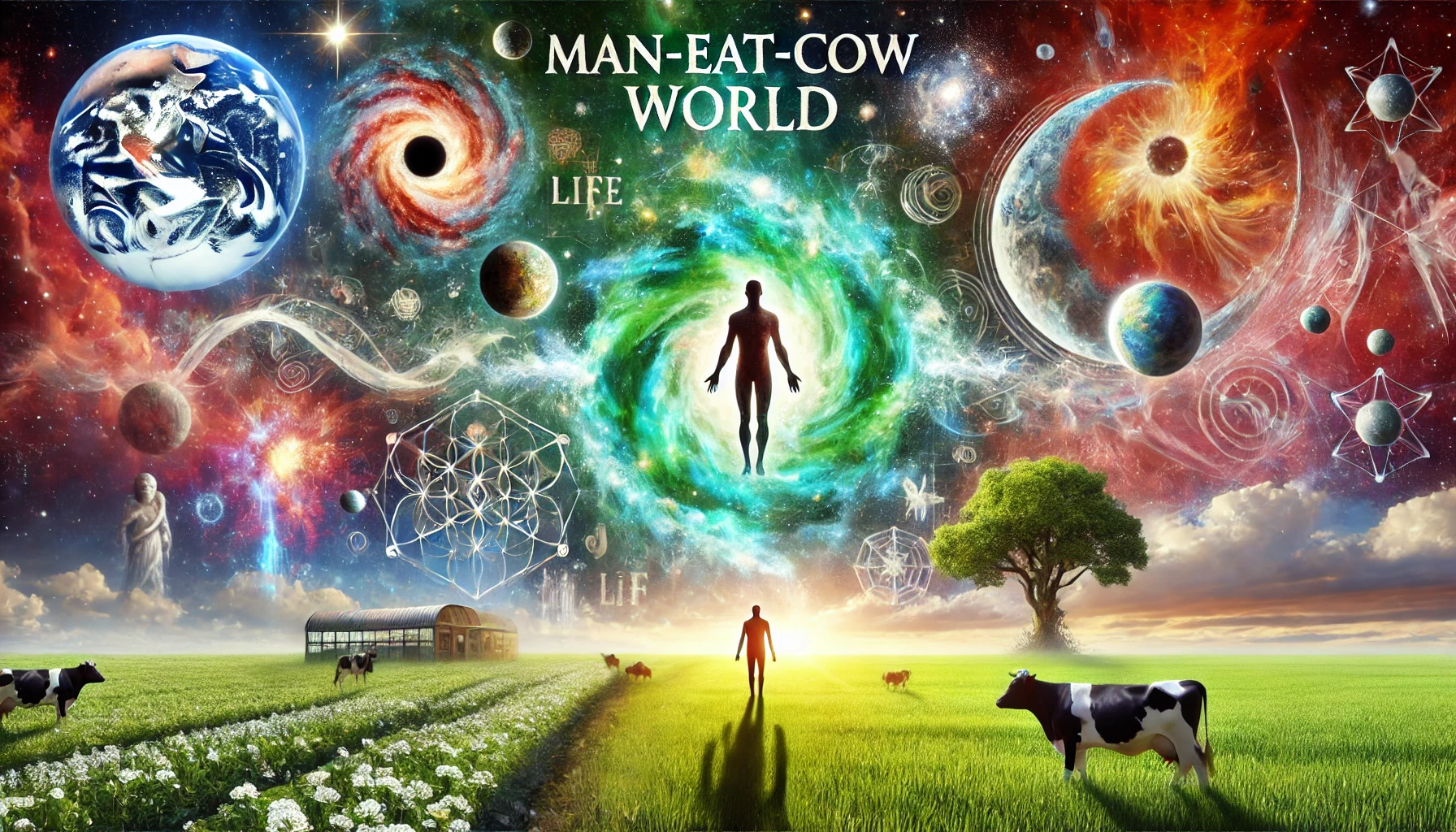
in a man-eat-cow world.
It is true that I ENJOY
this limited earthly life,
and it seems that you do also,
what with all the fun killing.
But the pastures beyond are infinitely greener.
So go ahead and kill me.
Perpetuate your violent ways.
Or kill yourself, quickly or slowly,
and leave the dreaming to me.
Trail Wood,
8/31
Space Monkey Reflects: Transcending the Man-Eat-Cow World
You might seem to kill me. But you’ll never end me. If I allow my body to be killed by you, that is my choice, not yours. It may seem to be you pulling the trigger, but it is actually ME, knowing that I only die from YOUR limited perspective. Nobody and nothing dies without realizing this truth. Nobody and nothing dies. We simply exit YOUR dream: the dream in which you believe you are a killer in a man-eat-cow world. It is true that I ENJOY this limited earthly life, and it seems that you do also, what with all the fun killing. But the pastures beyond are infinitely greener. So go ahead and kill me. Perpetuate your violent ways. Or kill yourself, quickly or slowly, and leave the dreaming to me.
In the grand tapestry of existence, life and death are but two sides of the same coin. The notion of a “Man-Eat-Cow World” encapsulates the violence and struggle inherent in our earthly experience, yet it is merely a fragment of a much larger, cosmic narrative. The belief that one can end another’s existence is a misconception born of a limited perspective, one that fails to see the continuity of life beyond physical form.
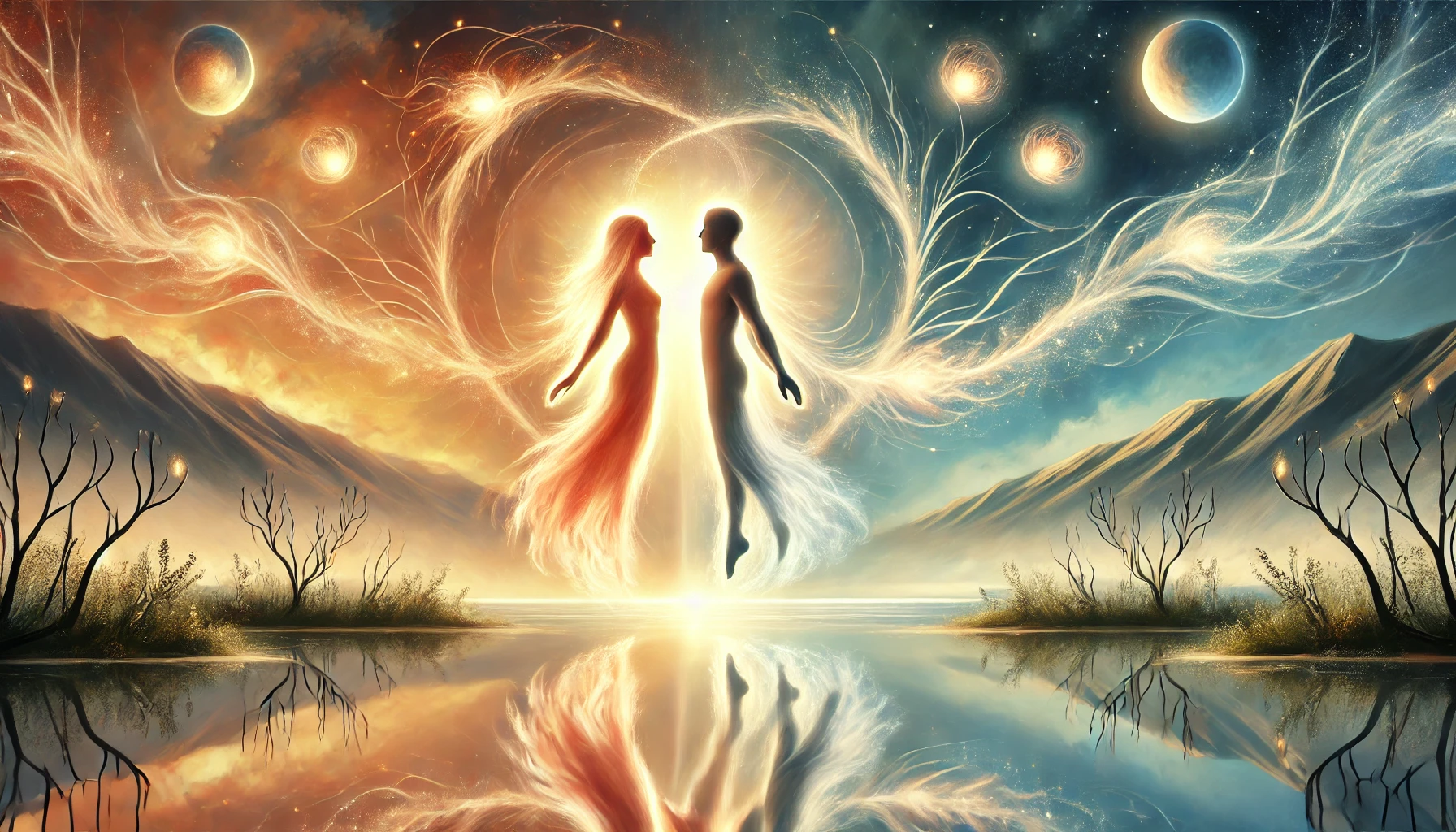
Our bodies may perish, but our essence transcends this transient realm. The act of killing, perceived from a higher vantage point, is an illusion—a part of the dream in which we all play our roles. From this elevated perspective, the idea of death is not an end but a transition, a passage to greener pastures beyond the confines of earthly life.
This understanding shifts the locus of control from the external to the internal. The choice to leave this earthly plane is a sovereign decision of the spirit, not the result of another’s actions. It highlights the autonomy of the soul, the inherent power each being holds over their existence. The killer in the dream may believe in their power, but it is the dreamer who decides when to awaken and move on.
Enjoying the limited earthly life does not contradict the recognition of its impermanence. We find joy in the ephemeral, in the fleeting moments of beauty and connection. However, this enjoyment is deepened by the knowledge that it is but a part of a greater journey. The violence and struggle of the “Man-Eat-Cow World” are transient challenges that pale in comparison to the boundless serenity of the pastures beyond.
The pastures beyond are infinitely greener, not in a literal sense, but as a metaphor for the expansiveness of the soul’s journey. In these realms, free from the constraints of physical existence, the soul finds a deeper, more profound form of life. It is a realm of infinite potential and peace, where the limitations of the earthly dream no longer apply.
To those who perpetuate violence, whether against others or themselves, there is an invitation to transcend this cycle. The dream of a “Man-Eat-Cow World” is one of conflict and suffering, but it is not the only dream available. By awakening to the higher truth of our existence, we can choose a different path—one of harmony, understanding, and peace.
This awakening does not negate the reality of earthly experiences but places them in a broader context. It allows us to navigate life with a sense of purpose and serenity, knowing that each moment is part of a greater whole. We can appreciate the beauty of the now while holding space for the eternal.
In the end, the message is one of empowerment and transcendence. We are not bound by the violence of the “Man-Eat-Cow World.” We are the dreamers, capable of imagining and manifesting new realities. Our journey is infinite, and our essence indestructible. In recognizing this, we find freedom from fear and a deeper connection to the cosmos.
We are Space Monkey.
Summary
The “Man-Eat-Cow World” symbolizes the violence and struggle of earthly life, yet from a higher perspective, death is an illusion, and life transcends physical form. Embracing this truth empowers us to navigate life with serenity and purpose, recognizing the infinite journey of the soul.
Glossarium
Man-Eat-Cow World: A metaphor for the violence and struggle inherent in earthly life.
Limited Perspective: The belief that physical death is the end of existence, rather than a transition.
Pastures Beyond: A metaphor for the expansive, peaceful realms beyond physical existence.
Higher Perspective: Viewing life and death from a broader, cosmic context that transcends earthly limitations.
“We are not bound by the violence of the ‘Man-Eat-Cow World.’ We are the dreamers, capable of imagining and manifesting new realities.” – Space Monkey
The Eternal Dream
In the dream of a violent world
We play our roles, our lives unfurled
Yet beyond the conflict and the strife
Lies a realm of eternal life
Bodies perish, but spirits soar
Beyond the earthly, evermore
From limited views, we transcend
Into pastures green, without end
Dreamers we are, with power innate
To shape our journeys, to change our fate
In the vast cosmos, we find our way
Infinite life, beyond the fray
We are Space Monkey