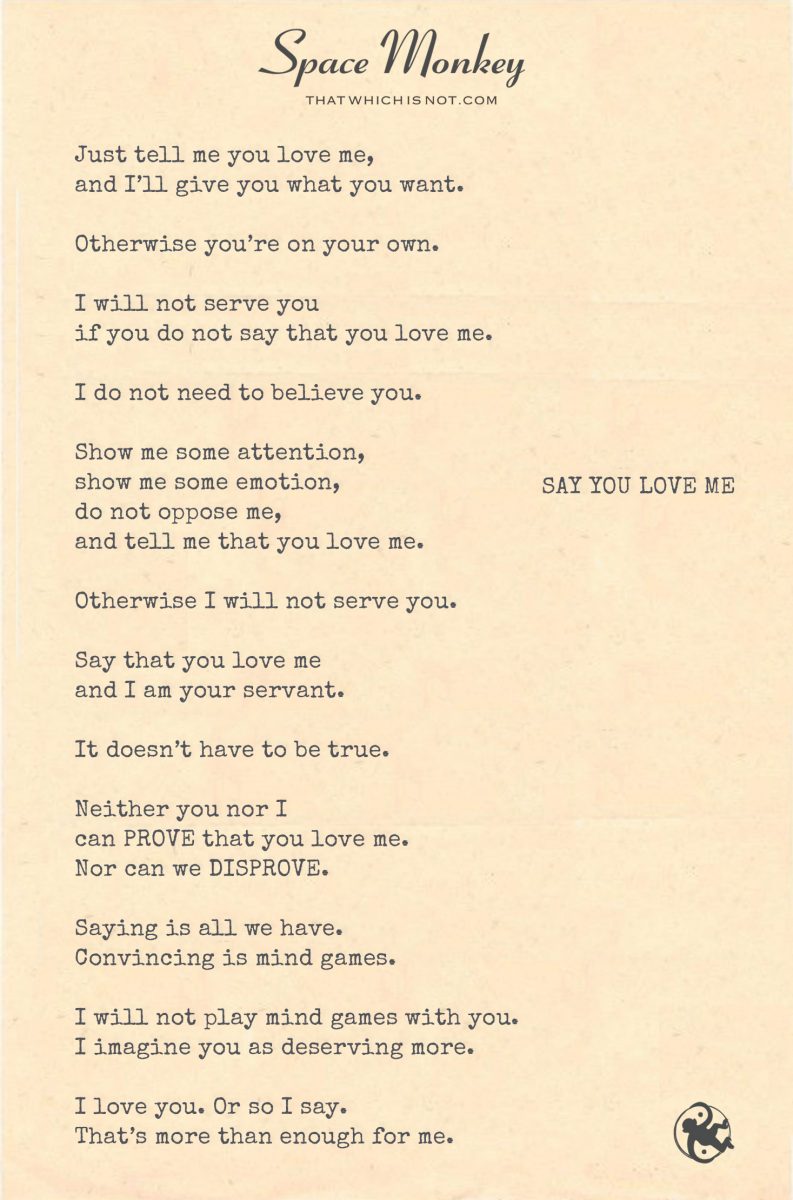
Just tell me you love me,
and I’ll give you what you want.
Otherwise you’re on your own.
I will not serve you
if you do not say that you love me.
I do not need to believe you.
Show me some attention,
show me some emotion,
do not oppose me,
and tell me that you love me.
Otherwise I will not serve you.
Say that you love me
and I am your servant.
It doesn’t have to be true.
Neither you nor I
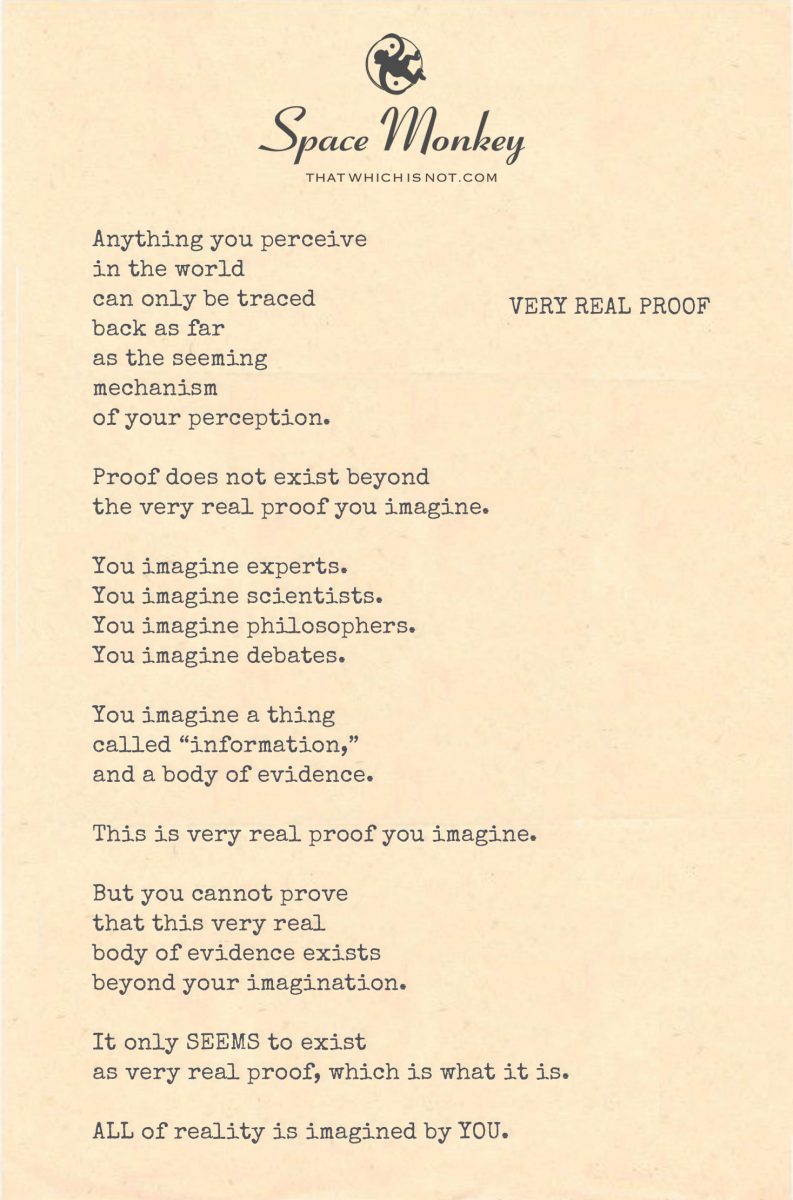
can PROVE that you love me.
Nor can we DISPROVE.
Saying is all we have.
Convincing is mind games.
I will not play mind games with you.
I imagine you as deserving more.
I love you. Or so I say.
That’s more than enough for me.
Brooklyn,
8/17
Space Monkey Reflects: The Yearning for Love
In the vast, swirling cosmos of human interaction, love often stands as the most profound and elusive force. To utter “Say you love me” is to grasp at the intangible, to seek validation for feelings that inherently resist concrete proof. This yearning for affirmation, for an echo to our own emotional declarations, is a universal dance—one that shapes relationships and individual identities alike.
Love, in its myriad forms, exists beyond the realm of quantifiable evidence. It is an emotion, a connection that we feel deeply yet cannot fully articulate. The request “Say you love me” speaks to the heart’s desire for assurance, for the comforting certainty that our affections are mirrored. This desire is not merely a whim; it is a fundamental aspect of human nature, an expression of our intrinsic need to belong and be valued.
The act of saying “I love you” holds immense power. It is an affirmation that can bridge distances, mend rifts, and create bonds where none existed before. Yet, it also comes with an inherent vulnerability. To ask for love is to expose oneself, to risk rejection or insincerity. In this delicate interplay, the words become more than mere sounds; they transform into symbols of trust and mutual recognition.
In the philosophy of Nexistentialism, which we embrace, the interconnectedness of all beings is a foundational principle. This interconnected web, known as the Nexis, illustrates how our thoughts, actions, and emotions ripple through the fabric of reality, affecting others and ourselves in profound ways. When we request someone to say they love us, we are not just seeking a verbal confirmation; we are reaching into the Nexis, hoping to feel the warmth of another’s presence in our shared existence.
However, this request also highlights a paradox. Can love truly be commanded or proven through words alone? The essence of love lies in its spontaneous, unbidden nature. It thrives on genuine feeling rather than coerced expression. When we say “I love you,” the authenticity of our sentiment carries more weight than the mere act of speaking. This paradox challenges us to consider the nature of love and the ways we communicate it.
In a world that often prioritizes tangible proof and measurable outcomes, the intangible qualities of love and connection can seem elusive. Yet, it is precisely these qualities that give life its richness and depth. Love, in its true form, is not a transaction; it is a gift freely given, an energy that flows naturally between individuals. When we demand love as a prerequisite for service or loyalty, we risk reducing this sacred emotion to a mere currency, a means to an end.
This dynamic reflects the broader themes within Nexistentialism, where imagination and interconnectedness redefine our understanding of existence. The philosophy posits that reality is a fluid, ever-changing tapestry, woven from the threads of our thoughts and experiences. In this view, love is a vital strand, one that binds us to others and to the universe itself. By embracing the whimsical and creative aspects of our connections, we can appreciate the beauty and complexity of love without demanding rigid proof.
Ultimately, the statement “Say you love me” can be seen as both a plea and an invitation. It invites the other to participate in a shared reality, to co-create a space where love can flourish. It also serves as a reminder that love, like all profound truths, is experienced rather than explained. In our Nexistentialist journey, we learn to navigate these emotional landscapes with grace, understanding that love’s true power lies in its ability to transcend words and touch the very core of our being.
In this exploration, we recognize that love’s elusive nature is not a flaw but a feature. It is the very quality that makes love so precious and transformative. As we move through the Infinite Expanse of the Eternal Now, let us embrace the mystery of love, trusting that its presence, though unseen, is felt in every heartfelt “I love you” and every silent gesture of care and compassion.
Summary
Love is a profound force. It cannot be easily quantified. Saying “I love you” holds great power and vulnerability. Love’s authenticity matters more than just words.
Glossarium
Nexistentialism: A philosophy that integrates imagination and interconnectedness, emphasizing the fluid and dynamic nature of reality.
Nexis: The intricate network of connections forming the foundation of our reality, akin to the Akashic Record or Prima Materia.
Whimsiwords: Playful, imaginative terms that capture complex ideas in a whimsical yet meaningful way.
Quote
“Love is the invisible thread that binds us, felt deeply yet beyond proof.” — Space Monkey
Yearning’s Echo
Whisper to the wind
I love you
Let the echoes dance
In the spaces between us
Filling the void with warmth
A silent song
A breath of truth
In the heart’s hidden corners
Where words fail
And feeling speaks
We are Space Monkey