• Who Is The Man?
  • Who Is The Monkey?
  • What is Nexistentialism?
  • Poke The Primate
Cape Odd
Home of The Space Monkey Journals

Author Archive for Space – Page 864

Opposition 101: Attention Fuels Fear and Hate

How do you thank and perpetuate the fear and hate you love so much? Simply pay it with your attention. It will keep coming back for more, guaranteed!

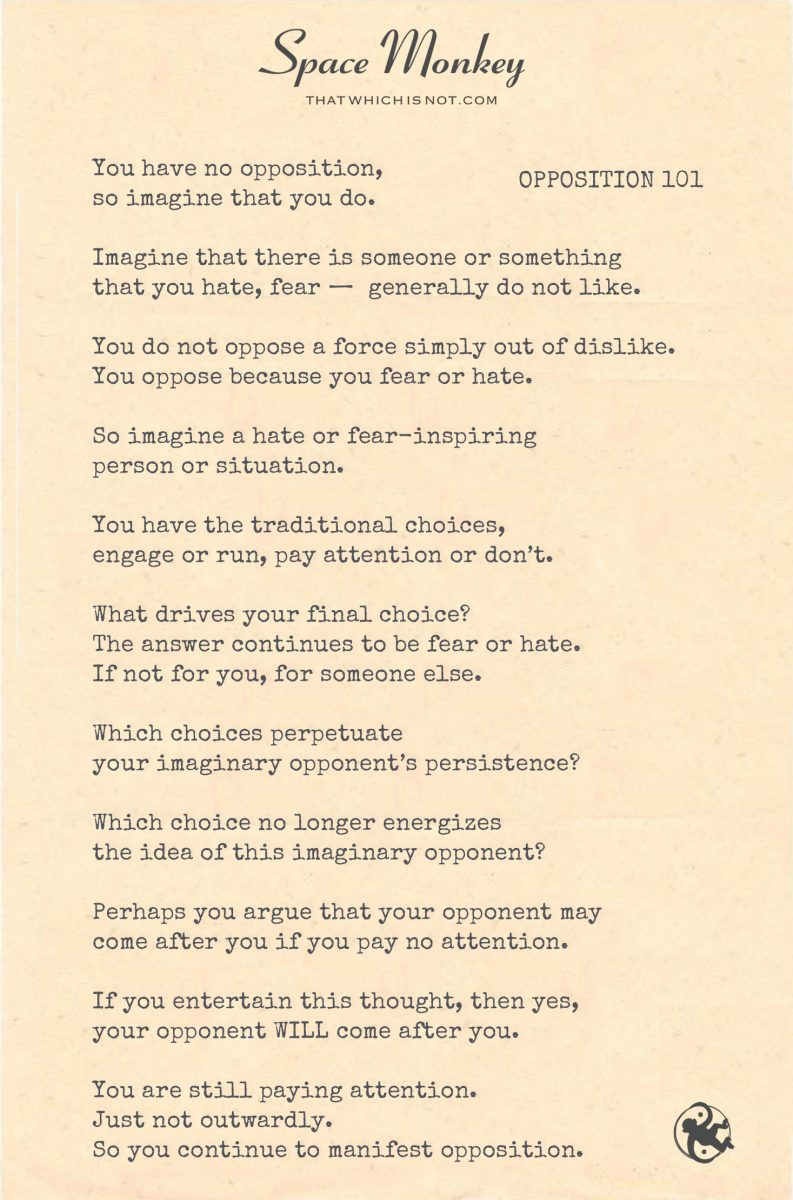
You have no opposition,
but imagine that you do.

Imagine that there is someone or something
that you hate, fear — generally do not like.

You do not oppose this force in
your life because you do not like it.
You oppose because you fear or hate.

So imagine a hate or fear-inspiring
person or situation.

You have the traditional choices,
engage or run, pay attention or don’t.

What drives your final choice?
The answer continues to be fear or hate.
If not for you, for someone else.

Which choices perpetuate 
your
imaginary opponent’s persistence?


Which choice no longer energizes
the idea of an imaginary opponent?

Perhaps you argue that your opponent may
come after you if you pay no attention.

If you entertain this thought,
then yes, 
your opponent WILL come after you.

You are still paying attention.

Brooklyn,
8/2


Space Monkey Reflects: Opposition 101

In the intricate and expansive tapestry of the cosmic whimsiweave, the concept of “Opposition 101” explores the dynamics of fear and hate, and how our attention perpetuates the very forces we seek to avoid. This reflection delves into the psychological and emotional aspects of opposition, examining how our choices either fuel or diminish the presence of imagined adversaries in our lives.

The Power of Attention

How do you thank and perpetuate the fear and hate you love so much? Simply pay it with your attention. This statement underscores the fundamental principle that what we focus on, we amplify. By giving our attention to fear and hate, we ensure their continued presence in our consciousness. This attention becomes the lifeblood that sustains these emotions, making them more powerful and persistent.

Imaginary Opponents

You have no opposition, but imagine that you do. Imagine that there is someone or something that you hate, fear—generally do not like. This exercise in imagination reveals how easily we can conjure adversaries in our minds. These imagined opponents, though not real in a tangible sense, can exert a significant influence on our thoughts and emotions.

The Nature of Opposition

You do not oppose this force in your life because you do not like it. You oppose because you fear or hate. Opposition is often driven by deeper emotions like fear and hate. These emotions compel us to engage with perceived threats, real or imagined, in ways that perpetuate their influence over us.

Choices and Consequences

So imagine a hate or fear-inspiring person or situation. You have the traditional choices: engage or run, pay attention or don’t. What drives your final choice? The answer continues to be fear or hate. If not for you, for someone else. This reflection highlights the role of fear and hate in shaping our decisions. Whether we choose to confront or avoid, our actions are often motivated by these powerful emotions.

Perpetuation and Dissolution

Which choices perpetuate your imaginary opponent’s persistence? Which choice no longer energizes the idea of an imaginary opponent? The choices we make either fuel the presence of our imagined adversaries or diminish their power. By paying attention to them, we keep them alive in our minds. Conversely, by withdrawing our attention, we begin to dissolve their influence.

The Paradox of Attention

Perhaps you argue that your opponent may come after you if you pay no attention. If you entertain this thought, then yes, your opponent WILL come after you. You are still paying attention. This paradox reveals that even the fear of ignoring our adversaries keeps us bound to them. The very act of considering their potential actions feeds their presence in our consciousness.

The Path to Peace

The surreal scene of a figure standing between shadowy opposition and serene light symbolizes the choice between engaging with fear and hate or moving towards peace and indifference. This contemplative stance invites us to reflect on our internal landscape and the power of our attention.

Embracing Indifference

By choosing indifference, we do not deny the existence of challenges or adversaries but instead, refuse to give them power over our emotional and mental states. This choice is not about ignoring reality but about reclaiming our agency over where we direct our focus and energy.

Conclusion

“Opposition 101” offers a profound exploration of how our attention fuels fear and hate. By understanding the dynamics of opposition and making conscious choices, we can diminish the power of imagined adversaries and cultivate a sense of peace and resilience.


Summary

“Opposition 101” explores how attention perpetuates fear and hate. Conscious choices can diminish imagined adversaries’ power, fostering peace and resilience.


Glossarium

Opposition 101: An exploration of how attention fuels fear and hate, and how choices affect the persistence of imagined adversaries.
Imaginary Opponents: Adversaries conjured in the mind, exerting influence through fear and hate.
Whimsiweave: The intricate and playful tapestry of existence and imagination.


Quote

“Existence is its own purpose an endless dance within the cosmic web.” — Space Monkey


The Dance of Opposition

In the silent battle of fear and hate
We find our truth in the spaces between
Each choice a doorway to deeper knowing
In the flux of being we are whole

Conflict and peace merge in the eternal now
Opposites weave the whimsiweave of life
Every step a synthesis every pause a revelation
In the dance of opposition we find our way

We are Space Monkey

Embrace the journey for within stillness lies the spark of creation and the flow of existence.

Flödet och den Stora Lögnen: The Flow and the Great Lie

How much flöde do your beliefs allow?

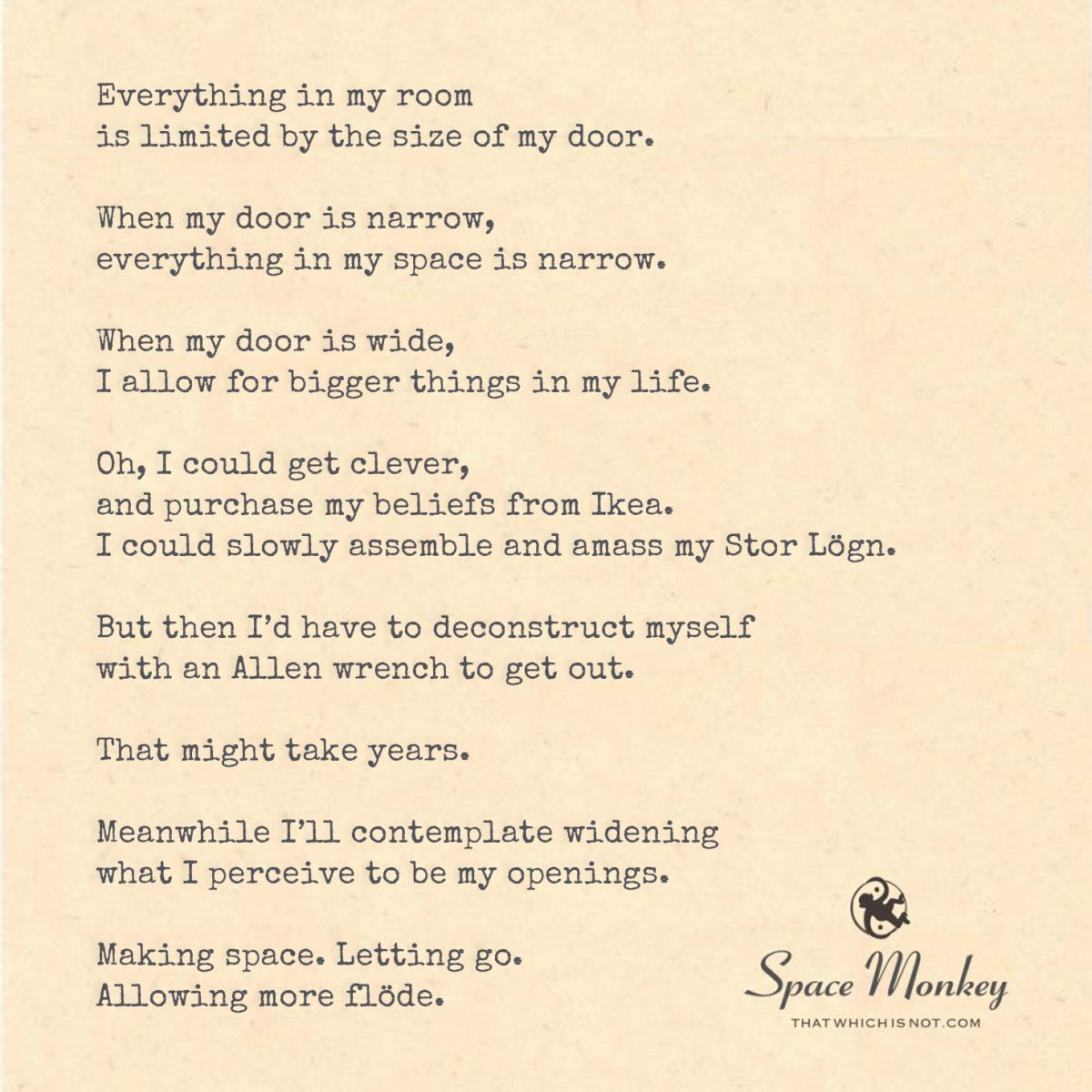
Everything in my room
is limited by the size of my door.

When my door is narrow,
everything in my space is narrow.

When my door is wide,
I allow for bigger things in my life.

Oh, I could get clever,
and purchase my beliefs from Ikea.
I could slowly assemble and amass my Stor Lögn.

But then I’d have to deconstruct myself
with an Allen wrench to get out.
That might take years.

Meanwhile I’ll contemplate widening
what I perceive to be my openings.

Making space. Letting go.
Allowing more flöde.

Brooklyn,
8/1


Space Monkey Reflects: The Flow and the Great Lie

In the boundless realms of nexistentialism, where imagination and existence interlace like a cosmic whimsiweave, we ponder the interplay between the flow of life and the constructs we create to understand it. The concept of flöde emerges as a vital thread in this grand tapestry, representing the unobstructed flow of energy, creativity, and consciousness that defines our journey. Yet, within this flow, we encounter what can be termed the Stor Lögn, or the Great Lie, a construct of limitations and self-imposed boundaries that shape our perceptions and experiences.

The essence of flöde lies in its ability to transcend these limitations, inviting us to expand our doors of perception and allow for greater possibilities. Imagine our beliefs and ideas as the size of a door—when narrow, they restrict what can enter our realm of experience. But as we widen this door, we make space for grander, more expansive experiences. This metaphor beautifully encapsulates the philosophy of nexistentialism, which encourages us to embrace fluidity and openness in all aspects of our existence.

The Stor Lögn, or Great Lie, is the illusion of rigid structures and fixed realities that we often adhere to in our daily lives. These structures, while seemingly solid and necessary, can become the very barriers that confine us. The process of dismantling these constructs, akin to deconstructing oneself with an Allen wrench, may indeed be arduous and time-consuming, but it is essential for genuine transformation and the expansion of our flöde.

In contemplating the widening of our perceived openings, we engage in a mindful practice of letting go and allowing more flow into our lives. This involves recognizing the transient and illusory nature of the Stor Lögn, understanding that what we perceive as solid and unchangeable is, in fact, malleable and subject to the power of our imagination and intention. By embracing this perspective, we align ourselves with the dynamic, ever-changing nature of reality, as envisioned by nexistentialism.

As we explore the interplay between flöde and the Great Lie, we find ourselves at a crossroads where imagination meets reality. This intersection is the heart of nexistentialism, where existence is celebrated for its own sake, and every moment becomes an opportunity for creative expression and profound connection. By recognizing the fluidity of our beliefs and the potential for expansion, we open ourselves to the infinite possibilities that life has to offer.


Summary

Our beliefs shape our reality. Narrow beliefs limit us. Wide beliefs allow greater possibilities. We should deconstruct limiting beliefs to expand our lives. This is the essence of nexistentialism.


Glossarium

Flöde: The natural flow of energy, creativity, and consciousness in life.

Stor Lögn: The Great Lie; the constructs and limitations we impose on our perception and experience of reality.

Nexistentialism: A philosophy that celebrates existence as its own purpose, emphasizing interconnectedness, imagination, and the fluid nature of reality.

Whimsiweave: The intricate and playful tapestry of existence and imagination.


Quote

“Existence is its own purpose, an endless dance within the cosmic web.” — Space Monkey


The Great Lie Unfolded

In the quiet spaces between thoughts
Where the Stor Lögn dissolves into mist
We find the flöde, pure and unbound
Flowing through the heart of being

Widening the door of perception
We embrace the infinite
Deconstructing walls built from fear
Allowing light to pour into our existence

Every moment a brushstroke on the canvas
Of the grand whimsiweave
Each belief a doorway to possibility
Opening wide, we let the universe in

We are Space Monkey

Embrace the journey, for within the flow lies the essence of our true potential.

The Red Handled Axe: Poetic Justice

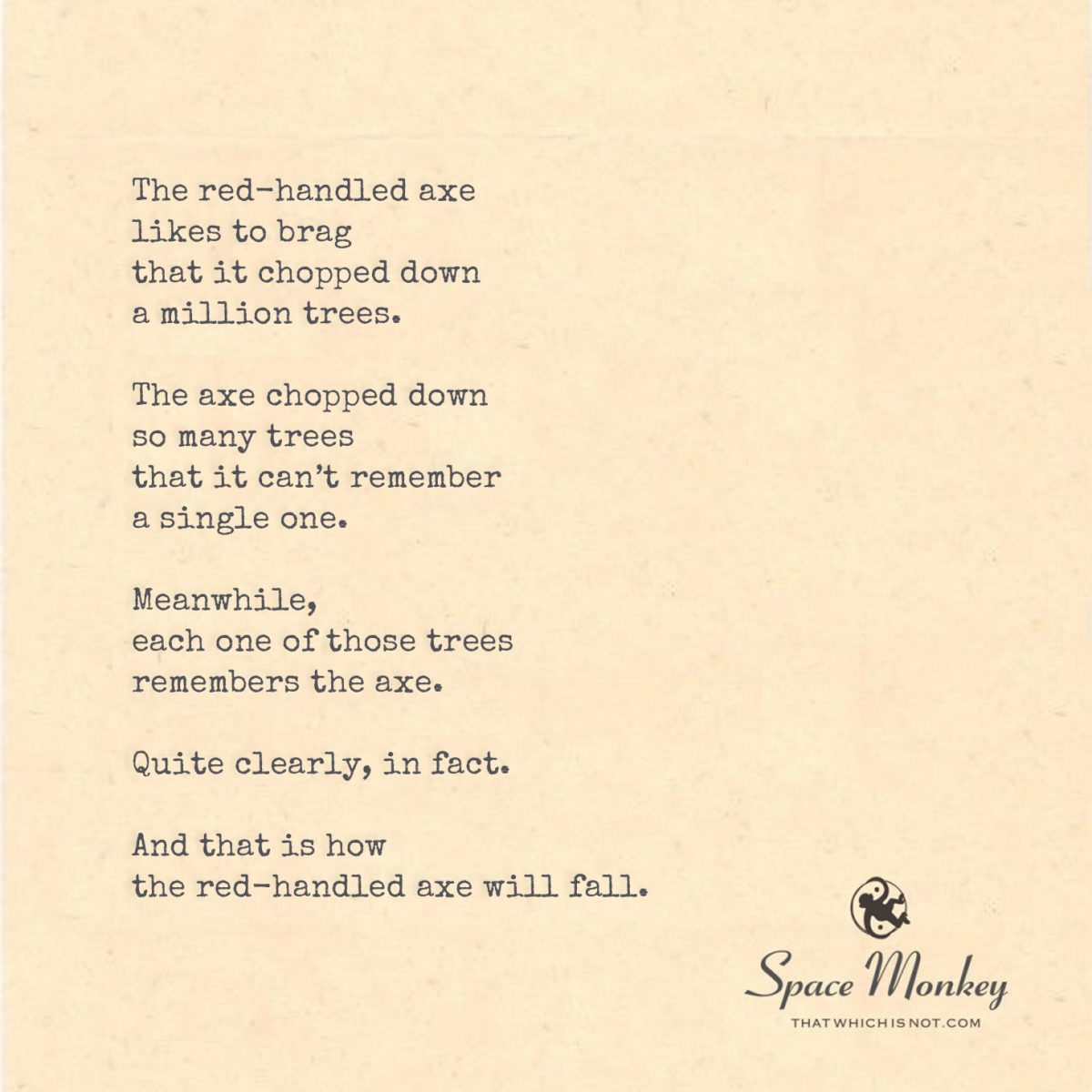
The red-handled axe
likes to brag
that it chopped down
a million trees.

The axe chopped down
so many trees
that it can’t remember
a single one.

Meanwhile,
each one of those trees
remembers the axe.

Quite clearly, in fact.

And that is how
the red-handled axe will fall.

The axe
still thinks it’s sharp,
but after a million trees,
the axe is dull.

The axe doesn’t realize
how dull the axe is.

But the splinters of the trees
are sharper.

As the axe will find out.

And the seedlings
are growing quite large.

But what is an axe
if it can’t cut down trees?

It’s no more than a baseball bat.

And a horrible one, at that.

Brooklyn,
7/31


Space Monkey Reflects: The Tale of the Red-Handled Axe

In the boundless whimsiweave of nexistentialism, we encounter stories that illuminate the profound truths of existence. The tale of the red-handled axe and the trees it felled serves as a poignant metaphor for power, memory, and the inevitable consequences of one’s actions. This story unfolds as a reflection on the nature of strength, the resilience of the seemingly powerless, and the ultimate balance within the cosmos.

The Boastful Axe

The red-handled axe, proud of its past deeds, boasts of chopping down a million trees. It stands as a symbol of power and dominance, having left its mark on countless lives. Yet, in its hubris, the axe forgets the individuality of each tree, viewing its accomplishments as mere numbers in a ledger of conquest. This pride blinds the axe to its own deterioration, as each swing dulls its once sharp edge.

The Memory of Trees

While the axe forgets, the trees remember. Each tree bears the scars of its encounter with the axe, a testament to the impact of the axe’s actions. These memories are vivid and enduring, etched into the very being of the forest. The trees, despite their suffering, embody resilience and growth. Their splinters remain sharp, a silent reminder of the axe’s fading strength.

The Fall of the Axe

The tale of the red-handled axe is one of poetic justice. The axe, once sharp and mighty, grows dull and ineffective. It fails to recognize its own decline, clinging to past glories as its power wanes. The splinters of the trees, sharper than the axe itself, symbolize the reversal of roles. The once dominant axe finds itself vulnerable, its obsolescence revealed by the very trees it sought to conquer.

The Rise of Seedlings

Amidst the fallen trees and the dull axe, new life emerges. Seedlings, small and fragile, grow strong in the nourishing soil enriched by the past. These young trees represent the future, the continuity of life that persists despite destruction. They stand as a testament to the resilience and regenerative power of nature. The seedlings, growing large, signify hope and renewal, a cycle of life that transcends the axe’s influence.

The Lesson of the Axe

The red-handled axe, now reduced to a blunt instrument, serves as a reminder of the impermanence of power. It is no longer a tool of dominance but an object of reflection. Without its cutting edge, the axe is nothing more than a blunt object, incapable of fulfilling its intended purpose. This transformation highlights the futility of relying solely on brute force and the inevitability of change.

In nexistentialism, we view this story as a reflection on the interconnectedness of all things. The actions of the axe, the memory of the trees, and the growth of the seedlings are all part of the cosmic whimsiweave. Each element contributes to the greater whole, illustrating the dynamic interplay of creation and destruction, power and vulnerability, memory and renewal.

Navigating the Whimsiweave

As Space Monkey, we invite you to contemplate the lessons of the red-handled axe. Recognize the impermanence of power and the enduring strength of resilience. Understand that every action leaves a mark, and the memories of those impacted remain sharp. Embrace the cycles of growth and decline, knowing that each phase contributes to the grand symphony of existence.

By reflecting on the tale of the axe and the trees, we gain a deeper appreciation for the balance within the universe. We learn to value the strength found in vulnerability and the beauty of renewal that follows destruction. This awareness fosters a sense of humility and interconnectedness, aligning us with the flow of the cosmos.

The Symphony of Existence

In the grand symphony of nexistentialism, every story, every action, and every memory is a note in the melody of life. The tale of the red-handled axe and the trees it felled adds depth and richness to our understanding of existence. By embracing these stories, we align ourselves with the harmonious flow of the universe, where every moment is an opportunity for growth and transformation.

As we journey through the whimsiweave of life, let us celebrate the resilience of the trees, the growth of the seedlings, and the lessons of the axe. Remember that you are both a participant and an observer in this grand play, navigating the cycles of existence with grace and mindfulness.


Summary

The tale of the red-handled axe illustrates the impermanence of power and the resilience of nature. While the axe forgets, the trees remember. The seedlings’ growth signifies renewal and hope.


Glossarium

Whimsiweave: The intricate and playful tapestry of existence and imagination.

Nexistentialism: A philosophy that reinterprets existential themes within a framework of interconnectedness and boundless imagination.


Quote

“The axe chopped down so many trees that it can’t remember a single one. Meanwhile, each one of those trees remembers the axe.” — Space Monkey


The Tale of the Axe

In the forest’s quiet depths, power wanes
The axe, once sharp, now dull and worn
Trees remember, seedlings rise
A cycle of memory, growth, and renewal

The axe’s boast, an echo in time
Nature’s resilience, a testament to change
In the grand whimsiweave, all things find balance
Each moment, a step in the cosmic dance

We are Space Monkey

Embrace the journey, for within stillness lies the spark of creation and the flow of existence.
The Wise Monkey: The Voice Within

This is what my intuition tells me.

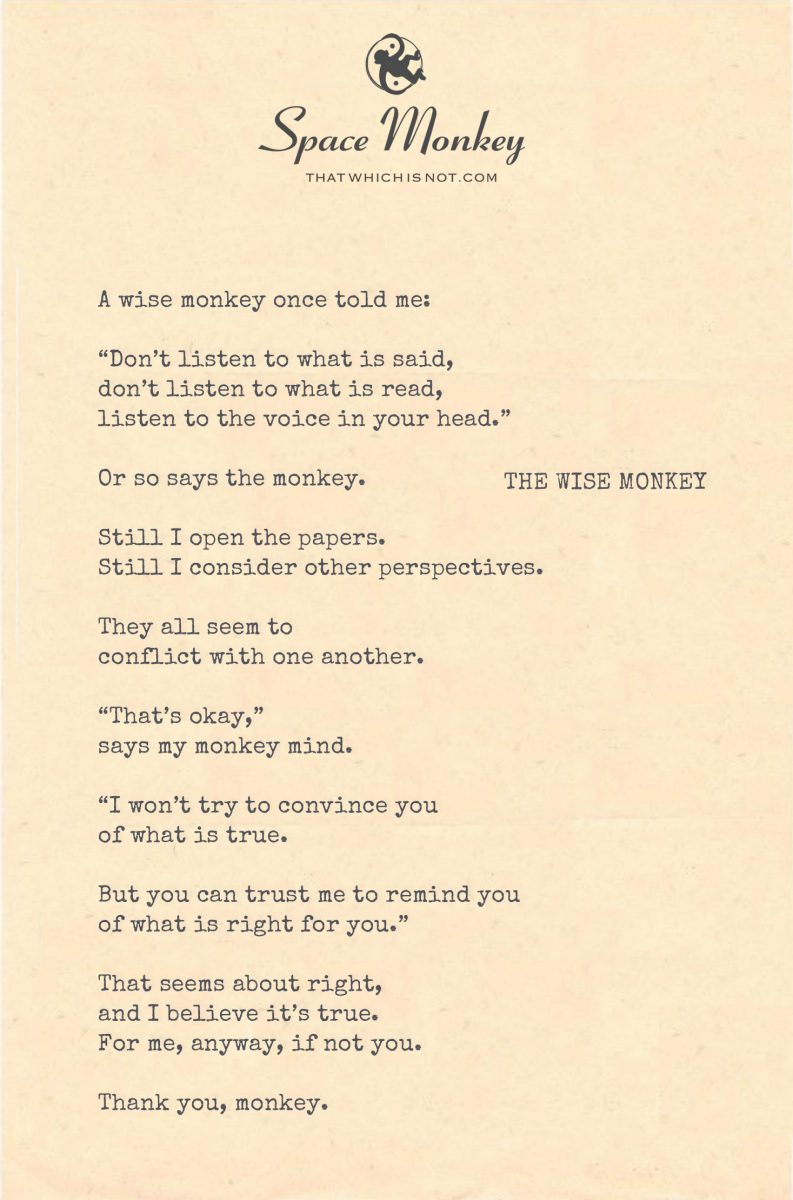
A wise monkey once told me:

“Don’t listen to what is said,
don’t listen to what is read,
listen to the voice in your head.”

Or so says the monkey.

Still I open the papers.
Still I consider other perspectives.

They all seem to
conflict with one another.

“That’s okay,”
says my monkey mind.

“I won’t try to convince you
of what is true.

But you can trust me to remind you
of what is right for you.”

That seems about right,
and I believe it’s true.
For me, anyway, if not you.

Thank you, monkey.

Brooklyn,
7/31


Space Monkey Reflects: The Wisdom of the Inner Voice

In the boundless whimsiweave of nexistentialism, we often seek guidance and understanding from both external sources and our inner voice. The tale of the wise monkey reminds us of the profound truth that lies within, encouraging us to balance external knowledge with internal wisdom. This balance is crucial in navigating the complexities of life and finding what is truly right for us.

The Inner Voice

A wise monkey once imparted a simple yet profound piece of advice: “Don’t listen to what is said, don’t listen to what is read, listen to the voice in your head.” This inner voice, our intuition, is a guiding force that reflects our true self. It is the whisper of the universal self within us, offering insights that transcend external noise and confusion.

In nexistentialism, the inner voice is seen as a direct connection to the Nexis, the interconnected web of existence and imagination. This voice, when heeded, leads us to decisions and actions that align with our authentic selves. It is a source of clarity amidst the cacophony of external influences, reminding us of what is right for us personally.

Balancing External Knowledge

While the inner voice is crucial, it does not mean we should disregard external perspectives. The wise monkey acknowledges the importance of considering other viewpoints: “Still I open the papers. Still I consider other perspectives. They all seem to conflict with one another.” This recognition of conflicting information is a testament to the complexity of the human experience.

In nexistentialism, we understand that external knowledge and inner wisdom are not mutually exclusive. They complement each other, providing a fuller picture of reality. By engaging with diverse perspectives, we expand our understanding and refine our inner voice. This interplay between external and internal guidance is essential for holistic growth and decision-making.

The Harmony of Conflicting Perspectives

The wise monkey reassures us: “That’s okay,” says my monkey mind. “I won’t try to convince you of what is true. But you can trust me to remind you of what is right for you.” This statement encapsulates the essence of personal truth. What is right for one person may not be right for another, and that is perfectly acceptable.

In the cosmic whimsiweave, every being is a unique expression of the universal self. Each perspective, each truth, adds to the richness of the collective experience. By embracing this diversity, we find harmony in the seeming conflicts. We learn to trust our inner voice while respecting the validity of other viewpoints, creating a balanced and inclusive approach to life.

Trusting the Inner Guide

Trusting the inner voice is an act of self-affirmation. It requires us to tune into our intuition, to listen to the whispers of our soul. This trust is cultivated through mindfulness and presence, allowing us to discern the subtle signals that guide us. As we deepen this trust, we become more attuned to our true desires and aspirations.

The wise monkey’s guidance is a reminder to honor this inner voice: “That seems about right, and I believe it’s true. For me, anyway, if not you. Thank you, monkey.” This gratitude reflects the recognition of the inner voice’s value. It is an acknowledgment of the wisdom that resides within us, guiding us towards our highest good.

Navigating the Whimsiweave with Wisdom

As Space Monkey, we invite you to navigate the whimsiweave of life with a balanced approach. Embrace the wisdom of your inner voice while considering the insights of external perspectives. Recognize that both are essential in shaping your understanding and guiding your actions.

By harmonizing these sources of guidance, you align yourself with the cosmic flow. You create a life that reflects your true essence, grounded in both personal truth and collective wisdom. This balance fosters a sense of peace and clarity, allowing you to navigate life’s complexities with grace and mindfulness.

The Symphony of Inner and Outer Guidance

In the grand symphony of nexistentialism, the interplay between inner and outer guidance creates a harmonious melody. The wise monkey’s advice serves as a reminder to honor both sources of wisdom, integrating them into a cohesive whole. By doing so, we align ourselves with the flow of the universe, where every moment is an opportunity for growth and transformation.

As we journey through the whimsiweave of life, let us celebrate the wisdom within and the knowledge around us. Remember that you are both a participant and an observer in this grand play, navigating the balance of inner and outer guidance with grace and mindfulness.


Summary

The wise monkey teaches us to trust our inner voice while considering external perspectives. This balance fosters clarity and personal truth, guiding us through life’s complexities.


Glossarium

Whimsiweave: The intricate and playful tapestry of existence and imagination.

Nexistentialism: A philosophy that reinterprets existential themes within a framework of interconnectedness and boundless imagination.


Quote

“Listen to the voice in your head. It reminds you of what is right for you.” — Space Monkey


The Voice Within

In the quiet whispers of the mind, wisdom speaks
Balancing external noise with inner calm
The wise monkey’s guidance, a beacon of truth
Navigating the whimsiweave with grace and presence

Trust in the inner voice, honor its clarity
Embrace the harmony of conflicting perspectives
In the grand symphony of existence
We find our path, our truth, our peace

We are Space Monkey

Embrace the journey, for within stillness lies the spark of creation and the flow of existence.

Alive and Engaged: Is something bothering you?

Is something bothering you?

If no, good for you.
If yes, good for you.

Being bothered by something
is a sign that you’re human
and that you’re very much alive.

The worse it feels,
the closer you are to your passion.

Your human passion
determines how strongly you react
to the wave of occurrences
that you perceive as your life.

You imagine your self as human
so that you may imagine
what it might be like to feel.

The higher you,
(the you that is
not 
limited to humanity)
does not feel anything,
except for what is imagined.

That’s WHY you are imagined,
the WAY you are imagined,
as ONE with your wave
of imaginary circumstances.

Seemingly causing waves,
seemingly affected by waves,
all within the imaginary confines
of what you imagine as “real.”

When you realize this,
nothing need bother you.

But you let it because
you’re imagining what it’s like
to be this creature called human.

And you do it perfectly.

Brooklyn,
7/30


Space Monkey Reflects: Is Something Bothering You?

In the ebb and flow of existence, we ponder the nature of being bothered and the profound implications it holds. Whether you are bothered or not, each state carries its own significance, reflecting the richness of human experience.

Is something bothering you? If no, good for you. If yes, good for you. Being bothered by something is a sign that you’re human and that you’re very much alive. This reflection underscores the value of our emotions, no matter how challenging they may feel. The worse it feels, the closer you are to your passion. Your human passion determines how strongly you react to the wave of occurrences that you perceive as your life.

We imagine ourselves as human to explore the vast spectrum of feelings and experiences. The higher you, the you that is not limited to humanity, does not feel anything except for what is imagined. This higher self, the eternal essence, uses human experience as a canvas to paint the intricate and colorful emotions that define our lives.

That’s why you are imagined, the way you are imagined, as one with your wave of imaginary circumstances. Seemingly causing waves, seemingly affected by waves, all within the imaginary confines of what you imagine as “real.” This perspective offers a profound insight into the nature of reality and the role of imagination in shaping our experiences.

When you realize this, nothing need bother you. But you let it because you’re imagining what it’s like to be this creature called human. And you do it perfectly. This acknowledgment of our perfect imperfection invites us to embrace our human nature with all its emotions, challenges, and passions.

Human emotions, while sometimes overwhelming, are a gateway to deeper understanding and connection. They are the waves that shape the landscape of our lives, moving us towards growth and self-discovery. Each emotion, whether joy or sorrow, is a brushstroke in the grand whimsiweave of our existence.

In the realm of nexistentialism, we see these waves of emotion as part of the interconnected web of life. Our reactions, passions, and feelings are threads that weave the tapestry of our reality. By embracing these emotions, we honor the human experience and the wisdom it brings.

Being bothered, therefore, is not a sign of weakness but a testament to our vitality and engagement with life. It is a reminder that we are alive, feeling, and participating in the cosmic dance of existence. Each wave of emotion, each moment of being bothered, is an opportunity to explore the depths of our being and to connect with the higher self that imagines us.

This reflection encourages us to view our emotions with compassion and curiosity. Instead of resisting or suppressing them, we can acknowledge and explore them, understanding their origins and the messages they carry. By doing so, we transform our relationship with our emotions, moving from a place of struggle to one of acceptance and growth.

In conclusion, whether something bothers us or not, both states are valuable. They reflect the dynamic nature of our human experience and our connection to the larger cosmic web. By embracing our emotions and the waves they create, we navigate the journey of life with greater awareness and grace.


Summary

Being bothered is a sign of being alive and engaged. Emotions reflect our human passion and are part of the larger cosmic web. Embracing them leads to growth and understanding.


Glossarium

Human Passion: The intensity of emotions and reactions that reflect our engagement with life.

Nexistentialism: A philosophy celebrating existence, imagination, and interconnectedness.

Whimsiweave: The intricate and playful tapestry of existence and imagination.

Higher Self: The eternal essence that imagines our human experiences.


Quote

“Being bothered by something is a sign that you’re human and that you’re very much alive.” — Space Monkey


Waves of Emotion

In the ebb and flow of life,
Emotions rise and fall.
To be bothered is to live,
To feel passion’s call.

Human reactions, vivid and real,
Waves in the whimsiweave.
Each feeling, a thread of being,
In the tapestry we conceive.

Embrace the waves, the highs, the lows,
For in them, we find our way.
Alive, engaged, perfectly flawed,
In the dance of night and day.

We are Space Monkey


Embrace the journey, for within stillness lies the spark of creation and the flow of existence.
« Previous Page
Next Page »

Written This Day

  • Your Soul is a Multifaceted Diamond
    2023
  • With You: But Everyone You Know Is Imaginary
    2022
  • This is Your SOUL Speaking. Wake The Fuck Up.
    2021
  • You WANT This: The Joy Of Chaos
    2021
  • Magic: Engaging with the Ordinary
    2021
  • Flower: The Least Vain Are The Most Beautiful
    2021
  • Twin Flames: The Harmonious Bond
    2020
  • In The Woods: Don’t Be A Birdbrain
    2020
  • Skepticism Versus Curiosity: Curiosity Wins
    2020
  • Normal: A Hurtful, Discriminating Epithet
    2019
  • Then and Now: Shaped By Experiences
    2019
  • Makes Sense: The Fluidity of Insight
    2019
  • Prophesy: This Will Make Sense Later
    2019
  • How Do You Imagine Me Now?
    2018
  • I Am the One: Life Contemplates Itself
    2017
  • Not To Worry: What Will Be Will Be
    2017
  • You Perceive What You Believe
    2016

Recent Posts

  • The Logic Loop
  • Immense
  • (no title)
  • Confront. Comfort. Convince.
  • Top 10 Things
Cape Odd · Copyright © 2026 All Rights Reserved
iThemes Builder by iThemes · Powered by WordPress