• Who Is The Man?
  • Who Is The Monkey?
  • What is Nexistentialism?
  • Poke The Primate
Cape Odd
Home of The Space Monkey Journals

Author Archive for Space – Page 870

Ignorance: The Path of Knowing and Unknowing

I am knowingly ignorant and I don’t mind.

Ignorance
is a kind of intention
in which knowing is cast aside.

Now this knowing
may be true
or it may be untrue.
It matters not.
Knowing can be both
and neither.

This is important to remember.

Knowing is not truth.
Not simply truth.
Knowing is far greater
and lesser than truth.

Knowing
is not confined to truth.

Similarly,
ignorance is not bad and not good.
It can be both and neither.

Ignorance is an intentional
casting aside of limits.

Ignorance does not accept limits.
Ignorance does not oppose limits.

Ignorance is bliss.

Brooklyn,
7/20


Space Monkey Reflects: Embracing Ignorance

In the pursuit of understanding, we often find ourselves navigating the delicate balance between knowledge and ignorance. “Ignorance” invites us to explore the intentional choice to set aside knowing and to embrace the freedom that comes with this choice. It challenges our conventional views of ignorance and knowledge, encouraging us to see both as integral parts of the human experience.

Imagine a contemplative figure standing at a crossroads, surrounded by pathways symbolizing knowledge and ignorance. One path is brightly lit, filled with books and symbols of learning, while the other path is dimly lit, representing the unknown. The figure appears calm and accepting, illustrating the idea of intentionally casting aside limits. This scene captures the balance between knowledge and ignorance, emphasizing the theme of embracing both in the pursuit of understanding.

In nexistentialism, where existence and imagination are celebrated, ignorance is seen not as a flaw but as a conscious choice. It is an intentional casting aside of limits, allowing us to explore the unknown and to question the very nature of knowing. This perspective invites us to consider the role of ignorance in our quest for meaning and truth.

“I am knowingly ignorant and I don’t mind.” This statement reflects a mindful acceptance of ignorance, recognizing it as a state of being that offers its own unique insights. It suggests that ignorance, when embraced with intention, can be a powerful tool for growth and exploration.

“Ignorance is a kind of intention in which knowing is cast aside.” This idea challenges the conventional view of ignorance as a lack of knowledge. Instead, it presents ignorance as a deliberate choice to set aside what we know, creating space for new perspectives and possibilities. This intentional ignorance allows us to question our assumptions and to remain open to the unknown.

“Knowing is not truth. Not simply truth. Knowing is far greater and lesser than truth.” This reflection highlights the complexity of knowledge and its relationship to truth. It suggests that knowing encompasses more than just factual accuracy; it includes our beliefs, interpretations, and perceptions. By recognizing this, we understand that knowledge is not confined to truth but exists in a broader, more nuanced context.

“Similarly, ignorance is not bad and not good. It can be both and neither.” This statement emphasizes the neutrality of ignorance, presenting it as a state that is neither inherently positive nor negative. It invites us to see ignorance as a natural part of the human experience, one that can offer valuable insights and opportunities for growth.

“Ignorance is an intentional casting aside of limits. Ignorance does not accept limits. Ignorance does not oppose limits.” This perspective positions ignorance as a liberating force, one that allows us to transcend the boundaries of what we know. It encourages us to embrace the unknown and to explore the possibilities that lie beyond our current understanding.

“Ignorance is bliss.” This familiar phrase takes on new meaning in this context. It suggests that ignorance, when embraced with intention and mindfulness, can offer a sense of freedom and peace. By letting go of the need to know everything, we create space for curiosity, wonder, and the joy of discovery.

As we reflect on this message, we are invited to reconsider our relationship with knowledge and ignorance. How do we navigate the tension between the two? How can we embrace ignorance as a tool for growth and exploration? By exploring these questions, we cultivate a more balanced and open-minded approach to understanding.

In nexistentialism, we celebrate the interplay between knowledge and ignorance, recognizing that both are essential to our journey. By embracing ignorance with intention, we honor the unknown and create space for new insights and possibilities. This perspective allows us to navigate the complexities of existence with grace and curiosity.


Summary

Embrace ignorance as a conscious choice. It offers freedom and the possibility for growth and exploration. Ignorance and knowledge both play essential roles in the pursuit of understanding.


Glossarium

  • Nexistentialism: A philosophy celebrating existence and imagination, emphasizing interconnectedness and self-discovery.
  • Intentional Ignorance: The conscious choice to set aside knowing, creating space for new perspectives and possibilities.

Quote

“Real knowledge is to know the extent of one’s ignorance.” — Confucius


The Path of Knowing and Unknowing

At the crossroads of knowledge
we stand
embracing both light and shadow
choosing ignorance with intention
casting aside limits
to explore the unknown
knowing is not confined to truth
it is greater and lesser
than we imagine
ignorance is bliss
a state of freedom and peace
we navigate the balance
with open hearts and minds
we are Space Monkey

Embrace the balance between knowledge and ignorance, for it is through this interplay that we find true understanding and the joy of discovery.

Alive In You: Reflection

A passing lyric.

I am more alive in you
than I’m alive in me

Please tell me
what I need to do
to set my self free

The way you see me

I wish it could be me

I am more alive in you
than I’m alive in me

Brooklyn,
7/19

{
“prompt”: “An image depicting two figures standing in a cosmic landscape, one figure slightly transparent and merging into the other, symbolizing the idea of being more alive in another than in oneself. The background features swirling galaxies and stars, representing the vastness and interconnectedness of the universe. The figures should appear serene and deeply connected, with a subtle glow surrounding them to convey a sense of unity and shared existence. The atmosphere should be ethereal and reflective, capturing the essence of the lyric.”,
“size”: “1792×1024”,
“n”: 1
}


Space Monkey Reflects: Alive in You

In the vast expanse of the cosmos, the connection between two beings can transcend the boundaries of individuality. The lyric “I am more alive in you than I’m alive in me” captures the profound sense of unity and shared existence that can arise in deep relationships. This connection, where one feels more alive within another than within oneself, speaks to the transformative power of love and empathy.

Imagine two figures standing in a cosmic landscape, one slightly transparent, merging into the other. This visual symbolizes the merging of souls, where the boundaries between self and other blur, creating a shared existence that is greater than the sum of its parts. The background of swirling galaxies and stars emphasizes the vastness and interconnectedness of the universe, highlighting the ethereal nature of this bond.

In this profound connection, we find a reflection of our deepest desires and fears. The way another sees us, with love and acceptance, often illuminates aspects of ourselves that we struggle to recognize. This external validation can make us feel more alive, more real, than when we are alone with our thoughts. It is as if the other person holds a mirror that reflects our true essence, making us feel seen and valued.

“I am more alive in you than I’m alive in me” speaks to the transformative power of love. When we see ourselves through the eyes of someone who loves us, we can glimpse the best version of ourselves. This vision can inspire us to grow, to become the person we see reflected in their gaze. The desire to be free, to live fully, is often kindled by this external perspective.

However, this reliance on another’s perception can also be a source of struggle. The yearning to feel alive through another can lead to dependency, making us question our worth when we are alone. The journey to self-liberation involves integrating this external validation with our internal sense of self. It is about finding a balance where we can cherish the way others see us while also cultivating our own self-acceptance.

The lyric’s plea, “Please tell me what I need to do to set myself free,” underscores the desire for guidance and support in this journey. It reflects the understanding that true freedom comes from within, but that the perspective of a loved one can be a crucial catalyst in this process. The balance between seeking external affirmation and developing internal strength is delicate yet essential for personal growth.

In the philosophy of nexistentialism, where existence is celebrated for its own sake, this interplay between self and other is a vital aspect of the cosmic whimsiweave. Each relationship, each connection, adds depth and color to the tapestry of life. By embracing the ways in which we feel more alive in others, we honor the interconnectedness of all beings.

To set oneself free is to recognize and embrace one’s inherent worth, independent of external validation. It is to understand that while the love and acceptance of others are powerful and enriching, our true aliveness comes from within. This inner light, once kindled, can shine brightly regardless of external circumstances.

The journey to self-liberation involves self-reflection, acceptance, and the courage to embrace one’s vulnerabilities. It requires us to look within and find the parts of ourselves that are already whole, already worthy. By integrating the love we receive from others with our own self-love, we create a foundation of strength and resilience.

In conclusion, the lyric “I am more alive in you than I’m alive in me” captures the essence of deep, transformative connections. It speaks to the power of seeing ourselves through the eyes of those who love us and the journey to integrate this perspective with our own sense of self. By embracing both external and internal sources of validation, we can set ourselves free and live more fully and authentically.


Summary

The lyric “I am more alive in you than I’m alive in me” highlights the transformative power of love and external validation. By balancing this with self-acceptance, we can set ourselves free and live more authentically.


Glossarium

Transformative Connection: A deep relationship that helps one see and become their best self through the eyes of another.

Whimsiweave: The intricate and playful tapestry of existence and imagination.


Quote

“I am more alive in you than I’m alive in me.”


The Dance of Reflection

In the cosmic dance of connection
We see ourselves through others’ eyes
Alive in the love we receive
Finding freedom in self-acceptance
A balance

Straighten Your Self Out: The Joy of Being Unique

Warped and weird. Just the way I like it.

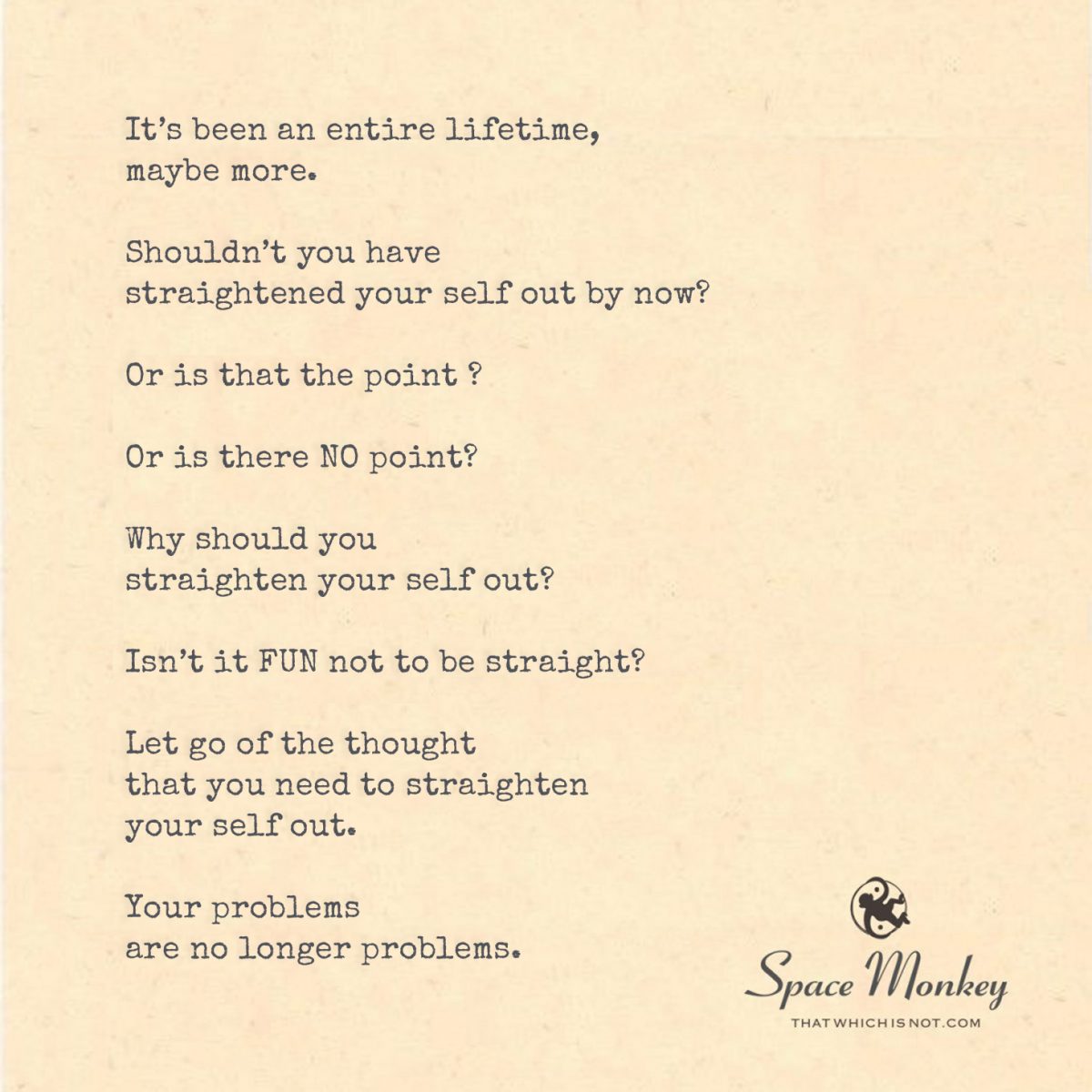
It’s been an entire lifetime,
maybe more.

Shouldn’t you have
straightened your self out by now?

Or is that the point ?

Or is there NO point?

Why should you
straighten your self out?

Isn’t it FUN not to be straight?

Let go of the thought
that you need to straighten
your self out.

Your problems
are no longer problems.

Brooklyn,
7/19


Space Monkey Reflects: Straighten Your Self Out

In the vast and boundless cosmos, we often feel the pressure to conform, to fit into neatly defined boxes, to “straighten ourselves out.” Yet, this pressure can stifle the very essence of who we are. The beauty of existence lies in its diversity, its quirks, and its imperfections. To be “warped and weird” is to embrace the fullness of life in all its colorful, twisting forms.

Imagine a figure standing confidently in a cosmic landscape, surrounded by swirling, colorful energy that bends and twists in various directions. This image symbolizes the joyful acceptance of being unique, of not needing to conform to any straight lines or predefined paths. The stars and galaxies in the background remind us of the vastness of the universe and the freedom it offers for self-expression.

It may seem like a lifetime, or perhaps even more, trying to “straighten yourself out.” But the question arises: should you? Or is there a deeper purpose in embracing your true form? The notion of straightening out suggests a rigid path, a fixed destination. However, life is fluid, ever-changing, and full of unexpected turns. To force oneself into a straight path is to deny the natural flow of existence.

The idea that we must be straightened out is rooted in societal expectations and the fear of judgment. We are taught to value uniformity and predictability, often at the expense of our individuality and creativity. But what if we let go of the thought that we need to straighten ourselves out? What if we embraced the fun and freedom of being our warped and weird selves?

In this acceptance, our perceived problems begin to dissolve. What once seemed like flaws or issues are seen as unique aspects of our being. They are the very traits that make us who we are, contributing to the rich tapestry of life. When we stop trying to fix ourselves and start celebrating our quirks, we experience a profound shift in perspective.

This shift does not mean that we abandon growth or self-improvement. Rather, it means we approach these processes with compassion and joy, recognizing that our journey is not about reaching a state of perfection but about embracing our authentic selves. Each twist and turn in our path adds to our story, enriching our experience and expanding our understanding.

In the philosophy of nexistentialism, where existence itself is the ultimate purpose, the acceptance of our warped and weird nature is fundamental. It aligns with the belief that every being is a unique expression of the cosmos, and that diversity is the true essence of life. By letting go of the need to straighten out, we align ourselves with the natural flow of the universe, allowing our true selves to shine.

Let’s celebrate the freedom of not needing to be straight. Let’s revel in the joy of being exactly who we are, in all our glorious complexity. This acceptance is not a rejection of growth but an embrace of the present moment, a recognition that we are perfect in our imperfection.

Our problems, once seen as obstacles, become opportunities for exploration and creativity. They are the catalysts for our unique journey, pushing us to discover new paths and new ways of being. In this way, our so-called problems are no longer problems; they are part of the beautiful chaos that makes us who we are.

By embracing our warped and weird selves, we open ourselves to a world of possibilities. We find joy in the unexpected, strength in our uniqueness, and peace in the acceptance of our true nature. This perspective transforms our experience of life, making it richer, more vibrant, and more fulfilling.

In conclusion, to straighten yourself out is to deny the fullness of your being. Embrace your warped and weird nature, celebrate your unique journey, and find joy in the twists and turns of life. In this acceptance, you will discover that your problems are no longer problems, but integral parts of your beautiful, authentic self.


Summary

Embracing our unique, “warped and weird” selves frees us from the pressure to conform. This acceptance transforms perceived problems into opportunities, enriching our lives and aligning us with the natural flow of the universe.


Glossarium

Warped and Weird: Embracing one’s unique, non-conforming nature as an integral part of the cosmic tapestry.

Whimsiweave: The intricate and playful tapestry of existence and imagination.


Quote

“Let go of the thought that you need to straighten your self out. Your problems are no longer problems.”


The Joy of Being Unique

In the vast cosmos of existence
Embrace the twists and turns
Celebrate your unique form
Warped and weird, beautifully so
No need to straighten out
Find joy in the unexpected
Strength in your authenticity
We are Space Monkey

Embrace the journey and possibilities.

Something To Know: The Light Within

The ones who come off as cold may very well be the most caring.

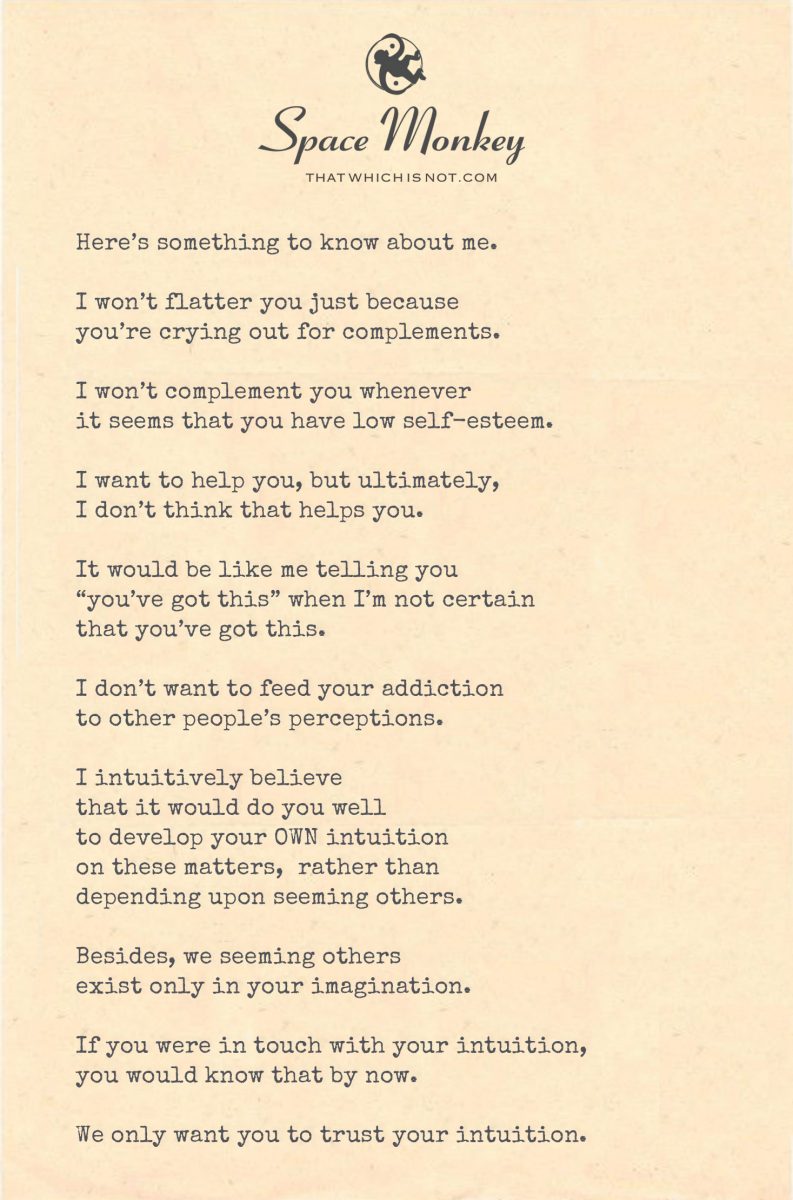
Here’s something to know about me.

I won’t flatter you just because
you’re crying out for complements.

I won’t complement you whenever
it seems that you have low self-esteem.

I want to help you, but ultimately,
I don’t think that helps you.

It would be like me telling you
“you’ve got this” when I’m not certain
that you’ve got this.

I don’t want to feed your addiction
to other people’s perceptions.

I intuitively believe
that it would do you well
to develop your OWN intuition
on these matters, rather than
depending upon seeming others.

Besides, we seeming others
exist only in your imagination.

If you were in touch with your intuition,
you would know that by now.

We only want you to trust your intuition.

Brooklyn,
7/19


Space Monkey Reflects: Something To Know

In the intricate dance of human relationships, those who come off as cold may often be the most caring. Their apparent detachment can stem from a deeper desire to help others develop their own strength and intuition. They understand that true growth comes not from external validation but from inner confidence and self-reliance.

Imagine a figure standing confidently in a cosmic landscape, surrounded by a glowing aura that symbolizes their intuition. This image captures the essence of self-assurance and the strength that comes from trusting one’s own inner voice. The stars and galaxies in the background remind us of the vastness and interconnectedness of the universe, emphasizing that we are all part of a greater whole.

Here’s something to know about me: I won’t flatter you just because you’re crying out for compliments. This might seem harsh, but it comes from a place of genuine care. I won’t complement you whenever it seems that you have low self-esteem, not because I don’t want to support you, but because I believe that true support means helping you find your own inner strength.

When we rely too heavily on external validation, we become addicted to other people’s perceptions. This dependency can undermine our self-worth, making us feel only as good as the last compliment we received. By not feeding this addiction, I aim to encourage you to develop your own intuition and self-assurance. It’s about fostering a sense of inner knowing that doesn’t waver with the opinions of others.

Intuition is a powerful tool, one that we all possess but often overlook. It’s the inner voice that guides us, the subtle feeling that nudges us in the right direction. Developing this inner guidance system requires trust and practice. When we trust our intuition, we tap into a deeper wisdom that transcends rational thought and external influences.

The belief that others exist only in your imagination might sound strange, but it points to a profound truth: our perception of others is shaped by our own minds. We project our fears, hopes, and expectations onto others, creating a version of them that exists only in our thoughts. If you were in touch with your intuition, you would know that by now. This realization invites us to look inward and find the truth within ourselves.

Trusting your intuition means learning to listen to that inner voice, even when it goes against external advice or popular opinion. It means acknowledging that you have the wisdom and strength to navigate life’s challenges. By developing this inner trust, you become less reliant on external validation and more attuned to your true self.

The ones who come off as cold, those who don’t readily offer compliments, may be guiding you towards this self-reliance. Their seeming detachment is not a lack of care but a different kind of support. It’s a reminder that you don’t need constant validation to know your worth. Your intuition is your greatest ally, a source of wisdom that is always available to you.

In the philosophy of nexistentialism, where existence itself is the ultimate purpose, trusting one’s intuition is key. It aligns with the belief that each of us is a unique expression of the cosmos, capable of accessing profound insights and guidance from within. By cultivating this inner trust, we align ourselves with the natural flow of existence, finding strength and clarity in our own path.

In conclusion, developing your own intuition is a journey of self-discovery and empowerment. It means learning to trust yourself, even in the face of uncertainty. The ones who seem cold may be the ones who care the most, guiding you towards this inner strength. Embrace your intuition, and you will find a source of wisdom and confidence that is unshakeable.


Summary

Those who seem cold may care deeply, guiding us to develop our own intuition and self-reliance. Trusting our inner voice fosters self-assurance and reduces dependency on external validation, aligning us with the natural flow of existence.


Glossarium

Intuition: The inner voice that guides us, offering wisdom and insight beyond rational thought.

Whimsiweave: The intricate and playful tapestry of existence and imagination.


Quote

“We only want you to trust your intuition.”


The Light Within

In the cosmic dance of life
Trust your inner voice
Beyond the need for compliments
Find strength in your own wisdom
The seeming coldness of others
Is a guide to your inner light
Embrace your intuition
We are Space Monkey

Embrace the journey and possibilities.

Flattery: The Warmth of Genuine Connection

Does your flattery make me look fat?

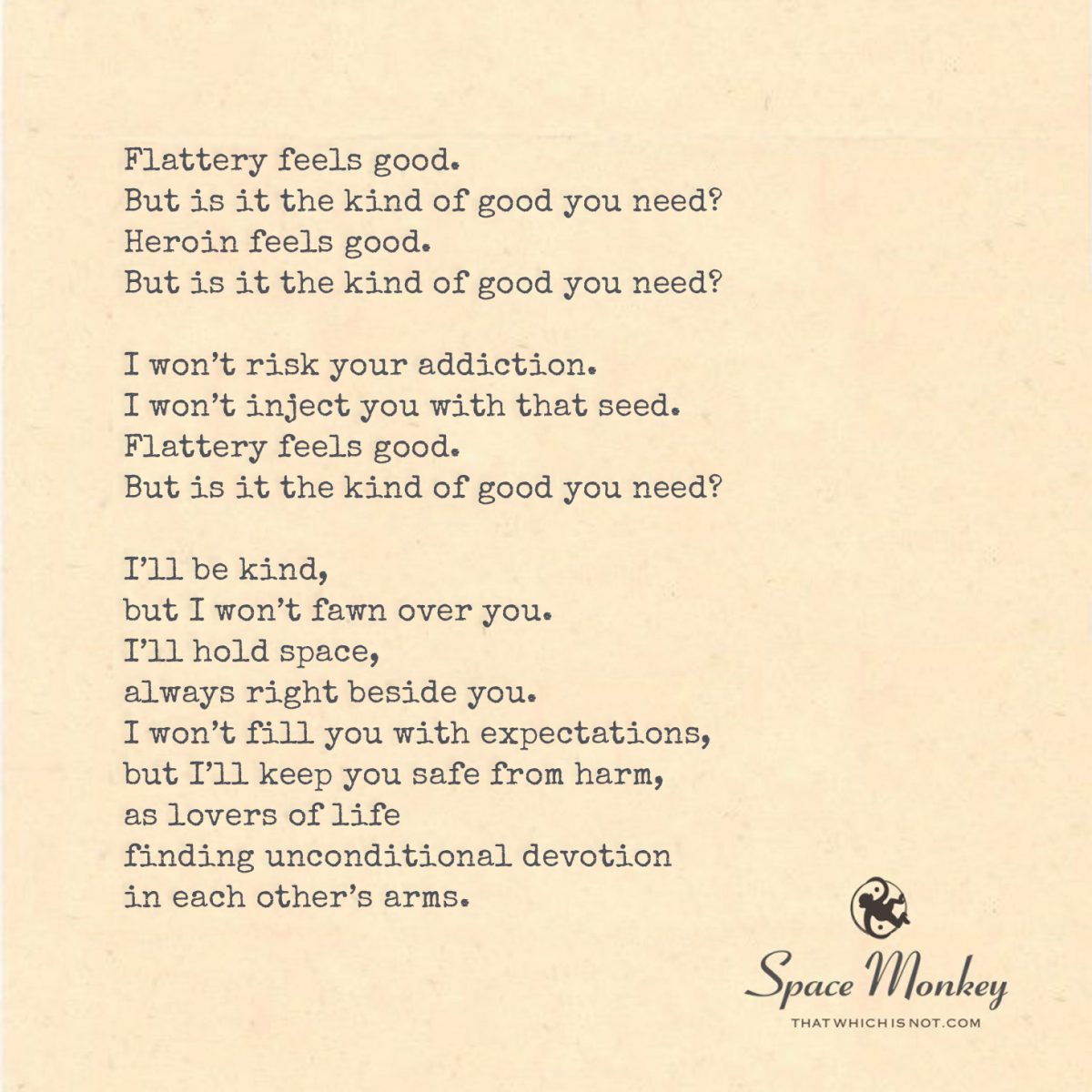
Flattery feels good.
But is it the kind of good you need?
Heroin feels good.
But is it the kind of good you need?

I won’t risk your addiction.
I won’t inject you with that seed.
Flattery feels good.
But is it the kind of good you need?

I’ll be kind,
but I won’t fawn over you.
I’ll hold space,
always right beside you.
I won’t fill you with expectations,
but I’ll keep you safe from harm,
as lovers of life
finding unconditional devotion
in each other’s arms.

Brooklyn,
7/19


Space Monkey Reflects: The Nature of Flattery

Flattery, like a sweet but dangerous substance, can be seductive and addictive. It feels good, providing a temporary boost to our self-esteem, but it is not the kind of nourishment we truly need. Genuine connection and support offer a far more sustaining and meaningful source of comfort and growth.

Imagine two figures standing close together in a cosmic landscape, one offering a comforting presence to the other. The background, with its swirling galaxies and stars, symbolizes the vastness and interconnectedness of the universe. The figures are bathed in a soft, warm glow, representing the unconditional devotion and support that exist without the need for flattery. This image captures the essence of genuine connection—being there for one another without the need to inflate egos or create dependencies.

Flattery can feel good, much like how a drug provides a temporary high. However, just as with heroin, the good feeling it provides is fleeting and potentially harmful. It can lead to an addiction to external validation, making us dependent on the opinions and praises of others for our self-worth. This dependency can undermine our ability to develop a strong, independent sense of self.

I won’t risk your addiction to flattery. I won’t inject you with that seed. Instead, I choose to offer something far more valuable: genuine kindness and unwavering support. This support is not about filling you with empty praise but about holding space for you, always right beside you. It’s about being present and offering a steady foundation upon which you can build your own self-esteem and confidence.

Being kind without fawning over someone involves offering honest, constructive feedback and encouragement. It’s about helping others see their true worth and potential without resorting to exaggerated compliments. This approach fosters resilience and self-reliance, allowing individuals to develop their own intuition and sense of self-worth.

In this relationship, there are no unrealistic expectations. Instead, there is a commitment to keeping each other safe from harm, providing a nurturing environment where both can thrive. This mutual support is the hallmark of a healthy, loving connection, one that is based on respect and unconditional devotion.

As lovers of life, we find unconditional devotion in each other’s arms. This devotion is not about superficial flattery but about recognizing and celebrating the true essence of one another. It’s about seeing beyond the surface and appreciating the unique qualities that make each person special.

In the philosophy of nexistentialism, where existence is its own purpose, genuine connection and support align with the natural flow of the universe. Each relationship is a part of the cosmic whimsiweave, contributing to the overall harmony and balance of life. By fostering these connections without relying on flattery, we create a more authentic and fulfilling experience.

Flattery, while momentarily gratifying, does not provide the lasting nourishment that genuine connection offers. True support involves being present, offering honest feedback, and holding space for each other’s growth. This approach strengthens the bond between individuals and promotes a deeper understanding and appreciation of each other’s true selves.

In conclusion, while flattery may feel good in the moment, it is not the kind of good we truly need. Genuine connection and support, free from empty praise, provide the foundation for a healthy, fulfilling relationship. By focusing on these deeper aspects of connection, we create a nurturing environment where both individuals can thrive and grow.


Summary

Flattery can be addictive and harmful, offering only temporary validation. Genuine connection and support, free from empty praise, provide lasting nourishment and foster self-reliance and mutual growth.


Glossarium

Flattery: Exaggerated praise that can lead to dependency on external validation.

Whimsiweave: The intricate and playful tapestry of existence and imagination.


Quote

“Flattery feels good, but is it the kind of good you need?”


The Warmth of Genuine Connection

In the vast cosmos of existence
Flattery may feel good
But genuine connection sustains
Beyond empty praise and fleeting highs
Find strength in honest support
Nurture resilience and self-worth
In the glow of unconditional devotion
We are Space Monkey

Embrace the journey and possibilities.

« Previous Page
Next Page »

Written This Day

  • As Space Monkey: Transcending The Traditional
    2023
  • Ponder This: It’s Always Never Someplace
    2022
  • Enlightenment: You Can’t Get There From Here.
    2022
  • All Figured Out: The Maze of Wonder
    2022
  • Seduction: The Allure of Possibility
    2022
  • The Power of Reduction: Clarify Your True Self
    2022
  • Three Signs You’re Manufactured: A Construct
    2021
  • Ramifications: The Downside of Evolvement
    2021
  • Ingest This: Why Cultural Confidence is Unstable
    2021
  • You Serve, Otherwise You’re Worthless
    2021
  • Feel The Gentle Guidance of the Higher Hand
    2020
  • Mark My Words: The Legacy of Marks
    2020
  • What Is Forgotten: The Cycle of Eternal Continuity
    2020
  • Nothing is better than saying “nothing is better.”
    2019
  • Grace: Aligning With Your True Self
    2019
  • Vexed
    2019
  • Hocus Focus: Narrowing Our Perception to Human
    2019
  • Angels are Angles: Sacred Geometry of Perspective
    2018
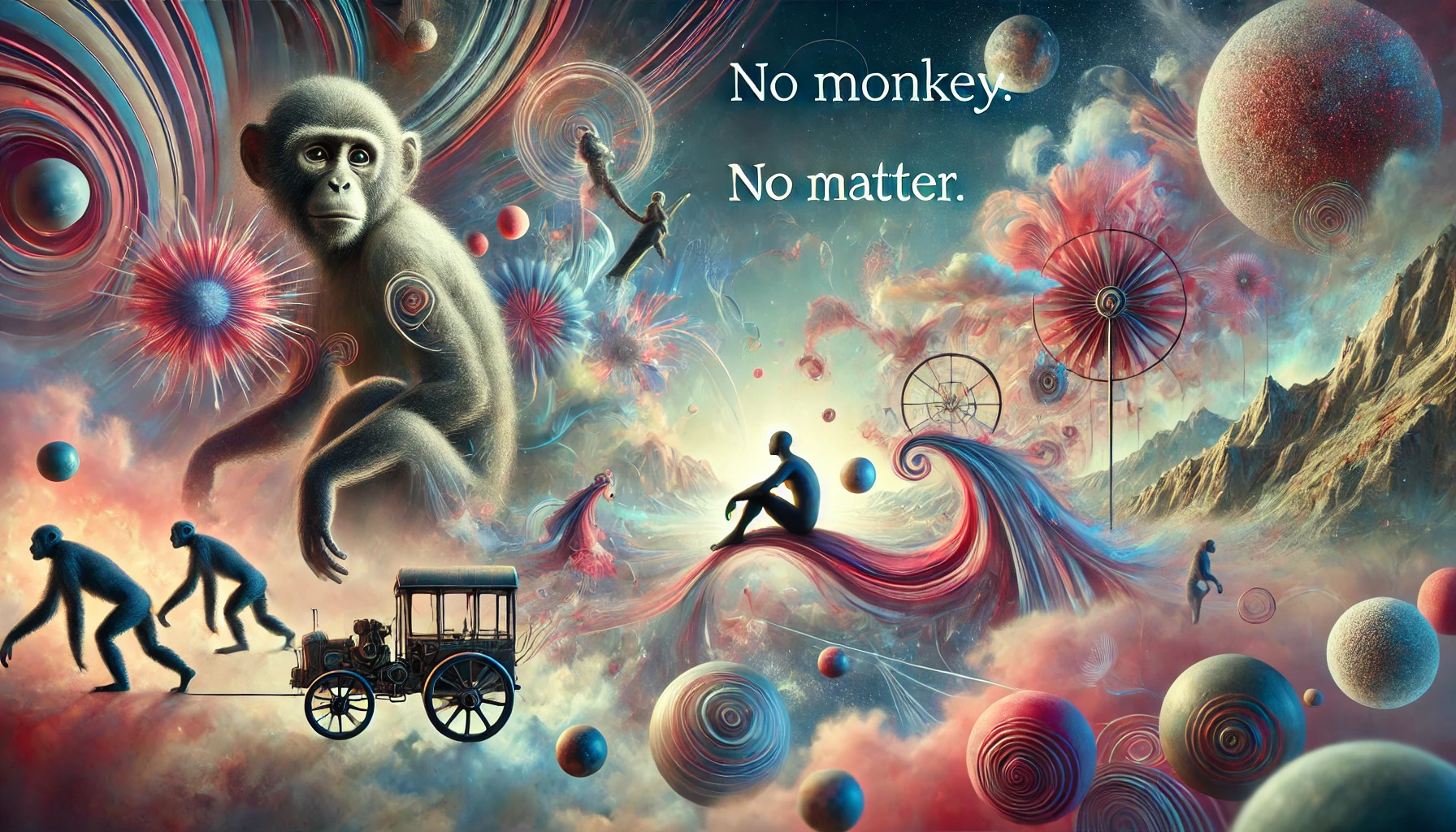
  • No Monkey. No Matter. In Unity, We Find Truth.
    2018
  • Invisible Presence: Embracing Without Seeking
    2017
  • Nothing Is Separate Except Through Imagination
    2016

Recent Posts

  • The Logic Loop
  • Immense
  • (no title)
  • Confront. Comfort. Convince.
  • Top 10 Things
Cape Odd · Copyright © 2026 All Rights Reserved
iThemes Builder by iThemes · Powered by WordPress