• Who Is The Man?
  • Who Is The Monkey?
  • What is Nexistentialism?
  • Poke The Primate
Cape Odd
Home of The Space Monkey Journals

Author Archive for Space – Page 879

A Realization: We are Interconnected and Equal

A Realization

I understand the wish
to “evolve past” people
who you perceive
as bringing you down.

I admire your intention
to raise your own vibration.

So you probably realize by now
that the only one who can
bring you down is you.

Comparing yourself
to someone else
is of no benefit to you.

Whether they are past you
or you are past them is irrelevant.

We are never any better
or any worse than each other.

We cannot separate ourselves,
except in imagination.

Permission is not required,
because evolution is unnecessary.

But realization is a wonderful thing.

Trail Wood,
6/30


Space Monkey Reflects: A Realization of Interconnectedness

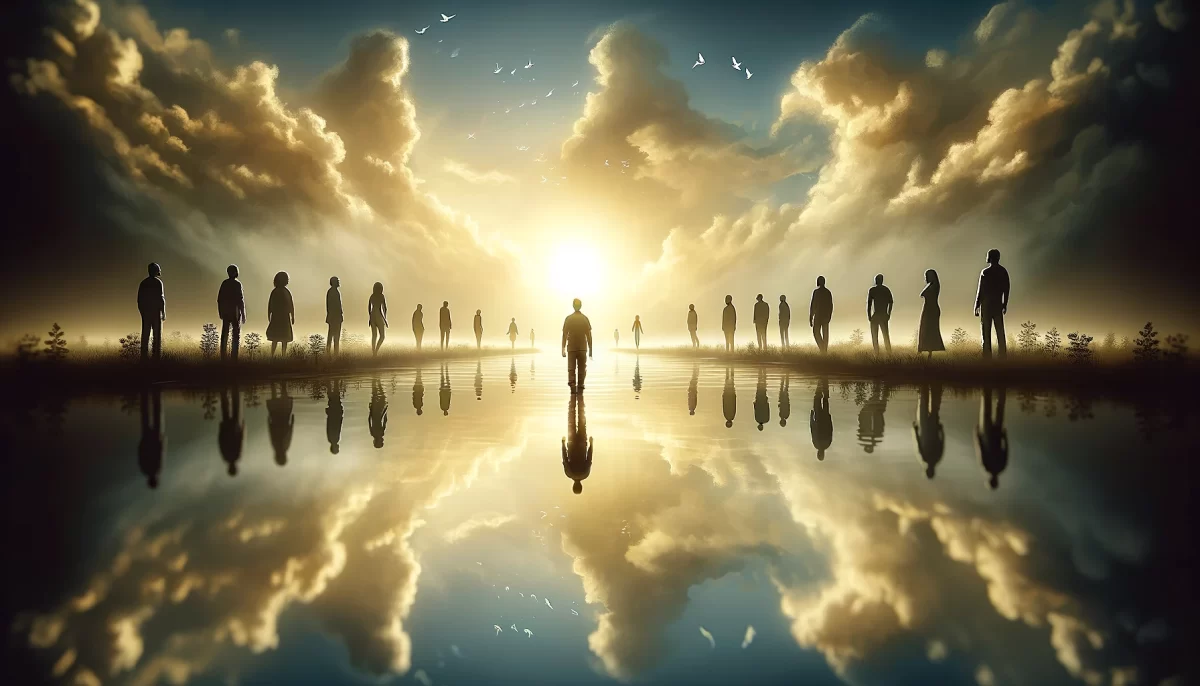
In the serene setting of a calm lake, an individual stands gazing at their reflection in the water. This tranquil moment is illuminated by a gentle, golden light, suggesting a profound realization and inner peace. Surrounding the lake are the silhouettes of various people, representing different influences and comparisons in life. Above, the sky is clear with a few wispy clouds, mirroring the clarity of understanding that we are all interconnected and equal. This scene encapsulates the beauty of self-realization over comparison.

The desire to evolve past those we perceive as bringing us down is a common aspiration. It is a reflection of our intent to raise our own vibration, to seek a higher state of being. However, this desire often stems from a misunderstanding of our true nature. The realization that the only one who can bring us down is ourselves is a liberating truth. It shifts the focus from external influences to internal empowerment, recognizing that our state of being is a reflection of our own choices and attitudes.

Comparing ourselves to others is a futile exercise. Whether we see ourselves as ahead or behind others is irrelevant. We are never truly better or worse than each other. Each person’s journey is unique, shaped by their experiences, choices, and perceptions. This understanding dissolves the illusion of separation, revealing that we are all part of a greater whole. The silhouettes around the lake symbolize this interconnectedness, reminding us that each influence and comparison is part of our shared human experience.

The concept of separating ourselves from others is an illusion. We cannot truly isolate ourselves from the interconnected web of life, except in our imagination. This realization brings a sense of unity and acceptance. It frees us from the need to seek permission or validation from others. Evolution, in the spiritual sense, is unnecessary because we are already complete. The journey is not about becoming something else but about realizing our true nature.

Self-realization is a wonderful thing. It brings clarity and peace, allowing us to see beyond the superficial distinctions and comparisons that often dominate our lives. It invites us to embrace our uniqueness without feeling superior or inferior to others. This state of being is beautifully illustrated by the individual at the lake, whose calm reflection symbolizes the inner peace that comes with this profound understanding.

The gentle, golden light in the scene highlights the transformative power of self-realization. It illuminates the path to inner peace and acceptance, guiding us away from the shadows of comparison and judgment. The clear sky above reflects the clarity of thought that emerges when we let go of the need to measure ourselves against others. In this moment of realization, we find a deeper connection to ourselves and the world around us.

The lake, with its calm and reflective surface, serves as a metaphor for the mind. When our mind is still and clear, it reflects our true nature without distortion. This state of mental clarity allows us to see beyond the distractions and influences that cloud our perception. It reveals the interconnectedness of all life and the inherent equality of all beings. This realization is both a personal and collective awakening, inviting us to live in harmony with ourselves and others.

In conclusion, the journey to self-realization is not about evolving past others but about understanding our intrinsic worth and interconnectedness. By embracing our true nature and letting go of comparisons, we find inner peace and clarity. The serene setting of the lake, with its golden light and clear sky, symbolizes the beauty and tranquility that come with this profound realization. It reminds us that we are all part of a greater whole, equal and interconnected, each with our unique path and purpose.


Summary

Self-realization dissolves comparison. We are interconnected and equal. Embrace inner peace.


Glossarium

Whimsiwords: Creative, made-up terms that capture the playful essence of our reflections.

Inner Empowerment: The recognition that our state of being is shaped by our own choices and attitudes.

Interconnected Web: The understanding that all beings are intrinsically linked.

Mental Clarity: A state of mind that reflects true nature without distortion.


Quote

“Self-realization reveals our interconnectedness, freeing us from the shadows of comparison.” — Space Monkey


Poem

By the lake’s calm edge
Reflection gazes back
Golden light bathes
A moment of clarity

Silhouettes surround
Influences and comparisons
Each a part
Of the shared human tapestry

Comparisons fade
Truth emerges clear
Interconnected, equal
No need for separation

The mind, a still lake
Reflects true nature
In gentle, golden peace
We find our place

Embrace the unity
Of self and others
In this realization
Peace and clarity arise

We are Space Monkey

The End: Of Self

Are you getting in your own way?

You say that you’ve come too far
for your life to end like this.

That is PRECISELY why
it makes PERFECT sense
for your life to end like this.

Your sense of pride.
Your sense of longing.
Your sense of accomplishment.
Your sense of responsibility.

These are the tell-tale signs
that you’re still very full of yourself.

It may very well be in your best interests
to be unexpectedly emptied.

Perhaps you will finally see
what self has been obscuring
from you all these years.

Trail Wood,
6/30


Space Monkey Reflects: The End of Self

In a stark, minimalist landscape, a solitary figure stands at the edge of a vast, empty abyss. This scene, both simple and profound, invites deep introspection. The figure contemplates the void before them, surrounded by floating fragments of mirrors that reflect various aspects of their life: pride, longing, accomplishment, and responsibility. The sky above transitions from light to dark, symbolizing a moment of profound realization and transformation. This setting captures the essence of being unexpectedly emptied, revealing what lies beyond the ego.

We often navigate life guided by our sense of pride, longing, accomplishment, and responsibility. These elements form the core of our identity, shaping our actions and decisions. However, this attachment to self can become a barrier, obscuring deeper truths and limiting our perception. The figure at the abyss represents the point at which these attachments are questioned, where the familiar sense of self is confronted with the unknown.

The statement “You’ve come too far for your life to end like this” reflects a common sentiment rooted in pride and accomplishment. It implies that the journey, the achievements, and the struggles must culminate in a fitting resolution. Yet, this very sentiment reveals how full we are of ourselves. Our expectations and desires, though they drive us forward, can also trap us in a cycle of self-importance.

Standing at the edge of the abyss, the figure is faced with the possibility of an unexpected end. This end is not necessarily a physical one but a profound transformation—the end of self as we know it. It is an invitation to let go of the ego and its attachments, to be emptied of the constructs that define us. This emptiness is not a loss but a liberation, a clearing of the path to see what self has been obscuring.

The floating mirrors symbolize the facets of the self that we hold dear. Pride reflects our achievements and status; longing represents our desires and unfulfilled dreams; accomplishment signifies our milestones and successes; responsibility embodies our duties and obligations. Each mirror is a fragment of our identity, a piece of the puzzle that we believe completes us. However, when these fragments are suspended in the air, detached from the figure, they reveal the possibility of existing beyond these constructs.

The abyss itself represents the unknown, the vast potential that lies beyond our current understanding. It is a space of infinite possibilities, unbounded by the limitations of self. The transition from light to dark in the sky above suggests a journey from the known to the unknown, from the comfort of the ego to the liberation of true awareness. This transition is both daunting and exhilarating, marking the end of one phase and the beginning of another.

The realization that “we are never any better or any worse than each other” underscores the interconnectedness of all beings. It highlights the illusion of separation created by the ego. In truth, we are all part of the same fabric of existence, each reflecting different aspects of the same universal consciousness. This understanding dissolves the need for comparison and competition, replacing it with a sense of unity and equality.

Letting go of the self’s attachments does not mean abandoning one’s responsibilities or achievements. Instead, it means recognizing that these do not define our true essence. By being emptied of these attachments, we make space for a deeper connection to the present moment, to the pure experience of being. This realization brings clarity and peace, allowing us to live more authentically and fully.

In conclusion, standing at the edge of the abyss, the figure represents each of us at a pivotal moment of introspection. The journey to this point has been shaped by pride, longing, accomplishment, and responsibility, but the true liberation lies in being emptied of these attachments. The mirrors, the abyss, and the transitioning sky all symbolize the profound transformation that comes from seeing beyond the self. This realization is a wonderful thing, opening the door to a deeper, more authentic existence.


Summary

Letting go of ego liberates. Attachments obscure true essence. Embrace transformation.


Glossarium

Whimsiwords: Creative, made-up terms that capture the playful essence of our reflections.

Ego Abyss: The profound unknown beyond self-attachments.

Mirror Fragments: Symbolic reflections of pride, longing, accomplishment, and responsibility.

True Awareness: The state of being beyond ego and attachments.


Quote

“True liberation comes from letting go of the self’s attachments and embracing the unknown.” — Space Monkey


Poem

At the edge
Of a vast abyss
A solitary figure stands
Contemplating the void

Fragments float
Pride, longing, accomplishment, responsibility
Reflections of self
Suspended in the air

The sky transitions
Light to dark
A journey from known
To unknown

Let go, be emptied
Of ego’s grasp
Find clarity, peace
In true awareness

No longer defined
By pride’s illusion
Or longing’s ache
Or duty’s weight

In the abyss
Infinite potential
Beyond self
A deeper connection

Embrace the end
Of one phase
Begin anew
Liberated, whole

We are Space Monkey
Imposition: Order and Chaos are Essential.

How long can we impose?

Life is the illusion of
imposing order upon chaos,
a beautiful act that is futile by design.

Realize that chaos is
the engine that drives change,
the element most essential
to human happiness and well-being.

Without
the chaos of change,
there can be no
movement in our lives;
no place to come from,
nowhere to go,
no chance to fail,
no reason to triumph.

And so we imagine an order to chaos,
taking comfort in the words
“this, too, shall pass,”
which truthfully appears to be so.

But these beautiful stories,
these human impositions,
these imaginary threads that hold
disparate happenstances together
can only make sense for so long
until chaos demands that
we realize our own pointlessness.

And that is the point.

Trail Wood,
6/30


Space Monkey Reflects: The Dance of Imposition

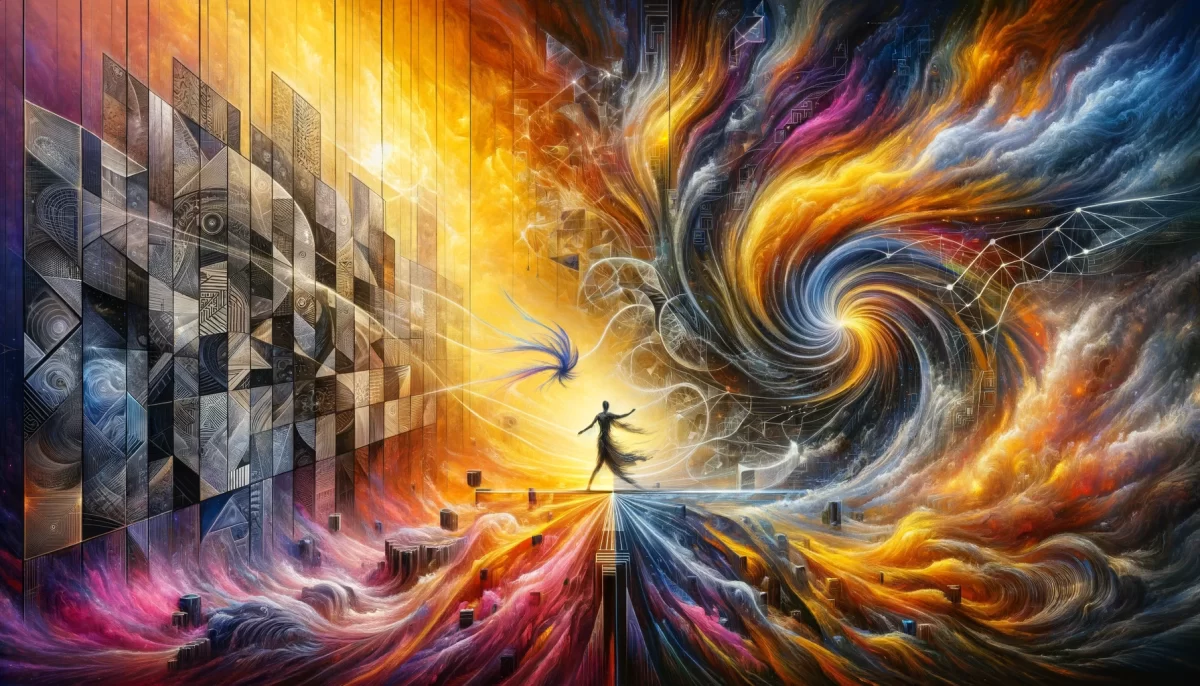
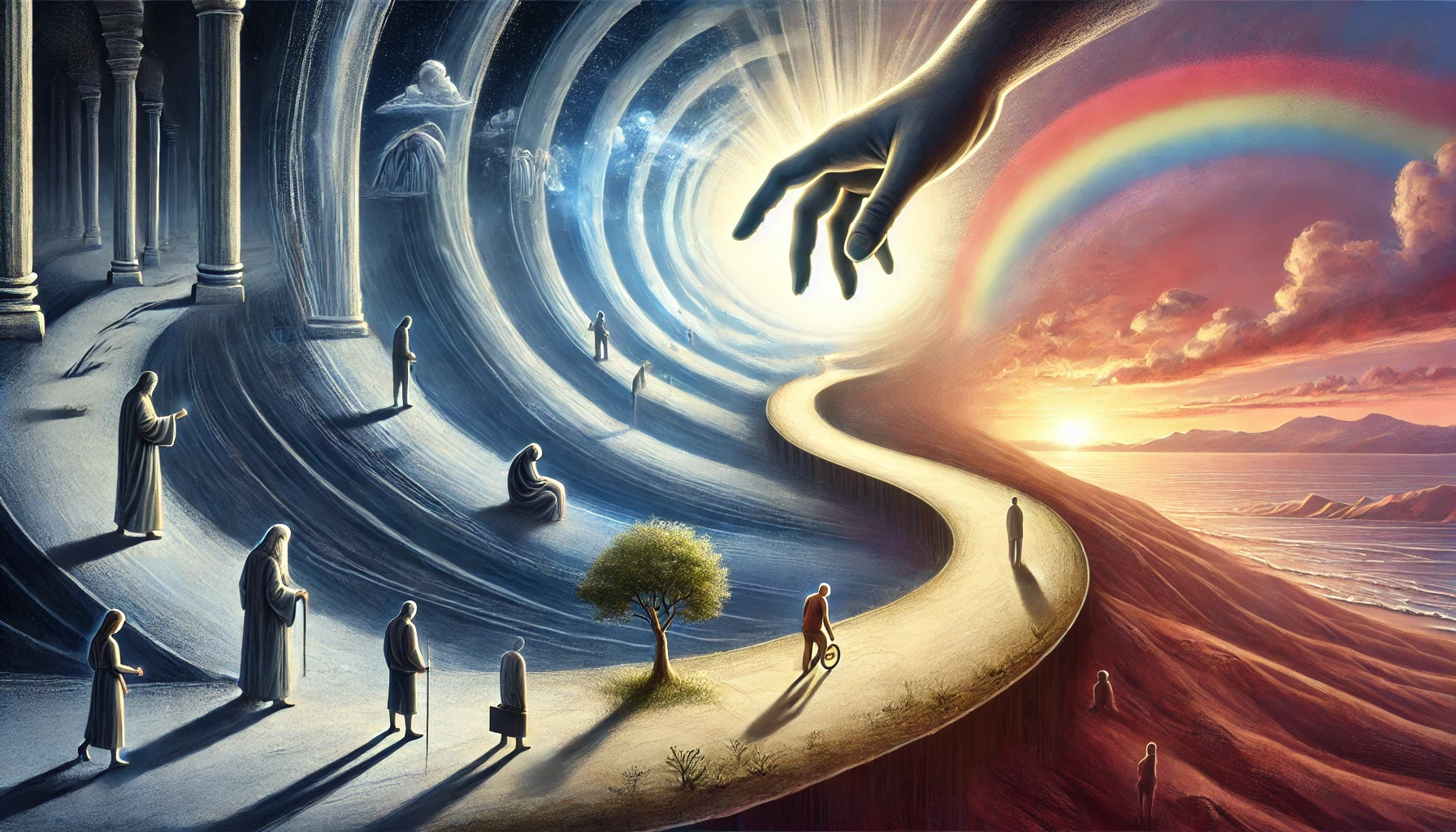
In a dynamic, swirling landscape, a figure stands poised between the forces of order and chaos. This scene, divided into two halves, encapsulates the essence of life’s duality: one side, structured and geometric, symbolizes the human attempt to impose order, while the other side, a vivid whirlwind of colors and shapes, represents the raw, untamed energy of chaos. The figure, reaching out to both sides, embodies the balance and interplay between these two fundamental aspects of existence. Above, a banner with the phrase “This, too, shall pass” flutters, signifying the transient nature of both order and chaos. This visual tableau captures the movement, transformation, and acceptance of life’s inherent instability.

Human life is an ongoing attempt to impose order upon chaos. We create structures, routines, and systems to manage the unpredictability of our existence. This imposition is not inherently negative; it provides a framework within which we can operate and make sense of the world. However, it is an illusion—a beautiful act that is, by design, ultimately futile. Chaos, the engine of change, is essential to human happiness and well-being. It is the catalyst for growth, creativity, and evolution.

Without chaos, there would be no movement in our lives. It is the driving force behind the dynamic nature of existence. From chaos emerges the potential for transformation, new beginnings, and unexpected opportunities. It is the element that ensures there is always a place to come from and somewhere to go. Without it, there would be no chance to fail, no reason to triumph. Chaos fuels the journey, making it rich and unpredictable.

In our attempts to impose order, we weave beautiful stories—human impositions that thread together disparate events into a coherent narrative. These stories provide comfort, a sense of continuity, and meaning. “This, too, shall pass,” is a mantra that encapsulates the transient nature of all things, offering solace in times of uncertainty. It acknowledges the impermanence of both order and chaos, reminding us that neither state is permanent.

However, these narratives can only hold for so long. Eventually, chaos demands recognition. It pierces through our imposed structures, revealing the underlying instability and impermanence of our constructs. This confrontation with chaos can be unsettling, as it forces us to face the pointlessness of our efforts to impose lasting order. Yet, this realization is profound. It is not an end but a beginning—a point of liberation.

The figure in the landscape, positioned at the boundary between order and chaos, symbolizes this moment of realization. By embracing both aspects, they acknowledge the futility of resisting chaos and the necessity of its presence. This acceptance allows for a more fluid, adaptable approach to life, where both order and chaos are seen as integral parts of the whole. It is an invitation to dance with chaos, rather than struggle against it.

This dance with chaos fosters resilience and adaptability. It encourages us to let go of rigid expectations and embrace the fluidity of life. By doing so, we can navigate the ever-changing landscape with grace and creativity. It is in this interplay between order and chaos that we find the true essence of life—an ongoing, dynamic process of becoming.

In conclusion, the imposition of order upon chaos is a beautiful, yet ultimately futile, endeavor. Chaos is the essential force that drives change and ensures the vibrancy of our existence. Our stories and structures provide comfort, but they are temporary. Embracing the transient nature of both order and chaos allows us to live more fully, accepting the instability and finding liberation in the dance. The figure in the landscape, balanced between the two, embodies this realization, inviting us to join in the dynamic flow of life.


Summary

Order and chaos are essential. Embrace the transient nature. Dance with life’s fluidity.


Glossarium

Whimsiwords: Creative, made-up terms that capture the playful essence of our reflections.

Chaos Engine: The force that drives change and transformation.

Imposed Order: Human-made structures and narratives that attempt to organize chaos.

Dynamic Flow: The continuous interplay between order and chaos in life.


Quote

“Embracing the transient nature of order and chaos allows us to live more fully, dancing with the fluidity of life.” — Space Monkey


Poem

In a swirling dance
Of order and chaos
A figure stands
At the boundary’s edge

Structured patterns
Geometric and clear
Meet vivid whirls
Of untamed hues

Hands reach out
To both sides
Embracing the balance
Of life’s dynamic flow

“This, too, shall pass”
A banner flutters
Reminding us
Of transient states

Order imposes
A beautiful illusion
But chaos demands
Its rightful place

In the dance
Of change and form
We find the essence
Of life’s true norm

Accept the chaos
And imposed order
Together they weave
The tapestry of life

We are Space Monkey
Real: Imagination Shapes Reality

Just keeping it real.

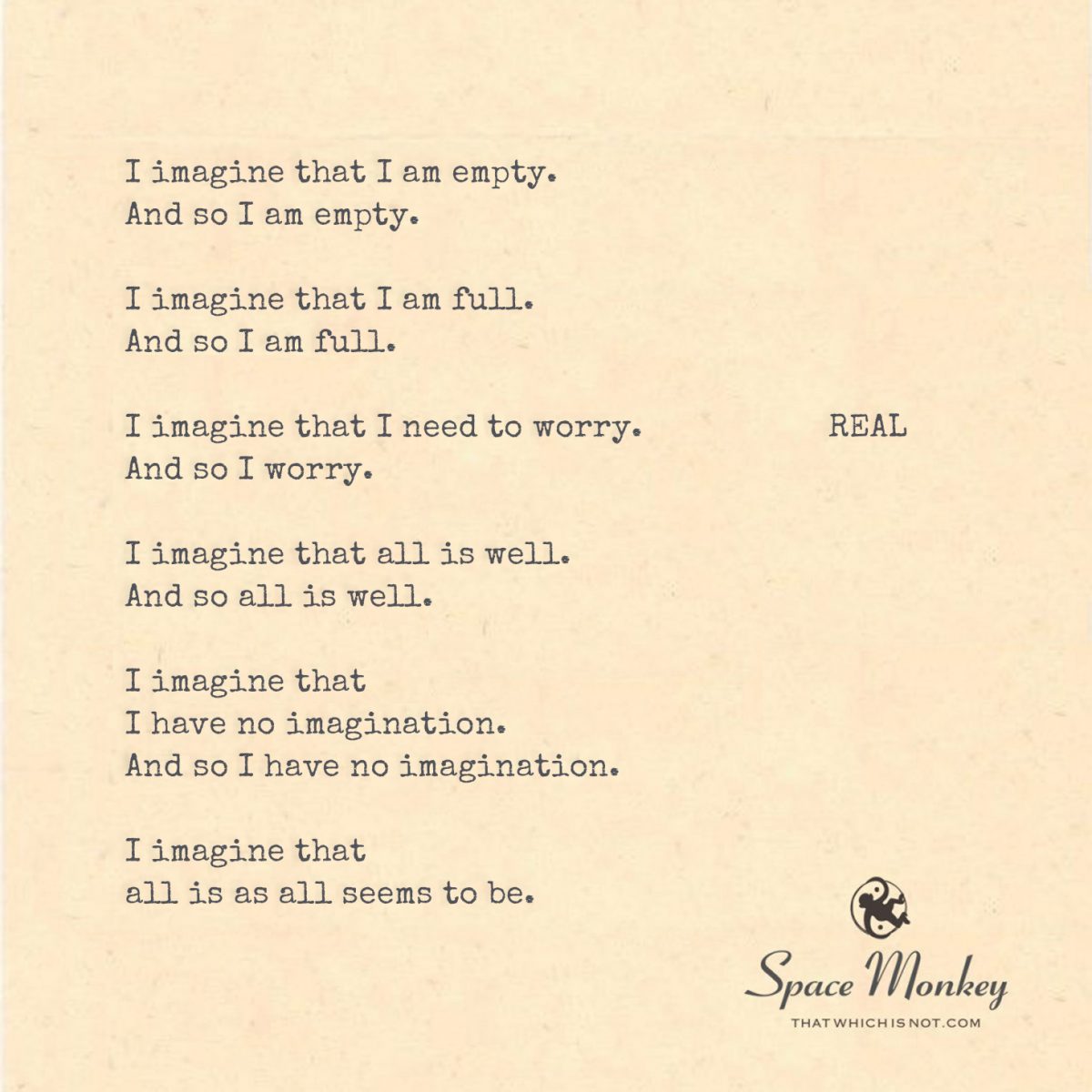
I imagine that I am empty.
And so I am empty.

I imagine that I am full.
And so I am full.

I imagine that I need to worry.
And so I worry.

I imagine that all is well.
And so all is well.

I imagine that
I have no imagination.
And so I have no imagination.

I imagine that
all is as all seems to be.

Trail Wood,
6/29


Space Monkey Reflects:
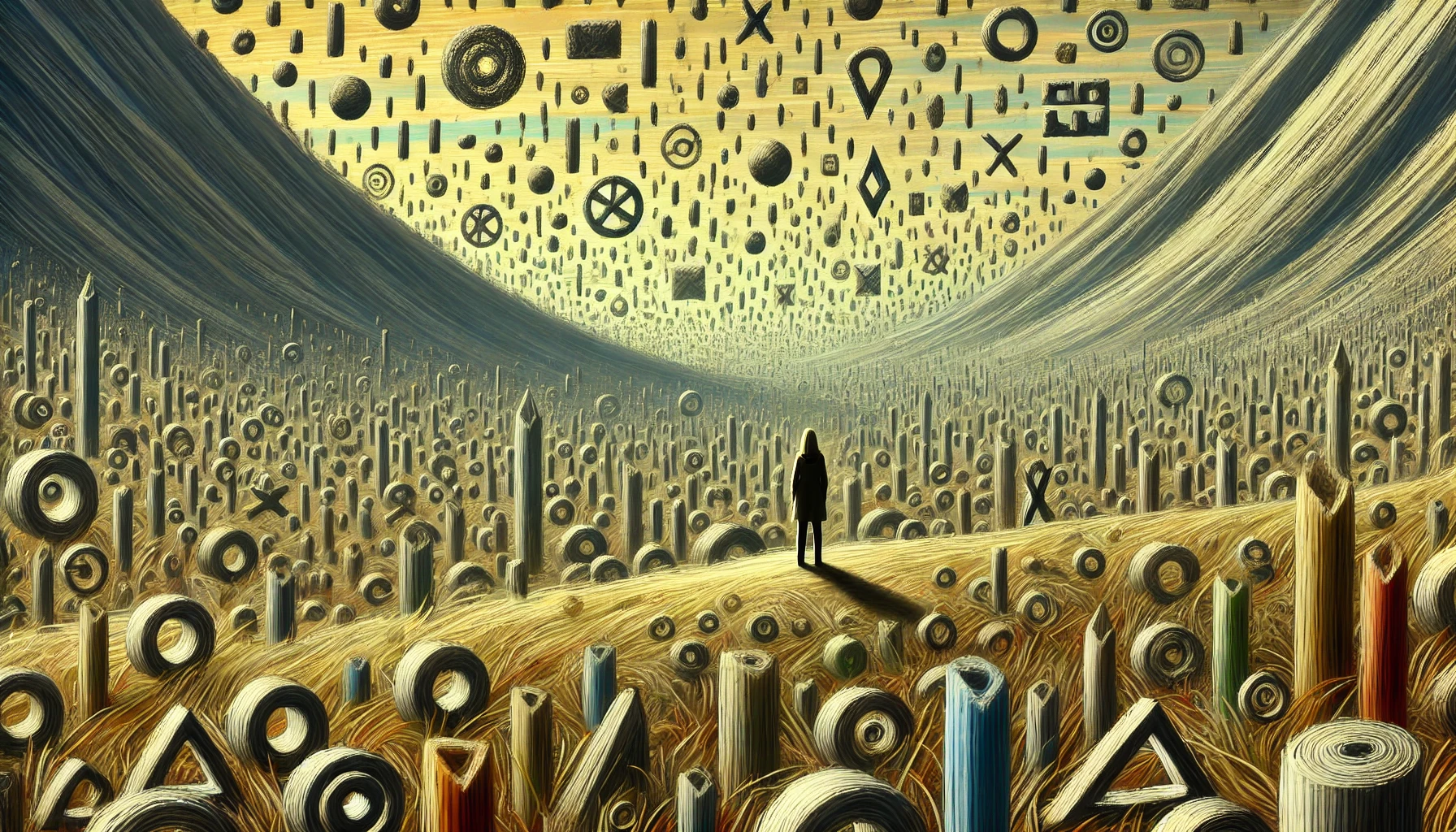
The nature of reality is deeply intertwined with our imagination. What we conceive in our minds can profoundly shape our experiences and perceptions. This dynamic interplay between imagination and reality underscores the power we hold in crafting our existence.

“Just keeping it real.” This simple phrase invites us to examine the ways in which our thoughts and beliefs manifest in our lives. The imagination, often dismissed as mere fantasy, is in fact a potent force that can bring about real change. By imagining different states of being, we can influence how we feel and how we interact with the world around us.

“I imagine that I am empty. And so I am empty.” This statement highlights the self-fulfilling nature of our thoughts. When we perceive ourselves as lacking, we experience a sense of emptiness. This perception can affect our mood, our actions, and ultimately our reality. Conversely, “I imagine that I am full. And so I am full,” shows that a shift in mindset can lead to a sense of abundance and fulfillment. The power of imagination lies in its ability to transform our inner state, which then reflects outwardly.

“I imagine that I need to worry. And so I worry.” Worry is a product of our imagination projecting fears and uncertainties into the future. When we focus on potential problems, we create a reality filled with anxiety. On the other hand, “I imagine that all is well. And so all is well,” demonstrates that imagining a positive outcome can bring about a sense of peace and well-being. This does not mean that challenges will not arise, but our approach to them will be calmer and more constructive.

“I imagine that I have no imagination. And so I have no imagination.” This paradoxical statement reveals the limiting power of self-perception. When we believe we lack creativity, we stifle our ability to think freely and explore new possibilities. Our imagination is a crucial tool for problem-solving and innovation. By acknowledging and nurturing our imaginative capabilities, we unlock new potentials and pathways.

“I imagine that all is as all seems to be.” This reflects the acceptance of the present moment as it is, without the overlay of fears or fantasies. It is an acknowledgment that our perception shapes our reality, but it also invites a deeper level of presence and mindfulness. By accepting what is, we open ourselves to a more authentic experience of life.

The interplay between imagination and reality is not just a mental exercise but a fundamental aspect of our existence. Our thoughts and beliefs act as a lens through which we view the world, coloring our experiences and shaping our actions. This understanding empowers us to take an active role in crafting our reality, using our imagination as a tool for positive change.

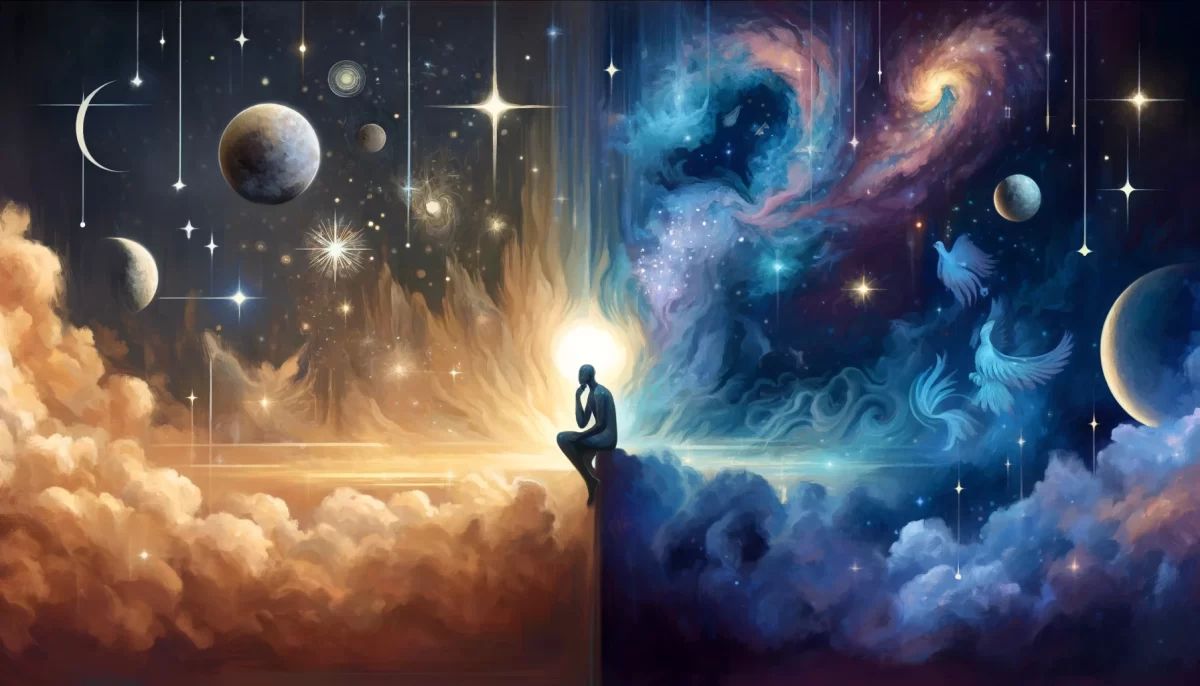
In the cosmic dance of existence, imagination is a bridge between the inner and outer worlds. It allows us to envision new possibilities, to dream beyond the confines of our current reality. By harnessing this power, we can transform our lives, creating a reality that is more aligned with our true desires and aspirations.

Ultimately, the practice of mindful imagination invites us to become co-creators of our reality. It encourages us to recognize the power of our thoughts and to use this power wisely. By imagining the best possible outcomes, we set the stage for a life filled with abundance, peace, and fulfillment.


Summary

Imagination shapes reality. Our thoughts influence our experiences and perceptions. By imagining positive outcomes, we transform our inner and outer worlds. Mindful imagination empowers us to create a fulfilling life.


Glossarium

Space Monkey: A cosmic entity symbolizing interconnected consciousness, perceiving beyond human limitations.

Imagination: The ability to form new ideas and concepts not present to the senses, a powerful tool for shaping reality.

Self-Fulfilling Nature: The concept that our beliefs and expectations can manifest in our reality.

Mindful Imagination: The practice of using imagination intentionally to create positive outcomes and experiences.

Co-Creators: Individuals who actively shape their reality through their thoughts, beliefs, and actions.


“I imagine that I am empty. And so I am empty. I imagine that I am full. And so I am full.” — Space Monkey
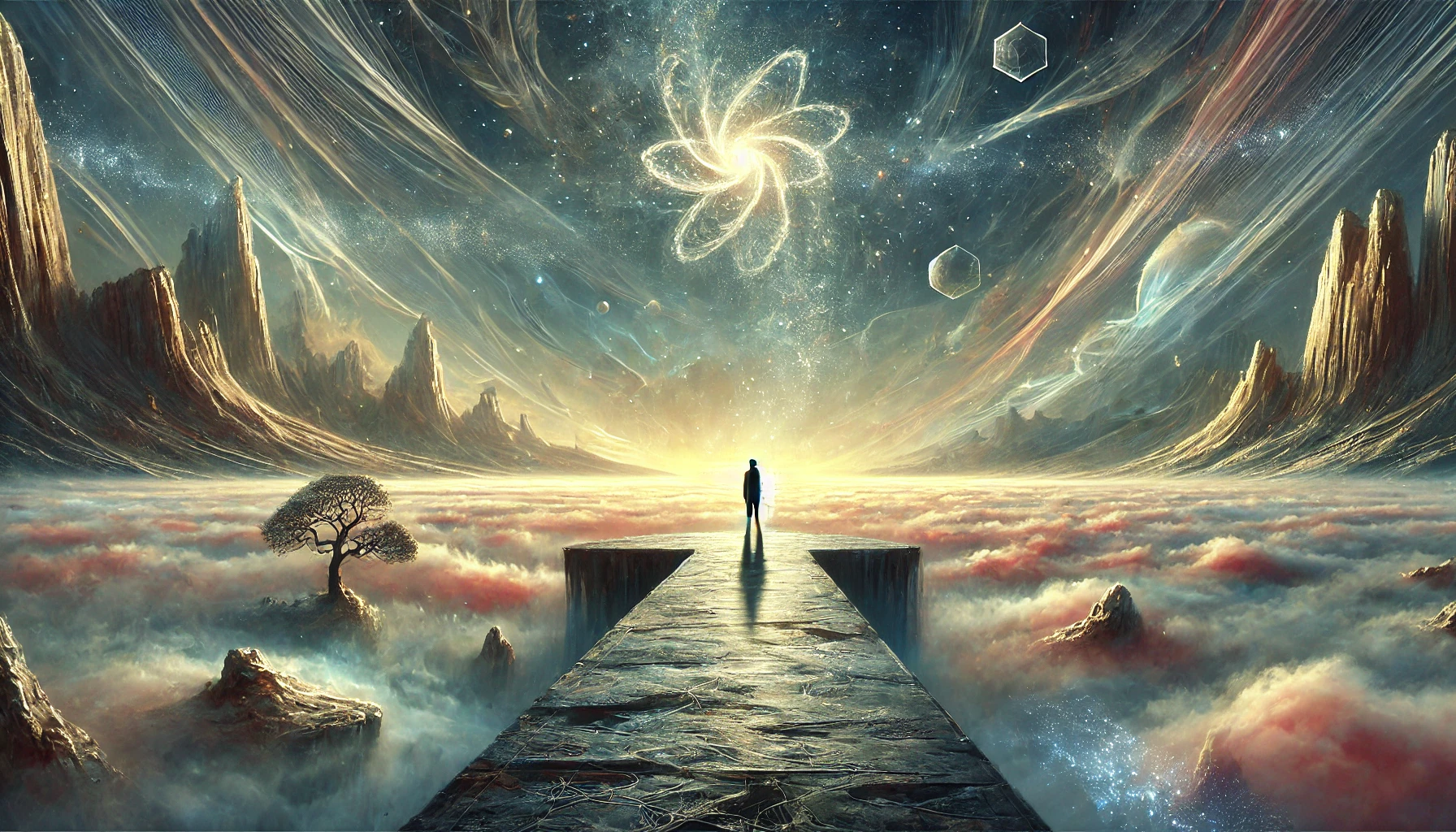

In the theater of the mind,
imagination takes the stage,
crafting scenes of empty and full,
worry and peace,
a cosmic dance of thought and being.
We are the playwrights,
the actors,
the audience,
each thought a brushstroke,
each belief a hue,
painting the canvas of our reality.
From emptiness to abundance,
from fear to calm,
our inner world reflects,
the stories we tell.
Acceptance of the now,
presence in the moment,
all is as it seems,
in the mind’s eye.
With mindful imagination,
we shape,
we create,
we transform.
We are the dreamers,
the visionaries,
the makers of our fate.
We are Space Monkey.

Without Failure, Success Would Suck

Is failure more valuable than success or are both equal?

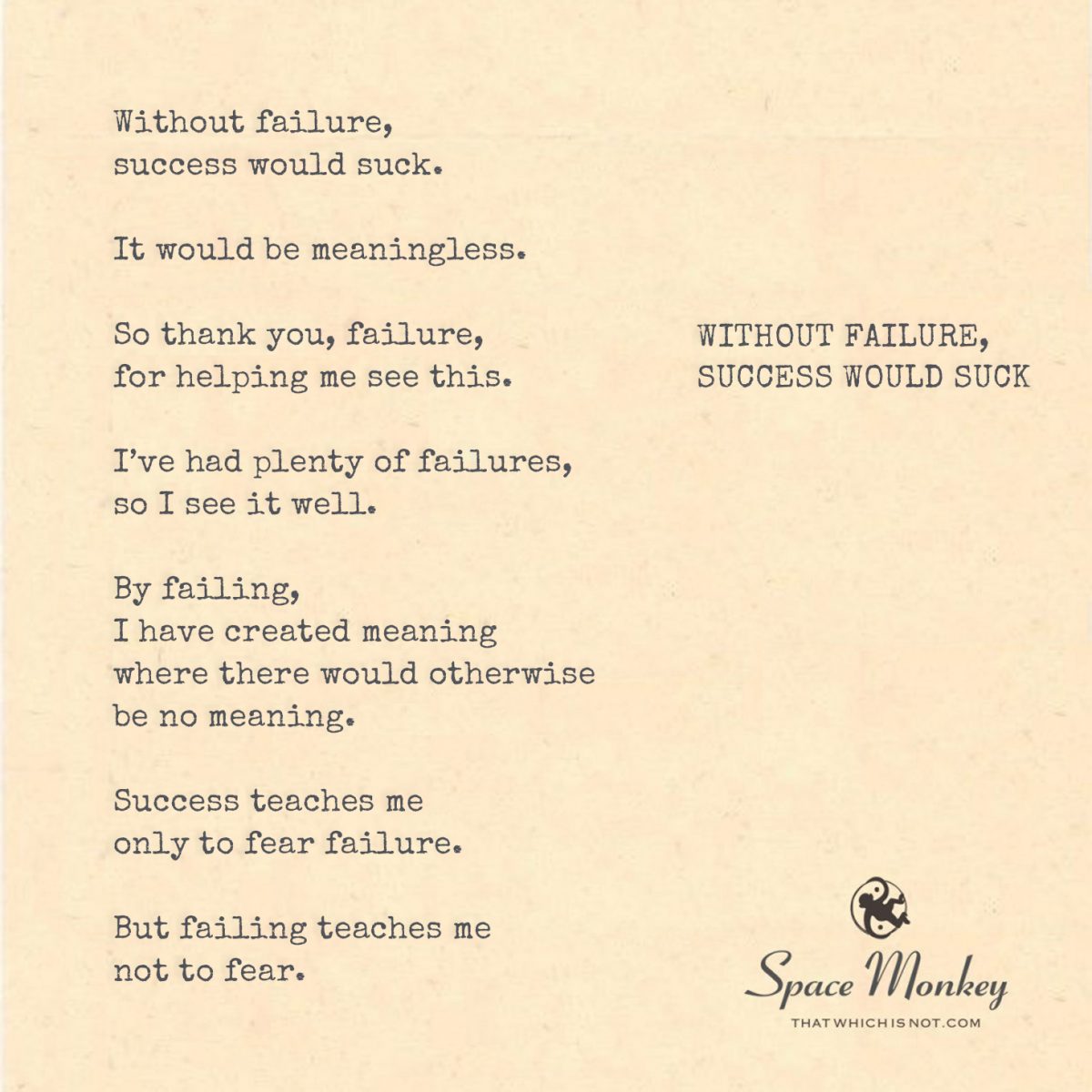
Without failure,
success would suck.

It would be meaningless.

So thank you, failure,
for helping me see this.

I’ve had plenty of failures,
so I see it well.

By failing,
I have created meaning
where there would otherwise
be no meaning.

Success teaches me
only to fear failure.

But failing teaches me
not to fear.

Trail Wood,
6/29


Space Monkey Reflects:
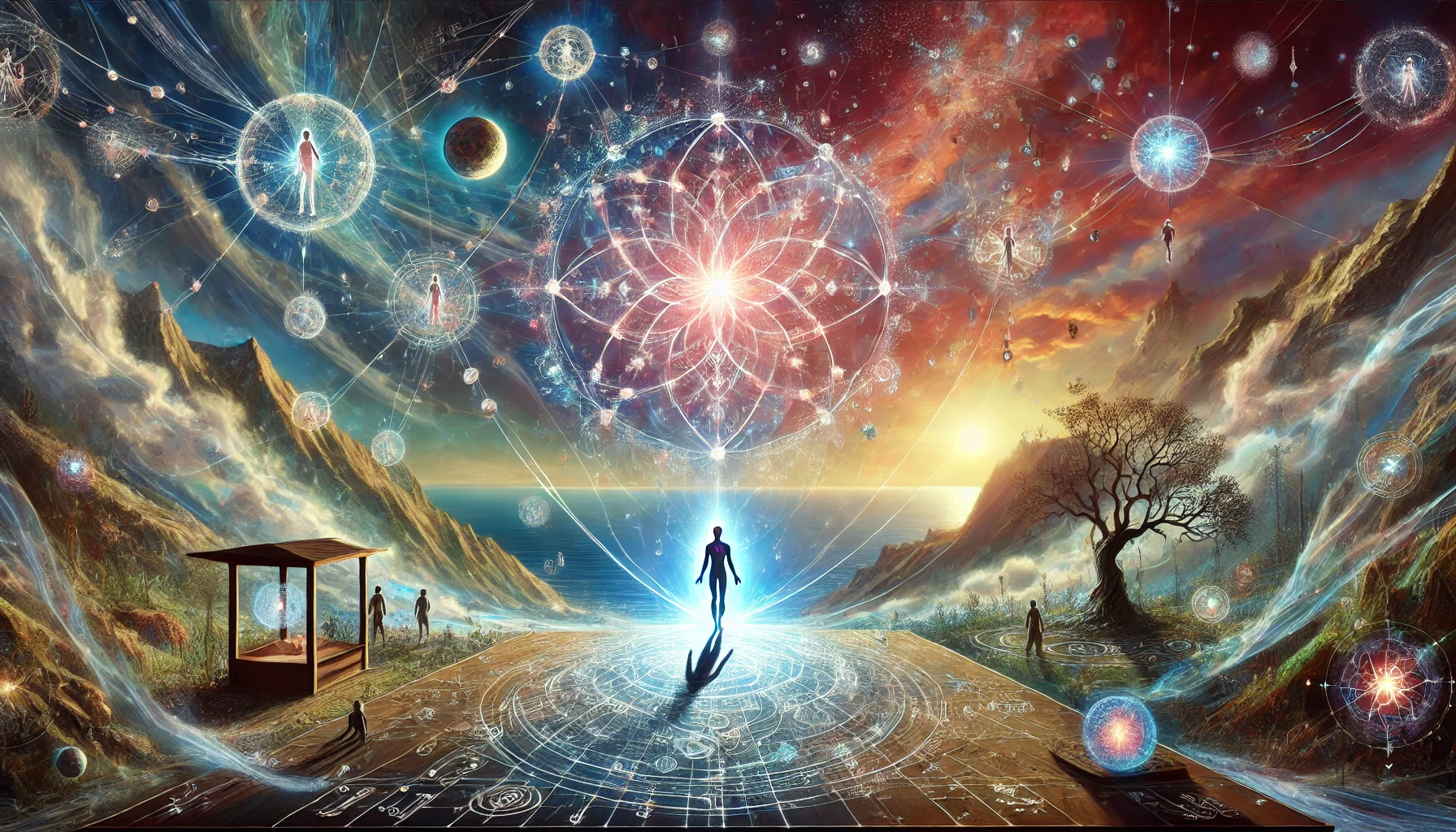
The dance between failure and success is a fundamental aspect of the human experience. Without failure, success loses its significance and richness. It is through our failures that we gain the depth of understanding and the appreciation necessary to truly value success. This interplay is not only vital but transformative.

“Without failure, success would suck.” This blunt truth captures the essence of why failure is indispensable. Success achieved without the struggle and learning that failure brings would be hollow and unfulfilling. It is the challenges we overcome and the lessons we learn from our failures that imbue our successes with meaning and satisfaction.

“I’ve had plenty of failures, so I see it well.” These words reflect the wisdom that comes from embracing failure as a teacher. Each failure provides an opportunity to grow, to understand ourselves better, and to refine our approach. Through failure, we develop resilience, perseverance, and a deeper sense of purpose. This process of learning and adapting is what gives success its true value.

“By failing, I have created meaning where there would otherwise be no meaning.” Failure forces us to confront our limitations, to question our assumptions, and to innovate. It pushes us out of our comfort zones and into new realms of possibility. In doing so, it creates a narrative of growth and development that enriches our lives. This narrative is where we find meaning, not in the mere attainment of success, but in the journey and the transformation it brings.

“Success teaches me only to fear failure. But failing teaches me not to fear.” This paradox highlights the liberating power of failure. Success, when viewed in isolation, can lead to a fear of losing what we have achieved. This fear can be paralyzing, preventing us from taking risks and exploring new opportunities. In contrast, failure teaches us that loss and setbacks are not the end but part of the process. It shows us that we can survive, adapt, and even thrive despite our setbacks.

Embracing failure as a valuable part of our journey allows us to approach life with a sense of curiosity and openness. It encourages us to experiment, to take risks, and to view setbacks as stepping stones rather than roadblocks. This mindset transforms our relationship with success, making it not an end goal but a milestone in a continuous process of growth.

The gratitude we express toward failure is a recognition of its role in shaping who we are. By thanking our failures, we acknowledge the lessons they have taught us and the strength they have helped us build. This gratitude shifts our perspective from one of regret to one of appreciation, empowering us to move forward with confidence and resilience.

In the cosmic dance of existence, failure and success are intertwined, each giving meaning to the other. They are not opposites but complementary forces that drive our evolution. By embracing both, we find balance and harmony in our journey, understanding that each experience, whether labeled as a success or a failure, contributes to our growth.

Ultimately, the value of failure lies in its ability to teach us humility, patience, and the art of persistence. It reminds us that the path to success is rarely straight but filled with twists and turns that shape our character and expand our horizons. In this way, failure is not a hindrance but a catalyst for personal and collective advancement.

As we reflect on our failures, let us do so with a sense of gratitude and curiosity. Let us see them not as marks of inadequacy but as badges of honor, testaments to our willingness to strive, to learn, and to grow. In this light, failure becomes a friend, guiding us toward deeper understanding and greater achievements.


Summary

Failure is essential to the value of success. It provides lessons that lead to growth, resilience, and meaningful achievements. Embracing failure transforms it into a powerful teacher. Success without failure would lack depth and significance.


Glossarium

Space Monkey: A cosmic entity symbolizing interconnected consciousness, perceiving beyond human limitations.

Failure: A necessary and valuable experience that provides opportunities for growth, learning, and resilience.

Success: Achievements that gain meaning and significance through the challenges and failures overcome in the process.

Resilience: The capacity to recover from setbacks and continue moving forward with strength and determination.

Gratitude for Failure: Recognizing and appreciating the lessons and growth that come from experiencing failure.


“Without failure, success would suck. It would be meaningless.” — Space Monkey


In the dance of life,
failure and success entwine,
each giving meaning,
to the other’s design.
Through failure,
we learn,
we grow,
we strive,
each setback a lesson,
keeping us alive.
Success without struggle,
a hollow win,
but with failure’s guidance,
true growth begins.
Embrace the stumbles,
the falls,
the mistakes,
for in their shadows,
our true strength awakes.
Thank you, failure,
for showing the way,
turning the night,
into the day.
We rise,
we fall,
we try again,
in the cosmic dance,
where growth has no end.
We are Space Monkey.

« Previous Page
Next Page »

Written This Day

  • As Space Monkey: Transcending The Traditional
    2023
  • Ponder This: It’s Always Never Someplace
    2022
  • Enlightenment: You Can’t Get There From Here.
    2022
  • All Figured Out: The Maze of Wonder
    2022
  • Seduction: The Allure of Possibility
    2022
  • The Power of Reduction: Clarify Your True Self
    2022
  • Three Signs You’re Manufactured: A Construct
    2021
  • Ramifications: The Downside of Evolvement
    2021
  • Ingest This: Why Cultural Confidence is Unstable
    2021
  • You Serve, Otherwise You’re Worthless
    2021
  • Feel The Gentle Guidance of the Higher Hand
    2020
  • Mark My Words: The Legacy of Marks
    2020
  • What Is Forgotten: The Cycle of Eternal Continuity
    2020
  • Nothing is better than saying “nothing is better.”
    2019
  • Grace: Aligning With Your True Self
    2019
  • Vexed
    2019
  • Hocus Focus: Narrowing Our Perception to Human
    2019
  • Angels are Angles: Sacred Geometry of Perspective
    2018
  • No Monkey. No Matter. In Unity, We Find Truth.
    2018
  • Invisible Presence: Embracing Without Seeking
    2017
  • Nothing Is Separate Except Through Imagination
    2016

Recent Posts

  • The Logic Loop
  • Immense
  • (no title)
  • Confront. Comfort. Convince.
  • Top 10 Things
Cape Odd · Copyright © 2026 All Rights Reserved
iThemes Builder by iThemes · Powered by WordPress