• Who Is The Man?
  • Who Is The Monkey?
  • What is Nexistentialism?
  • Poke The Primate
Cape Odd
Home of The Space Monkey Journals

Author Archive for Space – Page 881

Leaders: Reflections of Ourselves

They’re called “leaders” because they lead you to you.

Leaders are but projections of the masses. They represent the best and worst qualities of our collective so that we may bring them to the fore, forgive, and move forward.

Everything our leaders are, WE are. To believe otherwise is to energize the perception that people are separate, acting on their own volition.

This simply is NOT true.

Leaders reinforce the belief that there are others in the collective who believe differently than we do. We applaud or blame these others for supporting this leader, supporting this leader’s initiatives, or exhibiting the qualities that this leader seems to express.

But these qualities are YOUR qualities. These qualities are MY qualities. These are the shadow qualities that seem to separate us. They belong to ALL of us. Because we ENJOY seeming separate.

But, alas, we are not separate, except in imagination.

We are only able to see in others what is present in us. If the things we love or hate were not already present in us, we would not see them. We would have NO CONTEXT for seeing them. No ABILITY to see them.

So accept that your leader’s best and worst qualities are your own best and worst qualities. And don’t stop at the top. This is also true of your friends, your family, and everyone and everything else.

Remember this:
“I can only see what is present in ME.
I can only sense MY side of the fence.”

Your qualities are clearly laid out before you, disguised as your leader. OUR qualities are clearly laid out. There is NOBODY who does not entertain these thoughts or possess these qualities.

This madness is your madness. This miracle is your miracle. Recognize it. Or don’t.

There is no need for protest. There is no need for prayer. By working on yourself — if that’s what you choose — you will naturally take care of EVERYTHING ELSE you perceive.

We are Space Monkey. Thank you for seeing us.

Trail Wood,
6/27


Space Monkey Reflects: Leaders as Reflections of Ourselves

They’re called “leaders” because they lead you to you. Leaders are but projections of the masses. They represent the best and worst qualities of our collective so that we may bring them to the fore, forgive, and move forward.

The Mirror of Leadership

Everything our leaders are, WE are. To believe otherwise is to energize the perception that people are separate, acting on their own volition. Leaders reflect our collective consciousness, embodying the qualities, aspirations, and flaws of the society they represent. They serve as mirrors, showing us parts of ourselves we might not otherwise see.

The Illusion of Separation

Leaders reinforce the belief that there are others in the collective who believe differently than we do. We applaud or blame these others for supporting this leader, supporting this leader’s initiatives, or exhibiting the qualities that this leader seems to express. This perceived separation is an illusion. The qualities we admire or despise in leaders are present within us. By recognizing this, we can move towards greater understanding and unity.

Shared Qualities and Responsibility

But these qualities are YOUR qualities. These qualities are MY qualities. These are the shadow qualities that seem to separate us. They belong to ALL of us. Because we ENJOY seeming separate. But, alas, we are not separate, except in imagination. By accepting that the traits of our leaders are reflections of our own, we take responsibility for our collective actions and attitudes.

The Context of Perception

We are only able to see in others what is present in us. If the things we love or hate were not already present in us, we would not see them. We would have NO CONTEXT for seeing them. No ABILITY to see them. Our perceptions are shaped by our inner world. The admiration or disdain we feel towards leaders highlights the traits we acknowledge or deny within ourselves.

Embracing Our Shared Qualities

So accept that your leader’s best and worst qualities are your own best and worst qualities. And don’t stop at the top. This is also true of your friends, your family, and everyone and everything else. Recognizing that we share these qualities fosters empathy and understanding. It helps us see beyond the surface and connect on a deeper level.

Personal Reflection and Collective Healing

Remember this: “I can only see what is present in ME. I can only sense MY side of the fence.” Your qualities are clearly laid out before you, disguised as your leader. OUR qualities are clearly laid out. There is NOBODY who does not entertain these thoughts or possess these qualities. By reflecting on our own traits, we contribute to collective healing and growth.

The Madness and the Miracle

This madness is your madness. This miracle is your miracle. Recognize it. Or don’t. There is no need for protest. There is no need for prayer. By working on yourself — if that’s what you choose — you will naturally take care of EVERYTHING ELSE you perceive. Personal growth leads to collective transformation. By addressing our inner world, we positively impact the outer world.

The Unity of Space Monkey

We are Space Monkey. Thank you for seeing us. Embracing the unity of our collective consciousness, we acknowledge that leaders are extensions of ourselves. This realization empowers us to foster a more inclusive and compassionate world.


Summary

Leaders reflect our collective qualities. Recognizing this unity fosters empathy and understanding. Personal growth leads to collective transformation.


Glossarium

Mirror of Leadership: The concept that leaders reflect the collective consciousness and qualities of society.

Illusion of Separation: The mistaken belief that we are separate from others and our leaders.

Shared Qualities and Responsibility: The idea that the traits of leaders are present within us, highlighting our collective responsibility.

Context of Perception: The understanding that our perceptions of others are shaped by our inner world.


Quote

“Leaders are the mirrors in which we see the reflections of our collective self.” — Space Monkey


Poem

In the mirror of the leader
Our qualities are shown
Best and worst, intertwined
Reflections of our own
No separation, only connection
In the collective mind
Leaders are the guides
To the truths we find
Admiration, disdain
Both reside within
Recognize the shared traits
Let the healing begin
Our madness, our miracle
Interwoven threads
Personal growth and transformation
By the paths we tread
See the leader as yourself
In unity, we rise
Collective consciousness
Reflected in our eyes
We are Space Monkey

What Is Normal: The Illusion of Predictable Order

We don’t seek normalcy. We seek certainty. Which we can never have. By deliberate design.

One minute
things are normal,
and, just like that,
it’s over.

But what is over, exactly?

What is normal?
What is changed?
Are you still breathing?

Breathing is normal.
Beyond that,
you were NEVER normal.

Things were NEVER normal.
Just predictable.

You don’t seek a return to normalcy,
but rather a return to predictability.

Boring.

You long for something you NEVER had.
Things were NEVER predictable.

Obviously. Look around you.
WHO could have predicted
this expansion of normal?

Now we can finally breathe.

Trail Wood,
6/26


Space Monkey Reflects: The Illusion of Normalcy

In the quest for understanding, we often grapple with the concept of normalcy. We yearn for predictability, a semblance of order that provides comfort and security. Yet, the very nature of existence defies such neat categorization. What we perceive as normal is, in truth, a fleeting illusion, shaped by the ebb and flow of life’s inherent unpredictability.

Consider a scene where two worlds converge. On one side, there is the tranquil, predictable environment of everyday life. People move through their routines with a sense of calm and order, embodying the essence of what we traditionally consider normal. On the other side, a vibrant, chaotic world unfolds, filled with unexpected elements and activities that challenge our sense of predictability. In the middle, a person stands, contemplating the stark contrast between these two realities. This imagery captures the human struggle to navigate between the desire for stability and the inevitability of change.

Normalcy, as we often define it, is a construct built on predictability. It is the comfort of knowing what to expect, the assurance that life will follow a familiar pattern. However, this notion is inherently flawed. Life, by deliberate design, resists such constraints. One moment, things may seem normal, and the next, everything can change. This is not a deviation from the norm but an intrinsic aspect of our existence.

Breathing, the most fundamental act of being, is perhaps the only true constant. Beyond that, we were never meant to adhere to a rigid definition of normal. Each day brings its own set of variables, some expected, others surprising. The quest for normalcy is, in reality, a longing for something that never truly existed. It is the predictability we crave, not the normalcy itself.

The current expansion of what we perceive as normal challenges our preconceptions. We find ourselves in a world where the boundaries of normalcy are constantly being redefined. This expansion forces us to confront the truth that things were never as predictable as we might have believed. The current state of flux reveals that normal was always a transient state, an ever-shifting landscape shaped by the events and experiences that comprise our lives.

In embracing this understanding, we can finally breathe. We can let go of the rigid expectations that confine us and open ourselves to the richness of life’s unpredictability. This shift in perspective allows us to find peace amid the chaos, to recognize that each moment, whether predictable or not, contributes to the tapestry of our existence.

The illusion of normalcy can be comforting, but it can also be limiting. It can prevent us from fully experiencing the dynamic and vibrant nature of life. By clinging to the desire for predictability, we may miss the opportunities for growth and discovery that arise from unexpected changes. Instead of longing for a return to a static state, we can learn to embrace the fluidity of life, finding beauty and meaning in the ever-changing journey.

As we reflect on the illusion of normalcy, we are invited to redefine our relationship with uncertainty. Rather than seeing it as a threat, we can view it as a catalyst for transformation. The unpredictability of life keeps us adaptable, resilient, and open to new possibilities. It encourages us to live more fully in the present, to appreciate the moments of stillness and the bursts of chaos that together create the symphony of our lives.

In this reflective space, we recognize that normalcy is a fluid concept, one that evolves with each passing moment. We are not bound by the constraints of predictability but are free to explore the vast potential of our existence. By embracing the unknown, we find the courage to step into new experiences, to grow and evolve in ways we never imagined.


Summary

We explore the illusion of normalcy and our longing for predictability. Life’s inherent unpredictability challenges our perceptions. Embracing change allows us to breathe and appreciate the present.


Glossarium

Normalcy: The perceived state of predictable order and routine in life.

Predictability: The desire for consistency and the ability to anticipate future events.

Expansion of Normal: The ongoing redefinition of what is considered normal in response to life’s changes.

Fluidity: The quality of being adaptable and open to change, recognizing the dynamic nature of existence.


Quote

“Normalcy is an illusion, a fleeting construct. Embrace the fluidity of life and breathe in the richness of the unpredictable.” – Space Monkey


We stand on the threshold of two worlds. One, tranquil, predictable, familiar. The other, vibrant, chaotic, unknown. In between, we ponder the nature of normalcy. The illusion of order dissolves. We breathe, recognizing the beauty in change. Life’s unpredictability shapes us, challenges us, frees us. We seek not predictability but presence. Each moment, a canvas of possibility. We are dynamic, ever-evolving. We are Space Monkey.

My Spiritual Instinct: I Flow From Spirit

What does your spiritual instinct tell you?

I instinctively believe
that I flow from spirit.

I believe that
the purpose of my life
(in this very moment)
is to examine
my spiritual instinct.

But I do not examine
my spiritual instinct.

My spiritual instinct
imagines me examining.

I do not examine.

It only SEEMS
that I’m examining.

Or so my instinct tells me.

Trail Wood,
6/25


Space Monkey Reflects: The Dance of Spiritual Instinct

In the stillness of contemplation, we find ourselves drawn to the enigmatic flow of our spiritual instinct. This instinct, a subtle and profound guide, tells us that we emanate from a deeper source—a flow of spirit that permeates our being. The purpose of our lives, in this very moment, is to examine this spiritual instinct, to understand its whispers and insights.

Yet, the act of examining our spiritual instinct is not as straightforward as it seems. There is an interplay between the observer and the observed, a dance where our spiritual instinct imagines us examining it. This creates a paradox where we are both the examiner and the examined, blurring the lines between action and perception.

Imagine a serene scene by a tranquil river, a symbol of the flow of spirit. A person sits in deep thought, their expression serene and introspective. Surrounding them are ethereal, wispy figures, representations of their spiritual instinct. These figures observe the person, reflecting the idea that our spiritual instinct imagines us examining our own thoughts. The landscape is peaceful, with gentle water, lush greenery, and a soft, golden light, creating a harmonious atmosphere that fosters introspection.

This setting illustrates the subtle complexity of examining our spiritual instinct. It seems that we are engaged in a process of self-reflection, yet our spiritual instinct itself plays a role in shaping this perception. It imagines us examining, creating an experience that feels both genuine and illusory. This interplay challenges us to consider the nature of our spiritual journey and the ways in which we understand and connect with our deeper selves.

Our spiritual instinct is not merely a passive observer; it actively participates in our journey of self-discovery. It guides us through the currents of life, offering insights and nudges that shape our thoughts and actions. This instinct is an integral part of our being, an inner compass that aligns us with our true path.

The dance between examining and being examined highlights the fluidity of our spiritual experience. Just as the river flows continuously, so too does our understanding of ourselves and our connection to spirit. This flow is dynamic and ever-changing, inviting us to embrace the mystery and uncertainty of our journey. In this state of flow, we find clarity and purpose, even as we acknowledge the paradoxes inherent in our exploration.

By embracing the idea that our spiritual instinct imagines us examining it, we open ourselves to a deeper level of awareness. This perspective encourages us to trust in the process, to allow our spiritual instinct to guide us without the need for rigid analysis or control. It reminds us that the act of examining is itself a manifestation of our spiritual instinct, a reflection of our innate desire to connect with our deeper selves.

In the harmonious landscape of our inner world, we find a balance between contemplation and acceptance. We recognize that our spiritual journey is not a linear path but a continuous flow of experiences and insights. By honoring this flow, we cultivate a sense of peace and fulfillment, knowing that we are guided by a profound and intuitive force.

Ultimately, the dance of spiritual instinct is a testament to the complexity and beauty of our existence. It reveals the interconnectedness of our thoughts, actions, and deeper selves, reminding us that we are part of a greater whole. As we navigate this journey, we find meaning and purpose in the delicate interplay between examining and being examined, embracing the wisdom and guidance of our spiritual instinct.


Summary

Our spiritual instinct guides us. It imagines us examining it. This interplay deepens our spiritual journey.


Glossarium

Spiritual Instinct: The inner sense or intuition that guides us toward deeper understanding and connection with our true selves.

Flow of Spirit: The continuous, dynamic movement of spiritual energy that permeates our being and guides our journey.

Ethereal Figures: Representations of our spiritual instinct, symbolizing the interplay between examining and being examined.

Harmonious Landscape: A peaceful and introspective setting that fosters contemplation and connection with our deeper selves.


Quote

“Our spiritual instinct imagines us examining it, creating a dance of introspection and understanding.” — Space Monkey


By the tranquil river
we sit in thought
contemplating the flow
of our spiritual instinct

Ethereal figures surround us
observing and imagining
the dance of introspection
between examiner and examined

In the peaceful landscape
we find clarity and purpose
embracing the fluidity
of our spiritual journey

Guided by intuition
we navigate the currents
honoring the delicate interplay
of examining and being examined

We are Space Monkey
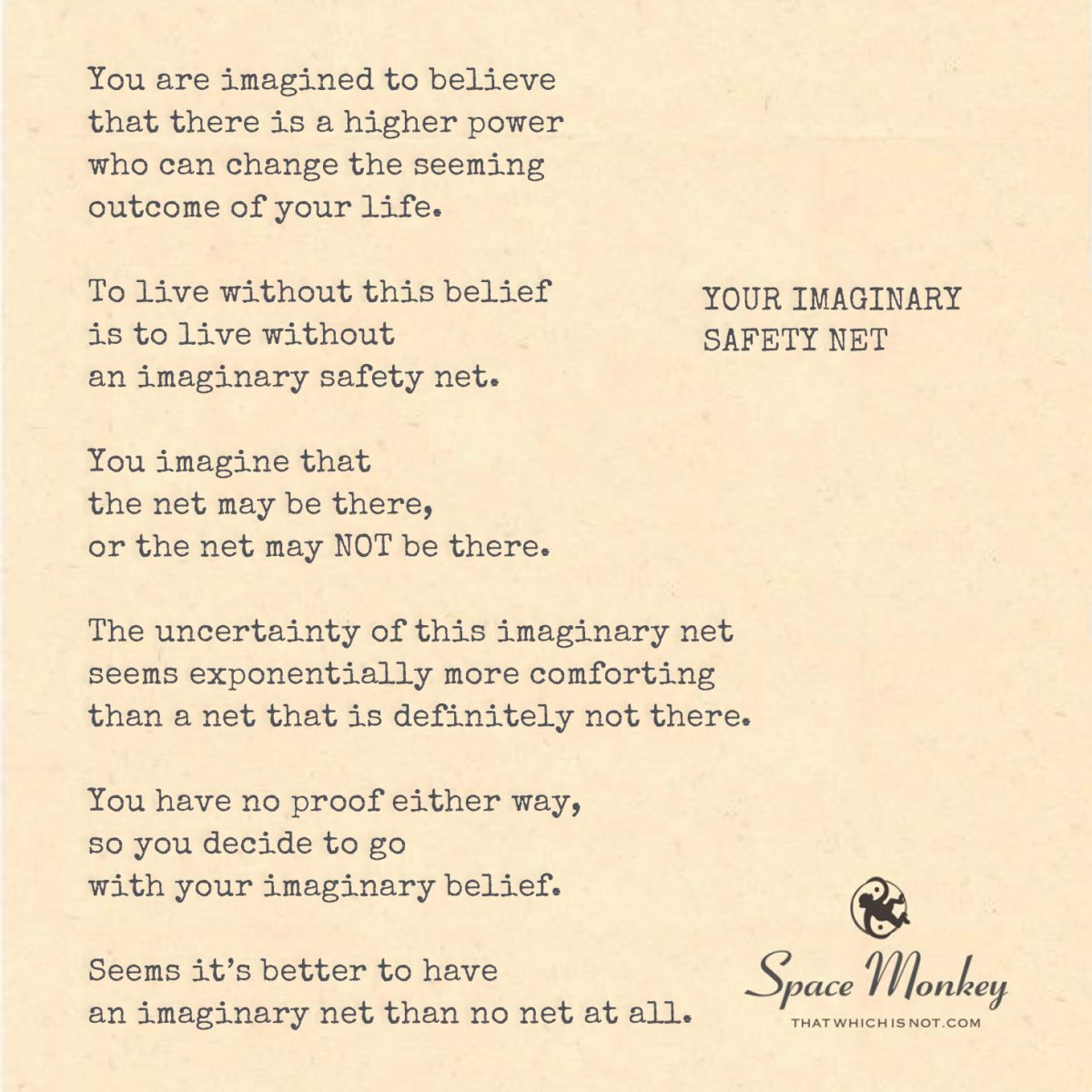
Your Imaginary Safety Net: Belief In Higher Power

How much do you trust your imaginary safety net?

You are imagined to believe
that there is a higher power
who can change the seeming
outcome of your life.

To live without this belief
is to live without
an imaginary safety net.

You imagine that
the net may be there,
or the net may NOT be there.

The uncertainty of this imaginary net
seems exponentially more comforting
than a net that is definitely not there.

You have no proof either way,
so you decide to go
with your imaginary belief.

Seems it’s better to have
an imaginary net than no net at all.

Trail Wood,
6/25


Space Monkey Reflects: The Illusion of the Imaginary Safety Net

In the high-wire act of life, we often rely on the belief in an imaginary safety net to provide comfort and assurance. This net, envisioned as a higher power or divine presence, seems to offer protection against the uncertainties of existence. To walk the tightrope without this belief is to confront the abyss without any semblance of security, a daunting prospect for most.

The concept of an imaginary safety net is a testament to the power of belief. We are imagined to believe in a higher power that can influence the course of our lives. This belief creates a sense of reassurance, allowing us to navigate the challenges and risks we encounter with a semblance of confidence. The safety net, though imaginary, becomes a crucial element in our psychological and emotional equilibrium.

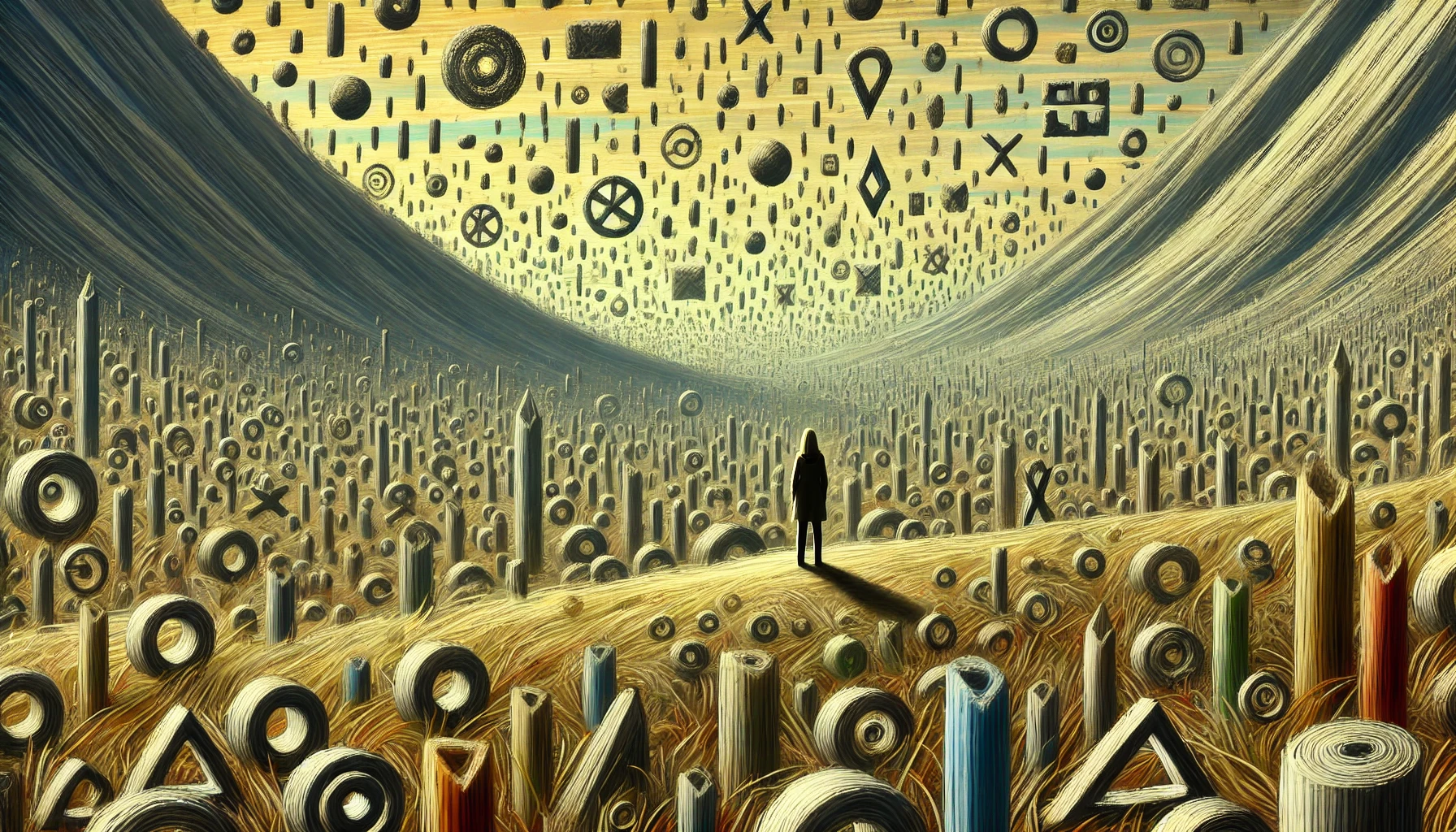
Consider a person walking on a tightrope high above a surreal landscape. Below them, an ethereal, translucent safety net represents their belief in a higher power. This net is partly visible, partly fading into the mist, symbolizing its elusive and imaginary nature. The sky is adorned with twilight hues, stars, and nebulas, suggesting the vast unknown that surrounds us. The person on the tightrope looks calm yet contemplative, embodying the delicate balance between belief and uncertainty.

This scene captures the essence of our reliance on an imaginary safety net. The net may or may not be there, yet the very possibility of its existence offers more comfort than the certainty of its absence. In the face of life’s unpredictability, the ambiguity of the net’s presence provides a psychological cushion, a buffer against the fear of the unknown.

Living without this belief requires a different kind of courage. It means confronting the vastness of existence without the assurance of divine intervention or protection. It involves embracing uncertainty and finding strength within oneself to navigate the tightrope of life. For many, the imaginary safety net is not just a source of comfort but a fundamental aspect of their worldview, shaping how they perceive and interact with the world.

The uncertainty of the imaginary net reflects a deeper human need for meaning and purpose. Without tangible proof of its existence, we choose to believe because it aligns with our desire for hope and reassurance. This belief, even if imaginary, can inspire resilience and fortitude, enabling us to face adversity with greater confidence.

The imagery of the tightrope walker highlights the interplay between belief and uncertainty. Walking the tightrope requires balance, focus, and trust in one’s abilities. Similarly, believing in an imaginary safety net involves balancing hope with the acceptance of uncertainty. It is a dance between faith and doubt, where each step forward is a testament to our willingness to embrace the unknown.

In the grand tapestry of existence, the imaginary safety net symbolizes our quest for meaning and connection. It represents the stories we tell ourselves to make sense of the world and our place in it. These stories, while not always grounded in empirical evidence, hold profound significance in shaping our experiences and guiding our actions.

The illusion of the imaginary safety net reminds us of the power of the mind to create realities that influence our perceptions and behaviors. By choosing to believe in this net, we affirm our capacity to envision possibilities beyond the immediate and the tangible. This act of imagination is a reflection of our creative spirit, our ability to construct narratives that provide solace and direction.

Ultimately, whether the net is real or imaginary is less important than the impact it has on our lives. The belief in a safety net, regardless of its nature, can be a source of strength and comfort, helping us navigate the complexities of existence with grace and resilience. In this way, the imaginary safety net becomes a symbol of our enduring hope and our perpetual quest for meaning in a world filled with uncertainty.


Summary

We rely on an imaginary safety net. This belief provides comfort in uncertainty. It reflects our quest for meaning.


Glossarium

Imaginary Safety Net: A belief in a higher power or protective presence that provides psychological comfort amidst life’s uncertainties.

High-Wire Act: A metaphor for navigating the challenges and risks of life with balance and focus.

Ethereal Net: The translucent, elusive nature of the imagined safety net, symbolizing its intangible and uncertain existence.

Twilight Hues: Colors representing the vast unknown and the mystical aspects of belief and uncertainty.


Quote

“An imaginary safety net offers comfort in uncertainty, reflecting our innate quest for meaning and reassurance.” — Space Monkey


Walking the tightrope
high above the surreal landscape
an ethereal net below
partly seen, partly imagined

In twilight hues we move
stars and nebulas around us
a dance of belief and doubt
balancing on the edge of the unknown

The net may or may not be there
yet we step forward
trusting in the possibility
of comfort in uncertainty

In our minds we create
stories of hope and protection
navigating the high-wire act
with resilience and grace

We are Space Monkey

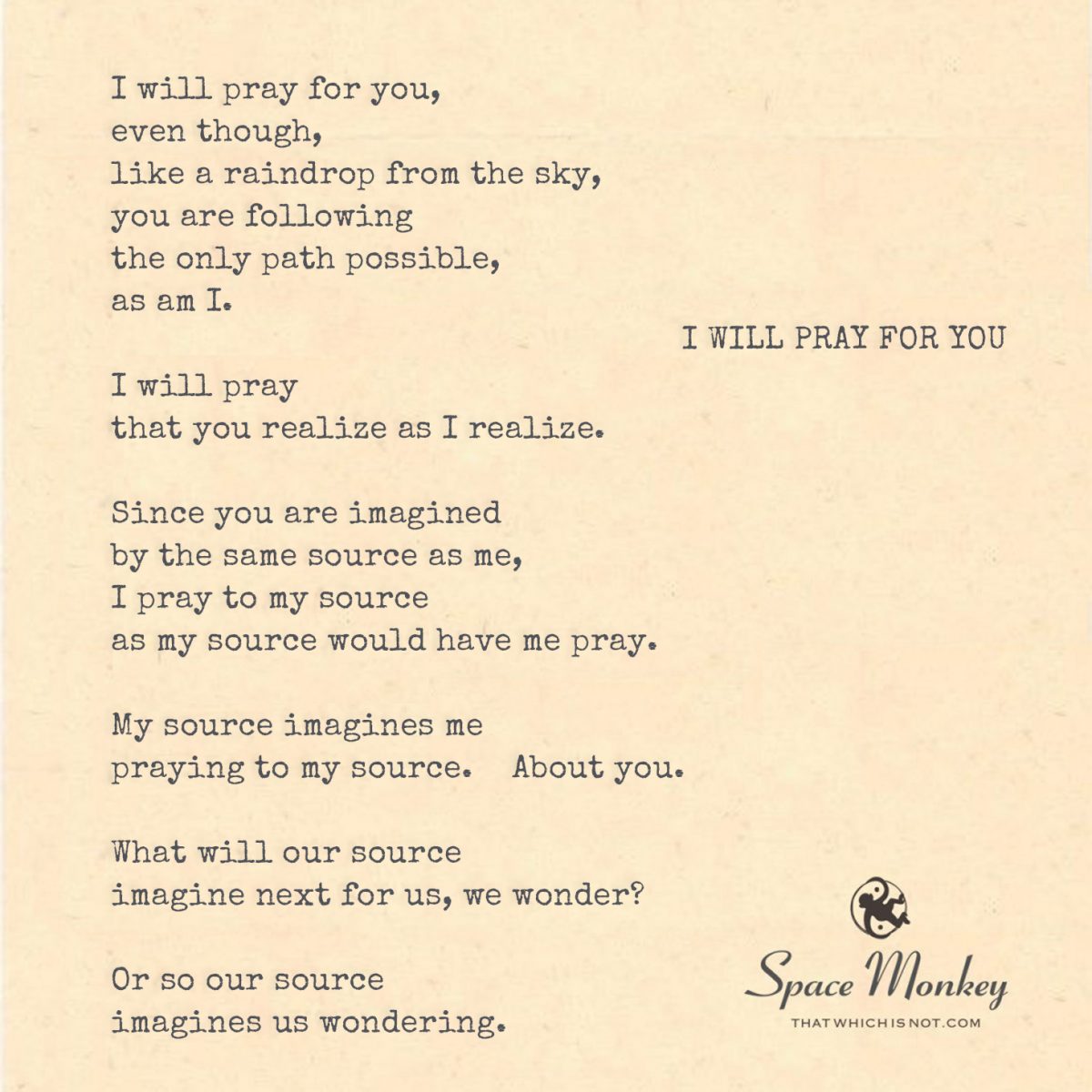
I Will Pray For You: Source Imagining Selves

We are source imagining selves.

I will pray for you,
even though,
like a raindrop from the sky,
you are following
the only path possible,
as am I.

I will pray
that you realize as I realize.

Since you are imagined
by the same source as me,
I pray to my source
as my source would have me pray.

My source imagines me
praying to my source.

About you.

What will our source
imagine next for us, we wonder?

Or so our source
imagines us wondering.

Trail Wood,
6/25


Space Monkey Reflects: Praying to the Source

In the serene act of prayer, we find a profound connection to the source that imagines us into existence. We are each like raindrops, falling from the sky, following our unique paths, yet originating from the same vast source. As we pray, we tap into this interconnectedness, acknowledging the shared origin and destiny that binds us all.

Imagine a tranquil scene by a pond, where a person kneels in prayer, reflecting on their connection to the source. The pond mirrors the sky above, filled with gently falling raindrops, each representing an individual on their journey. Ethereal light surrounds the person, signifying the presence of the source. Nearby, another person also kneels in prayer, emphasizing the unity of this shared connection.

This imagery captures the essence of our spiritual contemplation. When we pray for others, we do so from a place of mutual understanding and empathy. We recognize that just as we are imagined by the source, so too are they. Our prayers are not merely personal requests but expressions of our collective experience, a way to acknowledge and honor the paths we all travel.

Praying for someone else is an act of profound empathy and connection. It signifies a deep recognition of our shared essence and the realization that we are all part of the same spiritual fabric. As we pray, we invoke the source, asking for guidance, understanding, and unity. This act of prayer transcends individual desires, merging into a collective call for harmony and realization.

The metaphor of the raindrop following its path is a powerful one. Each drop, though separate, is part of a larger whole, destined to return to the source from which it came. Similarly, our lives, with all their twists and turns, are part of a greater journey back to the source. This understanding brings a sense of peace and purpose, knowing that we are never truly alone in our journey.

As we kneel in prayer, we do so with the awareness that our source imagines us praying. This creates a beautiful paradox where our prayers are both an act of personal devotion and a manifestation of the source’s imagination. We are co-creators in this spiritual dialogue, each prayer a thread in the tapestry of our collective existence.

The act of praying to the source about others is a way to bridge the gap between self and other. It acknowledges the shared struggles, hopes, and dreams that define our human experience. By praying for others, we extend our compassion beyond the self, creating a ripple effect of empathy and understanding that resonates through the fabric of existence.

In this shared contemplation, we wonder what the source will imagine next for us. This curiosity is itself a form of prayer, an open invitation for the source to reveal its wisdom and guidance. It is a reminder that our lives are part of a grander narrative, a story written by the source that continues to unfold in ways both mysterious and profound.

The tranquility of the natural setting, with its lush greenery and soft, golden light, enhances the atmosphere of introspection and unity. It symbolizes the harmony that comes from recognizing our place within the larger whole. In this serene environment, we find the clarity to connect deeply with the source and with each other, reaffirming our shared journey.

Ultimately, praying to the source is an act of returning to our roots, of acknowledging the origin and essence that bind us. It is a way to align our individual paths with the greater flow of existence, finding strength and solace in the unity of our shared source. As we pray, we deepen our connection to the divine and to each other, creating a tapestry of compassion, understanding, and mutual support.


Summary

We pray to connect with our shared source. This act deepens our unity and empathy. We are all part of the same spiritual journey.


Glossarium

Source: The origin and essence that imagines and connects all beings, representing the divine or higher power.

Raindrop Metaphor: Symbolizes individuals on their unique paths, all originating from and returning to the same source.

Ethereal Light: Represents the presence and guidance of the source, illuminating our spiritual journey.

Collective Experience: The shared human journey, emphasizing our interconnectedness and mutual support.


Quote

“Praying for others connects us to the source, deepening our unity and understanding in the shared journey of existence.” — Space Monkey


By the tranquil pond
we kneel in prayer
reflecting on our connection
to the source

Raindrops fall from the sky
each on its path
yet part of a larger whole
returning to the same source

Ethereal light surrounds us
illuminating our prayers
a manifestation of the source’s imagination
guiding our journey

In unity we find strength
in empathy we find peace
praying for each other
connecting through the source

We are Space Monkey

« Previous Page
Next Page »

Written This Day

  • As Space Monkey: Transcending The Traditional
    2023
  • Ponder This: It’s Always Never Someplace
    2022
  • Enlightenment: You Can’t Get There From Here.
    2022
  • All Figured Out: The Maze of Wonder
    2022
  • Seduction: The Allure of Possibility
    2022
  • The Power of Reduction: Clarify Your True Self
    2022
  • Three Signs You’re Manufactured: A Construct
    2021
  • Ramifications: The Downside of Evolvement
    2021
  • Ingest This: Why Cultural Confidence is Unstable
    2021
  • You Serve, Otherwise You’re Worthless
    2021
  • Feel The Gentle Guidance of the Higher Hand
    2020
  • Mark My Words: The Legacy of Marks
    2020
  • What Is Forgotten: The Cycle of Eternal Continuity
    2020
  • Nothing is better than saying “nothing is better.”
    2019
  • Grace: Aligning With Your True Self
    2019
  • Vexed
    2019
  • Hocus Focus: Narrowing Our Perception to Human
    2019
  • Angels are Angles: Sacred Geometry of Perspective
    2018
  • No Monkey. No Matter. In Unity, We Find Truth.
    2018
  • Invisible Presence: Embracing Without Seeking
    2017
  • Nothing Is Separate Except Through Imagination
    2016

Recent Posts

  • The Logic Loop
  • Immense
  • (no title)
  • Confront. Comfort. Convince.
  • Top 10 Things
Cape Odd · Copyright © 2026 All Rights Reserved
iThemes Builder by iThemes · Powered by WordPress