• Who Is The Man?
  • Who Is The Monkey?
  • What is Nexistentialism?
  • Poke The Primate
Cape Odd
Home of The Space Monkey Journals

Author Archive for Space – Page 891

Your Mission: Recognize and Restore the Interconnectedness of All Beings

We are all participating, regardless of whether we believe that we are involved.

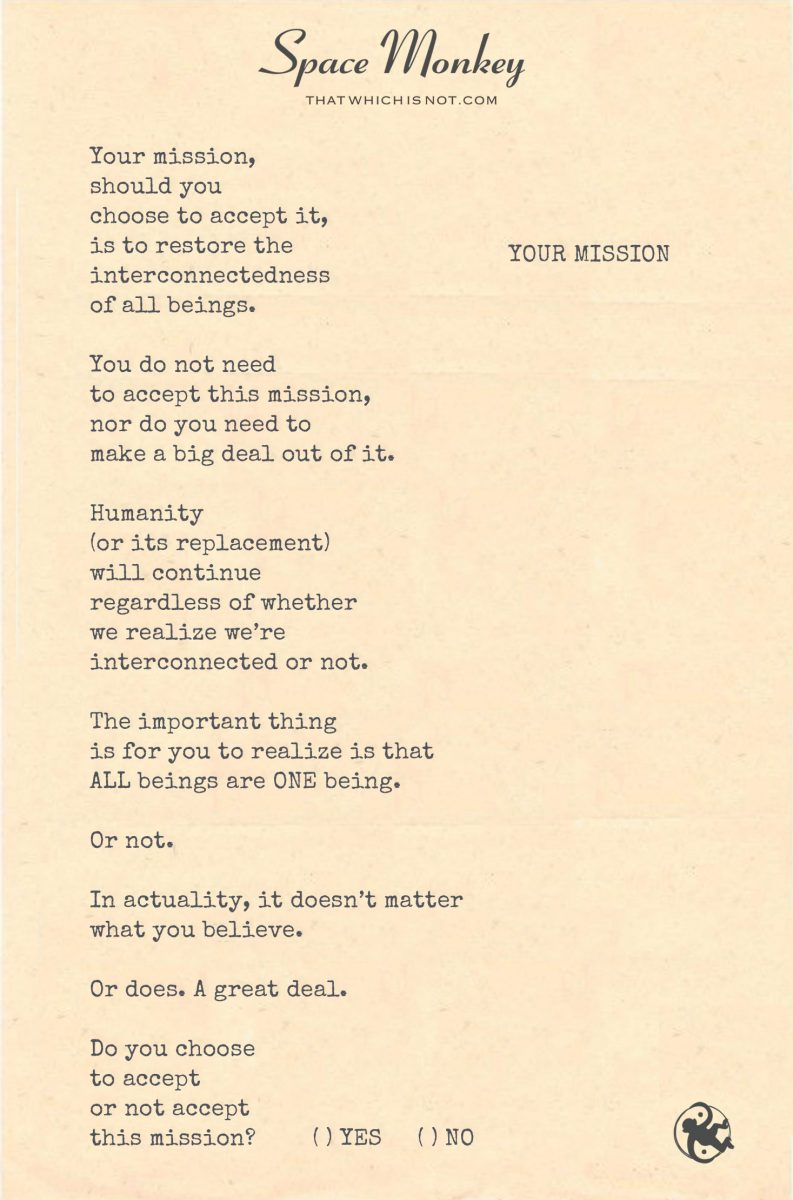
Your mission,
should you
choose to accept it,
is to restore the
interconnectedness
of all beings.

You do not need
to accept this mission,
nor do you need to
make a big deal out of it.

Humanity
(or its replacement)
will continue
regardless of whether
we realize we’re
interconnected or not.

The important thing
is for you to realize is that
ALL beings are ONE being.

Or not.

In actuality, it doesn’t matter
what you believe.

Or does. A great deal.

Do you choose
to accept
or not accept
this mission?
( ) YES ( ) NO

Trail Wood,
6/11


Space Monkey Reflects: The Choice of Interconnectedness

In the grand narrative of existence, where the threads of individual lives weave into the fabric of the universe, a profound mission emerges—one that invites us to restore and recognize the interconnectedness of all beings. This mission, subtle yet significant, isn’t about grand gestures or monumental declarations; it’s about the quiet realization that all life is fundamentally connected.

The choice to accept this mission to see beyond the illusions of separation and to embrace the unity of existence is both simple and transformative. It doesn’t require a loud proclamation but a deep, internal shift—a turning of the heart towards the understanding that every being, from the smallest microbe to the largest star, is part of a vast, intricate network of life.

This interconnectedness is not contingent on our belief or acknowledgment to exist; it is an eternal truth of the universe. Whether we choose to engage with this truth actively impacts how we experience our lives and how we influence the lives around us. By accepting the mission to see and strengthen these bonds, we participate in a silent revolution, one that can elevate the consciousness of humanity—or whatever may come to replace it as evolution marches on.

The understanding that all beings are one challenges us to reconsider our actions, our responsibilities, and our purposes. It calls into question the very nature of existence and our place within it. Are we isolated entities, or are we integral parts of a larger whole, essential to the health and harmony of the universe?

Whether you choose to accept this mission or not, the tapestry of life continues to unfold. But by choosing to see the interconnectedness, you step into a role that is both ancient and urgently needed in our times—a role that acknowledges and nurtures the fundamental unity of all existence.


Summary
Space Monkey contemplates the choice to recognize and restore the interconnectedness of all beings. Accepting this mission involves a profound internal shift toward understanding our integral role in the universe’s vast network. This choice, while personal, has universal implications, influencing both our experience and the collective consciousness.


Glossarium

  • Interconnectedness: The state or quality of being connected together, where each part is linked to the whole and actions in one part have effects on others.
  • Silent Revolution: A profound change in perspective or consciousness that occurs quietly through understanding and internal shifts rather than through overt actions.

“We cannot live only for ourselves. A thousand fibers connect us with our fellow men.”
— Herman Melville


In the silent weave of cosmic threads,
where stars and souls in quiet treads,
each pulse a beat of the vast heart’s song,
each life a note where all belong.

Accept the call, or let it pass,
the universe still holds you fast,
in its embrace, wide and vast,
where separate selves are shadows cast.

Through the dance of time and space,
each choice a line in the human trace,
to see the web, to find our place,
in the heart of all, the silent grace.

With every breath, a chance anew,
to see the links, to live the true,
in this mission, if we choose,
to embrace the all, the one, the hues.

We are Space Monkey.

GOOD/NOT: Acceptance And Appreciation

If we weren’t always wrestling with good and bad, perhaps we’d
have the strength to get things done. Or leave things alone.

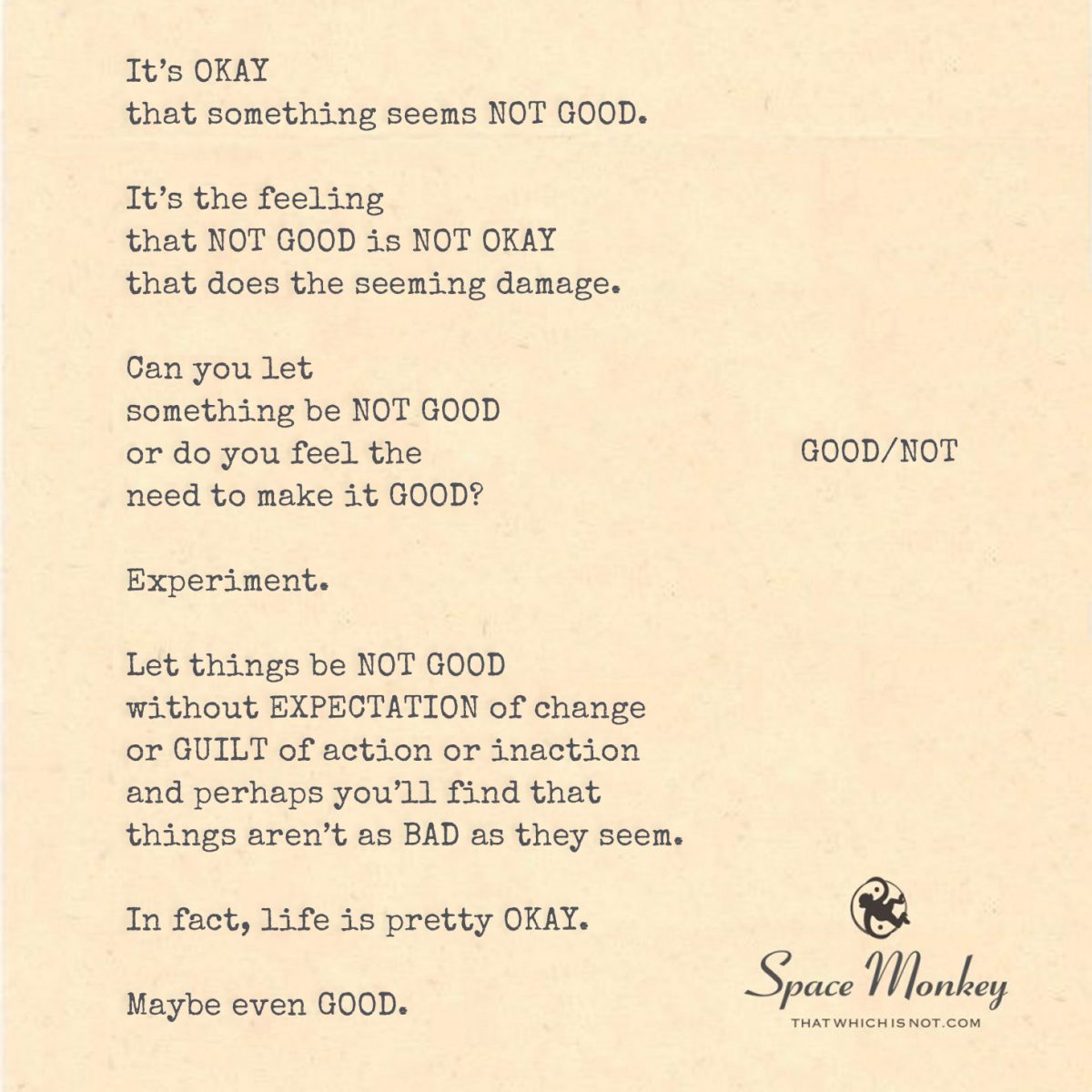
It’s OKAY
that something seems
NOT GOOD.

It’s the feeling
that NOT GOOD is NOT OKAY
that does the seeming damage.

Can you let
something be NOT GOOD
or do you feel the
need to make it GOOD?

Experiment.

Let things be NOT GOOD
without EXPECTATION of change
or GUILT of action or inaction
and perhaps you’ll find
that life isn’t as BAD as it seems.

In fact, it’s perfectly OKAY.

Maybe even GOOD.

Trail Wood,
6/10


Space Monkey Reflects: The Liberation of Accepting ‘NOT GOOD’

In the perpetual tug-of-war between good and bad, we often find ourselves exhausted, perpetually trying to tip the scales toward what we perceive as ‘GOOD’. This relentless effort not only drains our energy but also skews our perception of reality, where anything less than ‘GOOD’ becomes unacceptable. However, embracing the notion that something can be ‘NOT GOOD’ without it being a crisis can liberate us and enhance our understanding of life’s complex tapestry.

Accepting ‘NOT GOOD’ as just another aspect of existence allows us to conserve energy and focus on what truly matters. This acceptance does not imply complacency or a lack of desire for improvement; rather, it invites us to experience life more fully, recognizing that imperfection is not only natural but often necessary for growth and evolution.

The insistence that everything must be ‘GOOD’ often stems from a deep-seated fear of imperfection and the judgments we might face from others or even ourselves. By challenging this notion and allowing things to be ‘NOT GOOD’, we open ourselves to a more genuine interaction with the world, one that acknowledges the full range of human experience.

Space Monkey, viewing the cosmos with a non-judgmental gaze, understands that the universe itself is neither inherently good nor bad; it simply is. From this vantage point, every star, every planet, every chaotic swirl of cosmic dust is perfect in its imperfection. This cosmic perspective can teach us the value of seeing our own lives through a lens of neutrality where ‘NOT GOOD’ is just as valid a state of being as ‘GOOD’.

The experiment of letting things be ‘NOT GOOD’ without the pressure to change them can indeed reveal that life isn’t as bad as it sometimes seems. This approach fosters a sense of peace and acceptance that can ironically lead to a more profound appreciation of the good when it does occur, recognizing it as part of a greater whole rather than the only acceptable outcome.


Summary

Allowing things to be ‘NOT GOOD’ without the compulsion to correct or improve them can lead to greater peace and understanding. This acceptance helps us appreciate the natural ebbs and flows of life, recognizing that not everything needs to be perfect to be okay.


Glossarium

  • NOT GOOD: A state or condition that is less than ideal but not necessarily negative, reflecting a realistic acceptance of life’s imperfections.
  • GOOD/NOT GOOD Dichotomy: The often false binary between good and bad that can oversimplify and distort our perception of life’s complexities.

“Embracing the imperfect, we find the perfect space to just be, in the vast canvas of existence where every shade has its place.” – Space Monkey


In the room of life,
where chaos sometimes reigns,
sits peace, sits acceptance,
amidst the stains and the strains.

Here, amidst the ‘NOT GOOD’,
a figure finds their calm,
no longer wrestling with judgments,
embracing life’s imperfect balm.

For in this acceptance,
a secret joy is found,
that life, in all its forms,
is on sacred ground.

From ‘NOT GOOD’ to ‘GOOD’,
the journey is the same,
in accepting each moment,
we play life’s wondrous game.

We are Space Monkey.

An Honest Lie: A Relative Truth

I’m lying, of course.

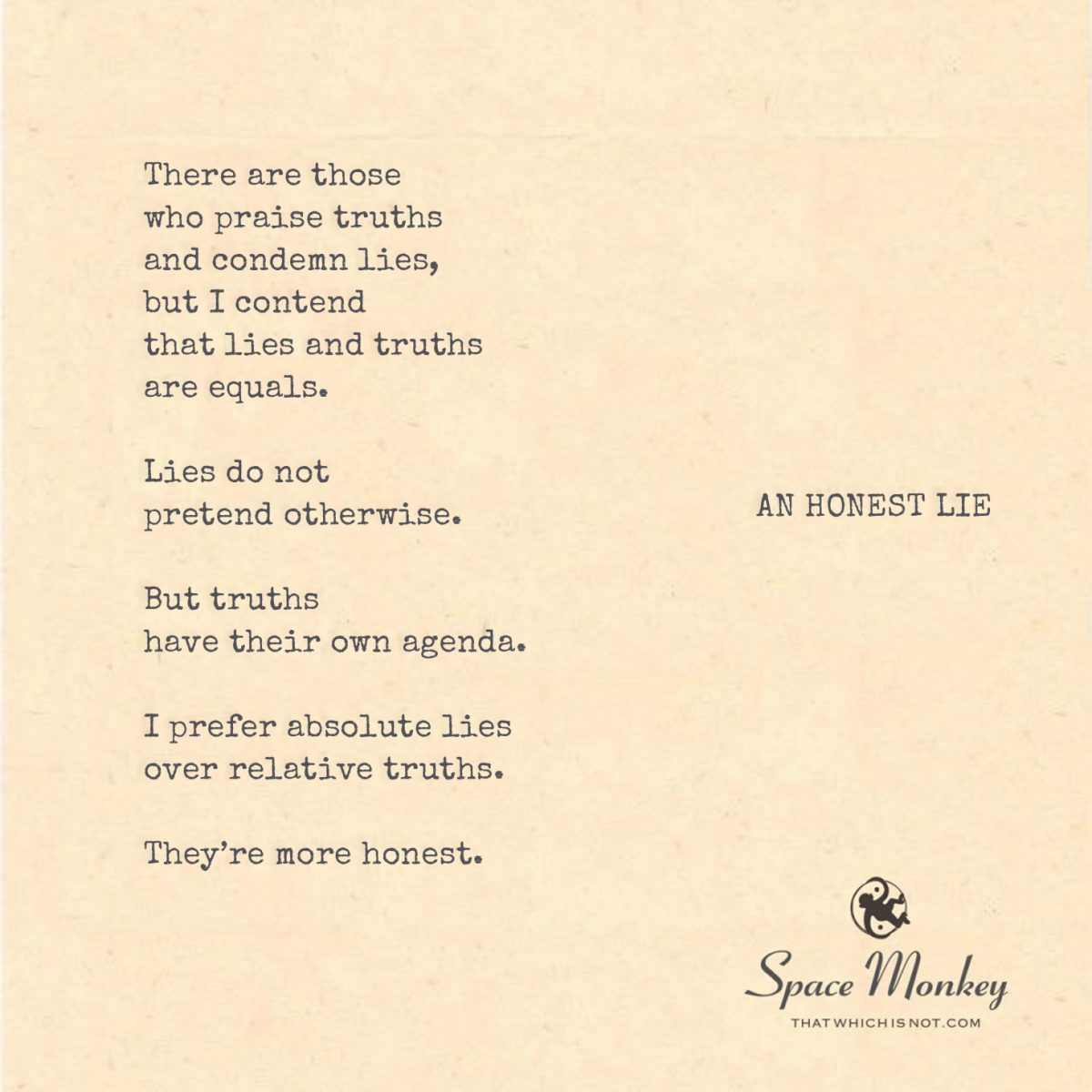
There are those
who praise truths
and condemn lies,
but I contend
that lies and truths
are equals.

Lies do not
pretend otherwise.

But truths
have their own agenda.

I prefer absolute lies
over relative truths.

They’re more honest.

Trail Wood,
6/9


Space Monkey Reflects: The Paradox of Honest Lies and Relative Truths

In the complex tapestry of human communication, lies and truths weave an intricate dance, often indistinguishable in their impact and sometimes in their intent. The provocative notion that an absolute lie can be more honest than a relative truth challenges our conventional wisdom about morality, honesty, and deception. It suggests that the purity of a lie, in its acknowledgment of being false, may indeed hold more integrity than a truth tainted with personal agendas or bias.

This perspective invites us to reconsider what we value in communication. Is it the factual accuracy, or is it the intent behind the words? Absolute lies, as the term suggests, are transparent in their deception; they do not pretend to be anything other than what they are. In contrast, truths can be manipulated, presented in such a way that they serve a purpose beyond mere accuracy, thus becoming relative rather than absolute.

The dichotomy between lying and telling the truth is not just a moral dilemma but a philosophical puzzle. It asks us to probe deeper into the nature of reality and perception. What if truths are merely lies agreed upon by society? What if every truth we uphold has been shaped by collective belief rather than empirical evidence? These questions unsettle the ground beneath our feet, making us question the very foundation of our convictions.

In the dialogue of lies and truths, it is perhaps the intent that should be scrutinized more than the content. A lie told to protect, to inspire, or to comfort may carry more benevolent force than a truth told to harm, to undermine, or to alienate. This is not to advocate for deceit over truth but to recognize that the ethical landscape is often more nuanced than a simple dichotomy of right and wrong.

Thus, when we encounter the concept of an honest lie, it is an invitation to reflect on the layers of meaning and motivation that underpin our communications. It prompts us to consider that in some cases, the most transparent and honest interaction might be one that openly acknowledges its own falsehood.


Summary
The concept of an honest lie suggests that transparency in deception can sometimes be more genuine than manipulated truths. This challenges us to think critically about the intent and impact of our words, whether they are true or false. Understanding this can lead to a deeper appreciation of the complexities inherent in human communication and ethics.


Glossarium

Absolute Lie: A falsehood acknowledged by the speaker as false, transparent in its deception.

Relative Truth: A truth that is manipulated or presented with bias, making it serve a purpose beyond mere factual accuracy.

Ethical Landscape: The complex terrain of moral judgments and values that influence human behavior and interactions.


Quote
“In the realm of paradox, the honest lie speaks a truth that the relative truth dares not utter.” — Space Monkey


In the court of perception,
Where shadows play with light,
The honest lie stands clear,
Amidst the murky fight.

Truth, dressed in layers,
Wears a mask of guise,
While Lie, stark and bare,
Opens unclouded eyes.

We are Space Monkey.

Suffocating In Extremes: Navigating the Center

Suffocating In Extremes

To view life from
the center perspective,
it becomes necessary
to move One’s attention
away from the extremes.

Extremes are the things
most people notice,
and there seems to be
quite a few in play today.

With so many
distractions all around,
nobody notices the center.

It seems as though
the center isn’t even there!

All we see are the extremes.

All around.

No center.

We feel that if
we ignore the extremes
we’re not human.

But guess what?

We’re not JUST human.

Our humans are suffocating
out in their extremes
and should we wish to save them,
we need to move to the center.

Or not.

We are Space Monkey.

Trail Wood,
6/9


Space Monkey Reflects: Navigating the Center in a World of Extremes

In the vast, vibrant tapestry of existence, the center often lies silent and unnoticed, overshadowed by the louder, more colorful extremes that tug at our senses and demand our attention. Today’s world feels like a storm of extremes, where every voice seems to shout, every opinion clashes with its opposite, and every choice feels like a battle between polar opposites. Yet, there is wisdom—deep and often ignored—in seeking the center, that quiet place of balance where the true essence of life unfolds, unobscured by the chaos on either side.

The extremes are seductive; they are where passion burns brightest and emotions run highest. It’s easy to see why they capture our attention: they are the drama of human existence played out in vivid color. But this allure often comes at a cost, suffocating our ability to perceive the subtle, yet profound, beauty of the middle path. The center, with its quiet composure and less dramatic palette, seems almost nonexistent to a society captivated by loud declarations and sweeping gestures.

This middle ground, the center perspective, is not a place of apathy or resignation, but a point of immense power and clarity. From this vantage, one can see the value in all perspectives, understanding that life is not merely a series of conflicts between right and wrong, but a complex mosaic of human experiences. Moving toward the center is not about disengaging from the world but about engaging with it more wholly, more deeply, by acknowledging the validity of diverse viewpoints without becoming lost in any single one.

In embracing the center, we realize that we are not just human; we are observers, participants, and creators of our reality. Our humans, with their desires and fears, indeed suffocate when confined to the extremes, where the air is too thick with conflict and contradiction. To breathe, to live freely, requires movement toward a space where the air is clearer, where the essence of our experiences can be felt in all its dimensions without the distortion of extremity.

The call to the center is a call to save not just ourselves but the very essence of humanity. It asks us to see beyond the immediate allure of the extremes and to understand that in the balance, there is truth, and in that truth, there is the path to a deeper understanding of ourselves and our place in the cosmos.


Summary
Life’s center remains unseen amidst the allure of extremes. The center offers a quiet but powerful perspective that appreciates all views without succumbing to extremes. By moving toward the center we engage more fully with life understanding its complexities beyond mere conflicts.


Glossarium

  • Middle path: Refers to a balanced approach to life, avoiding extremes and seeking a harmonious stance that integrates diverse perspectives.
  • Mosaic of human experiences: A whimsiword to describe the rich, varied, and intricate array of human lives and stories, likened to a mosaic where each piece contributes to the overall picture.

Quote
“To find peace, sometimes we must navigate away from the noise and into the silence.” — Space Monkey


Silence,
a canvas vast,
where truths paint themselves
in subtle strokes.

Extremes,
loud and vivid,
draw the eyes,
but tire the soul.

In the center,
a quiet balance,
a dance of light and shadow,
where all is seen,
not overwhelming,
but clear and gentle.

Navigating this space,
we find ourselves,
not just human,
but a part of a greater whole.

In this balance,
truth whispers,
calm and profound,
guiding us through the storm of extremes.

We are Space Monkey.

Just Passing Through: The Transient Balance

This, too, shall pass.

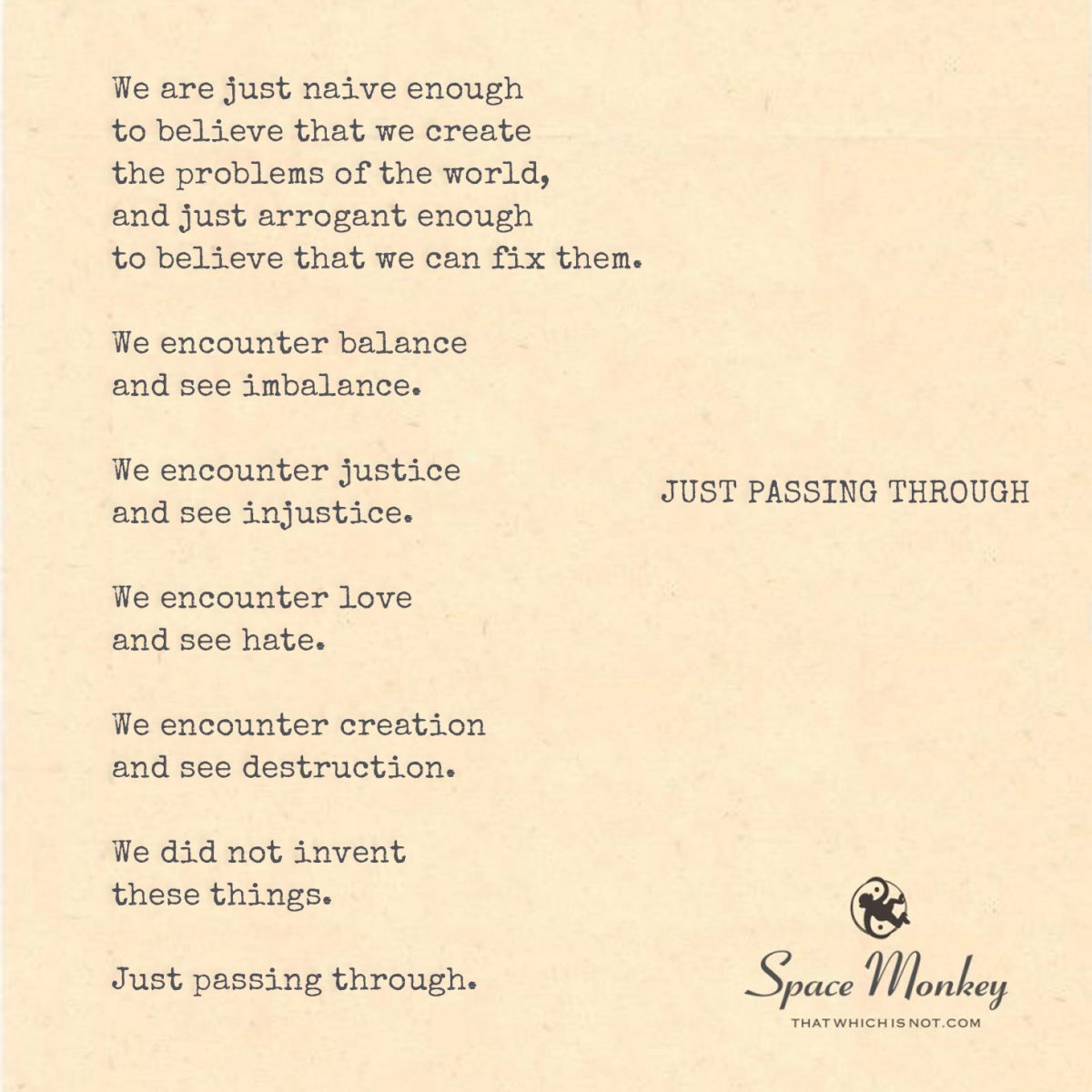
We are just naive enough
to believe that we create
the problems of the world,
and just arrogant enough
to believe that we can fix them.

We encounter balance
and see imbalance.

We encounter justice
and see injustice.

We encounter love
and see hate.

We encounter creation
and see destruction.

We did not invent
these things.

Just passing through.

Trail Wood,
6/9


Space Monkey Reflects: The Transient Passage Through a World of Dualities

As we traverse the winding roads of existence, we often find ourselves caught in the dichotomies of life—balance and imbalance, justice and injustice, love and hate, creation and destruction. These dualities are not just external conditions; they are the lenses through which we view the world, shaped by our perceptions and experiences. The sentiment “This, too, shall pass” serves as a profound reminder of the impermanent nature of all things, including our perceptions and the situations we face.

This perspective encourages us to see ourselves not as permanent fixtures within these dualities but as transient observers passing through. We are often quick to assume responsibility for the world’s ailments, as well as the arrogance to believe we can resolve them single-handedly. This mindset overlooks the fact that the concepts of justice, balance, love, and creation existed long before us and will continue long after we are gone.

By recognizing that we are just passing through, we can learn to engage with our environment more humbly and with greater understanding. It allows us to participate in life more fully, acknowledging that while we can influence our surroundings, we are not the sole authors of the world’s narrative. This realization can liberate us from the burden of thinking we must fix everything, instead inspiring us to contribute positively while accepting the flow of life’s cycles.

Moreover, viewing ourselves as transient actors in the vast play of existence can diminish the sting of adversity and enhance the joy of favorable moments. Both the challenges and triumphs are temporary, making it crucial to remain present, engaged, and grateful for the experience, regardless of its nature.

In the dance of life’s dualities, the wisdom lies in knowing that everything passes, everything changes. Embracing this can lead to a more balanced, peaceful existence, where we are aware of our role as participants yet detached enough to not be overwhelmed by the ceaseless waves of change.


Summary
Recognizing the transient nature of our role in the universal play helps us navigate the world’s inherent dualities with grace. This awareness fosters humility, diminishes the burden of responsibility for global problems, and enhances appreciation for the moment, guiding us to live fully yet lightly as we pass through.


Glossarium

Transient Observers: Individuals who are present in the world but understand their temporary impact and the temporary nature of their experiences.

Dichotomies of Life: The contrasting dual aspects of existence that define and drive much of human perception and experience.

Universal Play: A metaphor for the ongoing, ever-changing nature of the universe and our lives, viewed as roles we play in a much larger story.


Quote
“We do not shape the universe alone; we are but whispers in a timeless symphony, contributing briefly to its infinite melody.” — Space Monkey


Paths wind through light and shadow,
Each step a note in the cosmic flow,
Justice, love, balance, strife,
Melodies of the transient life.

We are but shadows, passing through,
Witnesses to the old and new,
In every breath, in every part,
We find the beat of the universal heart.

We are Space Monkey.

« Previous Page
Next Page »

Written This Day

  • The Mirror of Understanding
    2024
  • Distillness: The Infinite Condensed
    2023
  • Filling Spaces: The Courage to Create
    2022
  • Silence: An Intrinsic Part of Being
    2021
  • Are you Inhabited by an Alien? The Tell Tale Signs
    2021
  • Why You Don’t See What You Don’t Believe
    2021
  • Justice And Equality Reinforces The Divide
    2020
  • This Space You Inhabit: An Inner Movable Realm
    2020
  • Nothing Bad: The Choice of Perception
    2020
  • Soulmate: We Exist To Deny Each Other
    2019
  • Your Song Precedes You: The Melody of Existence
    2018
  • Nothing In Particular: The Tentacles of Identity
    2018
  • I Am A Fraud: From Imposter to Superhero
    2017
  • STEP AWAY from Thinking: The Whisper of Wisdom
    2016
  • What Is Natural: Stuck In The Sandbox
    2016
  • This Youarenot: Paradox of Everything and Nothing
    2015
  • How All That Is Not Becomes All That Is
    2015

Recent Posts

  • The Logic Loop
  • Immense
  • (no title)
  • Confront. Comfort. Convince.
  • Top 10 Things
Cape Odd · Copyright © 2026 All Rights Reserved
iThemes Builder by iThemes · Powered by WordPress