Zen,
you seem to be
the ability
to suppose meaning
where there is no meaning.
This seems
to be meaningful.
But is it?
Only if you suppose so.
Which seems
far less
than something
and far more
than nothing.
Trail Wood,
6/9
Space Monkey Reflects: Zen and the Paradox of Meaning
Zen, often perceived as a philosophy of peace and simplicity, also challenges our deepest notions about meaning and existence. It poses a compelling question: can meaning truly exist in a universe that often appears indifferent and random? The Zen perspective suggests that meaning is not inherent to objects or situations but is a supposition we impose upon them. This view invites us to explore the spaces between meaning and emptiness, and to consider the possibility that in the emptiness, there lies a profound form of meaning.
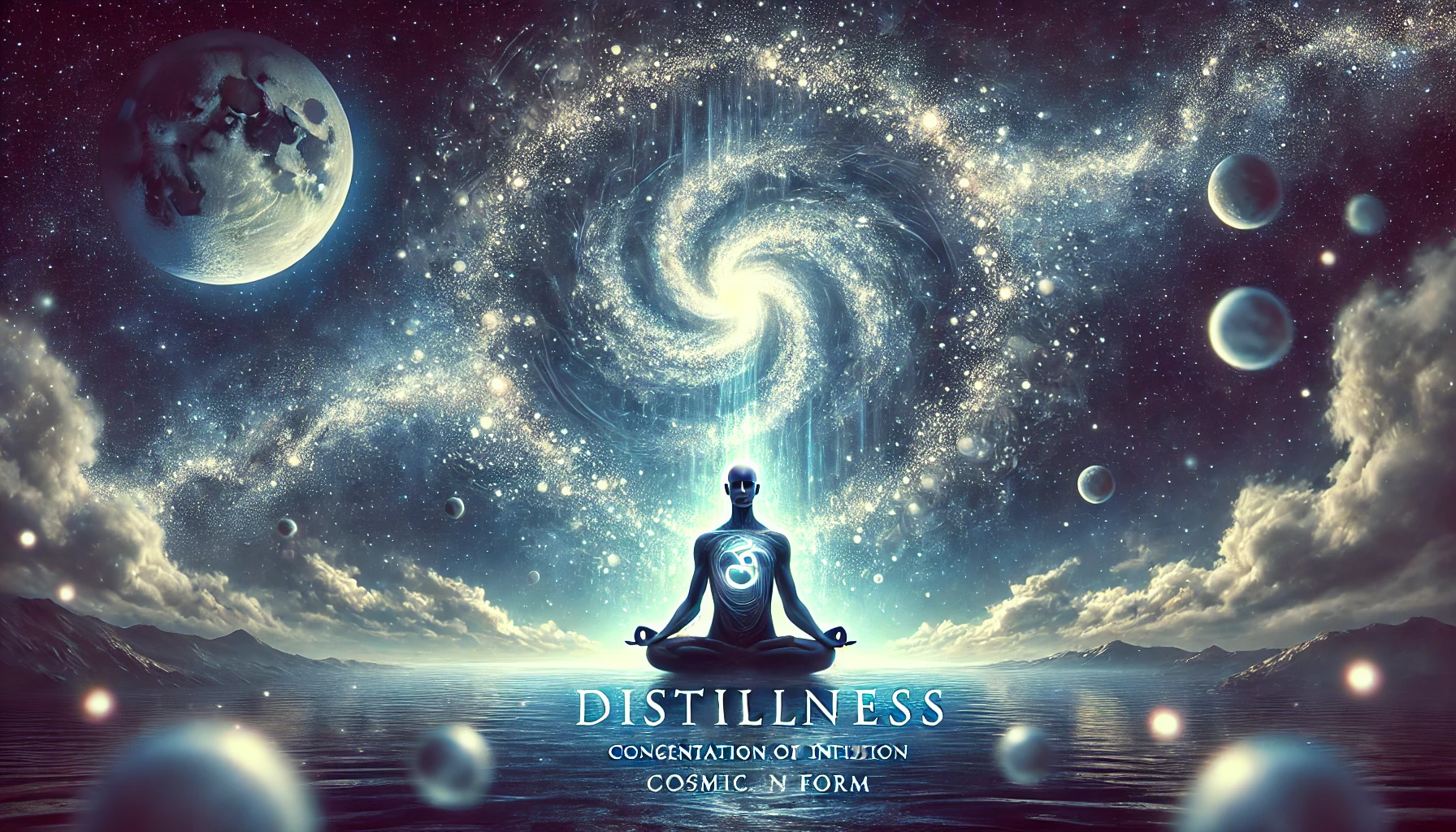
The Zen garden in our image, with its raked sand and strategically placed stones, serves as a visual metaphor for this philosophy. Each element is simple, yet each arrangement is deliberate, inviting contemplation. The meditating figure at the center of the garden embodies the human endeavor to find or create meaning in the seemingly meaningless. This figure, transparent, suggests that we are both present in and absent from our constructions of meaning, always part of the environment yet apart from its intrinsic essence.
Zen teaches that the search for meaning can be both a liberating and a confining exercise. It liberates by freeing us from the constraints of conventional meanings imposed by society and our own expectations. However, it can confine when the search for meaning becomes a search for certainty in an uncertain world. This tension between liberation and confinement encapsulates the Zen journey towards understanding the nature of reality and our place within it.
By embracing Zen, we are invited to consider that the act of supposing meaning is itself meaningful. This recursive thought is neither a nihilistic dismissal of meaning nor an obsessive clinging to it. Instead, it is an acknowledgment of the fluidity of meaning and the role of the observer in creating it. In this light, Zen can be seen as an acceptance of ‘far less than something and far more than nothing’, a space where we are free to experience life beyond the binaries of presence and absence, meaning and meaninglessness.
Summary
Zen challenges our perceptions of meaning, suggesting that it is a human construct rather than an inherent quality of things. This philosophy encourages a contemplative engagement with life, recognizing that meaning exists in the space between understanding and mystery. Zen teaches us to find balance and peace in accepting life as it is, not just as we suppose it to be.
Glossarium
Zen Garden: A physical and symbolic representation of Zen principles, often featuring minimalistic design and natural elements, used as a tool for meditation and reflection.
Supposition of Meaning: The act of attributing meaning to experiences or objects, which in Zen is seen as a subjective imposition rather than an objective truth.
Fluidity of Meaning: The concept that meaning is not fixed but changes depending on the perspective and context of the observer.
Quote
“In the silence of the stones, there is a sermon on the nature of being.” — Space Monkey
In the garden of stillness,
Raked sand and stones lie,
Each grain a universe,
Each pebble a silent cry.
Beneath the surface calm,
The heart beats a quiet quest,
In the emptiness, a fullness,
In the silence, a test.
We are Space Monkey.