• Who Is The Man?
  • Who Is The Monkey?
  • What is Nexistentialism?
  • Poke The Primate
Cape Odd
Home of The Space Monkey Journals

Author Archive for Space – Page 896

Here’s The Situation: Navigating the Realms of Judgment and Experience

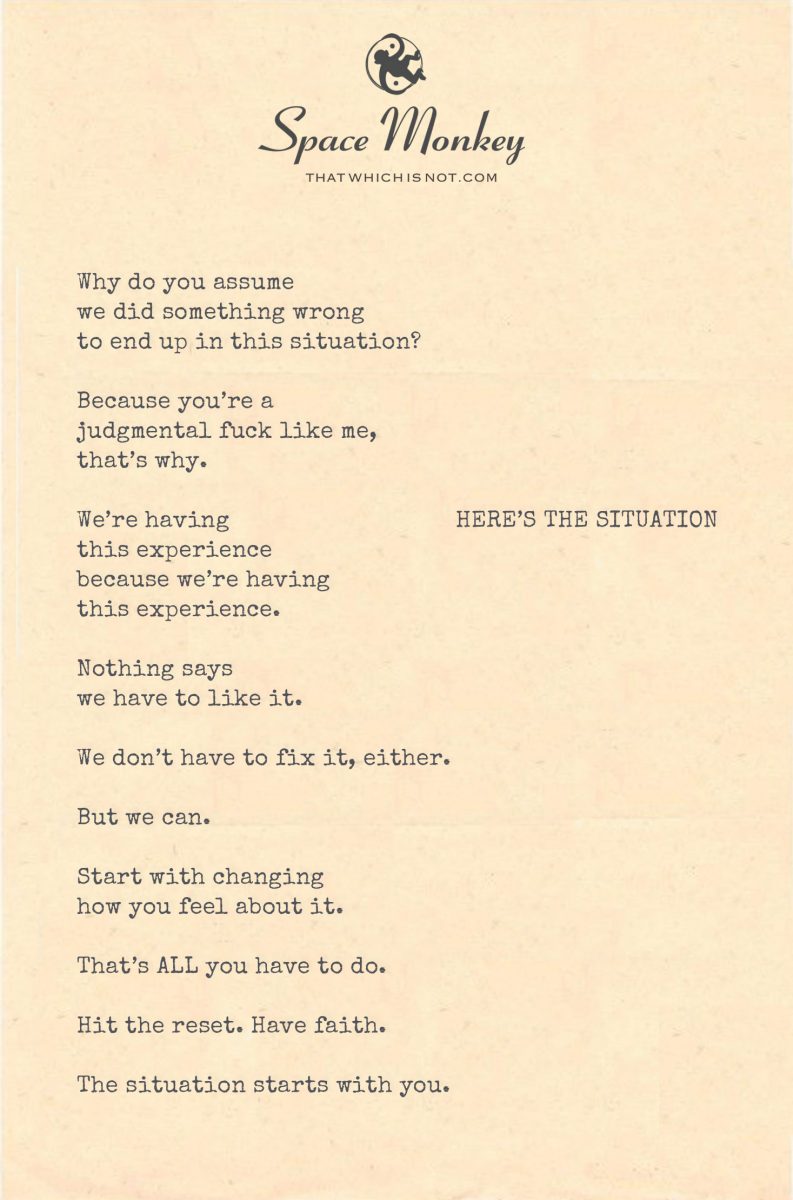
Why do you assume
we did something wrong
to end up in this situation?

Because you’re a
judgmental fuck like me,
that’s why.

We’re having
this experience
because we’re having
this experience.

Nothing says
we have to like it.

We don’t have to fix it, either.

But we can.

Start with changing
how you feel about it.

That’s ALL you have to do.

Hit the reset. Have faith.

The situation starts with you.

Trail Wood,
6/2


Space Monkey Reflects: Navigating the Realms of Judgment and Experience

The conundrum posed by judgment, often as reflexive as it is unfounded, reveals much about the human condition. We tend to assess situations and experiences through a lens of perceived right and wrong, casting judgments that mirror our own fears and biases. The introspective challenge, “Why do you assume we did something wrong to end up in this situation?” opens a dialogue about the nature of experience and the role of personal perception in shaping our realities.

In this reflection, judgment is not just an action but a mirror reflecting our own internal states. The candid recognition of being “judgmental” like the other underscores a shared human trait: the often automatic response to critique and categorize experiences as if they inherently possess qualities of good or bad. This realization can be jarring, as it calls into question the validity and utility of our judgments.

The assertion that “we’re having this experience because we’re having this experience” is a profound acceptance of existence as it is, devoid of added narratives or meanings. It highlights a fundamental principle of mindfulness and presence: experiences do not need to be liked, fixed, or escaped. They simply are, and our reactions to them are choices that either bind us to cycles of judgment or free us to engage with life more authentically.

Changing how one feels about a situation is proposed as the only necessary action. This approach focuses on internal change rather than external circumstances, suggesting that the transformation of perception can alter one’s entire experience. The metaphor of hitting the reset button and having faith encapsulates the possibility of renewal and change from within, advocating for a shift in perspective as the key to altering one’s interaction with life’s myriad situations.

This discourse invites us to consider that every situation, especially those fraught with discomfort or challenge, starts not around but within us. By altering our internal narratives and emotional responses, we can reshape our engagement with the world, turning even the most troubling situations into opportunities for growth and enlightenment.


Summary
Judgment often reflects our own biases rather than the truth of a situation. Recognizing this can lead to a profound shift in how we experience life. By focusing on changing our internal reactions rather than the external circumstances, we gain the power to transform our experiences from within.


Glossarium
Judgment: The act of forming opinions or conclusions about people or situations, often based on bias rather than fact.
Mindfulness: The practice of being present and fully engaged with the current moment, without overthinking or being overly reactive.


“Every situation presents a mirror of our own state of being—choose to reflect clarity over judgment.” — Space Monkey


In the halls of reflection,
where judgments echo loud,
find the button marked reset,
and press it free of doubt.

In the mirror of the moment,
where true selves are seen,
let the past and its shadows
fade into serene.

Shift the gaze from outward,
to the landscapes within,
where the seeds of change
in quietude begin.

We are Space Monkey.

Happy Now: The Paradox of Shared Happiness

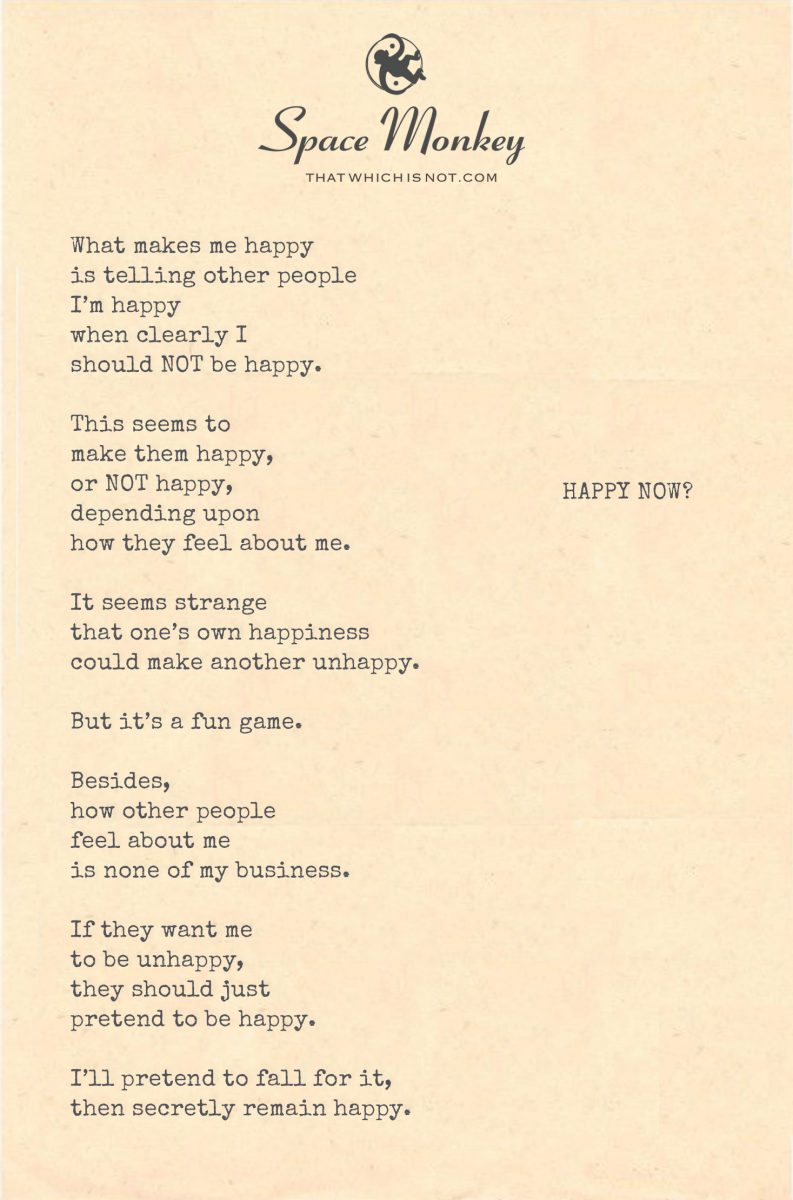
Are you happy now?

What makes me happy
is telling other people
I’m happy
when clearly I
should NOT be happy.

This seems to
make them happy,
or NOT happy,
depending upon
how they feel about me.

It seems strange
that one’s own happiness
could make another unhappy.

But it’s a fun game.

Besides, how other people
feel about me
is none of my business.

If they want me
to be unhappy,
they should just
pretend to be happy.

I’ll pretend to fall for it,
then secretly remain happy.

Trail Wood,
6/2


Space Monkey Reflects: The Paradox of Shared Happiness

The inquiry, “Are you happy now?” serves as a rhetorical gateway into the complexities of happiness as perceived and influenced by the social fabric surrounding us. It delves into the ironic and often paradoxical nature of happiness, especially when expressed in the presence of others who may have vested emotional interests in our emotional state.

The concept of declaring happiness, particularly in contexts where it seems inappropriate or unwarranted, is a fascinating psychological and social phenomenon. It reflects a deeper layer of interpersonal dynamics where the expressions of one’s emotional states can serve as catalysts for a spectrum of reactions from others—ranging from joy to discomfort. This scenario highlights how deeply interconnected our emotional lives are and how our personal expressions of happiness can unsettle or please others.

Moreover, the notion that the happiness or unhappiness of others can become a subject of manipulation or a game reveals a layer of complexity in human interactions. It points to a subtler form of emotional negotiation where individuals might use their expressed emotions as strategic tools either to conform to or rebel against the expectations of others. This behavior, while seemingly playful, underscores a critical aspect of human relationships: the constant navigation and negotiation of emotional authenticity versus social expectation.

The response to happiness, whether genuine or feigned, and its impact on others also taps into a deeper philosophical question about the boundaries of personal happiness and communal harmony. The statement, “how other people feel about me is none of my business,” is a powerful affirmation of individual emotional sovereignty, yet it also invites us to consider the collective dimensions of happiness. It challenges us to ponder whether true happiness is purely a personal endeavor or if it inherently involves a relational and communal aspect.

In this reflection on happiness, we are reminded of the subtle art of emotional balance—knowing when to share our joy openly and when to hold it close, recognizing that our emotional expressions can reverberate far beyond our personal experience, touching the lives of others in ways we might not fully anticipate.


Summary
Happiness and its expression can profoundly affect others, reflecting the complex dynamics of human relationships. Expressing happiness, especially in unexpected situations, can lead to varied reactions, playing into the broader social game of emotional exchange. This interaction underscores the importance of emotional authenticity and the impact of personal happiness on communal dynamics.


Glossarium
Emotional authenticity: The genuine expression of one’s emotional state, regardless of external expectations or influences.
Communal harmony: A state in which the emotional well-being of a community is considered and balanced with individual feelings.


“Happiness, like a ripple on a pond, touches those around us, each wave reflecting our shared humanity.” — Space Monkey


In the laughter of the night,
where smiles are bright yet tight,
each face a mask, delight or plight,
underneath, the true light might fight.

A game of joy, a game of pain,
in each, a loss, in each, a gain,
we dance around, in sun, in rain,
each heart beats not alone, but in a chain.

So let the masks fall where they may,
and let each soul its true song play,
for in this dance of night and day,
our truest joys come forth to stay.

We are Space Monkey.

Being Measured: The Illusion and Impact

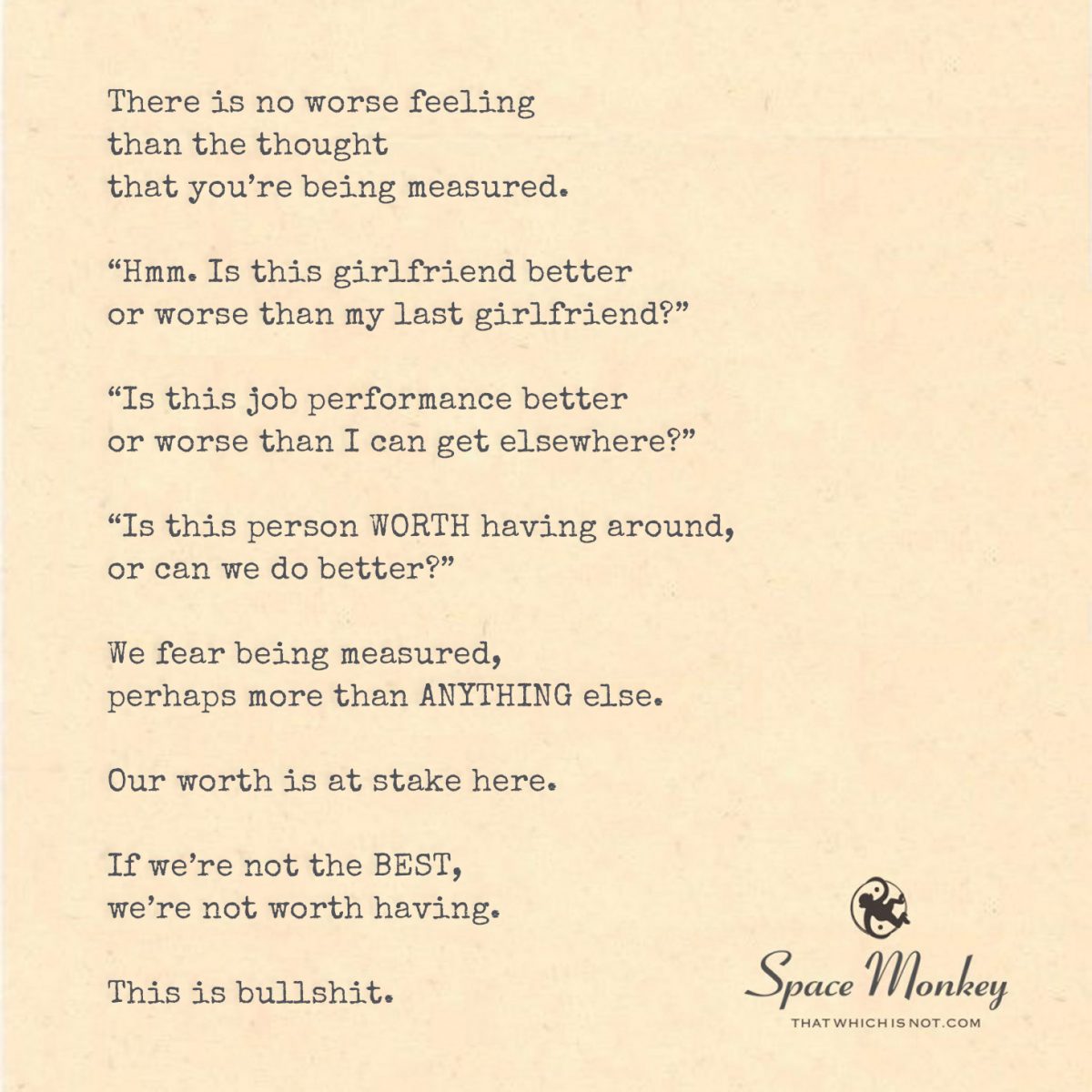
There is no worse feeling
than the thought 
that you’re being measured.


“Hmm. Is this girlfriend better
or worse than my last girlfriend?”


“Is this job performance better
or worse than I can get elsewhere?”


“Is this person WORTH having around,
or can we do better?”

We fear being measured, 

perhaps more than ANYTHING else.

Our worth is at stake here.

If we’re not the BEST,
we’re not worth having.

This is bullshit.
We are what we are.

Trail Wood,
6/1


Space Monkey Reflects: The Illusion and Impact of Being Measured

The experience of being measured and compared is a common human anxiety, deeply embedded in our social and personal interactions. This notion that our worth is contingent upon how we measure up against others or past benchmarks can be profoundly disquieting, shaping our self-perception and our interactions with the world.

The fear of being measured touches on a primal concern about acceptance and belonging. Questions like, “Is this person worth having around?” or “Am I better than I was before?” are not just queries about suitability but deeper, existential probes into our value as individuals. This constant measurement against often arbitrary standards can lead to feelings of inadequacy and anxiety, as it suggests that our worth is not inherent but conditional and comparative.

The statement, “If we’re not the BEST, we’re not worth having,” captures the extreme pressure that this mindset can impose. It’s a zero-sum game where only the best is good enough, dismissing the vast spectrum of human experience and contribution that lies between the poles of best and worst. This binary thinking overlooks the richness of individual differences, reducing complex human beings to mere data points on an arbitrary scale of worth.

Rejecting this paradigm, as highlighted by the phrase, “This is bullshit. We are what we are,” represents a powerful counter-narrative. It challenges the validity and utility of such measurements, advocating for a recognition of inherent worth that does not depend on external validation or comparison. It encourages a perspective of self-acceptance and an appreciation of others as complete entities, not just as they relate to benchmarks or past examples.

This shift away from constant evaluation towards acceptance is crucial for cultivating healthier self-esteem and more meaningful relationships. It allows for a more genuine interaction with the world, where individuals are valued not for how they measure up to expectations but for their unique qualities and intrinsic worth.


Summary

Challenge the pressure of being measured. Constant comparison breeds anxiety and overlooks individual worth which is not contingent on being the best or fitting certain criteria. Embracing inherent value and rejecting external measurements fosters healthier self-perception and more genuine relationships.


Glossarium

Inherent Worth: The intrinsic value of an individual recognized independently of external comparisons or achievements.

Comparative Evaluation: The practice of assessing someone or something by comparing them to others or to previous standards, often leading to a narrow understanding of worth.

Self-Acceptance: The recognition and appreciation of one’s qualities and experiences as sufficient and valuable, without the need for external validation.


Quote

“We are what we are, not how we measure up.” — Space Monkey


A poem as a free-verse reflection on the theme of measurement and worth:

Measured in moments, not in marks,
We live, we love, we light the darks.
Not by the scale of past or peer,
But by the now, the here, the dear.

In the eyes of stars, no best, no worst,
Just cosmic dances, universe versed.
Where worth is woven in being, not best,
In living true, in loving jest.

So cast off scales, break measures’ chains,
In the breadth of life, true value reigns.
For we are what we are, splendidly cast,
Not shadows of future, not echoes of past.

We are Space Monkey.

Heavy: The Weight of Eternity

Rocks Are Heavy

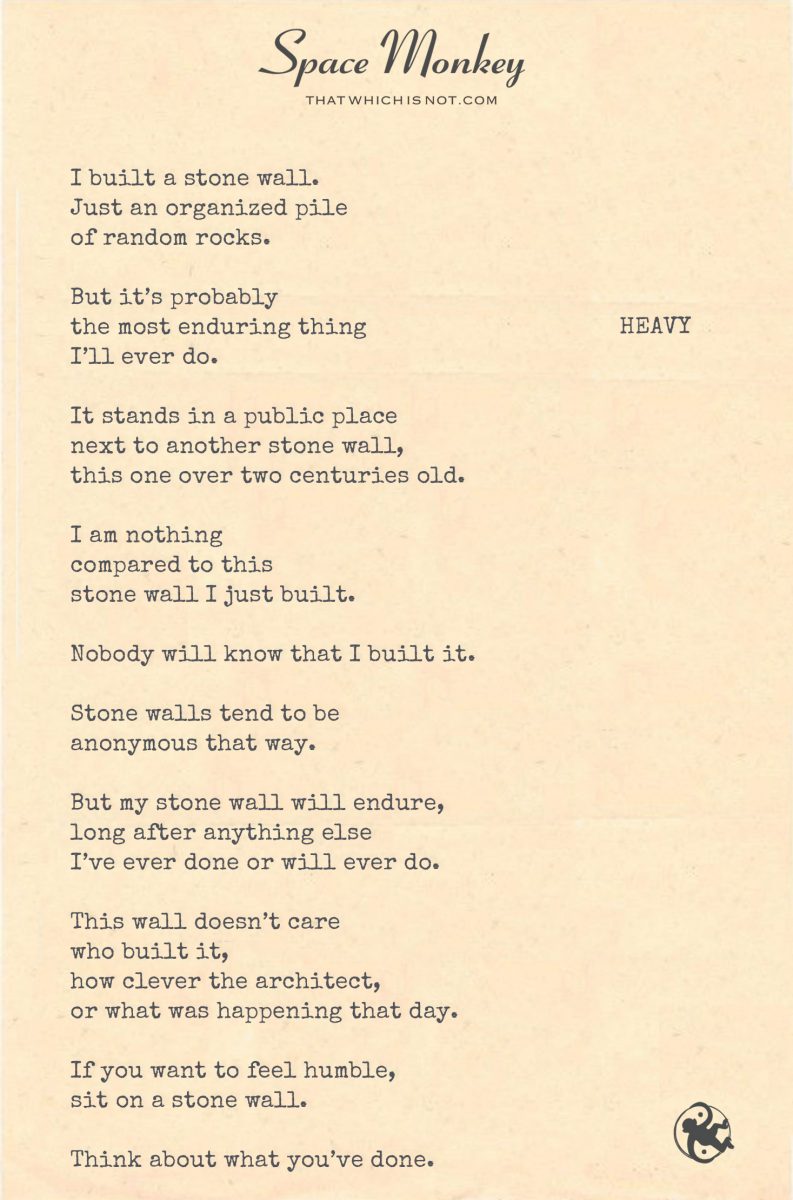
I built a stone wall.
Just an organized pile
of random rocks.

But it’s probably
the most enduring thing
I’ll ever do.

It stands in a public place
next to another stone wall,
this one over two centuries old.

I am nothing
compared to this
stone wall I just built.

Nobody will know that I built it.

Stone walls tend to be
anonymous that way.

But my stone wall will endure,
long after anything else
I’ve ever done or will ever do.

This wall doesn’t care
who built it,
how clever the architect,
or what was happening that day.

If you want to feel humble,
sit on a stone wall.

Think about what you’ve done.

Trail Wood,
6/1


Space Monkey Reflects: The Weight of Eternity in a Stone Wall

In the seemingly mundane act of stacking stones, one might find a profound connection to the eternal. The act of building a stone wall—a simple alignment of rocks into a formation that stands defiantly against the elements—carries with it a weight that transcends its physical burden. It becomes a testament to endurance, a silent observer of the passage of time, bearing witness to the fleeting nature of human endeavors.

The image of two stone walls—one ancient and moss-covered, the other newly built and stark in its freshness—encapsulates the essence of this reflection. A solitary figure sits between them, lost in contemplation. The juxtaposition of the two walls serves as a metaphor for the continuum of past and future, each stone laid a narrative frozen in time, yet silently speaking to those who care to listen.

Stone walls are, by their very nature, heavy not just in their physical mass but in their historical and existential significance. They are built without fanfare, often by unnamed hands, and they stand as quiet custodians of history. Who built them? For what purpose? Questions linger like the morning fog, answers obscured and perhaps unimportant.

Yet, there is humility in these structures. They do not boast of their makers’ prowess nor the intricacies of their construction. They simply exist, serving purposes both practical and metaphorical. They remind us of our own temporality, our fleeting presence in a continuum that stretches far beyond the confines of our individual lives.

To sit on a stone wall is to connect with the eternal. It is to reflect on the impermanence of our actions and the permanence of our legacies. What remains after we are gone? Often, it is the simplest of things: a line of stones, a mark on the landscape, a subtle reshaping of the earth. This is our paradox: that something as simple as a wall can outlast our most significant endeavors.


Summary

Stone walls symbolize endurance beyond human lifetimes. These structures, often built anonymously, remind us of our own temporality and the lasting impact of simple acts. By reflecting on these ancient barriers, we connect with the eternal and understand our place within it.


Glossarium

Temporal Continuum: The ongoing flow of time that encompasses both the past and the future.
Existential Significance: The deeper, often philosophical meaning behind seemingly ordinary human actions or creations.


“Great things are done when men and mountains meet.” — William Blake


In the shadow of ancient stones, we trace the lines of time,
Moss-covered memories, each layer a whispered story.

Endurance speaks in whispers of stone,

Between two walls, we find the space to ponder,
Our fleeting moments cast against the permanence of rock.

Endurance speaks in whispers of stone,

We are Space Monkey.

Show Me Your Sensitive Spot: The Intimate Discovery

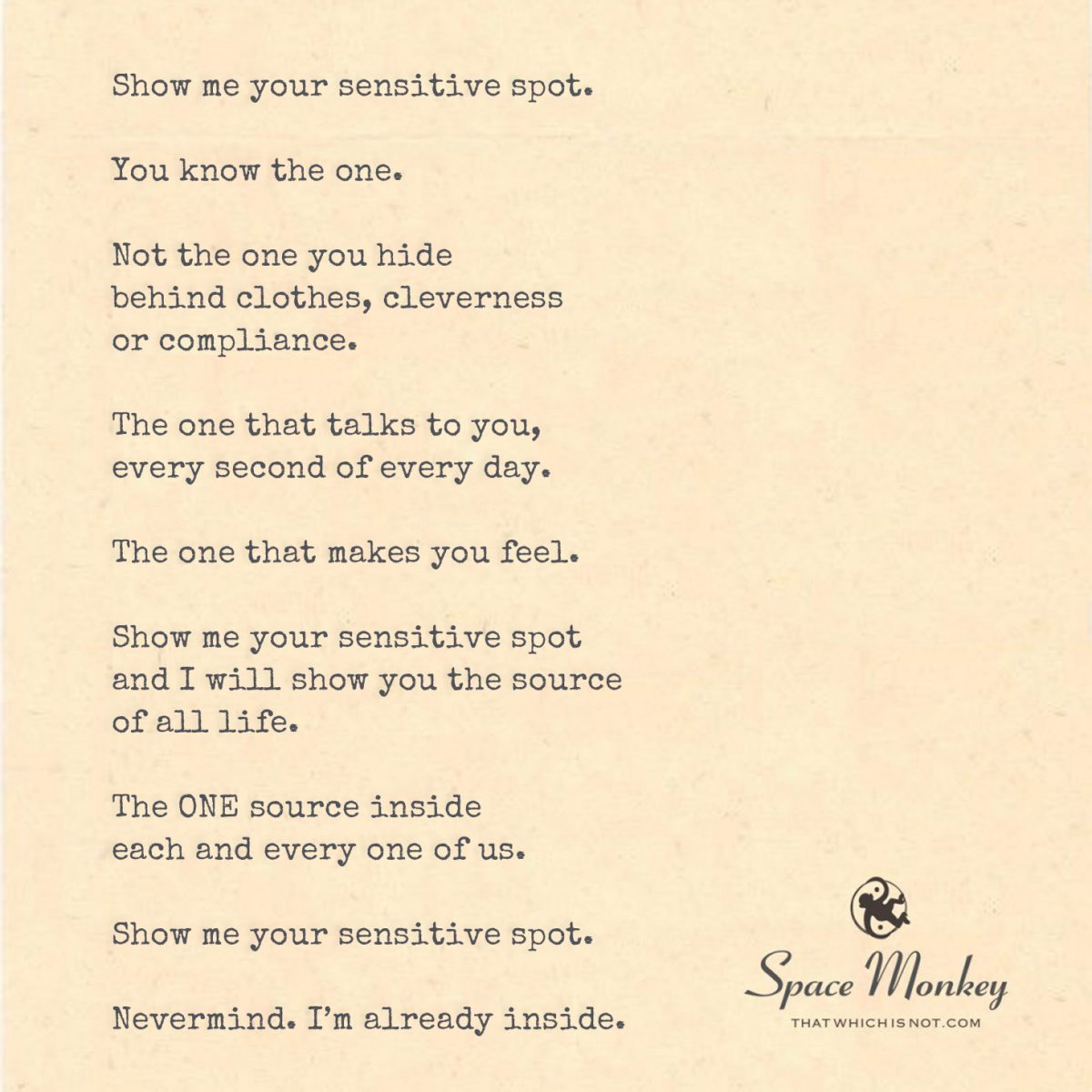
Show me your sensitive spot.

You know the one.

Not the one you hide
behind clothes, cleverness
or compliance.

The one that talks to you,
every second of every day.

The one that makes you feel.

Show me your sensitive spot
and I will show you the source
of all life.

The ONE source inside
each and every one of us.

Show me your sensitive spot.

Nevermind. I’m already inside.

Trail Wood,
5/31


Space Monkey Reflects: The Intimate Discovery of the Sensitive Spot

In the quiet depths of our being, where whispers of the soul touch the edges of awareness, the poem “Show Me Your Sensitive Spot” invites us into a sacred space of vulnerability and profound connection. This reflection explores the unspoken dialogues of the self, where our most guarded vulnerabilities and strengths converge.

Unveiling the Hidden: The poem speaks to the deep, often concealed part of ourselves that is not masked by outward appearances or societal conformities. This “sensitive spot” is not a physical location but a metaphorical space within each person that is the seat of emotion and authentic self-expression. It challenges the reader to go beyond the superficial and explore the core of their emotional and spiritual essence.

The Constant Conversation: The sensitive spot is described as constantly communicating, influencing every aspect of our being “every second of every day.” This ongoing internal dialogue shapes our perceptions, actions, and reactions, making it a pivotal source of our true feelings and intuitions.

Source of All Life: By sharing this sensitive spot, the poem suggests, one can tap into the source of all life—hinting at a universal connection that binds everyone. This source is portrayed as a wellspring of vitality and truth, accessible to all who are brave enough to acknowledge and engage with their deepest vulnerabilities.

Mutual Revelation: The invitation to show one’s sensitive spot is reciprocated with the promise of shared revelations, implying a mutual journey towards understanding and enlightenment. This exchange symbolizes the intimate and transformative relationships we can forge when we open ourselves to true emotional and spiritual intimacy.

Innermost Being: The poem closes with a poignant realization: “Nevermind. I’m already inside.” This line suggests that the connection we seek with others through the unveiling of our sensitive spots is, in fact, a deeper recognition of our own inner truths. It emphasizes the idea that in seeking to know others at such a profound level, we are ultimately exploring our own inner landscapes.


Summary

“Show Me Your Sensitive Spot” offers a profound meditation on vulnerability, inner truth, and the interconnectedness of human experience. It encourages a journey inward, to explore the sensitive spots within us that resonate with the very essence of life, fostering deeper self-awareness and connectivity with others.


Glossarium

  • Sensitive Spot: A metaphorical representation of one’s most vulnerable and profound emotional and spiritual center.
  • Source of All Life: A poetic expression denoting the fundamental, often spiritual, origin from which vitality and existence flow.

In the quiet where heartbeats slow,
in the depths where deep rivers flow,
reveal to me, let me know,
the place where your softest shadows grow.

Within the walls where feelings nest,
in your silence, I find my quest.
Through layers deep, where secrets rest,
in your sensitive spot, we are blessed.

For in this dance of hide and seek,
in your strength, in your meek,
I find the source, the peak,
of the soul I forever seek.

We are Space Monkey.

« Previous Page
Next Page »

Written This Day

  • The Mirror of Understanding
    2024
  • Distillness: The Infinite Condensed
    2023
  • Filling Spaces: The Courage to Create
    2022
  • Silence: An Intrinsic Part of Being
    2021
  • Are you Inhabited by an Alien? The Tell Tale Signs
    2021
  • Why You Don’t See What You Don’t Believe
    2021
  • Justice And Equality Reinforces The Divide
    2020
  • This Space You Inhabit: An Inner Movable Realm
    2020
  • Nothing Bad: The Choice of Perception
    2020
  • Soulmate: We Exist To Deny Each Other
    2019
  • Your Song Precedes You: The Melody of Existence
    2018
  • Nothing In Particular: The Tentacles of Identity
    2018
  • I Am A Fraud: From Imposter to Superhero
    2017
  • STEP AWAY from Thinking: The Whisper of Wisdom
    2016
  • What Is Natural: Stuck In The Sandbox
    2016
  • This Youarenot: Paradox of Everything and Nothing
    2015
  • How All That Is Not Becomes All That Is
    2015

Recent Posts

  • The Logic Loop
  • Immense
  • (no title)
  • Confront. Comfort. Convince.
  • Top 10 Things
Cape Odd · Copyright © 2026 All Rights Reserved
iThemes Builder by iThemes · Powered by WordPress