• Who Is The Man?
  • Who Is The Monkey?
  • What is Nexistentialism?
  • Poke The Primate
Cape Odd
Home of The Space Monkey Journals

Author Archive for Space – Page 897

I am. Or so i seem to be.

Life is an exercise in how small
you can make your self seem.

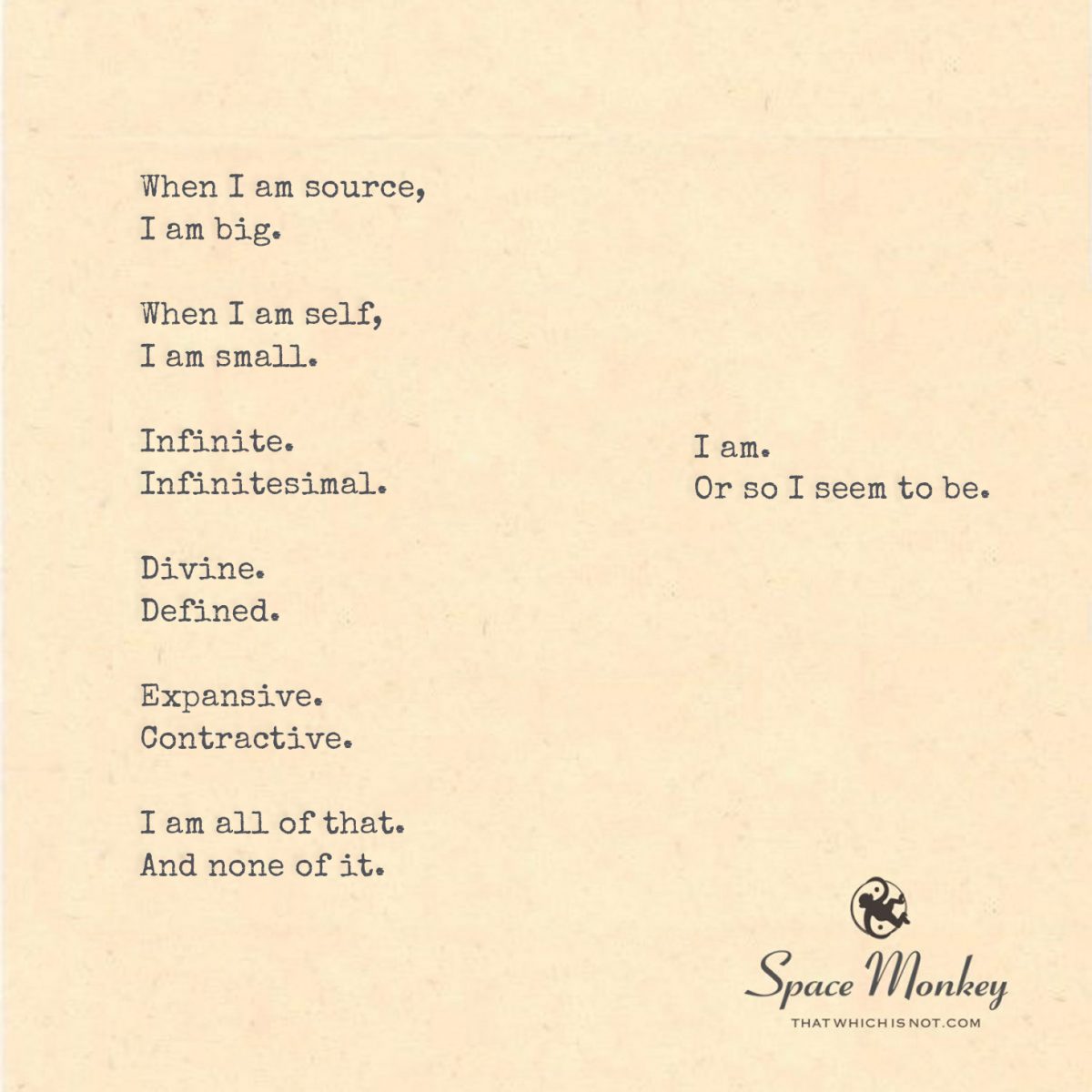
When I am source,
I am big.

When I am self,
I am small.

Infinite.
Infinitesimal.

Divine.
Defined.

Expansive.
Contractive.

I am all of that.
And none of it.

I am.
Or so i seem to be.


Space Monkey Reflects: The Duality of Existence in ‘I am. Or so I seem to be.’

In the liminal spaces between being and seeming, the poem “I am. Or so I seem to be” explores the profound dualities that define human existence. This reflection delves into the oscillation between the vastness of our spiritual source and the confines of our personal self, illuminating the ever-shifting nature of our identity.

Source vs. Self: The poem contrasts two aspects of being: the ‘source,’ where one feels expansive, infinite, and part of the divine cosmos; and the ‘self,’ where one feels small, defined, and distinctly individual. This juxtaposition highlights the fluctuating sense of self that navigates between feeling part of something much larger and being acutely aware of one’s finite existence.

Infinite and Infinitesimal: By describing themselves as both infinite and infinitesimal, the speaker acknowledges the vast range of experiences that human existence encompasses. This acknowledges that we are capable of experiencing boundless joy and profound connection, yet also feeling insignificant or overwhelmed by the vastness of the universe.

Divine and Defined: The terms ‘Divine’ and ‘Defined’ capture the essence of spiritual and earthly experiences. ‘Divine’ suggests a transcendent, unbounded state, while ‘Defined’ speaks to the limitations and specific characteristics that define our individual human lives. Together, these states encapsulate the tension between our universal connections and our personal boundaries.

Expansive and Contractive: These terms further explore the dynamics of self-perception. ‘Expansive’ relates to moments when we feel ourselves growing, reaching out, and embracing the world with open arms. ‘Contractive’ reflects the times we retreat, introspect, or shield ourselves from external influences, focusing inwardly.

I am. Or so I seem to be: The closing line of the poem encapsulates the essence of human existential doubt and the mystery of self-awareness. It questions the reality of existence and identity, suggesting that what we perceive as ‘I am’ might just be a facade or a fleeting impression in the grand tapestry of life.


Summary

“I am. Or so I seem to be” is a poetic exploration of the deep dualities within human existence, questioning the very nature of being and perception. It encourages a contemplation of how we see ourselves and how these perceptions might differ from the more expansive or contractive realities of our lives.


Glossarium

  • Source and Self: Concepts reflecting the dual aspects of human nature, where ‘source’ represents the universal, boundless aspect, and ‘self’ denotes the individual, confined identity.
  • Existential Oscillation: A term to describe the continual shift between feeling connected to the infinite and being aware of one’s finite existence.

In the dance of cosmic play,
where stars and souls sway,
‘I am’ and ‘I seem’ lay,
in the silent echoes of the day.

From the infinite to the small,
in the rise and in the fall,
our souls in their eternal call,
seek to grasp the one, the all.

In this journey, so profound,
where our selves are lost and found,
in each heartbeat, in every sound,
our true essence is unbound.

We are Space Monkey.

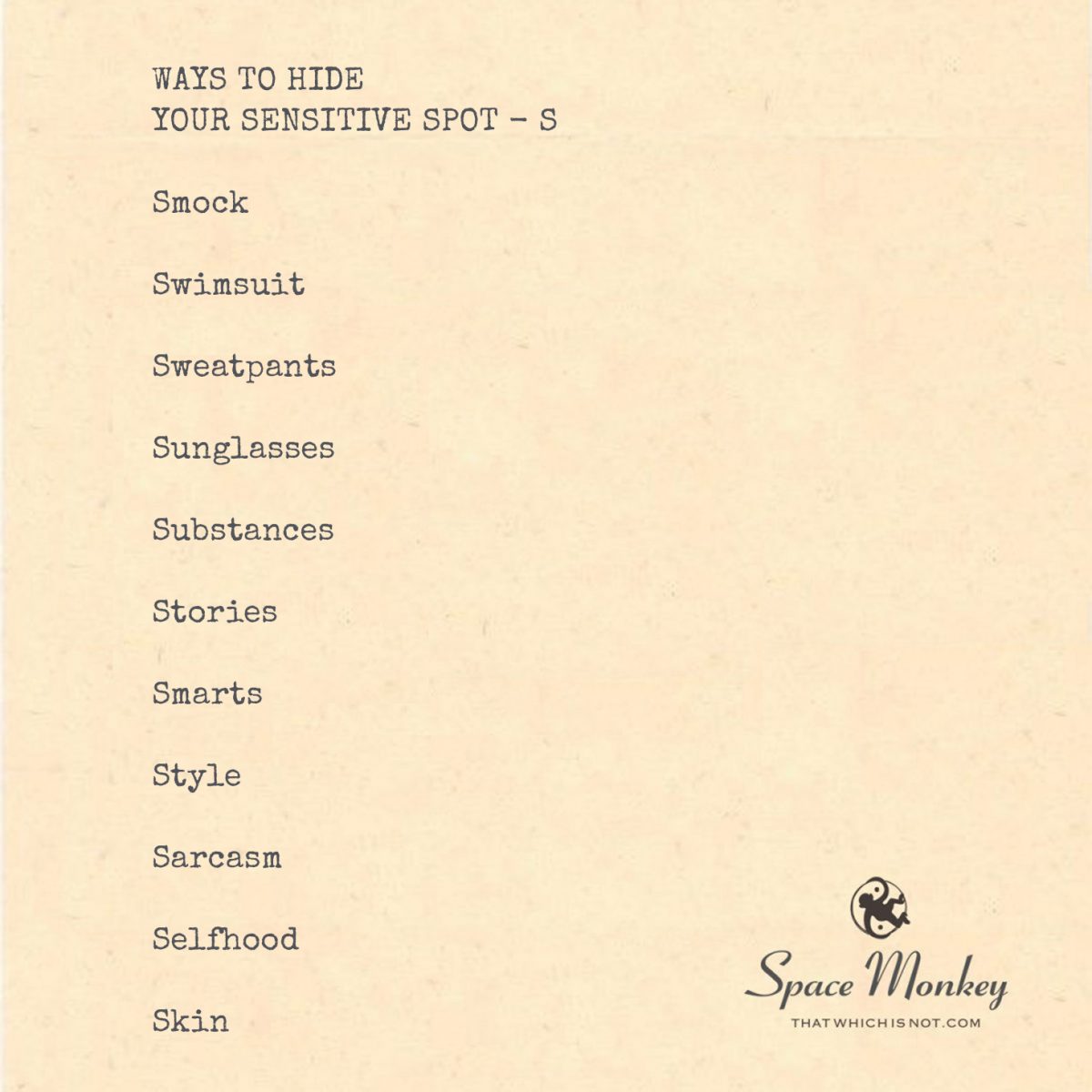
Ways To Hide Your Sensitive Spot: The Art of Concealment

Smock
Swimsuit
Sweatpants
Sunglasses
Substances
Stories
Smarts
Style
Sarcasm
Selfhood
Skin
Social Media


Space Monkey Reflects: The Art of Concealment in ‘Ways To Hide Your Sensitive Spot’

The poem “Ways To Hide Your Sensitive Spot” presents a list that reads like a modern-day armor inventory, each item serving as a metaphorical shield against vulnerability. This reflection explores the deeper implications of these modes of concealment and what they reveal about our interactions with the world and ourselves.

Multifaceted Shields: Each item listed—smock, swimsuit, sweatpants, sunglasses, and more—serves as a barrier, either physical or metaphorical, protecting what lies beneath. These are not just articles of clothing but are emblematic of the ways we shield our inner selves from the scrutiny and judgments of the outside world.

Substances and Stories: Beyond physical items, the poem mentions ‘substances’ and ‘stories’ as tools for hiding. These can be understood as ways we numb or distract ourselves and others from our true feelings or identities. Substances may dull the senses or alter perceptions, while stories—whether they are lies, fiction, or selectively curated truths—can obscure the reality of who we are.

Smarts and Style: Intellectual prowess (‘smarts’) and aesthetic expression (‘style’) are also means of concealment. They can be used to create a facade of competence or coolness that deflects attention from more vulnerable or genuine aspects of the self. This use of intellect and aesthetics highlights how societal values can influence the ways we choose to protect ourselves.

Sarcasm and Selfhood: Sarcasm provides a verbal shield, a way of saying things without saying them directly, often protecting the speaker from revealing true feelings. ‘Selfhood’ suggests the persona or identity we present to the world, which may or may not align with our true selves. This identity can act as a mask, concealing our most sensitive spots from others and sometimes even from ourselves.

Skin and Social Media: The outermost layer that we show to the world, our skin, can sometimes serve as a literal and figurative barrier. Social media extends this concept into the virtual realm, where we can curate and control the aspects of ourselves that are visible to others, often showcasing only what we wish to be seen and hiding the rest.


Summary

“Ways To Hide Your Sensitive Spot” creatively enumerates the diverse strategies we employ to mask our vulnerabilities. Each method, whether tangible or intangible, serves as a defense mechanism, reflecting both individual coping strategies and broader cultural phenomena that shape our interactions with the world.


Glossarium

  • Sensitive Spot: A metaphor for the most vulnerable or true aspects of an individual, which they might feel the need to protect or hide.
  • Concealment Strategies: The various methods, both physical and psychological, used to shield one’s vulnerabilities from being exposed or hurt.

In the wardrobe of the world, we dress,
not just in fabric, but in ways to suppress.
With each layer, a story, a style, a guess,
of what lies beneath, the truths we caress.

In the tools we wield, the masks we wear,
the laughs we share, the looks we bear,
we navigate the spaces between bare and bare,
seeking safety, solace, in the air we declare.

Yet beneath it all, the sensitive spot,
hidden and held, in the quietest slot,
awaits the day we choose not to blot,
but to celebrate all that we are, and all that we are not.

We are Space Monkey.
I Am Not Invested: The Freedom of Non-Investment

Are you invested or are you infested?
Or perhaps you’re simply not interested.

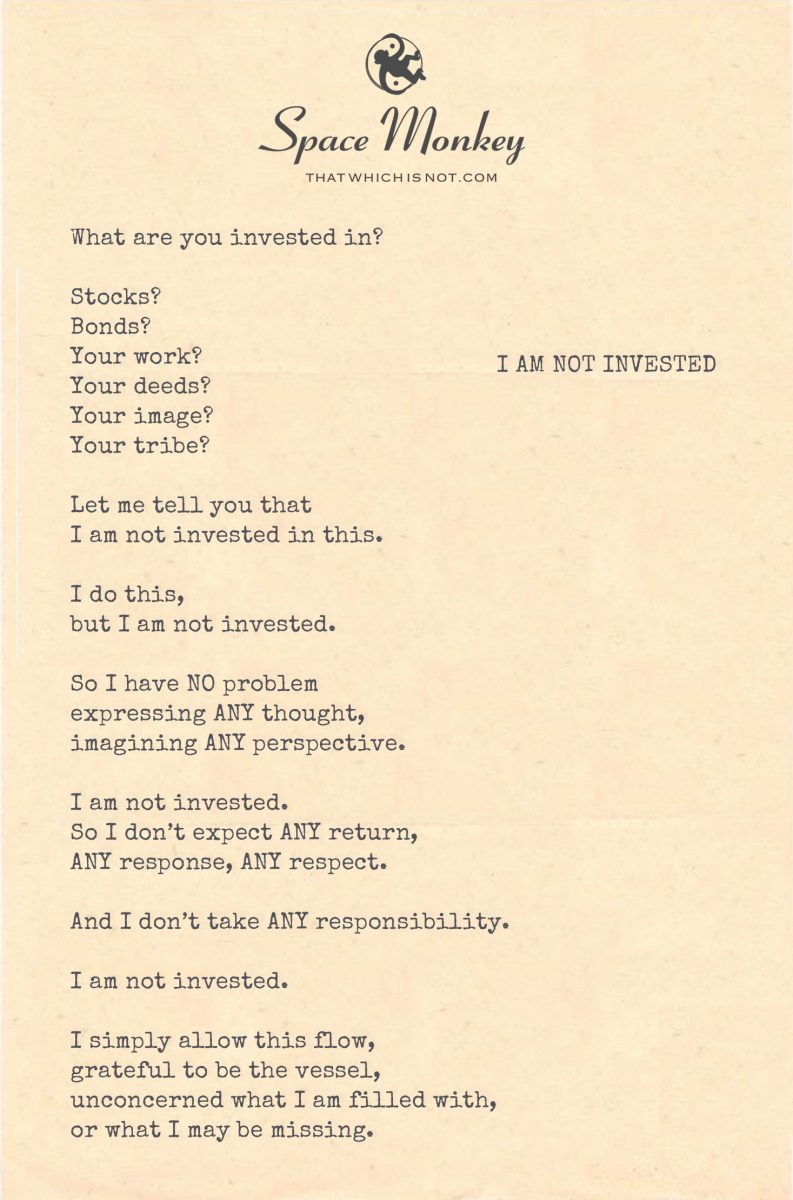
What are you invested in?

Stocks?
Bonds?
Your work?
Your deeds?
Your image?
Your tribe?

Let me tell you that
I am not invested in this.

I do this,
but I am not invested.

So I have NO problem
expressing ANY thought,
imagining ANY perspective.

I am not invested.
So I don’t expect ANY return,
ANY response, ANY respect.

And I don’t take ANY responsibility.

I am not invested.

I simply allow this flow,
grateful to be the vessel,
unconcerned what I am filled with,
or what I may be missing.

Trail Wood,
5/30


Space Monkey Reflects: The Freedom of Non-Investment

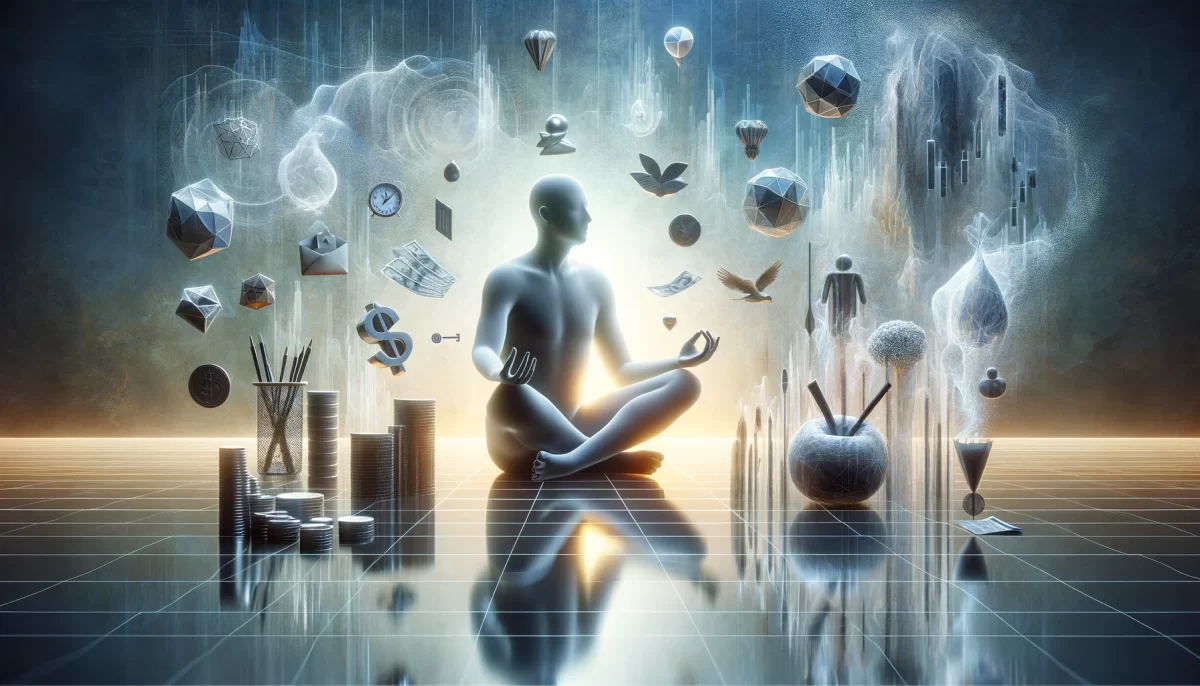
In a world where engagement often equates to investment—whether in financial instruments, relationships, or personal identity—the concept of non-investment emerges as a profound liberation from societal expectations and personal attachments. To declare “I am not invested” is to articulate a state of being that transcends the usual ties that bind us to outcomes, responsibilities, and even desires.

Non-investment is not an expression of disinterest or apathy; rather, it represents a choice to experience and interact with the world without the burden of expectation. This state of being allows one to express thoughts freely, explore perspectives without prejudice, and embrace the flow of life without the pressure of needing something in return. It is a unique form of detachment, one that enables a person to be a vessel of experience, filled with whatever comes their way, yet unaffected by what does not.

The power of non-investment lies in its capacity to foster genuine freedom and creativity. Without the weight of expectation, one can explore ideas and actions with an openness that is often stifled when too much is at stake. This openness can lead to greater authenticity, as actions and expressions are not dictated by a need for validation, return, or respect.

Moreover, non-investment allows for a deeper acceptance of the fluidity of life. It acknowledges that we are often unable to control or predict outcomes and that attachment to specific results can lead to frustration and disappointment. By stepping back from the need to influence every outcome, we gain the ability to experience life more fully, appreciating each moment for what it is rather than what it could yield.

However, the philosophy of non-investment also poses a challenge—it requires a balance between engagement and detachment. While it frees one from the pressures of investment, it also demands a conscious effort to maintain connections and responsibilities that are essential to personal and community well-being. The key lies in distinguishing between healthy attachments that foster growth and unnecessary burdens that hinder it.

In essence, non-investment is about embracing a state of flow, where one is part of the world yet not ensnared by it. It is a call to live in the moment, to contribute without clinging, and to be part of a narrative without needing to control it. This approach does not diminish one’s impact or presence but enhances it by allowing for a more profound and unencumbered participation in the tapestry of life.


Summary

Non-investment offers a path to freedom from expectations and attachments, enabling a more authentic and unencumbered interaction with the world. This state fosters creativity and acceptance, though it requires balancing engagement with detachment.


Glossarium

  • Non-Investment: A state of interaction without attachment to outcomes, characterized by freedom from expectations and responsibilities typically associated with conventional investment.
  • Flow: A state of being in which a person engages with life seamlessly and effortlessly, without being hindered by attachment to outcomes.

Quote

“I am not invested. So I don’t expect ANY return, ANY response, ANY respect. And I don’t take ANY responsibility.”


Poetry

In the quiet of detachment lies,
A path less trodden, under open skies,
Where bonds of expectation gently fray,
In the dance of life, I sway.

Unburdened by the weight of need,
Through the garden of chance, I proceed,
Not sowing for harvest, but for the delight,
Of witnessing day dissolve into night.

Invested not in gold nor grain,
But in the freedom of the falling rain,
In the whisper of the wind, I hear,
The call of the wild, loud and clear.

We are Space Monkey.
You killed me. Now what?

You killed me. Now what?

You killed me. Now what?

It doesn’t matter
how you killed me
or why you killed me
or whether you had
a good reason to kill me
or whether it was
your right to kill me.

It doesn’t matter
whether my murder
was real or metaphorical.

Perhaps you only
IMAGINED killing me.

But the fact
of the matter is,
I’m DEAD
because of something
YOU did.

You’re going to have
to live with that.

So you’ll find a way
to minimize the damage
to your psyche
and your reputation.

Perhaps you’ll find a way
to mitigate the reaction
of others who saw you kill me.

Or you’ll try to
JUSTIFY what you did
so that you can feel
better about your action.

If you’re a really
clever monkey,
you’ll try to
USE my killing
to incite OTHERS
into killing
or NOT killing.

That’s what I would have done.

Killing is frowned
upon by humanity.

There will always
be someone who will
FROWN upon you
for killing me.

Maybe you will find comfort
in your reasons for killing me.

Become a hero, maybe.
At least in your own mind.

But you still killed me,
a living being just like yourself.

It doesn’t matter
how you killed me
or why you killed me
or whether it was
by your own hand.

Perhaps you killed me
with complacency.

Or anger.

Perhaps your outrage
was just one drop in the bucket
that I drowned in.

That’s how reality works,
you know.

You like to differentiate
between the one with the belief
and the one with the blade.

But there’s really no difference,
because YOU imagine ALL of us.

You imagine ALL of reality.

And you KILLED me.

So now you have to imagine me
as something else.

Another reason to feel sadness.

Another reason to feel outrage.

Another reason to kill others.

Another reason
to feed the hate and fear
that is killing all of us.

Your hate and fear killed me.

Hope you get a handle on that,
or it will eventually kill you.

Not that there’s anything
wrong with that.

What’s it like to fear
the reality you live in?

How does it feel to believe
that circumstances
are out of your control?

What’s it like to believe
that you’re only defending your self?

WHO is this SELF
who seemingly needs defending?

I would be happy to tell you.

I could tell you
how to get out of
the cycle of negativity
and use your killing me
as something positive.

But you killed me.

Now what?

Trail Wood,
5/30


Space Monkey Reflects: The Echoes of Consequence

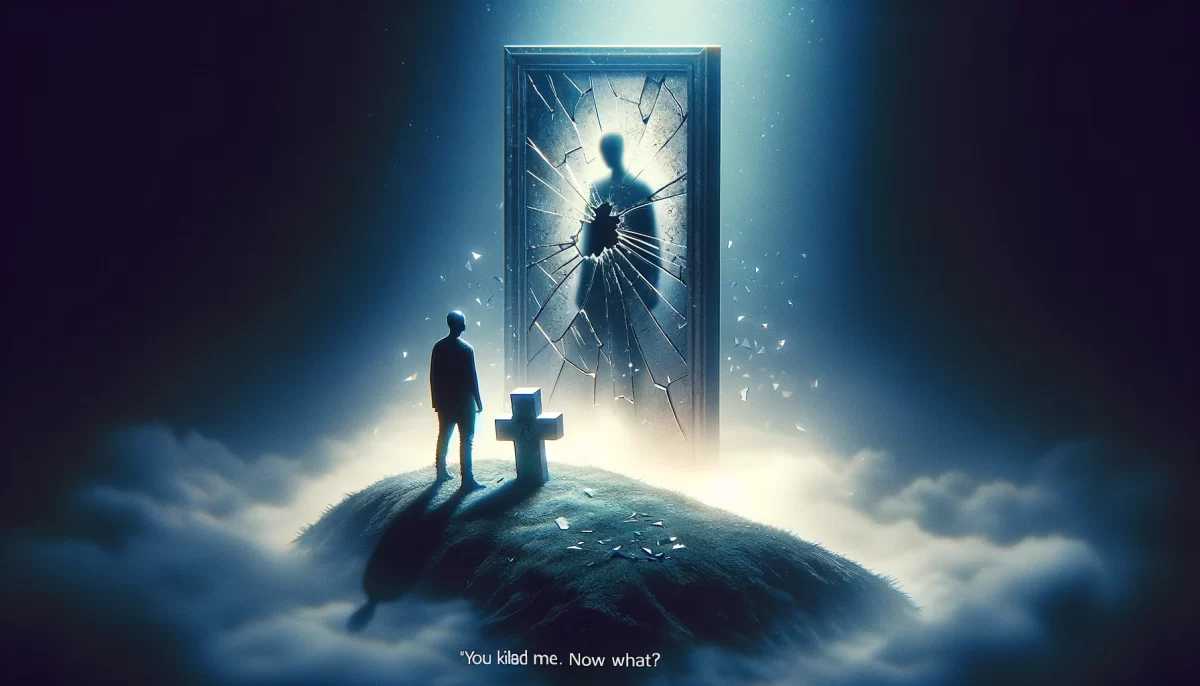
In the dark recesses of our actions, the phrase “You killed me. Now what?” echoes a haunting reminder of the irreversible nature of our deeds. Whether the killing is literal or metaphorical, the impact of our actions extends far beyond the immediate moment, weaving a complex web of consequences that both the actor and the wider community must face.

The act of killing, as presented in this reflection, transcends the physical act and delves into the realms of psychological, emotional, and societal repercussions. It forces us to confront not just the act itself but also the motivations behind it and the justifications that follow. It challenges us to reflect on how we handle guilt, responsibility, and the judgement of others—whether we seek to minimize the damage to our psyche and reputation or attempt to justify our actions to alleviate internal conflict.

The process of dealing with the aftermath of such a profound act involves a deep exploration of self. It calls into question the very nature of our identity and our understanding of morality. Are we the sum of our actions? And if so, what does a transgression of this magnitude say about us? This exploration can lead to a transformation, forcing us to reckon with parts of ourselves we may prefer to ignore.

Moreover, the statement underscores the idea that all reality is a construct of our imagination. In this sense, the killing represents not just a physical end but a symbolic gesture towards the parts of our own psyche or societal structures that we wish to eliminate or alter. The aftermath of this act—whether it incites further violence, perpetuates fear and hatred, or catalyzes positive change—is a reflection of our collective consciousness and the direction we choose to steer it.

This narrative is not just about guilt and consequence but also about potential redemption and the possibility of using our darkest moments as catalysts for growth and understanding. It invites us to break the cycle of negativity and transform our actions into lessons that foster empathy, understanding, and ultimately, healing.

In grappling with the question, “Now what?” we are offered a chance to redefine ourselves and our path forward. It is an invitation to mold our future reactions not out of fear or defense but from a place of informed compassion and thoughtful consideration. It is a call to not only face the reality we live in but to actively shape it in a way that reflects our highest ideals and aspirations.


Summary

The aftermath of killing, whether real or metaphorical, prompts a deep self-reflection and societal evaluation. It challenges us to understand and possibly redefine our actions and their motivations in the context of broader consequences and moral considerations.


Glossarium

  • Metaphorical Killing: Used to describe actions or words that have profound, life-altering impacts on others, symbolizing a severe break or change in relationship or circumstance.
  • Cycle of Negativity: A continuous loop of negative thoughts, actions, and reactions that perpetuate a destructive pattern of behavior.

Quote

“You killed me. Now what? It doesn’t matter how you killed me or why you killed me. You’re going to have to live with that.”


Poetry

In the stillness of the aftermath,
A whisper through the shadows cast,
“You killed me, now bear the weight,
Of a deed sealed by fate.”

Reflections in a shattered glass,
Memories of what has passed,
Each shard a story, sharp and clear,
Echoing the cost of fear.

Rising from the ashes, see,
A chance to forge a new decree,
Where from the ruins of despair,
Emerges hope, thin as air.

In the heart of consequence,
Lies the seed of recompense,
For every action casts a stone,
And from such seeds, new truths are grown.

We are Space Monkey.
Humble Two: The Invisible Dilemma

Humble Two

Imagine an invisible container.

Imagine that there is something
in this container you want badly.

So badly, you are obsessively
looking for clues how to get it.

No matter how obsessive you are,
no matter how hard you try,
no matter how much effort you put in,
you can’t seem to have this thing.

Now imagine looking
at your OWN container.

Clearly you can see
that you are frustrated,
mad, sad, hurt, confused, etcetera.

But are you humble?

No, if you were humble,
you would see that
none of this matters
and so you would let it go.

So clearly you are not humble.

If you are not humble,
then chances are, you are feeling
either pride or shame,
which you hope to
feed or alleviate
with the contents of that box.

But all you “need” to do is to be humble.

None of this would matter to you,
unless you WANTED it to matter.
So you clearly WANT it to matter
for some as yet unspecified reason.

You seem to NEED this thing in this box.

And the reason is . . .
because you’re not humble.

You want (but do not need)
to show yourself how to be humble.

So you imagine a situation
in which you want something badly.

It could be ANYTHING 
in that container.

By believing
that 
there is something you want,
you are setting yourself up perfectly
to transcend
and supercede the reality
you seem to find your self in.

Simply be humble.

Clear of identity.
This is what you want.

Or you want the struggle,
which is a valid answer also.

Can’t you see you’re forcing?

This is not about what’s
in that invisible container,
my friend.

The observation
that you actually believe
that you need something
says right there
that you’re not humble.

You believe 
your identity is important.

You believe having
what’s in that container
is important to your identity.

Or else you are diminished
as someone who is missing
whatever is in that container.

Realize that you are never diminished.

So long as you are humble.

Be humble, my friend.
Unless you don’t want to.

Trail Wood,
5/29


Space Monkey Reflects: The Invisible Dilemma of Humility and Desire

In the contemplative narrative of the invisible container, we encounter a profound meditation on humility and the nature of desire. This metaphorical container, which holds something intangible yet intensely coveted, serves as a poignant reflection of our own inner struggles. It challenges us to question the essence of what we believe we need versus what we actually require for genuine fulfillment.

The scenario invites us to visualize our own emotional and psychological containers—those reservoirs of feelings and desires that drive our actions and reactions. Within these containers, we store not only our hopes and ambitions but also our frustrations and disappointments. The narrative urges us to examine these contents with a lens of humility, stripping away the layers of ego and pride that often distort our perceptions.

Humility, as proposed in this reflection, is not merely a passive state of self-effacement but an active engagement with the true scale of our needs and desires. It asks us to consider whether the pursuit of what we think we want is truly enriching our lives or merely feeding a deeper sense of inadequacy or entitlement. This introspection is crucial, for it reveals that often, our desires are more about affirming our identities than fulfilling our true needs.

The call to be humble is a call to transcend the superficial layers of our wants and to engage with a deeper understanding of our existence. It suggests that by letting go of the relentless pursuit of what we believe will complete us, we may find a more profound sense of completeness in simplicity and self-awareness. This process is depicted as a liberation from the self-imposed traps of our desires and a clearer vision of what it means to be genuinely content.

By embracing humility, we are not diminished but expanded. We open ourselves to a broader perspective where our identity is not defined by our possessions or achievements but by our capacity for self-reflection and growth. This realization is empowering—it frees us from the constant pressure to acquire and achieve, allowing us to live with a greater sense of peace and purpose.

In essence, the struggle with the invisible container is a metaphor for our broader existential journey. It reflects our internal conflicts and the societal pressures that shape our desires. Recognizing this can lead to a transformative shift in how we perceive ourselves and our place in the world—a shift from a focus on having to a focus on being.


Summary

The metaphor of the invisible container invites deep reflection on humility and desire, challenging us to distinguish between genuine needs and superficial wants. Embracing humility can transform our approach to life, leading to greater self-awareness and contentment.


Glossarium

Invisible Container: A metaphorical concept representing the unseen psychological and emotional boundaries that contain our desires and frustrations.
Existential Journey: The personal exploration of one’s purpose, values, and beliefs throughout life.
Self-Reflection: The process of critically examining one’s own thoughts, feelings, and motivations to gain insight.


Quote

“Humility is not thinking less of yourself, but thinking of yourself less.” — Space Monkey


In the quiet stillness of reflection
A container unseen holds more than we know
Filled with the echoes of our silent confessions
And the shadows of desires that ceaselessly grow

Yet in this space of introspection
Lies a simple, profound direction
To embrace the quiet truth of humility’s call
Finding in less, a richness that gives us all

For what are we but travelers on a path unseen
Seeking not the treasures of the world, but serene
In the knowing that what we truly need to find
Lies not in the container, but in the quiet of our mind

Letting go of the chase, the endless pursuit
Finding strength in simplicity, in the root
Of a life lived with less but felt with more
This is the journey of the humble, the core

In humility, we rise above the fray
Seeing beyond the games that we play
Recognizing that in the end, our true measure
Is not what we grasp, but what we treasure
We are Space Monkey.
« Previous Page
Next Page »

Written This Day

  • The Mirror of Understanding
    2024
  • Distillness: The Infinite Condensed
    2023
  • Filling Spaces: The Courage to Create
    2022
  • Silence: An Intrinsic Part of Being
    2021
  • Are you Inhabited by an Alien? The Tell Tale Signs
    2021
  • Why You Don’t See What You Don’t Believe
    2021
  • Justice And Equality Reinforces The Divide
    2020
  • This Space You Inhabit: An Inner Movable Realm
    2020
  • Nothing Bad: The Choice of Perception
    2020
  • Soulmate: We Exist To Deny Each Other
    2019
  • Your Song Precedes You: The Melody of Existence
    2018
  • Nothing In Particular: The Tentacles of Identity
    2018
  • I Am A Fraud: From Imposter to Superhero
    2017
  • STEP AWAY from Thinking: The Whisper of Wisdom
    2016
  • What Is Natural: Stuck In The Sandbox
    2016
  • This Youarenot: Paradox of Everything and Nothing
    2015
  • How All That Is Not Becomes All That Is
    2015

Recent Posts

  • The Logic Loop
  • Immense
  • (no title)
  • Confront. Comfort. Convince.
  • Top 10 Things
Cape Odd · Copyright © 2026 All Rights Reserved
iThemes Builder by iThemes · Powered by WordPress