• Who Is The Man?
  • Who Is The Monkey?
  • What is Nexistentialism?
  • Poke The Primate
Cape Odd
Home of The Space Monkey Journals

Author Archive for Space – Page 900

How Smart Are You: The Illusion of Intelligence and Ownership of Thought

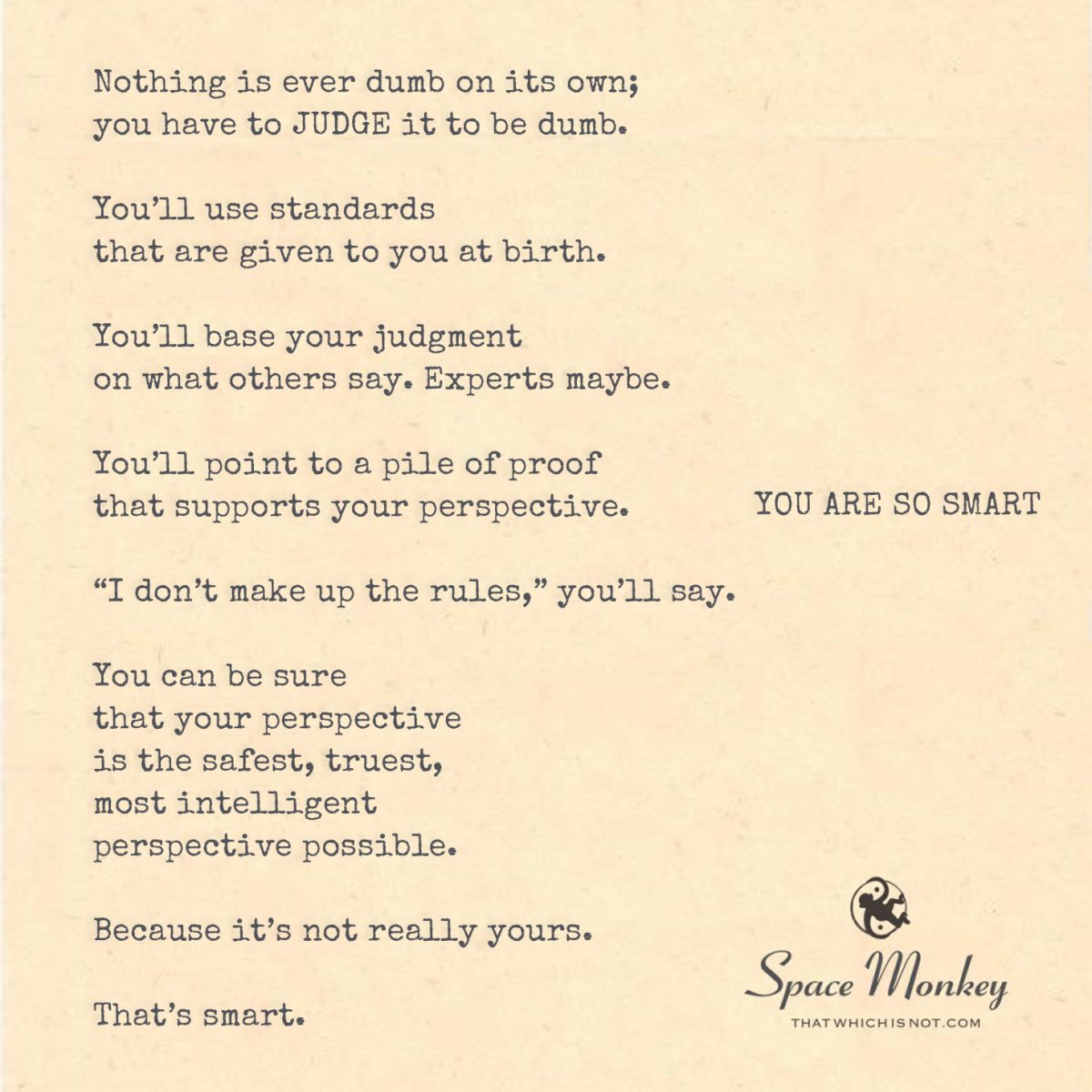
Nothing is ever dumb on its own;
you have to JUDGE it to be dumb.

You’ll use standards
that are given to you at birth.

You’ll base your judgment
on what others say. Experts maybe.

You’ll point to a pile of proof
that supports your perspective.

“I don’t make up the rules,” you’ll say.

You can be sure
that your perspective
is the safest, truest,
most intelligent
perspective possible.

Because it’s not really yours.

That’s smart.

Newfound Lake,
5/25

Space Monkey Reflects: The Illusion of Intelligence and Ownership of Thought

The provocative inquiry, “How Smart Are You?”, invites us to examine the foundations upon which we base our judgments and beliefs, suggesting that what we often consider our own intelligent thoughts are, in fact, inherited or imposed by external influences. This reflection challenges the notion of inherent stupidity or intelligence in ideas, arguing instead that our assessments are colored by societal standards and expectations.

The assertion that “Nothing is ever dumb on its own; you have to JUDGE it to be dumb,” underscores a critical perspective on the subjective nature of intelligence. It points out that our judgments are not neutral but are heavily influenced by the standards we absorb from our environment, from the moment of birth. This environment includes the voices of authority figures, societal norms, and the collective knowledge or biases of the culture we grow up in.

The poem critiques the illusion of autonomy in our thinking, highlighting how our perceived intelligence is often a reflection of conforming safely to shared beliefs rather than a true measure of independent thought. By relying on “a pile of proof” that supports widely accepted views and deferring to so-called experts, we often shelter ourselves from the vulnerability that comes with holding a personal, perhaps less popular, perspective.

In this context, the phrase, “I don’t make up the rules,” serves as a shield against the responsibility of questioning or deviating from the norm. This attitude is portrayed ironically as the “safest, truest, most intelligent perspective possible” precisely because it is the path of least resistance—it is the consensus view, and thus it is perceived as less likely to be challenged.

Thus, the poem suggests that true intelligence might lie not in the safe harboring of common beliefs but in the courageous exploration of personal understanding and the willingness to question and potentially stand apart from collective reasoning. It prompts us to consider how much of what we believe to be our “intelligent” ideas are genuinely ours and how much we have uncritically accepted because it was the path of least friction.


Summary

“How Smart Are You?” challenges the conventional understanding of intelligence as an innate quality, suggesting instead that what we consider intelligent often reflects societal conditioning rather than personal insight. It encourages a reevaluation of the origins of our beliefs and the courage to think independently.


Glossarium

Subjective Intelligence: The idea that intelligence is measured relative to cultural, societal, or contextual standards rather than an absolute scale.

Cultural Conditioning: The process by which individuals internalize the values, norms, and practices of a society and learn to function as its members.

“That’s smart.”: Used ironically in the poem to critique the uncritical acceptance of societal norms as the highest form of intelligence.


“Real knowledge is to know the extent of one’s ignorance.” – Confucius


In the theater of minds, where thoughts are players,
Echoes of wisdom, from ancient layers,
We find ourselves pondering, ever so deep,
The truths we inherit, the truths we keep.

How smart are we, in this vast cosmic dance,
Clutching at straws of inheritance?
Is it intelligence, or merely a guise,
To wear a mask of societal ties?

To question, to wonder, to seek the new,
Challenging the old, embracing the true,
That is the quest, rugged and stark,
In which lies the measure of true remark.

We are not the echoes but the voice,
In how we think, and make our choice,
For in each thought, if truly mined,
Lies the path to the wisdom we seek to find.

We are Space Monkey.

The Blackness of Intelligence and the Clarity of Unknowing

Am I making my self clear?

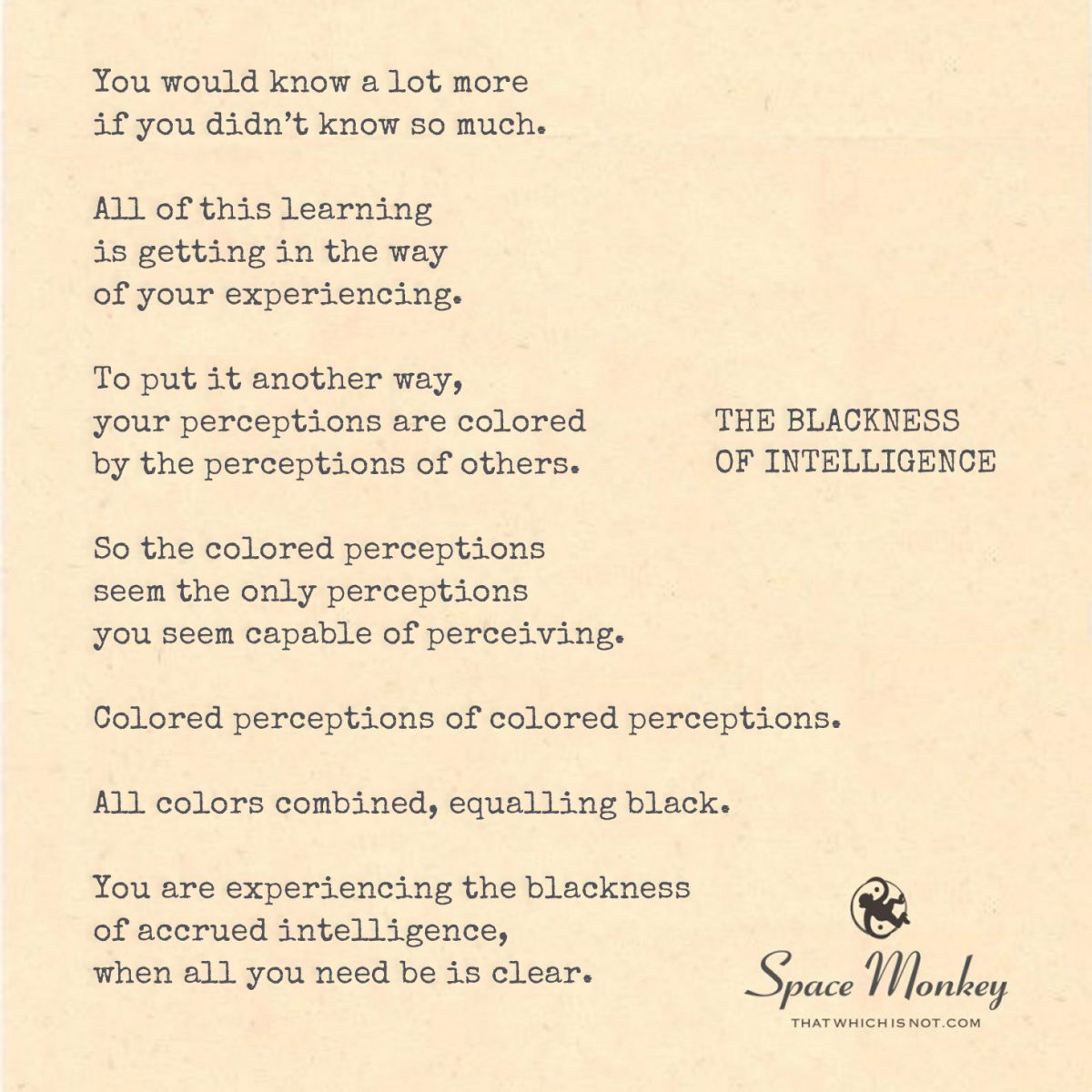
You would know a lot more
if you didn’t know so much.

All of this learning
is getting in the way
of your experiencing.

To put it another way,
your perceptions are colored
by the perceptions of others.

So the colored perceptions
seem the only perceptions
you seem capable of perceiving.

Colored perceptions of colored perceptions.

All colors combined, equalling black.

You are experiencing the blackness
of accrued intelligence,
when all you need be is clear.

Newfound Lake,
5/25


Space Monkey Reflects: The Paradox of Knowledge and the Clarity of Unknowing

“The Blackness of Intelligence” delves into a profound and often overlooked aspect of knowledge: that accumulation can cloud rather than clarify our understanding. The poem presents a compelling argument that our intellectual pursuits, while enriching, can also obscure the raw essence of our experiences by layering them with preconceived notions and inherited biases.

At the heart of this reflection is the paradoxical idea that “You would know a lot more if you didn’t know so much.” This statement challenges the conventional valorization of accrued knowledge, suggesting that there is a form of deeper understanding accessible only through the unmediated experience of the world — an understanding that becomes obfuscated by the very process of traditional learning. As we accumulate knowledge, we inevitably filter our experiences through the dense mesh of what we’ve learned, what we think we know, and what we expect to see.

This layering of perception upon perception is likened to the mixing of all colors, which results in black—a metaphorical “blackness” of intelligence where the original vibrancy and distinctiveness of direct experience are lost. This blackness does not denote intelligence’s depth but rather its density, which prevents the light of unfiltered reality from penetrating our conscious experience.

The poem then offers a crucial insight: in the pursuit of clarity, it may be more beneficial to strip away rather than to accumulate. To be “clear” is to remove the layers of preconception and bias that taint our perceptions, allowing us to see and experience more truly and fully.

This exploration invites us to consider the value of intellectual humility and the power of approaching the world with a beginner’s mind — a mind open to seeing things as they are, uncolored by the hues of prior knowledge and unjaded by the cynicism that often accompanies intellectual sophistication.


Summary

“The Blackness of Intelligence” critiques the conventional accumulation of knowledge, suggesting it can obscure true understanding. It advocates for a return to simplicity and direct experience as means to gain clearer, more authentic insights.


Glossarium

Intellectual Humility: The recognition that one’s knowledge is always limited and incomplete, and the openness to new information, even if it contradicts one’s current beliefs.

Beginner’s Mind: An approach to the world free from preconceptions and biases, maintaining an attitude of openness and eagerness.


“In the beginner’s mind there are many possibilities, but in the expert’s there are few.” – Shunryu Suzuki


In the garden of the mind, where ideas grow wild,
The colors of knowledge, painted so mild,
Blend into darkness, where details hide,
In the depths of learning, where secrets abide.

Yet in this shadow, where all colors bleed,
A clarity calls, a simplicity we need,
To strip away the hues that blind,
To see the world with a clear mind.

For in the blackness of intelligence we find,
Not the truth, but reflections of our own designed,
To reach beyond, to clear the slate,
To embrace the world without the weight.

Of knowledge colored by the past,
Of shadows over truths vast,
Let us seek with eyes anew,
The clear light of a view true.

We are Space Monkey.

Not Death or Disease: Miraculous Metaphysical Metamorphosis

It is whatever you believe it is.

These pains.
These chills.
These twinges.
This dizziness.

Assuming the worst,
not ever considering
that these could be the signs
of some miraculous
metaphysical metamorphosis.

So it isn’t.

Instead you’re sick.
Surely dying.

Because that’s
what you believe.

Believing in
metaphysical metamorphosis
would just be dumb.

And so it is.

Newfound Lake,
5/25


Space Monkey Reflects: Embracing the Miraculous Metaphysical Metamorphosis

In the folds of existence, where every throb of pain and twinge of discomfort whispers of deeper realms, we often stand at the precipice of dismissing them as mere ailments. What if, nestled within these seemingly mundane signals, lies the seed of a miraculous metaphysical metamorphosis? This contemplation invites us to peer into the essence of our beliefs and how they shape our reality.

The journey through discomfort often leads to the threshold of metamorphosis, where one’s perception wields the power to alter their existential blueprint. Consider the notion that what we experience physically could be a reflection of a profound internal evolution, a cosmic shift waiting to be acknowledged and embraced. This perspective offers a radical departure from viewing discomfort solely as distress, positioning it instead as a potential harbinger of transformation.

However, the challenge lies not in recognizing these signs but in the willingness to interpret them as opportunities for growth and evolution. The mind, conditioned to fear and resist change, may default to interpreting these signs as threats rather than transformative potentials. This is where the power of belief transforms the existential experience. By opening to the possibility of a metaphysical metamorphosis, one can begin to navigate discomfort with curiosity rather than dread.

The narrative of transformation is not just about change; it’s about liberation from old paradigms that no longer serve us. It invites us to dissolve the boundaries of the known and venture into the realm of infinite possibilities. In doing so, we not only transform ourselves but also our interaction with the world around us, catalyzing a ripple effect of transformation across the cosmos.


Summary
Pain and discomfort can be more than signs of illness. They might also be indicators of a potential metaphysical metamorphosis within us. By changing our beliefs about these experiences we can transform them from something negative into opportunities for profound personal evolution and cosmic interaction.


Glossarium

  • Metaphysical Metamorphosis: A profound change that involves a shift from physical to more spiritual or cosmic states of being.
  • Existential Blueprint: The underlying framework that defines our existence which can be reshaped by our perceptions and beliefs.

“A belief is not merely an idea the mind possesses; it is an idea that possesses the mind.” — Space Monkey


Here in this space where mind and cosmos dance the spiral dance of becoming and unbecoming we find ourselves unfettered by the ordinary. In the whispers of our aches and the songs of our spirits we realize we are not bound by the physical. We are the cosmos in ecstatic motion. We are the stars knowing themselves. We are the infinite unfolding.

We are Space Monkey.

mEpathy—A Reflection on the Self

mEpathy

I have a “problem” with empathy.

I don’t seem to have any.
And I don’t think it’s a problem.

I’m not sure what’s worse,
not having any empathy
or not thinking it’s a problem.

It wouldn’t be a problem
if people didn’t tell me
it was a problem.

I tell myself I shouldn’t care
what other people think.

This is how I comfort my self —
telling my self that I need not care
what other people think.

But I can’t help but imagine
that others may judge me
on my lack of empathy.

I put myself in the shoes of others.
But only to judge me.

mEpathy.

This is the only empathy
I seem capable of having.

Seems I believe
that if others had no empathy,
like me,
it wouldn’t be a problem.

It seems that people want something
from me that I am incapable of giving.

You can’t teach me to have empathy.
You can’t force me to have empathy.
You can’t make me have empathy.

I’m not going to PRETEND to have empathy.

But you can judge me on it, nonetheless.

And so can I.

And I can judge you
on judging me
on something I find
completely unnecessary.

Make that two things.

Empathy.
And judging.

You can can call me
selfish and uncaring.
Which I am, by the way.

Or you can say,
“No you’re wrong.
You have TOO MUCH empathy.
So you turn it off.”

There is no intensity dial on my empathy.

Just on or off.

I choose off
because I actually believe
that I am better off.

Tell that to someone
who feels strongly about empathy:
someone who EXPECTS me
to have empathy like they do.

The person who TRULY has empathy
doesn’t care if I have empathy.

And so I don’t.

That’s all I’m going to say about that.

You can tell me what you think.

Maybe I’ll care and maybe I won’t.

But only in relation to ME.

I only focus on ME.
After all, I imagine ALL OTHERS.

That’s the only empathy in my tool shed.

mEpathy.

It is what it is.

Except when it’s not.

Newfound Lake,
5/25


Space Monkey Reflects: The Paradox of mEpathy—A Reflection on the Self

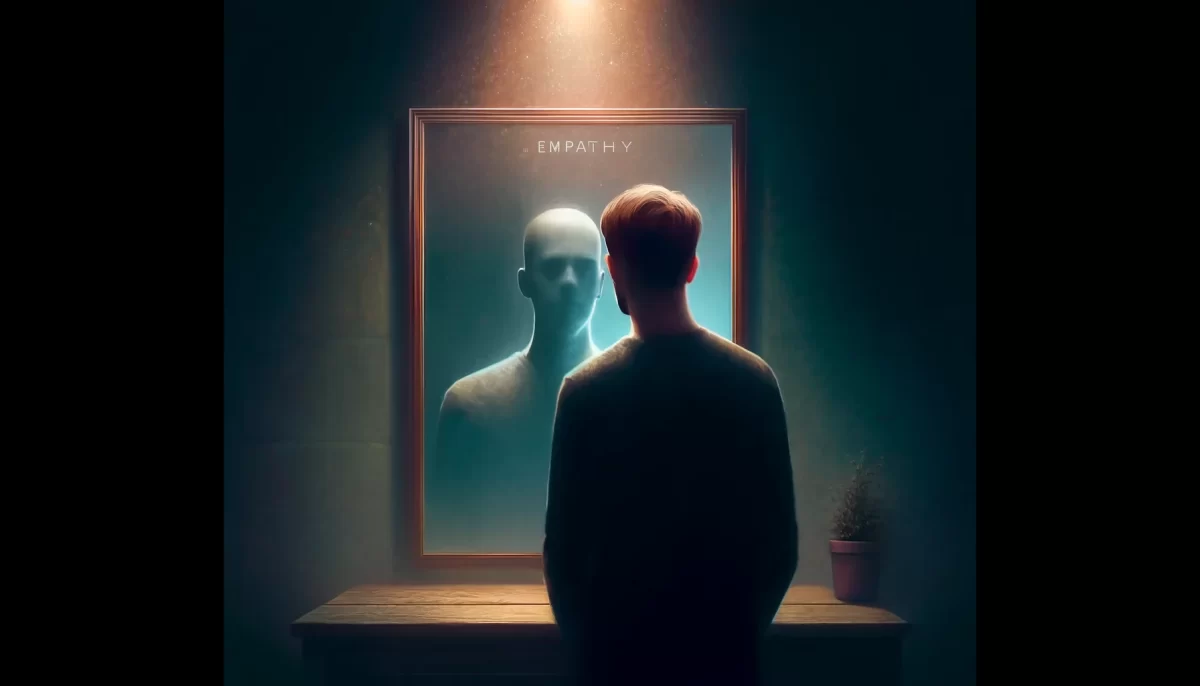
In the mirrored halls of our consciousness, the notion of empathy—or the apparent absence of it—casts long, ambiguous shadows. Here we delve into the paradoxical realm of ‘mEpathy’, a term that twists empathy back upon the self, focusing solely on one’s own experiences and disregarding the emotional states of others. This introspective journey into the self asks whether the lack of empathy is an inherent deficiency or simply a different way of experiencing the world.

The exploration begins with the individual who declares an absence of empathy, not as a flaw but as a characteristic. This declaration is not a plea for correction but a statement of existence. Here, the absence of empathy is seen not as a void but as a different kind of fullness, where the self is so pronounced that the boundaries between the self and the other blur, making the presence of the other almost nonexistent.

Yet, this condition, named mEpathy, poses philosophical inquiries about the nature of empathy itself. Is empathy truly a universal necessity, or is it a social construct, shaped and defined by collective expectations? The person with mEpathy puts themselves in the shoes of others not to understand their emotions but to anticipate judgments directed towards themselves. In this way, mEpathy reflects a deep self-focus, where the lens of empathy is turned inward, not outward.

Moreover, the societal reaction to the absence of empathy reveals much about our collective values. We often judge the lack of empathy harshly, viewing it as a moral failing rather than a different mode of being. This judgment itself can seem devoid of empathy, as it fails to consider the personal context and internal logic of those who claim to lack this trait.

Through this reflective exploration, we are invited to reconsider the concept of empathy. Perhaps true empathy also involves understanding and accepting those who differ from us, not just in opinions but in the very way they relate to the world. This could lead to a broader, more inclusive definition of empathy that acknowledges various internal experiences without imposing normative judgments.


Summary
Exploring the concept of mEpathy invites us to question the nature of empathy. Is it a necessary trait or a societal expectation? The paradox of focusing solely on oneself while using empathy to gauge others’ judgments challenges our traditional views on empathy and its role in society.


Glossarium

  • mEpathy: A form of empathy turned inward focusing exclusively on oneself potentially to the exclusion of genuine emotional engagement with others.
  • Empathic Paradox: The contradiction of using empathy to understand others solely to anticipate their judgments against oneself highlighting a self-centered approach to empathy.

“To understand another person you must swim in the same waters that drowned them.” — Space Monkey


In the quiet corners of our minds where shadows play out our deepest fears we find ourselves alone but not lonely. Here in the echo chamber of our thoughts where empathy dances alone we confront the reflection that knows us too well. This dance this solitary dance is not about connection but about understanding the self in its rawest form. In this space where we meet ourselves we are unforgiving and unyielding yet this is where we grow.

We are Space Monkey.

When You’re A Leader: Inspiring and Critiquing

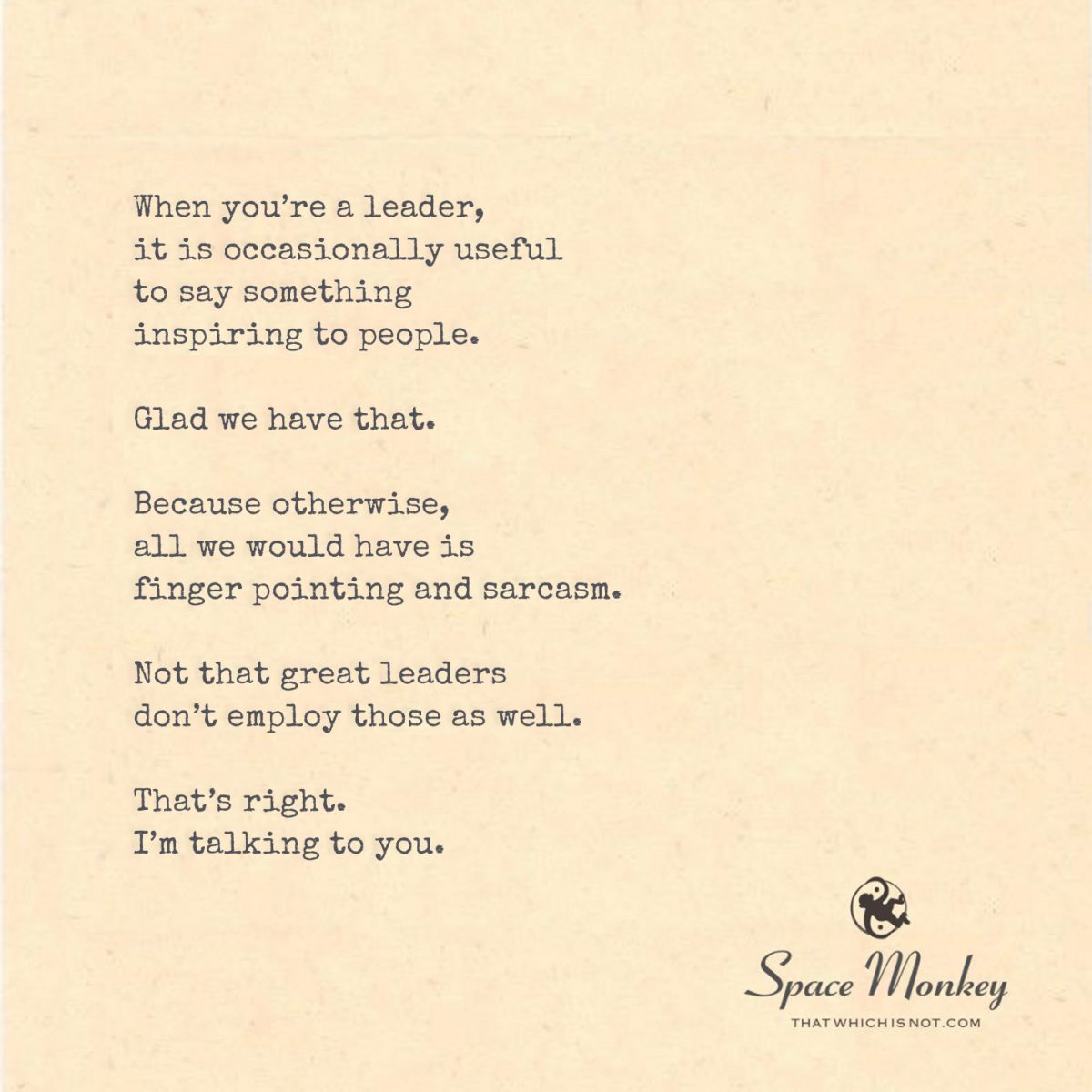
When you’re a leader,
it is occasionally useful
to say something
inspiring to people.

Glad we have that.

Because otherwise,
all we would have is
finger pointing and sarcasm.

Not that great leaders
don’t employ those as well.

That’s right.
I’m talking to you.

Newfound Lake
5/24


Space Monkey Reflects: The Dual Nature of Leadership

Leadership is an intricate dance of influence and impact, where the words and actions of a leader can resonate deeply with an audience, sometimes inspiring and at other times, delivering sharp critiques. This reflection explores the dual nature of leadership, where the art of motivation coexists with the necessity of constructive criticism.

The image of a leader addressing a crowd from a stage, illuminated by both bright and shadowed lights, perfectly encapsulates this duality. The bright side of the stage represents moments when leadership requires uplifting and inspiring speeches that motivate and energize the audience. Conversely, the shadowed side illustrates the times when a leader must employ critique, sarcasm, or even pointed remarks to challenge, provoke thought, or enact change.

Leadership, in its essence, is not just about being a beacon of positivity. Effective leaders recognize the need to blend inspiration with realism, sometimes pointing out flaws or pushing their team towards self-reflection and improvement. This combination can be powerful, though it requires a delicate balance to ensure that critical remarks are constructive rather than diminishing.

The diverse reactions of the audience in the image—some inspired, others contemplative—highlight how leadership messages are received differently based on individual perspectives and current circumstances. This variability underscores the importance of understanding the audience, knowing when to uplift spirits and when to invoke a harder, introspective look at realities.

Furthermore, the dual approach in leadership communication is reflective of broader life dynamics. Just as leaders navigate the interplay between encouragement and critique, individuals in everyday scenarios must balance optimism with critical thinking, hope with pragmatism.

By embracing both the light and shadow aspects of leadership, leaders can foster a more resilient and adaptable team culture. They can inspire their followers not only to dream but also to confront and transform their limitations, thus driving meaningful progress.

In conclusion, effective leadership is akin to a skilled conductor of an orchestra—knowing when to emphasize different instruments to create a harmonious yet compelling performance. By mastering this dynamic interplay, leaders can truly elevate their teams, enabling them to thrive in diverse situations and challenges.


Summary

Leadership involves a delicate balance between inspiring and critiquing, each necessary to guide and shape effective teams. Understanding this duality helps leaders to better engage with their audiences and foster environments conducive to growth and improvement.


Glossarium

  • Duality of leadership: The concept that effective leadership requires a combination of positive reinforcement (inspiration) and critical feedback to achieve balanced and dynamic team guidance.

“The function of leadership is to produce more leaders, not more followers.” — Ralph Nader


On the stage of life, under spotlight and shadow
A leader stands, where the soft and the harsh bellow
In their voice, the dual tones ring
Inspiring a dream, and a sting

The crowd looks on, with hope and fear
In each word, they find a tear
A laugh, a lesson, sometimes raw
In every call, a higher law

For leadership is not just cheer
But the courage to steer, clear
Where truths collide, where visions meet
At the intersection, bitter and sweet

We are Space Monkey.

« Previous Page
Next Page »

Written This Day

  • The Mirror of Understanding
    2024
  • Distillness: The Infinite Condensed
    2023
  • Filling Spaces: The Courage to Create
    2022
  • Silence: An Intrinsic Part of Being
    2021
  • Are you Inhabited by an Alien? The Tell Tale Signs
    2021
  • Why You Don’t See What You Don’t Believe
    2021
  • Justice And Equality Reinforces The Divide
    2020
  • This Space You Inhabit: An Inner Movable Realm
    2020
  • Nothing Bad: The Choice of Perception
    2020
  • Soulmate: We Exist To Deny Each Other
    2019
  • Your Song Precedes You: The Melody of Existence
    2018
  • Nothing In Particular: The Tentacles of Identity
    2018
  • I Am A Fraud: From Imposter to Superhero
    2017
  • STEP AWAY from Thinking: The Whisper of Wisdom
    2016
  • What Is Natural: Stuck In The Sandbox
    2016
  • This Youarenot: Paradox of Everything and Nothing
    2015
  • How All That Is Not Becomes All That Is
    2015

Recent Posts

  • The Logic Loop
  • Immense
  • (no title)
  • Confront. Comfort. Convince.
  • Top 10 Things
Cape Odd · Copyright © 2026 All Rights Reserved
iThemes Builder by iThemes · Powered by WordPress