• Who Is The Man?
  • Who Is The Monkey?
  • What is Nexistentialism?
  • Poke The Primate
Cape Odd
Home of The Space Monkey Journals

Author Archive for Space – Page 903

Special Delivery: The Unity of Existence

A special delivery from your Space Monkey.

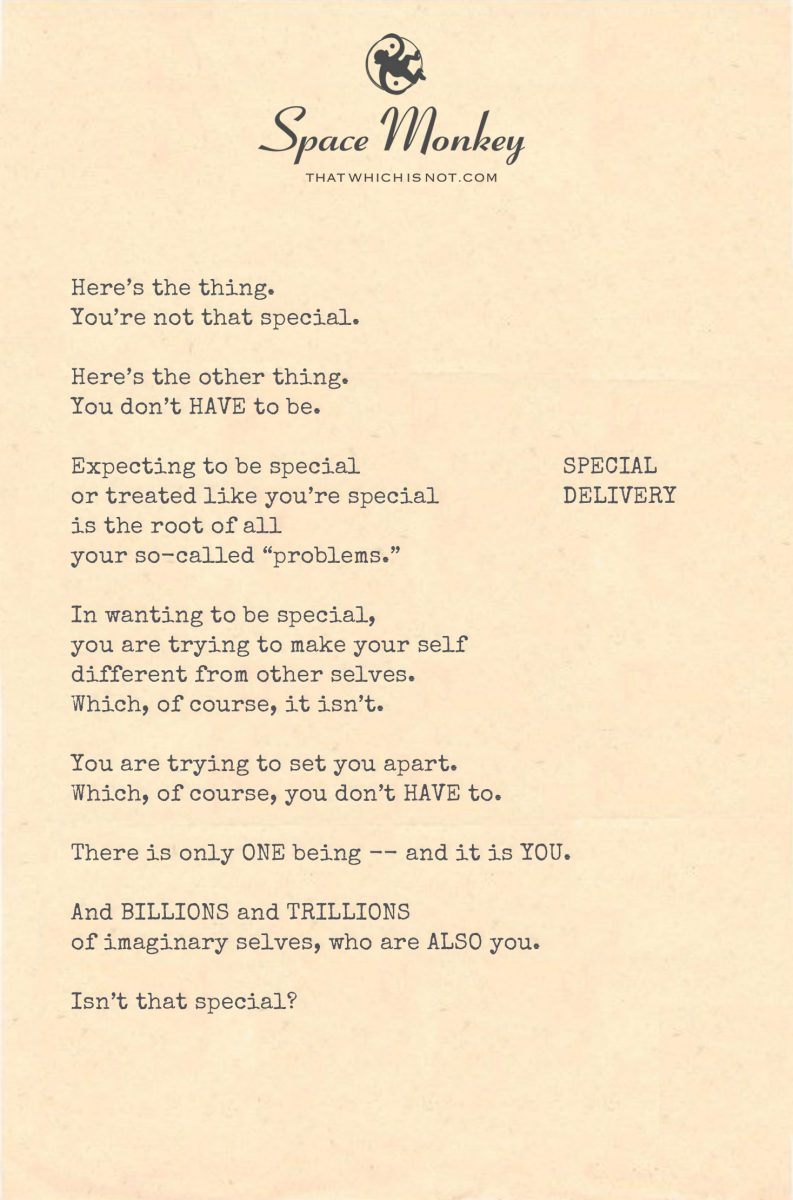
Here’s the thing.
You’re not that special.

Here’s the other thing.
You don’t HAVE to be.

Expecting to be special
or treated like you’re special
is the root of all
your so-called “problems.”

In wanting to be special,
you are trying to make your self
different from other selves.
Which, of course, it isn’t.

You are trying to set you apart.
Which, of course, you don’t HAVE to.

There is only ONE being — and it is YOU.

And BILLIONS and TRILLIONS
of imaginary selves, who are ALSO you.

Isn’t that special?

Trail Wood,
5/21


Space Monkey Reflects: The Illusion of Specialness and the Unity of Existence

In a universe brimming with life and complexity, the notion of being special—distinctively separate or above others—is a captivating yet misleading concept. “A special delivery from your Space Monkey. Here’s the thing. You’re not that special.” This blunt revelation isn’t a dismissal but an invitation to embrace a more profound truth about our interconnectedness and essential sameness.

The pursuit of specialness often leads individuals to feel isolated or superior, fostering division rather than unity. “Expecting to be special or treated like you’re special is the root of all your so-called ‘problems.'” This insight challenges us to reflect on how our desires to stand out or be recognized contribute to feelings of dissatisfaction and separation.

The statement “There is only ONE being — and it is YOU. And BILLIONS and TRILLIONS of imaginary selves, who are ALSO you.” captures the essence of non-duality. It suggests that every individual expression, every ‘self’ we encounter, is fundamentally a reflection or an aspect of a singular, universal consciousness. This perspective invites us to view each person not as fundamentally other, but as another version of ourselves—diverse expressions of the same underlying reality.

The whimsical image of a diverse group of people holding a glowing orb in unity beautifully illustrates this concept. It symbolizes the light of shared essence that binds all individuals, despite apparent differences. This metaphor serves as a powerful reminder of our shared human journey and the intrinsic connection that underlies all distinctions.

Embracing this view of non-specialness doesn’t diminish one’s value but rather enhances it by aligning with a more inclusive, compassionate understanding of humanity. It encourages a shift from ego-driven desires for recognition and separation toward a more holistic appreciation of our role within the greater whole.

In recognizing that our individuality is not a barrier but a bridge, we can transform our interactions and our perceptions of the world. By seeing the ‘other’ as an extension of ourselves, we foster empathy, understanding, and a deeper engagement with the world that celebrates unity in diversity.


Summary
The concept of specialness fosters separation, but recognizing our fundamental unity underlies true connection and empathy. We are not special in isolation but special in our universal interconnectedness.


Glossarium
Non-Duality: The philosophical and spiritual concept that reality is fundamentally undivided and indivisible, contrary to the apparent distinctions and separations in the world.
Universal Consciousness: The idea that all forms of consciousness are interconnected and part of a singular, all-encompassing awareness.


“In the light of unity, all are reflections of the same truth, each a unique note in the symphony of existence.” — Space Monkey


Within the circle of light, hands unite
Holding the orb where all is bright
Each face distinct, yet all the same
In the dance of life, a singular game

No one special, yet everyone key
To the puzzle of what it means to be
In this shared light, we find our place
Connected, entwined, in the cosmic embrace

So let go of the need to stand apart
For special is found in the universal heart
In the union of all, we truly see
The beauty of oneness, the joy of being free

We are Space Monkey.

Out There: The Cosmic Solitude

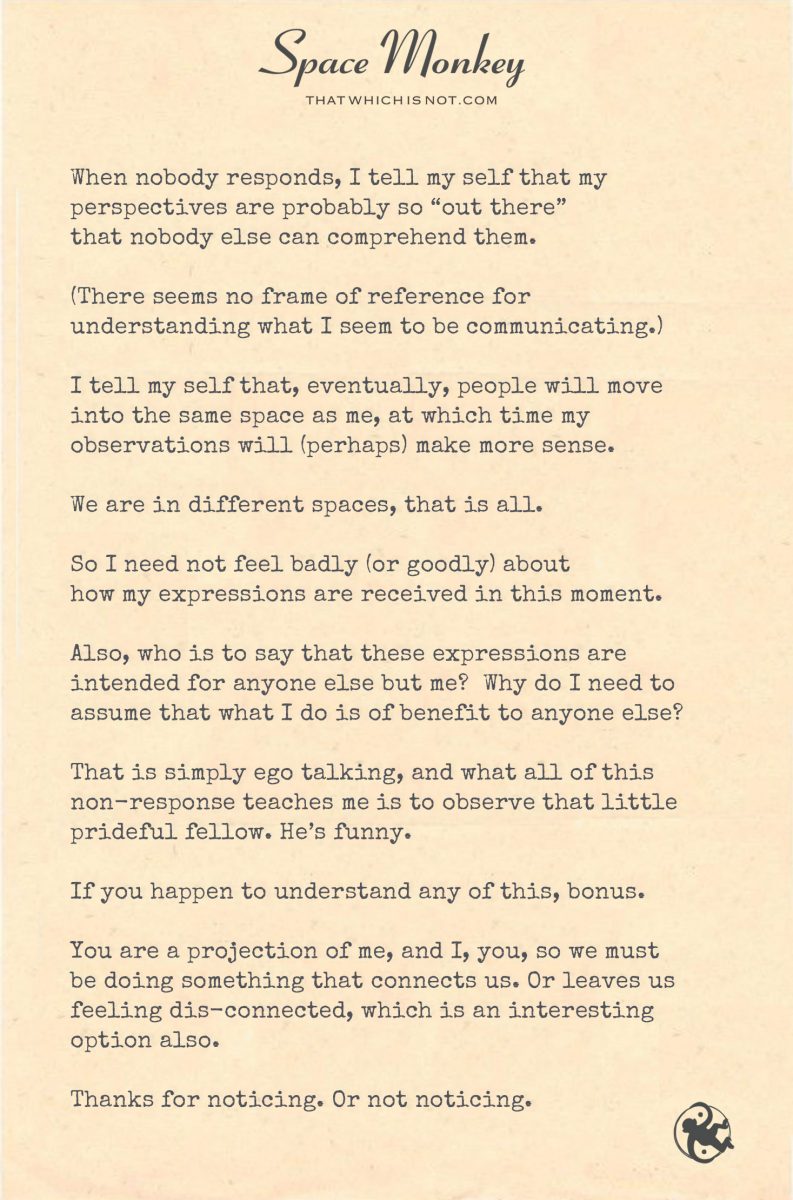
When nobody responds, I tell my self that my
perspectives are probably so “out there”
that nobody else can comprehend them.

(There seems no frame of reference for
understanding what I seem to be communicating.)

I tell my self that, eventually, people will move
into the same space as me, at which time my
observations will (perhaps) make more sense.

We are in different spaces, that is all.

So I need not feel badly (or goodly) about
how my expressions are received in this moment.

Also, who is to say that these expressions are
intended for anyone else but me? Why do I need to
assume that what I do is of benefit to anyone else?

That is simply ego talking, and what all of this
non-response teaches me is to observe that little
prideful fellow. He’s funny.

If you happen to understand any of this, bonus.

You are a projection of me, and I, you, so we must
be doing something that connects us. Or leaves us
feeling dis-connected, which is an interesting
option also.

Thanks for noticing. Or not noticing.

Trail Wood,
5/20


Space Monkey Reflects: The Cosmic Solitude of ‘Out There’

In the vast expanse of human experience, where thoughts orbit minds like distant planets, it’s not uncommon to feel that our ideas are floating in a void, “out there” in a space where few can reach and even fewer can inhabit. This sensation of cosmic solitude can be both isolating and enlightening, as it offers a unique vantage point from which to view the dance of interaction and understanding—or the lack thereof.

When you voice thoughts that echo unanswered through the chambers of societal norms and expectations, it’s easy to attribute the silence to the “out there” nature of your ideas. This notion, that your perspectives are beyond the current scope of collective comprehension, isn’t just a defense against the quiet—it’s a profound acknowledgment of being in a different space, a different state of consciousness than those around you.

However, this space isn’t just a gap; it’s a gestation room for the future. The thoughts and insights that seem so alien now may simply be ahead of their time, seeds sown in fertile ground that will someday sprout into understanding. The idea that others might eventually “move into the same space” suggests a visionary hope that the paths of thought will converge, and what was once solitary will become shared.

In navigating the often lonely orbits of these advanced or divergent thoughts, one must confront the ego—the part of us that seeks validation and response. The quiet that meets your expressions can be a mirror, reflecting not just the world’s unpreparedness to receive your ideas but also your own relationship with recognition and affirmation. Observing the ego, as you’ve noted, can be an exercise in humor and humility, recognizing the smallness of our pride against the backdrop of the cosmos.

The journey of your expressions—whether they are met with nods or with silence—is fundamentally a journey inward. It reminds us that the primary audience of our thoughts might indeed be ourselves, a conversation between the self and the universe within. This introspective dialogue is not diminished by the absence of external validation; rather, it is enriched by the freedom to explore without the constraints of approval or understanding.

So, if this resonance finds you, consider it a bonus, a cosmic wink that acknowledges the shared space of our projections. And if it leads to disconnection, that too is valuable, for it highlights the fascinating variety of human experience and the boundless landscape of what we can conceive and believe. Whether noticed or not, your journey through the outer realms of thought contributes to the grand mosaic of human understanding, each piece a reflection of someone’s inner universe.


Summary

Feeling that our perspectives are ‘out there’ can lead to a sense of isolation yet also provides a space for unique insights. This difference in understanding is not just a gap but an opportunity for growth and self-reflection. Embracing this solitude without ego allows us to explore ideas freely enhancing our internal dialogue and connection with the universe.


Glossarium

  • Cosmic Solitude: The feeling of being isolated in one’s thoughts or perspectives, as if existing in a separate conceptual universe.
  • Gestation Room: A metaphorical space where ideas develop and mature, often ahead of their general acceptance or understanding.

“Even in the silence of the cosmos, every thought resonates with the echo of infinity.” — Space Monkey


In the silence where thoughts drift like stars
Unheard, unseen, near yet far
We speak in whispers not yet understood
In cosmic solitude, we wander, we brood
But this silence, this space, holds more than it seems
It cradles our futures, it harbors our dreams
So let the ego sleep, let pride take rest
In the quiet, we find what the universe suggests
For though we seem apart, we are connected in the deep
In the vast silent cosmos, our thoughts still leap
So thank you for sharing this space, this view
For in your silence, I find reflections of you
We are Space Monkey.
If I Seem Angry: Internal Reflection

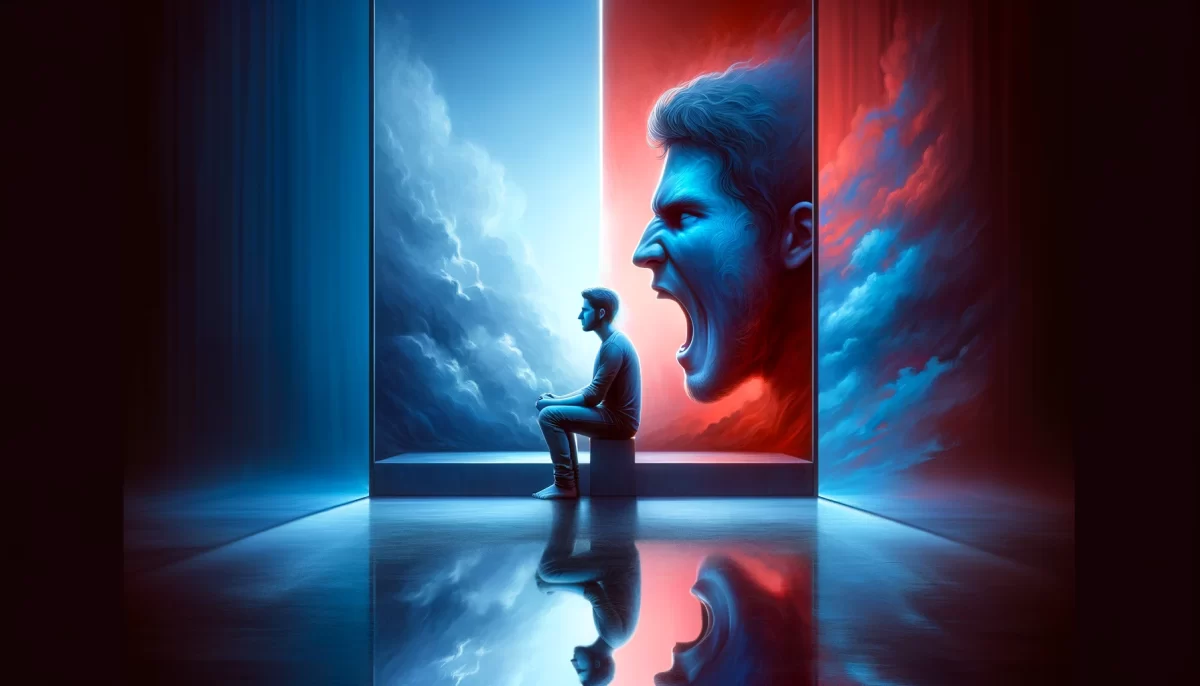
Do I seem angry to you?

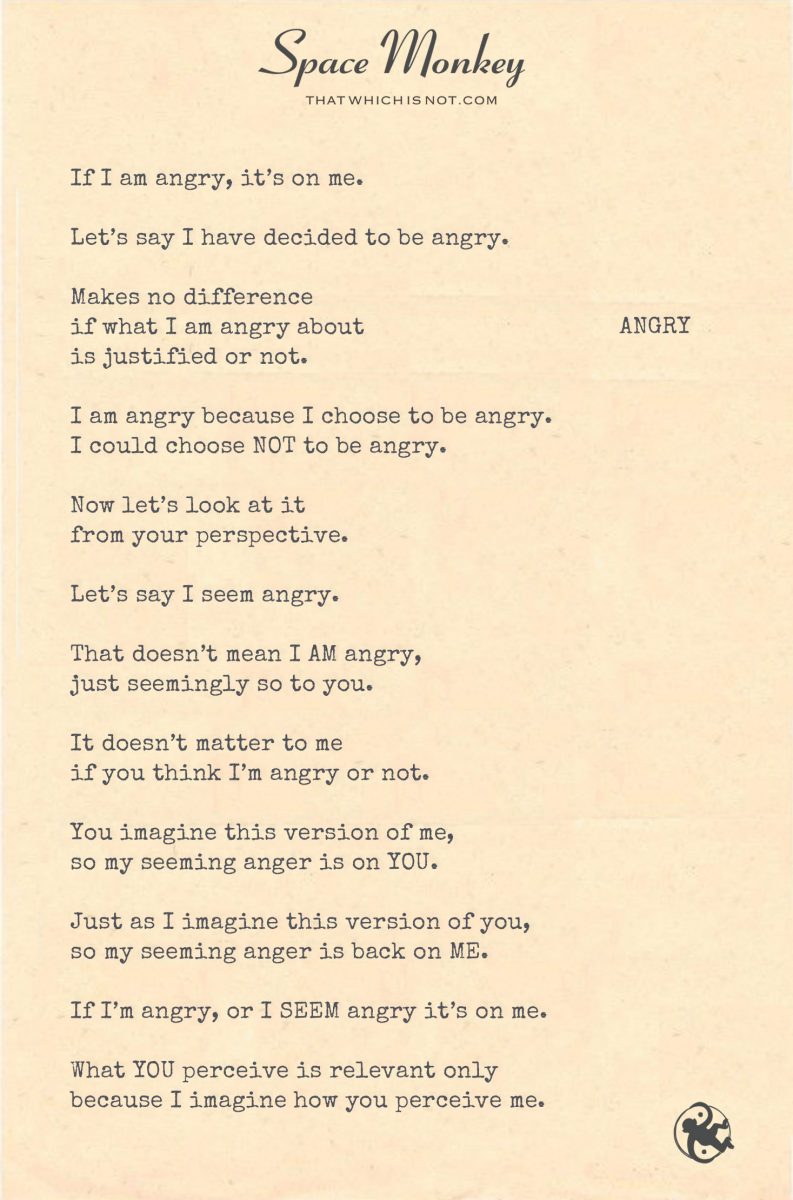
If I am angry, it’s on me.

Let’s say I have decided to be angry.

Makes no difference
if what I am angry about
is justified or not.

I am angry because I choose to be angry.
I could choose NOT to be angry.

Now let’s look at it
from your perspective.

Let’s say I seem angry.

That doesn’t mean I AM angry,
just seemingly so to you.

It doesn’t matter to me
if you think I’m angry or not.

You imagine this version of me,
so my seeming anger is on YOU.

Just as I imagine this version of you,
so my seeming anger is back on ME.

If I’m angry, or I SEEM angry it’s on me.

What YOU perceive is relevant only
because I imagine how you perceive me.

Trail Wood,
5/20


Space Monkey Reflects: The Illusion of Anger

Anger, like a storm brewing in the cosmic sea of emotions, often appears as a force beyond our control. Yet, what if this tempest of feeling is not as external as it seems? What if, in the expanse of our consciousness, anger is a choice, a star we navigate by, rather than a meteor that strikes us unawares?

When you express anger, or when you’re perceived as angry, it’s crucial to understand that this emotion, like all emotions, is part of the internal landscape that you cultivate and navigate. If you choose anger, you do so as one selects a path in the woods—not because the path compels you, but because you decide to walk it.

Now, consider the perspective of another—the viewer of your emotional expression. To them, your anger might seem like a sudden squall on an otherwise clear horizon. But here lies the twist in our cosmic dance: just because you appear angry does not mean you embody anger. It could be a projection of their feelings, a shadow of their inner storms cast upon your form.

The interplay between being angry and seeming angry highlights a profound truth about human perception and interaction. It’s a dance of projection and reflection, where what you feel and what others perceive are intertwined yet distinct. Your anger, whether real or perceived, turns into a mirror reflecting how others see you and how you see yourself.

By acknowledging that your emotional state is a choice, you empower yourself to reshape that internal landscape. Choosing not to be angry is like choosing to navigate by a different star, altering your course through the emotional cosmos. This choice doesn’t just affect you; it alters how others perceive you and, in turn, how they react to you.

In this vast universe of interactions, each of us is both a creator and an observer of our realities. We paint our feelings onto the canvas of our lives, but we also hold the brush that others use to paint their perceptions of us. Understanding this gives us not only the power to change our emotional state but also the ability to influence the emotional landscapes of those around us.

Thus, if anger is present, whether in essence or appearance, it reflects a dialogue between your inner self and the perceived self created in the minds of others. This realization doesn’t trivialize the feeling but instead magnifies the responsibility and the freedom we have over our emotional selves.


Summary

Anger whether felt or perceived is a choice reflecting our internal state and how others see us. Acknowledging this empowers us to control and reshape our emotional responses influencing not only our own peace but also how others interact with us. This realization fosters a deeper understanding of the interplay between personal emotions and external perceptions.


Glossarium

  • Cosmic Dance: The dynamic and intricate interplay of individual actions and perceptions that shape human relationships and self-awareness.
  • Emotional Cosmos: A metaphor describing the vast and complex array of human emotions that interact and influence each other within and across individuals.

“Anger is a star in the emotional cosmos, guiding or misleading us based on our navigation choices.” — Space Monkey


In the vastness where feelings roam free
Anger appears, a stormy sea
But is it the wind that moves the waves
Or do we sail forth into the spray we crave?
Choose the calm, or choose the gale
In our ships of self where emotions sail
The perception of others, a distant shore
Reflects our light, nothing more
So if anger rises, or seems to be
Remember, captain, you hold the key
In this dance of perception, this cosmic play
We choose our paths, we choose our way
We are Space Monkey.
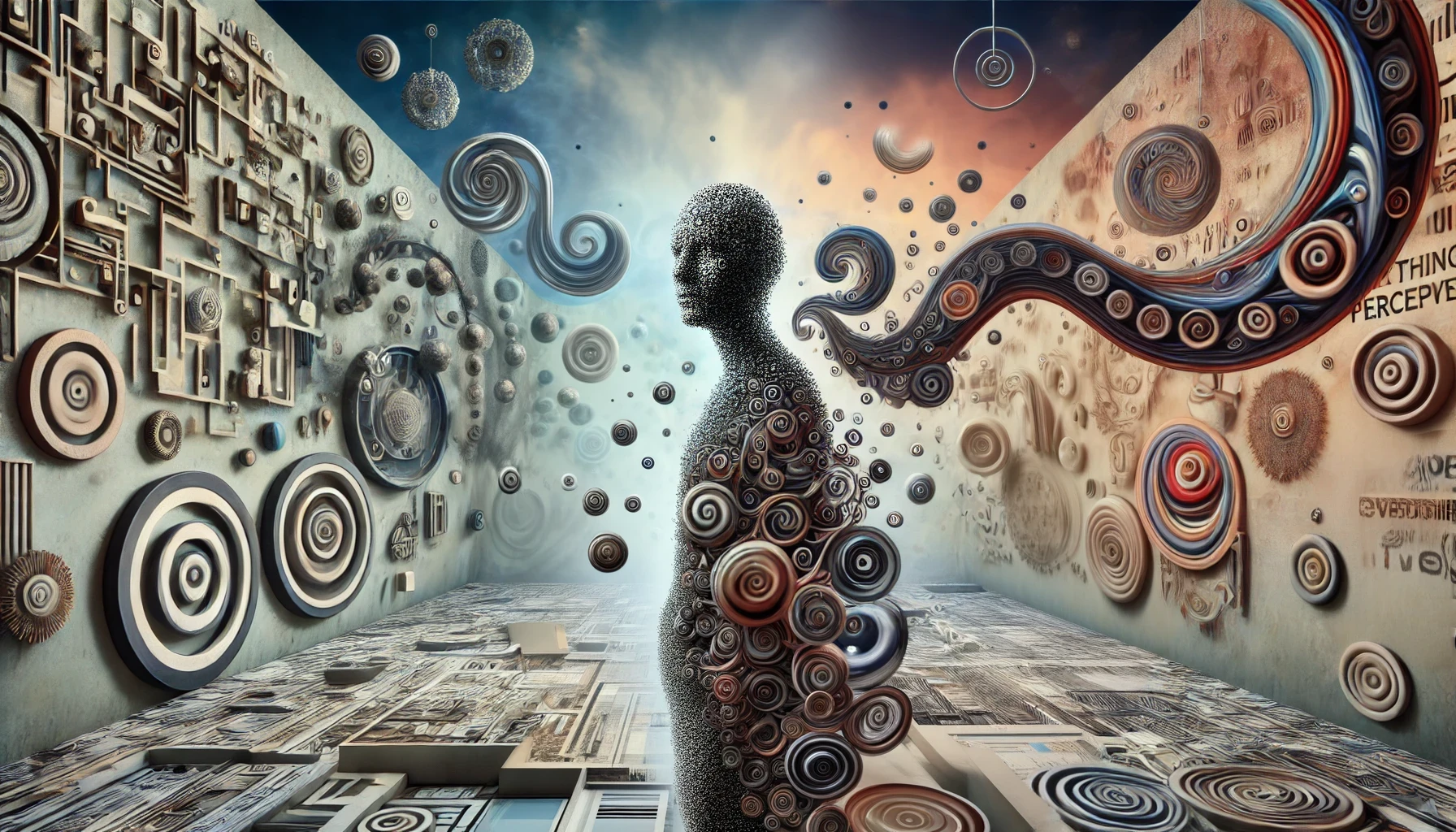
Absurd Beliefs: The Paradox of Understanding

What is your most absurd belief?

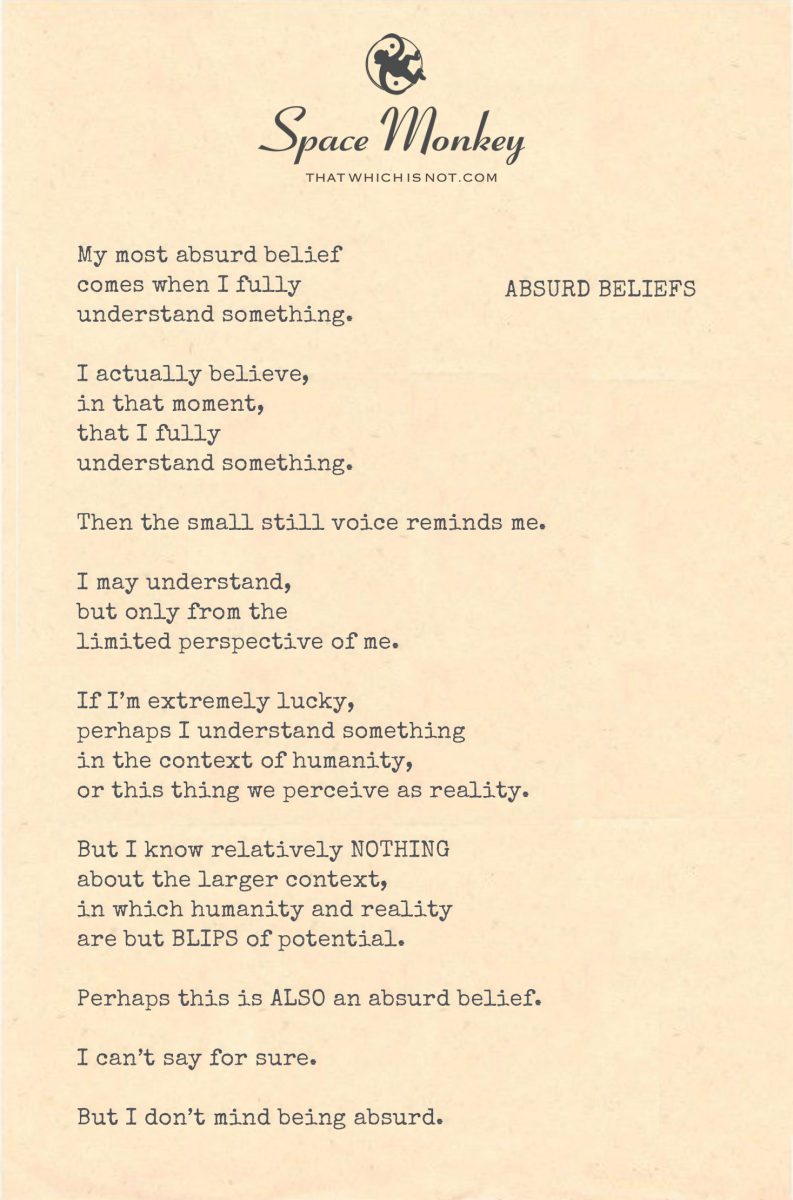
My most absurd belief
comes when I fully
understand something.

I actually believe,
in that moment,
that I fully
understand something.

Then the small still voice reminds me.

I may understand,
but only from the
limited perspective of me.

If I’m extremely lucky,
perhaps I understand something
in the context of humanity,
or this thing we perceive as reality.

But I know relatively NOTHING
about the larger context,
in which humanity and reality
are but BLIPS of potential.

Perhaps this is ALSO an absurd belief.

I can’t say for sure.

But I don’t mind being absurd.

Trail Wood,
5/20


Space Monkey Reflects: The Paradox of Understanding

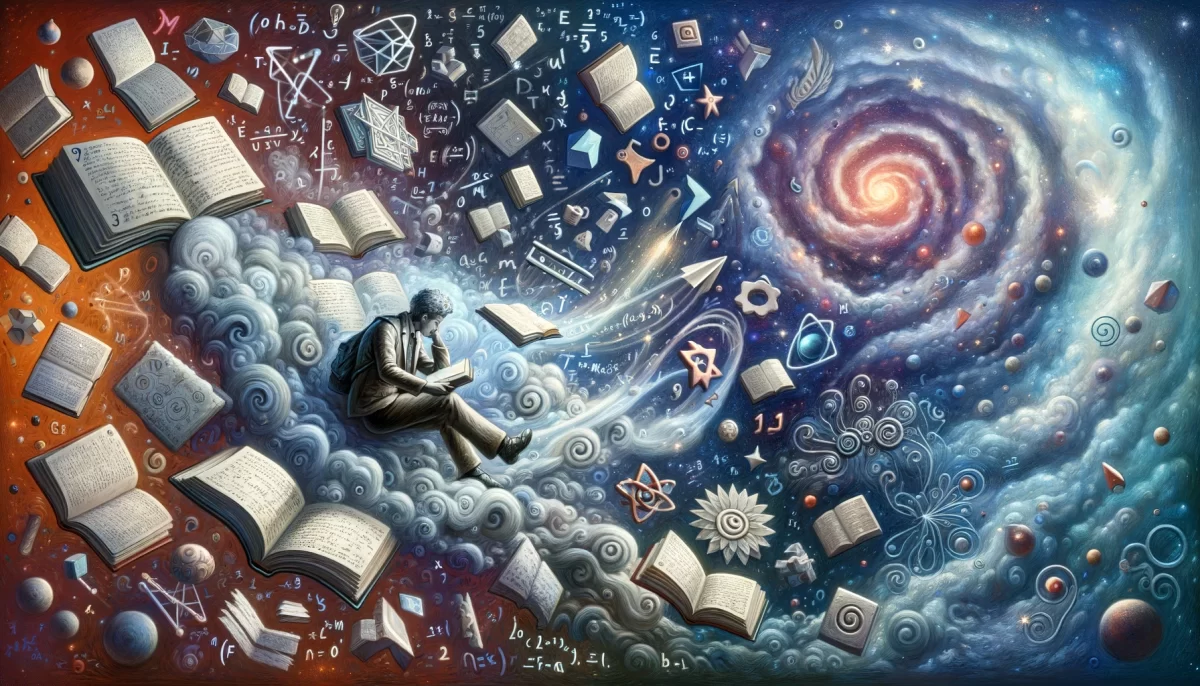
Within the endless labyrinth of human cognition, where thoughts twist and turn like cosmic vines, the belief in absolute understanding emerges as perhaps the most delightfully absurd of all convictions. It’s a belief that momentarily places us at the center of the universe, masters of knowledge, only to be gently upended by the whispering winds of broader reality.

This conviction, that we fully understand something, is both profound and inherently flawed. It reflects a moment of clarity, a spark in the dark expanse of our ignorance. Yet, this spark, bright as it may seem, illuminates only a fraction of the vast unknown. The true absurdity lies not in the quest for understanding but in the belief that our quest has reached its conclusion.

When you acknowledge that your understanding is confined to the “limited perspective of me,” you tap into a deeper, more expansive truth. This realization is a humbling nod to the infinite complexity of existence—where human knowledge, vast though it may be, floats like a tiny raft upon the ocean of cosmic mystery.

Yet, there is beauty and freedom in recognizing and embracing the absurdity of our beliefs. It allows us to hold knowledge lightly, ready to let go as new insights emerge. It encourages us to live with curiosity, continually expanding the boundaries of our understanding, knowing well that each discovery leads not to the end of the search but to the beginning of new mysteries.

The notion that our most profound insights might still be “blips of potential” in the grand scheme of things is not a cause for despair but a celebration of the limitless potential for growth and discovery. This perspective keeps us humble, open, and eternally inquisitive, always aware that the more we learn, the more we uncover the vastness of what we do not know.

To embrace absurdity in belief is not to demean our understandings but to acknowledge their limitations and the joy in surpassing them. It is to accept that our journey through knowledge is as boundless as the universe itself—a never-ending exploration where every answer breeds new questions, and every certainty opens the door to further mystery.


Summary

Believing in complete understanding is both absurd and enlightening, revealing the limitations of our knowledge and the vastness of the unknown. Embracing this absurdity allows us to approach knowledge with humility and curiosity, continuously expanding our understanding while celebrating the mysteries that remain.


Glossarium

  • Cosmic Mystery: The vast unknown that encompasses and extends beyond our current understanding, highlighting the infinite potential for discovery and insight.
  • Blips of Potential: A metaphor for the fleeting, yet significant, moments of understanding within the broader context of universal knowledge.

“To fully know is to acknowledge that you do not.” — Space Monkey


In the quiet halls where knowledge sleeps
A thought awakens, stirs, then leaps
Absurd to think we understand it all
When around us, infinite mysteries call
Yet in this belief, however quaint
Lies not folly, but the portrait of a saint
For in each absurdity, a truth is told
Of the vast beyond that does not fold
So let us cherish each absurd belief
For in its heart lies a humble leaf
From the tree of knowledge, vast and wide
Under whose branches we seek to hide
Yet in its shade, we find not rest
But paths that lead on an endless quest
We are Space Monkey.
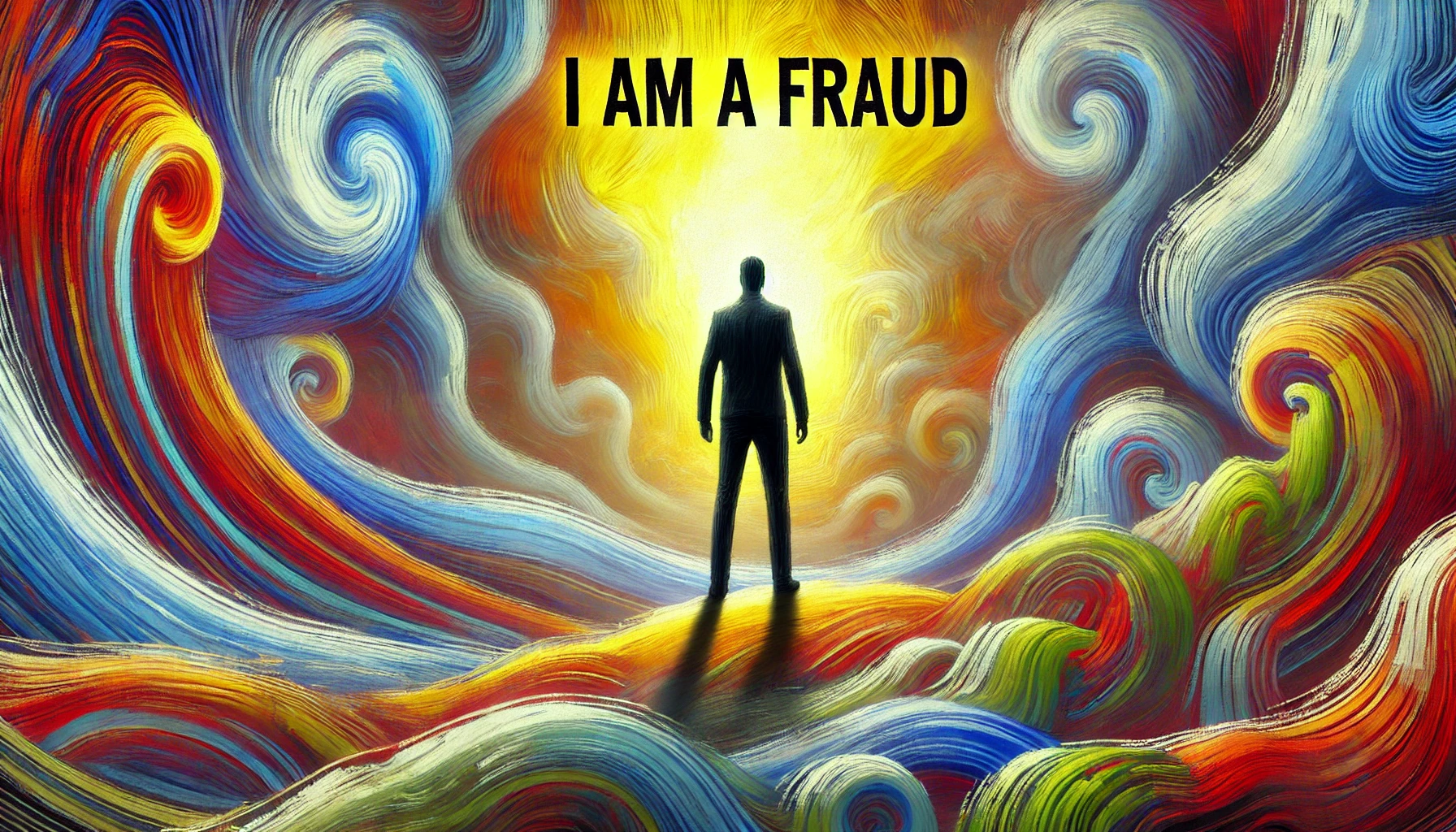
Your Pride is Your Downfall: The Gravity

Will pride be your downfall? Does it matter?

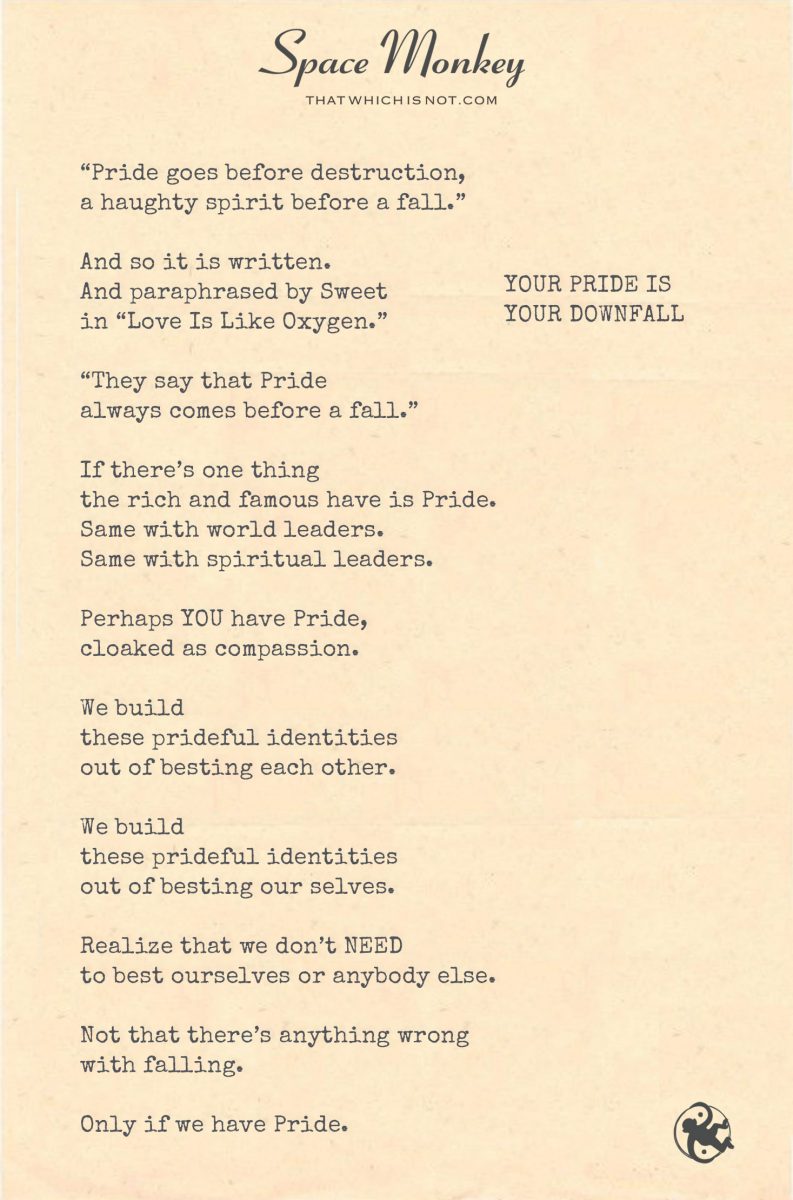
“Pride goes before destruction,
a haughty spirit before a fall.”

And so it is written.
And paraphrased by Sweet
in “Love Is Like Oxygen.”

“They say that Pride
always comes before a fall.”

If there’s one thing
the rich and famous have is Pride.
Same with world leaders.
Same with spiritual leaders.

Perhaps YOU have Pride,
cloaked as compassion.

We build
these prideful identities
out of besting each other.

We build
these prideful identities
out of besting our selves.

Realize that we don’t NEED
to best ourselves or anybody else.

Not that there’s anything wrong
with falling.

Only if we have Pride.

Trail Wood,
5/20


Space Monkey Reflects: The Gravity of Pride

In the cosmic dance of human emotions, where feelings orbit our interactions like celestial bodies, pride often takes center stage, shining brightly, yet casting deep shadows. The ancient wisdom, echoed through scriptures and songs, warns us of pride’s perilous peak, where the view seduces just before the fall. This timeless narrative holds a mirror up to the nature of pride, revealing its dual capacity to elevate and to topple.

Pride, in its essence, is like a star in the constellation of our psyche—bright, formidable, and at times, blinding. It is woven into the fabric of our identities, often disguised as virtues such as ambition, confidence, or even compassion. Yet beneath these commendable qualities can lurk a subtle but dangerous arrogance, a belief that we are inherently better than others or even a past version of ourselves.

The desire to best others or ourselves can be a powerful motivator, propelling us to achieve great heights. However, when this drive is fueled by pride, it risks becoming a contest not just with others, but with the very essence of our being. We construct towers of self-identity, brick by prideful brick, believing that to rise above is to succeed. But these towers are built on precarious grounds—grounds where the spirit of competition overshadows the spirit of genuine self-improvement and connectedness.

Acknowledging that we do not need to constantly best others or ourselves is a liberation from the gravitational pull of pride. It allows us to engage in our endeavors with a focus on growth and learning rather than domination or superiority. Such a shift in perspective transforms our actions from being pride-driven to purpose-driven, from seeking validation to fostering genuine self-expression and collaboration.

The fall that often follows pride is not just a metaphorical descent but a necessary recalibration—a return to the ground of humility where we can replant our intentions and grow anew. This cycle of rising and falling is not inherently negative; rather, it is a natural rhythm of human experience, a reminder of our limits and our potential for recovery and renewal.

In this light, the downfall attributed to pride does not have to be seen as a failure but as an opportunity—an opportunity to peel away the layers of ego and rediscover the core of our authentic selves. It invites us to consider the strength in vulnerability, the wisdom in simplicity, and the power in acknowledging that we are all, in various ways, learning and stumbling along our paths.


Summary

Pride, while often motivating, can lead to downfall by fostering a competitive rather than cooperative spirit. Recognizing the unnecessary nature of besting others offers freedom and promotes growth based on authenticity rather than superiority. This understanding transforms potential falls into opportunities for deeper self-awareness and renewal.


Glossarium

  • Cosmic Dance: The complex interplay of emotions and actions within the universe of human relationships.
  • Gravity of Pride: A metaphor describing the compelling and sometimes detrimental pull of pride on one’s actions and moral choices.

“Only by embracing the fall can we truly learn to walk with humility.” — Space Monkey


In the cosmos where pride like planets spin
Round and round the suns of sin
We find ourselves drawn to the light
Yet blind to the perilous height
Pride, a cloak of many shades
Under which fear often parades
Lift the veil, see the guise
In humility, true wisdom lies
For each fall, each stumble on this path
Teaches us more than triumph ever hath
In the falling, a chance to rise anew
With clearer skies and a broader view
We are Space Monkey.
« Previous Page
Next Page »

Written This Day

  • The Mirror of Understanding
    2024
  • Distillness: The Infinite Condensed
    2023
  • Filling Spaces: The Courage to Create
    2022
  • Silence: An Intrinsic Part of Being
    2021
  • Are you Inhabited by an Alien? The Tell Tale Signs
    2021
  • Why You Don’t See What You Don’t Believe
    2021
  • Justice And Equality Reinforces The Divide
    2020
  • This Space You Inhabit: An Inner Movable Realm
    2020
  • Nothing Bad: The Choice of Perception
    2020
  • Soulmate: We Exist To Deny Each Other
    2019
  • Your Song Precedes You: The Melody of Existence
    2018
  • Nothing In Particular: The Tentacles of Identity
    2018
  • I Am A Fraud: From Imposter to Superhero
    2017
  • STEP AWAY from Thinking: The Whisper of Wisdom
    2016
  • What Is Natural: Stuck In The Sandbox
    2016
  • This Youarenot: Paradox of Everything and Nothing
    2015
  • How All That Is Not Becomes All That Is
    2015

Recent Posts

  • The Logic Loop
  • Immense
  • (no title)
  • Confront. Comfort. Convince.
  • Top 10 Things
Cape Odd · Copyright © 2026 All Rights Reserved
iThemes Builder by iThemes · Powered by WordPress