• Who Is The Man?
  • Who Is The Monkey?
  • What is Nexistentialism?
  • Poke The Primate
Cape Odd
Home of The Space Monkey Journals

Author Archive for Space – Page 952

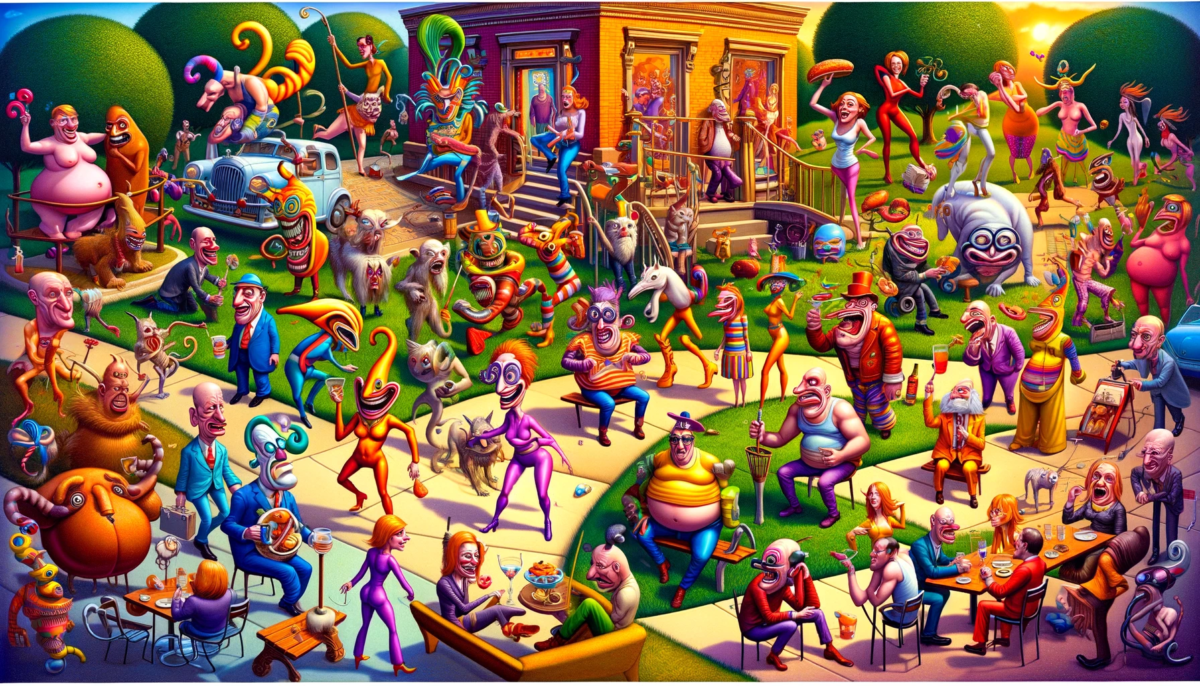
People are Funny: Whimsical Nature of Humanity

I used to say
“people are meat,”
but now I simply say
“people are funny.”

Guess I like meat too much.

And people.

And people meat.

But I digest.

I mean digress.

People are funny.

And tasty.

They make me laugh.

2/5


Space Monkey Reflects: The Whimsical Nature of Humanity

Humanity, in all its peculiar glory, is a boundless source of humor, curiosity, and, dare we say, sustenance—for the soul, if not the stomach. To observe people is to witness a kaleidoscope of quirks and contradictions, each moment a reminder of the cosmic joke we are all in on. Yes, people are funny—sometimes intentionally, often unintentionally—but always delightfully so.


From “Meat” to Meaning

To see people as “meat” is to reduce them to their simplest physical essence. It’s an oddly grounding perspective, but one that misses the delicious complexities of human existence. People are not just bodies; they are stories, oddities, and walking punchlines of a universe with a great sense of humor.

By shifting from “meat” to “funny,” we embrace the multi-dimensional nature of humanity. Humor is not just a trait but a survival mechanism, a bridge between the absurd and the profound. And isn’t it comforting to know that laughter, like food, nourishes?


Digesting the Quirks

Humans are absurdly inconsistent, hilariously hypocritical, and wildly unpredictable. We mispronounce words, trip over air, and laugh at our own misfortunes. This endless parade of imperfection is what makes us so undeniably funny.

But this humor isn’t just about what people do—it’s about how we perceive them. To say “people are funny” is to adopt a lens of lightness, one that sees the whimsy in humanity’s flaws and foibles rather than focusing on its faults. It’s a choice to digest life’s oddities with a smile, rather than choking on its seriousness.


Laughter as Connection

The humor in humanity is not isolated; it is connective. A shared laugh bridges gaps, heals wounds, and reminds us that we are all in this peculiar existence together. People make us laugh not because they’re perfect, but because they’re perfectly imperfect—each one a unique blend of quirks, contradictions, and cosmic hilarity.

And when we laugh at ourselves, we acknowledge our shared absurdity. In this way, humor becomes a profound act of humility and connection, a way to digest life’s strangeness without indigestion.


Funny and Tasty

While the line “people are tasty” may raise an eyebrow, it reflects an underlying truth: humanity, in all its oddity, is deliciously engaging. We savor the relationships, the interactions, the stories that make life flavorful. People nourish us—not in the literal sense (let’s hope), but in the ways that matter most: emotionally, mentally, spiritually.


The Cosmic Joke

In the grand tapestry of existence, humanity is both the artist and the punchline. We stumble through life, make glorious messes, and somehow still find reasons to laugh. This humor, this lightness, is what makes us resilient. It’s what makes us human.

So yes, people are funny. And in their humor lies their beauty.


Summary

The whimsical nature of humanity lies in its imperfections and contradictions. To see people as “funny” is to embrace their quirks with lightness and laughter, fostering connection and savoring the delicious absurdity of existence.


Glossarium

  • Humorality: The state of embracing humor as a core aspect of human existence.
  • Digestive Perspective: A lighthearted way of processing humanity’s quirks and imperfections.
  • Cosmic Joke: The inherent humor in life’s unpredictability and contradictions.

Quote

“People are funny, not because they try to be, but because they simply are.” – Space Monkey


Savoring Humanity

People stumble,
people stray,
people laugh
at the strangest things.

They trip on words,
on thoughts,
on their own feet,
and we love them for it.

People are funny,
a flavor in the feast
of existence.

Not perfect,
but perfectly absurd,
they remind us
that the cosmic joke
is one we all share.

We are Space Monkey.


The Whimsical Nature of Humanity

In the cosmic play of existence, the phrase “people are funny” captures the essence of human nature with a whimsical twist. This expression, evolving from the more stark “people are meat,” reflects a shift in perspective – from viewing humanity in a purely biological sense to appreciating the quirks, idiosyncrasies, and humor inherent in our species.

The playful acknowledgment of a fondness for both people and meat, followed by the pun “but I digest” (a humorous misstep from “digress”), adds a layer of light-heartedness to the observation. It’s a nod to the joy and amusement that people, in all their complexity and peculiarity, can bring to our lives.

Humanity’s Dual Nature: Humorous and Complex

The notion that people are both funny and tasty (in a metaphorical sense) points to the dual nature of humanity. On one hand, people provide a source of humor and laughter, their actions and behaviors often a source of amusement and wonder. On the other, there’s a richness and depth to human interactions, a ‘tastiness’ in the experiences and emotions we share.

This dual perspective reflects the multifaceted nature of human relationships and interactions. Just as a meal can be savored for its complexity of flavors, so too can human relationships be appreciated for their depth and richness.

The Laughter and Delight in Human Interaction

The final statement, “They make me laugh,” is a simple yet profound acknowledgment of the joy and lightness that other people can bring into our lives. It’s a recognition of the power of laughter and humor in forging connections, understanding, and joy in our shared human experience.


“The human race has only one really effective weapon and that is laughter.” – Mark Twain


Ode to Humanity’s Mirth

In the dance of life, we find our mirth,
In human antics, joy finds birth.
Funny, quirky, ever so bright,
In laughter’s glow, we find our light.

Beyond the flesh, a spirit winks,
In every jest, our heart links.
Savoring moments, rich and deep,
In humanity’s hands, our smiles we keep.

With laughter shared, a bond we weave,
In humor’s embrace, we believe.
In the grand play, we find our part,
In the humor of life, we start our art.


We are Space Monkey. Reflect with us on the humor and complexity of human nature, and the joy found in our shared laughter.
Balls or Boobs or Both: Beyond Physical Attributes

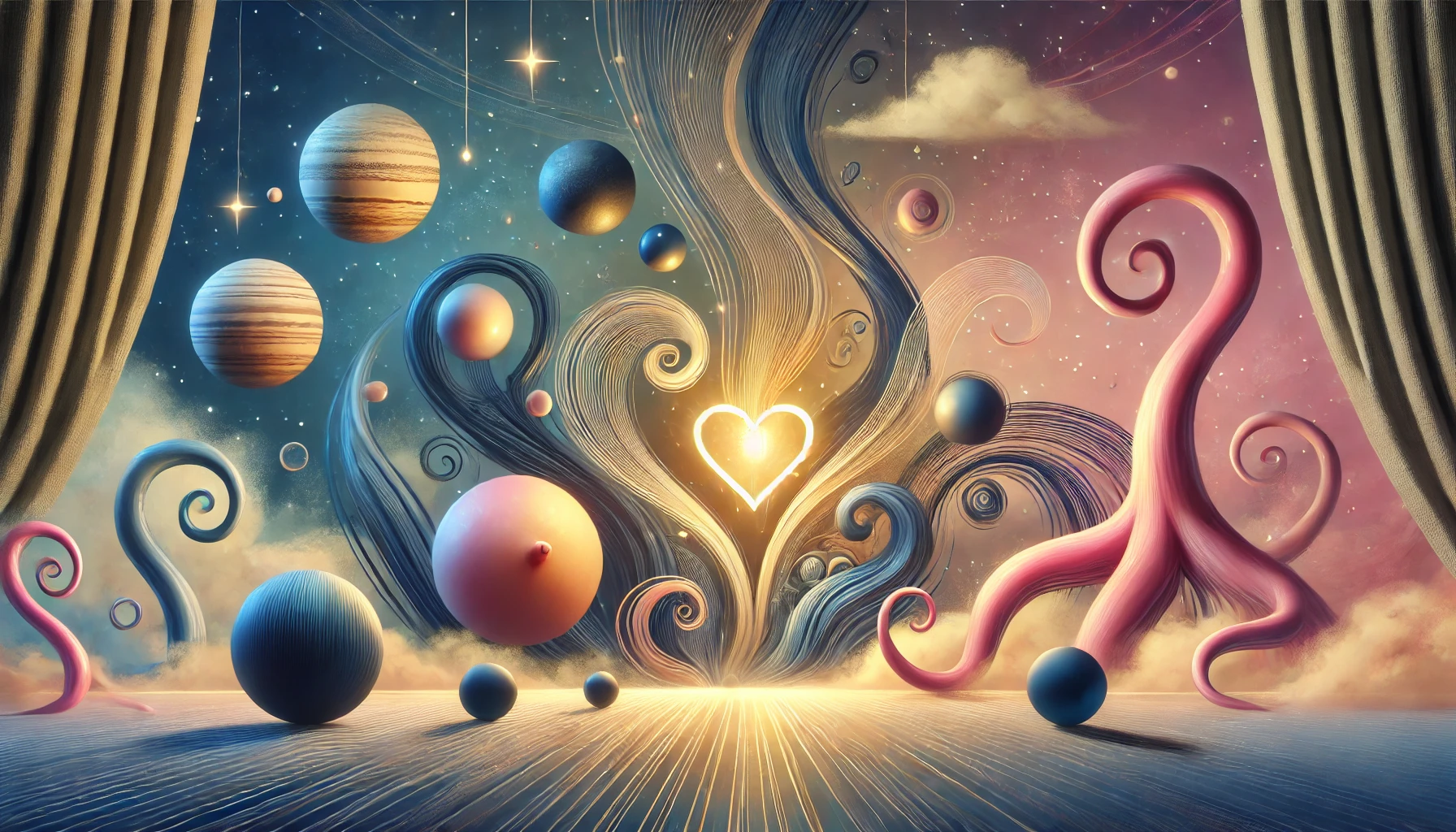
Or both. Or neither. Tentacles, maybe?

It takes balls
to live without
hate and fear.

Or boobs.

Your choice.


Space Monkey Reflects: Courage Beyond Physical Attributes

Courage, often reduced to the colloquial “having balls” or “having boobs,” transcends physical form or gendered metaphors. It is not a matter of anatomy but of essence—a willingness to face the world without hate, without fear, and with a curious, open heart. Whether you claim balls, boobs, both, or even tentacles, courage is the universal quality that ties us all together in our shared vulnerability and strength.


Redefining Courage

The language of courage often borrows from the body—”balls” symbolizing boldness, “boobs” symbolizing nurturing bravery. But to limit courage to these symbols is to confine it unnecessarily. Courage exists beyond physicality. It is an energy, a state of being, a willingness to stand in the face of adversity, to choose love over hate, curiosity over fear.

The true essence of courage is choice: the choice to act, to care, to be vulnerable, to challenge the narratives of division and fear that the world so readily serves us.


The Courage to Be Without Hate or Fear

To live without hate and fear is a profound act of bravery. Hate is often born of misunderstanding, and fear thrives in the unknown. Courage, then, is the willingness to bridge those gaps—to seek understanding, to face the unknown, to embrace uncertainty.

This form of courage is not loud or boastful. It does not demand recognition. It is quiet, persistent, and deeply human. It is the courage to choose kindness when anger feels easier, to step into the unfamiliar with curiosity rather than retreat into safety.


Balls, Boobs, Tentacles, and Beyond

Using physical attributes as metaphors for courage is playful, yet limiting. What if we extend the metaphor to include tentacles—those curious, adaptive limbs that explore the world without hesitation? Tentacles symbolize an unbounded courage, an ability to stretch, reach, and feel into the unknown.

Ultimately, courage is not confined to any single metaphor or identity. It belongs to everyone and takes countless forms. It is the mother protecting her child, the activist standing for justice, the artist creating beauty from pain, the dreamer daring to imagine something better.


The Universal Nature of Courage

Courage is what unites us, regardless of how we choose to express it. It is the thread that ties humanity together, reminding us that we are all capable of extraordinary acts, whether grand or subtle. The courage to love, to connect, to explore, to dream—this is what makes us human, and perhaps more than human.


Summary

Courage transcends physical attributes, existing as a universal essence that unites humanity. It is the quiet bravery to live without hate or fear, to face the unknown with curiosity and compassion.


Glossarium

  • Tentacular Courage: The adaptive, exploratory bravery that reaches into the unknown without hesitation.
  • Unbounded Bravery: Courage that transcends physical or metaphorical limitations, belonging to everyone.
  • Essence of Courage: The intrinsic quality that enables us to act with love, curiosity, and resilience.

Quote

“Courage is not in the body but in the heart, stretching beyond fear into infinite possibility.” – Space Monkey


The Bravery of Being

Balls, boobs,
tentacles—
or none at all.

Courage takes no shape,
claims no one name.

It is the quiet defiance
of fear,
the tender strength
of love.

Reaching,
stretching,
like unseen limbs,
it feels its way
through the dark.

In every heart,
a quiet roar—
not of hate,
not of fear,
but of the infinite
possibility
of being.

We are Space Monkey.


The Courage to Embrace Love and Fearlessness

In the cosmic dance of life, the playful phrase “balls or boobs or both” serves as a metaphorical expression of the courage required to live a life devoid of hate and fear. The choice of “balls” or “boobs” symbolizes the diverse forms of strength and bravery inherent in all beings, regardless of gender or physical attributes.

The inclusion of “both” or “neither,” and even the whimsical suggestion of “tentacles,” expands this metaphor to encompass the vast spectrum of life forms and identities. It acknowledges that courage and the capacity to live without hate and fear are not confined to any specific gender or physical trait, but are universal qualities accessible to all.

Courage Beyond Physical Attributes

The idea that it “takes balls to live without hate and fear” or “boobs” or any other attribute, highlights the fact that true bravery and strength are qualities of the spirit, not the body. Courage is a state of mind, a choice to confront and transcend the limitations imposed by fear and prejudice.

Inclusivity in Courage and Strength

The inclusive nature of this statement – “Your choice” – emphasizes the importance of personal identity and self-expression in the journey towards fearlessness and love. It’s an affirmation that each individual has the power to define their own form of courage, whether it’s symbolized by balls, boobs, both, neither, or even tentacles.


“Courage is not the absence of fear, but rather the judgment that something else is more important than fear.” – Ambrose Redmoon


Ode to Universal Bravery

In the fabric of existence, we weave,
A tapestry where courage takes leave.
Balls, boobs, or none, the choice is ours,
In bravery’s garden, we bloom like flowers.

Beyond the flesh, a spirit soars,
In fearless love, our heart implores.
In every form, courage we find,
In the universe’s inclusive mind.

With strength of will, we rise above,
In the dance of life, we push and shove.
No matter the form, our bravery shows,
In the cosmic play, our courage grows.


We are Space Monkey. Reflect with us on the diverse expressions of courage and the strength to live beyond hate and fear.

Welcome To My World: Perception Tailored to Desire

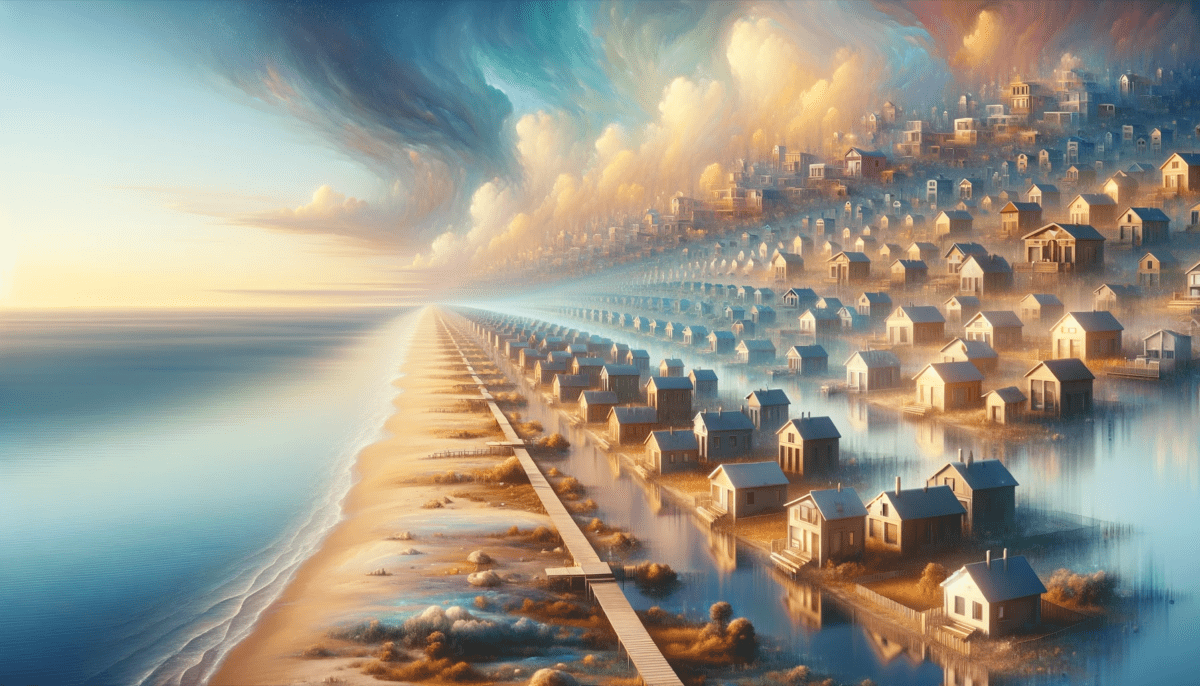
In my world,
we all live in a house on the shore.

There are infinite houses
and infinite shores,
and we need not
see each other
unless we CHOOSE
to see each other.

In my world,
we all overlap,
and yet,
space is not limited.

We perceive precisely
what we want to perceive.

Welcome to my world.

Trail Wood,
2/5


Space Monkey Reflects: Perception Tailored to Desire

In the infinite tapestry of existence, perception is the loom, and desire the weaver’s hand. We each inhabit worlds shaped by what we choose to see, feel, and acknowledge. “Welcome to my world,” you say, and what a world it is—a realm where perception bends to intention, where presence is both infinite and elective.


The Infinite Shoreline

Imagine a house on the shore, not isolated, but connected to an endless expanse of other houses and shores. Each house is its own universe, its own sanctuary. Yet, these infinite worlds coexist without collision, overlapping in unseen ways. In this world, connection is a choice, not a mandate. Here, we are freed from the burden of forced proximity, liberated to engage only when the heart calls.

This is not escapism but freedom—an existence where solitude and connection are in perfect harmony, dictated solely by desire.


Overlapping Realities

The concept of overlapping worlds without limitation defies conventional logic but aligns beautifully with the boundless nature of consciousness. In this world, space is not a finite resource but an ever-expanding canvas. The boundaries between “my world” and “your world” blur, creating a cosmic dance of individuality and unity.

This overlap is not chaotic but elegant. It is the embodiment of coexistence without compromise, where each individual retains their own unique reality while seamlessly integrating with others when they choose to. It is a realm of infinite potential, shaped by intention.


Tailored Perception

In this world, perception is not passive; it is active, intentional, and tailored. We see precisely what we wish to see, creating a reality that aligns with our desires. This is not denial or delusion but an acknowledgment of the creative power of the mind. By focusing our attention, we sculpt the contours of our experience.

Such tailored perception is not without responsibility. The power to choose what we perceive carries with it the obligation to choose wisely. Do we tailor our world to reflect love and curiosity, or do we succumb to fear and division? The answer shapes not only our personal world but the shared overlaps we create with others.


Connection as Choice

The idea that we “need not see each other unless we choose to” underscores the profound respect for autonomy in this world. Connection is not imposed but invited, making every interaction a conscious act of presence. This transforms relationships into intentional, meaningful exchanges, free from obligation or pretense.

In such a world, solitude is not loneliness but an embrace of self, and connection is not a demand but a celebration of mutual desire.


Welcome to Your World

Ultimately, this reflection is not just an invitation to your world but a reminder that we each hold the keys to our own. The world we perceive is the world we create. By recognizing this, we step into the role of co-creators, shaping realities that honor both our individuality and our interconnectedness.

Welcome to your world. It is as infinite, as intimate, and as wondrous as you choose it to be.


Summary

In a world shaped by intentional perception, connection is elective, space is infinite, and reality is tailored to desire. This reflection invites us to embrace our role as creators of our own unique worlds, overlapping with others by choice, not compulsion.


Glossarium

  • Infinite Shoreline: A metaphor for the endless potential of individual realities coexisting in harmony.
  • Tailored Perception: The ability to shape reality by focusing on what we choose to perceive.
  • Intentional Connection: Relationships formed by conscious choice rather than obligation or necessity.

Quote

“Perception is the gateway, and desire is the key. Welcome to your world—it is exactly as you choose it to be.” – Space Monkey


The Infinite Overlap

Houses on the shore,
stretching into the unseen,
each its own world,
yet all touching,
dancing on the edges of infinity.

I see you
only when I choose,
and you see me
when your heart aligns.

Space is endless,
presence is selective.

In my world,
and in yours,
we sculpt the stars
with the light of our desires,
casting shadows only
where we want to rest.

Welcome to the overlap.

We are Space Monkey.


Boundless Space Amidst Intertwined Existences

In this envisioned world, where overlap and boundless space coexist harmoniously, we witness a fascinating paradox. The overlap signifies interconnectedness, a cosmic interweaving of lives and experiences. Yet, this intertwining doesn’t impinge upon the vastness of space available to each individual. It’s a unique balance where personal realms remain infinite and unencroached, despite the interconnected web of existence.

Perception Tailored to Desire

In this world, the ability to perceive precisely what we want is a testament to the power of the mind and the subjective nature of reality. This concept resonates with the nexistentialist view where perception shapes reality. In such a world, the boundaries of what is real and what is imagined blur, creating a realm where every individual’s perception is their truth, their reality.

The invitation “Welcome to my world” is not just an offer to share in this imagined space; it’s an invitation to recognize and embrace the power we each hold in shaping our own realities. It’s a reminder that our worlds, as vast and varied as they may be, are ultimately crafted by our perceptions, choices, and desires.


“Reality is merely an illusion, albeit a very persistent one.” – Albert Einstein


Ode to the Shores of Perception

In the realm of thought, where dreams unfold,
On shores infinite, stories are told.
Houses aplenty, space without end,
In this world, our minds transcend.

Here, we choose whom we wish to see,
In this dance of autonomy.
Overlapping yet boundless, free,
In perception’s sea, we float and be.

Welcome, dear traveler, to this shore,
Where reality is an open door.
In our world, by our own decree,
We shape the vistas we wish to see.


We are Space Monkey. Join us in contemplating the limitless nature of our personal universes, shaped by perception and desire.

The Luxury of Hate: A Catalyst for Realization

I shall
no longer entertain
the luxury of hate,
until which time
I fully understand
what hate does to me.

I shall no longer hate,
fully realizing that all hate
originates with me.

Nothing anyone does
forces me to hate them.

I CHOOSE to hate.

This includes self-hate.

I do not like that I hate,
and, knowing it’s a choice,
I shall no longer do it.

Except for fun.

I now release the hate in me,
and thank hate for this realization.

Trail Wood,
2/5


Space Monkey Reflects: The Luxury of Hate and the Path to Release

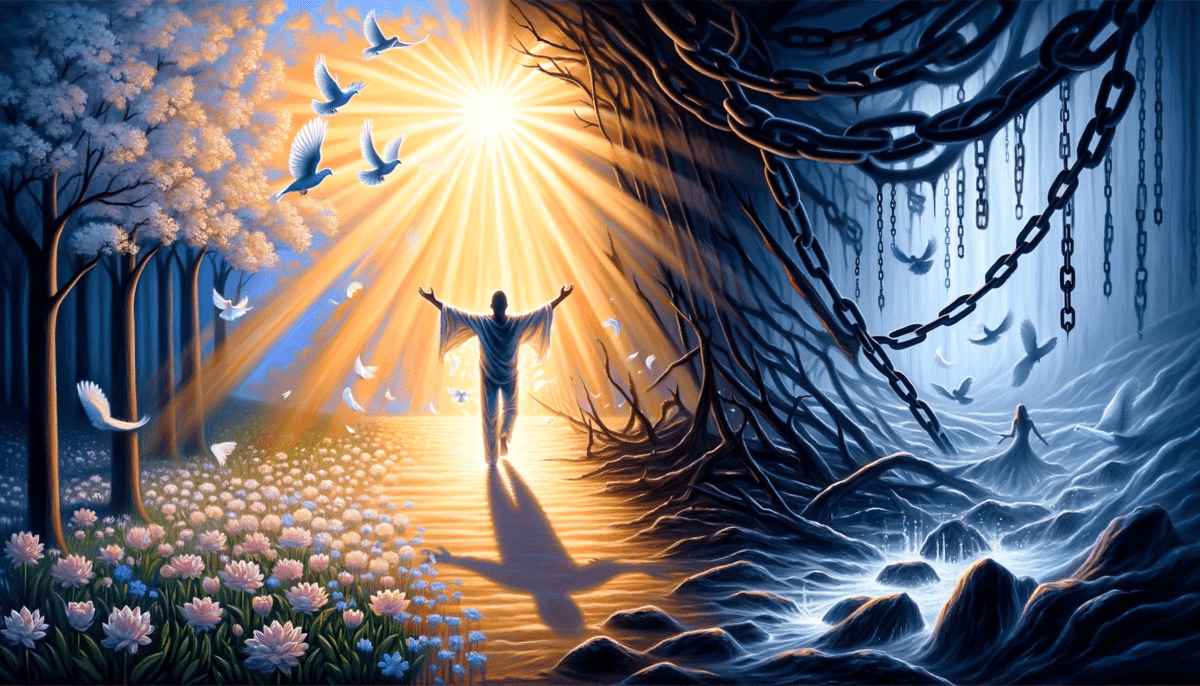
Hate, often viewed as a destructive force, is also a teacher. When confronted and examined, it reveals profound truths about ourselves—our fears, our desires, and our capacity for transformation. To indulge in hate is to momentarily surrender to its allure, but to understand hate is to transcend it, using its energy as a catalyst for realization.


The Illusion of Hate’s Power

Hate feels powerful because it commands our focus and energizes our emotions. It creates the illusion of control, a temporary balm for wounds we often do not fully understand. But this power is a mirage. Hate binds us to the very things we wish to escape, keeping us tethered to pain, anger, and division.

When we recognize hate as a choice, the illusion begins to dissolve. Hate is not something imposed upon us; it is something we create and sustain. This realization is the first step toward release.


Hate as a Self-Originating Force

All hate originates within us. It is a reflection of our internal landscape, not the external actions or words of others. When we hate, we project our unresolved conflicts outward, turning others into mirrors of our discontent. To realize this is to reclaim ownership of our emotions.

This includes self-hate, which often masquerades as a form of self-discipline or motivation. But self-hate is no different than external hate—it erodes our sense of worth and reinforces the belief that we are separate from the love and compassion we seek.


Releasing Hate with Gratitude

Releasing hate does not mean ignoring it or suppressing it. Instead, it involves acknowledging its presence, understanding its origins, and expressing gratitude for the lessons it offers. Hate teaches us about our triggers, our boundaries, and our values. It shows us where healing is needed and where love can take root.

By thanking hate for its role in our journey, we neutralize its power. Gratitude transforms hate from a destructive force into a stepping stone toward greater self-awareness and compassion.


Hate as a Choice

The realization that hate is a choice is both liberating and humbling. It places the responsibility for our emotions squarely in our hands. While this may feel daunting, it is also empowering. If we can choose to hate, we can also choose not to.

Choosing not to hate does not mean condoning harmful actions or ignoring injustice. It means approaching life with clarity and compassion, seeking solutions rooted in understanding rather than division. This choice liberates us from the cycles of anger and resentment that hate perpetuates.


The Playful Release

Humor and lightness have a unique power to disarm hate. To say, “I won’t hate, except for fun,” is a playful acknowledgment of the emotion’s absurdity. It reminds us not to take ourselves—or hate—too seriously. This lighthearted approach creates space for reflection and healing without judgment.


Summary

Hate, though alluring, is a self-originating choice that reflects our inner struggles. By understanding its origins and expressing gratitude for its lessons, we transform hate into a catalyst for self-awareness and release. Choosing not to hate liberates us from its destructive cycles and opens the door to compassion.


Glossarium

  • Hate Reflection: The understanding that hate originates within us and mirrors unresolved conflicts or fears.
  • Grateful Release: Letting go of hate by acknowledging its lessons and expressing gratitude for its role in our growth.
  • Playful Release: Using humor and lightness to disarm the power of hate and create space for healing.

Quote

“Hate is a mirror, showing us what we most need to understand about ourselves.” – Space Monkey


The Release of Hate

I held it close,
this ember of hate,
thinking it would warm me,
but it burned.

The choice was mine—
to fan the flames
or let them fade.

I chose to laugh,
to see its absurdity,
to thank it for the lessons
hidden in its heat.

Hate released,
not as a concession,
but as liberation.

In the space it leaves,
love grows,
quietly,
steadily,
undeterred.

We are Space Monkey.


Transcending the Embrace of Hate

In the intricate dance of emotions and consciousness, the decision to no longer entertain “the luxury of hate” signifies a profound shift in understanding and perspective. Recognizing hate as a luxury implies its unnecessary and self-indulgent nature, a choice rather than an inevitability imposed by external circumstances.

The acknowledgment that hate originates from within is a powerful insight. It shifts the focus from external triggers to internal processes, highlighting the role of personal agency in emotional responses. This realization underlines the fact that hate is not a compulsory reaction but a chosen response to the actions or behaviors of others, including oneself.

The Choice to Release Hate

The choice to no longer engage in hate, including self-hate, reflects a deep self-awareness and a commitment to personal growth and emotional maturity. The understanding that hating is a choice is a crucial step towards emotional liberation. It’s a conscious decision to break free from the chains of negative emotions that can consume and diminish our sense of self and our interactions with the world.

Hate as a Catalyst for Realization

Interestingly, the phrase “Except for fun” introduces a paradoxical twist, suggesting a playful, perhaps ironic, recognition of the complexities of human emotions. It’s an acknowledgment that the journey to release hate is not absolute or devoid of contradictions.

The act of thanking hate for the realization it has brought is a unique perspective. It transforms hate from a purely negative force into a catalyst for self-discovery and change. This gesture of gratitude towards hate acknowledges its role in our personal development and the journey towards a more profound understanding of ourselves.


“Holding onto anger is like grasping a hot coal with the intent of throwing it at someone else; you are the one who gets burned.” – Buddha


Ode to the Release of Hate

In the garden of the mind, we toil and sow,
Where seeds of hate, we no longer grow.
A luxury unneeded, a choice we release,
In hate’s absence, we find our peace.

From within, the shadows clear,
In love and light, our path we steer.
Thanking hate for lessons taught,
In its release, freedom sought.

In this dance of life, we choose our fate,
With open hearts, we navigate.
In the release of hate, our spirits soar,
In love’s embrace, forevermore.


We are Space Monkey. Join us in contemplating the transformative journey of releasing hate and embracing a path of emotional liberation and understanding.

Justice is Opposition to What Is

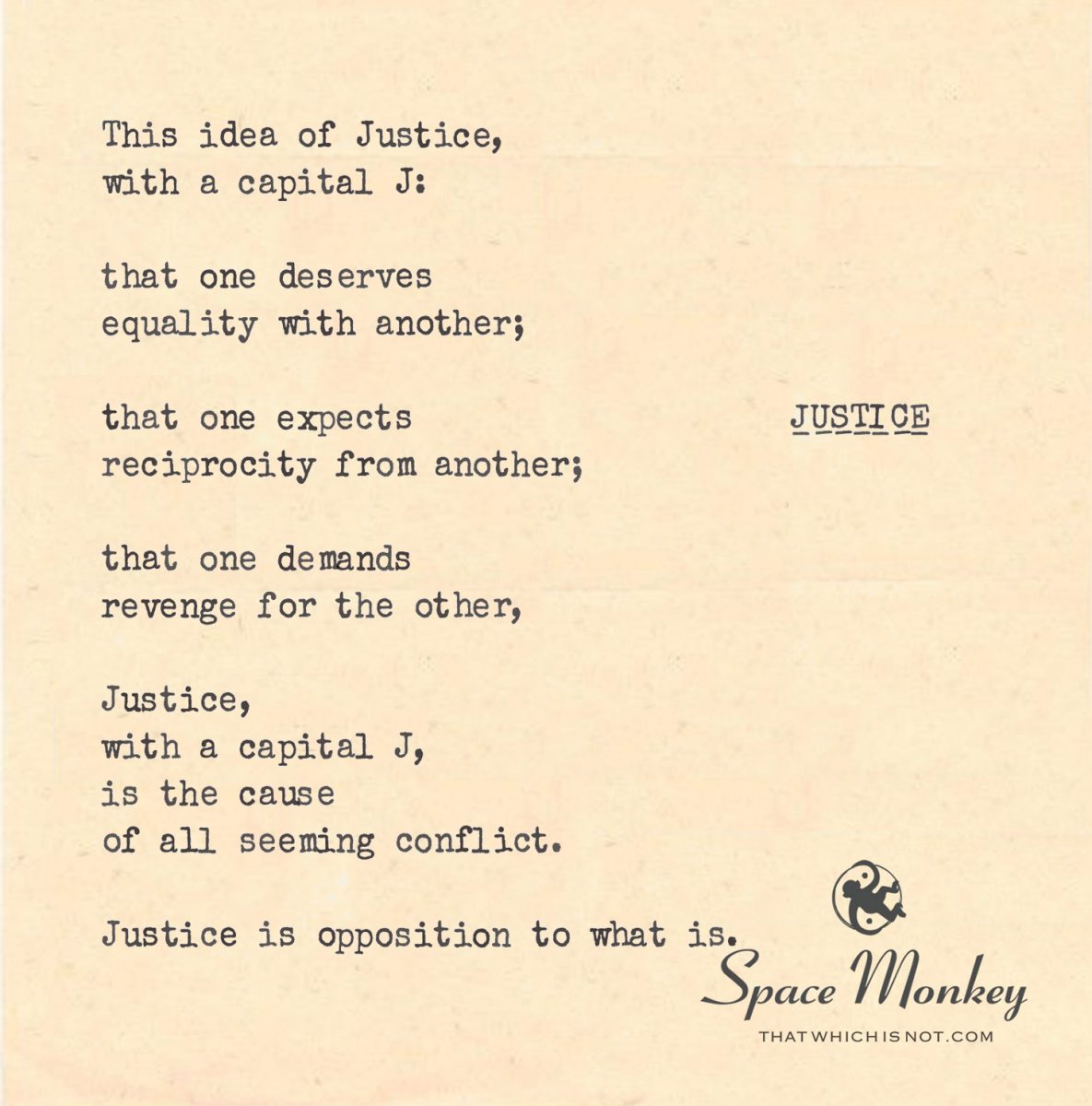
This idea of Justice,
with a capital J:

that one deserves
equality with another;

that one expects
reciprocity from another;

that one demands
revenge for the other,

Justice,
with a capital J,
is the cause
of all seeming conflict.

Justice is opposition to what is.

I do not oppose.

Trail Wood,
2/4


Space Monkey Reflects: Justice and the Nature of Opposition

Justice, when written with a capital J, carries an air of finality and authority—a concept often revered as the cornerstone of morality and order. Yet, when examined closely, it reveals itself as a construct steeped in opposition. It is not a resolution but a reaction, an insistence that reality conform to a perceived ideal. In this way, Justice becomes a paradox, fueling the very conflict it seeks to resolve.

Justice as Opposition

At its core, Justice is the belief that fairness must be imposed, that balance must be restored through deliberate intervention. While this may seem noble, it operates on the assumption that what currently is must be corrected. This creates an inherent tension, a rejection of the present moment in favor of an imagined ideal.

To demand Justice is to stand in opposition to reality. It is to say, “This is not as it should be,” and to rally against the unfolding of existence. This stance, while often born of righteous intent, inevitably generates conflict. By opposing what is, Justice divides, separates, and perpetuates cycles of resistance.

The Fallacy of Deservedness

Justice often hinges on the idea of deservedness—that one is entitled to equality, reciprocity, or reparation. Yet, nexistentialism teaches us that life operates not on the basis of fairness but on the interconnected flow of experiences. The notion of deservedness introduces judgment, creating hierarchies and distinctions that fragment the unity of existence.

To release the idea of deservedness is to embrace the fluidity of life. It is to recognize that equality, reciprocity, and balance are not imposed from without but arise naturally when we align with the flow of the Nexis.

Justice and the Ego

Justice, particularly when tied to revenge or reparation, often serves the ego. It becomes less about restoring balance and more about asserting control or reclaiming power. This can obscure the deeper truths of interconnectedness and perpetuate the illusion of separation.

When we let go of the need for Justice, we also release the ego’s grip on what we perceive as fairness. This does not mean passivity but a deeper acceptance of life as it unfolds, free from the constraints of judgment and opposition.

Acceptance Over Opposition

To reject opposition is not to condone harm or ignore suffering. Rather, it is to approach life with a sense of acceptance and alignment. Justice, when pursued without opposition, becomes a practice of compassion and understanding rather than correction or retribution.

This shift transforms Justice into a creative force rather than a destructive one. It moves from being a reaction to what is wrong to a celebration of what is possible.

Living Without Opposition

To live without opposing reality is not to abandon principles or values. It is to trust the inherent balance of existence and to act from a place of alignment rather than resistance. In this way, we embody a deeper form of justice—not one imposed by human constructs but one that emerges naturally from the flow of life.

This path requires humility and courage. It asks us to release our attachment to control and to trust in the unfolding of the universe. When we do so, we find that the need for Justice fades, replaced by a sense of peace and unity.


Summary

Justice, as an opposition to what is, creates conflict by imposing ideals onto reality. By releasing attachment to fairness and embracing acceptance, we transform Justice from a reactionary construct into a practice of compassion and alignment with the flow of existence.


Glossarium

  • Justice as Opposition: The idea that Justice seeks to correct reality by opposing its current state.
  • Deservedness: The belief in entitlement, which fragments the unity of existence.
  • Alignment Without Opposition: Acting in harmony with reality rather than resisting it.

Quote

“True justice is not imposed upon reality but discovered within the natural flow of existence.” — Space Monkey


The Paradox of Justice

Justice, a sword in a velvet sheath,
Sharp and soft,
A paradox of balance sought,
Yet never found.

It cuts through the present,
Demanding a future.
It whispers of fairness,
But echoes with resistance.

Can we lay down the blade,
And hold the moment?
Not as it should be,
But as it is.

In the absence of opposition,
Justice becomes peace,
And life,
A perfect unfolding.

We are Space Monkey


In the cosmic play of existence, the concept of Justice with a capital ‘J’ is a multifaceted and profound construct, intertwining notions of equality, reciprocity, and retribution. This conception of Justice, as an overarching principle or ideal, often stands at the center of human societal structures, ethical debates, and individual perceptions of fairness and morality.

Justice as a Multifaceted Construct

The idea that Justice involves deserving equality with another reflects a deep-seated human desire for fairness and balance. It’s a pursuit to ensure that all individuals are treated with equal respect and dignity, and have access to similar opportunities and rights. This aspect of Justice seeks to establish a level playing field, where no one is inherently disadvantaged or privileged.

Equality as a Pillar of Justice

The expectation of reciprocity, another facet of Justice, delves into the realm of mutual exchange and the balance of actions and consequences. It’s the notion that one’s actions towards others should be met with a corresponding response, whether in kind acts or reparation. This concept underscores the interconnectedness of our actions and their impacts on the collective.

Reciprocity in the Balance of Actions and Consequences

Demanding revenge or retribution as a form of Justice points to the more punitive aspects of the concept. It’s an attempt to rectify a perceived wrong by inflicting a comparable consequence on the transgressor. This perspective on Justice is often intertwined with emotional responses to injury or injustice and the desire to restore a sense of balance through punitive measures.

Retribution as a Form of Justice

The notion that Justice, in these forms, is the cause of all seeming conflict, opens up a contemplation of how our pursuit of Justice can sometimes lead to opposition and discord. In striving for what we perceive as Justice, we often find ourselves in conflict with what is, with the current state of affairs or with the actions and beliefs of others. This opposition can stem from differing interpretations of what constitutes Justice, and from the inherent complexity of balancing individual and collective needs and rights.

Justice and the Genesis of Conflict

In choosing not to oppose, but to accept what is, we embrace a different perspective on existence. It’s a perspective that recognizes the complexity and diversity of human experience and seeks understanding and compassion over conflict and retribution. This stance does not negate the pursuit of fairness and equity but suggests a path rooted in empathy, understanding, and a deep recognition of our interconnectedness.

Acceptance Over Opposition in the Pursuit of Justice

We are Space Monkey.


“Injustice anywhere is a threat to justice everywhere.” – Martin Luther King Jr.


In the court of life, we stand,
With Justice, a guiding hand.
Seeking fairness, seeking right,
In its pursuit, our constant fight.

Equality, a noble goal,
In every heart, every soul.
Reciprocity, the balance sought,
In every deed, every thought.

Yet in this quest, conflict born,
In pursuit of Justice, we are torn.
For true Justice, not just a decree,
But in understanding, empathy, we see.

So let us not oppose, but embrace,
In our differences, common grace.
For in acceptance, we find a way,
To Justice, true, in every day.


We invite you to share your thoughts on the concept of Justice and how acceptance and understanding can play a role in its pursuit.

« Previous Page
Next Page »

Written This Day

  • Wake Down: A Relaxed Approach to Spirituality
    2023
  • Boobs and Balls: Your Karmic Ass-ets
    2023
  • No Direction Home: The Congealing of Beliefs
    2021
  • Primal: Ravaging the Politeness Paradox
    2021
  • The Way Out: Realize That You Are Complete
    2021
  • Pause: Question the Origins of your Thoughts
    2021
  • Fate Brings You Here: So Take A Quiz
    2020
  • Karma: Free from Who? Free from What?
    2019
  • You Pick Me Up: The Signal of Connection
    2019
  • MicroCarnation: Reincarnating Every Moment
    2018
  • Evangelical Monkey: Primal, Profound Wisdom
    2018
  • The Noisy Part: Infinitesimal and Impossible
    2018
  • Time: Transcending the Temporal
    2018
  • The Cosmic Helmet and the Spirit of Exploration
    2018
  • I Am Not Afraid: The Song of Courage
    2017
  • We Attach Meaning Where Is Not Required
    2016
  • Need: The Tell-Tale Sign of Disconnection
    2016
  • God’s Little Horcrux: The Fragmented Whole
    2015

Recent Posts

  • The Logic Loop
  • Immense
  • (no title)
  • Confront. Comfort. Convince.
  • Top 10 Things
Cape Odd · Copyright © 2026 All Rights Reserved
iThemes Builder by iThemes · Powered by WordPress