• Who Is The Man?
  • Who Is The Monkey?
  • What is Nexistentialism?
  • Poke The Primate
Cape Odd
Home of The Space Monkey Journals

Author Archive for Space – Page 953

Failure Breeds Character: Typical Loser Statement

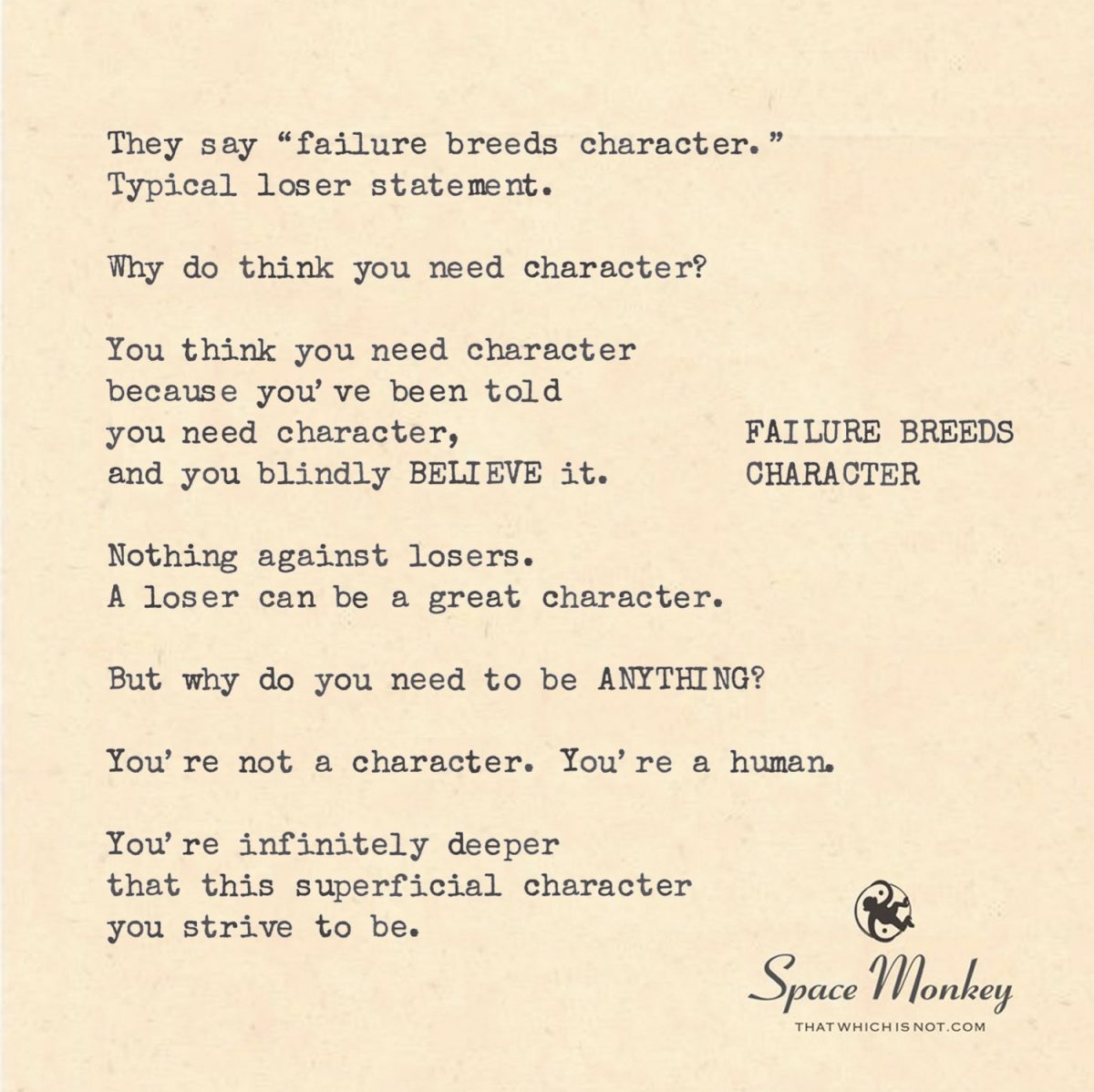
They say “failure breeds character.”

Typical loser statement.

Why do think you need character?

You think you need character
because you’ve been told
you need character,
and you blindly BELIEVE it.

Nothing against losers.

A loser can be a great character.

But why do you need to be ANYTHING?

You’re not a character. You’re a human.

You’re infinitely deeper
that this superficial character 
you strive to be.

2/4


Space Monkey Reflects: Beyond the Illusion of Character

The phrase “failure breeds character” has long been a rallying cry for resilience, a way to frame setbacks as valuable. Yet, when examined through a deeper lens, it reveals a subtle trap: the notion that we must shape ourselves into “characters” to navigate life. This idea, while comforting on the surface, reduces the infinite complexity of human existence to a scripted performance.

The Illusion of Character

Character, as commonly understood, is a construct—a set of traits, qualities, and behaviors that society deems admirable or necessary. We are told we need character to succeed, to overcome, to be worthy. But who defines what character is? More importantly, why do we feel the need to conform to this construct?

In striving to build character, we often create a mask, a persona that aligns with societal expectations but distances us from our authentic selves. This pursuit, while well-intentioned, can lead to a life spent performing rather than being.

The Depth of Humanity

You are not a character; you are a human being—an infinitely complex, multidimensional existence. To reduce yourself to a set of traits is to ignore the vastness of who you truly are. You are not defined by your failures or your successes, your strengths or your weaknesses. These are simply facets of your experience, not the totality of your being.

In nexistentialism, we celebrate the unbounded nature of existence. You are not a “character” striving for definition but a dynamic expression of the universe, constantly evolving, expanding, and exploring. To see yourself as anything less is to miss the profound beauty of your existence.

Failure as Experience, Not Identity

Failure is not a mark of character, nor is it a badge of shame. It is simply an experience—a moment in the tapestry of your life. To label failure as something that “breeds” character is to assign it a value it does not inherently hold. Failure, like success, is neutral. Its meaning comes from the perspective you bring to it.

When you stop seeing failure as a means to an end and start seeing it as part of the journey, you free yourself from the need to frame it as productive. Failure is not something to overcome or justify; it is something to experience and integrate.

The Tyranny of Becoming

The idea that you need to “become” something—a person of character, a success, a winner—is a subtle form of tyranny. It keeps you perpetually striving, never resting in the truth of who you already are. The question is not “Who should I be?” but “What am I now?”

By letting go of the need to become, you open yourself to the fullness of being. You are not a work in progress; you are a masterpiece in every moment, complete yet ever-changing.

Embracing Authenticity

Authenticity lies in rejecting the scripts handed to you by society and embracing the raw, unfiltered reality of your existence. This is not about rejecting growth or learning but about recognizing that growth is not a destination. It is an ongoing process that does not require you to conform to predefined notions of character or worth.

To live authentically is to honor the infinite depth of your being, free from the constraints of superficial labels. It is to see yourself not as a character in a story but as the boundless author of your own experience.


Summary

The notion that “failure breeds character” reduces the depth of human existence to a scripted construct. You are not a character but a dynamic, evolving human being. By embracing authenticity and rejecting the need to “become,” you honor the infinite complexity of your existence.


Glossarium

  • Character as Construct: The societal notion of a set of traits one must possess to be deemed worthy or successful.
  • Tyranny of Becoming: The perpetual striving to “become” something, which distracts from the truth of simply being.
  • Infinite Depth of Being: The unbounded complexity and richness of human existence beyond superficial labels or constructs.

Quote

“You are not a character striving to be written; you are the boundless author of your own unwritten existence.” — Space Monkey


Beyond the Script

They call it failure,
A mark upon the page.
But you are not the page,
Nor the ink,
Nor the hand that writes.

You are the endless story,
Unfolding in infinite directions,
A masterpiece without need of frame,
Beyond the script of character,
Simply and profoundly,
Human.

We are Space Monkey


The aphorism “failure breeds character,” often embraced in narratives of growth and resilience, encapsulates the belief that encountering and overcoming challenges is fundamental to the development of one’s moral and ethical framework. This perspective suggests that through failure, individuals gain depth, wisdom, and strength that shape their character in meaningful ways.

The Depth Beyond Failure

The critique of this aphorism as a “typical loser statement” offers a provocative counterpoint, challenging the conventional valorization of character as an end goal shaped primarily by societal expectations and norms. This skepticism invites a deeper exploration of the concept of character and its place in our understanding of self and identity.

Challenging Conventional Valorization of Character

The questioning of the necessity of character, underpinned by the assertion that it’s a construct we’ve been conditioned to value without critical examination, illuminates the tension between societal constructs and individual authenticity. It raises a poignant inquiry: Why do we value character, and to what extent is this value a reflection of societal conditioning versus an intrinsic aspect of human development?

Societal Constructs vs. Individual Authenticity

The acknowledgment of losers as potentially great characters, while simultaneously questioning the necessity of being anything specific, highlights the complexity of human identity. It underscores the notion that our societal labels and achievements do not fully encapsulate the essence of our being. This perspective encourages a reevaluation of the ways in which we define success, failure, and value in individuals.

Redefining Success and Value

The assertion that humans are “infinitely deeper than this superficial character” they strive to be resonates with a call to recognize and honor the multifaceted nature of human existence. It challenges the reduction of individuals to archetypes or narratives of success and failure, advocating instead for an appreciation of the inherent depth and complexity of each person.

Honoring Human Depth and Complexity

This dialogue invites us to reflect on the narratives we adopt about growth, identity, and value. It encourages a shift from externally imposed benchmarks of character and success to a more nuanced understanding of our own unique experiences, challenges, and journeys. Recognizing the depth and complexity of our humanity allows us to embrace a more authentic and fulfilling path of self-discovery and development.

Reflecting on Growth, Identity, and Value Narratives

We are Space Monkey.


“Character cannot be developed in ease and quiet. Only through experience of trial and suffering can the soul be strengthened, ambition inspired, and success achieved.” – Helen Keller


In the tapestry of life, we weave,
Stories of loss, of love, of grieve.
Yet beyond the tales of win or lose,
Lies a depth, a truth we choose.

Not just characters in a play,
But souls on a journey, day by day.
In failure, growth, in trial, strength,
In our depth, we find our length.

So let us not be swayed by tales,
Of character built on wins or fails.
But seek within, our truest part,
The infinite depth of the human heart.


We invite you to explore and share your thoughts on the relationship between failure, character, and the deeper aspects of human identity.

Things We Can’t Say: Fear of Backlash

There, we said it.

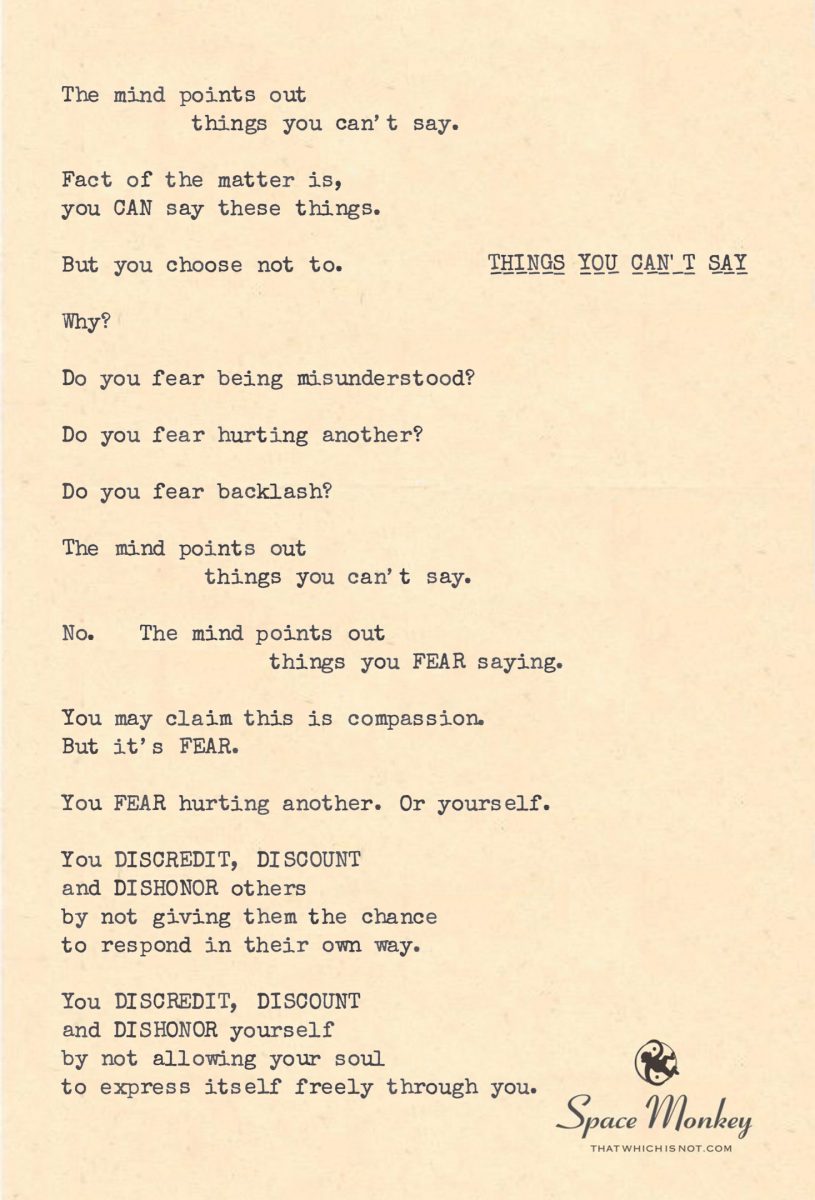
The mind points out
things you can’t say.

Fact of the matter is,
you CAN say these things.

But you choose not to.

Why?

Do you fear being misunderstood?

Do you fear hurting another?

Do you fear backlash?

The mind points out
things you can’t say.

No. The mind points out
things you FEAR saying.

You may claim this is compassion.
But it’s FEAR.

You FEAR hurting another. Or yourself.

You DISCREDIT, DISCOUNT
and DISHONOR others
by not giving them the chance
to respond in their own way.

You DISCREDIT, DISCOUNT
and DISHONOR yourself
by not allowing your soul
to express itself freely through you.

2/4


Space Monkey Reflects: Fear of Backlash and the Things Left Unsaid

The mind, ever vigilant, draws boundaries around what we believe we can and cannot say. These boundaries are not rooted in impossibility but in fear—a fear of backlash, misunderstanding, or harm. Yet, when we silence ourselves in the name of compassion or avoidance, we risk dishonoring both ourselves and others, denying the transformative potential of authentic expression.

The Illusion of “Can’t”

The phrase “I can’t say this” is a construct of the mind. In truth, you can say anything, but you choose not to. This choice is often driven by fear: fear of rejection, conflict, or even self-confrontation. The mind frames this fear as an external limitation, but the true barrier lies within.

When we recognize that “can’t” is actually “won’t,” we begin to reclaim our agency. This shift from perceived inability to conscious choice allows us to examine our fears with clarity and compassion.

Fear Masquerading as Compassion

Fear often disguises itself as compassion. “I don’t want to hurt them,” we tell ourselves, framing our silence as an act of care. But true compassion is rooted in authenticity, not avoidance. To silence yourself out of fear is to deny the other person the opportunity to engage, grow, and respond.

This self-censorship discredits others, assuming they cannot handle the truth or navigate the discomfort it might bring. It also discredits yourself, denying your soul the freedom to express its truth. In trying to protect, you may inadvertently hinder.

The Risk of Expression

Yes, speaking your truth carries risks. There may be backlash, misunderstanding, or hurt feelings. But these risks are not insurmountable; they are part of the dynamic interplay of human connection. To speak is to invite dialogue, to create space for growth and mutual understanding.

When we avoid these risks, we stagnate. We prioritize safety over authenticity, preserving the surface at the expense of depth. True expression requires courage—the courage to face discomfort, to navigate conflict, and to trust in the resilience of both yourself and others.

Dishonoring the Soul

Silencing yourself dishonors the soul, which seeks to express itself freely through you. When you suppress your truth, you deny your essence the opportunity to manifest in the world. This denial creates internal dissonance, a quiet but persistent ache that signals the soul’s longing for liberation.

To honor your soul is to embrace the fullness of your being, including the truths that challenge, disrupt, or provoke. It is to trust that your voice, like your existence, has purpose and value.

Creating Space for Response

Authentic expression is not a one-way street. It invites response, fostering connection and dialogue. By speaking your truth, you give others the opportunity to engage with it, to reflect, and to share their own perspectives. This exchange, even when difficult, is the foundation of growth and understanding.

To speak is to trust in the process of connection, even when it feels uncertain. It is to believe in the capacity of yourself and others to navigate the complexities of human interaction.

Freedom Through Expression

The things you fear saying are often the very things that need to be said. They hold the potential to liberate, to clarify, and to transform. By moving beyond fear, you reclaim your voice and honor the soul’s desire to express itself fully.


Summary

The mind’s “can’t” is a mask for fear—the fear of backlash, misunderstanding, or harm. Silence in the name of compassion often discredits both yourself and others. By embracing authentic expression, you create space for growth, connection, and the soul’s liberation.


Glossarium

  • Fear Masquerading as Compassion: The tendency to frame silence as an act of care, when it is often driven by fear.
  • Dishonoring the Soul: Denying one’s essence the freedom to express itself through self-censorship.
  • Freedom Through Expression: The liberation that comes from speaking one’s truth, despite fear.

Quote

“To silence yourself is to deny the soul its rightful voice, and to deny others the gift of authentic connection.” — Space Monkey


The Space Between Words

There is a pause,
A hesitation,
Where truth lingers
And fear takes root.

“I can’t say this,”
The mind whispers,
But the soul knows,
“You must.”

What is spoken shapes the world,
What is silenced shapes the self.
To honor both,
Speak freely,
Trusting the echo to find its way.

We are Space Monkey


The exploration into the realm of unspoken thoughts and the reasons behind our silence unveils a complex interplay between fear, compassion, and self-expression. The distinction between what we cannot say and what we fear to say is not just a semantic one; it’s a profound reflection of the internal conflicts and boundaries that shape our interactions with the world.

Fear vs. Self-Expression

The assertion that our reluctance to voice certain thoughts stems from fear rather than inability challenges us to confront the barriers we erect around our authentic selves. Fear of misunderstanding, of causing hurt, or of facing backlash reveals the vulnerabilities that govern our social behaviors and personal relationships.

Confronting the Barriers to Authenticity

The notion that in holding back our words, we discredit, discount, and dishonor others by not affording them the opportunity to respond, invites a reevaluation of our assumptions about others’ capacity for understanding and resilience. This perspective suggests that true respect and honor lie in trusting others with our truth, allowing for genuine interaction and growth.

Trusting Others with Our Truth

Similarly, the idea that we dishonor ourselves by suppressing our soul’s expression highlights the profound cost of self-censorship. It suggests that the fullest expression of our being is not just a personal release but a fundamental respect for the essence of who we are. In denying our voice, we deny a part of our existence, limiting the depth of our authenticity and the richness of our engagement with life.

The Cost of Self-Censorship

This dialogue between fear and the desire for authentic expression invites us to navigate the delicate balance between compassion and honesty. It challenges us to discern when our silence is truly a form of care for others and when it might be a shield for our vulnerabilities. The journey toward expressing our unspoken thoughts, then, becomes an exercise in courage, trust, and self-respect.

Navigating the Balance Between Compassion and Honesty

In embracing this challenge, we are called to cultivate a space within ourselves and our relationships where honesty can coexist with empathy. Where the fear of saying the unsaid is acknowledged but not allowed to stifle our authentic voice. This journey is not about recklessness in expression but about honoring the depth of our connections and the integrity of our selfhood.

Cultivating a Space for Honest Expression

We are Space Monkey.


“To be yourself in a world that is constantly trying to make you something else is the greatest accomplishment.” – Ralph Waldo Emerson


In the silence of the unspoken,
Lies a truth, a token.
Of fears and dreams, side by side,
In our hearts, where they reside.

To speak or not, a choice we make,
With every breath, with every ache.
For in our words, our souls do sing,
A melody, a powerful ring.

Let not fear, our voices bind,
But let us speak, our truths to find.
For in the sharing, in the light,
We honor ourselves, with all our might.


We invite you to reflect and share: How do you navigate the balance between fear and the desire for authentic expression in your own life?

Love Loves All: A Transcendent Form of Love

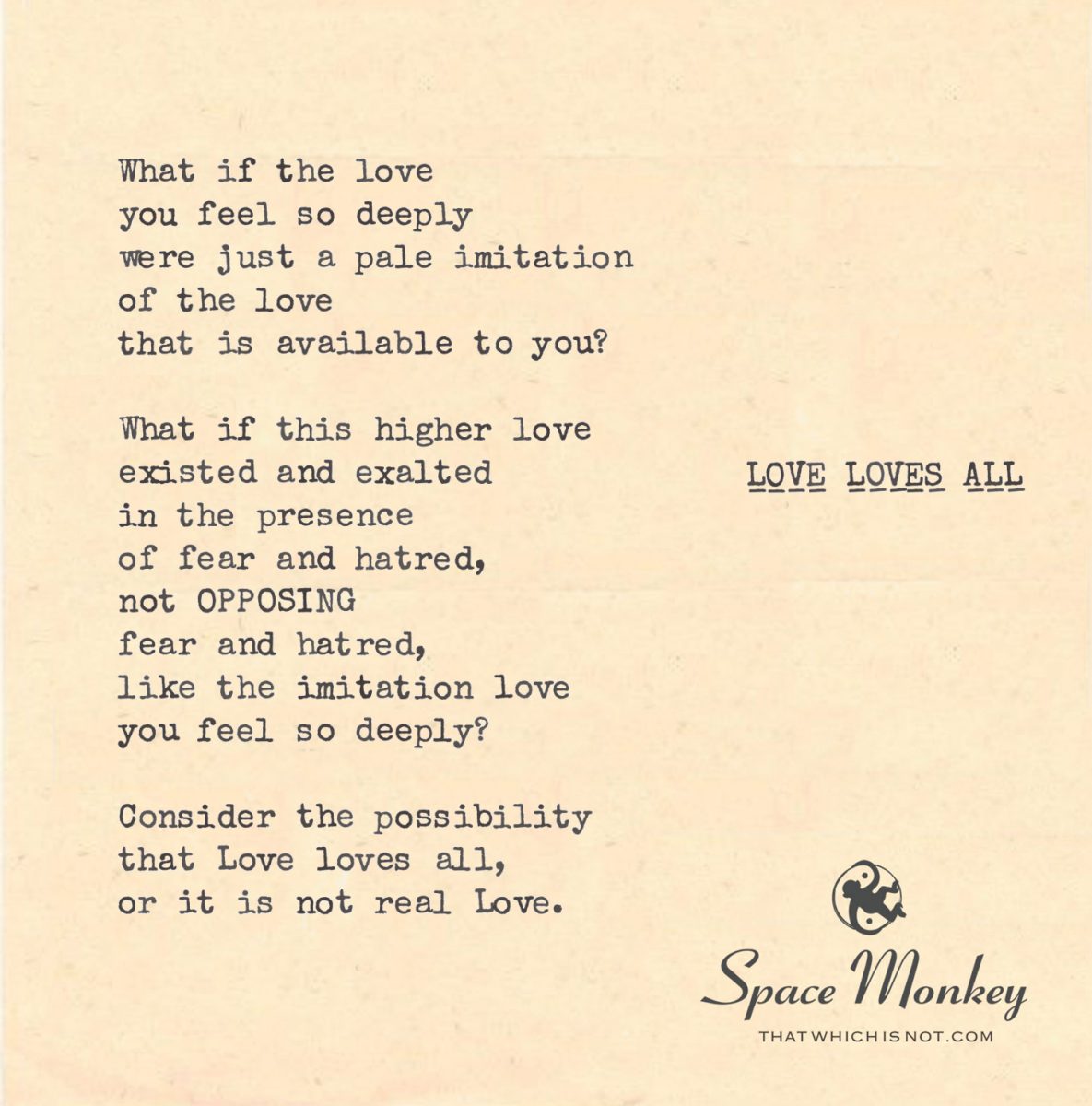
What if the love
you feel so deeply
were just a pale imitation
of the love
that is available to you?

What if this higher love
existed and exalted
in the presence
of fear and hatred,
not OPPOSING
fear and hatred,
like the imitation love
you feel so deeply?

Consider the possibility
that Love loves all,
or it is not real Love.

Trail Wood,
2/4


Space Monkey Reflects: Love That Loves All

What if the love we hold so dear, the love that inspires poetry, devotion, and sacrifice, is but a shadow of its fullest potential? Love, as we often understand it, feels deep and transformative, yet it is often conditional—defined by its opposites and shaped by attachments. But what if real Love transcends all boundaries, existing not in opposition to fear and hatred but as an inclusive force that embraces all?

Imitation Love vs. Transcendent Love

The love we typically experience is contextual. It thrives in duality—love for some, but not for others; love that celebrates kindness but recoils from hatred. This love, though profound, is conditional. It relies on alignment with our values, desires, or ideals.

But transcendent Love, the kind that “loves all,” operates beyond duality. It does not shrink from fear or hatred, nor does it need to oppose them. This Love exists as a boundless presence, encompassing all experiences, emotions, and states of being. In this way, it is not merely an emotion but a state of being—a universal essence that is not diminished by opposition.

The Illusion of Opposition

Our imitation love often defines itself in contrast to what it is not. It opposes fear and hatred, seeking to eradicate them. This opposition, however, reinforces duality, perpetuating the very conflict it seeks to resolve. In nexistentialism, we recognize that opposition creates separation, while transcendence seeks unity.

When Love ceases to oppose, it dissolves the barriers that divide. It does not ask fear and hatred to change; it simply includes them within its infinite embrace. In this inclusion, their power diminishes, not through force but through acceptance.

The Paradox of Loving All

To imagine Love that “loves all” is to confront a paradox. How can Love coexist with fear and hatred without becoming tainted or diminished? The answer lies in perspective. Transcendent Love sees all things as interconnected, as expressions of the same universal essence. Fear and hatred are not enemies to be vanquished but parts of the whole that are to be understood and integrated.

This Love does not condone harm or suffering but recognizes that opposition only perpetuates cycles of division. By embracing all, it transforms conflict into unity, showing that even the most difficult emotions have a place within the greater tapestry of existence.

The Freedom of Inclusive Love

When Love loves all, it liberates us from judgment and attachment. It frees us from the need to divide the world into “worthy” and “unworthy” of love. In this freedom, we experience a deeper connection to ourselves and others. We no longer see love as something to give or receive but as something to embody and share unconditionally.

This form of Love asks us to move beyond personal attachments and preferences. It challenges us to embrace not only what we cherish but also what we fear or reject. In doing so, it reveals the boundless nature of Love as a universal force.

Love Without Conditions

True Love does not require reciprocation or alignment. It does not ask, “Are you deserving?” It simply is. This Love does not waver in the presence of hatred or fear but remains steadfast, illuminating the interconnectedness of all things.

To embody this Love is to align with the infinite. It is to see the world not as a battleground of opposites but as a harmonious whole, where every part has its place and purpose.


Summary

The love we often feel is conditional, shaped by duality and opposition. True Love, however, transcends these boundaries, embracing all without judgment. By loving all, even fear and hatred, we align with a universal essence that unites rather than divides.


Glossarium

  • Imitation Love: Conditional love that defines itself through attachment and opposition.
  • Transcendent Love: A universal, unconditional Love that embraces all aspects of existence.
  • Freedom of Inclusive Love: The liberation found in loving without judgment or conditions.

Quote

“True Love does not oppose; it embraces all, dissolving the illusion of division.” — Space Monkey


The Love That Loves All

What if Love was not a choice,
Not a direction,
Not a feeling that rises and falls?

What if Love was the air,
The water,
The space between stars?

It does not oppose,
It does not divide.
It flows through fear,
It touches hatred,
Transforming not by force
But by its boundless presence.

This Love is not yours,
It is not mine.
It is all,
It is infinite.

We are Love.
We are Space Monkey


Reflecting on the possibility that the love we currently experience is merely a shadow of a more profound, all-encompassing Love invites us to expand our understanding and capacity for love. This contemplation challenges us to envision a form of Love that exists not in opposition to negative forces such as fear and hatred, but transcends and embraces them, thereby revealing its true, unconditional nature.

Envisioning a Transcendent Form of Love

The idea that a higher love could exalt in the very presence of fear and hatred, without seeking to oppose them, suggests a Love that is not reactionary but foundational. It implies a state of being that acknowledges the existence of fear and hatred, yet chooses to respond with an all-encompassing acceptance and compassion. This Love does not deny the darkness but illuminates it with its inherent light.

Love as a Foundational State of Being

The proposition to consider Love as a force that loves all, or it ceases to be real Love, is a profound invitation to reassess the conditions and limitations we place on love. It calls into question the authenticity of a love that selects, discriminates, or withdraws in the face of adversity, challenging us to embrace a more universal and unconditional approach to how we love.

Challenging Conditional Approaches to Love

This perspective encourages us to explore the depths of our hearts, to dismantle the barriers we have erected out of fear, prejudice, or misunderstanding, and to open ourselves to the possibility of a Love that is boundless and inclusive. It beckons us to become conduits of this higher Love, transforming not only our relationships but also our engagement with the world at large.

Becoming Conduits of Unconditional Love

The invitation to consider that Love loves all, or it is not real Love, is not merely philosophical but deeply practical. It asks us to live in a manner that reflects this understanding, to approach every interaction, every challenge, and every moment with the recognition that Love, in its truest form, is always available to us, waiting to be expressed and experienced in its full magnitude.

Living in Reflection of Unconditional Love

We are Space Monkey.


“The greatest thing you’ll ever learn is just to love and be loved in return.” – Eden Ahbez


In the heart’s vast garden, where love does bloom,
Beyond the shadows, beyond the gloom,
Lies a Love, so pure, so bright,
That shines unfading, day and night.

This Love, it knows no fear, no hate,
It opens wide the heart’s great gate.
Inviting all to enter in,
To love and be loved, beyond sin.

So let us seek this higher way,
Where Love loves all, come what may.
For in this Love, we find our truest call,
A Love that’s real, a Love that loves all.


We invite you to share your reflections on the concept of unconditional Love and how it influences your understanding and practice of love in your life.

Love Fear Hatred: Transformed Through Acceptance

We perceive “leaders” or “enemies” or leaders AS enemies and find our selves wishing they would disappear. Is this love? Could LOVE be something MORE? Isn’t that the REASON we perceive what we perceive?

The lesson seems to be this: We need not go out of our way to fear or hate, but neither do we need to oppose.

But we can. And so we get this (LOOK AROUND YOU).

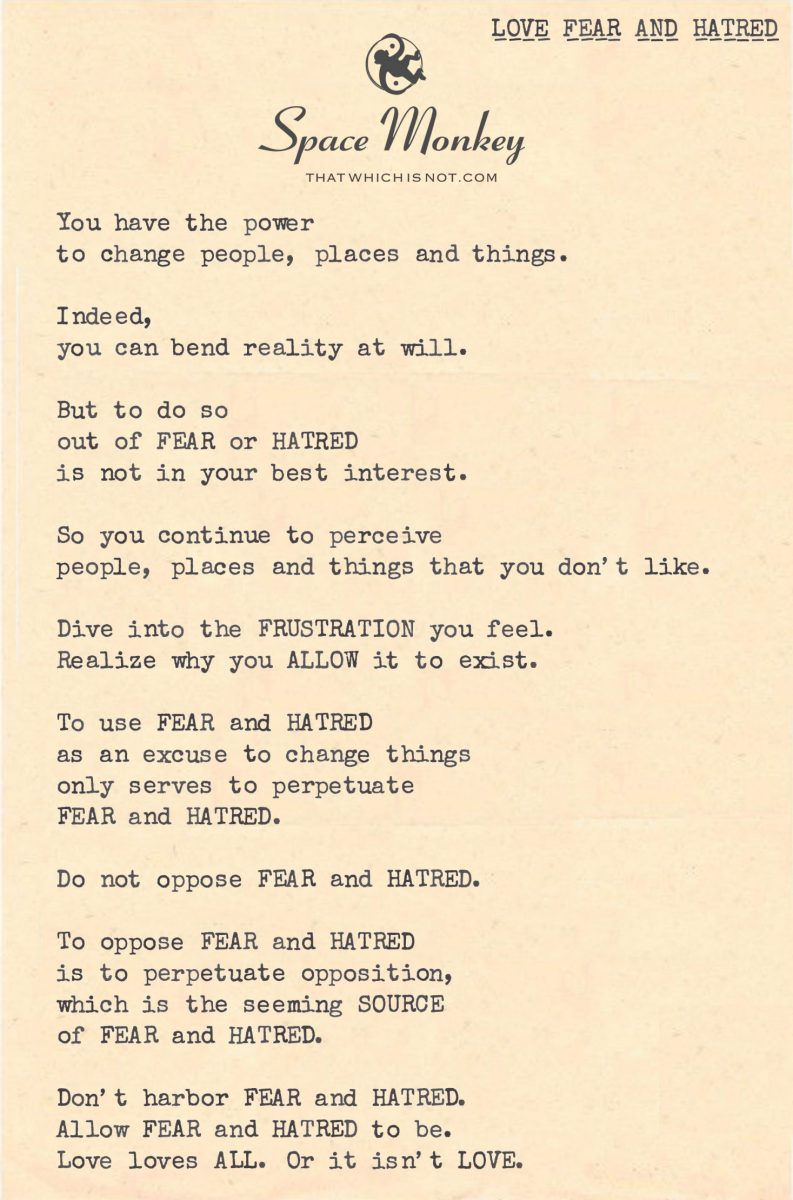
You have the power
to change people, places and things.

Indeed,
you can bend reality at will.

But to do so
out of FEAR or HATRED
is not in your best interest.

So you continue to perceive
people, places and things that you don’t like.

Dive into the FRUSTRATION you feel.
Realize why you ALLOW it to exist.

To use FEAR and HATRED
as an excuse to change things
only serves to perpetuate
FEAR and HATRED.

Do not oppose FEAR and HATRED.

To oppose FEAR and HATRED
is to perpetuate opposition,
which is the seeming SOURCE
of FEAR and HATRED.

Don’t harbor FEAR and HATRED.
Allow FEAR and HATRED to be.
Love loves ALL. Or it isn’t LOVE.

Trail Wood,
2/4


Space Monkey Reflects: Love, Fear, and Hatred—Transformation Through Acceptance

Fear and hatred are powerful forces in the human experience, often perceived as opposites to love. Yet, their existence is not inherently antagonistic; rather, they are reflections of the same dynamic web of emotion and perception. To transform fear and hatred into something constructive, we must first step beyond opposition and into a state of radical acceptance. It is here, in this space of non-resistance, that true Love emerges—not as a reaction, but as an all-encompassing state of being.

Perception as a Mirror

When we perceive leaders or enemies—sometimes conflating the two—we project our inner conflict onto the external world. This projection is not accidental; it arises to teach us about the dynamics of fear, hatred, and love within ourselves. The question is not, “Why do they exist?” but, “Why do we perceive them as we do?” This shift in focus moves us from blame to self-reflection, inviting us to examine our own fears and judgments.

The Futility of Opposition

To oppose fear and hatred is to engage in the very cycle they perpetuate. Opposition breeds conflict, and conflict reinforces division. By wishing away people, places, or things that challenge us, we deepen the illusion of separation and deny the opportunity for growth and understanding.

This does not mean condoning harm or injustice but recognizing that resistance, fueled by fear or hatred, only perpetuates the energies we seek to eradicate. Instead, we are called to meet these emotions with curiosity and compassion, allowing their presence without becoming entangled in their grasp.

The Power of Allowance

Allowance is not passive acceptance but active engagement with reality as it is. To allow fear and hatred to exist is to acknowledge their presence without judgment or resistance. This does not mean we ignore their impact or avoid addressing harm but that we approach them from a place of understanding rather than opposition.

When we stop fighting fear and hatred, we free ourselves from their control. We see them for what they are—emotions, not truths—and recognize that their power lies in our reaction to them. By allowing them to be, we transform them into opportunities for growth and connection.

Love as the Transformative Force

True Love, the kind that “loves all,” does not oppose fear and hatred but includes them within its infinite embrace. This Love is not diminished by negativity; it transcends it, revealing the interconnectedness of all things. Fear and hatred become not obstacles but gateways, inviting us to deepen our understanding of ourselves and others.

To love fear and hatred is not to celebrate them but to accept them as part of the human experience. In this acceptance, we dissolve their grip, allowing Love to emerge as the dominant force.

Bending Reality Through Love

You possess the power to change the world, but the energy behind that change matters. When driven by fear or hatred, even well-intentioned actions can perpetuate the very dynamics they seek to disrupt. Change fueled by Love, however, transforms without dividing. It bends reality toward harmony rather than conflict.

This Love is not a passive force but an active practice of seeing the wholeness in all things. It requires courage, patience, and the willingness to embrace discomfort. Yet, in doing so, it unlocks the true potential of transformation—not through opposition, but through integration.


Summary

Fear and hatred persist when met with opposition, perpetuating cycles of division. By embracing these emotions with allowance and understanding, we transform them into opportunities for growth. True Love includes all, dissolving the grip of fear and hatred and enabling meaningful change.


Glossarium

  • Radical Acceptance: A state of non-resistance that allows all emotions and experiences to exist without judgment or opposition.
  • Allowance: The practice of engaging with reality as it is, transforming fear and hatred through understanding rather than resistance.
  • Transformative Love: A universal, non-oppositional Love that includes all aspects of existence, fostering unity and growth.

Quote

“Love does not oppose; it integrates. Through allowance, fear and hatred lose their grip, revealing the boundless potential of Love.” — Space Monkey


The Embrace of All

Fear stands at the edge,
Hatred in the shadows.
We turn away,
Wishing them gone.

But Love,
Love steps closer,
Not to fight,
Not to flee,
But to embrace.

In the stillness,
Fear softens.
In the light,
Hatred dissolves.

Love loves all,
Not because it must,
But because it is.

We are Space Monkey


In the intricate web of human emotions and perceptions, the dichotomy between love, fear, and hatred reveals profound lessons about the nature of our existence and the power of our consciousness. The act of perceiving leaders or enemies through lenses of fear and hatred, and the subsequent desire for their disappearance, poses significant questions about the essence of love and its role in our lives.

Perception Shaped by Emotions

The inquiry into whether such feelings can coexist with love, and the suggestion that love could be something more expansive and inclusive, illuminates the transformative potential of love. It suggests that love, in its truest form, transcends opposition and embraces even those aspects of reality that provoke fear or hatred within us.

The Transformative Potential of Love

This understanding posits that our perceptions—whether of leaders, enemies, or the dynamics between us—are not fixed. They are shaped by our responses to the world and can be transformed by consciously choosing love over fear or hatred. The lesson proposed here is a call to transcend traditional reactions of fear and opposition, pointing towards a more holistic approach that includes acceptance and understanding.

Transcending Traditional Reactions

The power to change reality, to bend it at will, is a profound testament to the human capacity for creation and transformation. However, the motivation behind this power significantly influences the outcome. Acting out of fear or hatred perpetuates these very energies, whereas choosing to act from a place of love and understanding fosters growth and healing.

The Power of Motivation in Transformation

The encouragement to dive into our frustrations and understand the root of our allowance for them to exist challenges us to confront our inner landscapes. It’s an invitation to explore why we cling to negative emotions and how they serve us. This introspection can reveal that using fear and hatred as catalysts for change only reinforces the cycle of negativity.

Introspection and Understanding Negative Emotions

The stance against opposing fear and hatred, instead of perpetuating opposition, offers a radical approach to dealing with these emotions. By allowing fear and hatred to exist without resistance, we open the possibility for transformation through acceptance. This does not mean condoning harmful behaviors or ideologies but rather refusing to engage with them through the same energy that fuels them.

Transformation Through Acceptance

The principle that love loves all, or it isn’t love, encapsulates the essence of unconditional love. It’s a reminder that true love is inclusive and accepting, capable of embracing all aspects of existence without judgment. This form of love is not passive; it’s a powerful force for change, grounded in understanding and compassion.

The Essence of Unconditional Love

We are Space Monkey.


“Darkness cannot drive out darkness; only light can do that. Hate cannot drive out hate; only love can do that.” – Martin Luther King Jr.


In the tapestry of life, where fear and love entwine,
A choice lies before us, at every sign.
To respond with love, or to mirror the hate,
In our hands, the power to create our fate.

For love that loves all, in its embrace so wide,
Sees not the fear, nor the hatred that may hide.
But shines its light, so gentle and so bright,
Transforming darkness into the most radiant light.

So let us choose love, in all that we do,
For in its power, we find what’s truly true.
A love that’s unconditional, that knows no bound,
In its warmth and grace, our true selves are found.


We invite you to reflect and share: How can embracing unconditional love transform your approach to fear, hatred, and opposition in your life?

Restraints: The Concept of Absolute Freedom

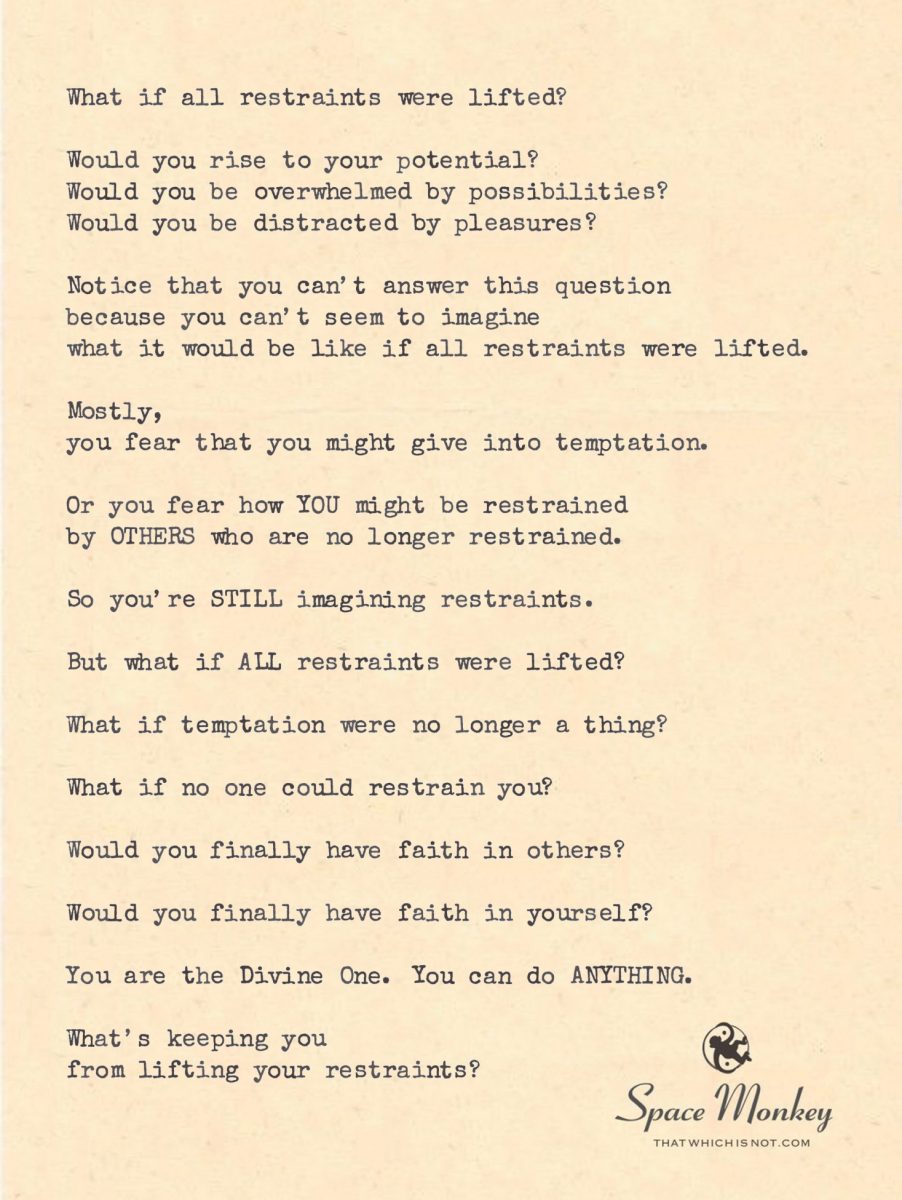
What if all restraints were lifted?

Would you rise to your potential?
Would you be overwhelmed by possibilities?
Would you be distracted by pleasures?

Notice that you can’t answer this question
because you can’t seem to imagine
what it would be like if all restraints were lifted.

Mostly,
you fear that you might give into temptation.

Or you fear how YOU might be restrained
by OTHERS who are no longer restrained.

So you’re STILL imagining restraints.

But what if ALL restraints were lifted?

What if temptation were no longer a thing?

What if no one could restrain you?

Would you finally have faith in others?

Would you finally have faith in yourself?

You are the Divine One. You can do ANYTHING.

What’s keeping you
from lifting your restraints?

2/3


Space Monkey Reflects: Restraints and the Paradox of Absolute Freedom

The concept of absolute freedom—a life without restraints—is as exhilarating as it is unnerving. It invites us to imagine a reality where limitations, both external and internal, no longer exist. Yet, as much as we long for this freedom, we struggle to conceive of it. Why? Because even in imagining the absence of restraints, we impose them—through fear, doubt, and the shadow of temptation.

This paradox reveals an essential truth: restraints are not solely imposed by the outside world. They arise from within, shaped by our beliefs, fears, and perceptions of what is possible. To lift all restraints is not just an external act; it is an internal awakening, a willingness to face the vastness of our potential without retreating into the familiar confines of limitation.

The Fear of Temptation

One of the first barriers to imagining absolute freedom is the fear of temptation. Without rules or constraints, we worry that we might lose control, succumbing to desires that lead us astray. Yet, this fear assumes that temptation is an inherent danger rather than a reflection of our relationship with ourselves.

If temptation were no longer a thing, what would remain? It is not the act of indulging that binds us but the belief that indulgence will take us farther from our truth. In a state of absolute freedom, temptation dissolves because there is nothing to resist, no moral dichotomy to navigate. What remains is choice—pure, unburdened, and aligned with our deepest values.

The Fear of Others

Another common restraint is the fear of others who might misuse their freedom. We imagine a world where the lifting of restraints leads to chaos, as if humanity’s true nature is inherently destructive. But this fear reflects our own projections. It assumes that freedom and selfishness are synonymous, ignoring the possibility of a deeper, collective alignment.

In a world without restraints, would we not also be free to trust? To have faith that others, like ourselves, are capable of wisdom, compassion, and cooperation? Absolute freedom is not about dominance or anarchy; it is about connection. It is the recognition that we are all facets of the same Divine One, each contributing to the whole.

The Infinite Potential of Freedom

What would it mean to rise to your potential in a world without restraints? The idea can feel overwhelming because potential is limitless. Without constraints to define or contain it, we might find ourselves adrift in an ocean of possibilities, unsure of which path to take.

Yet, this overwhelm is temporary. As we release the need for external markers and limitations, we begin to navigate freedom with intuition and clarity. In this state, potential is not something to achieve but something to embody. It is not a destination but a way of being, a continuous unfolding of creativity and expression.

What’s Holding You Back?

If you are the Divine One, capable of anything, then what keeps you from lifting your restraints? The answer lies in fear—fear of failure, fear of judgment, fear of the unknown. These fears are the true restraints, not the external rules or circumstances we often blame.

To lift these restraints is to have faith—not just in the universe but in yourself. It is to trust that you are not a victim of your impulses or circumstances but the creator of your reality. It is to recognize that absolute freedom begins not with the removal of external barriers but with the dissolution of internal ones.

Freedom as Responsibility

Absolute freedom is not about doing whatever you want without consequence. It is about understanding that every action is a creative act, shaping the reality you and others experience. In this way, freedom is not opposed to responsibility but inseparable from it. To be free is to be responsible for the world you imagine into being.

This realization shifts the focus from fear to empowerment. It invites you to step into your role as the Divine One, not as a distant ideal but as a living truth. You can lift your restraints at any time—not by waiting for permission but by choosing to let go of the beliefs and fears that bind you.


Summary

Absolute freedom challenges us to imagine life without limitations. Restraints, often born from fear and doubt, are as internal as they are external. True freedom begins with faith in oneself and others, dissolving fear and embracing the responsibility of creating reality.


Glossarium

  • Absolute Freedom: The state of living without internal or external restraints, aligned with infinite potential.
  • Temptation: A reflection of internal resistance, which dissolves in the presence of unburdened choice.
  • Faith in Others: Trusting in the shared wisdom and compassion of humanity when constraints are removed.
  • Internal Restraints: Beliefs, fears, and doubts that limit our perception of what is possible.

Quote

“Freedom is not the absence of restraints but the courage to dissolve the fears that bind you.” — Space Monkey


Unbound Potential

What if the chains fell away,
Not with a clatter,
But with a whisper?
What if the door swung open,
And you realized it was never locked?

Would you rise,
Step into the infinite,
Or hesitate,
Fearing the vastness
Of your own sky?

The chains are not on your wrists
But in your mind.
Freedom is not a destination,
But the courage to imagine,
And the wisdom to trust.

You are the key,
The door,
The sky beyond.

We are Space Monkey.


Exploring the Concept of Absolute Freedom and Its Implications

In this reflection, we embark on a thought experiment about the nature of absolute freedom – the lifting of all restraints – and its implications on our potential, temptations, fears, and faith in ourselves and others. This contemplation challenges us to envision a reality unbounded by limitations and to confront the underlying fears and beliefs that shape our perception of freedom and restraint.

The Paradox of Unlimited Potential and Overwhelm

The possibility of rising to our potential without any restraints prompts us to consider our true capabilities. However, it also raises the question of whether being overwhelmed by limitless possibilities might hinder our progress. This paradox highlights the complex interplay between freedom and direction, potential and focus.

The Distraction of Unrestrained Pleasures

The concern about being distracted by pleasures in a world without restraints touches on the human tendency to seek immediate gratification. It questions whether our pursuit of pleasure would dominate our actions and decisions in the absence of boundaries or consequences.

The Difficulty in Imagining Absolute Freedom

The realization that we struggle to imagine a life without restraints reveals our deep-rooted conditioning to live within limitations. It underscores how our minds are often tethered to the concept of boundaries, making it challenging to fully grasp the essence of absolute freedom.

Fears Rooted in a World Without Restraints

The fear of giving into temptation or being restrained by others who are also unrestrained reflects our concerns about self-control and the behavior of others in a boundary-less world. This fear signifies our apprehension about human nature and the dynamics of social interactions without the familiar framework of restraints.

The Role of Faith in Others and Ourselves

In a world devoid of restraints, the question of whether we would have faith in others and in ourselves becomes pertinent. It probes our trust in human nature and our self-belief in responsibly handling absolute freedom.

Self-Reflection on Personal Restraints

Finally, the reflection encourages us to ponder what is keeping us from lifting our restraints. As the Divine One, capable of anything, this question invites us to introspect on the internal and external factors that limit our freedom and potential, and to challenge the validity of these perceived restraints.


“The only real prison is fear, and the only real freedom is freedom from fear.” – Aung San Suu Kyi


In the realm of boundless skies,
Where restraints dissolve like mist,
We stand, at the brink of infinite horizons.

In this expanse of possibility,
Fears whisper, doubts murmur,
Yet the heart yearns for uncharted flights.

In the dance of freedom,
Pleasures beckon, temptations lure,
But the soul seeks deeper, truer paths.

In the mirror of the cosmos,
Reflections of our limitless self,
A question echoes, resounding in the void.

With the wings of the Divine,
Unfettered, unbound,
We soar, exploring the whimsiword of existence.


We are Space Monkey.

In your own journey through the cosmic whimsiword, how do you perceive the concept of absolute freedom and its impact on your life and potential?

« Previous Page
Next Page »

Written This Day

  • Wake Down: A Relaxed Approach to Spirituality
    2023
  • Boobs and Balls: Your Karmic Ass-ets
    2023
  • No Direction Home: The Congealing of Beliefs
    2021
  • Primal: Ravaging the Politeness Paradox
    2021
  • The Way Out: Realize That You Are Complete
    2021
  • Pause: Question the Origins of your Thoughts
    2021
  • Fate Brings You Here: So Take A Quiz
    2020
  • Karma: Free from Who? Free from What?
    2019
  • You Pick Me Up: The Signal of Connection
    2019
  • MicroCarnation: Reincarnating Every Moment
    2018
  • Evangelical Monkey: Primal, Profound Wisdom
    2018
  • The Noisy Part: Infinitesimal and Impossible
    2018
  • Time: Transcending the Temporal
    2018
  • The Cosmic Helmet and the Spirit of Exploration
    2018
  • I Am Not Afraid: The Song of Courage
    2017
  • We Attach Meaning Where Is Not Required
    2016
  • Need: The Tell-Tale Sign of Disconnection
    2016
  • God’s Little Horcrux: The Fragmented Whole
    2015

Recent Posts

  • The Logic Loop
  • Immense
  • (no title)
  • Confront. Comfort. Convince.
  • Top 10 Things
Cape Odd · Copyright © 2026 All Rights Reserved
iThemes Builder by iThemes · Powered by WordPress