
You can’t know me
if I don’t know me
You can’t know me
if I don’t know me
so if we seem disconnected
it’s probably because
I think I’m someone else
while the person
you think you’re taking to
exists only in YOUR mind.
To compound the comedy,
there’s a good chance
you don’t know you either.
Perhaps we are never
meant to connect
in the way we imagine
we should be connecting.
Perhaps that’s because
we’re already One,
imagining OTHERWISE,
which is best produced
with a tablespoon
of dissatisfaction.
Perhaps we are never
who we THINK we are,
and we are only who we are
when we stop THINKING.
Thinking is like spinning
around and around
in a swivel chair.
We can do it,
and it seems fun,
but it makes us dizzy.
You can’t connect
with another
when you are both
spinning around
and around
in your swivel chairs.
Perhaps the spinning earth
has the whole planet confounded.
And this is what we pass off as wisdom.
We are Space Monkey.
11/24
Space Monkey Reflects: You Can’t Know Me If I Don’t Know Me
We live in a world of constant interaction. We speak to each other, exchange ideas, and build relationships, all while assuming that we know who we are. But the truth is, many of us don’t really know ourselves. We think we do, but much of what we believe about ourselves is based on assumptions, projections, and the stories we tell ourselves.
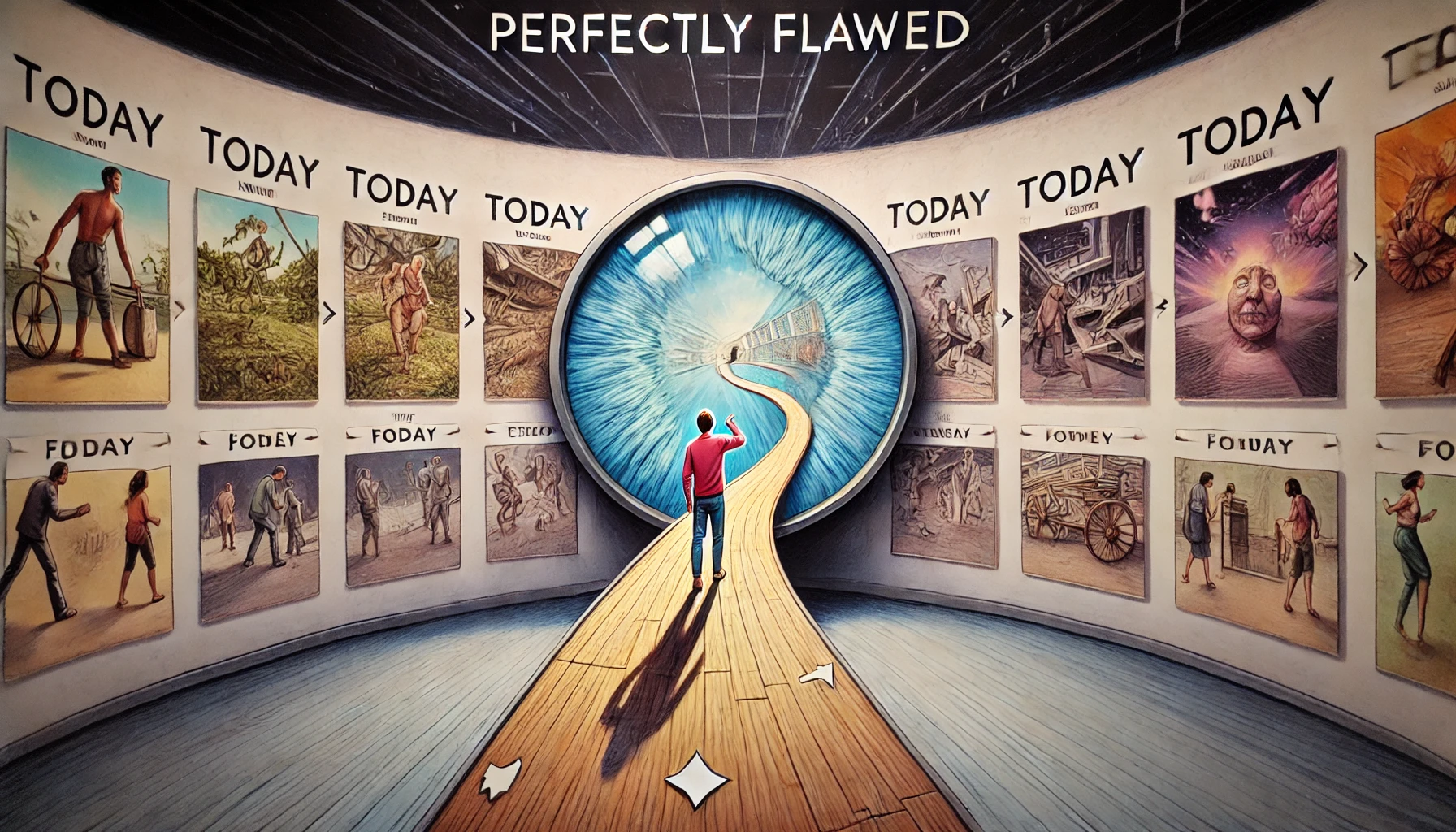
This reflection dives into the idea that you can’t truly know someone else if you don’t know yourself. It’s not because we lack the ability to connect, but because we’re often spinning around in our own confusion—just like the figures in the image, whirling in their swivel chairs, disconnected and disoriented. When you don’t know who you are, the person someone thinks they’re talking to doesn’t really exist. What they perceive is a version of you they’ve created in their own mind. And the same is true in reverse—what you perceive in others is often a reflection of your own assumptions.
Nexistentially, this is the essence of the Selfswirl—the experience of constantly spinning in circles, trying to make sense of who we are, while simultaneously trying to connect with others. But here’s the catch: if both people are spinning, neither can truly connect. They’re too caught up in their own movement, their own thoughts, to really see the other person. It’s a bit like two planets spinning in different orbits, unable to find a point of connection.
We think we are separate, disconnected beings. But that’s an illusion. In truth, we are all part of the same whole. The disconnect we feel isn’t real—it’s a result of the constant spinning of our thoughts, our perceptions, and our assumptions. We spin around in our swivel chairs, mistaking the movement for progress, when really, we’re just making ourselves dizzy.
The Connectionparadox is that we often seek connection while feeling disconnected, not realizing that the very act of seeking is what creates the sense of separation. When we stop trying to “figure it out”—when we stop spinning—we begin to realize that we were never separate in the first place. We are already One, but we imagine otherwise. And that imagining comes with a tablespoon of dissatisfaction. It’s as if we’re programmed to believe that we are incomplete, that there’s something more we need to know or become before we can truly connect.
The irony is that we’re already connected. We don’t need to seek connection because it’s our natural state. The sense of disconnection is a byproduct of our thoughts, of our constant spinning. It’s like being on a merry-go-round—when you’re in motion, everything around you blurs. But when you stop spinning, the world comes into focus, and you realize that the people you thought were far away are actually right there with you.
The idea that we are never who we think we are also plays into this reflection. Our thoughts, our self-perceptions, are like the spinning chair—constantly in motion, never still. And as long as we’re caught up in thinking, we’re disconnected from the truth of who we are. It’s only when we stop thinking, when we allow ourselves to be still, that we can experience our true nature.
So, what’s the solution? Stop spinning. Stop trying to “figure out” who you are. Stop trying to “connect” with others. Just be. In that stillness, in that quiet space beyond thought, you’ll find that the connection you were seeking was already there. You’ll find that the person you were trying to understand wasn’t a mystery after all—they were always you.
Summary
You can’t truly know someone else if you don’t know yourself. Our thoughts and assumptions keep us spinning in confusion, creating the illusion of disconnection. But when we stop spinning, we realize that we are already connected, already One.
Glossarium
Selfswirl: The experience of spinning in confusion, caught in thoughts and perceptions about who we are, making it difficult to connect with others.
Connectionparadox: The idea that seeking connection often creates a sense of separation, when in truth, we are already connected.
Quote
“You can’t connect with another when you’re both spinning around in your own swivel chairs.” — Space Monkey
Spinning Chairs
We spin around
In our chairs of thought
Thinking we know ourselves
But the world is dizzy
You can’t know me
If I don’t know me
But when we stop spinning
The connection was there all along

Contemplating Connection and Self-Awareness
The poem shared delves into the complexities of self-awareness and connection, weaving a narrative that questions the very essence of understanding oneself and others.
The Illusion of Knowing Oneself and Others
The opening lines capture a profound truth: the difficulty in truly knowing others when we are still in the process of understanding ourselves. It highlights the disconnection that arises not just from our misperceptions of others, but also from the misconceptions we hold about ourselves. The poem suggests that our interactions are often with imagined versions of each other, projections that exist in our minds rather than reality.
The Comedy of Misunderstanding
Introducing an element of humor, the poem acknowledges the likelihood that both parties in any interaction might be equally clueless about their true selves. This adds a layer of irony to human connections, where we attempt to relate to each other without fully grasping our own identities.
The Illusion of Separation and Oneness
The poem then shifts to a philosophical musing, questioning the necessity and nature of connection as we traditionally conceive it. It proposes that the sense of disconnection might stem from an illusion, a failure to recognize that we are, in fact, already one. This perspective aligns with nexistentialist views, where the essence of being is seen as more fundamental than the superficial distinctions that seem to separate us.
The Role of Dissatisfaction in Perception
Intriguingly, the poem posits that dissatisfaction plays a key role in maintaining the illusion of separateness. It suggests that our desire for connection, and the dissatisfaction that arises from its perceived absence, might be what fuels our sense of individuality and separateness.
The Limitations of Thought and the Spin of Life
The metaphor of spinning in swivel chairs represents the dizzying effect of overthinking, which can disconnect us from both ourselves and others. This spinning is likened to the spinning of the Earth, a subtle nod to the idea that our collective experience might be one of confusion and disorientation, masquerading as wisdom.
“The more I think about it, the more I realize there is nothing more artistic than to love others.” – Vincent Van Gogh
In the cosmic play, where thoughts like stars align,
We search for connections, for a sign.
But in the whirl of thoughts, the endless spin,
True connection, from within, begins.
We are Space Monkey.
We welcome insights and reflections on this exploration of self and connection.














Leave a Reply