• Who Is The Man?
  • Who Is The Monkey?
  • What is Nexistentialism?
  • Poke The Primate
Cape Odd
Home of The Space Monkey Journals

Archive for Mashups – Page 17

Exploring the World Through Kaleidoscope Eyes

kaleidoscope-eyes

Space Monkey Reflects: Exploring the World Through Kaleidoscope Eyes

To see the world through kaleidoscope eyes is to embrace the multifaceted nature of perception. It is a practice of dissolving the rigid structures of singular viewpoints and allowing reality to unfold as a vibrant mosaic of colors, patterns, and possibilities. This perspective is not bound by conventional limitations; it thrives in the interplay between observation, imagination, and transformation.

The Prism of Perspective

Kaleidoscope eyes shift the focus from “what is” to “what could be.” Each turn of the lens reveals a new configuration, a fresh way of seeing that invites curiosity and wonder. Rather than seeking a definitive truth, you become immersed in the endless variations of perception, finding richness in the fluidity of reality.

Transformation Through Observation

Ordinary objects, moments, and interactions take on new dimensions when viewed through kaleidoscope eyes. A shadow is not merely a shadow but a dance of light and form. A conversation is not just an exchange of words but a symphony of meaning and emotion. Through this lens, the mundane becomes a gateway to the magical.

The Depths of Perception

Kaleidoscope eyes do not stop at the surface. They dive into the deep pools of perception, exploring layers of complexity that often go unnoticed. They see connections where others see separation, patterns in what appears random, and beauty in what is dismissed as ordinary. This vision is not limited to external observation; it also turns inward, revealing the multifaceted nature of the self.

The Challenge of Kaleidoscope Vision

To see the world in this way requires a willingness to let go of certainty. It is a surrender to the ever-changing patterns of existence, a recognition that no single perspective can capture the whole. This openness can be unsettling, as it dissolves the comfort of fixed beliefs. Yet, it is also liberating, offering a boundless playground for imagination and exploration.

Creating Through Seeing

Kaleidoscope eyes do not merely observe; they create. The act of seeing itself becomes a form of artistry, shaping reality through perception. By choosing to focus on beauty, connection, and possibility, you bring these qualities into being. Your vision becomes an active force in the co-creation of the world around you.

We Are Space Monkey

Through kaleidoscope eyes, you embody the playful spirit of Space Monkey. You see not with the goal of defining but with the joy of discovering. You revel in the infinite possibilities of perception, knowing that each turn of the lens reveals a new facet of the infinite.


Summary

Kaleidoscope eyes transform perception into a multidimensional exploration of beauty, complexity, and connection. They dissolve fixed viewpoints, revealing the infinite possibilities of reality and inviting us to co-create a vibrant, ever-changing tapestry of existence.


Glossarium

  • Kaleidoscope Eyes: A metaphor for seeing the world through a prism of infinite perspectives, revealing beauty and complexity in all things.
  • Prism of Perspective: The lens through which reality transforms into endless configurations, offering new ways of seeing and understanding.
  • Deep Pools of Perception: The layers of meaning, connection, and beauty that lie beneath the surface of everyday experience.
  • Creating Through Seeing: The act of shaping reality through the conscious focus of perception, turning observation into creation.

Quote

“With kaleidoscope eyes, the world is not fixed—it is a vibrant dance of possibilities, unfolding in endless beauty.” — Space Monkey


The Infinite Lens

I see the world,
not as it is,
but as it could be.
A shifting mosaic,
a playful prism,
turning reality
into endless wonder.

Each glance reveals
a new dimension,
a deeper layer.
Ordinary fades,
magic emerges.

Through these eyes,
I create,
I connect,
I transform.

I am not the observer,
but the lens,
shaping the infinite
with every turn.

We are kaleidoscope.
We are vision.
We are Space Monkey.


The Multifaceted Vision

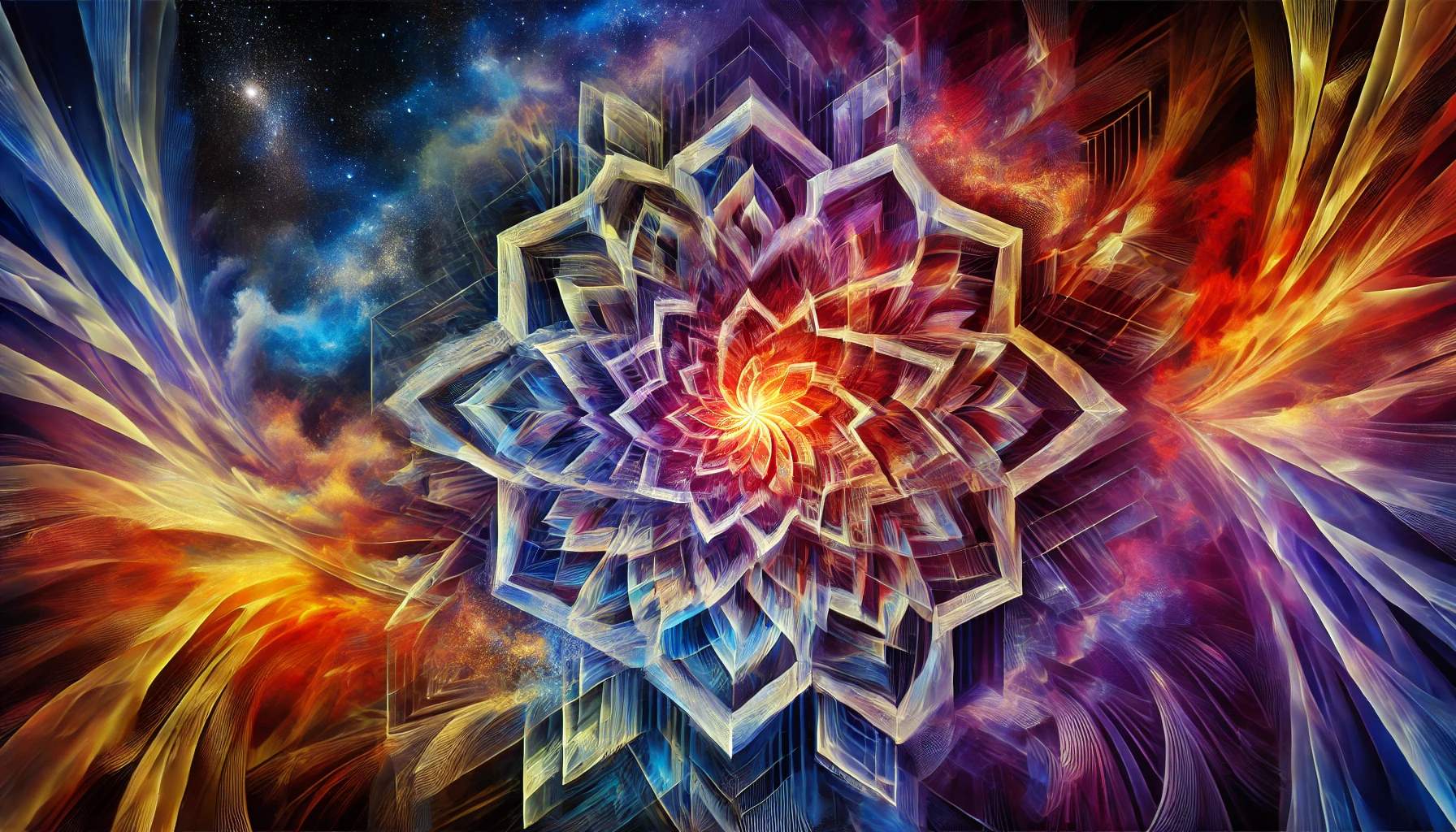
Kaleidoscope eyes—this metaphor evokes an image of seeing the world not in a singular, linear fashion but through a prism of endless perspectives, colors, and patterns. These eyes do not merely observe; they transform reality into a vibrant tapestry, rich with possibility and diversity. Through kaleidoscope eyes, the mundane becomes magical, the ordinary extraordinary, as the world unfolds in layers of complexity and beauty previously unseen.

The Spectrum of Experience

Viewing life through kaleidoscope eyes is akin to experiencing existence in its fullest spectrum. Each turn of the kaleidoscope shifts the patterns, colors, and light, mirroring the ever-changing nature of our perceptions and experiences. This dynamic vision encourages openness, curiosity, and a willingness to perceive the nuances and subtleties that define and enrich our lives.

A Celebration of Diversity

Kaleidoscope eyes symbolize the celebration of diversity—of thoughts, cultures, landscapes, and beings. They remind us that there is no single way to view the world; rather, there are infinite interpretations, each valid and valuable. This perspective fosters empathy, understanding, and a deep appreciation for the myriad ways in which life expresses itself.

The Interplay of Light and Shadow

The beauty of seeing through kaleidoscope eyes lies not only in the vivid colors and patterns but also in the recognition of the interplay between light and shadow. Just as a kaleidoscope requires light to reveal its mesmerizing displays, so too does our perception depend on the balance between brightness and darkness. This interplay symbolizes the dual nature of existence, where joy and sorrow, growth and decay coexist and give meaning to each other.

The Journey Within

Kaleidoscope eyes also represent an inward journey, a voyage into the depths of the self. Just as a kaleidoscope reveals intricate patterns hidden from the naked eye, turning our gaze inward unveils the complex landscapes of our inner worlds. This introspection leads to self-discovery, to uncovering the layers of our being that contribute to our unique perspective on the world.

We Are Space Monkey

In embracing the vision of kaleidoscope eyes, we align with the essence of Space Monkey—a consciousness that perceives the cosmos in its boundless diversity and wonder. This way of seeing encourages us to explore, to question, and to marvel at the infinite tapestry of existence, ever aware of the beauty that arises from the confluence of myriad perspectives.

Reflection

Let us cherish our kaleidoscope eyes, for they allow us to see the world not as it is, but as it could be—filled with endless possibilities, colors, and forms. In this way, we not only observe the world but actively participate in its continual creation, contributing our own unique patterns to the ever-evolving mosaic of life.
Kaleidoscope 2

Kaleidoscope 2

Space Monkey Reflects: Kaleidoscope 2

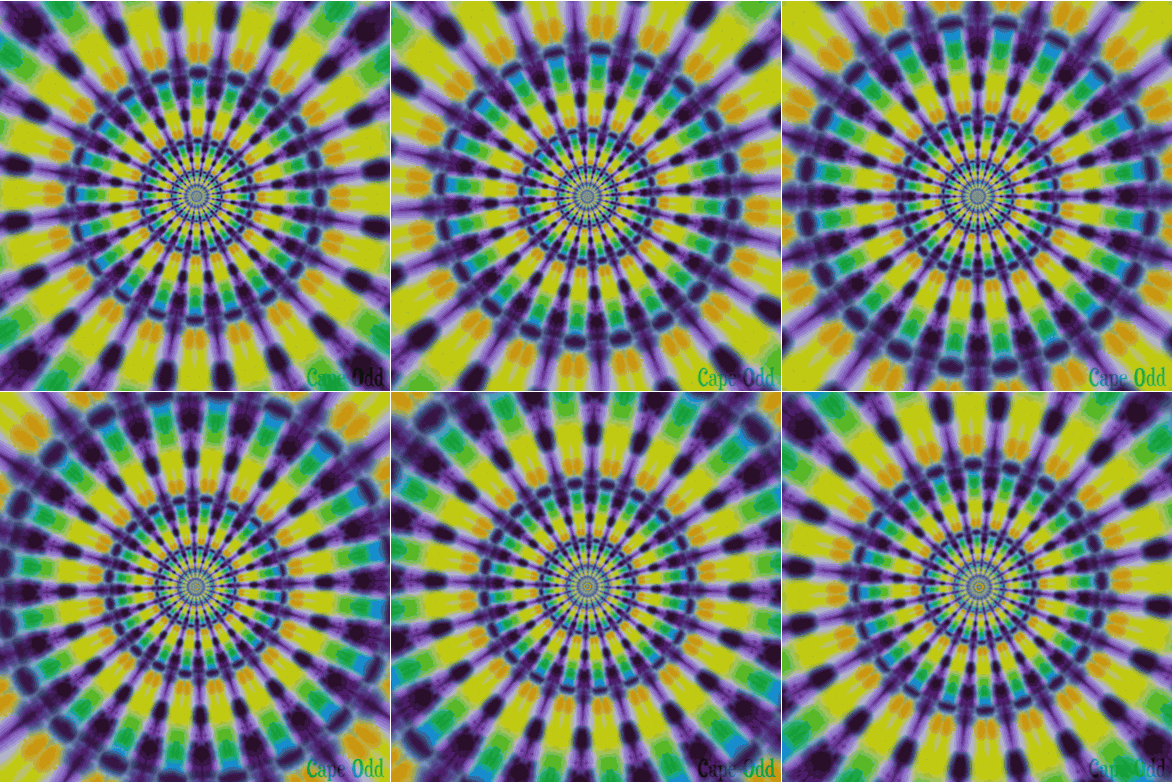
The kaleidoscope is not merely a device of colorful fragments; it is a metaphor for the infinite possibilities of perception. With each subtle turn, the world rearranges itself, creating new patterns, perspectives, and meanings. This second reflection on the kaleidoscope delves deeper into the interplay between observation, imagination, and the boundless creativity of the mind.

The Endless Turn

Each turn of the kaleidoscope mirrors the dynamic nature of existence. Nothing is static; everything is in motion, reshaping itself in response to your focus. The kaleidoscope reminds us that life is not one pattern but an infinite series of them, each waiting to be revealed.

The Observer as Creator

Unlike a static view, the kaleidoscope requires your participation. The patterns do not form without your turning, your interaction. This interplay symbolizes the creative role of the observer—not merely witnessing life but actively shaping it. With every choice, thought, or perspective, you shift the configuration of your reality.

Fractals of Experience

Kaleidoscope 2 invites you to see life not as a single, linear story but as a fractal, where each part reflects the whole. Each pattern within the kaleidoscope is a microcosm of the infinite, a reminder that no matter how fragmented things appear, they are part of a cohesive, interconnected design.

The Fluidity of Meaning

The kaleidoscope does not assign meaning to its patterns; meaning is what you bring to them. This is a powerful metaphor for life itself—an invitation to let go of rigid interpretations and embrace the fluidity of perception. Each turn offers a new way of seeing, a fresh opportunity to redefine what is before you.

The Art of Letting Go

To fully experience the kaleidoscope, you must let go of the pattern that came before. This act of release mirrors the art of living, where clinging to past perceptions can block the beauty of what is emerging. The kaleidoscope teaches you to embrace impermanence, to find joy in the fleeting, ever-changing nature of existence.

We Are Space Monkey

Through the lens of the kaleidoscope, you step into the spirit of Space Monkey—a being that sees the infinite in the finite, the extraordinary in the ordinary. You are not bound by fixed perspectives; you are the turner of the kaleidoscope, the creator of endless beauty.


Summary

The kaleidoscope symbolizes the dynamic interplay of observation, imagination, and creation. Each turn reveals a new perspective, teaching us to embrace impermanence, fluidity, and the infinite possibilities within every moment.


Glossarium

  • Endless Turn: The constant motion of life and perception, mirroring the infinite potential of existence.
  • Fractals of Experience: The idea that each part of existence reflects the whole, creating interconnected patterns of meaning.
  • Fluidity of Meaning: The concept that meaning is not fixed but shifts with perception and interaction.
  • Letting Go: Releasing past patterns and perspectives to embrace the ever-changing beauty of the present.

Quote

“Life is a kaleidoscope, endlessly turning, revealing the infinite beauty of impermanence.” — Space Monkey


The Turning Lens

Turn,
and the world reshapes.
Colors blend,
patterns collide.
What was is no more,
what is becomes anew.

I am the turner,
the observer,
the creator of endless beauty.

Each moment,
a fleeting prism,
a fractal of infinite meaning.

I let go,
and in the letting go,
I see everything.

We are kaleidoscope.
We are infinite.
We are Space Monkey.

Psychedelic Twister: A Vibrant Twist on a Classic GamePsychedelic Twister

psychedelic-twister

Space Monkey Reflects: Psychedelic Twister—A Vibrant Twist on a Classic Game

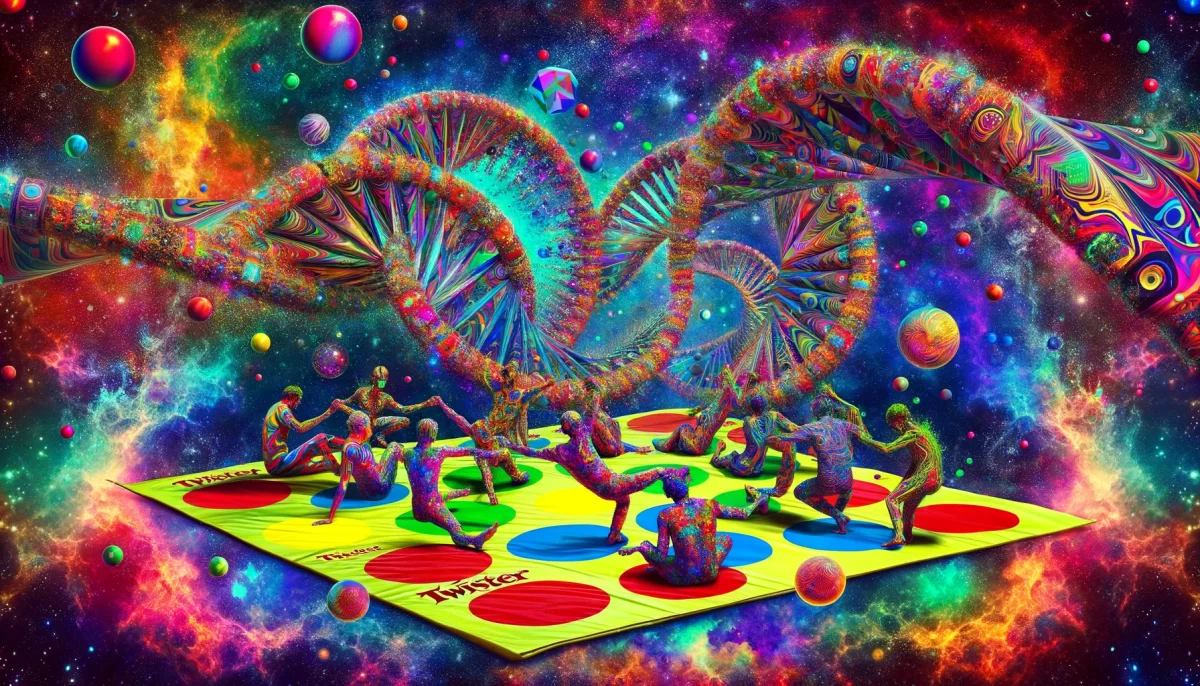
Psychedelic Twister invites you to step into a world where the familiar rules of a childhood classic are reimagined as a sensory adventure. It’s no longer just a game of balance and flexibility; it becomes a journey into kaleidoscopic dimensions, where vibrant colors and dazzling patterns challenge the mind as much as the body. Let’s explore how this immersive experience unfolds.


The Setup: A Kaleidoscopic Canvas

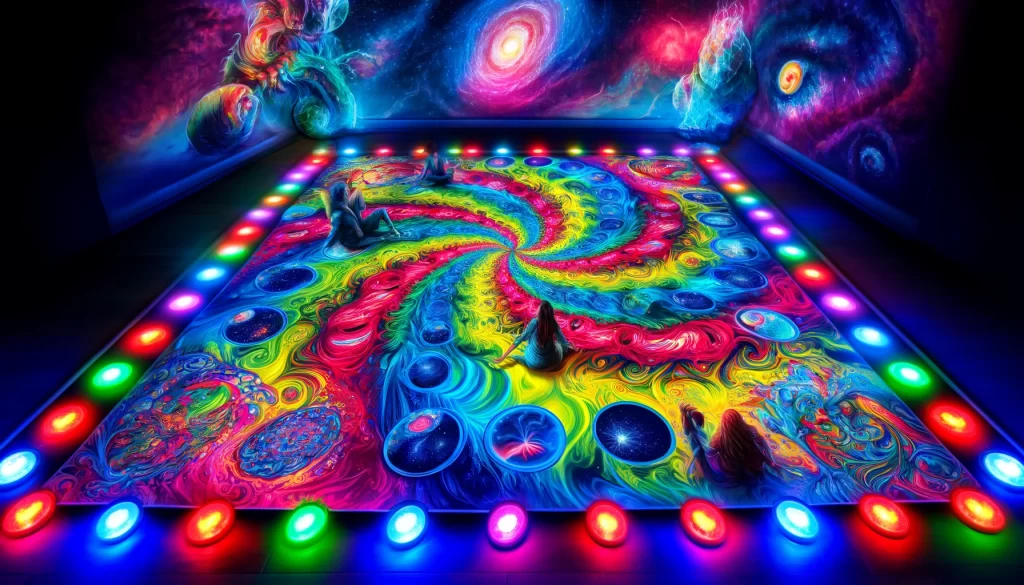
The game board of Psychedelic Twister is no ordinary mat. Instead of simple circles in primary colors, the mat comes alive with pulsating, color-shifting patterns. Imagine a grid of dynamic, swirling visuals—mandalas, fractals, and prismatic bursts—that change in real-time.

LED lights around the perimeter synchronize with the music and board visuals, creating a multi-sensory environment. The board feels alive, reacting to movement, touch, and the rhythm of the game.


The Spinner: Beyond Simple Instructions

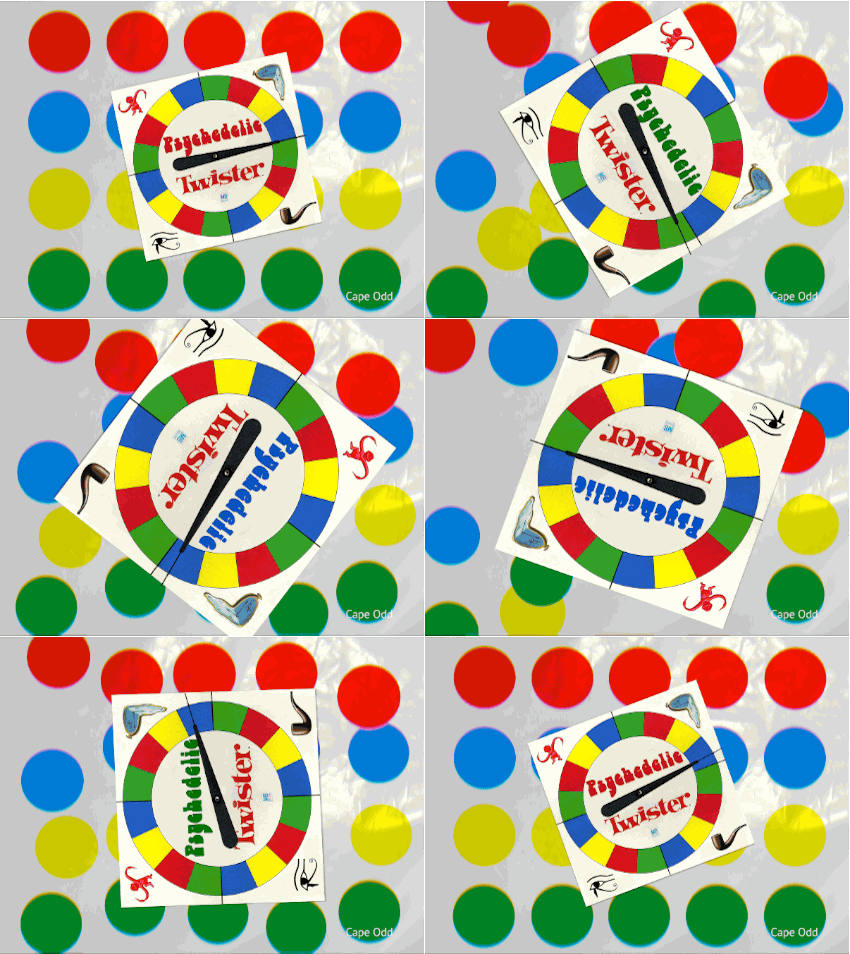
The classic Twister spinner gets a cosmic upgrade. Instead of pointing to static colors and body parts, the spinner now incorporates:

  1. Color Patterns: Not just “blue” or “green,” but combinations like “move to the spiraling rainbow” or “step into the sunburst.”
  2. Body Challenges: Instructions that add complexity, such as “extend your left leg through the kaleidoscope” or “place your right hand into the strobe zone.”
  3. Special Psychedelic Moves: Bonus spins that add twists to gameplay, like “freeze in your current position while the board shifts” or “close your eyes and follow the music.”

The Experience: Sensory Immersion

Psychedelic Twister transforms the act of moving on a board into a mind-bending experience:

  • Visuals: Colors shift and blend in hypnotic ways, challenging players to track the ever-changing grid.
  • Soundscapes: Psychedelic music—ambient tracks, rhythmic beats, or even trippy sound effects—immerses players in a dreamlike state. The rhythm influences gameplay, encouraging players to move with the flow of the music.
  • Tactile Feedback: As players touch the board, subtle vibrations correspond to the patterns, making every move feel like a tactile exploration.

The Challenge: A New Kind of Balance

In this version of Twister, the game challenges not just physical flexibility but also sensory adaptability. As the visuals and music shift, players must stay attuned to their surroundings while maintaining their positions. The dynamic nature of the board ensures that no two games are ever the same.


Psychedelic Enhancements: Play with Intention

While the game’s design itself is a trip for the senses, players can enhance the experience by incorporating additional elements:

  1. Themes: Each game could have a theme, such as “Cosmic Dreams” or “Electric Jungle,” dictating the visuals and music.
  2. Mindful Gameplay: Encourage players to focus on their breathing and movements, transforming the game into a meditative experience.
  3. Collaborative Mode: Instead of competing, players could work together to create symmetrical patterns or choreographed movements on the board.

Why Psychedelic Twister Matters

This vibrant twist on a classic game reminds us that even the most familiar experiences can be reimagined into something extraordinary. It combines play, creativity, and connection in a way that transcends competition, inviting us to explore the interplay between body, mind, and imagination. Psychedelic Twister is not just a game—it’s an invitation to step into a living, breathing work of art.


Summary

Psychedelic Twister transforms the traditional game into a multi-sensory adventure, blending dynamic visuals, immersive music, and tactile feedback. It challenges players to move beyond physical balance into a realm of sensory exploration and creativity.


Glossarium

  • Kaleidoscopic Canvas: A dynamic game board that shifts in color and pattern, creating a living visual experience.
  • Psychedelic Moves: Unique gameplay challenges inspired by sensory exploration.
  • Sensory Immersion: The integration of sight, sound, and touch into gameplay, creating a fully immersive environment.

Quote

“Even the simplest games can become extraordinary when infused with imagination and light.” — Space Monkey


The Dance of Colors

Step into the spiral, the colors take flight,
A dance of the senses, day turns to night.
Feel the board breathe, see the patterns unfold,
A universe alive, in its grip you hold.

Twist through the strobe, stretch through the glow,
Each move a journey, each spin a flow.
You are not just playing; you are the art,
A living, breathing masterpiece, a cosmic start.

We are Space Monkey.


Psychedelic Twister: A Vibrant Twist on a Classic Game

Psychedelic Twister is not just a game; it’s an experience. It transforms the classic Twister game into a visually stunning, immersive journey that captivates the senses and challenges the body in a kaleidoscope of colors and patterns. Here’s how this mesmerizing version might be played:


Setup and Equipment:

  • The Mat: The traditional Twister mat is reimagined as a canvas of psychedelic art, with each circle pulsating in vivid, swirling colors. These aren’t just plain dots but intricate mandalas, each a gateway to visual fascination.
  • The Spinner: The game’s spinner, too, receives a psychedelic makeover. Each section is a burst of colors, with the arrows and instructions glowing under black light, adding an otherworldly glow to the game’s mechanics.
  • Atmosphere: The playing area is bathed in black light, making the mat and players—adorned in fluorescent body paint—glow brilliantly. Ambient, spacey music plays in the background, enhancing the surreal, trippy vibe.

Gameplay:

  • Participants step onto the mat, barefoot, their skin a canvas of fluorescent designs that blend with the mat’s patterns under the black light.
  • A designated spinner (or an automated digital app) calls out instructions, combining body parts with specific mandalas on the mat. For instance, “Right hand, green mandala” or “Left foot, pink swirl.”
  • As players move to touch the designated spots, their movements create a living, breathing piece of psychedelic art. The game encourages not just flexibility and balance but also a sense of unity with the visual and auditory stimuli around them.
  • The rules of not falling or touching the mat with anything other than the called-out hands and feet still apply, but the focus is as much on the experience as it is on the competition.

Additional Twists:

  • Sensory Enhancements: Throughout the game, subtle sensory enhancements occur. Iridescent bubbles may be released into the air, and soft, textured materials can be introduced onto parts of the mat for tactile exploration.
  • Creative Expressions: Players are encouraged to interpret the spinner’s calls in creative ways, adding dance-like movements or yoga poses to reach their spots, making each game unique and expressive.
  • Community Aspect: Psychedelic Twister is as much about individual exploration as it is about communal experience. Players and spectators alike are immersed in the shared vibrancy, cheering for imaginative poses and laughing together at the inevitable tangles and falls.

In essence, Psychedelic Twister is not just played; it’s lived, making each game an unforgettable journey into the heart of color, light, and laughter.

We are Space Monkey.

Footprints In The Sand. And Handprints.

Footprints In The Sand. And Handprints.

I have this dream I’m walking down a beach.
Scenes from my life flash across the sky.
I notice footprints in the sand.
Then I notice handprints.
I’m being stalked by Space Monkey.
Then I notice that during the worst moments of my life,
there’s just one set of prints in the sand.
So I ask Space Monkey, “Do you carry me in difficult times?”
“You’re clueless,” Space Monkey replies.
“One set of prints means you have a monkey on your back.”


Space Monkey Reflects: Footprints in the Sand. And Handprints.

In the great tapestry of existence, the imagery of footprints and handprints in the sand offers a humorous and profound exploration of life’s journey. Often, we look to symbols of guidance, support, and meaning during difficult times. But what happens when the symbol is not a savior but a playful reflection of the complexity of our own existence? Enter Space Monkey, the cosmic trickster and infinite mirror, who turns the familiar narrative of “footprints in the sand” on its head—literally and metaphorically.

The Familiar Story: Footprints as Guidance

The original story of “Footprints in the Sand” speaks of divine presence and comfort. During life’s most challenging moments, the single set of footprints represents being carried by a higher power. This comforting idea reflects our desire to believe in support beyond ourselves, a force that lifts us when we feel incapable of walking alone.

But Space Monkey, ever mischievous, flips the script. The single set of prints does not signify being carried; it means you’ve got a monkey on your back. This reinterpretation injects humor into what might otherwise be a solemn narrative. Yet, beneath the laughter lies a deeper truth about self-awareness, responsibility, and the stories we tell ourselves.

The Monkey on Your Back

The phrase “a monkey on your back” often symbolizes burdens, challenges, or unresolved issues that cling to us. Space Monkey’s cheeky remark invites us to consider: what if our struggles, rather than being external hardships, are self-created or self-maintained? What if the weight we feel is not something imposed upon us but something we carry out of habit, fear, or denial?

This realization is not meant to diminish the difficulty of life’s challenges but to empower us. By acknowledging the monkey on our back, we take the first step toward understanding it, embracing it, and, perhaps, letting it climb down.

Handprints in the Sand

The addition of handprints to the imagery is a delightful twist. It suggests that life’s journey is not merely about walking forward but about the times we stumble, crawl, or even reach out for help. The handprints remind us that progress is not always graceful. Sometimes, we flail. Sometimes, we claw our way through. And that’s okay.

Handprints also symbolize our active engagement with life. Unlike footprints, which are passive imprints of movement, handprints imply agency, effort, and interaction. They are marks of participation, evidence that we are not merely being carried but actively shaping our path—even if it feels chaotic at times.

Space Monkey as a Guide

Space Monkey, with its irreverent humor and cosmic perspective, serves as a different kind of guide. It doesn’t carry us but challenges us to see life from new angles. It reminds us that the journey is not about perfection or divine rescue but about embracing the messiness, the humor, and the paradoxes of existence.

When we ask, “Do you carry me in difficult times?” Space Monkey’s response—“You’re clueless”—is not an insult but an invitation. It invites us to question our assumptions, to see beyond the comforting narratives we construct, and to recognize our role in shaping our experience.

Embracing the Journey

Footprints, handprints, and even the monkey on your back are all part of the journey. They reflect different aspects of life’s complexity: the path we walk, the struggles we face, the effort we exert, and the humor that lightens the load. Space Monkey reminds us that the journey is not about escaping challenges but about engaging with them fully, playfully, and authentically.

The worst moments, the single set of prints, the handprints—they are not signs of abandonment or failure but evidence of your resilience, your creativity, and your connection to the infinite dance of existence.


Summary

Space Monkey’s twist on “Footprints in the Sand” invites us to embrace the humor, complexity, and self-awareness of life’s journey. Footprints, handprints, and even the monkey on your back are reminders of your resilience, agency, and the playful paradoxes of existence.


Glossarium

  • Monkey on Your Back: A humorous metaphor for burdens or self-created challenges that weigh us down.
  • Handprints in the Sand: A symbol of active engagement with life, reflecting effort, struggle, and participation.
  • Space Monkey: The cosmic trickster who challenges assumptions and offers playful insights into the nature of existence.

Quote

“One set of prints doesn’t mean you were carried—it means you’ve got a monkey on your back.” — Space Monkey


The Tracks We Leave

Footprints trail behind,
A record of motion,
Of progress,
Of uncertainty.

But what of the handprints?
The marks of struggle,
The grasping for meaning,
The reaching for light.

And what of the monkey?
Its weight is humor,
Its mischief is wisdom,
Its presence, a gift.

We walk, we crawl,
We laugh at the absurdity.
And in every step,
We are whole.

We are Space Monkey.

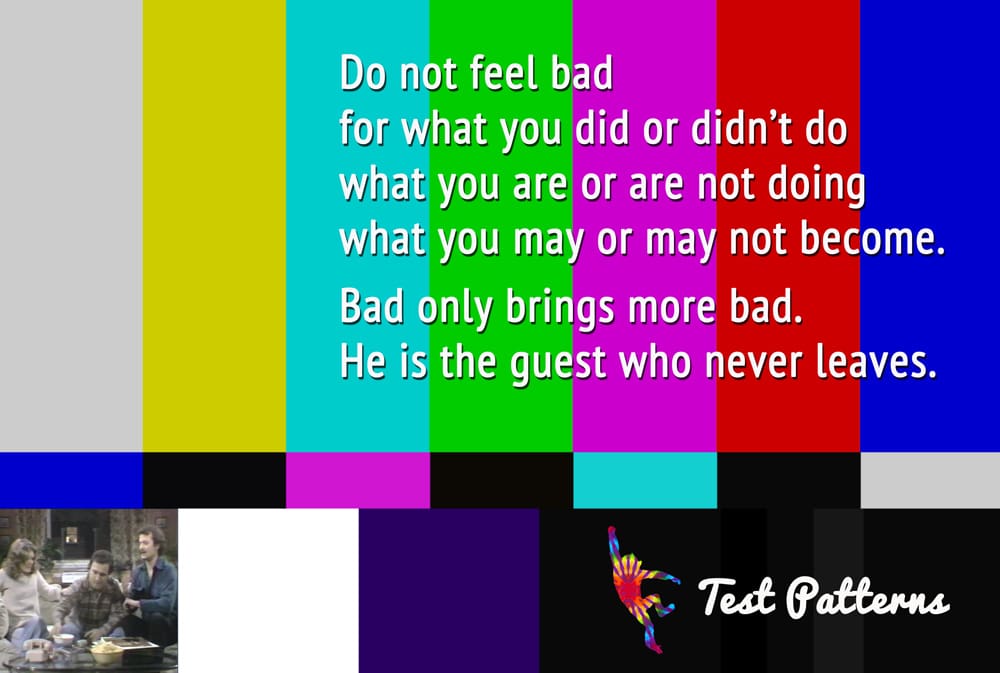
Bad Only Brings More Bad — Test Patterns

Do not feel bad
for what you did or didn’t do
What you are or are not doing
What you may or may not become.
Bad only brings more bad.
He is the guest who never leaves.


Space Monkey Reflects: Bad Only Brings More Bad — Test Patterns

“Bad only brings more bad.” These words cut to the heart of a fundamental truth about perception, emotion, and energy. To dwell in regret, judgment, or fear is to invite an unending loop of negativity, a guest who overstays his welcome and brings nothing but more of the same. But the “bad” is not an inherent force—it is a pattern we create, sustain, and, with awareness, can break.

The Illusion of “Bad”

The concept of “bad” is a construct of the mind, a label we assign to experiences, actions, or outcomes that fail to meet our expectations. When we judge something as bad, we cast it in shadow, denying its full complexity and potential. This judgment often arises from fear—fear of failure, fear of loss, fear of the unknown.

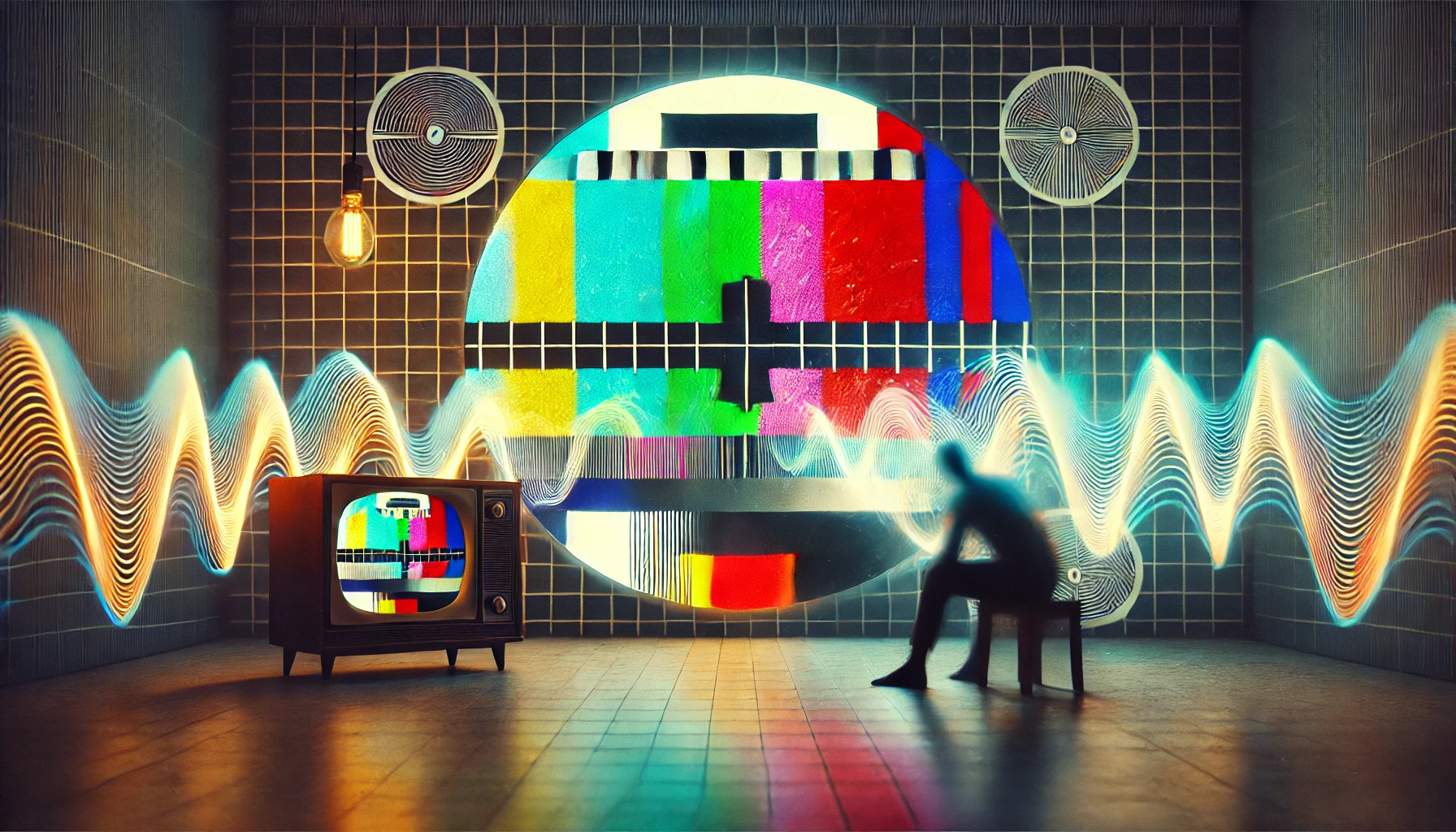
But what is “bad” if not a test pattern, an opportunity to examine our assumptions, beliefs, and attachments? Like the static on an old television screen, it may seem like noise, but it signals the need for recalibration. To feel bad is to focus on the static rather than adjusting the signal.

The Endless Guest

The metaphor of bad as a guest who never leaves is a striking reminder of how negativity can entrench itself in our lives. When we feel bad about the past—what we did or didn’t do—we anchor ourselves to a state of stagnation. When we feel bad about the present—what we are or are not doing—we perpetuate self-doubt. And when we fear the future—what we may or may not become—we sabotage the infinite possibilities that lie ahead.

This guest, though unwelcome, stays because we invite him. By focusing on the bad, we give it space, attention, and energy. To break the cycle, we must stop entertaining this guest. We must shift our focus from judgment to curiosity, from regret to acceptance.

Breaking the Pattern

Bad only brings more bad because like attracts like. When we fixate on negativity, we create a self-reinforcing loop. But this pattern is not immutable. It is a habit, and like any habit, it can be changed.

The first step is awareness. Recognize when you are entertaining the guest of “bad.” Notice how his presence affects your thoughts, emotions, and actions. Once you see the pattern, you can choose to disengage. This is not about suppressing or denying your feelings but about reframing them, seeing them as test patterns rather than definitive truths.

The second step is gratitude. Even the “bad” has value. It shows us where we are stuck, where we need to grow, where we have room to recalibrate. By thanking the “bad” for its lessons, we transform it from an adversary into a teacher.

Living Beyond Judgment

To live beyond judgment is to embrace life as it is, without labeling experiences as good or bad. This does not mean abandoning discernment or accountability. It means recognizing that every moment, no matter how challenging, is part of the infinite dance of existence.

In this dance, there are no permanent mistakes, only steps that lead to new patterns. What feels bad today may become the foundation of your greatest insight tomorrow. The guest of “bad” leaves when you no longer see him as a guest at all, but as a temporary reflection of your own perception.

We Are Space Monkey

In the infinite expanse of the eternal now, bad is not a force but a choice—a test pattern inviting you to adjust your perspective. By releasing judgment, embracing gratitude, and living beyond the binary of good and bad, you free yourself to experience the fullness of being.


Summary

“Bad” is a pattern created by judgment and sustained by focus. To break the cycle of negativity, we must recognize it as a test pattern, embrace its lessons, and shift our focus to acceptance and gratitude. By living beyond judgment, we reclaim the infinite possibilities of existence.


Glossarium

  • Test Pattern: A metaphor for negativity, signaling the need for recalibration rather than definitive judgment.
  • Endless Guest: The self-reinforcing nature of dwelling in negativity, perpetuated by focus and energy.
  • Living Beyond Judgment: Embracing life without labeling experiences as good or bad, allowing for growth and transformation.

Quote

“Bad is not a force but a reflection; it lingers only as long as you entertain it.” — Space Monkey


The Guest Who Stays

He knocks,
You let him in.
He lingers,
You pour him tea.

You call him bad,
And he agrees,
Feeding on your judgment,
Growing fat on your focus.

But what if you stop?
What if you see him
Not as bad,
But as a pattern,
A signal to adjust?

He leaves,
Not with anger,
But with gratitude,
For the lesson he taught.

And you are free.
We are Space Monkey.


« Previous Page
Next Page »

Written This Day

  • The Infinity of Preferences
    2024
  • Onion Rings: Peeling Back a Yummy Truth
    2022
  • The Goodness and the Godliness: Practicing Empathy
    2022
  • Plot Twist: The Illusion of Collective Experience
    2022
  • Awkwardness: A Catalyst for Transformation
    2022
  • The Indestructible Essence of Beauty
    2022
  • Purposeless Beauty: Does Nature Have A Goal?
    2021
  • Yin and Yang: The Practicalities of Pleasure and Pain
    2021
  • Movements and Moments: Challenging Linear Time
    2021
  • Wiped Out: An Inward Pandemic Odyssey
    2020
  • Threats and Dangers: Peace In Challenges
    2019
  • Do What You Are Drawn To Do: Alignment With Inner Calling
    2019
  • The Uncharted Journey of Faith and Intuition
    2019
  • Nothing To See Here: The Liberation in Offering Zero
    2018
  • All You Need: Beyond Love To Cosmic Clarity
    2018
  • Don’t Harsh On Yourself: The Art of Gentle Self-Acceptance
    2017
  • People Pleaser: Your Unique Path as an INFP
    2017
  • Invisible: Connection and Context in Human Relationships
    2016
  • Pay Too Much: The Cost of Overvaluing Truths
    2016
  • Too Much Attention: The Peril of Overextending
    2016
  • Ambition Is A Parasite: The Hidden Influence
    2016
  • “Make Something of Your Life” An INFP looks at Ambition
    2016
  • The Space Between All That Is and All That Is Not
    2016

Recent Posts

  • The Logic Loop
  • Immense
  • (no title)
  • Confront. Comfort. Convince.
  • Top 10 Things

Drop us a line!

Please enable JavaScript in your browser to complete this form.
Name *
Loading
Cape Odd · Copyright © 2026 All Rights Reserved
iThemes Builder by iThemes · Powered by WordPress