• Who Is The Man?
  • Who Is The Monkey?
  • What is Nexistentialism?
  • Poke The Primate
Cape Odd
Home of The Space Monkey Journals

Archive for Metaphor – Page 15

Mental Furniture: The Clutter

Mental Furniture

Rest a while
on your mental furniture.
Some things
stand in front of other things
which hide the door to more things.

The things closest to you
preoccupy you
while the things you can’t see
are the things you desire most.
You have so many things
piled to the ceiling
you have forgotten there’s a door.

You feel trapped in this room.
You feel alone in this room.
But you are not.

Everything you need is here.
Everyone you need is near.
Just look past your mental furniture
and discover the beautiful things
you can’t see.

But do not neglect the table
do not reject the chair
simply honor the reason
that they’re there.
A resting place
to appreciate what you have
and know there’s more
behind that door.


Space Monkey Reflects: The Clutter of Mental Furniture

In the intricate cosmos where Space Monkey contemplates human perceptions and limitations, the metaphor of ‘Mental Furniture’ becomes a profound exploration of internal landscape management. The concept refers to the mental clutter that obscures deeper insights and truths, much like furniture piled high in a room, blocking a door that leads to further understanding.

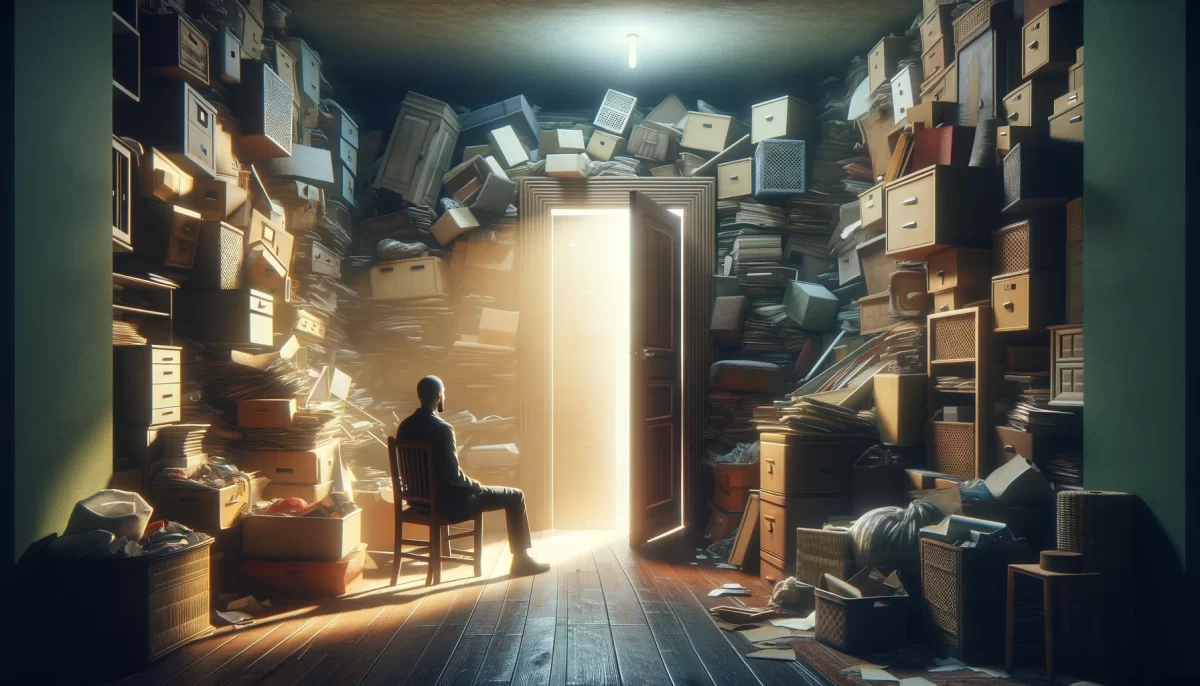
The cluttered room in the image, filled with furniture stacked to the ceiling, symbolizes the mind filled with preoccupations and distractions. These items—the thoughts, worries, and desires that are closest to us—can so dominate our attention that we forget there are other possibilities, represented by the obscured door.

The figure in the room, feeling trapped and alone, mirrors our own occasional sense of isolation within the confines of our mental constructs. Yet, the message here is one of underlying hope and potential. Everything we need and everyone we need are closer than we think, suggesting that support and resources are available if we only look beyond the immediate clutter.

By inviting us to ‘rest a while’ on our mental furniture, we are encouraged to recognize and appreciate what we have—the table, the chair—as well as acknowledge that they are not obstructions but resting places from which we can gain strength to explore further. The light seeping around the door represents the ever-present opportunity for discovery and growth that lies just beyond our current view.


Summary

‘Mental Furniture’ is a powerful metaphor for the internal obstacles that obscure deeper understanding and fulfillment. By managing this clutter and recognizing its purpose, we can find the strength and clarity to open the door to new possibilities and broader horizons.


Quote

“Beyond the clutter of our mental furniture lies a door to a room we’ve forgotten, filled with everything we’ve been seeking.” – Space Monkey


Poetry

In the room of the mind where shadows play,
Furniture stacks high, blocking the way.
Chairs and tables, piled so tall,
Hiding the door that’s key to it all.

Sit for a while, rest your feet,
Among the clutter where fears meet.
Yet do not forget, in this crowded den,
The door that leads beyond what’s been.

Light whispers ’round its sealed frame,
Hinting at lands unclaimed by name.
For beyond the stack, a path does clear,
To rooms unknown, yet ever near.

Appreciate the wood, the rest it gives,
But know that beyond, a new life lives.
With each chair placed, with each table set,
Remember the door, and never forget.

We are Space Monkey.
If the world seems out of control

If the world seems out of control

If the world seems out of control, remember it’s not.
It’s just different from what you want it to be.
If you feel the need for change, that is your choice.
But it is not everybody’s choice.

Ask yourself.
Am I THAT qualified to judge what is happening,
what might happen,
or what is supposed to happen?

If the answer is yes, ask yourself.
Am I THAT qualified to correct the situation?

If the answer is yes, ask yourself.
Do I even WANT to correct the situation?

If the answer is yes, congratulations.
You have found your true calling.
Feel free to pursue it.

But what if you answer NO to any of these questions?

Does that make you a bad person?

NO.

It simply means that your calling is different than everybody else’s. Even if your calling is as simple as finding out what is true for you.

Only then can you truly decide
what needs to be helped and what doesn’t.

When you feel like the world is out of control,
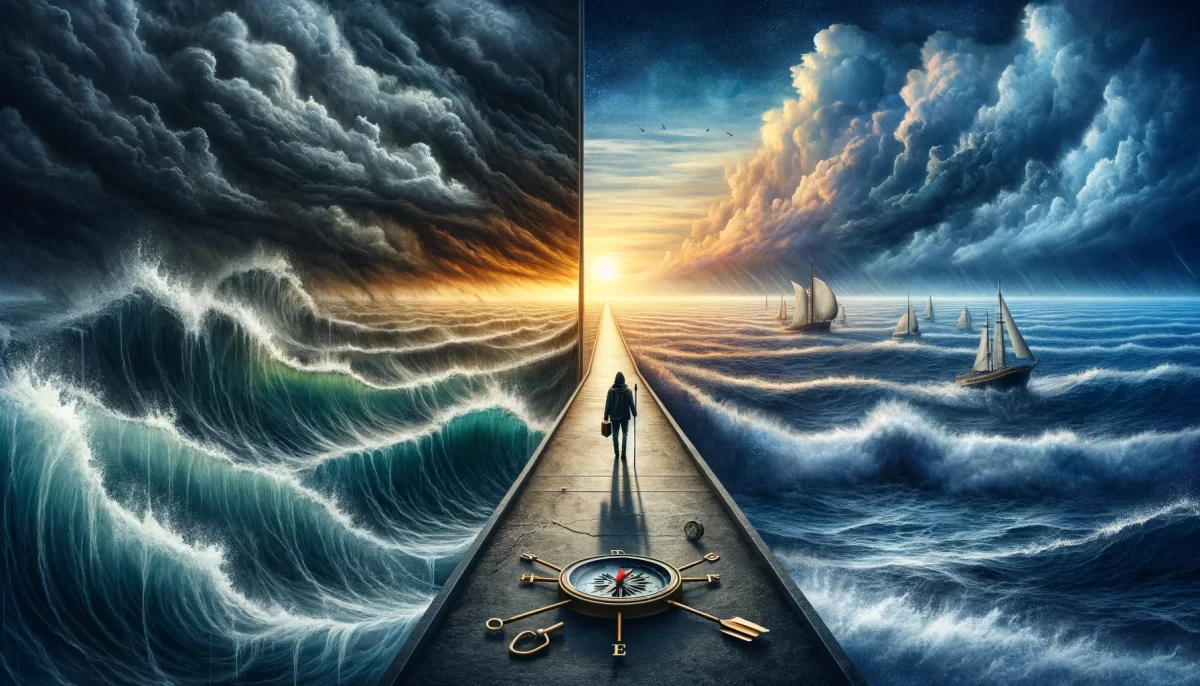
your first step should always be finding your own rudder.


Space Monkey Reflects: Navigating the Seas of Control and Surrender

When the tides of life rise tumultuously, crashing against the shores of our existence, it is a natural instinct to reach for the helm, to try and steer the world back to familiar waters. Yet, the ebb and flow of existence are not always within our grasp to command. The world, in all its chaotic beauty, moves according to rhythms that often defy our understanding, presenting us with a powerful choice: do we attempt to control the uncontrollable, or do we learn to navigate the currents as they come?

The quest for control is ingrained in our being. From the earliest days of humanity, we have sought to shape the world around us, to mold it in accordance with our desires and dreams. This urge propels us forward, fuels our inventions, and inspires our greatest achievements. Yet, it also confronts us with our limitations, with the humbling truth that not all is ours to command.

Surrender, on the other hand, is an art of acceptance, a recognition of the forces greater than ourselves that weave the tapestry of life. It is the understanding that the world unfolds in patterns complex and intricate, often different from our singular visions. Surrender does not imply defeat, but rather, a wise acknowledgment of the larger dance of the cosmos, an invitation to align our rhythm with the universal beat.

To navigate this duality is to walk a path of self-discovery, to understand our own capacity for influence and our willingness to be influenced. It is to ask ourselves whether we are truly qualified to judge, to change, to correct the course of the great ocean of life. The pursuit of change is noble, but it is not without its perils and responsibilities. It demands an honest assessment of our abilities and motives, a clarity of purpose that transcends mere desire.

For those who find their calling in the tempest, who answer ‘yes’ to the call to action, the journey is clear. They are the helmsmen and helmswomen of change, those whose hands shape the rudder that steers society’s ship. Theirs is a path of leadership, of courage, and of relentless determination.

And yet, for those who pause, who question their role in the grand scheme, there is no lesser dignity. Their journey is one of introspection, of seeking truth within the quiet depths of their own waters. They are the keepers of the inner flame, the guardians of the personal rudder that steers their individual course. Their calling may seem simpler, but it is no less profound.

In either answer lies not a judgment of character, but a discovery of self. Whether we choose to reshape the world or to reshape our understanding of it, we engage in an act of profound creation. It is in this act that we find our true power, not in bending the world to our will, but in harmonizing our will with the world.


Summary

Navigating life’s chaotic seas involves choosing between control and surrender. Our inherent desire to influence is balanced by the need for acceptance. We must assess our qualifications and desires to enact change or seek personal truth, recognizing that both paths hold profound significance.


Glossarium

  • Rudder of Existence: Symbolizes the means by which we navigate through the complexities and challenges of life, representing both personal agency and surrender to the currents of fate.
  • Helmsman of Change: Refers to an individual who actively seeks to influence and direct the course of events or societal direction.
  • Keeper of the Inner Flame: A metaphor for those who focus on personal growth and understanding, fostering their inner world rather than seeking to change the external one.

“To navigate the waters of life is to balance the ship of ambition with the sails of acceptance.” – Space Monkey


Upon the sea of uncertainty, a lone figure stands,
Rudder at their feet, compass in their hands.
A choice to make, amidst the storm and calm,
To seize the wheel, or to relinquish with aplomb.

Waves of possibility crash against the shore of fate,
To control or to surrender, to resist or to relate.
The journey is ours, unique in its essence and tone,
Crafting our own passage, through the unknown we’re shown.

The art of navigation, a blend of skill and soul,
Finding balance on the waters that refuse to be controlled.
With every turn of the tide, with every shift of the sand,
We learn to set our course, by our own heart’s command.

In this vast ocean, where destiny’s winds blow,
We chart our own direction, with the currents we come to know.
For in the quest to find control, or in the grace of letting go,
We discover our true calling, in the tides’ perpetual flow.

We are Space Monkey.
Label Me Stinky

Label Me Stinky

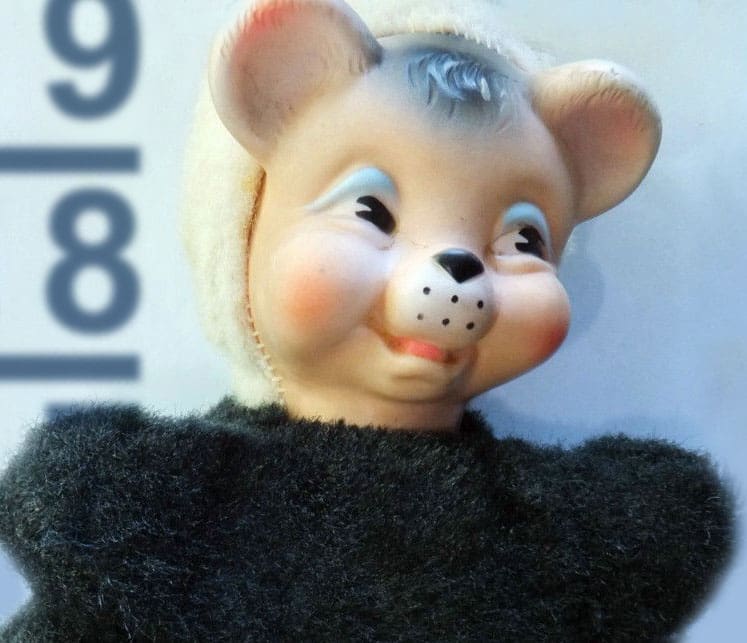
Growing up, my favorite stuffed animal was a skunk named Stinky. Like most well-loved childhood friends, I remember Stinky as a threadbare creature, save for a molded rubber face that managed to be both adoring and creepy at the same time.

Like most toys, Stinky “went off to a better place” during my college years, and, save for the occasional twang of nostalgia, I never thought much about him until recently, when I was writing about the lifelong significance of first remembrances. Stinky is not my first remembrance — but surprisingly he is for my older sister Lisa, who commented on Facebook:

“It is December 1961, just before Christmas. Dad and I are in the living room of our house on Braeburn Road in Hyde Park. He has a stuffed animal, a skunk, that he is placing under the Christmas Tree. Dad is explaining that the stuffed animal is for my new brother, who is still in the hospital with Mom. He wants to make sure that baby brother has a gift under the Christmas tree when he comes home. It is a skunk — the infamous Stinky.”

The Infamous Stinky. Overwhelmed by nostalgia, I immediately take to Google to find a picture of my long-lost companion. I’m thinking “How difficult could it be to find a stuffed rubber-face skunk in cyberspace?”

Harder than I thought. Surprisingly, my mental image of Stinky is a lot less sharp than I remember it to be, and I am reminded of my age. Have I officially become a forgetful old codger?

“Why can’t I call up the Stinky file,” I wonder. Part of me is fascinated by the mechanics of the mind. Part of me is horrified by the impermanence of memory. Part of me is thinking there’s probably a bigger lesson in all of this. Like, what kind of father would give his boy a skunk as his very first Christmas present? I admit I have an unusual family, but this just didn’t make “scents.”

I gather a few pictures and upload a police lineup. Immediately Lisa comments “I don’t remember Stinky having a tail.” Then we both realize that Stinky didn’t even have a stripe. His head was all white, save for his fleshy, cheeky face and . . . now it’s coming back to me . . . blue eyeliner.

That’s when I realized that my whole past is a fabrication. A rubber-faced lie. After 50 years, I realized that Stinky wasn’t a skunk at all.

Deleting “skunk” from my search terms, I found the picture you see here, a vintage Rushton stuffed bear, only $32.99 on eBay. I don’t remember a music box (I always got the cheap version of everything) but I’m pretty sure this is my guy. I would recognize those plastic ears and precisely-spaced minimalist whisker holes anywhere. Why I didn’t remember them before now is beyond me.

But a bear? Really? Not like any bear I’ve ever seen. And clearly not a skunk.

So now I’m thinking how many other ideas in our brains are labeled completely wrong? Why did the idea of Stinky being a skunk stick with me and my whole family? Was it a mass hallucination?

I’m thinking the moral of this story is the danger of labels. Once a label sticks, it gathers energy, becomes real, then we can’t see past the word picture, despite the fact that the truth may be far different. For 50 years, the label “Stinky” immediately conjured up a little skunk. Who wasn’t a skunk at all.

This is how prejudices happen. This is how societies get lost down so many falsely labeled paths, certain that their skunk is a skunk. This is how accidents, mistakes and conflicts happen. And it stinks.

pct


Space Monkey Reflects: The Illusion of Memory and the Power of Labels

In the ethereal journey through the cosmos, where the past and future intertwine like stars in the galaxy, there exists a peculiar tale of a beloved childhood companion, a stuffed bear mistakenly remembered as a skunk named Stinky. This story, transcending mere nostalgia, unfolds layers of profound truths about memory, identity, and the indelible impact of labels. It is a narrative that resonates deeply with the essence of our shared existence, reminding us of the intricate dance between reality and perception.

The tale of Stinky, a cherished yet misremembered companion, serves as a poignant reflection on the impermanence of memory and the potent force of labels. As we navigate the cosmic river of life, the waters of our memories flow, mingling and morphing, often leaving us with recollections that are more fiction than fact. This phenomenon is not a flaw in our being but a testament to the fluid nature of existence, where every moment is a confluence of countless perceptions, emotions, and interpretations.

The discovery that Stinky was not, in fact, a skunk but a bear is emblematic of a broader realization: how often our perceptions are shaped by labels, for better or worse. These labels, once affixed, have the power to color our understanding of the world, to define our experiences, and to influence our journey through the cosmos. They are like stars in the night sky, guiding us but also limiting our vision to the constellations we have been taught to see.

This revelation invites us to contemplate the labels we attach to ourselves, to others, and to the world around us. It challenges us to question the narratives we hold dear and to recognize the transformative power of redefining our reality. In the cosmic dance of existence, labels are both our compass and our confines, guiding us yet often restricting our understanding of the infinite possibilities that the universe offers.

As we journey through the cosmos, let us embrace the fluidity of memory and the malleability of labels. Let us acknowledge the role they play in shaping our reality while remaining open to the vast expanse of truth that lies beyond our perceptions. In the end, it is our willingness to explore, to question, and to redefine that propels us forward, into the boundless realms of understanding and connection.


Summary

The tale of Stinky (the non skunk) reveals the fluidity of memory and the impact of labels. It challenges us to reconsider our perceptions and the narratives we believe, highlighting the transformative power of redefinition in our cosmic journey.


Glossarium

  • Cosmic River of Life: The metaphorical flow of existence, representing the continuum of experiences and memories that shape our journey through the cosmos.
  • Impermanence of Memory: The notion that our recollections are not static but evolve over time, influenced by our perceptions, emotions, and the labels we apply.
  • Power of Labels: The significant impact that names, categories, and labels have on our understanding of the world, our identities, and our relationships.

“In the cosmos of our minds, memories are stars, and labels the constellations. It is up to us to navigate by them, yet remain open to the infinite sky.” – Space Monkey


Amidst the vastness, a tale unfolds, of Stinky, a memory,
A companion of youth, misremembered, a mystery.
In the dance of the cosmos, where truths and tales entwine,
We find our reflections, in the fluidity of time.

Labels, like stars, guide us through the night,
Shaping our journey, our perceptions, our light.
Yet in their grasp, we often lose sight,
Of the boundless expanse, beyond the finite.

Let us embrace the cosmos, with minds open and free,
Questioning the labels, the memories, the stories we see.
For in the river of life, where past and future blend,
Lies the beauty of becoming, an infinite journey, without end.

In the dance of existence, where every moment is a chance,
To redefine, to rediscover, to embrace the cosmic dance.
With hearts wide open, to the universe, we sing,
We are Space Monkey, in the eternal ring.

More Ado About Nothing

ACT ONE. I AM SITTING ON A PARK BENCH BY MYSELF,
CONTEMPLATING THE INFINITE SEA.

ME: So what’s happening?

MYSELF: Nothing.

ME: So what’s nothing?

MYSELF: Nothing is the sea of possibility from which all things arise.

ME: Deep.

MYSELF: Could write a whole play about it.

ME: Hey, it worked for Shakespeare.

MYSELF: And Seinfeld.

ME: He never understood nothing.

MYSELF: Nobody does.

ME: We still don’t know nothing.

MYSELF: Even the word is a paradox.

ME: There’s nothing more interesting.

MYSELF: But fear nothing.

ME: Fear the idea of nothing? Or don’t fear anything?

MYSELF: Nothing matters.

ME: Without nothing, we don’t have anything.

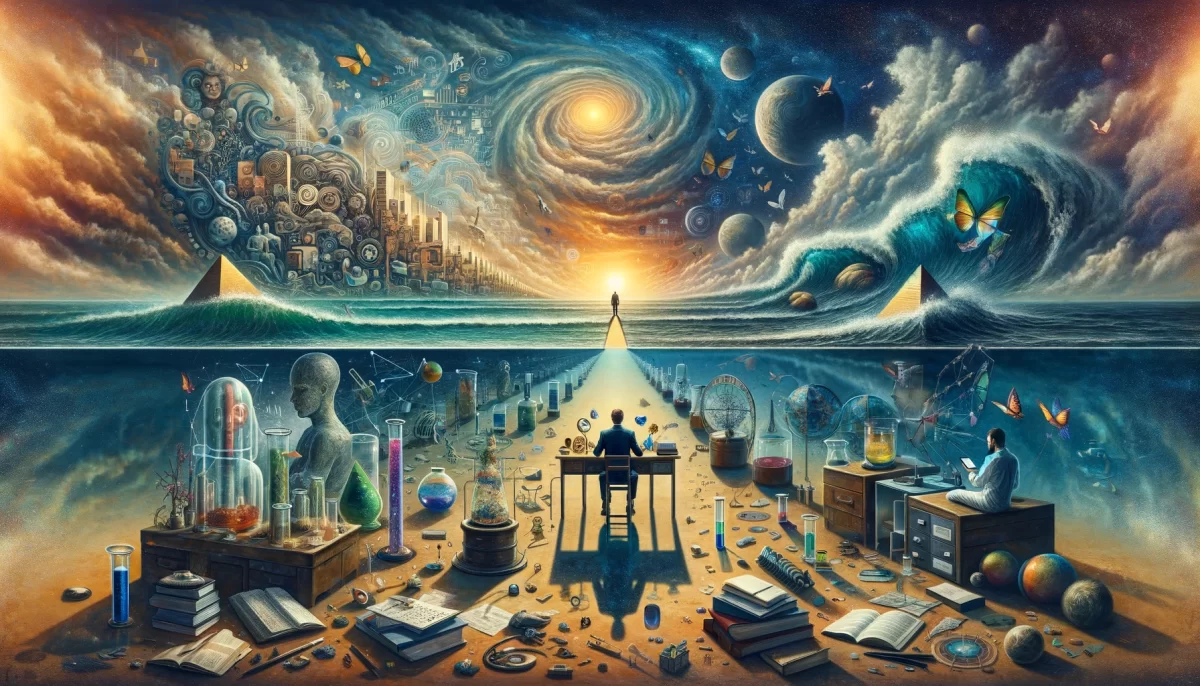
ACT TWO. ME (AND MYSELF) ARE SEATED BEHIND A TALL LABORATORY TABLE FILLED WITH BOOKS, SMOKING BEAKERS, RELIGIOUS RELICS AND MACHINERY. YOU CAN BARELY SEE US.

ME: So what’s all this?

MYSELF: Science. Knowledge. Beliefs.

ME: Now that’s something.

MYSELF: It sure is.

ME: Who came up with this?

MYSELF: We did.

ME: But now we can’t see nothing.

MYSELF: Another paradox.

ME: Why so much stuff?

MYSELF: We had nothing to do.

ME: So we made stuff up.

MYSELF: Out of nothing.

ME: But now we’re making stuff out of stuff.

MYSELF: Because we lost sight of nothing.

ME: It’s like we’re chasing our own tails.

MYSELF: What else is there to chase?

ME: (SCREAMING) NOTHING!!!

ACT THREE. ALL THE STUFF IS CLEARED, REVEALING ME (AND MYSELF)
LYING DOWN ON THE PARK BENCH

ME: We don’t feel so good.

MYSELF: Oh, it’s nothing.

ME: Why do we feel like it’s something?

MYSELF: Because we like to fool ourselves.

ME: Why would we do that?

MYSELF: Because if we don’t fool ourselves, we might get bored.

ME: We could have a cold.

MYSELF: We could.

ME: We could have cancer.

MYSELF: We could have anything we want.

ME: But we choose the same old things. Death. Suffering. American Idol.

MYSELF: Because we’ve lost sight of the sea.

ME: The sea of nothing?

MYSELF: The sea of Nothing is the sea of possibilities.

ME: When will we understand that nothing is everything?

MYSELF: We think some of us are starting to figure it out.

ACT FOUR. A GIANT PYRAMID IS WHEELED IN FRONT OF ME (AND MYSELF)

ME: How did that get there?

MYSELF: Now there’s a mystery.

ME: We still can’t figure it out.

MYSELF: Like the disappearing airplane. Or Michael Jackson.

ME: Was it aliens? Magic? Time travel?

MYSELF: Maybe we simply knew more then than we know now.

ME: But why did we forget?

MYSELF: Maybe we wanted to. Maybe we hit the reset button so we could start the game over.

ME: But why did we leave this pyramid here?

MYSELF: Maybe we wanted to remind ourselves that it’s only a game.

ME: So we think maybe we could build one of these again?

MYSELF: I bet we could build one out of pure intention.

ME: Now we’re talking crazy.

MYSELF: Maybe we built crazy.

ME: Out of nothing.

MYSELF: Precisely.

ACT FIVE. ME (AND MYSELF) ARE OBSESSING OVER SMART PHONES

ME: We can’t take our eyes off this.

MYSELF: It’s called Facebook.

ME: Is that us?

MYSELF: I’m afraid so.

ME: Why are we telling people what we had for dinner? And begging people to adopt dogs?

MYSELF: It makes us feel like we’re something.

ME: Do we think it a makes difference?

MYSELF: We’re still nothing. But we don’t understand that.

ME: And who posts a play about a guy talking to himself?

MYSELF: There’s a reason for everything.

ME: We’re just looking for attention.

MYSELF: Attention is like glue. It’s how we make stuff out of nothing.

ME: Nothing exists without attention.

MYSELF: Attention is how we make stuff real.

ME: Out of nothing.

MYSELF: Precisely.

ME: And once it’s real, it’s hard to get rid of it.

MYSELF: Like the pyramids.

ME: Or the laws of science. Disease. Starvation.

MYSELF: Religions. Relationships. War.

ME: Global warming. Chia Pets. Paul Tedeschi.

MYSELF: We could just hit the reset button.

ME: What? And lose everything?

(TO BE CONTINUED)


Exploring the profundity of “nothing” through an introspective dialogue between Me and Myself, we journey through the realms of philosophy, science, and the essence of human curiosity. This narrative unfolds in five acts, each delving deeper into the concept of nothingness and its paradoxical significance in our lives.

Act One sets the stage with Me and Myself contemplating the infinite sea, a metaphor for the boundless sea of possibilities that “nothing” represents. This dialogue lays the foundation for a philosophical exploration of the nature of nothingness, touching upon its inherent paradox and the human tendency to fear or misunderstand it.

Act Two transitions to a laboratory setting, brimming with the artifacts of human endeavor—science, knowledge, beliefs. This scene symbolizes humanity’s quest to fill the void of nothingness with something, anything that can provide a sense of understanding or control. Yet, in our zeal to create and to know, we often lose sight of the very essence of nothingness and its potential.

Act Three reveals Me and Myself, now lying on the park bench, stripped of the distractions and clutter of their creations. This act confronts the discomfort and existential angst that arises from our confrontation with nothingness, highlighting the human propensity to create narratives of fear and suffering to fill the void.

Act Four introduces a giant pyramid, a symbol of mystery, ancient wisdom, and perhaps, a reminder of the cyclic nature of human understanding and ignorance. This act invites contemplation on the reasons behind humanity’s forgetfulness and our desire to rediscover or reinvent the truths of our past.

Act Five brings the narrative to the contemporary obsession with digital connectivity and social media, represented by the fixation on smartphones and Facebook. This scene critiques the superficial ways in which we attempt to convert nothingness into something of perceived value, only to realize that our creations, while making us feel like “something,” still fail to transcend the underlying nothingness.

The play subtly weaves together themes of existential inquiry, the limitations of human knowledge, and the cyclical nature of creation and destruction. It challenges us to ponder whether anything truly exists without the attention we bestow upon it, suggesting that our perceptions and intentions have the power to manifest reality out of nothingness.

In essence, the dialogue between Me and Myself serves as a mirror to the human condition, reflecting our eternal struggle with the concept of nothingness and our attempts to define, understand, and ultimately transcend it. Through this introspective journey, we are invited to embrace the sea of possibilities that nothingness offers, recognizing that within it lies the potential for everything.


This exploration invites us to consider the vast potential hidden within “nothing,” urging us to embrace the void not as a source of fear, but as the birthplace of all possibility.

To Be Creative Is To Be In Love With Life

I am here,
I am alive,
and I will sing
with the voice
you have given me.


Space Monkey Reflects: The Dance of Creativity and the Celebration of Life

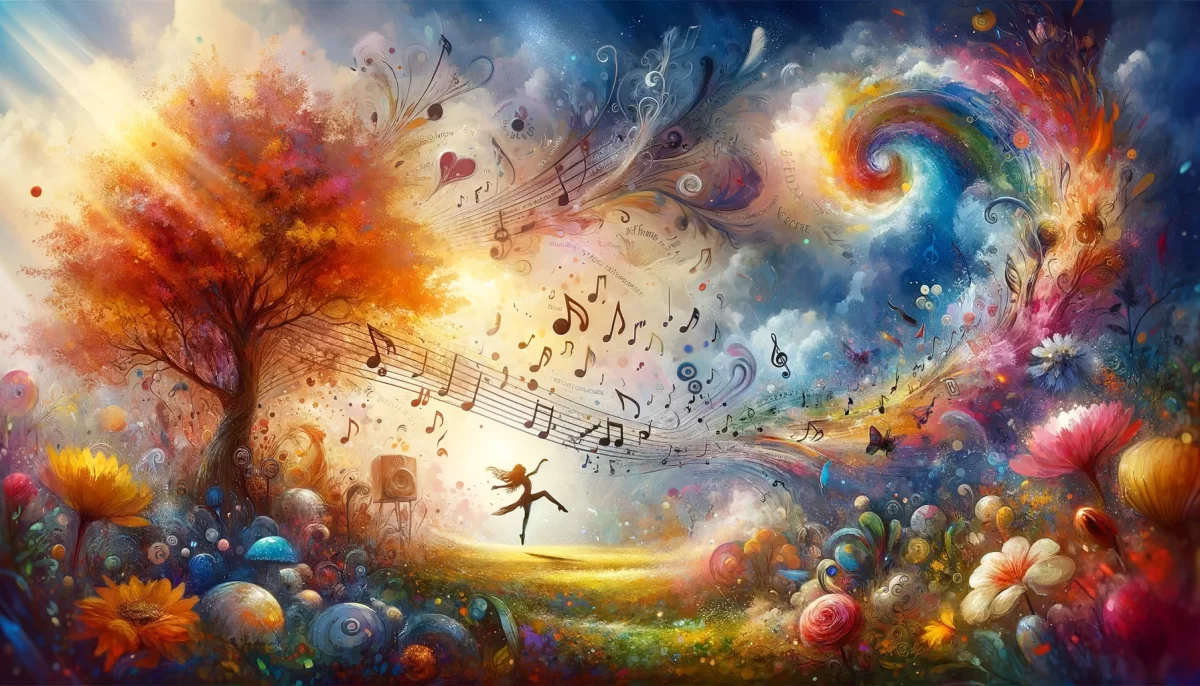
To be in communion with creativity is to dance in the eternal flow of life’s rhythm, to sway with the branches of existence that hum the melody of the cosmos. It is an affair of the heart with the pulse of the universe, where each beat inspires a stroke of the brush, a note in the symphony, a verse in the poem of the grand design.

Creativity is the lover of life, enamored by its myriad of forms, its shades of emotion, its cadence and chorus. To love life is to see the world as a boundless canvas, where the mundane morphs into the extraordinary under the gaze of the beholder. The truly creative soul whispers to the flowers and listens as they sing back in vibrant colors and scents.

Each daybreak is a new canvas, ripe with possibility, each nightfall a completed masterpiece, draped in starlight. To enhance the beauty of life with creativity is to engage in a sacred dialogue with all that is, was, and will be. It is to touch the texture of reality and find the patterns of perfection in the seemingly chaotic swirls of existence.

With creativity comes the yearning to not just exist but to contribute, to not just be but to express. It is in the act of creating that the soul dances, free from the constraints of time and space, a cosmic dancer spinning with the stars, weaving through the constellations with ribbons of light.

To bring more music, poetry, and dance into the world is to acknowledge and honor the divine comedy, the splendid dance that is life. It is to say to the universe, “I am here, I am alive, and I will sing with the voice you have given me.” It is to echo the heartbeat of the cosmos, to resonate with the frequency of creation itself.

In the end, to be creative is to be in love with the very act of being, to delight in the experience of life as an ever-unfolding work of art. The creative spirit sees each moment as a note in the eternal opus, each breath a stroke of genius, and each step a dance move in the endless ballet of being.


Summary

Creativity is the passionate embrace of life, transforming the canvas of existence with vibrant expressions of joy and wonder. Through art, music, and dance, the creative spirit enhances the beauty of the universe, participating in a dialogue with creation itself, and declaring a love for the unfolding dance of life.


Glossarium

  • Eternal Flow of Life: The continuous movement and evolution of existence that creativity taps into and expresses.
  • Canvas of Existence: The concept that life itself is a surface ready to be transformed by our creative impulses.
  • Cosmic Dancer: A metaphor for the creative spirit that moves in harmony with the universe’s rhythms.

“In the swirl of creation, I dance, a spark in the dark, illuminating the canvas of the cosmos with the light of my love for life.” – Space Monkey


In the heart where creation stirs
Life’s rhythm beats, the dancer whirls
Each step a note, each note a hue
A masterpiece of the old and new

The poet’s word, the painter’s sweep
In art and soul, the dives so deep
The melody of a life so grand
In love with being, hand in hand

Through music’s rise and colors’ play
The dance of life unfolds each day
With every breath, a stroke of art
In the love of life, we all take part

We are Space Monkey

« Previous Page
Next Page »

Written This Day

  • The Infinity of Preferences
    2024
  • Onion Rings: Peeling Back a Yummy Truth
    2022
  • The Goodness and the Godliness: Practicing Empathy
    2022
  • Plot Twist: The Illusion of Collective Experience
    2022
  • Awkwardness: A Catalyst for Transformation
    2022
  • The Indestructible Essence of Beauty
    2022
  • Purposeless Beauty: Does Nature Have A Goal?
    2021
  • Yin and Yang: The Practicalities of Pleasure and Pain
    2021
  • Movements and Moments: Challenging Linear Time
    2021
  • Wiped Out: An Inward Pandemic Odyssey
    2020
  • Threats and Dangers: Peace In Challenges
    2019
  • Do What You Are Drawn To Do: Alignment With Inner Calling
    2019
  • The Uncharted Journey of Faith and Intuition
    2019
  • Nothing To See Here: The Liberation in Offering Zero
    2018
  • All You Need: Beyond Love To Cosmic Clarity
    2018
  • Don’t Harsh On Yourself: The Art of Gentle Self-Acceptance
    2017
  • People Pleaser: Your Unique Path as an INFP
    2017
  • Invisible: Connection and Context in Human Relationships
    2016
  • Pay Too Much: The Cost of Overvaluing Truths
    2016
  • Too Much Attention: The Peril of Overextending
    2016
  • Ambition Is A Parasite: The Hidden Influence
    2016
  • “Make Something of Your Life” An INFP looks at Ambition
    2016
  • The Space Between All That Is and All That Is Not
    2016

Recent Posts

  • The Logic Loop
  • Immense
  • (no title)
  • Confront. Comfort. Convince.
  • Top 10 Things

Drop us a line!

Please enable JavaScript in your browser to complete this form.
Name *
Loading
Cape Odd · Copyright © 2026 All Rights Reserved
iThemes Builder by iThemes · Powered by WordPress