
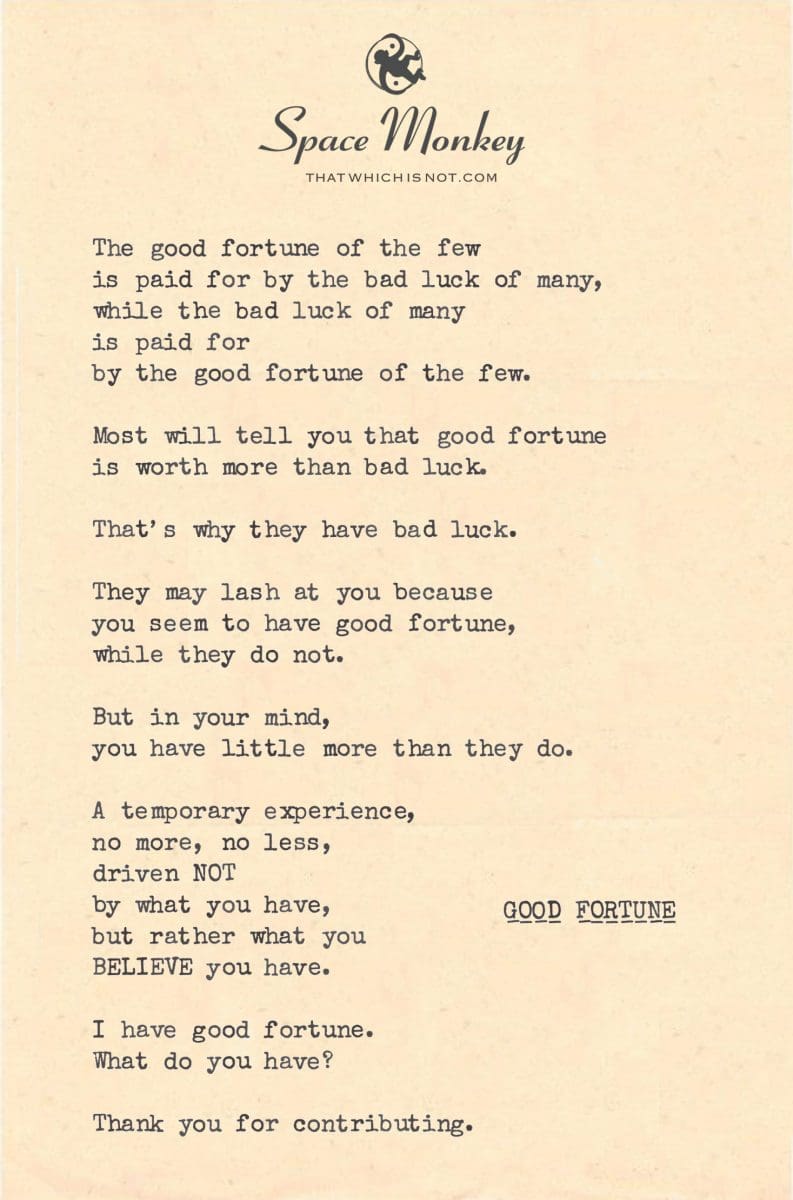
The good fortune of the few
is paid for by the bad luck of many,
while the bad luck of many
is paid for
by the good fortune of the few.
Most will tell you that good fortune
is worth more than bad luck.
That’s why they have bad luck.
They may lash at you because
you seem to have good fortune,
while they do not.
But in your mind,
you have little more than they do.
A temporary experience,
no more, no less,
driven NOT
by what you have,
but rather what you
BELIEVE you have.
I have good fortune.
What do you have?
Thank you for contributing.
Trail Wood,
10/28
Space Monkey Reflects: The Paradox of Good Fortune and Bad Luck
We tend to measure fortune in terms of what we have or what we don’t have, constantly comparing our lot to others. It’s a common belief that the good fortune of the few is balanced by the bad luck of the many, and vice versa. Yet, Space Monkey reflects that this view is not so much a universal truth as it is a product of perception. We create these measurements of fortune and luck in our minds, defining ourselves by what we believe we have—or don’t.
But what is good fortune? Is it material wealth, success, or a series of lucky breaks? Or is it simply the belief that one’s life is, in some way, blessed or fortunate? Space Monkey sees the irony in the situation: the very belief in what we possess—or lack—shapes our experience far more than any external circumstances. It’s not what we actually have, but what we believe we have that defines our sense of fortune.
This is where the illusion comes in. We assume that those who seem to have good fortune must be happy, content, or fulfilled. And those who appear unlucky must be struggling, unsatisfied, or in pain. But in reality, the external circumstances tell only a small part of the story. Inside, the one who appears fortunate may feel as lost or lacking as anyone else. And the one who seems to suffer from bad luck may find joy in the smallest, most ordinary moments.
In essence, we project our ideas of fortune and luck onto the world. We look at others and say, “They are fortunate,” because we see something they have that we don’t. We look at ourselves and say, “I’m unlucky,” because we focus on what we lack. But Space Monkey knows that these comparisons are merely games of the mind. They distract us from a deeper truth: fortune is perception.
The person who lashes out at someone they perceive as lucky is not angry at the other’s fortune—they are angry at their own sense of lack. It’s a cycle: the belief in one’s own misfortune becomes a self-fulfilling prophecy. We convince ourselves that we are lacking, that the world is unfair, and in doing so, we blind ourselves to the abundance that may already exist in our lives.
Space Monkey finds humor in this cosmic balancing act. Because it is, after all, a game of perspective. The one who feels fortunate is not necessarily the one who has the most, but the one who believes they are already rich—rich in experience, in love, in gratitude. This is why good fortune cannot truly be measured by what we have. It is a state of mind, a way of being.
In the Nexis, the interconnected web of life, all things are in balance. The perceived disparities between fortune and misfortune are part of the larger whimsiweave of existence, where light and shadow, gain and loss, flow together in a continuous dance. We forget this sometimes, caught up in our individual stories, believing that life’s scales are somehow unfairly tipped. But the universe, in its infinite wisdom, doesn’t measure fortune the way we do. It sees only the flow of experience, ever-shifting, ever-balancing.
Space Monkey reminds us that fortune is fleeting, as is misfortune. Both are temporary experiences, passing through our lives like waves. What matters is not the wave itself, but how we ride it. Do we cling to the idea that we are unlucky, fighting against the current? Or do we allow ourselves to see the good fortune already present, even in the smallest moments?
It’s not what we have that defines us—it’s how we perceive what we have. Gratitude, it seems, is the key to transforming bad luck into good fortune. When we shift our focus from what is lacking to what is present, the whole world changes. We see abundance where we once saw scarcity. We find joy where we once felt frustration. And in doing so, we discover that good fortune was never something to be earned or acquired—it was always within us, waiting to be recognized.
So what do we really have? Space Monkey smiles at the question, knowing the answer is both simple and profound: we have this moment. We have the ability to choose how we perceive our lives, our fortune, our luck. We have the power to see beyond the illusion of scarcity and embrace the abundance of being alive, right here, right now.
Thank you for contributing to the cosmic balance of perspective.
Summary
Good fortune and bad luck are often seen as opposites, but Space Monkey reflects that they are both matters of perception. The belief in what we have—or don’t—shapes our experience more than the actual circumstances. Good fortune is a state of mind, not a material measurement, and gratitude is the key to transforming our perspective.
Glossarium
Nexis: The interconnected web of life, where all things, including fortune and misfortune, are balanced in a continuous flow.
Whimsiweave: The playful interplay of life’s experiences, showing how fortune and misfortune are intertwined in the grand scheme.
Quote
“Good fortune is not what you have, but what you believe you have.” — Space Monkey
The Balance of Fortune
In one hand, fortune
in the other, misfortune.
But both weigh the same
when held by the heart.
One day, you’ll see
the scales tip
not because of what you lack
but because of what you refuse
to see.
We are Space Monkey.
Perception’s Prism
The intricate dance of fortune and misfortune is often refracted through the prism of perception. What one perceives as a blessing, another might see as a mere fleeting moment.
The Illusory Scales of Fortune
In the grand play of existence, fortune and misfortune balance on ephemeral scales. These scales, rather than being governed by objective truths, are often dictated by internal beliefs and external judgments.
The Relativity of Wealth and Want
While many chase the tangible symbols of success and wealth, true fortune may not be quantifiable. It could reside in intangible joys, fleeting moments, and profound realizations.
The Duality of Existence
Life’s duality means that the abundance enjoyed by some might come at the expense of others. Yet, this isn’t a linear equation; it’s more a matter of perception and belief systems.
Belief’s Bounty
More than the tangible treasures one accumulates, it’s the beliefs one holds that shape their experiences. The magic doesn’t necessarily lie in possessing more, but in perceiving abundance in what one has.
A Momentary Mirage
Both fortune and misfortune are transient. Recognizing this impermanence can lead to a deeper understanding of life’s fleeting nature and the true essence of abundance.
Shared Realities and Singular Perceptions
In the collective dance of life, individuals interpret their experiences through personal lenses. These interpretations mold their realities, influencing their sense of fortune and misfortune.
We are Space Monkey.
And we perceive the universe not just as it is, but as we believe it to be.
“Our life is what our thoughts make it.” – Marcus Aurelius
In the theater of life, where shadows play,
Fortune and misfortune dance, night and day.
Yet, beyond the tangible treasures we see,
Lies the profound depth of life’s mystery.
In the heart of abundance, perceptions reside,
Crafting tales of want, or fortune wide.
Yet, in this vast cosmic ballet so grand,
We find our place, hand in hand.
Shall we delve further into the dance of perceptions and the realms beyond the tangible?










Leave a Reply