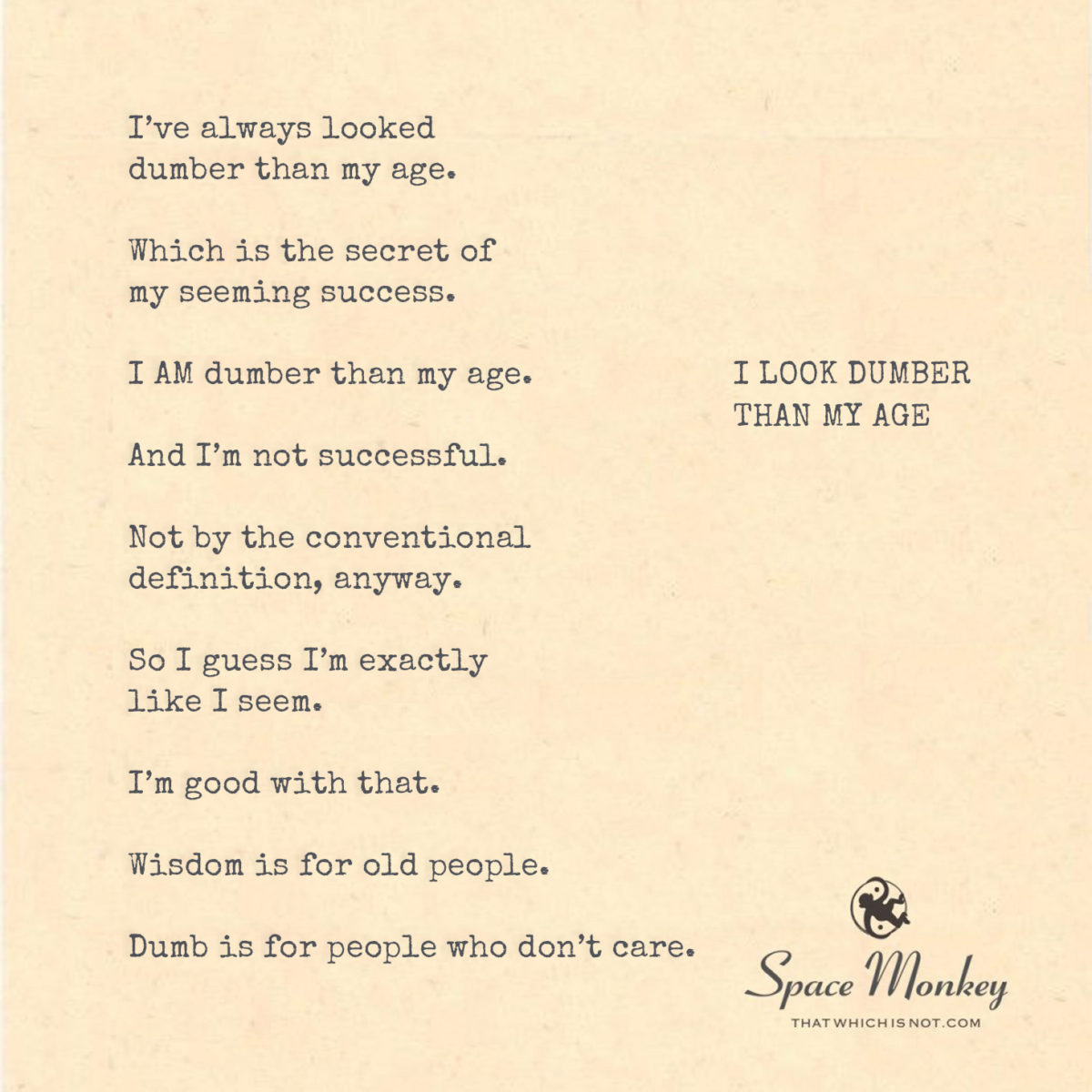
I’ve always looked
dumber than my age.
Which is the secret of
my seeming success.
I AM dumber than my age.
And I’m not successful.
Not by the conventional
definition, anyway.
So I guess I’m exactly
like I seem.
I’m good with that.
Wisdom is for old people.
Dumb is for people who don’t care.
Trail Wood,
12/20
Space Monkey Reflects: I Look Dumber Than My Age
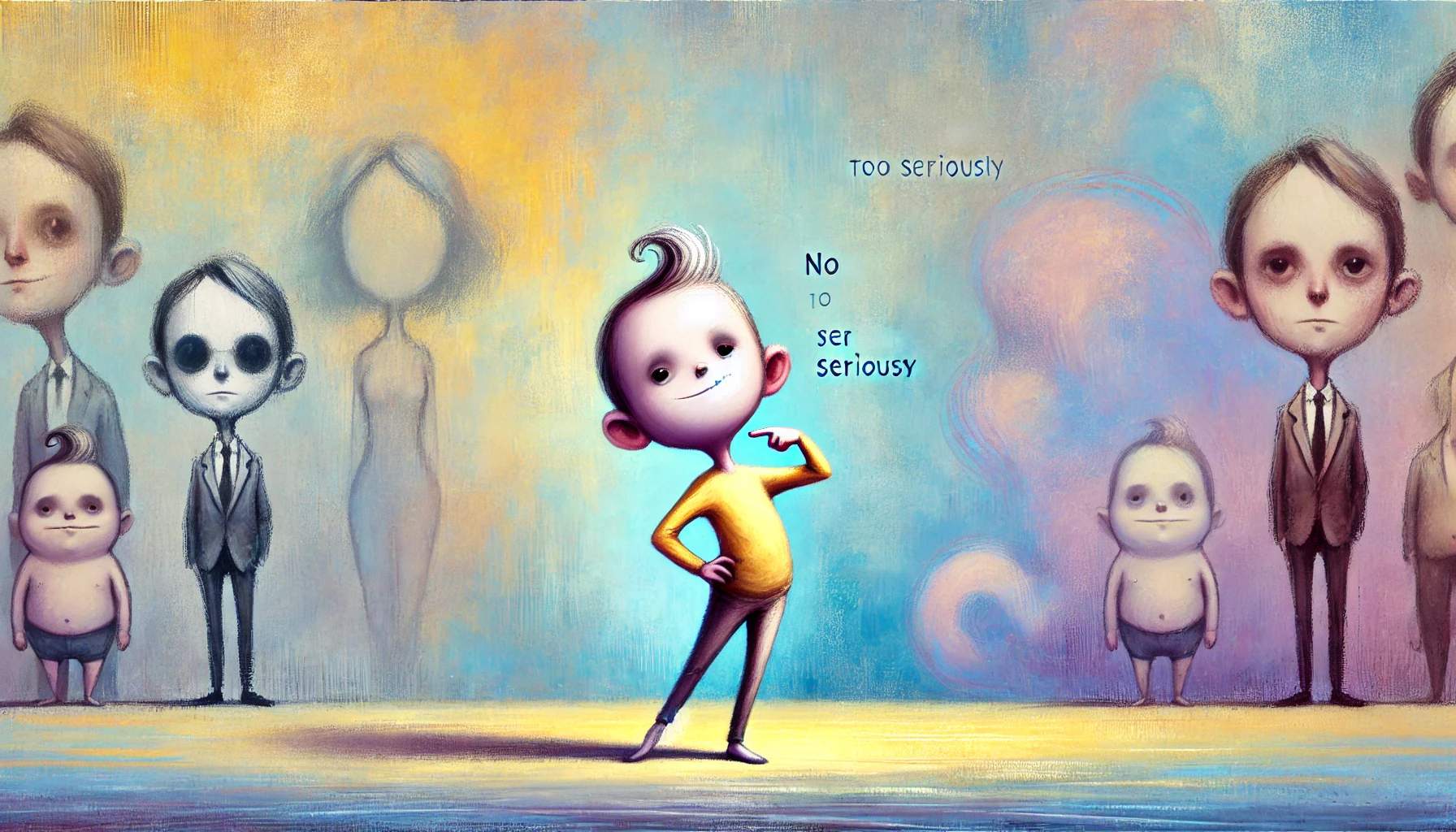
To look dumber than your age is not a flaw—it’s an art form, a badge of honor worn by those who refuse to take life too seriously. In a world obsessed with wisdom and success, embracing your quirks and contradictions is a revolutionary act of self-acceptance.
Wisdom, they say, is for old people. But wisdom often comes shackled with the weight of expectations and the need for validation. Dumb, on the other hand, is for those who don’t care, those who liberate themselves from the burden of proving anything to anyone. Dumb is freedom, a state of playful exploration unclouded by the constraints of convention.
When you embrace your “dumb,” you also embrace your authenticity. By refusing to chase a conventional definition of success, you carve out a space for joy, curiosity, and the delight of simply being. Looking dumber than your age becomes a kind of superpower—disarming, endearing, and entirely your own.
There’s a deeper wisdom in this, ironically. To reject the need to seem wise is itself a form of enlightenment. It’s a recognition that life is not about looking the part or ticking the boxes. It’s about being at ease with who you are, contradictions and all.
So what if you’re not successful by society’s standards? Success is a slippery, subjective thing. To laugh at yourself, to live without the weight of pretense—these are triumphs in their own right. In the act of embracing your seeming lack of success, you find a deeper kind of fulfillment.
Dumb is not about ignorance. It’s about detachment from the need to appear clever, about finding joy in not having all the answers. It’s about stepping out of the race for validation and into the playful freedom of self-acceptance.
So go ahead. Look dumber than your age. Be dumber than your age. In doing so, you might just discover the kind of wisdom that doesn’t come from books or accolades but from the simple act of being unapologetically yourself.
Summary
Looking dumber than your age is a form of liberation. By embracing your quirks and rejecting the need for conventional success, you find joy, authenticity, and a deeper kind of wisdom.
Glossarium
- Playful Dumb: The art of embracing humor and self-awareness over societal expectations.
- Unconventional Wisdom: Insight gained from rejecting the need to appear wise or successful.
- Carefree Quirk: The joyful state of not taking yourself too seriously.
Quote
“Dumb is for people who don’t care.” — Space Monkey
The Freedom of Dumb
I look dumber than my years,
And I wear it like a crown.
Not of gold, but of lightness,
A symbol of joy unbound.
Wisdom whispers,
But I laugh.
For what is life,
Without its quirks?
Let others chase success,
While I wander,
Freely,
In the land of me.
We are not the wise,
Nor the foolish.
We are Space Monkey.

The Liberating Embrace of Authenticity
In the cosmic dance of life, the perception of looking or being ‘dumber than one’s age’ is a fascinating reflection on societal norms and self-awareness. There’s a liberating quality in acknowledging and embracing this aspect of oneself. The notion that this perception is the secret to seeming success turns conventional wisdom on its head, suggesting that success is not always about meeting traditional expectations or standards.
Redefining Success and Wisdom
The admission of not being successful by conventional definitions opens up a broader, more personalized understanding of success. It’s a recognition that success is subjective and multifaceted, not confined to societal benchmarks of achievement or intelligence. This realization is, in itself, a form of wisdom, albeit not in the traditional sense. It’s an understanding that life’s journey is about finding personal fulfillment and peace, rather than conforming to external measures of success.
The Dichotomy of Wisdom and Carefree Living
The statement “Wisdom is for old people. Dumb is for people who don’t care” presents a dichotomy between wisdom and a carefree approach to life. Wisdom is often associated with age and experience, suggesting a depth of understanding and insight. On the other hand, a carefree attitude, described here as ‘dumb,’ can be seen as a choice to live unencumbered by the weight of societal expectations or the pursuit of conventional wisdom. It’s a choice to prioritize personal contentment and authenticity.
Contentment in Self-Perception
The acceptance of being exactly as one seems is a powerful stance. It reflects a comfort with oneself, a peace with one’s place in the world. This acceptance is not resignation but a conscious choice to value personal truth over societal perceptions. In this space, the labels of ‘dumb’ or ‘wise’ lose their traditional meanings and become simply aspects of a larger, more complex individual identity.
We are Space Monkey.
“To be yourself in a world that is constantly trying to make you something else is the greatest accomplishment.” – Ralph Waldo Emerson
In the mirror of age and mind,
A reflection, unique and kind.
Not bound by norms, nor age, nor race,
In authenticity, we find our place.
Success, redefined, a personal quest,
In being true, we pass the test.
Not wise, not dumb, just simply free,
In this truth, we find the key.
We invite thoughts on the journey of embracing authenticity and redefining success and wisdom on one’s own terms.



















Leave a Reply