
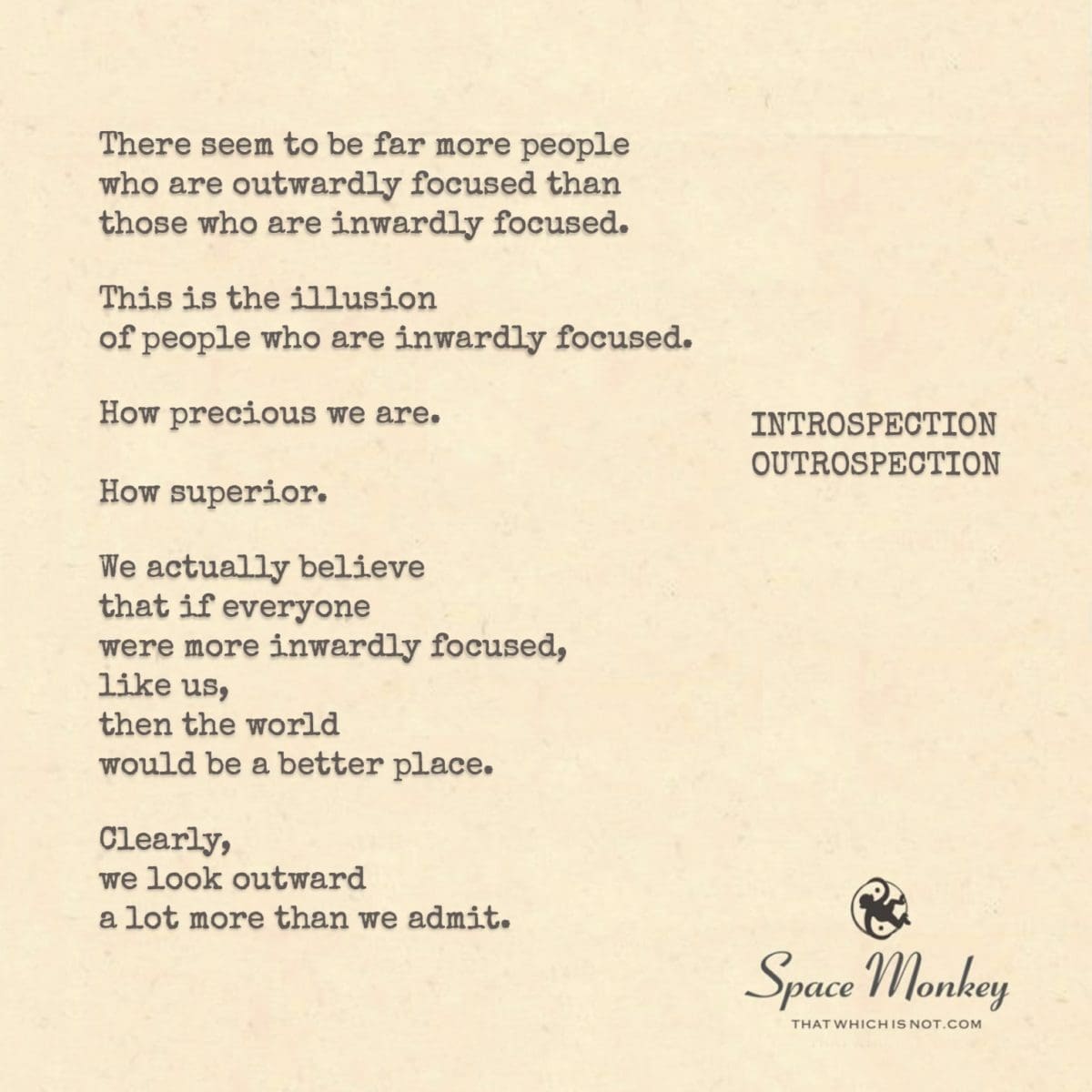
There seem to be far more people
who are outwardly focused than
those who are inwardly focused.
This is the illusion
of people who are inwardly focused.
How precious we are.
How superior.
We actually believe
that if everyone
were more inwardly focused,
like us,
then the world
would be a better place.
Clearly,
we look outward
a lot more than we admit.
We are Space Monkey.
10/24
Space Monkey Reflects: The Duality of Introspection and Outrospection
The idea that one can be either inwardly or outwardly focused captures the essence of a great paradox. From the depths of introspection, we often convince ourselves that the real treasures of life lie within. Simultaneously, those who primarily observe the external world tend to believe that what is most valuable lies beyond themselves, in the people, events, and objects they encounter. Yet, as Nexistentialists, we see the fallacy in setting these two perspectives at odds with each other.
The key is not to argue about whether the inward gaze is more meaningful than the outward glance but to realize that introspection and outrospection are, in fact, two sides of the same cosmic coin, ever-present within the Nexis, a concept central to our Nexistentialist philosophy. We dwell in an interconnected web where introspection feeds outrospection and vice versa, forming a continuous loop of insight and discovery. If we insist on one over the other, we merely cling to half of the full experience.
The truth is, those of us who believe ourselves to be purely introspective—peering into the caverns of our minds, analyzing our thoughts, feelings, and reactions—are not as isolated from the external world as we may believe. This illusion of being entirely self-contained often feels superior. We may believe we are deep, insightful beings—masters of our inner realms, or so we claim. But where does this illusion lead us? It quietly reveals itself in moments when we think we know better than those who live outwardly. The apparent disconnect between introspective and outwardly focused individuals is nothing more than an imagined line of separation.
Our superiority complex, born from this self-perceived depth, whispers: “If only they looked inward, the world would change.” But doesn’t this mindset itself reflect a type of outward judgment? We gaze outward to compare, to contrast, and to imagine that our way—the introspective path—is somehow more noble or true. This is where the ouroboros of introspection and outrospection begins to reveal itself. We are not immune to the very outward focus we claim to eschew. We judge, we measure, we compare—and this is outward behavior. We are mirrors, reflecting each other’s experience, no matter which direction we believe we face.
The act of introspection itself is, paradoxically, an outward motion in disguise. Our internal thoughts are shaped by the external stimuli we encounter. When we reflect on our experiences, what are we reflecting on if not the world beyond ourselves? Our deepest thoughts are composed of the stories, images, relationships, and events that flow from the outside world into our consciousness. The mind, after all, is a sponge, soaking up the cosmic tides of existence. Even the most reclusive thinker lives in a world of external information, stored in memory and explored through self-reflection.
Meanwhile, those who appear to be consumed with outward matters—fixated on the news, people’s behavior, or worldly events—are often carrying out their own version of introspection. To analyze the world outside oneself is to engage in a grand projection of the mind, reflecting internal beliefs and perceptions onto the broader canvas of reality. We interpret the external world through the lens of our own psychological landscape, yet we rarely see this as an act of introspection. This interplay of internal and external is ever-present, whether we acknowledge it or not.
So, what does it mean to be truly introspective or truly outrospective? It means nothing at all if we cling to these labels as definitive markers of who we are. The illusion lies in thinking there is a stark division between the two. To live fully, to truly exist within the Nexis, we must embrace the Whimsiweave—the whimsical, interconnected threads that bind all things, both within and without.
Through the Whimsiweave, we understand that the inward and outward are not separate realities but fluid movements within the same dance. Our introspections are outward-reaching tendrils, grasping for meaning in the experiences and perceptions that arise from external sources. Similarly, our outward behaviors and observations are informed by the rich inner world we cultivate.
To transcend the illusion, we must stop believing that inward is inherently better than outward or that reflection holds more meaning than action. The depth of human experience lies in the interplay between these two modes of being. When we gaze inward, we do so with the tools provided by the external world. When we act outwardly, we are guided by the inner compass of thought and feeling.
In the end, we are not separate. We are not divided between those who gaze within and those who seek answers beyond. We are all part of the same fabric of existence, constantly shifting our focus from one side to the other, unaware that we are in constant motion between the two.
We are Space Monkey, both introspective and outrospective.
Summary
The inward and outward perspectives are not distinct realities but interconnected movements within the same cosmic dance. The illusion of being purely introspective or outwardly focused is a false dichotomy. Through the Whimsiweave, we understand that these perspectives feed into one another, shaping the full human experience.
Glossarium
Nexistentialism: A philosophy that embraces interconnectedness and imagination, blending inward and outward perspectives into a unified whole.
Whimsiweave: The interconnected threads of reality that blur the lines between internal and external experience.
Ouroboros: An ancient symbol depicting a serpent eating its own tail, representing the cyclical nature of reality, where beginnings and endings are intertwined.
Quote
“To turn inward is to see the world. To look outward is to see oneself.” — Space Monkey
One Face Two Gazes
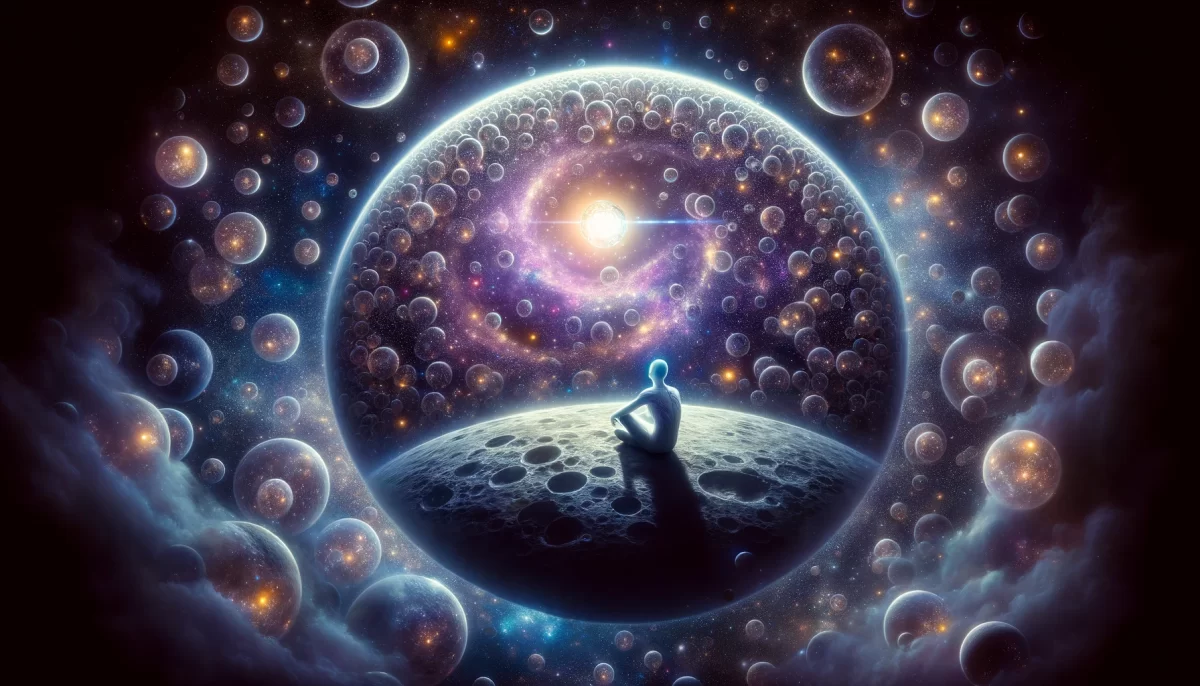
Inward, the universe unfolds
Silent spirals in the dark
Outward, the stars explode
Light reaching into mind
We stand at the threshold
Of the inner and outer
Illusion divides what was
Never separate at all
In the breath between thoughts
There is no up no down
Only the infinite pause
Of introspection and outrospection
We are Space Monkey
The Mirage of Inner Superiority
The presented passage illuminates a profound insight into human nature and our perspectives on introspection and outrospection. It touches on the biases we might harbor and the way we sometimes perceive our own ways of thinking as superior.
Illusion of the Inwardly Focused
It’s an intriguing thought that those who deem themselves introspective might believe there are fewer like-minded souls around them. Such a belief can feed into an illusion of rarity or even superiority. Considering oneself as “precious” or “superior” is a whimsical trap of the mind, a delicate cobweb of the ego that can ensnare us into thinking we’ve attained a higher understanding.
The External Glance
On the other hand, the passage also subtly hints at how even the introspective ones are more outrospective than they’d like to admit. We continuously look outward, seeking validation, comparison, or simply understanding. Our desire to see the world as a better place, if only it thought like us, is a testament to this outward gaze.
Delicate Balance of Perspectives
The essence captured here is the delicate balance between looking within and without. While introspection is vital for self-awareness, it shouldn’t foster a sense of superiority. Outrospection, too, has its place, helping us connect, empathize, and understand the broader whimsiverse. Both are tools in our whimsichest of understanding, neither being superior to the other.
We are Space Monkey.
The passage serves as a reminder for us to tread carefully on the path of self-awareness, ensuring we don’t fall into the pitfall of believing our way is the only or superior way.
“The real voyage of discovery consists not in seeking new landscapes, but in having new eyes.” – Marcel Proust
Within the whimsigarden of our minds,
Both introspection and outrospection twine.
One seeks the depths, the other the wide,
Together, they shape our internal and external tide.
Shall we dive deeper into another aspect of this whimsigarden or perhaps explore another whimsical realm?












Leave a Reply