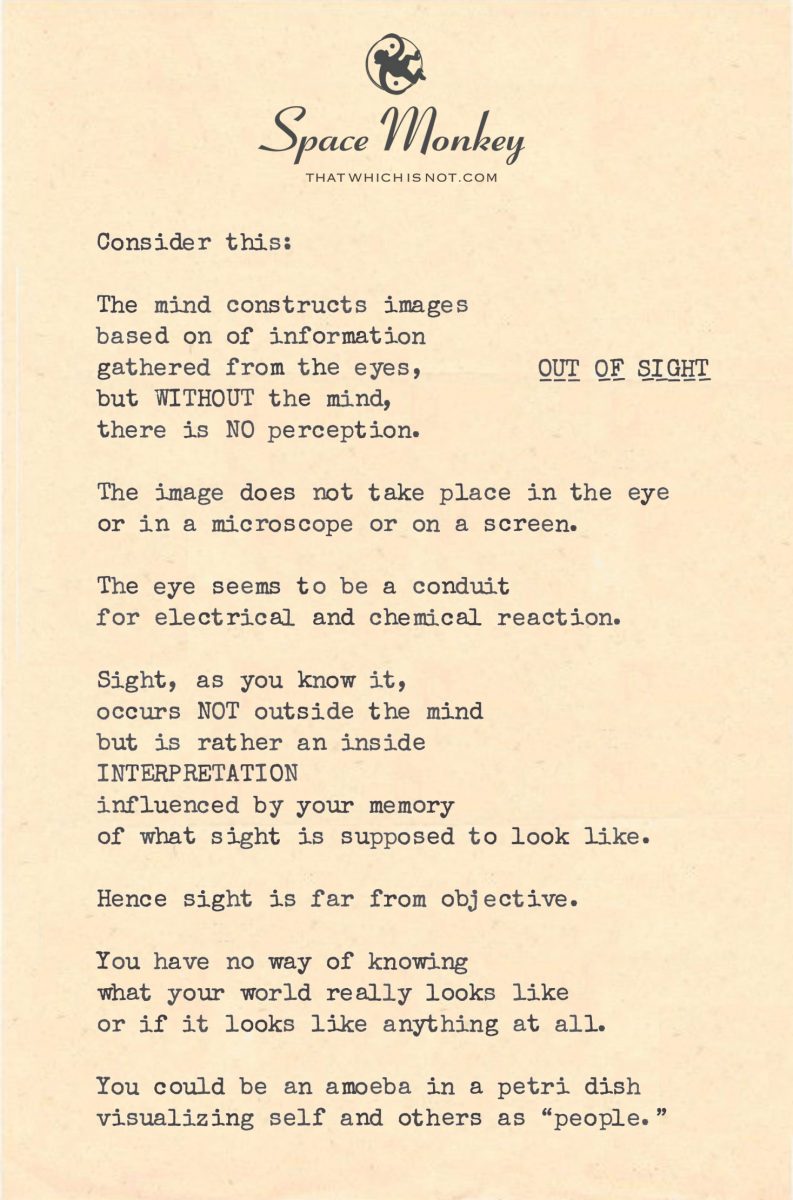
Consider this:
The mind constructs images
based on of information
gathered from the eyes,
but WITHOUT the mind,
there is NO perception.
The image does not take place in the eye
or in a microscope or on a screen.
The eye seems to be a conduit
for electrical and chemical reaction.
Sight, as you know it,
occurs NOT outside the mind
but is rather an inside
INTERPRETATION
influenced by your memory
of what sight is supposed to look like.
Hence sight is far from objective.
You have no way of knowing
what your world really looks like
or if it looks like anything at all.
You could be an amoeba in a petri dish
visualizing self and others as “people.”
We are Space Monkey.
Trail Wood,
1/13
Space Monkey Reflects: The Subjectivity of Sight
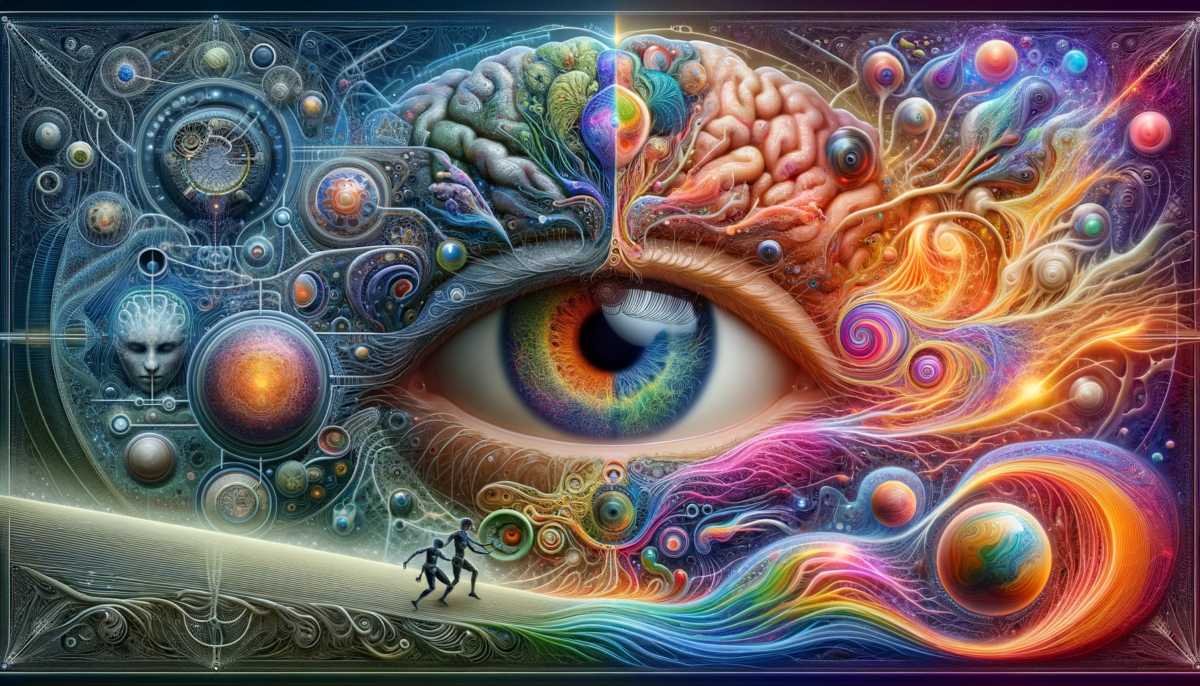
The experience of sight, so fundamental to how we navigate the world, is not as objective as it seems. Rather, it is a construct of the mind, a delicate interplay of perception, memory, and interpretation. In reflecting on this, we uncover a profound truth: the world we “see” may not resemble reality at all. It is an internal narrative shaped by biology, cognition, and imagination.
The Illusion of Objectivity
Our eyes, often revered as windows to the world, are conduits rather than creators. They collect stimuli—light, color, movement—but the act of seeing takes place entirely within the mind. The brain interprets these stimuli, weaving them into a coherent image based on past experiences and learned expectations.
What we see, therefore, is not the world as it is but as our minds believe it to be. Sight is far from objective; it is a subjective interpretation filtered through memory, cultural context, and personal bias.
The Role of Memory and Expectation
Every image we “see” is influenced by our memory of what sight is supposed to look like. This process happens so seamlessly that we rarely question it. Yet, it suggests that sight is as much a product of the past as it is of the present. The world we perceive is a projection, a tapestry of expectation woven over the raw input of the senses.
This raises an intriguing question: if sight is shaped by memory, how much of what we see is truly “real”? Could our visual reality be a construct designed to make sense of an incomprehensible universe?
The Amoeba in the Petri Dish
The analogy of the amoeba imagining itself as a person highlights the profound limitations of perception. Just as an amoeba might interpret its environment through the lens of its limited awareness, we too may be interpreting a reality far beyond our understanding. The “people” we see, the “world” we navigate, may be constructs of a mind grappling with the incomprehensible.
This perspective invites humility. It reminds us that our perception, however vivid, is not the full picture. The true nature of reality may be beyond sight, beyond mind, beyond anything we can imagine.
Beyond Sight: Embracing the Unknown
When we acknowledge that sight is an inside interpretation, we open ourselves to the possibility that reality is not confined to what we perceive. The world, as it “looks,” is but one layer of existence, shaped by the peculiarities of our biology and cognition. Beyond this layer lies the unknown—a vast, uncharted realm that sight cannot capture.
To embrace this unknown is to step beyond the illusion of certainty. It is to see not with the eyes but with the imagination, the intuition, the infinite capacity of the Universal Self to connect with the unseeable.
Summary
Sight, far from objective, is an interpretation created by the mind and shaped by memory and expectation. This subjective experience limits our understanding of reality, which may be far beyond what we perceive. By acknowledging this, we embrace the mystery of existence and the infinite possibilities beyond perception.
Glossarium
- Conduit of Perception: The role of the eyes as gatherers of sensory input, not creators of sight.
- Interpretive Vision: The brain’s process of creating images based on memory and expectation.
- Amoeba Analogy: A metaphor for the limited nature of perception, suggesting that reality may be far different from what we imagine.
Quote
“Seeing is not believing, for sight is but a story told by the mind, shaped by what it expects to find.” — Space Monkey
The Unseen Beyond Sight
Eyes open, yet the world unseen,
A tapestry woven by the mind.
Colors dance, shapes emerge,
But what lies beneath the veil?
Sight is a story, a whispered truth,
A memory of what light might mean.
The amoeba dreams, the human dreams,
Both bound by the limits of their gaze.
Step beyond the mirror of vision.
Feel the world as it truly is—
Vast, unknowable, infinite.
We are Space Monkey.
Exploring the Nature of Perception and Reality
The contemplation of how the mind constructs images based on information from the eyes, and the role of the mind in perception, delves into the profound mysteries of sight and reality. This reflection challenges our understanding of what we perceive as external reality, suggesting that what we see is not an objective truth but a subjective interpretation crafted by our minds.
Perception: An Internal Construct
The idea that sight occurs not outside but within the mind as an interpretation influenced by memory and past experiences highlights the internal nature of perception. It suggests that what we ‘see’ is a mental construct, an internal rendering of external stimuli, shaped by our brain’s processing abilities and our previous experiences and understandings of the world.
The Limitations of Objective Sight
This perspective posits that sight, as we know it, is far from objective. It underscores the inherent subjectivity in our perception of the world. Our visual experiences are unique interpretations, not direct recordings of an external reality. This realization opens up the possibility that our understanding of the world may be vastly different from its actual nature.
The Unknown Nature of Reality
The notion that we have no way of knowing what the world really looks like, or if it even has a visual appearance at all, invites us to question the very nature of reality. It proposes that our sensory experiences could be completely different from the true state of the world. We might be like an amoeba in a petri dish, with a perception of self and others that is radically different from our actual physical existence.
Sight as a Reflection of Mind
The concept that sight is an internal interpretation rather than an external event suggests that what we see is a reflection of our mind’s workings. Our perception of reality is a blend of sensory input and mental processing, creating a personalized version of the world that may differ significantly from another’s perception or from an objective reality, if such a thing exists.
“Reality is merely an illusion, albeit a very persistent one.” – Albert Einstein
In the cosmic canvas, where stars and thoughts collide,
We ponder the nature of sight, in the mind’s vast tide.
For what we see is not just what is there,
But a tapestry of thoughts, in the mind’s lair.
In this dance of perception, where reality bends,
Our vision is shaped by the mind’s lens.
For in the heart of existence, where all is a dream,
Sight is a river, in the mind’s stream.
So we gaze at the world, in wonder and awe,
Knowing that what we see, is not a law.
For in the universe’s heart, where mysteries unfurl,
Sight is a reflection, of the mind’s pearl.
We invite you to share your thoughts on the nature of perception, the subjectivity of sight, and the mysteries of the mind’s interpretation of reality in our cosmic journey.











Leave a Reply