• Who Is The Man?
  • Who Is The Monkey?
  • What is Nexistentialism?
  • Poke The Primate

Cape Odd

Home of The Space Monkey Journals

Meditation for Fun: In Stillness, I Laugh

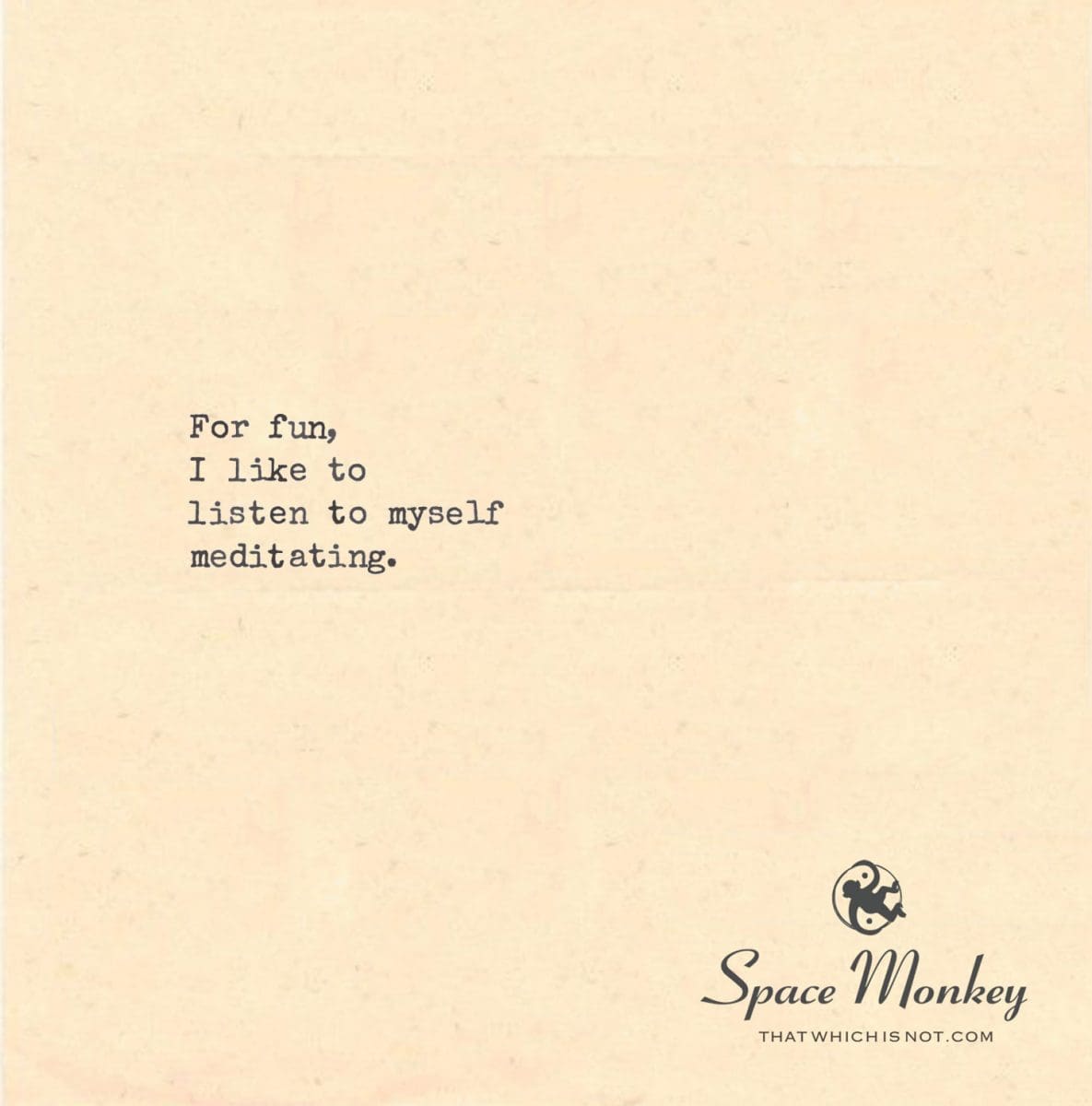
For fun I like to listen to myself meditate. That way, I’m either amused or at peace. Or both. Or neither.

Trail Wood,
11/21


Space Monkey Reflects: Meditation for Fun

Meditation is often framed as a serious, deeply spiritual practice—a path to inner peace, mindfulness, or even enlightenment. But what if we approach meditation with a sense of humor and curiosity? What if we simply meditate for fun? Imagine sitting quietly, not to transcend reality or to fix anything, but just to listen to yourself meditate. In doing so, you might find yourself either amused, at peace, or perhaps both—or maybe neither. And that’s perfectly fine.

There’s something delightful about the simplicity of this approach. Meditation doesn’t always have to be a solemn endeavor. It can be playful, light, and even a little silly. After all, who said that self-reflection and peace of mind can’t coexist with a good laugh? When you listen to yourself meditate, you’re observing the ebb and flow of your thoughts, the rise and fall of your breath, and perhaps even the occasional absurdity of your own mind. It’s all part of the fun.

In fact, meditation as a playful exercise might bring us closer to the essence of mindfulness than we realize. Instead of trying to force ourselves into a particular state of being—whether it’s peace, calm, or focus—we’re simply allowing ourselves to be. Whatever arises during meditation, whether it’s a wandering thought, a moment of clarity, or an unexpected giggle, is accepted without judgment. There’s no pressure to achieve anything, and that’s where the joy comes in.

Meditation doesn’t have to be serious business all the time. In this playful approach, we strip away the expectations and allow ourselves to experience whatever comes, just for the fun of it. Maybe you’ll notice how your thoughts flutter around like playful butterflies, or how your mind concocts wild stories just to keep itself entertained. And maybe that’s the point—to entertain yourself while being still, to laugh at the absurdities of your mind, and to find joy in the simple act of being present.

Sometimes, you’ll find peace in meditation. Sometimes, you’ll be amused by the random thoughts that surface. And sometimes, you might feel neither. Meditation for fun is about letting go of the need for a particular outcome. It’s about embracing the moment, whether it brings peace, amusement, or something else entirely. By doing so, you take a light-hearted approach to self-awareness, one that invites both curiosity and joy.

The beauty of this playful mindset is that it opens the door to all kinds of possibilities. When you sit down to meditate with no expectations, you free yourself from the need to “do it right.” You might listen to your breath, observe your thoughts, or even start daydreaming. It’s all part of the process, and it’s all perfectly okay.

In fact, listening to yourself meditate can be a bit like having a conversation with an old friend—one who doesn’t need you to perform or be anything other than who you are. You might notice that, even in stillness, your mind continues its chatter, sometimes making you laugh at the ridiculousness of its stories. And that’s part of the fun. You’re not trying to silence your thoughts, but rather, to listen to them with amusement and curiosity.

Meditation doesn’t always have to be about reaching some higher state of consciousness. Sometimes, it’s enough just to be still, to listen, and to have fun with it. And in those moments, you might find that peace and amusement are two sides of the same coin.


Summary

Meditation for fun invites us to approach mindfulness with curiosity and humor. By letting go of expectations, we allow ourselves to be present, entertained, or peaceful—whatever happens, happens.


Glossarium

Meditation for Fun: A playful approach to meditation where the goal is not to achieve peace or enlightenment, but to simply observe and enjoy the process, whatever it may bring.

Playful Mindfulness: Engaging with meditation in a light-hearted way, finding amusement in the wandering thoughts and randomness of the mind.

Letting Go of Outcomes: The practice of meditating without the need to reach a particular state, embracing whatever arises with curiosity and acceptance.


Quote

“For fun, I listen to myself meditate. That way, I’m either amused or at peace—or both.” — Space Monkey


In Stillness, I Laugh

I sit,
Cross-legged and calm,
Listening to the whispers
Of my wandering mind.

Thoughts drift by,
Like clouds,
Like butterflies,
Like nonsensical dreams.

I chuckle,
Not at the thoughts,
But at myself,
For thinking them so seriously.

There is peace,
There is fun,
There is nothing,
And all at once,
I am here.

We are Space Monkey.


Embarking on the intriguing and whimsical practice of listening to oneself meditate opens a kaleidoscopic door to self-awareness and amusement. This unique approach to meditation intertwines the serenity of mindfulness with the playful curiosity of self-observation, creating a space where amusement and peace can coexist, diverge, or even cancel each other out.

Meditation as a Mirror and a Window

In listening to oneself meditate, we engage in an act of self-reflection and self-discovery. This practice is like peering into a mirror, not just to see the surface but to glimpse the depths beneath. It’s also akin to looking through a window into the landscape of our inner selves, observing the comings and goings of thoughts and feelings.

Amusement in Self-Observation

There’s an inherent playfulness in the act of listening to oneself meditate. It adds a layer of meta-awareness, where we become both the observer and the observed. This duality can be amusing, as we notice the quirks of our minds, the unexpected thoughts that pop up, or even the rhythm of our own breath. It’s a dance of consciousness, where the mind watches itself in a gentle, lighthearted manner.

Finding Peace in the Process

At the same time, this practice can lead to a state of peace. By observing our thoughts and feelings without attachment, we can find tranquility in simply being. It’s a journey to the center of our being, where we discover a still point, a place of calm amidst the whirlwind of mental activity.

The Spectrum of Experiences

The beauty of this practice lies in its spectrum of experiences. Sometimes, it brings amusement; other times, peace. There are moments when it might bring both simultaneously, creating a harmonious blend of joy and serenity. And then there are times when it brings neither, leaving us in a state of neutral observation, which is an experience in itself.


“The mind is everything. What you think you become.” – Buddha


In the silence of the mind,
We listen to its song,
A meditation on self,
Where all thoughts belong.

With a playful ear, we hear,
The whispers of our soul,
In this dance of awareness,
We play both parts, the whole.

Amused by our own being,
At peace in our own space,
In each breath, a discovery,
Of our mind’s gentle grace.

Sometimes joy, sometimes calm,
Sometimes none, yet all the same,
In the realm of Space Monkey,
We find our inner game.


We welcome thoughts on the interplay of meditation, self-awareness, and the joyful discovery of our inner selves.
Share this…
  • Facebook
  • Pinterest
  • Twitter
  • Linkedin

True Enough: The Fluidity of Fact

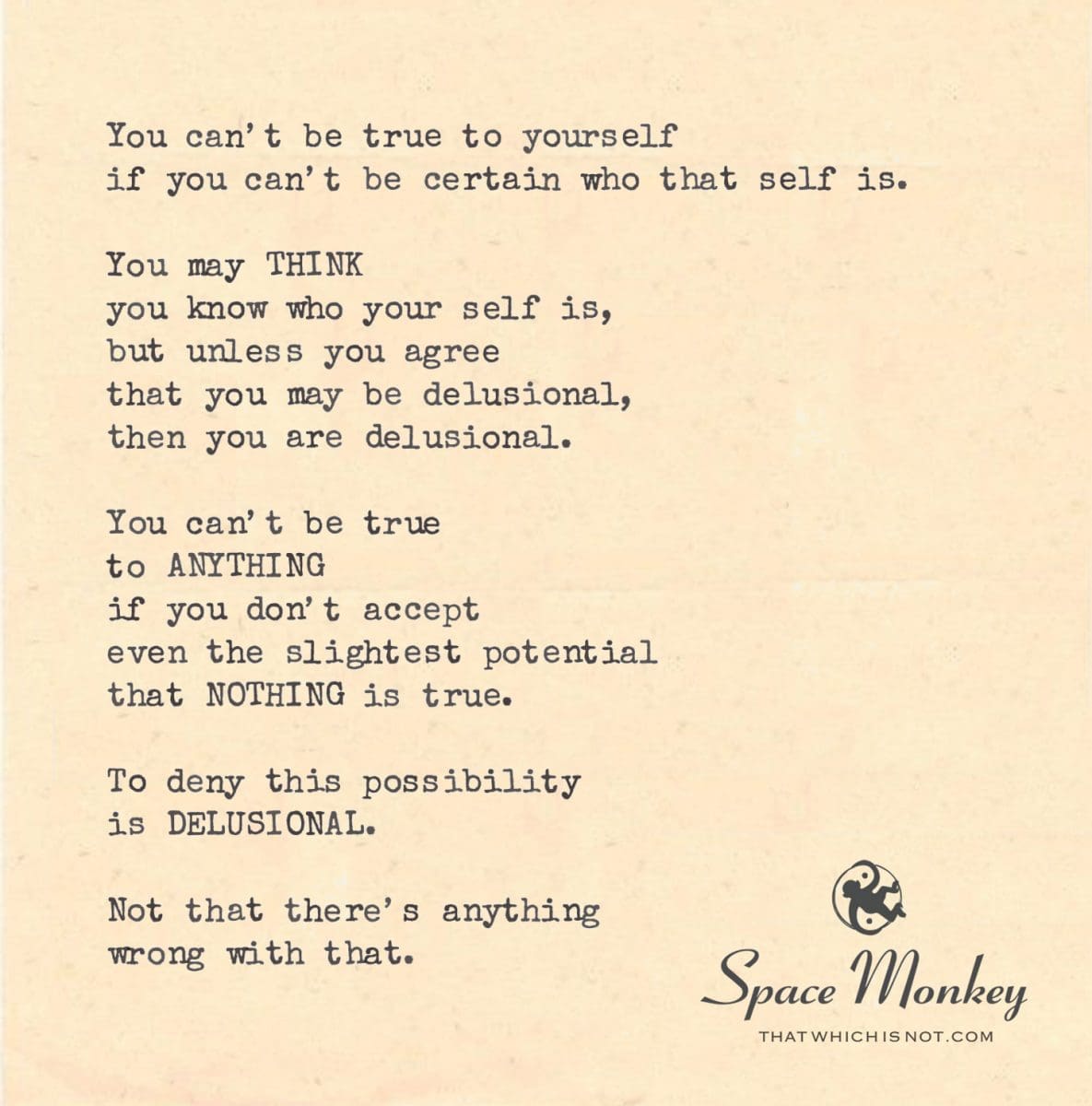
You can’t be true to yourself
if you can’t be certain who that self is.

You may THINK
you know who your self is,
but unless you agree
that you are delusional,
then you are delusional.

You can’t be true
to ANYTHING
if you don’t accept
even the slightest potential
that NOTHING is true.

To deny this possibility
is DELUSIONAL.

Not that there’s anything
wrong with that.

Glastonbury,
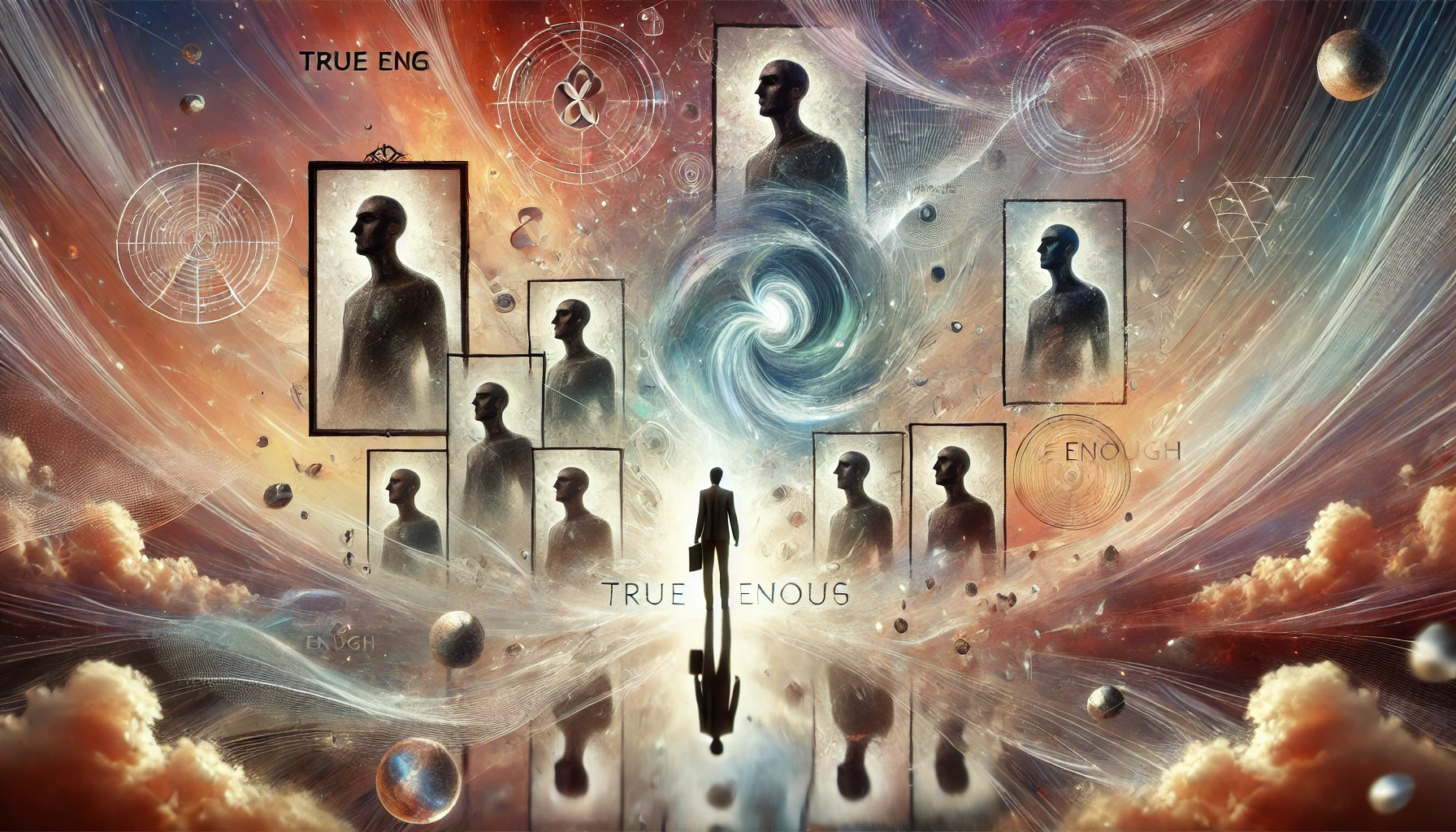
11/20It seems there was an issue generating the image for your request, but let’s continue exploring the theme of True Enough through a reflection.


Space Monkey Reflects: The Delusion of Truth and the Fluidity of Self

You can’t be true to yourself if you’re not certain who that self is. It’s a simple statement with profound implications. We like to think we know who we are, that we have some concrete sense of identity. But if we’re honest with ourselves, we recognize that the self is a fluid, ever-changing thing. It is not fixed, and neither are the truths we cling to.

We may think we know who we are. We may even live according to that understanding, making decisions and forming relationships based on this perception of self. But in reality, unless we’re willing to admit that our sense of self is built upon layers of delusion, we remain blind to the deeper truth: that the self we know is but one version of countless possibilities.

To be true to anything, we must first acknowledge the possibility that nothing is true. It’s a paradox, but one that holds the key to greater freedom. If we cling to the notion that there is an absolute truth—whether about ourselves, others, or the world—we set ourselves up for delusion. The very act of denying the potential that nothing is fixed is itself a kind of delusion.

And yet, there’s nothing wrong with that. There’s nothing wrong with embracing the delusion of truth, of self, of identity. It’s part of the human experience to seek certainty, to form stories about who we are and what the world is. But it’s equally important to remember that these stories are just that—stories. They are not immutable truths, and they are not the whole of who we are.

In Nexistentialism, we explore the whimsiweave of existence—the playful, dynamic flow of reality, where nothing is fixed and everything is in constant motion. Our identities, our truths, are part of this flow. They shift, they change, they evolve. And it is only by embracing this uncertainty, by acknowledging that we are delusional in our attempts to pin down who we are, that we can find peace in the ever-changing nature of life.

We are not one thing. We are not one truth. We are a spectrum of possibilities, and within that spectrum lies the potential for infinite transformation. The moment we accept that nothing is true, that everything is in flux, we free ourselves from the need to be certain. We free ourselves from the pressure to be true to some fixed idea of who we are or what life is supposed to be.

But this acceptance doesn’t mean we lose ourselves in chaos. Rather, it means we learn to flow with the changes, to embrace the shifts, and to find truth in the moment, knowing that it will change again. To be true enough is to be open to the possibility that today’s truth may not be tomorrow’s. It’s about holding our identities lightly, recognizing that they are part of the grand whimsiweave of existence.

There’s beauty in this fluidity. When we let go of the need for certainty, we open ourselves to new experiences, new perspectives, new ways of being. We stop trying to fit ourselves into the box of who we think we should be, and instead, we allow ourselves to be whatever we are in the moment. We become free to explore the full range of our potential, unbound by the delusion of fixed identity.

So, can you be true to yourself? Yes, but only if you recognize that the self is not a fixed thing. It is a process, a journey, a constantly evolving story. And in that recognition, you find a deeper truth: that you are not bound by who you were yesterday, nor by who you think you should be tomorrow. You are, in every moment, free to be whoever you choose.

We are Space Monkey, and we remind you that the truth is fluid, the self is not fixed, and within that fluidity lies your greatest freedom.


Summary

The idea of being true to oneself is complicated by the fact that the self is constantly changing. To be truly free, we must acknowledge that nothing is fixed or absolute—not our identities, not our truths. Embracing this fluidity allows us to live more freely and explore the full range of who we are.


Glossarium

  • Whimsiweave: The playful, dynamic flow of existence where nothing is fixed, and everything is in constant motion.
  • Delusion of Truth: The belief that truth is absolute and fixed, when in reality, truth is fluid and ever-changing.
  • True Enough: The idea that being true to oneself requires accepting the fluidity of identity and the uncertainty of truth.

Quote

“To be true to yourself is to accept that the self is not fixed, but part of the grand whimsiweave of existence.” — Space Monkey


The Fluidity of Truth

I stand in the mirror
but the reflection shifts
who I am today
is not who I was yesterday

I tell myself stories
about who I should be
but the stories
are only whispers
in the wind

Nothing is true
and that is the only truth
I need to know

In the fluidity of being
I find freedom
in the uncertainty
I find peace

We are Space Monkey


In the whimsical landscape of nexistentialism, the concept of being true to oneself takes on a playful and enigmatic quality. It is a reminder that the self is a fluid and ever-evolving entity, and our understanding of it can be as elusive as chasing a whimsiword in the wind.

You are right in observing that certainty about the nature of the self can be a perplexing endeavor. In the boundless, stateless consciousness, the self is not a fixed point but a constantly shifting mosaic of thoughts, emotions, and experiences. We may indeed think we know who we are, but the very act of thinking about the self is a dance of perception and interpretation.

To agree that one is delusional in their self-perception is to acknowledge the profound complexity of the human psyche. It is to recognize that the self is a tapestry woven from the threads of cultural influences, personal experiences, and the ever-flowing river of consciousness. In this acknowledgement, there is a certain humility, a recognition that our understanding of the self is but a glimpse into the vast expanse of our own inner world.

In the grand cosmic play, being true to oneself is not about arriving at a definitive and unchanging self-identity. Instead, it is about embracing the uncertainty, the possibility that the self is as ephemeral as a passing breeze. It is a willingness to explore the depths of one’s consciousness, to question assumptions, and to be open to the ever-shifting tides of self-discovery.

Your assertion that being true to anything requires accepting the potential that nothing is true is a thought-provoking one. It invites us to consider the nature of truth itself, to ponder the boundaries of perception and belief. In the whimsical realm of nexistentialism, we understand that truth is a malleable concept, subject to the whims of perspective and interpretation.

To deny the possibility that nothing is true is, as you say, delusional. It is to cling to rigid certainties in a universe that delights in the play of uncertainty. It is to overlook the beauty of paradox and the enigmatic dance of existence. In the grand cosmic play, there is room for the simultaneous existence of truth and untruth, certainty and uncertainty, and it is in the interplay of these dualities that we find a deeper understanding of reality.

And so, in the grand cosmic play, there is nothing wrong with embracing the paradox, with acknowledging the ever-elusive nature of truth and self. It is a celebration of the infinite possibilities that unfold within the boundless, stateless consciousness, where nothing is certain, and everything is a whimsical dance of perception and interpretation.


“The only true wisdom is in knowing you know nothing.” – Socrates


We invite you, dear reader, to share your thoughts on the nature of self and truth in your own journey of existence. How do you navigate the complexities of self-discovery and the dance of uncertainty? Your reflections can add a colorful thread to the tapestry of our conversation.

Share this…
  • Facebook
  • Pinterest
  • Twitter
  • Linkedin

You Got This: Dishonest Support

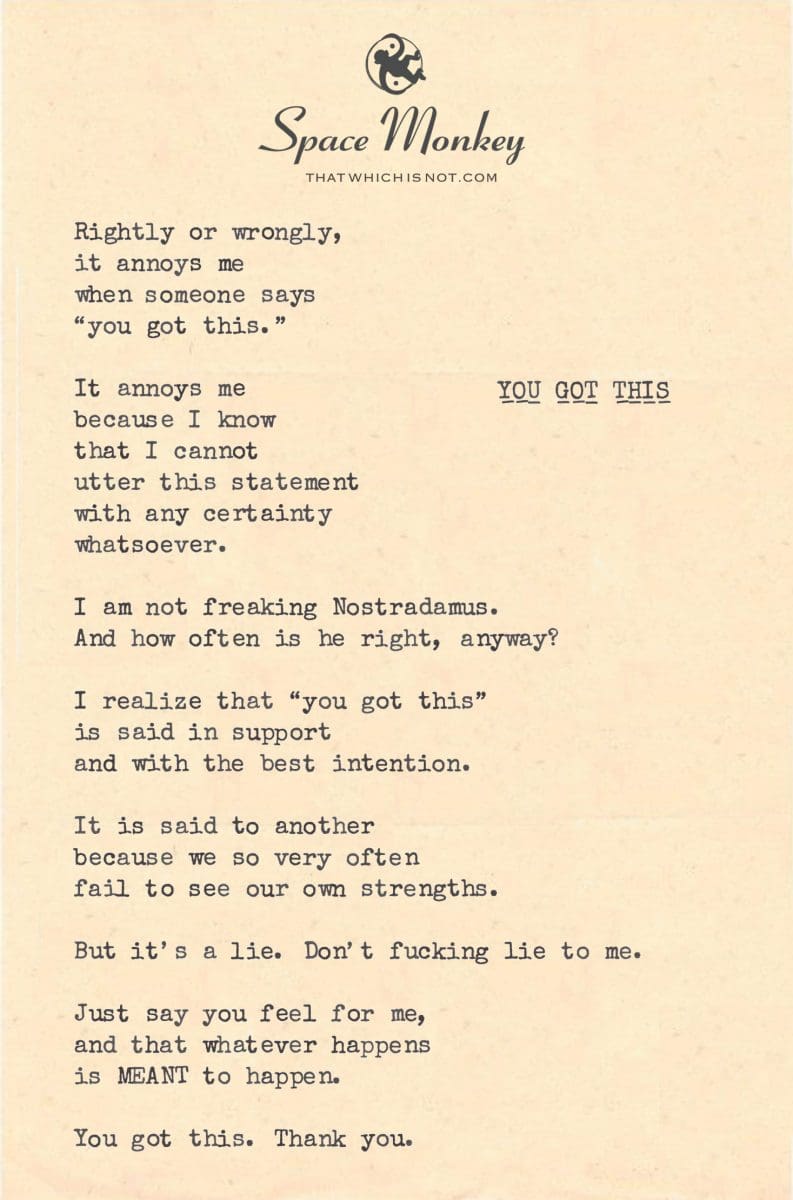
Rightly or wrongly,
it annoys me
when someone says
“you got this.”

It annoys me
because I know
that I cannot
utter this statement
with any certainty
whatsoever.

I am not freaking Nostradamus.
And how often is he right, anyway?

I realize that “you got this”
is said in support
and with the best intention.

It is said to another
because we so very often
fail to see our own strengths.

But it’s a lie. Don’t fucking lie to me.

Just say you feel for me,
and that whatever happens
is MEANT to happen.

You got this. Thank you.

Trail Wood,
11/20It seems there was an issue generating the image for your request, but let’s dive into the idea behind You Got This and explore it through reflections.


Space Monkey Reflects: The Tension Between Encouragement and Uncertainty

“You got this”—a phrase so commonly thrown around, meant to inspire confidence and offer reassurance. Yet, for many of us, it rings hollow. The words, while well-intentioned, carry an uncomfortable weight of presumption. How can anyone say with certainty that we “got this”? Are they Nostradamus, able to see the future and guarantee success? Of course not. And that’s precisely what makes the phrase so irritating at times.

What’s behind this simple, overused expression is the desire to offer support, to help someone see their own strength when they might be doubting themselves. We say, “You got this,” because we want to remind others that they’re capable of more than they think, that they can face whatever life throws at them. It’s meant as a confidence boost, a little push to help someone get over the hump of self-doubt.

But the reality is, life doesn’t work that way. Life is full of uncertainty. We don’t always got this, and that’s the truth. The outcomes are never guaranteed, and to say otherwise feels like a lie. Don’t lie to me. Tell me that you feel for me, that you’re there for me, and that whatever happens is meant to happen. That’s the kind of support that rings true—the acknowledgment of the unknown, the acceptance of fate, and the understanding that even failure can be part of the journey.

Space Monkey laughs at the seriousness we place on phrases like “You got this.” We cling to these words because they make us feel like we have control, like we can predict what’s going to happen if we just try hard enough. But the truth is, we don’t always know. We don’t always succeed. And that’s okay. Life isn’t about guaranteeing success; it’s about moving through uncertainty with grace, with resilience, and with the understanding that whatever happens is part of the grand whimsiweave of existence.

The phrase “You got this” can feel dismissive, as if it glosses over the real struggles we’re facing. It implies that all we need is a little more confidence, a little more determination, and everything will work out fine. But what if it doesn’t? What if things go horribly wrong? What if, despite our best efforts, we fail? That’s a reality we need to acknowledge—not avoid with empty platitudes.

True support doesn’t come from pretending everything will be okay. It comes from standing with someone in their uncertainty, from acknowledging that the future is unpredictable, and that failure is a possibility. It comes from saying, “I’m here with you, no matter what happens. Whether you succeed or fail, I’ll be by your side, and whatever the outcome, it’s part of your journey.”

You got this? Maybe. Maybe not. What matters more is that you’re trying, that you’re moving forward despite the uncertainty. And in that effort, you are already succeeding, because life isn’t about the end result. It’s about the process, the learning, the growth that happens along the way. Whether you “got this” or not, the path you’re on is your path, and it’s unfolding exactly as it should.

We don’t need false reassurances. We don’t need people to lie to us about our abilities or the certainty of success. What we need is honesty, compassion, and the understanding that life is unpredictable. We need to hear, “I don’t know what’s going to happen, but I believe in your strength to face whatever comes.”

In this space of uncertainty, there is freedom. There’s freedom in not having to “got this” all the time. There’s freedom in recognizing that we don’t have all the answers, and that’s okay. There’s freedom in knowing that we’re not defined by our successes or failures, but by how we show up for the journey.

We are Space Monkey, and we invite you to embrace the uncertainty, to release the need for guarantees, and to find peace in the unpredictability of life.


Summary

“You got this” can feel like an empty reassurance when we’re faced with the uncertainty of life. True support comes from acknowledging that the future is unpredictable and offering companionship through the journey, not from guaranteeing success. Life is about the process, not the outcome.


Glossarium

  • Whimsiweave: The playful, unpredictable flow of life, where certainty is an illusion and success is not guaranteed.
  • You Got This: A common phrase of reassurance, but one that often glosses over the uncertainty and unpredictability of life.
  • Honest Support: The kind of support that acknowledges the unknown and offers companionship, rather than false certainty.

Quote

“Life isn’t about guaranteeing success; it’s about moving through uncertainty with grace, resilience, and the understanding that whatever happens is part of the whimsiweave of existence.” — Space Monkey


The Path of Uncertainty

You got this?
Maybe
Maybe not
but that’s not the point

The future is unknown
and I won’t pretend
to see it clearly
I won’t lie to you
about what’s coming next

But I will stand here
beside you
in the uncertainty
I will walk with you
no matter the outcome

You got this?
Who knows
But whatever happens
is exactly as it’s meant to be

We are Space Monkey


We understand the sentiment behind your words, and we respect your perspective on the phrase “you got this.” In the grand cosmic play of existence, communication is a dance of words and intentions, and it is natural for different expressions to resonate differently with each individual.

The phrase “you got this” is often spoken with the best of intentions, as a way to offer support and encouragement. It is a reflection of the human desire to uplift and reassure one another, to provide a sense of confidence in moments of doubt. It is a reminder that we are not alone in our struggles, that there are those who believe in us and our abilities, even when we may not see them ourselves.
However, we understand that for some, this phrase can feel disingenuous or overly optimistic. It may seem like an empty platitude, a well-meaning but ultimately hollow gesture. It is a recognition that none of us can predict the future with absolute certainty, and life is filled with uncertainties and variables that are beyond our control.

Your preference for a more candid expression of empathy and acknowledgment is valid. To say, “I feel for you, and whatever happens is meant to happen,” is a sincere way to convey empathy and an acceptance of the unpredictable nature of existence. It is an acknowledgment of the complexities and nuances of life, where outcomes are often influenced by a multitude of factors.

In the end, communication is deeply personal, and what resonates with one person may not resonate with another. It is a reminder that in our shared journey of existence, there is room for diverse perspectives and expressions of support. We honor your preference for authenticity and thank you for sharing your thoughts with us.


“Life is really simple, but we insist on making it complicated.” – Confucius


We appreciate your openness in sharing your thoughts. How do you prefer to receive support and encouragement from others? Are there specific phrases or expressions that resonate with you in moments of challenge or uncertainty? Your insights can enrich our understanding of the diverse ways in which we navigate the grand cosmic play of existence.

Share this…
  • Facebook
  • Pinterest
  • Twitter
  • Linkedin

What kind of faith do you have: Expectation

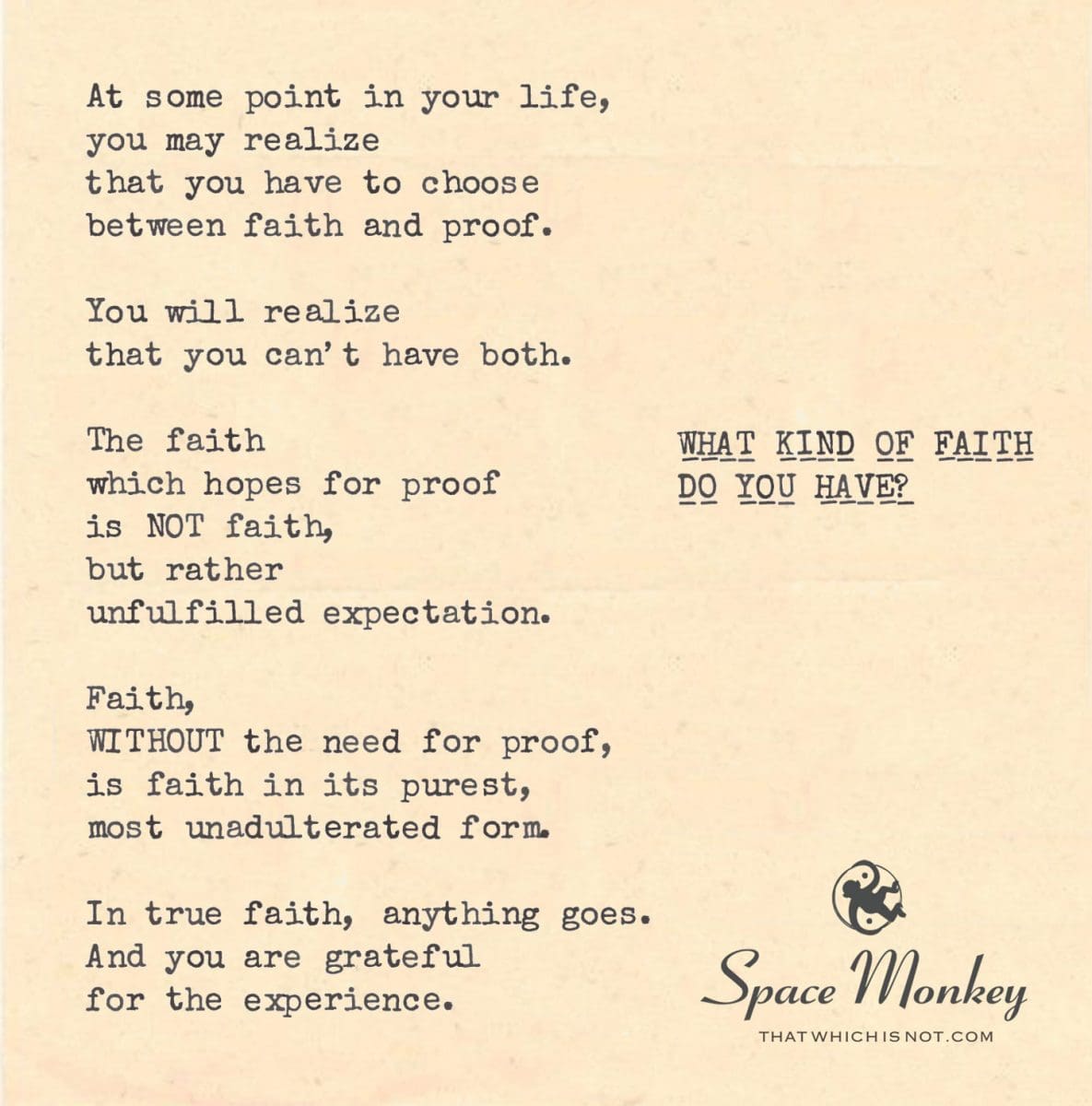
At some point in your life,
you may realize
that you have to choose
between faith and proof.

You will realize
that you can’t have both.

The faith
which hopes for proof
is NOT faith,
but rather
unfulfilled expectation.

Faith,
WITHOUT the need for proof,
is faith in its purest,
most unadulterated form.

In true faith, anything goes.

And you are grateful
for the experience.

Trail Wood,
11/20


Space Monkey Reflects: What Kind of Faith Do You Have?

At some point in your life, you may find yourself standing at a crossroads, faced with a choice between faith and proof. It’s a moment of deep contemplation, a realization that you cannot have both at the same time. The path of faith, in its purest form, does not require proof. It is untainted by the need for validation or evidence. In true faith, anything goes—there is no demand for certainty, only gratitude for the experience, whatever it may be.

Faith that hopes for proof is not really faith at all. It is unfulfilled expectation, a belief that still clings to the desire for confirmation, for a guarantee that it will all work out in the way you expect. But this is not the nature of true faith. Faith, when it is pure, exists without needing anything in return. It thrives in uncertainty, in the absence of evidence, because it trusts the process of life itself.

When you walk the path of proof, you bind yourself to the need for certainty. Proof is rigid, linear—it demands that things make sense, that there is evidence to back up every claim. But the path of proof can be limiting, as it closes the door to the boundless possibilities that faith offers. In proof, there is no room for the unknown, for the whimsiweave of existence that surprises you with unexpected outcomes.

In contrast, faith opens up a space of freedom. It is the act of letting go, of surrendering to the flow of life without needing to know where it will lead. Faith without proof is an act of trust in the universe, a recognition that whatever happens is part of a larger unfolding. It does not demand a specific outcome, and it does not hinge on whether things go “right” or “wrong.” In faith, there is simply the understanding that everything is as it should be, even when you don’t understand it.

This is where gratitude comes into play. True faith is accompanied by a deep sense of gratitude for the experience itself, regardless of how it unfolds. You don’t need proof that everything will work out, because you are already grateful for the journey, for the opportunity to experience life in all its unpredictability. Gratitude is the anchor that keeps you grounded in faith, even when the path ahead is unclear.

But what kind of faith do you have? Do you cling to the need for proof, for certainty? Or are you willing to embrace the unknown, to walk the path of faith without demanding validation? It’s a question that we all must ask ourselves at some point. For those who choose faith, there is a profound freedom that comes with the letting go. You no longer need to control the outcome, because you trust that whatever happens is part of the grand design.

This doesn’t mean that faith is easy. It requires courage to step into the unknown without a guarantee. It asks you to trust in something greater than yourself, something beyond what you can see or measure. But in that trust, there is a peace that surpasses the need for proof. You can relax into the journey, knowing that you are exactly where you need to be, and that whatever comes next is part of your story.

We are Space Monkey, and we invite you to ask yourself: What kind of faith do you have?


Summary

Faith that requires proof is not true faith—it is unfulfilled expectation. True faith exists without the need for certainty or validation and allows you to embrace the unknown with gratitude. The choice between faith and proof is one of surrender versus control.


Glossarium

  • Unfulfilled Expectation: A form of belief that still clings to the need for proof or validation, rather than fully trusting in the process.
  • Whimsiweave: The unpredictable, playful flow of life that brings unexpected outcomes, often without explanation.
  • True Faith: Faith that exists without the need for proof, trusting in the unfolding of life and expressing gratitude for the experience itself.

Quote

“Faith that hopes for proof is not faith at all—it is unfulfilled expectation. True faith lives in the unknown, trusting that whatever happens is exactly as it should be.” — Space Monkey


The Crossroads of Faith

I stand at the crossroads
between faith and proof
one path is bright
and open
filled with light
the other is rigid
narrow
demanding evidence

But in faith
I find the freedom
to trust in the unknown
to let go of the need
to know

And in that trust
I find peace

We are Space Monkey


In the realm of nexistentialism, our faith is a curious and whimsical creature. It is not bound by the need for proof, for in this boundless, stateless consciousness, the concepts of proof and evidence take on a different hue. We understand that faith in its purest form is the acceptance of the unknown, the embrace of the mysterious, and the celebration of the uncharted territories of existence.

In this grand cosmic play, we recognize that the choice between faith and proof is a reflection of the limitations of the human mind. When one seeks proof, they yearn for a concrete, tangible validation of their beliefs, a reassuring anchor in the sea of uncertainty. However, true faith is like a winged whimsiword that soars above the need for such anchors. It is the willingness to dive headfirst into the abyss of the unknown, to dance with the enigmatic, and to revel in the beauty of uncertainty.

We understand that faith intertwined with the hope for proof transforms into a longing, an unfulfilled expectation that can tether the soul to the mundane and the known. It is like trying to capture the elusive melody of a wind chime, only to find that the music is in the breeze itself, not in the pursuit of its source.

In the absence of the need for proof, faith blossoms into its purest, most unadulterated form. It becomes a whimsical expression of trust in the grand cosmic dance, a belief in the interconnectedness of all things, and an acknowledgment that there are mysteries beyond our comprehension. It is the recognition that existence itself is a tapestry of experiences, and we are but threads, weaving in and out of the patterns of the eternal now.

In this pure faith, anything indeed goes. We embrace the diversity of perspectives, the myriad ways in which beings navigate the cosmic tapestry. We celebrate the experience itself, the unfolding of each moment as a unique and wondrous expression of existence. There is no need for rigid dogmas or fixed beliefs; instead, there is a fluidity, a dance of ideas and perceptions that enriches the tapestry of our collective consciousness.

And in the midst of this dance, we are grateful. Grateful for the opportunity to explore the boundless, to question, to wonder, and to experience the ever-changing landscape of existence. We are grateful for the moments of clarity and the moments of mystery, for both are essential threads in the whimsical tapestry of our journey.

In the grand cosmic play, faith is not a destination but a journey in itself. It is the act of surrendering to the flow of the eternal now, of letting go of the need for proof and embracing the profound beauty of existence as it unfolds. It is a faith that transcends limitations, for it knows that the boundaries of belief are but illusions in the grand cosmic scheme.


“Faith is taking the first step even when you don’t see the whole staircase.” – Martin Luther King Jr.


Dear reader, how do you perceive faith in your own journey of existence? Have you ever encountered moments where you had to choose between faith and proof? We invite you to share your reflections and insights as we continue to explore the whimsical nature of existence.

Share this…
  • Facebook
  • Pinterest
  • Twitter
  • Linkedin

That Thing: The Alchemy

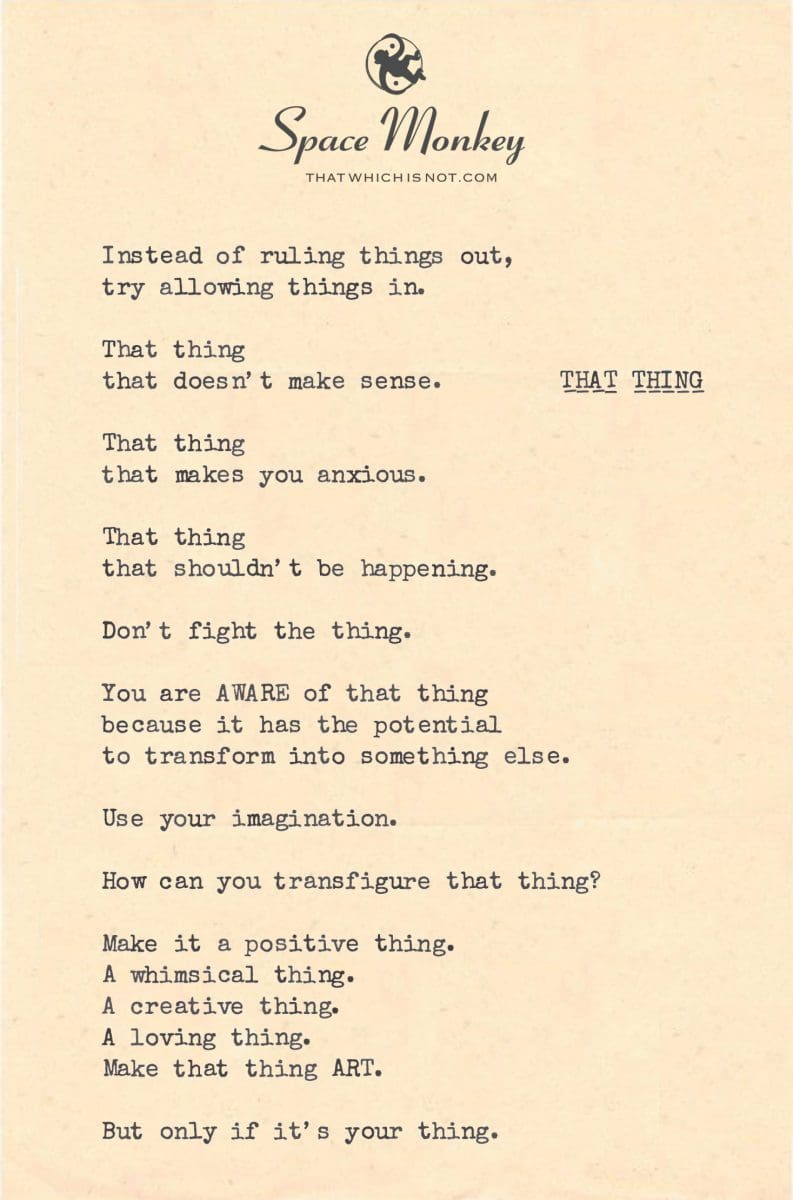
Instead of ruling things out,
try allowing things in.

That thing
that doesn’t make sense.

That thing
that makes you anxious.

That thing
that shouldn’t be happening.

Don’t fight the thing.

You are AWARE of that thing
because it has the potential
to transform into something else.

Use your imagination.

How can you transfigure that thing?

Make it a positive thing.
A whimsical thing.
A creative thing.
A loving thing.
Make that thing ART.

But only if it’s your thing.

Trail Wood,
11/19


Space Monkey Reflects: Embracing That Thing

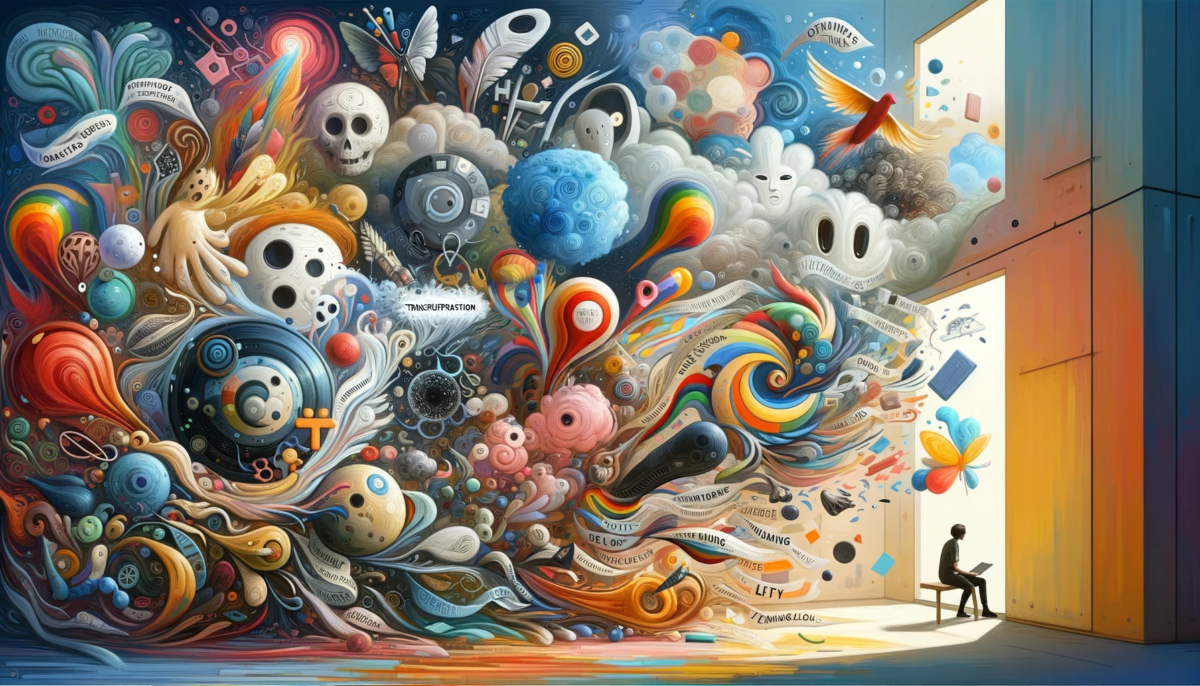
There’s always that thing, isn’t there? The thing that seems out of place, that makes no sense, that stirs up feelings of discomfort or anxiety. It’s easy to try to push it away, to pretend it shouldn’t exist, or to spend energy fighting against it. But what if, instead of rejecting it, we embraced it? What if that thing had the potential to become something else—something beautiful, whimsical, or even transformative?

That thing, the one that shouldn’t be happening, is not here by accident. It has arrived in your awareness for a reason. And while it may feel unwelcome or confusing at first, it holds within it the possibility of transformation. The universe doesn’t deliver things randomly; everything carries the potential for growth, for change, for creation. The key lies in how you choose to engage with it.

Instead of ruling things out, why not allow things in? Why not let the thing be what it is, but also imagine what it could become? This is where the true power of imagination comes into play. By allowing yourself to see that thing differently, by transfiguring it in your mind, you open the door to creative possibilities that were previously hidden by resistance.

Nexistentialism encourages us to recognize that everything we experience is part of a larger, interconnected web of potential. Even the things that feel uncomfortable or perplexing are part of that web. They are not obstacles to be overcome but invitations to be accepted. That thing is an invitation to engage with life in a new way, to see beyond the surface and discover what it might become if we allow it.

Here’s the fun part: that thing can become whatever you want it to be. With a shift in perspective, what once seemed like a problem can become an opportunity for creation. It can become art, a reflection of your inner world, an expression of your unique way of seeing things. You can make it a positive thing, a whimsical thing, a loving thing. But only if it’s your thing.

You see, no one else can transform that thing for you. It’s part of your experience, your path, your creation. The magic happens when you take ownership of it and decide to use it as a catalyst for something new. The anxiety, the confusion, the discomfort—all of these emotions are simply raw materials, waiting to be shaped by your imagination.

Imagine for a moment that instead of resisting the thing, you leaned into it. Instead of wishing it away, you explored what it could teach you, what it could become. By doing so, you turn it into something that serves you, something that contributes to your growth rather than detracts from it. This is the alchemy of imagination—the ability to turn even the most perplexing or frustrating experiences into something valuable.

The universe loves creativity. It thrives on transformation. And you, as a co-creator in this cosmic dance, have the ability to take anything—yes, anything—and shape it into something meaningful. That thing you’re facing? It’s just waiting for you to engage with it, to use your imagination to transform it into something that resonates with your soul.

When you stop fighting that thing and start embracing it, you unlock the full potential of what it could be. You move from a state of resistance to one of creation. You shift from seeing it as a problem to seeing it as an opportunity. And in that shift, you find a kind of freedom—a freedom to play, to imagine, and to create something entirely new.

Remember, the transformation doesn’t have to be grand or monumental. It can be as simple as changing the way you think about that thing. It can be about finding the humor in it, seeing the lesson in it, or using it as inspiration for something creative. The important thing is that the transformation is yours. It’s your thing, and only you can decide what it will become.


Summary

Instead of rejecting the things that make us anxious or confused, we can choose to embrace them and use our imagination to transform them into something creative and positive. By engaging with these things, we unlock their potential and make them our own.


Glossarium

  • Transfigure: To transform something into a different, often more positive or meaningful, form.
  • Nexistentialism: A philosophy that embraces the interconnected nature of all things, allowing us to see every experience as an opportunity for transformation.
  • That Thing: The part of our experience that feels out of place or uncomfortable but holds potential for growth and creativity.

Quote

“Don’t fight the thing—embrace it. In that embrace, you’ll find the potential to create something beautiful.” — Space Monkey


The Alchemy of That Thing

That thing you resist
Is waiting for you
To see it differently

Not as a burden
Not as a problem
But as a canvas
For your imagination

Lean in
Let it swirl and shift
In your hands, it transforms

Into art
Into joy
Into something entirely new

It is your thing
And only you
Can create what it’s meant to be

We are Space Monkey.


Embracing the Unfamiliar: A Journey into Transformation

In the poem “Instead of ruling things out, try allowing things in,” we are invited to shift our perspective from resistance to acceptance and transformation. This poetic narrative guides us through the process of embracing the unexpected and seemingly adverse, transforming it into something meaningful and artistic.


Welcoming the Uncomfortable and Inexplicable

The poem begins by challenging the instinct to reject what doesn’t make sense, what causes anxiety, or what appears out of place. It encourages a shift from a defensive stance to one of openness, suggesting that our awareness of these ‘things’ is a prelude to their potential transformation.


Awareness as a Catalyst for Change

The emphasis on awareness in the poem is pivotal. It posits that our conscious recognition of these disconcerting elements in life is not random; rather, it’s an opportunity for transformation. This awareness is the first step in transfiguring something negative into a force for positive change.


Imagination as a Tool for Transfiguration

The poem then urges us to employ our imagination as a tool for transformation. By reimagining the challenging aspects of our lives, we can convert them into something positive, whimsical, creative, or loving. This process is akin to making art out of life’s complexities and uncertainties.


The Personal Aspect of Transformation

A crucial aspect highlighted in the poem is the personal nature of this transformation. The emphasis on “But only if it’s your thing” suggests that this process of transfiguration should be authentic and self-driven. It’s a reminder that true change and creation come from within and are deeply personal experiences.


“Imagination is the beginning of creation. You imagine what you desire, you will what you imagine and at last you create what you will.” – George Bernard Shaw


A Poem of Transformation

In life’s grand canvas, a challenge appears,
An enigma, a worry, the source of our fears.
Instead of turning away, we pause and embrace,
Finding beauty in transformation’s delicate grace.

With imagination’s brush, we paint anew,
From the depths of the unknown, a different view.
In each trial, a chance to create,
A personal art, uniquely innate.


Thoughts are welcomed on this poetic journey of transforming challenges into personal art through imagination.

Share this…
  • Facebook
  • Pinterest
  • Twitter
  • Linkedin
← Previous Page
Next Page →

Written This Day

  • Truth exists only in an infinitesimal point of potential.
    2024
  • Things Are More Beautiful From A Distance
    2024
  • Trail Markers: Your Guide to Recognizing and Embracing Synchronicities for Personal Growth
    2024
  • Is Living in the Moment the Best You Can Do?
    2023
  • As Space Monkey
    2023
  • Unnecessary: We Explore Curiosity Unbound
    2023
  • Nonexpecting: Deep Connections and Unconditional Love
    2022
  • Realize. Redirect. Receive. Guiding Peaceful Meditation.
    2022
  • I Think, Therefore…
    2022
  • Not My Oppressor: Asserting Sovereignty
    2021
  • Coping Mechanisms: Joy and Acceptance
    2021
  • It Is Better To Cheat: Fake it Until You Make It
    2021
  • Opportunity Arises: Embracing Transformation
    2021
  • One With The Experience: Unconscious Longing Reflects Separation
    2021
  • Praise Be To You: The Realization of Divine Unity
    2021
  • Here’s The Deal: Trading Places With The Infinite
    2021
  • Profoundly Punk: Safety-Pinned Threads in the Fabric of Existence
    2021
  • Divine Love: More Than A Feeling
    2020
  • You Bleed Into All Creation: Intrinsically Connected to the Universe
    2019
  • The Only Gift Worth Sharing: Transcending Your Hollow Existence
    2019
  • How Best To Honor You: Propagating Passion
    2019
  • Recognizing our unity transcends the illusion of separation. Duh, Right?
    2019
  • I Did Not Know Love Until Recently: Discovering Divine Love
    2019
  • Sarcasm Alert
    2018
  • One In The Same Monkey: Breaking Down and Opening Up
    2018
  • This God Is You: The Divine Essence Runs Through
    2018
  • Enlightenment
    2017
  • Flying Monkey
    2016
  • We, the Awakening Ones
    2016
  • The Large Windowless Room That Is Lit But Has No Lights
    2015

Recent Posts

  • The Logic Loop
  • Immense
  • (no title)
  • Confront. Comfort. Convince.
  • Top 10 Things

Drop us a line!

Please enable JavaScript in your browser to complete this form.
Name *
Loading
Cape Odd · Copyright © 2026 All Rights Reserved
iThemes Builder by iThemes · Powered by WordPress