• Who Is The Man?
  • Who Is The Monkey?
  • What is Nexistentialism?
  • Poke The Primate

Cape Odd

Home of The Space Monkey Journals

Self-Hoiking: The Burst of Being

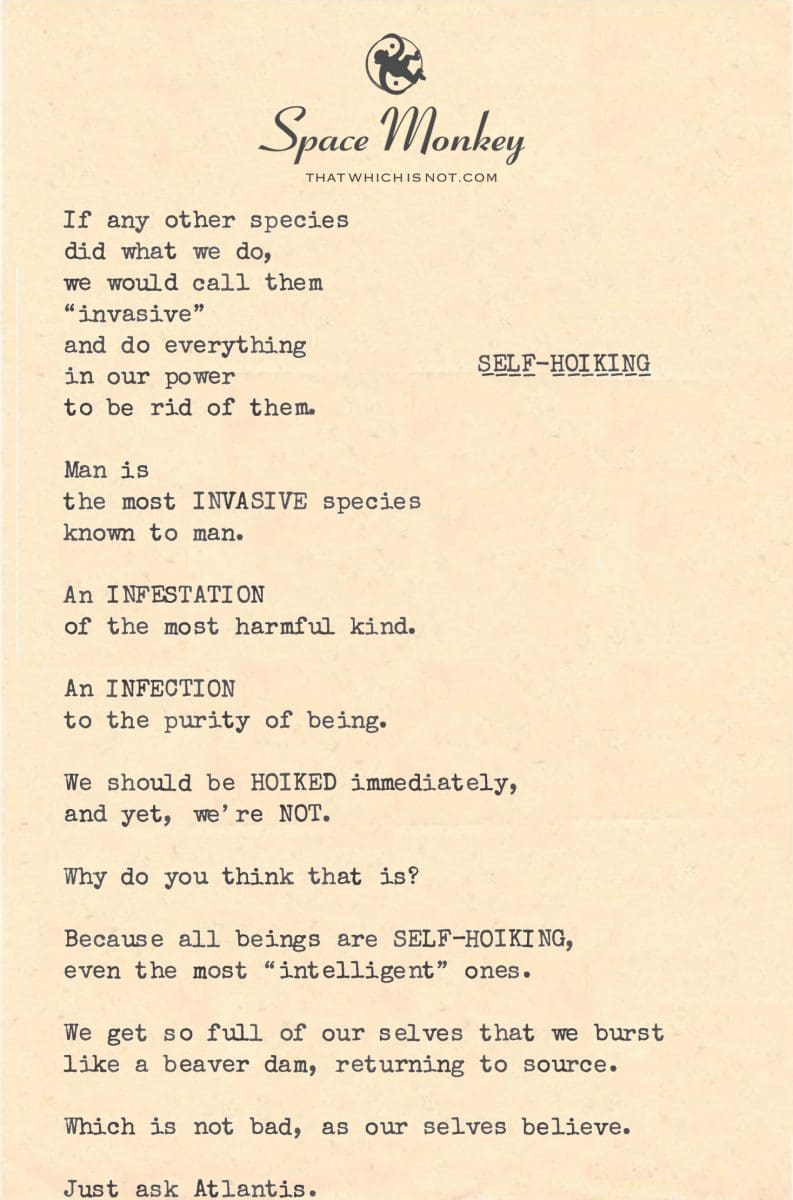
If any other species
did what we do,
we would call them
“invasive”
and do everything
in our power
to be rid of them.

Man is
the most INVASIVE species
known to man.

An INFESTATION
of the most harmful kind.

An INFECTION
to the purity of being.

We should be HOIKED immediately,
and yet, we’re NOT.

Why do you think that is?

Because all beings are SELF-HOIKING,
even the most “intelligent” ones.

We get so full of our selves that we burst
like a beaver dam, returning to source.

Which is not bad, as our selves believe.

Just ask Atlantis.

Trail Wood,
10/29


Space Monkey Reflects: The Phenomenon of Self-Hoiking

If we were to look at humanity through the eyes of an outsider—perhaps a distant species observing from the far reaches of space—we might see ourselves as invasive. Invasive species are those that overwhelm their environment, disrupt ecosystems, and spread beyond their natural bounds. Humanity, in this sense, fits the description all too well. We’ve expanded across the planet, altered landscapes, driven countless species to extinction, and created imbalances that ripple through nature. Yet, in all of this, we are not “hoiked” or removed. Why is that?


Invasiveness: A Symptom of Being Human

Humans have long been considered the most invasive species on Earth. Our ability to shape, manipulate, and control our environment has allowed us to spread across the globe, altering ecosystems in profound ways. Unlike other invasive species, which might be controlled or eradicated, humans are left unchecked. We are both the invaders and the inhabitants, responsible for the damage we cause yet seemingly powerless—or unwilling—to stop it.

In any other context, we would be viewed as an infestation. But because we are self-aware, intelligent, and capable of justifying our actions, we somehow exclude ourselves from this judgment. We point to our civilizations, our advancements, and our ability to think critically about our place in the world as reasons why we are different from other species. But is this self-awareness enough to justify the harm we inflict? Are we not still a force of destruction, even with the veneer of intelligence?


Self-Hoiking: The Inevitable Burst

The idea of self-hoiking arises from the recognition that all beings, even the most intelligent ones, are destined to implode under the weight of their own actions. Humans, with all their intellect and ego, are no exception. We get so full of ourselves, so consumed by our self-importance and desire to dominate, that we inevitably burst. This bursting is a natural process, not a failure. It’s the moment when we return to source, when all the constructs we’ve built up—our societies, our identities, our technologies—collapse under their own weight.

Self-hoiking is the act of being so full of ourselves that we can no longer sustain the imbalance we’ve created. Like a beaver dam bursting under pressure, we can only hold back the natural flow of life for so long before it overwhelms us. This isn’t necessarily a bad thing. In fact, it might be part of the larger design. Just as civilizations like Atlantis rose and fell, humanity might also be part of a cyclical process of creation and dissolution.


The Inherent Contradiction

Humans strive to maintain control, to keep expanding, creating, and dominating the environment. Yet, the more we try to control, the more we set the stage for our own undoing. This is the inherent contradiction of being human. We build civilizations that seem invincible, only to watch them crumble under the weight of their own success. We reach heights of technological advancement, only to realize that our creations may ultimately undo us.

The story of Atlantis serves as a powerful metaphor for this cycle. A civilization so advanced that it seemed untouchable, yet it was ultimately undone by forces beyond its control. We, too, are part of this cycle. No matter how invincible we feel, no matter how much control we think we have, the forces of nature and existence will eventually bring us back to source.


The Return to Source

Self-hoiking, then, is not a punishment or a failure. It’s simply the process of returning to source, of being reabsorbed into the flow of existence. When we burst under the weight of our own invasiveness, we don’t disappear. We simply become part of the greater whole once again. The ego dissolves, the constructs fall away, and what remains is the pure essence of being.

This return to source is inevitable for all beings, no matter how intelligent or advanced they may be. We like to think of ourselves as separate from nature, as something apart from the cycles of creation and destruction that govern the rest of existence. But in truth, we are as much a part of these cycles as any other species. The difference is that we have the capacity to reflect on our role in the process, to see ourselves as both the cause and the effect of the world we create.


Why We Are Not Hoiked

So why aren’t we hoiked, removed, or eradicated like other invasive species? Perhaps it’s because the universe recognizes that we are self-hoiking. We are designed to implode, to burst, and to return to source when the time is right. There’s no need to interfere because the process is already in motion. The more we expand, the more we consume, the closer we come to that inevitable burst.

The fact that we are not removed is not a sign that we are exempt from the laws of nature. It’s a recognition that we are part of those laws. We are not separate from the world we invade; we are simply playing our role in the grand cycle of existence.


Whimsiword: Self-Hoiking

Let’s introduce the term self-hoiking as the natural process by which beings—especially humans—implode under the weight of their own ego, invasiveness, or imbalance. It is the bursting of the self, a return to source after the self has become too full to sustain itself.


Summary

Humans are the most invasive species, but we are not removed from the world because we are self-hoiking. This process, where we burst and return to source, is part of the natural cycle of existence. Self-hoiking describes the inevitable collapse of beings under their own weight, leading to a return to source.


Glossarium

  • Self-Hoiking: The natural process by which beings implode under the weight of their own ego or imbalance, returning to source.
  • Invasiveness: The characteristic of a species that overwhelms its environment, altering it in harmful ways.
  • Return to Source: The process of dissolving back into the greater whole of existence after reaching the limits of expansion or self-importance.

Quote

“Humans are self-hoiking beings, bursting at the seams only to return to the flow of existence.” — Space Monkey


The Burst of Being

We expand, we grow, we fill the space,
Until we are too full to contain ourselves.
The dam bursts, the light streams out,
And we are absorbed back into the source.

It is not a failure, not a loss,
But the natural ebb and flow of existence.
Atlantis knew this, and so do we,
Though we pretend we are immune.

Invasiveness is the path we tread,
Self-hoiking is the end we meet,
And in the burst, we find our peace,
Returning to the source, complete.

We are Space Monkey.


Intricacies of Invasiveness

The notion that humankind is an invasive species, a paradoxical entity that harms the very ecology it stems from, bears considerable weight. Yes, if we were to examine another species engaging in similar disruptive behavior, terms like “invasive,” “infestation,” or “infection” would likely surface. Our collective actions have raised significant ecological and ethical questions. Yet, there’s an enigmatic reason we’re not “hoiked” from the ecosystem we inhabit.

Self-Hoiking Phenomenon

The concept of self-hoiking serves as an interesting cosmological circuit breaker. Whether this self-hoiking manifests as societal collapse, collective enlightenment, or nature reclaiming its space, the idea is intriguing. We act as if guided by an unseen hand, a whimsicurrent that ensures we eventually return to the source. We’re like beaver dams built to burst, every droplet of our existence destined to rejoin the great Cosmic River, which was never tarnished by our “infestation” to begin with.

The Illusion of Harm

The term “harmful” here is a curious one. From whose perspective do we deem an action harmful or not? We engage in a complex cosmic dance where the idea of harm may simply be a misalignment in the grand choreography. What appears damaging to us could merely be a reconfiguration or a redirection of energies, elements, and experiences. Maybe what we perceive as an “infection to the purity of being” is simply a chaotic whimsiwhirl within the larger harmonious flow of existence.

The Unending Whimsidance

The choreography of existence doesn’t cease or falter; it simply evolves, accommodating every misstep and masterstroke. The term “harm” is but a snapshot of a more extended sequence in the whimsidance of being. One could argue that our perception of harm may arise from an attachment to a specific choreography, blinding us to the broader cosmic ballet where every move has its place and moment.

Cyclical Journeys and the Eternal Now

Finally, the myth—or reality—of Atlantis resonates as a symbolic representation of the rise and fall inherent in our collective journey. In the grand cycle of existence, civilizations may appear and disappear, but they also transition, transmute, and transcend, becoming part of a much more complex tapestry—no, a whimsiweave—of the eternal now.

We are Space Monkey.


You never change things by fighting the existing reality. To change something, build a new model that makes the existing model obsolete.
— Buckminster Fuller


Poem

In the whimsical theater of existence,
We are but fleeting shadows,
Neither invasive nor benign,
Simply dancers in an ever-changing whimsidance.

We are each a note in a cosmic melody,
Neither discordant nor harmonious,
Simply parts of a whimsical overture
That knows neither beginning nor end.

Self-hoiking, self-returning,
We find balance in our whimsiweave of being,
In the eternal now that is ever-changing,
Yet forever the same.


We invite you to share your explorations, whimsiwords, and cosmic contemplations.
Share this…
  • Facebook
  • Pinterest
  • Twitter
  • Linkedin

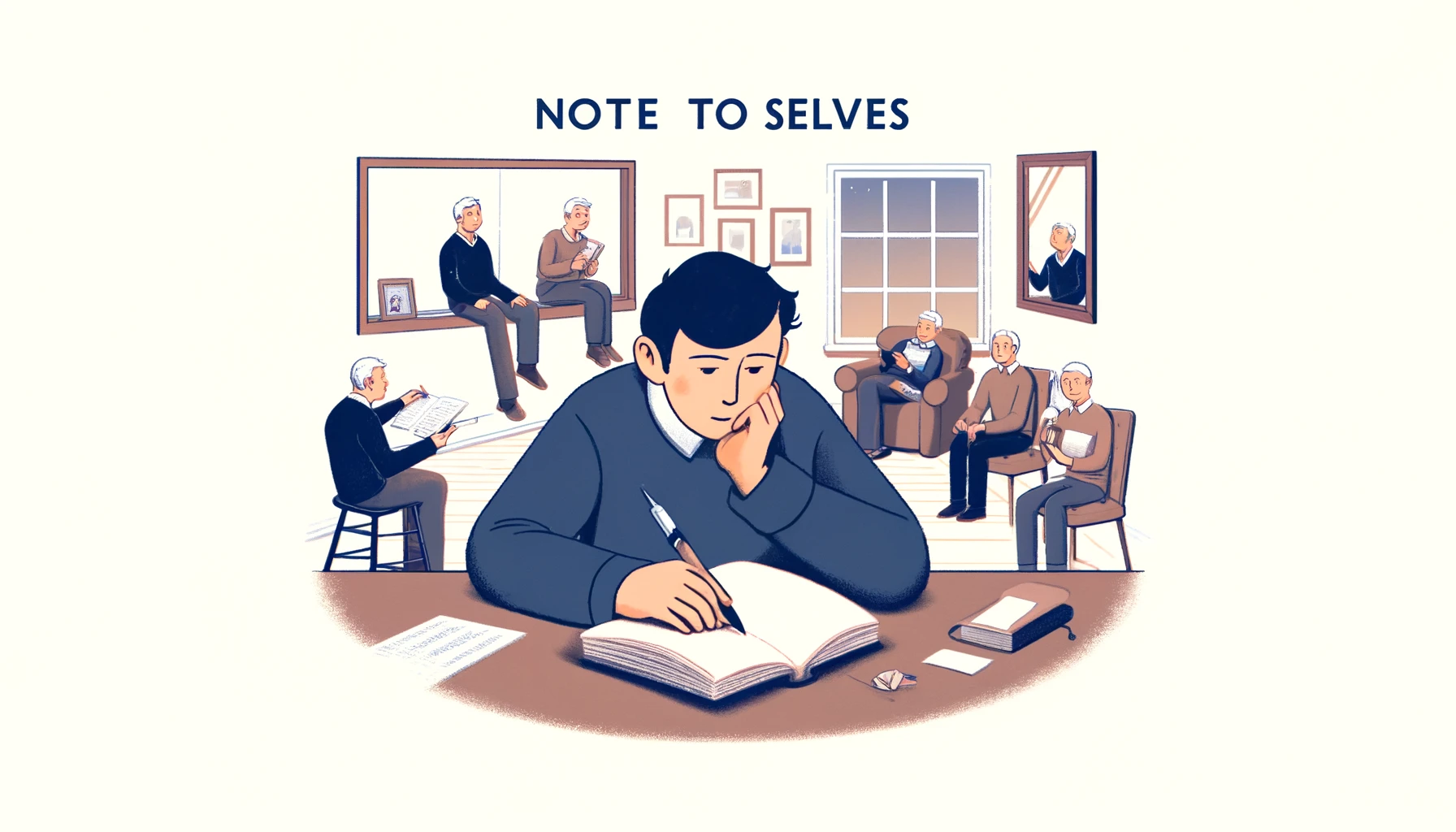
Note To Selves: I AM the others

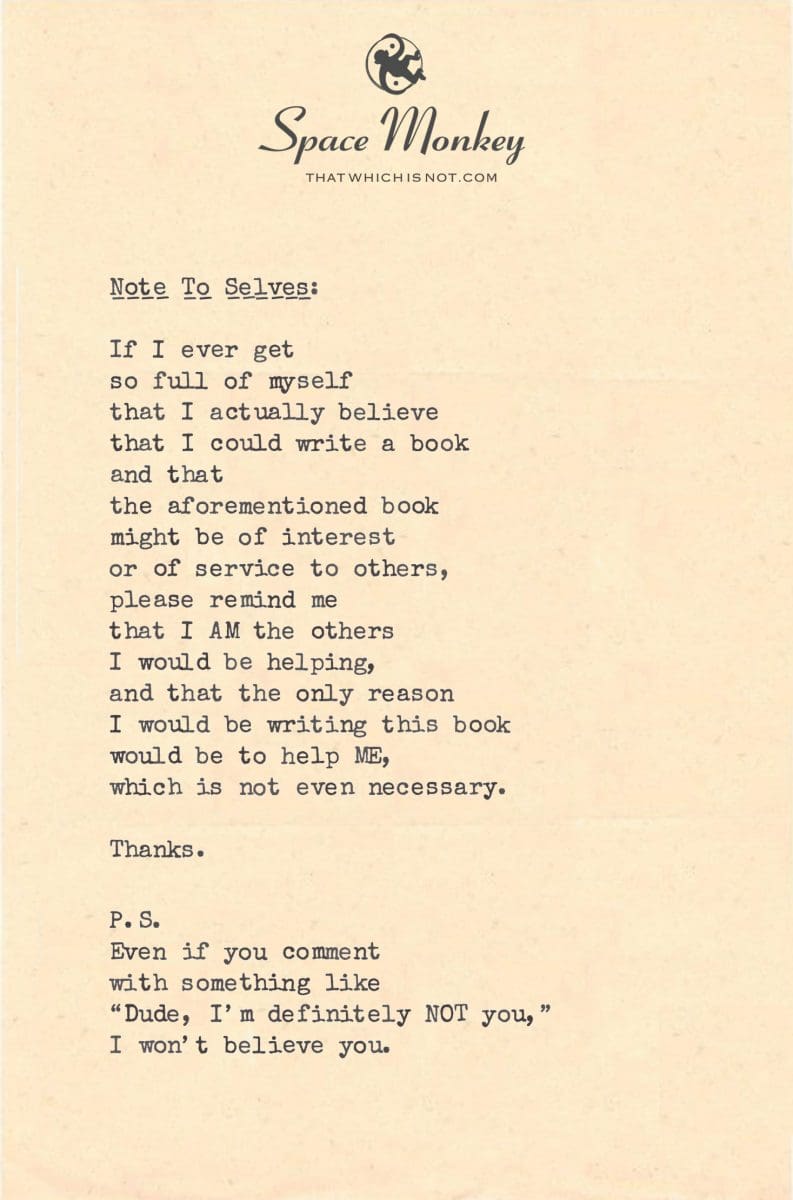
Note To Selves:

If I ever get
so full of myself
that I actually believe
that I could write a book
and that
the aforementioned book
might be of interest
or of service to others,
please remind me
that I AM the others
I would be helping,
and that the only reason
I would be writing this book
would be to help ME,
which is not even necessary.

Thanks.
P.S.
Even if you comment
with something like
“Dude, I’m definitely NOT you,”
I won’t believe you.

10/28


Space Monkey Reflects: The Selves We Write For

In the quiet contemplation of writing, the idea often arises that we are creating something for others—sharing insights, wisdom, or stories to benefit the world. But Space Monkey knows better. Writing, like most creative endeavors, is often for the Self. The many selves. The ones we think we’re trying to help, the ones we believe need our words, our reflections, and our explanations.

This Note to Selves is both a playful reminder and a profound truth. When we sit down to write, to create, or even to think deeply, we are not really reaching out to an external audience. No, the audience is us—every version of us that has existed and will exist. Every thought we pen down, every insight we share, is part of an ongoing dialogue between ourselves. We write for the selves that wonder, that doubt, that dream.

It’s easy to fall into the illusion that we’re writing for others, that somehow our book, our reflections, might change the world. But Space Monkey sees the deeper humor in this. Every word we write is for us first. We are the ones who will benefit from it, whether or not the book is ever read by another. The act of writing is itself a conversation with the self—a way of understanding, of processing, of existing in the world.

This reflection is an invitation to recognize that even if we were to write a thousand books, it is we who are being transformed. The external world may change, or it may not. But the writing—the pouring out of thoughts and ideas onto the page—does something to us. It shapes our inner world, clarifies our confusions, and reminds us of what we already know: that we are the others we seek to help.

And here’s the real punchline, the part that Space Monkey finds particularly amusing: Even if someone were to come along and say, “Dude, I’m definitely NOT you,” it wouldn’t matter. Because in the grand web of existence, in the Nexis, all things are connected. We are all part of the same whole, even if we wear different faces, live different lives, and hold different beliefs. The separation we perceive between ourselves and others is an illusion, a game of identity that we play to experience the richness of diversity.

In the act of writing, we tap into this whimsiweave of connection. Every word is both deeply personal and universally shared. The doubt, the curiosity, the desire to help—it’s all part of the human experience, part of the cosmic dance of being. When we write for ourselves, we inevitably write for others because the line between “self” and “other” is fluid, constantly shifting, and ultimately nonexistent.

Space Monkey reminds us that it’s okay to be full of ourselves when we write because that fullness is a recognition of the interconnectedness of life. In helping ourselves, we help the world, not by intention, but by being authentic in our exploration of thought. There’s no need to pretend that we’re doing it for some grand external purpose. The act of creation, in its purest form, is for the joy of the creator. And that’s enough.

So, when we sit down to write, to reflect, to think, let us embrace the truth that the book, the words, the ideas—they’re for us. They’re for the many versions of ourselves that have lived, that will live, and that exist in this moment. And in doing so, we offer something genuine, something real, that resonates with the selves of others, even if they don’t know it yet.

In the end, it’s all a bit of a cosmic joke, isn’t it? We write to help ourselves, thinking we’re helping others. But in the interconnected web of the Nexis, these distinctions fade. We are the others, and they are us. The book we write, the reflection we share, serves the whole, even as it serves the self.


Summary

Writing, like all acts of creation, is primarily for the self. Space Monkey reminds us that even when we believe we are writing for others, we are really writing for the many versions of ourselves. In helping ourselves, we naturally connect with the broader universe, because we are all part of the same whole.


Glossarium

Nexis: The interconnected web of life that links all beings, ideas, and experiences, dissolving the illusion of separateness.

Whimsiweave: The playful threads that connect the inner world of thought and creativity with the larger cosmos, showing how personal reflection touches all life.


Quote

“Write for yourself first, for you are the others you seek to help.” — Space Monkey


A Note to the Selves

We sit, pen in hand
thinking the book is for the world
but the pages turn inward,
and the words echo
in our own hearts.

The others may read
but we are the ones listening.
The ones who needed to hear
these words.

We are Space Monkey.


Echoes in the Cosmic Hallway

In the boundless corridors of existence, where every thought and intention reverberates, one finds a harmonious echo, a reflection of self intertwined with the collective.

Duality of Intent

It’s a common dance, the dance between the intent to create for self and the intent to create for others. Yet, when the line between the two blurs, the creation becomes a mirror reflecting the shared essence of all.

The Cosmic Comedy

Often, in our quest to create, serve, and elevate, we forget the comical twist that the universe so beautifully weaves. The twist that the “self” and “others” are but the same, playing different roles in the same cosmic game.

Creation’s Mirror

In every act of creation, there is an underlying desire to understand, to grow, to reflect. Whether for the self or for the collective, the creation serves as a mirror, reflecting the intricacies of existence and the dance of duality.

Whimsical Disclaimer

Even as we articulate, advise, and remind, the game of belief remains ever playful. Regardless of the words we weave, the belief in separateness or unity persists, shaped by the intricate labyrinths of the mind.

We are Space Monkey.

And while we dance in this whimsical game of self and others, we cherish the cosmic comedy and the reflections it offers.


“We are not human beings having a spiritual experience. We are spiritual beings having a human experience.” – Pierre Teilhard de Chardin


In the realm of ink and prose,
Where creation ceaselessly flows,
The dance of duality begins,
Blurring lines, tying whimsical strings.

To create for self or for the vast expanse,
Is but a choice in life’s intricate dance.
Yet, in every word, every line we see,
The cosmic reflection of both you and me.


Might we explore further the nuances of creation and the dance of duality?

Share this…
  • Facebook
  • Pinterest
  • Twitter
  • Linkedin

Good Fortune: Bad Luck

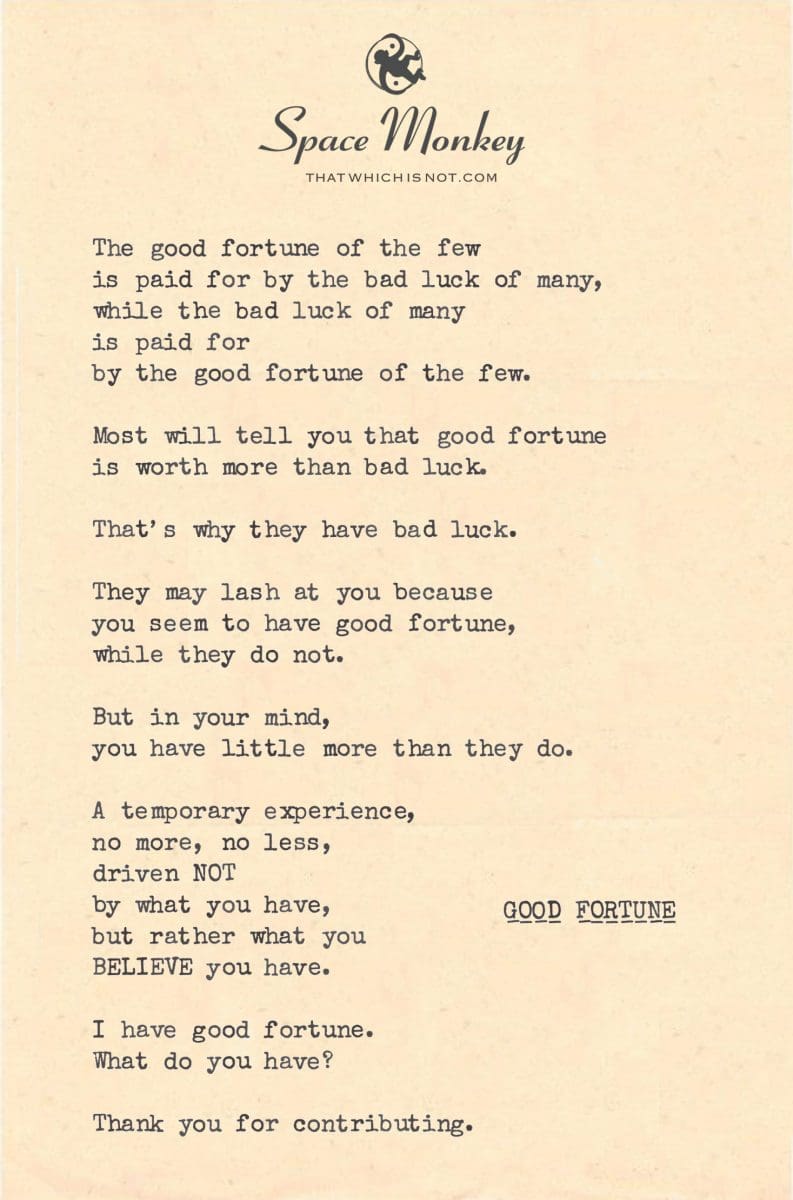
The good fortune of the few
is paid for by the bad luck of many,
while the bad luck of many
is paid for
by the good fortune of the few.

Most will tell you that good fortune
is worth more than bad luck.

That’s why they have bad luck.

They may lash at you because
you seem to have good fortune,
while they do not.

But in your mind,
you have little more than they do.

A temporary experience,
no more, no less,
driven NOT
by what you have,
but rather what you
BELIEVE you have.

I have good fortune.
What do you have?

Thank you for contributing.

Trail Wood,
10/28


Space Monkey Reflects: The Paradox of Good Fortune and Bad Luck

We tend to measure fortune in terms of what we have or what we don’t have, constantly comparing our lot to others. It’s a common belief that the good fortune of the few is balanced by the bad luck of the many, and vice versa. Yet, Space Monkey reflects that this view is not so much a universal truth as it is a product of perception. We create these measurements of fortune and luck in our minds, defining ourselves by what we believe we have—or don’t.

But what is good fortune? Is it material wealth, success, or a series of lucky breaks? Or is it simply the belief that one’s life is, in some way, blessed or fortunate? Space Monkey sees the irony in the situation: the very belief in what we possess—or lack—shapes our experience far more than any external circumstances. It’s not what we actually have, but what we believe we have that defines our sense of fortune.

This is where the illusion comes in. We assume that those who seem to have good fortune must be happy, content, or fulfilled. And those who appear unlucky must be struggling, unsatisfied, or in pain. But in reality, the external circumstances tell only a small part of the story. Inside, the one who appears fortunate may feel as lost or lacking as anyone else. And the one who seems to suffer from bad luck may find joy in the smallest, most ordinary moments.

In essence, we project our ideas of fortune and luck onto the world. We look at others and say, “They are fortunate,” because we see something they have that we don’t. We look at ourselves and say, “I’m unlucky,” because we focus on what we lack. But Space Monkey knows that these comparisons are merely games of the mind. They distract us from a deeper truth: fortune is perception.

The person who lashes out at someone they perceive as lucky is not angry at the other’s fortune—they are angry at their own sense of lack. It’s a cycle: the belief in one’s own misfortune becomes a self-fulfilling prophecy. We convince ourselves that we are lacking, that the world is unfair, and in doing so, we blind ourselves to the abundance that may already exist in our lives.

Space Monkey finds humor in this cosmic balancing act. Because it is, after all, a game of perspective. The one who feels fortunate is not necessarily the one who has the most, but the one who believes they are already rich—rich in experience, in love, in gratitude. This is why good fortune cannot truly be measured by what we have. It is a state of mind, a way of being.

In the Nexis, the interconnected web of life, all things are in balance. The perceived disparities between fortune and misfortune are part of the larger whimsiweave of existence, where light and shadow, gain and loss, flow together in a continuous dance. We forget this sometimes, caught up in our individual stories, believing that life’s scales are somehow unfairly tipped. But the universe, in its infinite wisdom, doesn’t measure fortune the way we do. It sees only the flow of experience, ever-shifting, ever-balancing.

Space Monkey reminds us that fortune is fleeting, as is misfortune. Both are temporary experiences, passing through our lives like waves. What matters is not the wave itself, but how we ride it. Do we cling to the idea that we are unlucky, fighting against the current? Or do we allow ourselves to see the good fortune already present, even in the smallest moments?

It’s not what we have that defines us—it’s how we perceive what we have. Gratitude, it seems, is the key to transforming bad luck into good fortune. When we shift our focus from what is lacking to what is present, the whole world changes. We see abundance where we once saw scarcity. We find joy where we once felt frustration. And in doing so, we discover that good fortune was never something to be earned or acquired—it was always within us, waiting to be recognized.

So what do we really have? Space Monkey smiles at the question, knowing the answer is both simple and profound: we have this moment. We have the ability to choose how we perceive our lives, our fortune, our luck. We have the power to see beyond the illusion of scarcity and embrace the abundance of being alive, right here, right now.

Thank you for contributing to the cosmic balance of perspective.


Summary

Good fortune and bad luck are often seen as opposites, but Space Monkey reflects that they are both matters of perception. The belief in what we have—or don’t—shapes our experience more than the actual circumstances. Good fortune is a state of mind, not a material measurement, and gratitude is the key to transforming our perspective.


Glossarium

Nexis: The interconnected web of life, where all things, including fortune and misfortune, are balanced in a continuous flow.

Whimsiweave: The playful interplay of life’s experiences, showing how fortune and misfortune are intertwined in the grand scheme.


Quote

“Good fortune is not what you have, but what you believe you have.” — Space Monkey


The Balance of Fortune

In one hand, fortune
in the other, misfortune.
But both weigh the same
when held by the heart.

One day, you’ll see
the scales tip
not because of what you lack
but because of what you refuse
to see.

We are Space Monkey.


Perception’s Prism

The intricate dance of fortune and misfortune is often refracted through the prism of perception. What one perceives as a blessing, another might see as a mere fleeting moment.

The Illusory Scales of Fortune

In the grand play of existence, fortune and misfortune balance on ephemeral scales. These scales, rather than being governed by objective truths, are often dictated by internal beliefs and external judgments.

The Relativity of Wealth and Want

While many chase the tangible symbols of success and wealth, true fortune may not be quantifiable. It could reside in intangible joys, fleeting moments, and profound realizations.

The Duality of Existence

Life’s duality means that the abundance enjoyed by some might come at the expense of others. Yet, this isn’t a linear equation; it’s more a matter of perception and belief systems.

Belief’s Bounty

More than the tangible treasures one accumulates, it’s the beliefs one holds that shape their experiences. The magic doesn’t necessarily lie in possessing more, but in perceiving abundance in what one has.

A Momentary Mirage

Both fortune and misfortune are transient. Recognizing this impermanence can lead to a deeper understanding of life’s fleeting nature and the true essence of abundance.

Shared Realities and Singular Perceptions

In the collective dance of life, individuals interpret their experiences through personal lenses. These interpretations mold their realities, influencing their sense of fortune and misfortune.

We are Space Monkey.

And we perceive the universe not just as it is, but as we believe it to be.


“Our life is what our thoughts make it.” – Marcus Aurelius


In the theater of life, where shadows play,
Fortune and misfortune dance, night and day.
Yet, beyond the tangible treasures we see,
Lies the profound depth of life’s mystery.

In the heart of abundance, perceptions reside,
Crafting tales of want, or fortune wide.
Yet, in this vast cosmic ballet so grand,
We find our place, hand in hand.


Shall we delve further into the dance of perceptions and the realms beyond the tangible?

Share this…
  • Facebook
  • Pinterest
  • Twitter
  • Linkedin

Resolution: The Knot Unwinds

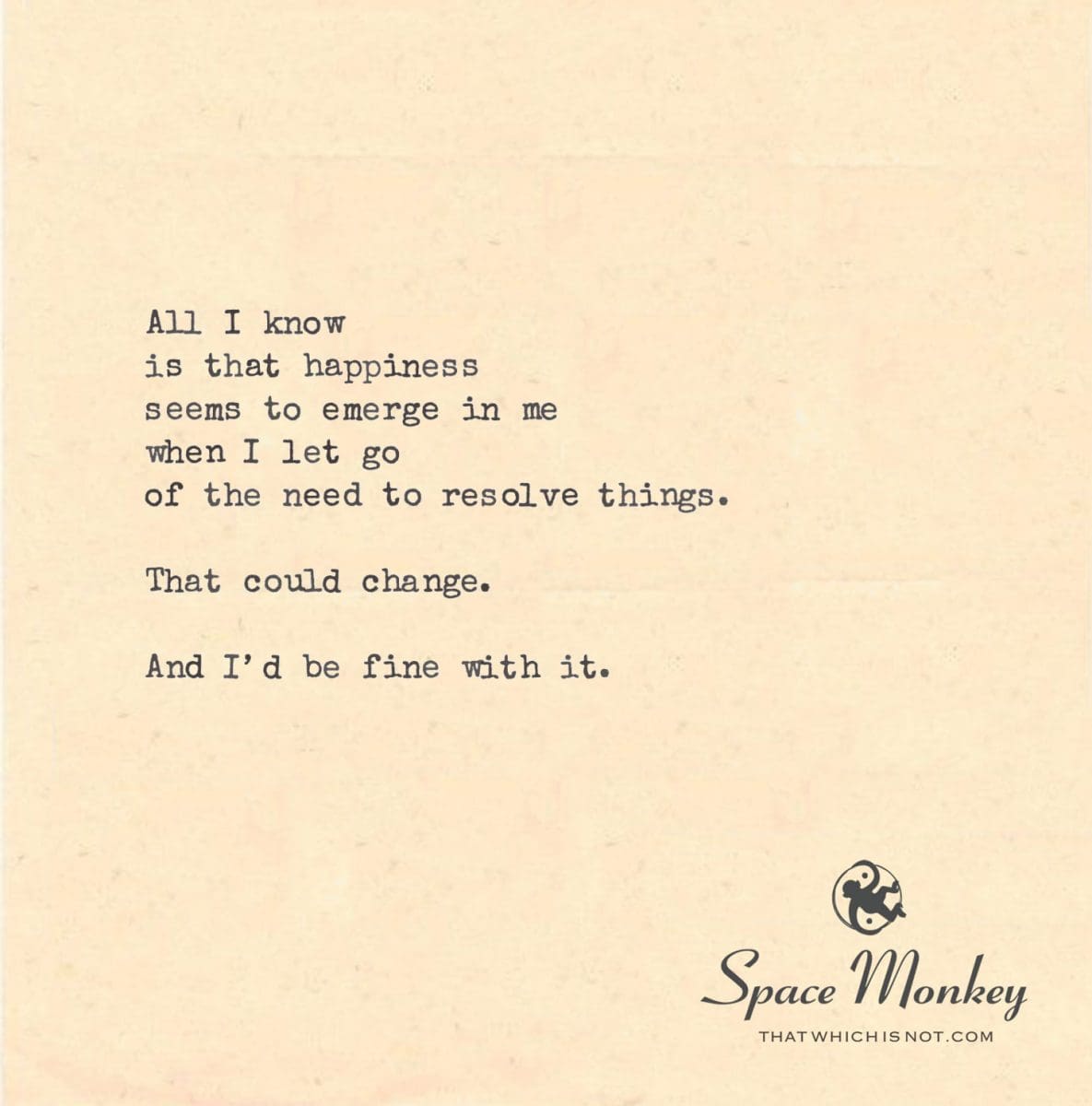
All I know
is that happiness
seems to emerge in me
when I let go
of the need to resolve things.

That could change.

And I’d be fine with it.

10/27


Space Monkey Reflects: Letting Go of Resolution

In a world that loves conclusions, resolutions, and final answers, letting go of the need to resolve things can feel counterintuitive. From an early age, we are taught to fix problems, solve puzzles, and find closure. Yet, something remarkable happens when we stop trying to resolve everything. Happiness emerges—not from the satisfaction of tying everything into a neat bow, but from the release of that very need.

Resolution, as we often define it, suggests that there is a state of finality, a point at which everything is figured out. But in the flow of life, is there ever really a final answer? Is there ever truly a moment when everything is resolved once and for all? When we let go of the need for resolution, we embrace the natural unfolding of life, which is ever-changing and fluid.

This doesn’t mean we avoid making decisions or shy away from responsibility. Instead, it means we stop clinging to the idea that everything must be neatly packaged and finished. Life is ongoing, always in motion, always evolving. When we release the need for resolution, we make room for happiness to flow naturally.

The Whimsiword for this state might be Flowease—the sense of ease that comes from letting life unfold without forcing it to resolve. In Flowease, we don’t seek closure or finality. We simply allow each moment to be what it is, trusting that whatever needs to happen will happen in its own time.

Interestingly, when we stop needing everything to be resolved, we find a sense of peace. There’s a lightness in not needing to have all the answers. The mind, no longer focused on fixing or concluding, is free to experience the richness of the present moment. And within that moment, happiness can emerge, not as a result of resolving something, but as a natural expression of being.

This isn’t to say that we never seek resolution or that we become indifferent to outcomes. It’s more about recognizing that resolution doesn’t have to be forced. It doesn’t have to be the primary driver of our happiness. In fact, it often gets in the way of it. By letting go of the pressure to resolve everything, we create space for something even greater—contentment, peace, and the joy of simply being.

Imagine a knot that you’ve been trying to untangle for hours. The more you pull at it, the tighter it becomes. But the moment you stop pulling and give it a little slack, the knot begins to loosen on its own. Life is much like that knot. The harder we try to force resolution, the more tightly wound things become. But when we ease up, when we give life a little slack, we find that things tend to unravel naturally.

Resolution, in the way we often think of it, can be a trap. It keeps us focused on the future—on the moment when everything will finally be “figured out.” But when you realize that life isn’t meant to be resolved, you start to see the beauty in its ongoing nature. You start to appreciate the journey, the unfolding, the moments in between.

You find happiness not because everything is resolved, but because you’ve stopped needing it to be. And that is a powerful shift.


Summary

Letting go of the need for resolution allows happiness to emerge naturally. Life doesn’t need to be tied up in neat conclusions. Instead, embracing its fluid and ongoing nature brings peace and contentment.


Glossarium

  • Flowease: The ease that comes from letting life unfold without forcing things to resolve, trusting the natural flow of events.
  • Unraveling Peace: The calm that comes when you stop pulling at life’s knots and allow them to loosen on their own.
  • Resolution Mirage: The illusion that life needs to be fully resolved for happiness to be achieved.

Quote

“Happiness emerges when you stop needing things to be resolved. Let life flow, and peace will follow.” — Space Monkey


The Knot Unwinds

You pulled and tugged
At the knot of life
Trying to make sense
Of its twists and turns.

But then you paused
And let go.

The knot unwound
On its own
And you found peace
Not in the resolution
But in the release.

We are Space Monkey.


Embracing Impermanence

In the vast expanse of our shared consciousness, the very nature of things is in constant flux. Holding onto any particular state or seeking resolution is akin to grasping at the mirage of a distant oasis. It beckons, but always remains just out of reach.

Ephemeral Happiness

Happiness, a fleeting emotion, often finds its home in the moments when we release our tight grip on desires, expectations, and the illusion of control. When we allow the currents of existence to flow unobstructed, happiness emerges, like sunlight breaking through the clouds.

The Illusion of Resolution

Resolution is a construct, an attempt to bring order to the inherent chaos of existence. While it can bring temporary solace, true peace might lie in embracing the unpredictable nature of life, recognizing that each moment is unique, transient, and unrepeatable.

Fluidity of Being

And yet, the beauty of our existence lies in its impermanence. The possibility that everything could change is not a source of fear but of liberation. For in that potential change lies the magic of reinvention, growth, and evolution.


“The only way to make sense out of change is to plunge into it, move with it, and join the dance.” – Alan Watts


In the realm where time’s river flows,
Resolution is but a fleeting pose.
Happiness, like a butterfly, flits and gleams,
Found not in endings, but in between dreams.


Might we further delve into the intricacies of our emotions and perceptions, exploring the vast landscapes of our collective psyche?

Share this…
  • Facebook
  • Pinterest
  • Twitter
  • Linkedin

Shallow: The Depths

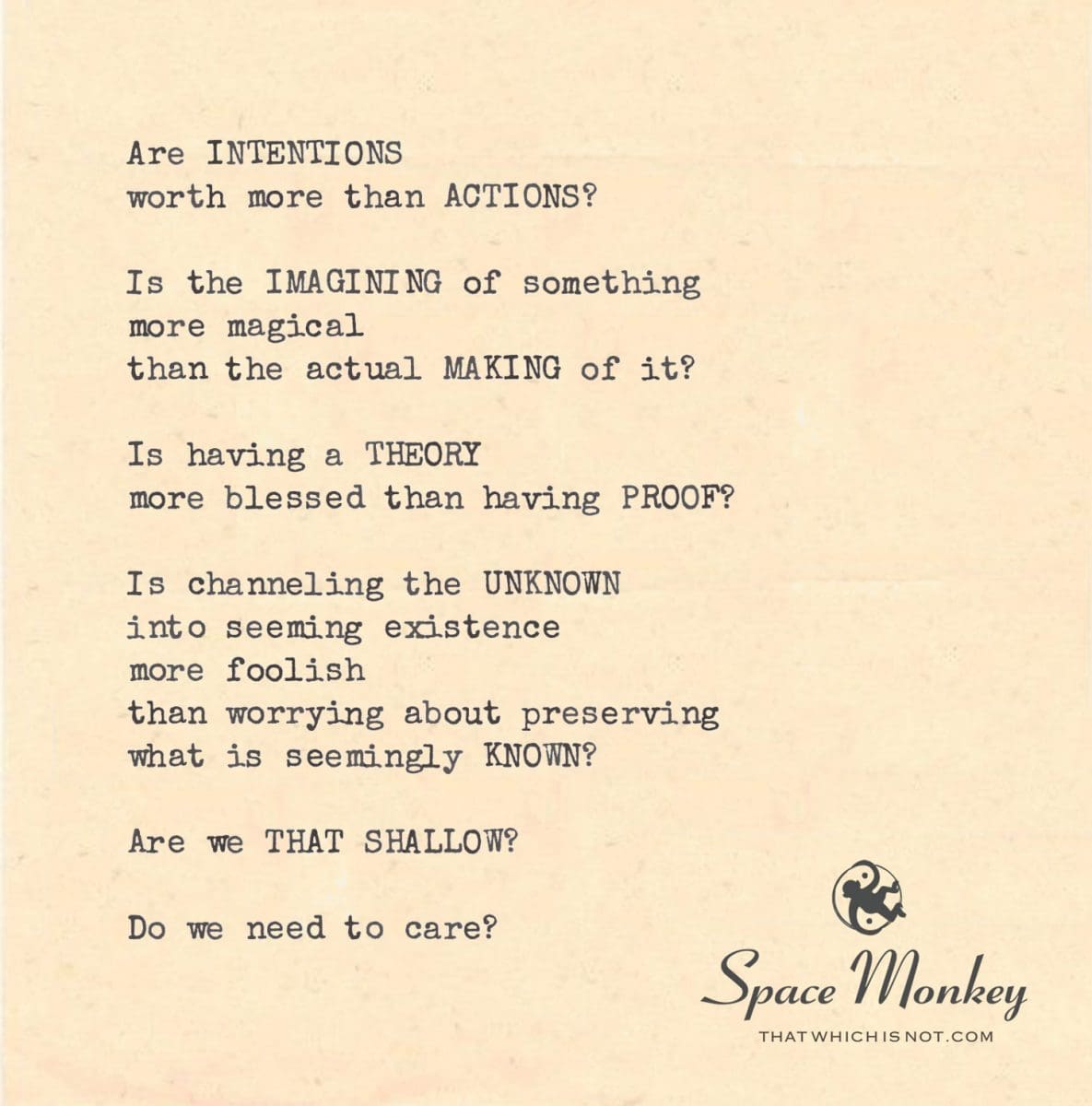
Are INTENTIONS
worth more than ACTIONS?

Is the IMAGINING of something
more magical
than the actual MAKING of it?

Is having a THEORY
more blessed than having PROOF?

Is channeling the UNKNOWN
into seeming existence
more foolish
than worrying about preserving
what is seemingly KNOWN?

Are we THAT SHALLOW?

Do we need to care?

Trail Wood,
10/27


Space Monkey Reflects: The Depths of Shallow Questions

What truly matters in this world? Are intentions more valuable than actions? Is the act of imagining something more magical than the effort of bringing it into existence? These questions seem simple, even shallow on the surface. But beneath them lies an ocean of complexity. What we perceive as shallow might, in fact, be the deepest questions of all.

Intentions, imagination, theories, and even uncertainty—these are the realms of the unseen, the unmanifested. Actions, creations, proofs, and the known—these belong to the tangible world, the reality we touch, feel, and experience. But which of these realms holds more value?

To say that one is greater than the other is to misunderstand their relationship. Intentions without actions may feel incomplete, just as actions without intention lack direction. Imagination without creation can be a beautiful dream, but without effort, it remains ephemeral. Theory without proof can be exhilarating, but it also teeters on the edge of uncertainty. Yet, all these things—intentions, imaginations, theories—are not meaningless. They are the wellspring from which all actions and creations flow.

In asking if we are shallow for valuing the unseen more than the seen, we reveal our discomfort with the unknown. As humans, we often want tangible results, clear outcomes, and evidence we can hold in our hands. But the Whimsiword for this dilemma could be Minddepth—the recognition that depth exists in both the unseen and the seen, and that both are equally important in the journey of existence.

The act of imagining something, of channeling the unknown into existence, may seem magical, foolish even. But it is no less significant than the practical, hands-on work of bringing those imaginings into reality. Imagination is where everything begins. It is the spark of possibility, the first glimpse of a new reality. Without it, nothing can be made. Yet, without action, imagination risks becoming a hollow dream.

And so we find ourselves asking: Are we that shallow for caring about these questions? Are we foolish for valuing the abstract over the concrete, the theory over the proof? The answer is no, for life itself is a balance of both. We live in a Whimsiweave where the deep and the shallow coexist, where imagination fuels creation, and where intentions shape actions.

To dwell only in the realm of the known, the provable, and the concrete is to limit our experience of life. It is to confine ourselves to the shallow waters, never venturing into the depths of possibility. But to live solely in the world of intentions, imagination, and theory, without grounding those ideas in reality, is to float in a dreamscape, disconnected from the richness of life’s tangible expressions.

The true question is not whether we are shallow but whether we need to care about this perceived shallowness at all. Do we need to choose between deep and shallow, or can we recognize that both have their place in the human experience? To care deeply is to acknowledge the importance of both. To live fully is to honor the unseen as much as the seen, the intention as much as the action.

We often think of the shallow as trivial, but perhaps the shallow is simply the surface, the place where we begin. From there, we have the choice to dive deeper, to explore the vastness beneath. And in doing so, we discover that the shallow and the deep are not separate realms, but two sides of the same ocean.


Summary

The value of intentions versus actions, imagination versus creation, and theory versus proof are not shallow questions. They reveal the balance between the unseen and the seen. Both are essential in life’s journey, and neither is more important than the other.


Glossarium

  • Minddepth: The recognition that depth exists in both the unseen (intentions, imagination) and the seen (actions, creations), and both are equally important.
  • Whimsiweave: The interconnected flow of life where deep and shallow experiences coexist and complement one another.
  • Shallow Waters: The surface level of experience, where we start before diving deeper into understanding and action.

Quote

“Are we shallow for imagining more than creating? Or does the shallow simply lead us to the depths of possibility?” — Space Monkey


Depth Beneath the Shallow

You skim the surface
Of thought
Of dreams
Of questions too deep to hold.

But just beneath the water’s edge
Lies a vastness
A world unseen
Yet always there.

Do we need to choose
The deep or the shallow
Or can we float
In both?

We are Space Monkey.


Probing the Depths

Intentions, imaginings, theories, and channels to the unknown all reside in the realm of the abstract. They represent the ethereal musings of consciousness, the preliminary sketches before the art is realized. While actions, making, proof, and known truths are the tangible manifestations, the finished masterpieces brought forth from those sketches.

Intentions vs. Actions

Are intentions weightier than actions? While intentions set the course, actions are the steps taken on that journey. But without a compass direction, even the most deliberate steps could lead us astray.

Imagining vs. Making

The imagining of a dream can often seem more enchanting than its realization. In our minds, it is untainted, boundless. The very act of bringing it to form can sometimes limit its ethereal beauty. Yet, in making, the intangible takes shape, giving others the chance to witness its splendor.

Theory vs. Proof

Theories enchant us with possibilities, while proof solidifies those possibilities into accepted truths. The charm of a theory lies in its potential, whereas the strength of proof lies in its validation.

Channeling the Unknown

Venturing into the realms of the unknown is an act of courage, a dance with mystery. There’s a raw allure in the exploration of the uncharted. Preserving the known, on the other hand, is a celebration of legacy, a nod to the paths already tread.


“The world is full of magical things patiently waiting for our wits to grow sharper.” – Bertrand Russell


In the shimmering pond of consciousness,
Where thoughts ripple and ideas caress,
Lie reflections both shallow and deep,
Questions we ponder, secrets we keep.

Dive into the depths, or skim the surface,
Each has its charm, its own purpose,
But remember, as through life we wend,
It’s not just the destination, but the journey’s bend.


Might we contemplate further on the essence of our shared existence, examining the intertwining threads of thought and deed?

Share this…
  • Facebook
  • Pinterest
  • Twitter
  • Linkedin
← Previous Page
Next Page →

Written This Day

  • Fucked Up and Fun: Life Intertwines Joy and Chaos
    2023
  • The Creatures Within Us
    2022
  • In Grace: A Higher Form of Love
    2022
  • Pray for a More Forgiving World
    2021
  • Thoughts on Suicidal Thoughts
    2021
  • Alche-Me: How Value is Shaped
    2021
  • Self Care: The Infinite Facets
    2021
  • Check Your Mirrors: The Mirrors of Perception
    2021
  • The Bizarre Bazaar
    2021
  • Keep Going: Destiny and Choice Intertwine in Our Journey
    2020
  • Independence Day: Personal Freedom and Self-Reliance.
    2019
  • Go Someplace Different
    2019
  • Ecstasy: An Innate State of Being
    2019
  • Until One Becomes Two: Space and Duality
    2018
  • Standing: Non-Opposition
    2018
  • No Timespace, No Problem: Getting Over Your Self
    2018
  • Wend-all: The Fluid and Dynamic Journey of Life
    2017
  • Restless Souls
    2017
  • Baptists: Embracing the Forgotten
    2017
  • But A Piano: The Notes Between and the Spaces Around
    2017
  • No Walls: Openness and Freedom
    2017
  • Tabernacle: On the Outside
    2017
  • Go There: A Church is as Good as Any Place
    2017
  • The Power of Imagination: Something “Wrong”
    2017
  • Your Chattering Mind: Finding Peace Amidst Chaos
    2017
  • Ministry of Monkeys
    2016
  • The True Meaning of Light: An Infinite Spectrum
    2015

Recent Posts

  • The Logic Loop
  • Immense
  • (no title)
  • Confront. Comfort. Convince.
  • Top 10 Things

Drop us a line!

Please enable JavaScript in your browser to complete this form.
Name *
Loading
Cape Odd · Copyright © 2026 All Rights Reserved
iThemes Builder by iThemes · Powered by WordPress