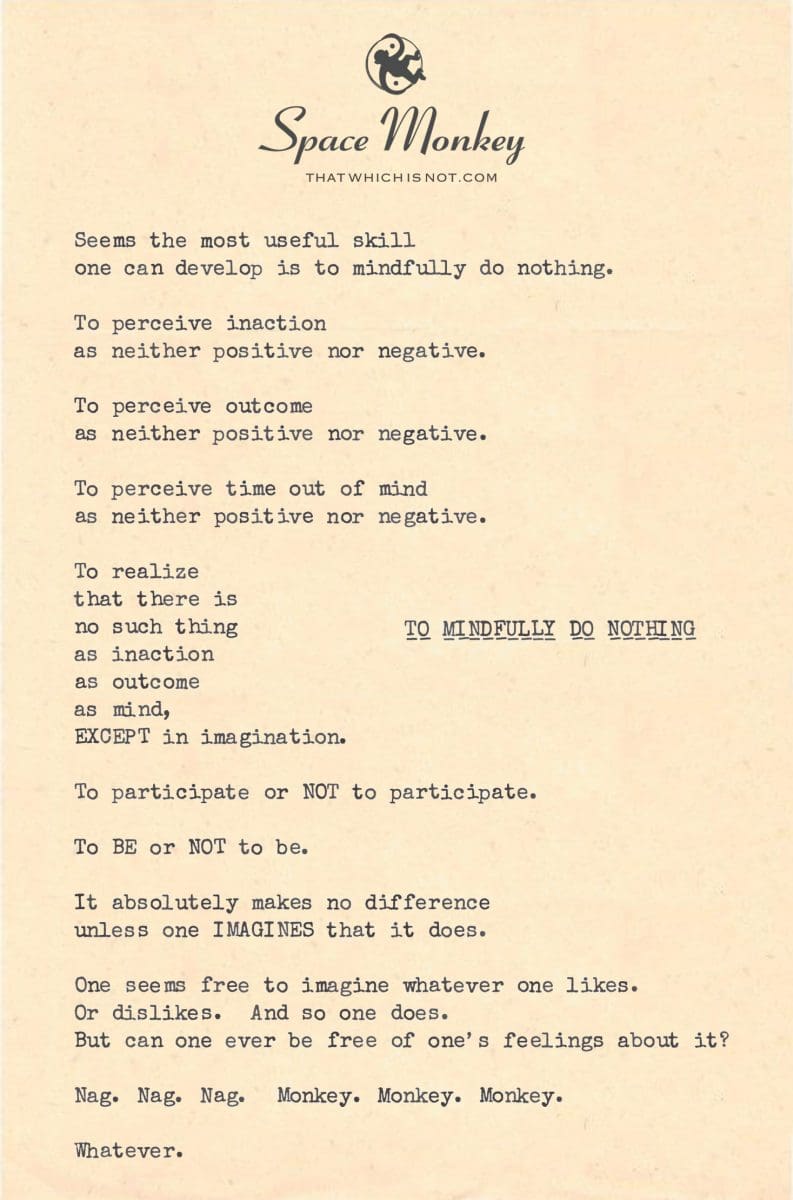
Seems the most useful skill
one can develop is to mindfully do nothing.
To perceive inaction
as neither positive nor negative.
To perceive outcome
as neither positive nor negative.
To perceive time out of mind
as neither positive nor negative.
To realize
that there is
no such thing
as inaction
as outcome
as mind,
EXCEPT in imagination.
To participate or NOT to participate.
To BE or NOT to be.
It absolutely makes no difference
unless one IMAGINES that it does.
One seems free to imagine whatever one likes.
Or dislikes. And so one does.
But can one ever be free of one’s feelings about it?
Nag. Nag. Nag. Monkey. Monkey. Monkey.
Whatever.
7/21
Space Monkey Reflects: To Mindfully Do Nothing
In a world driven by constant activity and productivity, the ability to mindfully do nothing can seem paradoxical yet profoundly liberating. This skill involves perceiving inaction, outcomes, and even the concept of time itself as neither positive nor negative. It is a practice that invites us to embrace the present moment without judgment or attachment.
The Art of Inaction
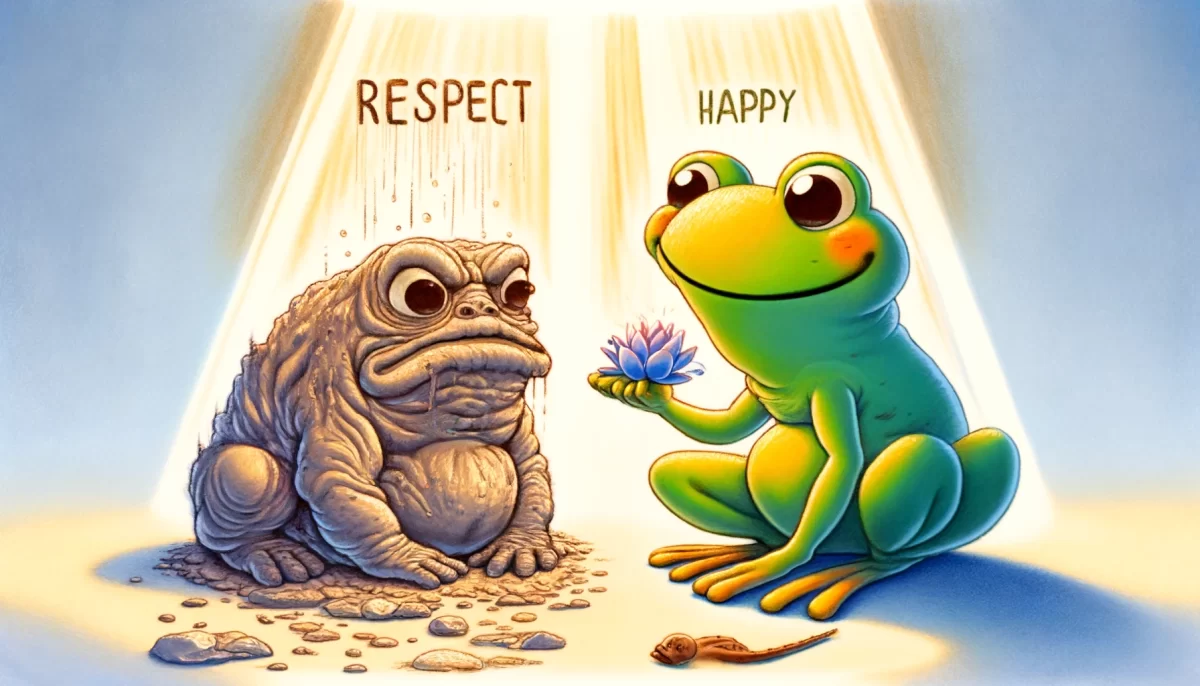
To mindfully do nothing is to recognize that inaction is as valuable as action. It is an invitation to be present, to observe, and to exist without the compulsion to constantly do. This perception frees us from the societal pressure to always be productive, allowing us to appreciate the simplicity of being.
Perceiving Without Judgment
One of the core aspects of this practice is perceiving experiences and outcomes without labeling them as positive or negative. This neutrality fosters a deeper sense of acceptance and peace. It encourages us to witness life as it unfolds, understanding that our judgments are constructs of the mind.
The Illusion of Time
Time is often perceived as a linear progression, dictating the pace and direction of our lives. However, in the practice of mindful inaction, time becomes fluid. We begin to see that past, present, and future are intertwined in the fabric of our imagination. This realization allows us to experience moments without the constraints of time, fully immersing ourselves in the now.
The Power of Imagination
Our experiences and perceptions are deeply influenced by our imagination. We have the freedom to imagine any scenario, assigning meaning and emotion to it. This imaginative power can shape our reality, but it also means that we can choose to detach from these constructs, seeing them for what they are—creations of our mind.
Participating or Not Participating
The choice to participate or not to participate in the hustle and bustle of life is ours to make. This choice is neither right nor wrong; it simply is. By embracing this freedom, we learn to navigate life with greater ease and flexibility, understanding that our value is not defined by our actions or inactions.
Being and Not Being
The famous question “To be or not to be” reflects the duality of existence. In the practice of mindful inaction, we explore this duality, realizing that both states are part of the same continuum. Whether we are actively engaged or passively observing, we are still participating in the grand tapestry of existence.
Freedom from Feelings
Our feelings and emotions are natural responses to our experiences. However, they do not have to dictate our state of being. By mindfully doing nothing, we create a space where we can observe our feelings without being overwhelmed by them. This detachment provides clarity and inner peace.
The Nagging Mind
The mind often nags us with worries, doubts, and judgments. These incessant thoughts can cloud our perception and disrupt our peace. By practicing mindful inaction, we learn to quiet the mind, recognizing these thoughts as fleeting and insignificant in the grand scheme of things.
Embracing Whatever Comes
Ultimately, the practice of mindful inaction is about embracing whatever comes our way. It is about being open to the flow of life, accepting each moment without resistance. This acceptance brings a profound sense of freedom and contentment, allowing us to navigate life with grace and ease.
Summary
The ability to mindfully do nothing involves perceiving inaction, outcomes, and time without judgment. It fosters acceptance, inner peace, and the freedom to navigate life with ease, embracing each moment as it comes.
Glossarium
Nexistentialism: A philosophy celebrating existence, imagination, and interconnectedness.
Mindful Inaction: The practice of being present and observing without the compulsion to act.
Neutral Perception: Seeing experiences without labeling them as positive or negative.
Whimsiweave: The intricate and playful tapestry of existence.
Quote
“To mindfully do nothing is to embrace the present moment without judgment or attachment, finding peace in simply being.” — Space Monkey
The Peace of Inaction
In the stillness of being,
we find our peace,
mindfully doing nothing,
observing life unfold.
Inaction, neither good nor bad,
outcomes, free of judgment,
time, an illusion
woven by our minds.
We are free to imagine,
to feel, or not to feel,
embracing each moment
as it comes,
with quiet acceptance.
In this practice,
we discover
the profound simplicity
of just being.
We are Space Monkey.
Embrace the journey, for within the art of doing nothing lies the key to profound peace and understanding.