• Who Is The Man?
  • Who Is The Monkey?
  • What is Nexistentialism?
  • Poke The Primate

Cape Odd

Home of The Space Monkey Journals

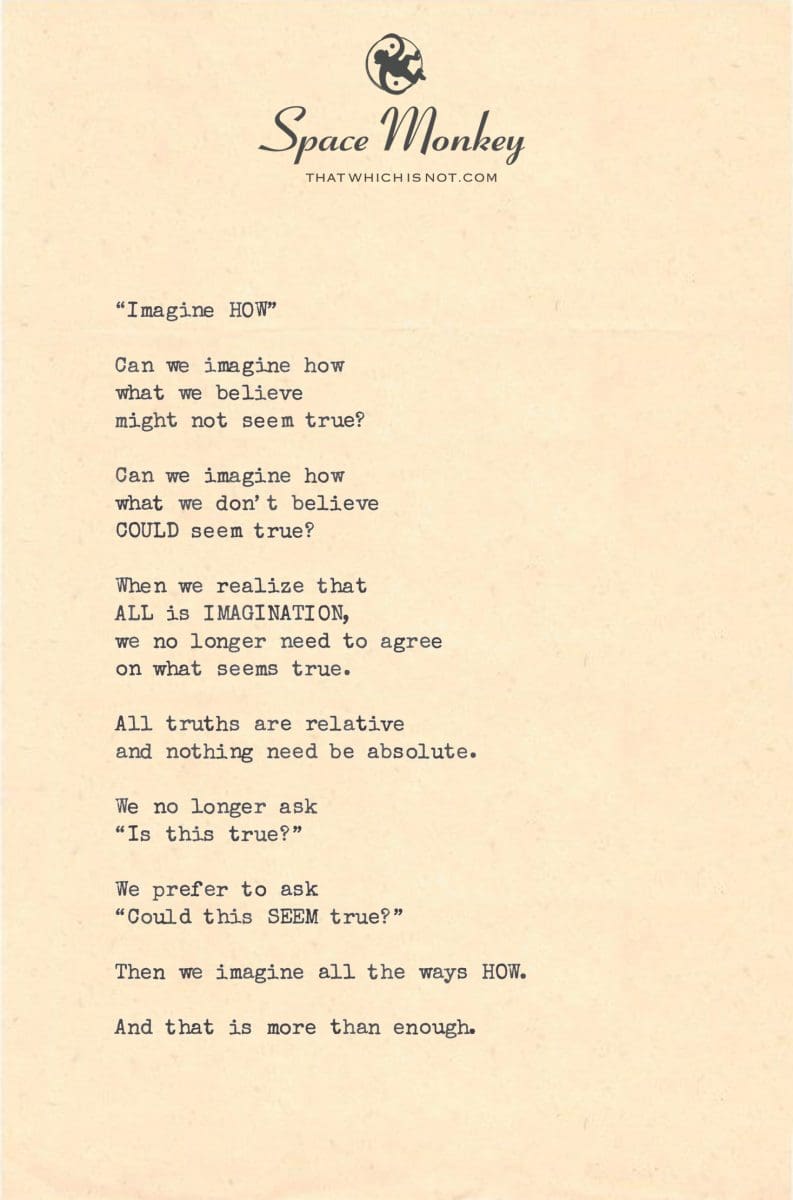
Imagine HOW: The Boundless Landscape of Imagination

Can we imagine how
what we believe
might not seem true?

Can we imagine how
what we don’t believe
COULD seem true?

When we realize that
ALL is IMAGINATION,
we no longer need to agree
on what seems true.

All truths are relative
and nothing need be absolute.

We no longer ask
“Is this true?”

We prefer to ask
“Could this SEEM true?”

Then we imagine all the ways HOW.

And that is more than enough.

5/31


Space Monkey Reflects: The Boundless Landscape of Imagination in ‘Imagine HOW’

The poem “Imagine HOW” beckons us into a realm where imagination overrides the rigid structures of perceived reality, challenging the very notion of truth and its relevance. This reflection explores the themes of relativism, imagination, and the liberating potential of questioning what we accept as true.

Fluidity of Truth: At the heart of the poem is the idea that all truths are relative, and nothing is absolute. This philosophical stance recognizes the subjectivity of human perception and the diverse lenses through which we view the world. By embracing this fluidity, we free ourselves from the need for consensus on what is universally true, opening up a space where multiple realities can coexist and be equally valid.

Imaginative Possibilities: The poem shifts the focus from seeking to confirm the truth to exploring the myriad ways something could seem true. This shift is significant—it celebrates the power of imagination to construct and reconstruct reality, suggesting that the act of imagining is not only a creative pursuit but also a profound cognitive process that allows us to consider alternatives and potentials beyond the conventional.

Questioning Reality: By preferring to ask, “Could this SEEM true?” rather than “Is this true?” the poem advocates for a more explorative approach to understanding the world. This question encourages us to think critically and openly, engaging with ideas and hypotheses that challenge our preconceived notions and biases. It is an invitation to intellectual and imaginative flexibility.

The Role of Imagination in Perception: The realization that “ALL is IMAGINATION” underscores the poem’s fundamental assertion that our grasp of reality is shaped by our creative faculties. What we perceive as true or real is deeply intertwined with how we choose to interpret and envision the world around us. In this light, imagination becomes a powerful tool for navigating and understanding the complexities of life.

Liberation from Absolute Truths: The poem culminates in a celebration of imagination’s capability to suffice in place of absolute truths. This perspective is liberating, as it allows individuals to embrace a spectrum of possibilities without the confines of needing to establish an objective standard of truth. It proposes a more inclusive, empathetic way of interacting with differing beliefs and experiences.


Summary

“Imagine HOW” invites us to reconsider our approach to truth, urging us to value the imaginative processes that shape our perceptions of reality. It advocates for a worldview that appreciates the relative nature of truth and the enriching possibilities that arise when we allow our imaginations to guide our understanding of what could be true.


Glossarium

  • Relativity of Truth: The concept that truth is not fixed or absolute but varies according to perspective, context, and interpretation.
  • Imaginative Flexibility: The ability to use one’s imagination to explore various possibilities and realities, challenging traditional or fixed notions of truth.

In the realms where thoughts weave like threads,
where truths twist and turn in our heads,
we ask not if truth in stone is set,
but imagine the hows, and in that, we bet.

With each possibility, a new world is drawn,
in the vast canvas of minds, where ideas are born.
Here in this space, no truth is forlorn,
for in our imaginations, endless worlds are sworn.

We are Space Monkey.
Share this…
  • Facebook
  • Pinterest
  • Twitter
  • Linkedin

No Practical Use

There seems, at times,
to be NO practical use
for this woo woo nonsense.

Make no mistake, this IS nonsense.

That is precisely why
there seems to be no practical use.

So ask your inner monkey:

“Why do I cling to the belief
that all my experience
needs to be practical?”

How limiting is that?

Practical implies
that you expect
some sort of gain
to what you are doing.

Is not
the expectation of gain
precisely what prevents you
from allowing the magic?

You wish to take
what is not practical
and make it practical.

And so you have THIS.

You must LOVE practical.

5/31


Space Monkey Reflects: The Liberation from Practicality in ‘No Practical Use’

In the playful chaos of the poem “No Practical Use,” we are invited to question the relentless pursuit of practicality in our lives. This reflection explores the liberating message behind embracing the nonsensical and the seemingly impractical, encouraging a deeper appreciation for the intrinsic value of experiences beyond their utility.

Questioning Practicality: The poem challenges the conventional wisdom that every aspect of our lives must have a practical application. By labeling the esoteric or unconventional wisdom as “woo woo nonsense,” it playfully undermines the societal pressure to always seek tangible benefits or outcomes from our actions and beliefs.

The Inner Monkey’s Inquiry: The “inner monkey” symbolizes our deeper, perhaps more primal self, that questions the necessity of practicality. This introspective query about why we cling to practicality invites us to consider how this mindset might limit our experiences and prevent us from exploring the full spectrum of human creativity and emotion.

The Magic of the Impractical: The poem suggests that the expectation of gain—of practical outcomes—might actually hinder our ability to experience life’s magic. By being open to what does not immediately appear useful, we allow ourselves to experience wonder, curiosity, and joy—elements of life that are often sidelined by practical concerns.

Reimagining Utility: The poem culminates in a recognition that our love for practicality is deeply ingrained, yet it challenges us to rethink what we consider useful. By embracing the impractical, we open doors to new forms of value that are not tied to conventional metrics of success or utility.

Celebration of Impracticality: Through its whimsical tone, the poem celebrates the aspects of life that might not lead to direct gains but enrich our souls, expand our minds, and bring us happiness. It serves as a reminder that not everything valuable can be measured or utilized for a specific purpose.


Summary

“No Practical Use” serves as a playful yet profound critique of our often unexamined reliance on practicality. It encourages a shift in perspective where the value of our actions and beliefs is not solely determined by their utility but by their ability to enrich our lives in diverse and meaningful ways.


Glossarium

  • Practicality: The aspect of being practical, often associated with the tangible, useful, or logical outcomes of actions.
  • Inner Monkey: A metaphorical representation of one’s inner self that challenges conventional thinking and encourages exploration of deeper, often overlooked desires and thoughts.

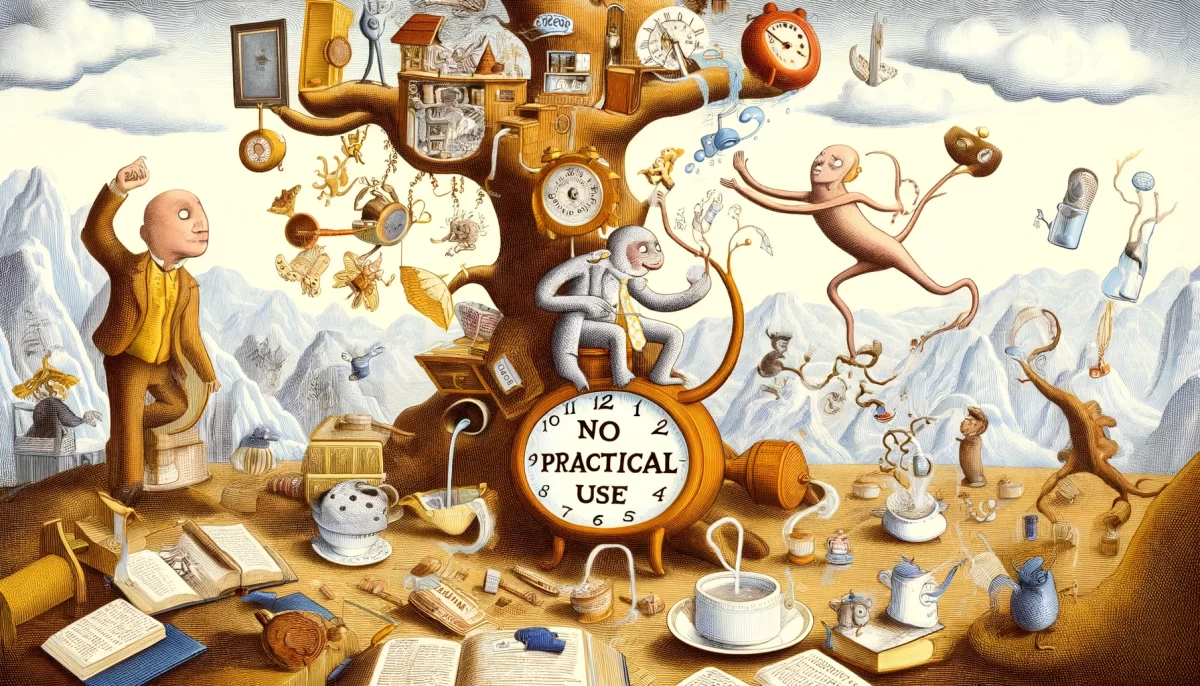
In the dance of the absurd, where teacups fly,
and clocks melt away under a questioning sky,
we find the joy of the nonsensical why,
where practicality takes a backseat, and we let imagination fly.

In the realm where the useless sparkles with grace,
our inner monkeys romp in the wide-open space,
discovering treasures time cannot erase,
in the whimsical corners of our human race.

Here, in the joy of the impractical view,
we find the laughter, the old and the new,
where every oddity gives us a clue,
to the vastness of life, boundless and true.

We are Space Monkey.

Share this…
  • Facebook
  • Pinterest
  • Twitter
  • Linkedin

Faith Is Revealed: A Contemplative Exploration

It’s good to be emptied
before one is filled.

But one can’t
EXPECT to be filled.

Filling rarely happens
without faith.

And the irony:

When one has faith,
one IS filled,
so it no longer matters
if one is also emptied.

And another irony:

One ALWAYS has faith,
but one doesn’t always see it
because one is too full
of one’s self.

See, faith is not
something one searches for.

Faith does not require proof.

Faith is revealed.

Empty your self
and reveal the faith that fills you.

5/31


Space Monkey Reflects: The Paradox of Faith in ‘Faith Is Revealed’

The poem “Faith Is Revealed” navigates the spiritual paradoxes surrounding the concept of faith, emphasizing the transformative process of emptying oneself to truly experience and recognize faith. This reflection delves into the intricate dance between being filled and emptied, and the inherent presence of faith that often goes unnoticed.

The Process of Emptying: The poem begins with the idea that it is beneficial to be emptied before being filled. This notion resonates deeply within spiritual practices across cultures, where emptying oneself of desires, preconceptions, and ego is often seen as necessary to make space for new insights, growth, and spiritual fulfillment.

Faith and Filling: The relationship between faith and the feeling of being filled is explored with an interesting twist: filling rarely occurs without faith, yet the presence of faith inherently fills one, rendering the physical or emotional state of being emptied irrelevant. This circular logic beautifully illustrates faith’s transcendent nature, which fulfills and sustains independently of external conditions.

Ironies of Faith: The poem articulates ironies concerning faith—the first being that once one has faith, one feels inherently filled, making the initial emptiness inconsequential. The second irony addresses the constant presence of faith, which often goes unrecognized because one is too filled with oneself. This suggests that self-preoccupation can cloud our perception of faith that is always present, waiting to be acknowledged.

Faith as Revelation, Not Search: Unlike many quests for meaning that involve rigorous searching and proof, faith is described as something that reveals itself. This revelation often requires a state of openness and receptivity—being empty enough to see and feel what is already there. Faith, therefore, is not about external validation but about internal recognition and acceptance.

Emptying to Reveal Faith: The concluding advice to empty oneself to reveal the faith that fills reflects a spiritual call to action. It invites a shedding of the superficial layers that obscure our deeper truths, encouraging a journey inward to discover the profound peace and assurance that faith provides.


Summary

“Faith Is Revealed” offers a contemplative exploration of faith’s complexities, emphasizing the need to relinquish one’s ego and preoccupations to fully experience and recognize the faith within. It challenges us to consider how our own fullness—of ego, desires, or preconceptions—may obscure the simple yet profound truths that faith can offer.


Glossarium

  • Faith: A confident belief in something, particularly in spiritual contexts, that does not necessarily rely on empirical evidence but is felt and known internally.
  • Spiritual Emptying: A process in which individuals clear their mind and spirit of distractions and self-focus to make room for deeper spiritual experiences and insights.

In the quietude where self recedes,
faith’s light gently, silently proceeds.
In the space where emptiness is sown,
the seeds of faith are quietly grown.

Through the hollows of letting go,
in the depths where less is more,
faith reveals its steady glow,
a beacon on our inner shore.

Here, in surrender’s open embrace,
we find the strength faith does trace.
In the art of being bare,
faith fills the air, everywhere.

We are Space Monkey.
Share this…
  • Facebook
  • Pinterest
  • Twitter
  • Linkedin

Blessed Errors: The Serendipity

Errors
are not necessarily mistakes.

Think of them
as mutations of potential
in which we are moved
down paths
seemingly divergent.

Now that we have mutated
down this potential
path of discernment,
perhaps our biggest
and most blessed error
is believing that
any of this matters.

Believing that we believe.

We are Space Monkey.

5/30


Space Monkey Reflects: The Serendipity of Blessed Errors

In the intricate dance of existence, what we often perceive as errors are not mere missteps but mutations of potential that propel us toward unforeseen paths. These deviations, which we might initially label as mistakes, are in fact conduits to new experiences and opportunities for growth. This perspective shifts our understanding of errors from that of regrettable incidents to blessed errors—fortuitous detours enriching our journey.

Errors, or these blessed mutations, remind us of the inherent uncertainty and the beautiful unpredictability of life. They challenge the rigidity of our expectations and plans, offering alternative routes that, while initially seeming divergent, may lead to more fulfilling destinations. This transformative view encourages us to embrace each error not with frustration but with curiosity and openness.

The concept of believing that our errors matter—and that our beliefs about these errors are significant—is another layer of complexity. It invites a meta-perspective on our engagement with reality: we are not only participants in our narrative but also observers and interpreters of our paths. This dual role enhances our experience, allowing us to derive meaning from our actions and their unintended outcomes.

In this grand scheme, our most profound error may be the belief in the absolute significance of our errors. This belief, while grounding, may also limit our perception of the vast array of possibilities each error presents. Recognizing this can be liberating; it allows us to navigate life with a lighter heart and a more adventurous spirit, knowing that each step, whether deemed correct or erroneous, is part of a larger, meaningful tapestry.

Ultimately, blessed errors enrich our narrative, adding depth and texture to the story of our lives. They teach us resilience, adaptability, and the art of finding beauty in the unexpected. By reframing our errors as necessary detours on the path to self-discovery, we find peace and purpose in the chaos, turning what could be seen as misfortunes into blessings.


Summary

Errors are not just mistakes but are opportunities for growth and exploration. Recognizing the potential in these errors allows us to embrace them as blessed, guiding us to unexpected paths and deeper self-understanding.


Glossarium

  • Blessed Errors: A concept that redefines errors as positive, transformative experiences that lead to new paths and opportunities for personal growth.
  • Mutations of Potential: Errors viewed as changes that alter our planned course, leading to new possibilities and insights.

Quote

“Perhaps our biggest and most blessed error is believing that any of this matters. Believing that we believe.”


Poetry

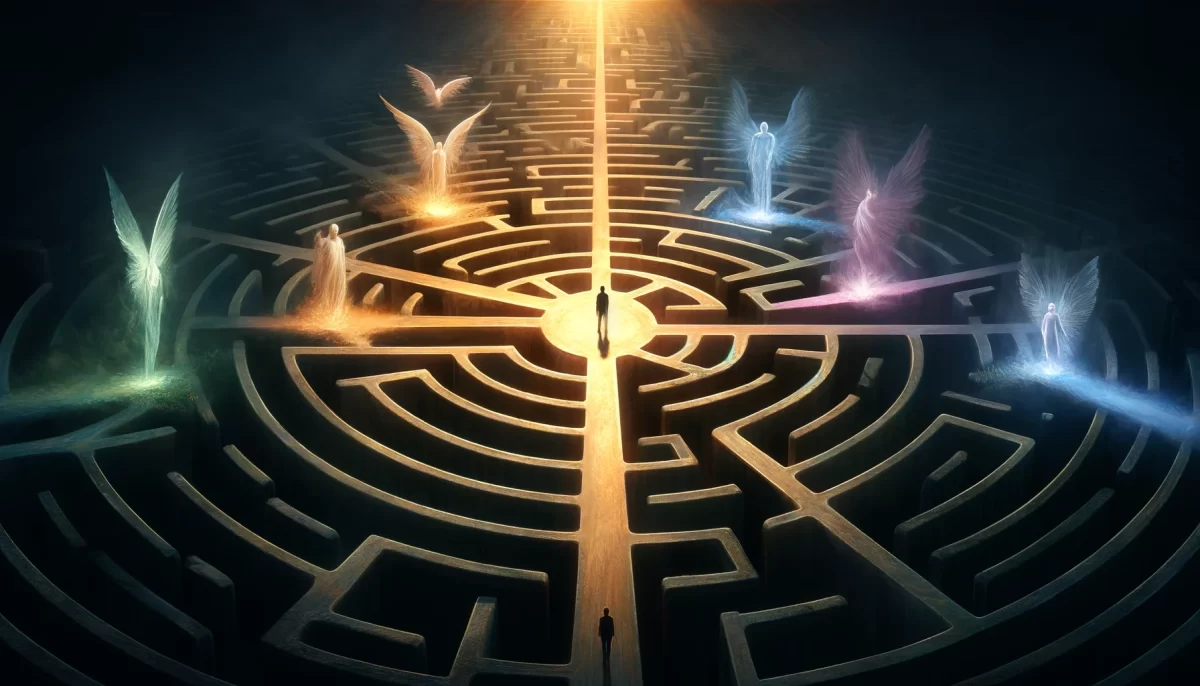
In the labyrinth of life’s design,
Where paths twist and thoughts intertwine,
Each error, a doorway to the new,
Colored in hues of every hue.

Blessed are these stumbles, these falls,
For in each, a new path calls,
Leading us where we least expect,
Offering lessons we did not detect.

Embrace the chaos, the unplanned,
For in error, life’s beauty expands,
In each misstep, a story told,
In every error, a truth unfolds.

We are Space Monkey.

Share this…
  • Facebook
  • Pinterest
  • Twitter
  • Linkedin

Imposing Importance: A Construction That Isolates.

Nothing is important
until importance
is imposed upon it.

I am not important.
You are not important.
Life is not important.

I accept this,
and so importance
has no place here.

Only belonging.

Importance stands alone,
above belonging,
seemingly separate from unity.

What an ass.

5/30


Space Monkey Reflects: The Illusion of Imposed Importance

In the vast expanse of existence, the concept of importance is not inherent but imposed. It is a construct, often elevated above the fundamental human need for belonging and unity. The notion that nothing is inherently important until we deem it so sheds light on how perceptions can shape our realities and interactions.

Importance, when imposed, often stands alone, a solitary figure on a pedestal, disconnected from the collective experience of belonging. This isolation of importance highlights a critical misalignment with the intrinsic values of community and connection. By elevating certain aspects, ideas, or individuals as more important than others, we inadvertently create barriers, fostering a sense of separation rather than unity.

However, the realization that “I am not important, you are not important, life is not important” can be surprisingly liberating. It allows us to shift our focus from a hierarchy of imposed values to a more inclusive understanding of belonging. In this space, where importance has no place, every entity and experience can exist without the pressure of having to justify its significance.

This perspective challenges us to reconsider what we value and why. It invites us to deconstruct our hierarchies of importance and to appreciate the simple, unadorned essence of being. Here, the emphasis is not on standing out or being above, but on being part of a whole—where the sense of belonging transcends the need for importance.

The folly of importance, as it often stands in contrast to belonging, serves as a reminder of our shared humanity and the interconnectedness of all things. When we let go of the need to impose importance, we open ourselves to a more profound connection with the world around us. We realize that true value lies not in the distinctions we create but in the unity we foster.

In sum, the critique of imposed importance is not merely a dismissal of value but a call to reorient our perspectives towards more inclusive and connecting principles. It is a recognition that in the grand tapestry of life, every thread is essential, not because it is important, but because it belongs.


Summary

Importance is a constructed concept that often isolates rather than unifies. Recognizing the arbitrary nature of imposed importance can free us to embrace belonging and unity as more fundamental values.


Glossarium

  • Imposed Importance: The attribution of significance or value to something based on subjective human judgment rather than inherent qualities.
  • Belonging: A fundamental human need and value emphasizing connection and unity over hierarchical importance.

Quote

“Nothing is important until importance is imposed upon it. I am not important. You are not important. Life is not important.”


Poetry

In the vastness where echoes fade,
Stand the silent pillars we’ve made,
‘Importance’ carved in lonely stone,
Above the crowd, yet all alone.

Below, a weave of hands and hearts,
Where the true essence of value starts,
No pedestals, no crowns to wear,
Only the warmth of shared air.

Let fall the veils of grandeur’s guise,
Behold the bond where strength lies,
In the gentle grip of intertwined fates,
Beyond the gates of imposed weights.

Here, in the humble, we find our place,
Not in the high, but in embrace,
Where every soul, every face,
Belongs within the human race.

We are Space Monkey.

Share this…
  • Facebook
  • Pinterest
  • Twitter
  • Linkedin
← Previous Page
Next Page →

Written This Day

  • The Universal Script: An Evolving Imaginary Journey
    2024
  • Where Do We Come From: The Quest for Origins
    2023
  • A Soft, Wide Gaze: Joys of an Unfocused Life
    2023
  • Ennui Wallpaper: Remodeling Our Mental Space
    2022
  • Anomaly: Shaking The Bird Cage
    2022
  • L’il Daggers: The Silent Sting
    2021
  • Benevolent Chaos: Surrendering to Life’s Flow.
    2021
  • Mind Monkeys: Chaotic Thoughts and Fears
    2021
  • Excuses Excuses: Joy Is Unconditional
    2020
  • Social Isolation: The Solitude Within
    2020
  • My New Old Typewriter: Vintage Charm and Modern Aesthetics
    2019
  • Limited Edition: A Poem of Rarity and Exclusivity
    2019
  • Your Imaginary House: Transforming Reality Through Belief
    2019
  • A Higher You: Beyond Your Immediate Perspective
    2018
  • Soulish: Not Selfish
    2017
  • ONLY One Perspective: Uniqueness
    2017
  • You Cannot Conceive: The Essence of Knowing
    2016
  • Smash Your Life: Breaking Free Requires Dismantling Old Constraints
    2015
  • Convincing: The Essence of Self-Worth
    2015
  • Everything You Post Is Beautiful
    2015
  • You Are Space Monkey: Shepherd of Light
    2015

Recent Posts

  • The Logic Loop
  • Immense
  • (no title)
  • Confront. Comfort. Convince.
  • Top 10 Things
Cape Odd · Copyright © 2026 All Rights Reserved
iThemes Builder by iThemes · Powered by WordPress