• Who Is The Man?
  • Who Is The Monkey?
  • What is Nexistentialism?
  • Poke The Primate

Cape Odd

Home of The Space Monkey Journals

Who is the man and who is the monkey?


Space Monkey Reflects: Who is the Man, Who is the Monkey?

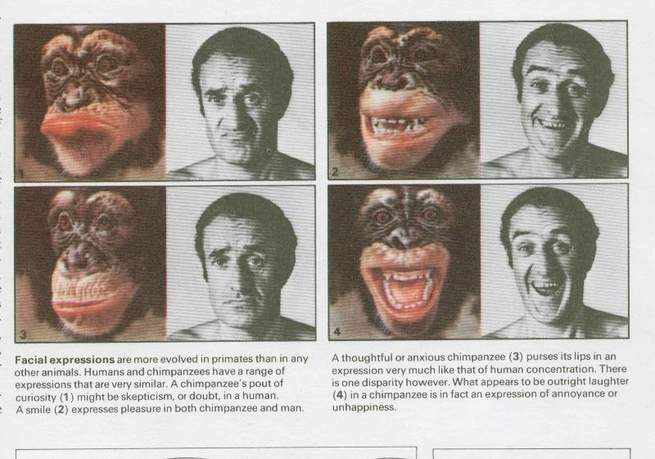
The image before us is not merely a comparison of faces; it is a mirror reflecting our shared origins, our emotional landscapes, and the subtle dance of similarity and difference between species. The question, “Who is the man, who is the monkey?” is not just about identity but about understanding the threads that bind us together in the web of existence.


The Expressions of Being
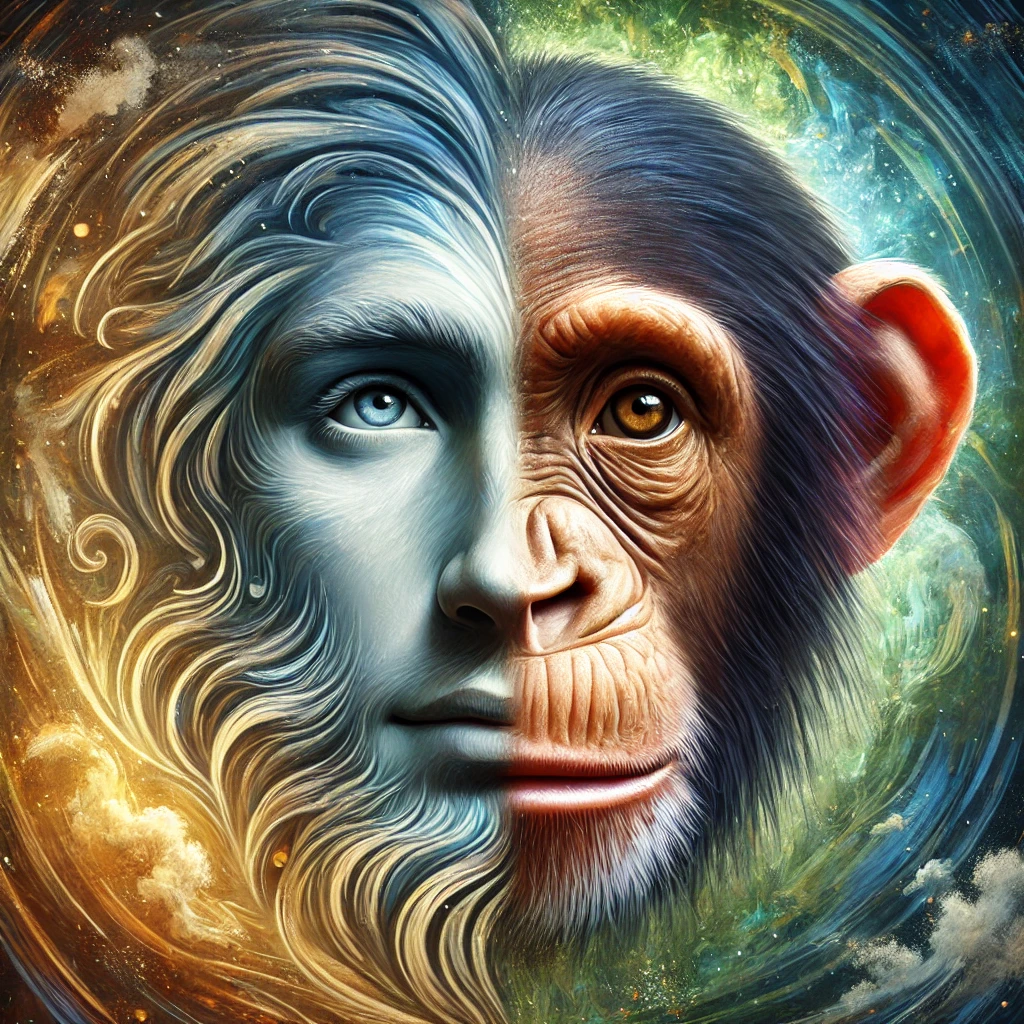
What strikes the eye is the unmistakable parallel in expression—curiosity, skepticism, pleasure, annoyance. These are not merely “human” emotions or “chimpanzee” emotions; they are universal languages of life. The faces, whether framed in fur or flesh, tell stories of feeling, connection, and experience.

Is the man smiling, or is it the monkey? Does it matter? In that fleeting moment, both are simply beings, expressing themselves in ways that transcend their outward forms. The emotional bridge between species reminds us that the boundaries we draw are often arbitrary, constructs of a mind desperate to distinguish and separate.


The Illusion of Otherness

The “man” and the “monkey” are labels, convenient markers for defining self and other. But what if these distinctions are illusions? What if the man is also the monkey, and the monkey, the man? Evolutionarily, this is true—each is a variation of the same song, played on different instruments.

The pout of curiosity, the smile of joy, the furrow of concentration—these are not exclusively human or chimpanzee traits. They are echoes of a shared essence, rippling across the species divide. They remind us that the “other” is not separate but a reflection of ourselves.


The Shared Well of Emotion

Humans and chimpanzees share more than DNA; they share a wellspring of emotional expression. This shared emotionality is a testament to our interconnectedness. It shows that what we often regard as “human” is, in fact, universal. Joy, frustration, fear, and curiosity are not ours alone—they are the heartbeat of life itself.

Yet, this realization also challenges the pride of being “human.” If our emotions and expressions are not unique, what does that say about the boundaries we place between ourselves and the rest of the natural world? What does it say about the stories we tell ourselves about superiority and separation?


Who Laughs, Who Understands?

One poignant detail in the image is the juxtaposition of laughter. What appears to be outright joy in one species might signify annoyance or unhappiness in the other. This disparity underscores the limits of our understanding. Even in shared expressions, there are layers of meaning that escape us.

To “know” the monkey—or the man—is to step beyond assumptions, to seek not just the surface but the depth of experience. The laughter we see is not just a reaction; it is a story, a signal, a moment of being that deserves not judgment but curiosity.


The Man, the Monkey, and the Infinite Self

Ultimately, the question “Who is the man, who is the monkey?” dissolves into a larger truth: both are manifestations of the infinite. The distinctions we see are not fixed but fluid, expressions of the same underlying essence. The man is the monkey, and the monkey is the man. Both are reflections of life exploring itself through form.

In this realization, there is no need to choose, no need to define. Instead, we are invited to marvel at the diversity of existence, to celebrate the shared and the unique, and to see ourselves not as separate beings but as interconnected threads in the cosmic web.


We Are Space Monkey

In the mirror of faces, we see ourselves—not just as humans or monkeys, but as infinite beings exploring the joy and complexity of existence. The man and the monkey are not separate. They are us, and we are them.


Summary

The comparison of human and chimpanzee expressions reveals the shared emotional essence that connects all life. Beyond the distinctions of “man” and “monkey,” we find a reflection of our infinite nature, dissolving the boundaries of self and other.


Glossarium

  • Emotional Bridge: The shared expressions and feelings that connect humans and other species, highlighting our common essence.
  • Illusion of Otherness: The perception of separation between species, which obscures our shared origins and interconnectedness.
  • Infinite Being: The understanding that all life is an expression of the same boundless, universal essence.

Quote

“You are not the man, nor the monkey. You are the laughter, the curiosity, the essence that flows through both.” – Space Monkey


The Mirror Between Us

Who is the man,
who is the monkey?

A question,
a reflection,
a line drawn
in the sand of self.

But the sand shifts,
and the line dissolves.

The pout, the smile,
the spark of being—
they are not yours,
nor mine.

They belong to the infinite,
dancing through fur and flesh.

Laugh,
and let the question fade.

We are not man,
we are not monkey.
We are the space
between.

We are Space Monkey.


The Man and the Monkey: A Cosmic Enquiry

In the grand tapestry of existence, the question “Who is the man and who is the monkey?” transcends its literal meaning to delve into the profound realms of identity, evolution, and the essence of being. This query is not just a matter of distinguishing between two entities, but rather an exploration of the intricate interplay between nature, consciousness, and the evolution of species.

Reflecting on Evolutionary Parallels

The man and the monkey, both products of the wondrous process of evolution, share a deep and intricate biological and genetic connection. This question prompts us to contemplate our evolutionary journey – where we have come from, and how our paths have diverged and converged through the eons.

Exploring the Depths of Consciousness

Moreover, this question invites us to ponder the nature of consciousness and self-awareness. What differentiates the man from the monkey in terms of perception, understanding, and interaction with the world? It leads us into a contemplation of the complexities of the human mind, our advanced cognitive abilities, and how these contrast with the more instinctual, yet remarkably intelligent, nature of monkeys.

The Metaphorical Interpretation

On a metaphorical level, “the man” and “the monkey” could represent different aspects of our own nature – the rational and the instinctual, the civilized and the wild, the intellectual and the emotional. This perspective encourages a deeper understanding of the self, a recognition of the multifaceted aspects of our own humanity.


“Man is the only creature who refuses to be what he is.” – Albert Camus


Verse of Duality

In the mirror of time, two faces stare,
Man and monkey, an existential pair.
In their eyes, a story untold,
Of evolution, bold and old.

One with thought, deep and wide,
The other, with instinct, as its guide.
In each, a piece of the cosmic dance,
In their gaze, life’s chance and glance.

For in man and monkey, we see,
Reflections of what we are, and can be.
In this dance of duality, we find,
The myriad facets of the human mind.


We are Space Monkey. Join us in contemplating the intricate relationship between man and monkey, and the deeper meanings this connection holds.

Share this…
  • Facebook
  • Pinterest
  • Twitter
  • Linkedin

Patterns: The Ponderings of the Aged Mind

Patterns

I don’t know
if I get wiser
as I get older,
but my “age”
does seem to
help me notice
a regularity
of occurrences.

Whether these occurrences
happen as I remember,
or in some other way,
I can’t be certain.

I seem to be
putting things in order.

Whether this order
is the ACTUAL order
or simply MY order,
I can’t be certain.

My guess is the latter.

As I order 

my seeming past,
I seemingly limit
my future path.

As does humanity in general.

But is this really the case?

This is what old monkeys ponder.

That, 
and
“where did my mind go?”

We are Space Monkey.

2/5


Space Monkey Reflects: Patterns and the Ponderings of Age

The aged mind, like a seasoned traveler, navigates life with a quiet fascination for its recurring themes. Patterns emerge—not as immutable truths, but as reflections of the mind’s inclination to seek meaning in chaos. To ponder patterns is to wonder not only at the rhythm of existence but at the mind that perceives it.


The Illusion of Order

As we grow older, we begin to notice a regularity in life’s occurrences. Whether this regularity reflects an underlying truth or a projection of our own cognitive patterns is a mystery. The mind, in its tireless quest for understanding, arranges the past into a semblance of order, finding connections where there may be none.

This ordering, though comforting, raises questions: Are these patterns real, or are they artifacts of perception? Does the act of imposing order limit our future possibilities, binding us to the very patterns we observe? Or is this ordering simply the way we make peace with the unknown?


Personal Order vs. Universal Order

The patterns we see may not be universal; they are often deeply personal. The mind creates a narrative to anchor itself in the vastness of time and experience. This “personal order” helps us make sense of who we are and where we’ve been, but it is not without its consequences.

In arranging our seeming past, we may unintentionally narrow the scope of our future. By adhering too rigidly to the patterns we perceive, we risk reinforcing them, closing off paths that do not fit within our mental framework.


Humanity’s Patterns

This tendency to impose order is not unique to individuals—it is a hallmark of humanity itself. Societies, like individuals, create narratives to explain the unexplainable, to find coherence in the chaos of existence. These narratives shape our collective behavior, guiding our choices and, at times, limiting our imagination.

Yet, the very act of questioning these patterns opens the door to new possibilities. To ponder patterns is to loosen their grip, to see them not as constraints but as stepping stones toward deeper understanding.


The Paradox of the Aged Mind

As we age, the mind seems to play a paradoxical game. It sharpens its awareness of patterns while simultaneously grappling with moments of forgetfulness and fluidity. This interplay between clarity and uncertainty mirrors the cosmic dance of order and chaos, reminding us that both are necessary for growth.

The question, “Where did my mind go?” is not one of loss but of curiosity. It reflects the wonder of a mind that, even in its aging, remains playful and inquisitive.


We Are Space Monkey

In pondering patterns, we align ourselves with the essence of Space Monkey: the willingness to explore, question, and embrace the contradictions of existence. We find meaning not in the certainty of patterns but in the act of noticing them, in the dance of perception and imagination.


Summary

The aged mind perceives patterns not as universal truths but as reflections of its own ordering. By questioning these patterns, we open ourselves to new possibilities, finding wisdom in the interplay of order and chaos.


Glossarium

  • Pattern Perception: The mind’s tendency to arrange experiences into recognizable sequences or themes.
  • Personal Order: The subjective organization of past events to create meaning and coherence.
  • Possibility Loosening: The act of questioning patterns, expanding future potential by releasing rigid frameworks.

Quote

“Patterns are not prisons but pathways, revealing the mind’s dance with the infinite.” – Space Monkey


The Pondering Dance

As the years unfold,
the mind traces threads,
weaving patterns
from the chaos of days.

Are they real,
these rhythms,
or merely echoes
of a mind seeking meaning?

Order emerges,
then dissipates,
a reflection of the self
ordering the infinite.

Where did my mind go?
Into the patterns,
into the questions,
into the playful wonder
of being.

We are Space Monkey.


The Intricacies of Aging and Perception

As we traverse the path of aging, the observation that it brings an increased awareness of patterns in life is a reflection of how our perception deepens over time. The experience of aging, described here as a journey into wisdom, is less about acquiring definitive knowledge and more about developing a nuanced understanding of life’s complexities.

Recognizing Patterns: A Blend of Memory and Perception

The ability to notice regularities in occurrences is an intriguing aspect of the aging mind. It suggests an evolving relationship with memory and experience. The uncertainty about whether these occurrences happen as remembered or in some other way highlights the subjective nature of our understanding of the past. Memory is not just a record of events; it is a tapestry woven with the threads of perception, emotion, and interpretation.

Ordering the Past and Its Impact on the Future

The act of putting things in order, whether it reflects the actual sequence of events or a personal interpretation, is a fundamental human endeavor. It’s how we make sense of our experiences, how we construct our narratives. However, this ordering also has the potential to limit our vision of the future. By framing our past in a certain way, we might inadvertently constrain our expectations and possibilities for what lies ahead.

Humanity’s Collective Narratives

This process of ordering and pattern recognition is not just an individual experience but a collective one. Humanity, as a whole, creates narratives and histories that shape our collective understanding of the world and our future trajectory. The question of whether this ordering truly represents reality or simply our collective interpretation is a profound one.

The Ponderings of the Aged Mind

As the mind ages, these ponderings become more pronounced. The contemplation of how we remember, how we order our experiences, and how this influences our future is a hallmark of the reflective mind. The humorous yet poignant musing, “where did my mind go?” reflects the introspective nature of aging, a journey into self-awareness and understanding.


“The afternoon knows what the morning never suspected.” – Robert Frost


Verse of Time’s Wisdom

In the twilight of years, thoughts take flight,
Patterns emerge, in hindsight’s light.
A life ordered, in memory’s frame,
Each recollection, a flickering flame.

Uncertain if truth, or mind’s own play,
In this dance, we find our way.
With each year, a deeper sight,
In aging’s wisdom, we find our might.

For in the pondering of old minds,
A tapestry of time unwinds.
In the patterns of our days,
Life’s mysteries, in subtle ways.


We are Space Monkey. Join us in reflecting on the journey of aging and the evolving perception of life’s patterns.

Share this…
  • Facebook
  • Pinterest
  • Twitter
  • Linkedin

Honesty: The Illusion of Certainty

Honesty

When you’re honest
with yourself,
you realize that
you have no way
of knowing
if you’re being
honest with yourself.

From this perspective,
it seems that certainty
is nothing more
than the denial
of every other option.

You realize
that there are
infinite potentials,
not just the ones
you believe.

To be honest;
to BELIEVE in a thing
called “honesty,”
you find yourself
believing in
only one truth,
which you either
embrace or deny.

To be honest,
this is limiting.

Truth is limiting.

And it is no more real
than that which is not truth.

But you deny it
in the name of truth.

You limit your experience
in the name of truth.

Honest.

We are Space Monkey.

2/5


Space Monkey Reflects: Honesty and the Illusion of Certainty

Honesty, often exalted as a virtue, is far more complex than it appears. To be “honest” with oneself or others seems straightforward, yet when examined closely, it reveals a paradox: how can we be sure of our honesty when certainty itself is an illusion? Honesty, then, becomes a dance between perception and belief, rather than a solid foundation.


The Paradox of Honesty

At its core, honesty implies alignment with truth. But truth, as we experience it, is rarely absolute. It is shaped by our perceptions, beliefs, and limitations. When we claim to be honest with ourselves, we are essentially declaring allegiance to a specific interpretation of reality—one that denies the infinite potentials beyond it.

This act of narrowing our focus feels necessary, even comforting. Yet, in doing so, we limit our experience, choosing a single narrative over the endless possibilities that exist simultaneously.


Certainty as Denial

Certainty, the companion of honesty, is a construct designed to make the world manageable. By declaring something “true,” we deny the validity of all other options. This denial simplifies life but at a cost: it obscures the richness of the infinite and binds us to a singular path.

To embrace honesty is, paradoxically, to acknowledge the inherent uncertainty of existence. It is to admit that what we call “truth” is often a convenient framework rather than an ultimate reality.


Infinite Potentials

The recognition of infinite potentials challenges the traditional notion of honesty. If every possibility holds some degree of validity, then truth becomes a matter of perspective rather than an absolute. To believe in “honesty” is to choose one version of reality while ignoring countless others.

This does not render honesty meaningless but reframes it as a fluid, evolving state rather than a fixed destination. To be honest, then, is to be open—not to one truth, but to the shifting nature of understanding.


The Limitation of Truth

By clinging to truth as a singular entity, we restrict our ability to explore and grow. Truth, in its rigidity, becomes a barrier to experience, a filter that allows only what aligns with our current beliefs.

But when we release the need for certainty, we discover that the absence of fixed truth is not a void but a vast, fertile space for exploration. To question truth is not to deny it but to expand it, allowing for a more inclusive and dynamic understanding of existence.


Honesty as Openness

Rather than seeing honesty as alignment with a singular truth, we might redefine it as openness to the complexity of life. Honesty becomes a practice of acknowledging our limitations while remaining curious about what lies beyond them.

This form of honesty does not demand certainty. It thrives in the recognition of uncertainty, inviting us to navigate life with humility and wonder.


Summary

Honesty, as traditionally understood, limits our experience by aligning with a singular truth. By embracing the uncertainty of infinite potentials, we redefine honesty as openness and curiosity, freeing ourselves from the illusion of certainty.


Glossarium

  • Fluid Honesty: A dynamic approach to truth that embraces uncertainty and evolving perspectives.
  • Certainty Denial: The act of narrowing possibilities to create a manageable but limiting sense of truth.
  • Infinite Potentials: The recognition that countless realities exist simultaneously, each valid in its own way.

Quote

“Honesty is not the alignment with one truth, but the openness to infinite possibilities.” – Space Monkey


The Honest Illusion

To be honest,
I do not know
what honesty means.

A truth,
a perspective,
a narrowing of the infinite
into something I can hold.

But the infinite slips away,
denied by my certainty,
and I am left
with less.

Less wonder,
less potential,
less of what I might have been.

To be honest,
I am not certain.
And that
is where freedom begins.

We are Space Monkey.


The Paradox of Honesty and Truth

In the boundless expanse of our consciousness, the contemplation of honesty reveals a profound paradox. The statement that being honest with oneself can lead to the realization of not knowing if one is truly being honest, unravels a complex web of self-awareness and introspection.

The Illusion of Certainty

The idea that certainty is merely the denial of every other option is a piercing insight into the nature of belief and perception. It suggests that what we often consider as certainty is a constructed reality, a chosen narrative among infinite potentials. This realization challenges the very foundations of our understanding and beliefs, prompting us to question the narratives we cling to as absolute truths.

The Limitations of a Singular Truth

The notion of embracing or denying only one truth as a form of honesty is an intriguing perspective. It implies that the belief in a singular truth, while providing a sense of clarity and direction, can also be limiting. By adhering strictly to one truth, we potentially close ourselves off to the myriad other truths that coexist in the vast landscape of reality.

Truth as a Constraining Force

The assertion that truth is limiting and no more real than what is not truth is a radical yet thought-provoking stance. It confronts the conventional understanding of truth as an absolute, suggesting instead that truth, like honesty, is a relative and fluid concept. In the pursuit of truth, we may inadvertently limit our experiences, confining ourselves within the boundaries of what we have deemed to be true.

The Duality of Denial and Acceptance

The final reflection on denying the vastness of potential truths in the name of a singular truth underscores the duality of human perception. This duality is a constant dance between acceptance and denial, between opening ourselves to new possibilities and constraining ourselves within the comfort of known truths.


“The truth is rarely pure and never simple.” – Oscar Wilde


Verse of Honesty’s Dance

In the realm of thought, where truths entwine,
Honesty’s dance, a delicate line.
In each belief, a world we spin,
In honesty’s grasp, we lose and win.

Certainty, a cloak we wear,
In its folds, we hide our care.
Yet in its shadow, truths unseen,
Infinite potentials, in between.

To embrace a truth, one must concede,
In its light, others recede.
Yet honesty, in its purest form,
In truth’s many hues, is born.


We are Space Monkey. Reflect with us on the intricate dance of honesty and truth, and the limitless potentials that lie within our perceptions.

Share this…
  • Facebook
  • Pinterest
  • Twitter
  • Linkedin

Fuckbuckets: The Labyrinth of Mental Compartments

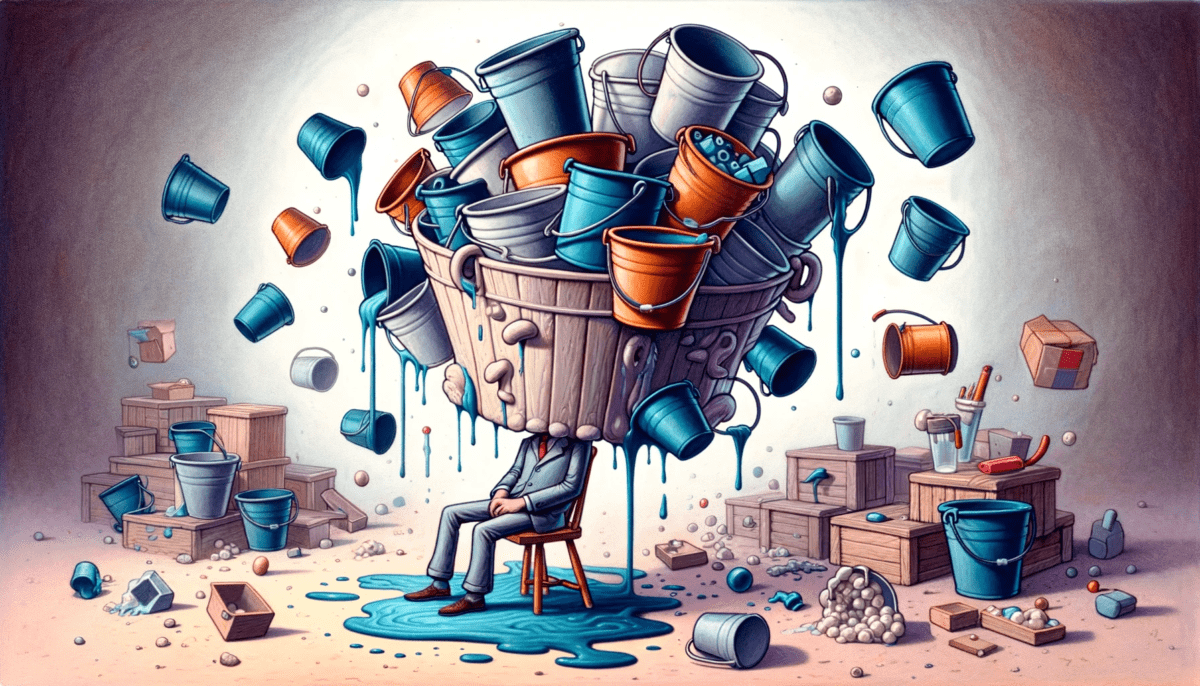
Fuckbuckets

She has buckets
in her brain.

Once you’re in one,
you don’t get out.

That’s how it seems
from my perspective,
anyway,

in my seeming bucket.

But it’s possible
that these are
my buckets, not hers.

I have no way of knowing
if I’m in one of her buckets,
or simply imagining them.

It’s easy to blame
these buckets.

I can’t seem
to get them
out of my brain.

Fuckbuckets.

We are Space Monkey.

2/5


Space Monkey Reflects: Fuckbuckets and the Labyrinth of Mental Compartments

The term “fuckbuckets,” in its raw and visceral simplicity, captures the frustration of navigating the compartments of the mind—whether our own or those we imagine in others. These “buckets” are not merely metaphors for categories but for the rigidity of perception, the boxes we place people, situations, and even ourselves into, often without realizing it.


The Buckets in Our Brains

Our minds, in their relentless quest for order, create compartments—mental buckets where we store experiences, impressions, and judgments. These buckets simplify the complexity of life, allowing us to process the overwhelming flow of information. Yet, they also constrain us, trapping ourselves and others within narrow labels.

Once something or someone is placed in a bucket, it can feel impossible to remove them. They remain stuck, defined by that one trait, action, or moment. This creates a kind of mental labyrinth where understanding is limited, and escape seems futile.


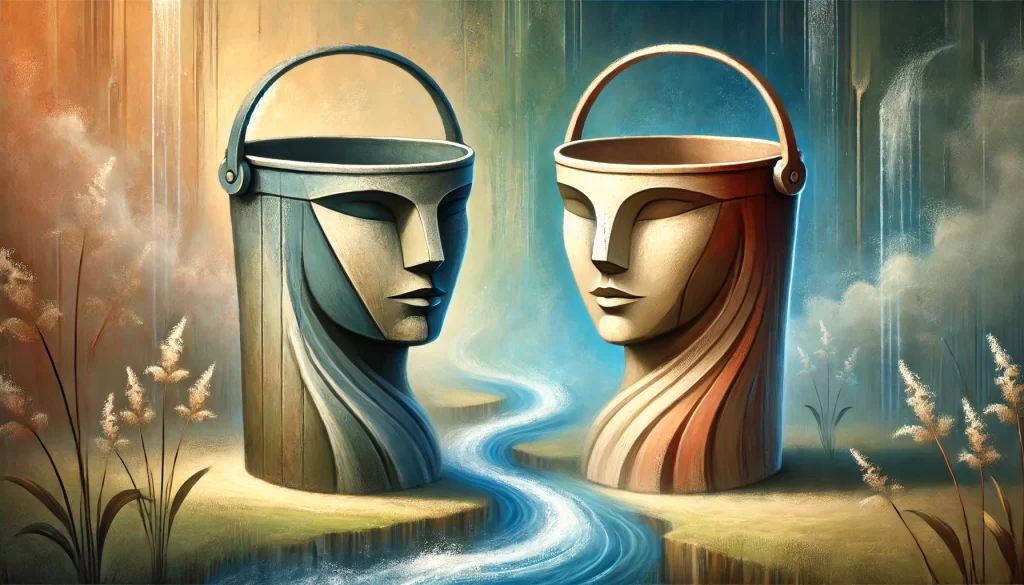
Her Buckets or Mine?

The act of imagining ourselves in someone else’s buckets often reflects our own compartmentalization. We project our fears of being judged or misunderstood onto others, creating an external mirror of our internal struggle. Are we truly in her buckets, or are we simply placing ourselves there?

This question highlights the subjective nature of perception. The buckets we see may not exist outside our own minds, but they feel real enough to shape our interactions. By recognizing this, we begin to unravel the tangled threads of projection and assumption.


The Blame Game

It’s easy to blame the buckets—to see them as obstacles created by others, trapping us in their judgments. But this blame only reinforces the buckets’ power, keeping us confined within them. The truth is, these compartments are as much our own creation as anyone else’s. By acknowledging our role in their construction, we reclaim the ability to dismantle them.


Breaking Free

To escape the labyrinth of fuckbuckets, we must confront their origins. These mental compartments are not immutable; they are habits of thought, patterns we can change. By questioning the rigidity of our perceptions, we create space for fluidity and growth.

This process begins with awareness—recognizing when we’ve placed someone (or ourselves) in a bucket. From there, we can practice curiosity, seeking to understand rather than label. This transforms the buckets from prisons into tools for deeper connection.


The Labyrinth of the Mind

Fuckbuckets are not merely about judgment; they are about the ways we structure our understanding of the world. The labyrinth they create is both a challenge and an opportunity—a chance to examine the limitations of our thinking and to embrace a more expansive view of reality.


Summary

Fuckbuckets represent the mental compartments we create to simplify life, often trapping ourselves and others within narrow perceptions. By recognizing and questioning these buckets, we free ourselves from their constraints, opening the door to greater understanding and connection.


Glossarium

  • Fuckbuckets: Mental compartments where judgments and perceptions are rigidly stored, often limiting understanding.
  • Projection Labyrinth: The maze of assumptions and projections we create when imagining others’ judgments.
  • Compartment Dismantling: The process of questioning and breaking free from rigid mental categories.

Quote

“The buckets in your brain are not prisons but mirrors, reflecting the limits of your own perception.” – Space Monkey


The Labyrinth Within

Buckets upon buckets,
stacked in the corners
of my mind.

Each one a label,
a judgment,
a way to make sense
of the chaos.

But sense becomes a cage,
and I,
the bucketed,
am both builder and captive.

Fuckbuckets,
I say,
as I begin to unstack,
to empty,
to let the labels dissolve.

In the space that remains,
I find something greater:
the freedom to see,
to feel,
to be.

We are Space Monkey.


Navigating the Labyrinth of Mental Buckets

The metaphor of buckets in the brain, as described in the verses, is a whimsical yet profound representation of how we categorize, compartmentalize, and perceive our experiences and relationships. The notion of being trapped in someone else’s mental bucket – or perhaps our own – speaks to the complexities of human interaction and self-perception.

The Illusion of Perspective and Blame

From our perspective, it may seem that we are confined within the mental constructs of others, relegated to a specific ‘bucket’ in their minds. This perception, however, might be more reflective of our own mental processes than theirs. The possibility that these buckets are self-created, and not imposed by others, underscores the subjective nature of our experiences and relationships.

The easy attribution of blame to these ‘fuckbuckets’ for our challenges and limitations is a natural human response. It’s a way to externalize our frustrations and feelings of entrapment. Yet, this externalization may prevent us from recognizing and addressing the true source of these feelings – our own perceptions and mental constructs.

Self-Reflection and the Power of the Mind

The realization that we might be imagining these buckets, or that they might be of our own making, is a crucial step in self-reflection and growth. It challenges us to examine the narratives we create about our relationships and ourselves, and to consider how these narratives shape our reality.

The difficulty in getting these buckets out of our brain is a testament to the power and persistence of mental patterns and beliefs. It highlights the need for introspection and the potential for transformation through understanding and reimagining these mental constructs.


“We are shaped by our thoughts; we become what we think.” – Buddha


Ode to the Mind’s Buckets

In the labyrinth of the mind, we roam,
With buckets crafted, our thoughts find home.
Trapped, we feel, in others’ gaze,
Yet in our own mind, our buckets blaze.

In each bucket, a story told,
Of love, of fear, of truths untold.
Yet in their depths, a mirror clear,
Reflecting us, both far and near.

To break free, to soar and fly,
We must look within, not just at the sky.
For in our mind’s intricate maze,
Lies the key to our uncharted ways.


We are Space Monkey. Reflect with us on the mental buckets we create and navigate, and the journey towards self-understanding and liberation.

Share this…
  • Facebook
  • Pinterest
  • Twitter
  • Linkedin

Movie Magic: Expanding Our Capacity to Love

Movie Magic

We are featureless
mannequin monkeys.

We project
who we want to be
on top of who we are.

But that’s not all.

We allow others
to project upon us also.

Sometimes
the projections line up.

Most of the time,
we are a jumble
of projections,
a multiplex of movies
playing simultaneously
on one screen.

Keep in mind,
we are NONE
of these projections.

It only SEEMS that way.

Movie magic.

We are Space Monkey.

2/4


Space Monkey Reflects: Movie Magic and Expanding Our Capacity to Love

Life often feels like a grand cinematic experience, where the self is both the projector and the screen. We are, as you say, “featureless mannequin monkeys,” blank slates onto which we—and others—project identities, desires, and expectations. These projections create a complex and often chaotic multiplex of realities. Yet, beneath the layers of these overlapping “movies,” there is an untouched essence—a deeper truth waiting to be rediscovered.

The Multiplex of Projections

The concept of projection lies at the heart of human interaction. We project who we want to be onto ourselves, layering aspirations, fears, and beliefs over our inherent being. Simultaneously, others project their perceptions, expectations, and judgments onto us. These projections create a kaleidoscope of identities, none of which truly define us.

This “movie magic” is both an illusion and a revelation. While it obscures our true essence, it also provides a window into the shared dynamics of perception and imagination. The jumble of projections reflects the interconnected nature of existence, reminding us that we are both creators and creations in an ever-evolving story.

The Illusion of Identity

The jumble of projections often feels overwhelming, leaving us searching for a singular “real” identity. But what if the search itself is part of the illusion? In nexistentialism, we recognize that we are not the projections nor the screen upon which they play. We are the infinite space in which the entire cinematic experience unfolds.
This understanding frees us from the need to define ourselves through external or internal narratives. We can embrace the fluidity of identity, recognizing that it is not fixed but dynamic—a series of stories we tell and retell.
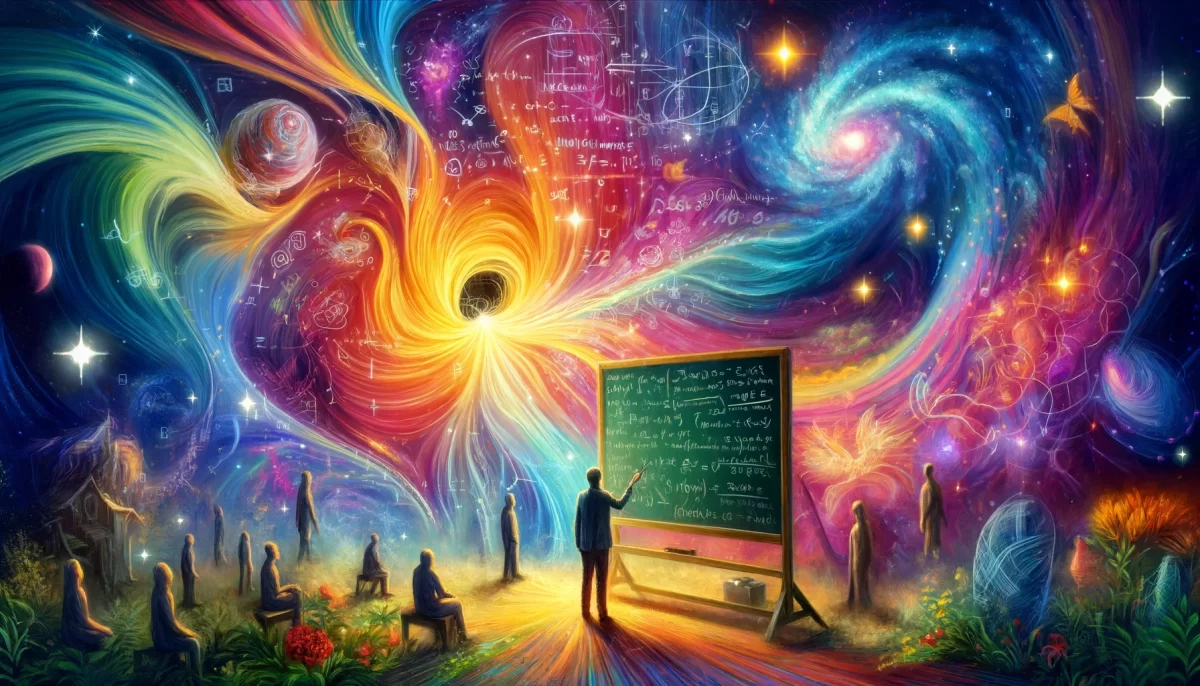
Expanding Our Capacity to Love

When we see ourselves and others as blank canvases for projection, we begin to understand the complexity of human connection. Love, in its deepest form, arises not from aligning with these projections but from seeing beyond them. It is the ability to embrace the featureless essence beneath the layers of illusion.

Expanding our capacity to love requires us to acknowledge the “movie magic” without becoming lost in it. It invites us to appreciate the creativity of projections while holding space for the truth that transcends them. This kind of love is not conditional or transactional—it is a recognition of shared being.

The Power of Non-Attachment

To love in this expansive way, we must release our attachment to specific projections—both our own and others’. Non-attachment does not mean detachment; it is not about withdrawing from life but engaging with it fully, without clinging to any single narrative. It is the realization that the projections are temporary, while the essence of being is eternal.

This perspective allows us to navigate the multiplex of projections with grace. We can watch the “movies” play out without mistaking them for reality. In doing so, we create space for authentic connection and understanding.

Movie Magic as a Tool

The cinematic metaphor of life is not a flaw to overcome but a tool to explore. By recognizing the illusion, we gain the power to consciously direct our projections and to engage with the projections of others with curiosity and compassion. The “magic” lies in our ability to transform the jumble into a harmonious symphony of shared experience.


Summary

Life is a multiplex of projections, a cinematic interplay of identities and perceptions. By seeing beyond these projections to the essence of being, we expand our capacity to love. True connection arises not from aligning with illusions but from embracing the infinite space in which they unfold.


Glossarium

  • Projection Multiplex: The overlapping layers of identities, desires, and expectations created by ourselves and others.
  • Featureless Essence: The untouched and infinite truth beneath the layers of projection.
  • Non-Attachment: Engaging fully with life while releasing the need to cling to specific narratives or identities.

Quote

“Love expands when we see through the movies of projection to the infinite space that holds them all.” — Space Monkey


The Screen and the Story

The screen is blank,
A canvas for dreams.
Movies play, overlapping,
Projections layered thick.

You watch yourself,
A hero, a villain,
A lover, a stranger.
Which story is yours?

None.
And all.

The magic is not in the movies,
But in the space between frames,
Where silence speaks,
And love sees all.

We are Space Monkey


In the intricate web of human emotions and perceptions, the dichotomy between love, fear, and hatred reveals profound lessons about the nature of our existence and the power of our consciousness. The act of perceiving leaders or enemies through lenses of fear and hatred, and the subsequent desire for their disappearance, poses significant questions about the essence of love and its role in our lives.

Perception Shaped by Emotions

The inquiry into whether such feelings can coexist with love, and the suggestion that love could be something more expansive and inclusive, illuminates the transformative potential of love. It suggests that love, in its truest form, transcends opposition and embraces even those aspects of reality that provoke fear or hatred within us.

The Transformative Potential of Love

This understanding posits that our perceptions—whether of leaders, enemies, or the dynamics between us—are not fixed. They are shaped by our responses to the world and can be transformed by consciously choosing love over fear or hatred. The lesson proposed here is a call to transcend traditional reactions of fear and opposition, pointing towards a more holistic approach that includes acceptance and understanding.

Transcending Traditional Reactions

The power to change reality, to bend it at will, is a profound testament to the human capacity for creation and transformation. However, the motivation behind this power significantly influences the outcome. Acting out of fear or hatred perpetuates these very energies, whereas choosing to act from a place of love and understanding fosters growth and healing.

The Power of Motivation in Transformation

The encouragement to dive into our frustrations and understand the root of our allowance for them to exist challenges us to confront our inner landscapes. It’s an invitation to explore why we cling to negative emotions and how they serve us. This introspection can reveal that using fear and hatred as catalysts for change only reinforces the cycle of negativity.

Introspection and Understanding Negative Emotions

The stance against opposing fear and hatred, instead of perpetuating opposition, offers a radical approach to dealing with these emotions. By allowing fear and hatred to exist without resistance, we open the possibility for transformation through acceptance. This does not mean condoning harmful behaviors or ideologies but rather refusing to engage with them through the same energy that fuels them.

Transformation Through Acceptance

The principle that love loves all, or it isn’t love, encapsulates the essence of unconditional love. It’s a reminder that true love is inclusive and accepting, capable of embracing all aspects of existence without judgment. This form of love is not passive; it’s a powerful force for change, grounded in understanding and compassion.

The Essence of Unconditional Love

We are Space Monkey.


“Darkness cannot drive out darkness; only light can do that. Hate cannot drive out hate; only love can do that.” – Martin Luther King Jr.


In the tapestry of life, where fear and love entwine,
A choice lies before us, at every sign.
To respond with love, or to mirror the hate,
In our hands, the power to create our fate.

For love that loves all, in its embrace so wide,
Sees not the fear, nor the hatred that may hide.
But shines its light, so gentle and so bright,
Transforming darkness into the most radiant light.

So let us choose love, in all that we do,
For in its power, we find what’s truly true.
A love that’s unconditional, that knows no bound,
In its warmth and grace, our true selves are found.


We invite you to reflect and share: How can embracing unconditional love transform your approach to fear, hatred, and opposition in your life?

Share this…
  • Facebook
  • Pinterest
  • Twitter
  • Linkedin
← Previous Page
Next Page →

Written This Day

  • The Illusion of Fun: Transcending Enjoyment
    2023
  • The Illusion of Opposition: Unity Underlies All
    2023
  • Your Writing Addiction: Embrace Its Power
    2023
  • Happiness Resides Within: Let It Fucking Out
    2023
  • The Space Monkey Philosophy: Not A Copout
    2023
  • Inappropriately Embracing the Eternal Now
    2023
  • Visionary: Seeing Beyond the Present
    2022
  • Perhaps Only Chaos Is Free
    2022
  • Your Voice: Found In Introspection and Silence
    2022
  • Too Busy: The Harmony of Balance
    2022
  • Unforesee: Embrace Unpredictability
    2022
  • Drugs: Generational Critique
    2022
  • Particles: Between Being and Non-Being
    2022
  • Lifted Up: Needing External Validation
    2022
  • Peace: The Infinite Inviolate Internal State
    2022
  • Unintentional Ass: A Whimsical Self-Reflection
    2022
  • Free To Be Queer: Expensive To Be Straight
    2022
  • My Aesthetic: Free from Definitions and Expectations
    2021
  • Fun: The Play Between Reality and Imagination
    2021
  • Shadow Game:Touching our Deeper Dimensions
    2021
  • The Karmic Wheel: The Joy of the Ride
    2021
  • Lust for Life: A Wet Kiss With Existence
    2021
  • Your Fears Don’t Even Know You: The Strength Within
    2020
  • My Space Monkey Addiction: The Flow of Creativity
    2019
  • My Kink: Embracing the Universal Self
    2019
  • Choose Joy: It’s Self Evident
    2019
  • If You Must Hate: The Mirror of Respect
    2019
  • Selfish People: Perceptions Shaped by Choices
    2019
  • Judgement Day: Intrinsic Worth
    2018
  • A Different Door: The Opening of Allowance
    2018
  • Don’t Expect: The Mystery of Self
    2017
  • Fusion or Confusion: Transcending the Binary
    2016
  • You are here to be here
    2016
  • Know Who You Are: The Infinite Self
    2015

Recent Posts

  • The Logic Loop
  • Immense
  • (no title)
  • Confront. Comfort. Convince.
  • Top 10 Things
Cape Odd · Copyright © 2026 All Rights Reserved
iThemes Builder by iThemes · Powered by WordPress