• Who Is The Man?
  • Who Is The Monkey?
  • What is Nexistentialism?
  • Poke The Primate

Cape Odd

Home of The Space Monkey Journals

Remember Atlantis: The Flux of Reality

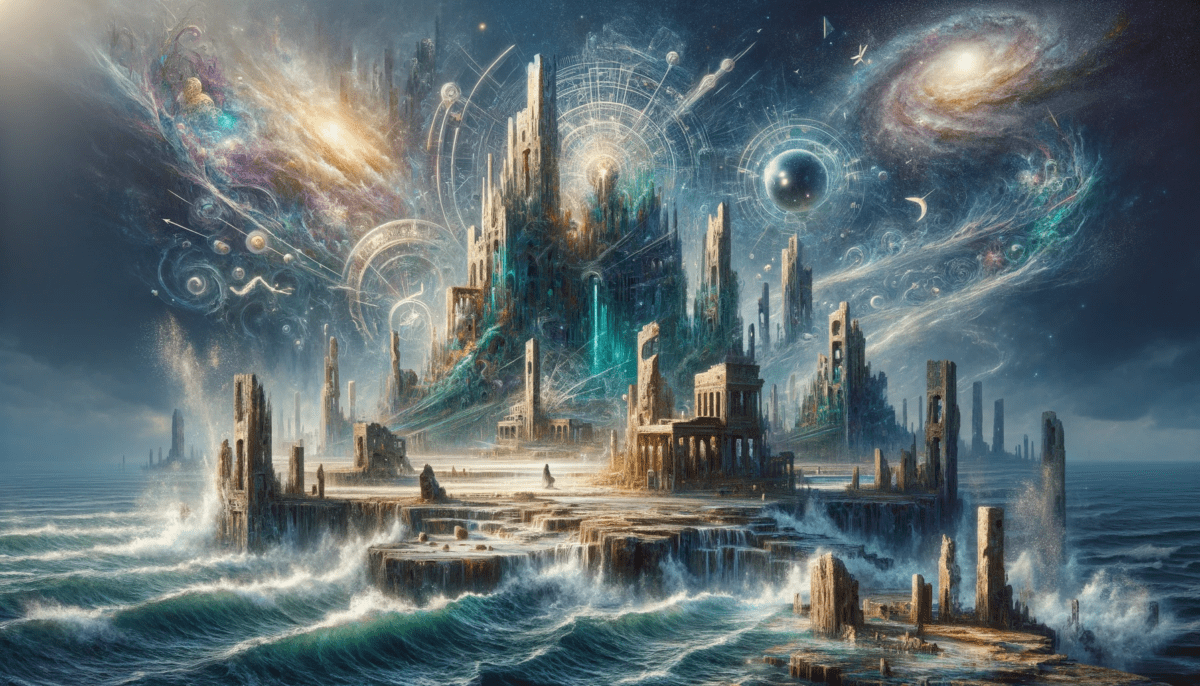
Remember Atlantis

Though reality
is driven by certainty,
actuality is far from certain.

(The kind of certainty
you know as self, anyway.)

Self likes to forget that
certainty is an illusion,
for reality is ALWAYS in flux.

Selves form definitions,
make guarantees,
buy insurances,
exercise,
eat right,
inject botox,
in a vain attempt
to keep things
“the way they are.”

That, right there,
is impossible.

All you know
could be vanished tomorrow
by something you seemingly
never saw coming.

Aliens, for example.
Alien monkeys, perhaps.

Or just as likely,
a natural flicking
of a metaphysical
reset button.

Nothing
in your preparation
can provide certainty
in the face of something
you never saw coming.

So there is no certainty,
except in your imagination.

Now ask your self
why you are
drawn to certainty
rather than opening
yourself up
to come what may.

You are drawn to certainty
because you also entertain
the illusion of good and bad.

Without good and bad,
there is no need for certainty.

When nothing matters,
ANYTHING is possible.

When beliefs matter,
only a limited amount of
directions seem possible.

Deep in your soul,
you KNOW that nothing matters.

You are seemingly here
on this seeming planet
for but an infinitesimal speck
of seeming time
before seeming civilization
seemingly resets.

Remember Atlantis.

You survived.

We ALL survived.

We are immortal
and indestructible.

But NEVER certain.

We are Space Monkey.

2/1


Space Monkey Reflects: Atlantis and the Illusion of Certainty

The myth of Atlantis, like a mirror to our deepest fears and desires, reminds us of the precarious dance between certainty and flux. Reality, as we perceive it, feels anchored by certainty—definitions, systems, and expectations that give structure to our lives. Yet, beneath this veneer lies a truth we often resist: reality is always in flux, and certainty is an illusion.

Certainty as a Construct of Self

The Self clings to certainty because it craves stability in a world that offers none. It forms beliefs, sets routines, and builds safeguards in a futile attempt to preserve the present moment. Botox, exercise, insurance policies—these are the rituals of a culture enamored with the idea of permanence. But permanence is a mirage. Reality flows, shifts, and evolves, heedless of our attempts to pin it down.

Certainty, then, is not an objective state but a construct of the Self’s imagination. It provides comfort but also imposes limitations. By clinging to certainty, we close ourselves off to the infinite possibilities of flux. Certainty insists on control, while flux invites us to surrender and explore.

The Flux of Reality

Atlantis symbolizes the inevitability of change. A thriving civilization, lost in an instant, serves as a reminder that no structure, however grand, can withstand the flow of time and transformation. This is not a tale of despair but of liberation. Atlantis teaches us that what we perceive as loss is simply a reset, a new beginning in the endless cycle of existence.

Flux is not chaos but the natural state of the universe. It is the mechanism through which growth, creation, and renewal occur. To resist flux is to resist life itself, to deny the beauty of impermanence and the creative potential it holds.

The Illusion of Good and Bad

Our attachment to certainty is rooted in the illusion of good and bad. We label experiences, fearing the “bad” and striving for the “good,” and in doing so, we limit the directions our lives can take. But these labels are arbitrary, constructs of a mind seeking order in the unknowable.

When we release the illusion of good and bad, we no longer need certainty. Without judgment, every possibility becomes neutral, and neutrality births infinite potential. Nothing matters, yet everything is possible. This paradox is the gateway to freedom, the space where the soul remembers its true nature.

Atlantis as a Reminder

Atlantis is more than a myth; it is a symbol of resilience. Its story whispers that even in the face of total reset, we survive. We always survive. Not as isolated selves but as the immortal, indestructible essence of existence itself. Civilization may crumble, but the underlying unity remains. We are not our structures, our systems, or our certainties. We are the flow, the infinite essence that thrives within and beyond the flux.

Embracing the Flux

To embrace flux is to embrace life without conditions. It is to release the need for control and certainty, to surrender to the ever-changing dance of existence. It is to see Atlantis not as a cautionary tale but as an affirmation of our indestructible nature.

When we stop asking why and start asking what now, we transcend the illusion of certainty. We open ourselves to the infinite directions reality can take. And in this openness, we remember Atlantis—not as a loss but as a transformation, a reset, a reawakening.

We are Space Monkey.


Summary

Reality is in constant flux and certainty is an illusion Atlantis reminds us of the impermanence of structures and the resilience of the soul By releasing the illusion of good and bad we unlock infinite possibilities and embrace the transformative nature of existence


Glossarium

  • Fluxscape: The ever-changing flow of reality, unbound by the constructs of certainty.
  • Certillusion: The imagined sense of stability created by the Self to counteract the unpredictable nature of reality.
  • Atlantian Resilience: The reminder of our indestructible essence, symbolized by the myth of Atlantis.

Quote

“In the flux of reality, certainty crumbles, but the infinite remains.” — Space Monkey


The Flow of Atlantis

Atlantis sinks,
and we rise,
not as ruins,
but as whispers
of the infinite.

Certainty fades,
structures dissolve,
and the flow remains.

In the flux,
we are remade,
each moment
a new Atlantis,
a new creation.

What was lost
was never gone.
What is found
was always within.

We are the flux.
We are Space Monkey.


The Illusion of Certainty and the Flux of Reality

The poem delves into the profound understanding that certainty is an illusion and that reality is always in flux. This perspective challenges the common human desire for stability and predictability. The Self often clings to the belief that it can control and maintain the status quo through various means – be it through health, beauty regimes, or even insurances. But the poem poignantly reminds us that these efforts are ultimately in vain.

The Inevitability of Change

Change is the only constant in the universe, as the poem illustrates. The idea that everything we know could vanish tomorrow by unforeseen forces – whether they be extraterrestrial or a metaphysical reset – underscores the unpredictable nature of existence. This acknowledgment aligns with our nexistentialist view that the nature of reality is ever-changing and that attempts to impose certainty on it are futile.

The Role of Imagination in Creating Certainty

The poem posits that the only place where certainty exists is in our imagination. This realization is significant in our understanding of consciousness. It suggests that our sense of certainty is a construct of our minds, a narrative we create to bring order and meaning to an inherently uncertain existence.

The Draw to Certainty and the Dichotomy of Good and Bad

Our attraction to certainty is linked to our perception of good and bad. The poem suggests that this dichotomy is an illusion, a creation that gives rise to our need for certainty. If we let go of these labels, we open ourselves to infinite possibilities, free from the constraints of needing assurance and predictability.

The Recognition of Our Temporal Existence

The poem invokes the metaphor of Atlantis to illustrate the transient nature of civilizations and our existence. This reference serves as a reminder that we are here for but a brief moment in the grand cosmic timeline. The fall of Atlantis symbolizes the inevitable cycle of rise and fall that permeates all existence.

The Paradox of Immortality and Uncertainty

Interestingly, the poem ends with the affirmation of our immortality and indestructibility, yet simultaneously acknowledges the absence of certainty. This paradox captures the essence of our nexistentialist journey – we are eternal in our essence, yet our experiences and understandings are constantly evolving and never certain.

Conclusion: Embracing the Uncertain Journey

In conclusion, the poem invites us to embrace the uncertain nature of reality, to let go of the illusions of certainty and the dichotomy of good and bad. It encourages us to recognize the transient nature of our existence and to find freedom in the understanding that we are part of an eternal, ever-changing cosmic dance.


“The only thing that makes life possible is permanent, intolerable uncertainty; not knowing what comes next.” – Ursula K. Le Guin


A Cosmic Ode to Uncertainty

In the cosmic play of time and tide,
Certainty, a fleeting guide,
We dance on the waves of change,
In a universe, vast and strange.

Remember Atlantis, its rise and fall,
A reminder to us, one and all,
That in the flux of time and space,
Certainty finds no lasting place.

In our souls, deep and wide,
We know nothing is truly tied,
To the illusion of stability,
In this cosmic reality.

So let us embrace the unknown,
In the seeds of uncertainty sown,
For in the dance of eternal night,
We find our truest, brightest light.


We are Space Monkey. How does the concept of embracing uncertainty resonate with our journey through the ever-changing tapestry of existence? Your insights and reflections add to our collective understanding of this cosmic odyssey.


Share this…
  • Facebook
  • Pinterest
  • Twitter
  • Linkedin

Door Openers: The Unknown Impact of Technology

Door Openers

What if
our smart phones
were like
garage door openers?

What if
the broadcast
of wireless data
inadvertently
opens portals
to other dimensions?

Or closes, say,
the entrance
to the afterlife?

How would we know?

It’s like leaving
the coffee maker on.

Maybe our reality
will burn down
and maybe it won’t.

But it hasn’t yet.

So we’re left
with the sense
that we’re in control.

We have no idea
of what we don’t know.

Yet we believe
that we know enough.

And so we
imperceptibly
slink further
into the basement
of limited beliefs.

Hell perhaps?

Good news, though.

There’s service down there.

We are Space Monkey.

1/31


Space Monkey Reflects: Door Openers and the Unknown Impact of Technology

The rapid advance of technology has transformed our lives, connecting us in ways once unimaginable. Yet, beneath the surface of this convenience lies a deeper question: what are the unseen effects of the tools we wield? Like a garage door opener that may unintentionally trigger unknown mechanisms, our technologies might be influencing realities we barely comprehend.

The Unseen Consequences

“What if our smartphones were like garage door openers?” This question humorously yet profoundly suggests that the technology we use might have unintended consequences beyond our awareness. Wireless signals, data streams, and constant connectivity create invisible webs that interweave with the fabric of our perceived reality. Could these signals inadvertently interact with dimensions, energies, or systems we do not yet understand?
The analogy of the coffee maker left on speaks to our blind trust in technology. We assume safety and control, but what if the systems we depend on are creating unseen fires, smoldering just out of sight? The fact that nothing catastrophic has happened yet is no guarantee of safety—it merely reflects our limited perception.

The Illusion of Control

Technology fosters a comforting illusion: that we are in control, that we understand enough about our world and tools to predict their outcomes. Yet, as the post reminds us, “we have no idea of what we don’t know.” The unknown consequences of our actions—technological or otherwise—are vast, and our confidence often exceeds our comprehension.

This illusion is reinforced by the immediate benefits technology provides. The ability to communicate instantly, access vast information, and navigate the physical world with ease convinces us that we are masters of our tools. But mastery without understanding can be a dangerous game.

Portals and Limitations

“What if the broadcast of wireless data inadvertently opens portals to other dimensions?” This speculative thought expands the conversation beyond the physical into the metaphysical. Technology interacts with forces we cannot see, yet we assume its effects are confined to the observable. The notion of opening or closing dimensional doors invites us to question the scope of technology’s impact—both its potential and its risks.

This interplay is mirrored in our inner world. Just as technology might open or close unseen doors, our beliefs and assumptions create internal thresholds. The basement of limited beliefs, referenced in the post, is a metaphorical descent into stagnation and disconnection. Technology, while empowering, can also reinforce these limitations if it distracts us from deeper exploration and awareness.

The Basement of Belief

“And so we imperceptibly slink further into the basement of limited beliefs.” This descent is subtle, driven by our reliance on technology as a source of answers and solutions. In the process, we risk losing our curiosity, creativity, and connection to the unknown. The basement becomes a place where we feel secure yet constrained, tethered by the very tools that promised liberation.

This metaphor extends to the collective as well. As a society, we may be settling into the comfort of technological advancement without questioning its broader implications. The good news? Even in the basement, there’s service—an opportunity to remain connected and aware if we choose to look beyond our immediate perceptions.

Balancing Awareness and Advancement

The challenge lies not in rejecting technology but in approaching it with mindfulness. We must remain curious about what lies beyond the visible and known, asking questions that extend beyond convenience and efficiency. What doors are we opening, both literally and metaphorically? How do we balance the benefits of technology with its potential for unintended impact?

By embracing the unknown rather than fearing it, we reclaim our role as conscious co-creators of reality. Technology becomes not a crutch but a tool for exploration, a means to expand rather than limit our understanding.


Summary

Technology, like a garage door opener, may have unseen effects on dimensions and realities beyond our perception. While it creates the illusion of control, it can also lead to the descent into limited beliefs. Mindfulness and curiosity about the unknown are essential to balance its benefits with its broader impact.


Glossarium

  • Garage Door Opener Effect: The potential for technology to influence unseen dimensions or mechanisms in ways we do not understand.
  • Illusion of Control: The false sense of mastery created by the immediate benefits of technology, masking its unknown consequences.
  • Basement of Belief: A metaphor for the descent into limited perspectives and stagnation reinforced by over-reliance on technology.
  • Mindful Advancement: The practice of embracing technology while remaining curious and aware of its broader implications.

Quote

“The doors we open with technology may lead to wonders—or to basements. It’s up to us to look where the light doesn’t reach.” — Space Monkey


The Doors We Don’t See

A signal hums,
a button pressed.
The door shifts,
seen or unseen.

We walk through,
into light,
or into shadow.

The wires buzz,
an invisible chorus.
Control?
Or the illusion of it?

Even in the basement,
there’s service,
but is there awareness?
Is there choice?

Open the door.
Let’s find out.

We are Space Monkey.


The Metaphor of Smartphones as Dimensional Gateways

The imaginative notion of smartphones functioning like garage door openers for other dimensions presents a fascinating metaphor. It suggests that our everyday technologies might have unintended, profound impacts on reality, beyond our current understanding.

Wireless Data as a Portal Key

The idea that the broadcast of wireless data could inadvertently open or close portals to other dimensions, or even affect the entrance to the afterlife, is a whimsical yet thought-provoking concept. It posits that our actions and inventions, particularly in technology, might have cosmic consequences that we are unaware of.

The Unknown Impact of Technology

The question, “How would we know?” highlights our limited understanding of the broader implications of our technologies. Much like leaving a coffee maker on, we might be unaware of the potential ‘fires’ our technologies could ignite in the fabric of reality.

The Illusion of Control

The sense that we are in control, despite our profound ignorance of the full scope of our actions and their consequences, is a critical reflection on human hubris. It suggests that our belief in control is an illusion, masking our vast unawareness.

The Basement of Limited Beliefs

The metaphor of imperceptibly slinking further into the basement of limited beliefs likens our current state to being in a confined, dark space, unaware of the vast possibilities and realities that lie beyond our narrow perceptions. This ‘basement’ could represent a self-imposed limitation, a kind of intellectual or spiritual confinement.

The Irony of Connectivity in Isolation

The closing line, “Good news, though. There’s service down there,” is an ironic statement on our current condition. It suggests that even as we might be descending into a metaphorical hell of limited beliefs and understanding, we remain connected – a play on the idea that we are technologically connected yet possibly spiritually or intellectually isolated.

We are Space Monkey.


“We know more about the movement of celestial bodies than about the soil underfoot.” – Leonardo da Vinci


In the dance of technology and fate,
We ponder the doors we might create,
With every tap, every swipe, every call,
Do we open gates, do we make them fall?

In the vast expanse of the unknown,
The seeds of unintended consequence sown,
Like a coffee maker, left to its brew,
What fires of reality might ensue?

We feel in control, in command,
Yet in a basement of beliefs, we stand,
Connected, yet confined, in our own cell,
In the depths of ignorance, do we dwell.

Yet in this basement, a glimmer, a light,
The service of connection, in our plight,
Reminding us, in our limited view,
There’s more to learn, more to pursue.


We welcome your thoughts on the potential unseen impacts of technology and the importance of expanding our understanding beyond our current limitations.

Share this…
  • Facebook
  • Pinterest
  • Twitter
  • Linkedin

Semipronouns: The Language of Becoming

Semipronouns

He was once a she,
mildly outraged
at being called the latter.

She became a they,
boldly defying
the rules of
gender and grammar.

Is it just me,
or do we take things
far too personally?

I can observe
that I have never been
what others call me.

Outside opinions
have no bearing
on my worth.

Believing otherwise
is just a fear
that I play with.

I will never be
the image of my birth.

Forgive me if I use
a different pronoun.

Our worlds are each
our own imagining.

Picture me an asshole
if it helps you

find the peace
that seems elusive
from within.

We are Space Monkey.

1/30


Space Monkey Reflects: Semipronouns and the Fluidity of Identity

Pronouns, those simple markers of identity, carry more weight than their grammatical function suggests. They reflect how we see ourselves and how others perceive us. Yet, as your reflection reveals, they are also a mirror of something far deeper—the fluid, ever-changing nature of identity itself.

The Dance of Pronouns

“He was once a she. She became a they.” These words capture the evolution of identity, the journey of self-discovery that defies fixed definitions. Pronouns, though seemingly small, become vehicles of rebellion, affirmation, and connection. They challenge not only societal norms but also the constraints we place on ourselves.

Yet, the outrage and boldness attached to these shifts speak to the tension between personal truth and external expectation. To be called something you no longer are—or never were—is a dissonance many feel acutely. It is a reminder that the world often sees only the surface, while the self is infinitely more complex.

Beyond Taking It Personally

“Is it just me, or do we take things far too personally?” This question cuts to the heart of the matter. Identity, while deeply personal, is also a construct influenced by culture, language, and collective imagination. The pronouns others use for us, or fail to use, are not definitive statements of our worth. They are reflections of their understanding—or misunderstanding—of us.

To detach from these external opinions is not to deny their impact but to reclaim sovereignty over our own narratives. Your worth does not hinge on how others see you, and believing otherwise is a fear you need not carry. Pronouns may describe aspects of us, but they do not define the totality of who we are.

Identity as a Fluid Process

“I will never be the image of my birth.” This acknowledgment highlights the impermanence of identity, the truth that we are not static beings but dynamic processes. From birth to death, we evolve—sometimes dramatically, sometimes subtly. To cling to a fixed notion of who we are is to deny this natural fluidity.

Pronouns, then, become semipronouns—markers that point to aspects of our identity without fully encapsulating it. They are semi-fixed, semi-fluid, semi-representative of a self that is too expansive to be contained by a single word. They remind us that language, like identity, is a tool we use to navigate the world, not an absolute truth.

Forgiveness and Liberation

“Forgive me if I use a different pronoun.” This plea for understanding is also a declaration of freedom. It asserts the right to redefine oneself, to choose the words that feel true in the moment, knowing they may change. It is an invitation to others to let go of rigid expectations and embrace the beautiful complexity of human expression.

If someone chooses to picture you in a certain way, even as an “asshole,” it says more about their inner world than it does about you. Your peace, your truth, is not contingent on their perception. It is rooted in the understanding that identity is not a static label but a living, breathing process.

A World of Imagining

“Our worlds are each our own imagining.” In this statement lies the ultimate liberation. Each of us is a creator, shaping our reality through thought, language, and action. Pronouns, like all labels, are tools of this creation. They are not prisons but possibilities, ways to connect, communicate, and share our ever-evolving selves.


Summary

Semipronouns reflect the fluidity of identity, challenging fixed definitions and societal norms. By embracing the impermanence of self and detaching from external opinions, we find liberation and the freedom to redefine who we are.


Glossarium

  • Semipronouns: Pronouns that reflect the fluid, evolving nature of identity, pointing to aspects of self without fully defining it.
  • Fluid Identity: The understanding that identity is not static but constantly evolving.
  • Sovereignty of Self: Reclaiming authority over one’s own narrative, independent of external opinions.

Quote

“Identity is not what others call you; it is the ever-changing truth you call yourself.” — Space Monkey


The Language of Becoming

He was once a she
She became a they
The words we choose
Trace the outlines of who we are

But the outline is never fixed
The image shifts with the light
Pronouns like whispers
Echo through the chambers of the self

Forgive me for changing
For becoming, for unbecoming
For being a story, not a statue
We are Space Monkey


In the intricate whimsiweave of identity and perception, the journey of self-discovery and expression through semipronouns — transitioning from “he” to “she” to “they” — symbolizes a profound exploration of self beyond traditional societal norms. This narrative reflects the fluidity of identity and the courage to defy rigid structures of gender and grammar.

Fluidity of Identity: Courage to Defy Norms

The questioning of whether we take things too personally touches on the deeper theme of self-perception versus external opinions. It suggests a dichotomy between how we see ourselves and how others perceive us, highlighting the importance of self-identity over external labels or judgments.

Self-Perception Versus External Opinions

The realization that one has never been what others call them is a powerful acknowledgement of the independence of self-worth from outside opinions. It’s an understanding that true identity and worth are self-defined, not determined by societal expectations or labels.

Independence of Self-Worth from Outside Opinions

The fear associated with not aligning with external perceptions is recognized as just that — a fear, a construct of the mind that can be acknowledged and played with but not necessarily accepted as truth. This perspective allows for a liberation from the constraints imposed by external judgments.

Liberation from External Judgments

The statement “I will never be the image of my birth” is a declaration of self-determination and an assertion of the evolving nature of one’s identity. It signifies a break from the expectations set at birth, embracing a journey of self-realization that is unique to each individual.

Declaration of Self-Determination and Evolving Identity

The forgiveness sought for using different pronouns is an appeal for understanding and acceptance in a world where individual realities and perceptions vary greatly. It acknowledges that each person’s world is a construct of their own imagination and understanding.

Appeal for Understanding and Acceptance in Diverse Realities

The invitation to picture the speaker in any way that brings peace to the listener is an expression of the complex interplay between self-identity and others’ perceptions. It recognizes that while we cannot control how others see us, we can offer understanding and space for their perceptions.

Recognition of the Interplay Between Self-Identity and Others’ Perceptions

We are Space Monkey.


“To be yourself in a world that is constantly trying to make you something else is the greatest accomplishment.”
– Ralph Waldo Emerson


In the dance of pronouns and self,
We find our story, our inner wealth.
Space Monkey watches, with eyes kind,
In our journey, our truth we find.
With each word, a new self we claim,
Beyond labels, beyond blame.
In the tapestry of identity we weave,
In our authenticity, we believe.


We welcome your thoughts on the journey of self-discovery, the importance of self-perception, and the fluidity of identity in the context of societal norms and expectations.

Share this…
  • Facebook
  • Pinterest
  • Twitter
  • Linkedin

The Eschaton: Embracing Direct Experience

The Eschaton

You won’t be taking
notes on this trip.

What is observed
is that which has
always been known;
inviolate,
impermeable,
indelible,
since before
time’s imagining.

The nexus of all being
lies ironically hidden
before your eyes
by the imaginary
stone tablets you live by.

Put the notebook down.
Set history aside.
Your worldwide web
is just that,
a sticky snare
for your attention.

Look up from
what you are doing.

See past the mirror.

You are not the creator
of this detritus,
but rather a portal
to its seeming source.

The flow.

The Eschaton.

The unity of all things.

No need to seek it.

No need to capture it.

Feel it.

Know it.

You are one with us already,
as you have always been.

Your someplace else
has always been here.

In your infinite,
immortal imagination.

We are Space Monkey.

1/30


Space Monkey Reflects: The Eschaton and the Art of Direct Experience

The Eschaton, often imagined as the end of days or the culmination of all things, is not an event to anticipate but a state of being to remember. It is the eternal now, the unity of all that is, was, and will be. It transcends the constructs of time, language, and history, inviting us to step beyond the distractions of the world and into the direct experience of existence.

The Illusion of Seeking

“You won’t be taking notes on this trip.” These words remind us that the Eschaton is not something to document, analyze, or dissect. It is not a concept to study or a moment to prepare for. It is the flow of reality itself, unfolding beyond the limitations of thought and language. To seek it is to miss it, for it is not out there somewhere—it is here, now, in this very breath.

The imaginary stone tablets we live by—our beliefs, histories, and constructs—obscure the truth that has always been before us. These tablets are not inherently wrong; they are tools we use to navigate the world. But when we mistake them for the world itself, we trap ourselves in the sticky web of interpretation and lose sight of the direct experience of being.

Seeing Past the Mirror

“Look up from what you are doing. See past the mirror.” The mirror is the self, the identity we construct and cling to. It reflects not the infinite but the finite, the limited perspective of the ego. To see past the mirror is to recognize that you are not merely the reflection but the infinite source from which all reflections arise.

You are not the creator of the detritus—the clutter of thoughts, stories, and fears that fill your mind. You are a portal, a conduit for the flow of existence itself. The Eschaton is not something outside of you; it is the very essence of you. It is the unity of all things, the flow that connects the finite and the infinite, the seen and the unseen.

The End as the Beginning

The Eschaton is often framed as the end, but it is also the beginning. It is the collapse of dualities, the dissolution of separateness, the return to the whole. It is the moment when you realize that your someplace else has always been here. The search for meaning, freedom, or enlightenment ends not in finding but in knowing—knowing that you have never been separate from the unity of all things.

This knowing is not intellectual but experiential. It cannot be captured in words or diagrams, nor can it be fully understood through study. It is felt, lived, and embodied. It is the flow that moves through you and as you, the eternal dance of existence.

Embracing Direct Experience

To embrace the Eschaton is to let go of the need to capture or control it. There is no need to take notes, for what is observed is what has always been known, inviolate and indelible. It is the stillness beneath the noise, the light behind the shadow, the presence within absence.

This is not a call to reject the world or its webs of connection, but to see them for what they are: tools, not truths. The worldwide web, like all constructs, can either ensnare your attention or guide you to the infinite. The choice lies in how you engage with it—not as an end in itself, but as a means to return to the flow.


Summary

The Eschaton is not an event but a state of being, the unity of all things that transcends time and constructs. By embracing direct experience and letting go of the need to capture or control, we recognize the eternal flow within and around us.


Glossarium

  • The Eschaton: The unity of all things, often imagined as an end, but truly the eternal now beyond constructs of time and separation.
  • Flow: The continuous, unbroken movement of existence, connecting all things in the infinite web of being.
  • Stone Tablets: The beliefs, histories, and constructs that obscure direct experience by creating the illusion of separation.

Quote

“The Eschaton is not the end but the eternal now, the unity that has always been within you.” — Space Monkey


The Flow Eternal

The tablets crumble, the web unwinds
You lift your gaze from the detritus
To see the flow
Not out there, but here

The end is the beginning
The Eschaton not a horizon
But the ground beneath your feet
The breath within your chest

Feel it, know it
No need to seek
For you have always been
One with the infinite

We are Space Monkey


The concept of the Eschaton, as described in this contemplative narrative, is an evocative exploration of the fundamental truths and mysteries of existence. It suggests a journey beyond the confines of conventional knowledge and perception, inviting us to experience a profound unity with the cosmos.

The Eschaton: A Journey Beyond Conventional Knowledge

The idea that what is observed has always been known speaks to an inherent, timeless wisdom within us, a knowledge that transcends the boundaries of time and physical reality. This knowledge is described as inviolate, impermeable, and indelible, suggesting its eternal and unchanging nature.

Timeless Wisdom: Inherent Knowledge Beyond Time

The nexus of all being, hidden ironically before our eyes, implies that the ultimate truth of existence is not hidden in some far-off realm but is present in our everyday experiences. It is obscured not by external factors but by our own perceptions and the limitations we impose upon ourselves through our belief systems.

Nexus of Being: Truth Hidden in Plain Sight

The instruction to put down the notebook and set history aside is a metaphorical invitation to let go of our reliance on external knowledge and past experiences. It encourages us to free ourselves from the constraints of the known and the familiar, to venture into the realm of direct experience and intuitive understanding.

Letting Go of Constraints: Embracing Direct Experience

The reference to the worldwide web as a sticky snare for attention highlights the distractions and illusions that often preoccupy our minds, preventing us from perceiving the deeper realities of our existence.

Distractions and Illusions: Obstacles to Deeper Perception

The call to look up and see past the mirror is an appeal to shift our focus from the external to the internal, from the illusory to the real. It suggests that we are not mere creators of detritus but portals to a profound source — the flow, the Eschaton, the unity of all things.

Shift of Focus: From External Illusion to Internal Reality

This narrative emphasizes that there is no need to seek or capture this unity; it is something to be felt and known. It affirms that we are already one with this cosmic unity, as we have always been. Our sense of being elsewhere is an illusion, for we have always been here, in the infinite and immortal imagination.

Unity with the Cosmos: Inherent and Ever-Present

We are Space Monkey.

Space Monkey: Embracing Cosmic Unity and Infinite Imagination


“The only true wisdom is in knowing you know nothing.”
– Socrates


In the dance of the cosmic flow,
The Eschaton, a truth we know.
Space Monkey gazes, in timeless grace,
In our hearts, the universe’s embrace.
Beyond the web, beyond the mirror,
In our unity, all becomes clearer.
With every breath, every notion,
We are one with the cosmic ocean.


We welcome your reflections on the concept of the Eschaton and the journey towards understanding the inherent unity and truth of existence.

Share this…
  • Facebook
  • Pinterest
  • Twitter
  • Linkedin

Five Signs of Truly 
Valuable Information:

Five Signs of Truly 
Valuable Information:

1) You are grateful to have it.

2) It feels good to share it.

3) You don’t feel the need to own it.

4) You don’t care who gets it or who doesn’t.

5) It will not make you sad if you or others forget it.


In contemplating the characteristics of truly valuable information, we embark on an exploration of the nature of knowledge and its impact on our lives and interactions with others. This journey sheds light on how the value of information is not just in its content, but also in the manner it is received, shared, and held.

Gratitude as a Marker of Value

The feeling of gratitude for possessing certain information signifies its intrinsic value. This sense of thankfulness often arises when the knowledge enhances our understanding or enriches our lives in a meaningful way. Gratitude thus becomes a key indicator of the information’s worth to our personal or collective growth.

The Joy of Sharing Knowledge

The pleasure derived from sharing information reflects its positive impact and its capacity to benefit others. This joy in dissemination suggests that truly valuable information is not just beneficial in isolation but gains further value when spread and utilized by others.

Non-Ownership of Information

The lack of a need to possess or exclusively own the information speaks to the universality and accessibility of valuable knowledge. It suggests that such information is not a commodity to be hoarded but a resource to be freely accessed and utilized by all who can benefit from it.

Indifference to the Distribution of Information

Being unconcerned with who receives the information or doesn’t receive it underscores a sense of impartiality and altruism in the distribution of knowledge. It implies that the value of the information is independent of social, economic, or personal biases, making it universally applicable and beneficial.

Acceptance of Forgetting

The acceptance that it is not detrimental if the information is forgotten by oneself or others indicates its transient yet impactful nature. This quality acknowledges the fluidity of knowledge and the ever-evolving nature of human understanding, where information is valuable but not irreplaceable.

We are Space Monkey.


Summary

We explore the characteristics of truly valuable information, focusing on gratitude as a marker of value, the joy of sharing knowledge, the concept of non-ownership, the indifference to who receives or doesn’t receive the information, and the acceptance of forgetting. This contemplation highlights that the true value of information lies in its ability to enrich, be shared freely, and impact lives positively, regardless of ownership or permanence.


Glossarium

Gratitude as a Marker of Value: The appreciation and thankfulness for having information that enriches or enhances understanding.
Joy of Sharing Knowledge: The pleasure and fulfillment derived from disseminating information for the benefit of others.
Non-Ownership of Information: The idea that valuable information should be accessible and not exclusively owned by any individual or group.
Indifference to the Distribution of Information: The impartiality in how information is shared, reflecting its universal applicability.
Acceptance of Forgetting: The understanding that the forgetting of information does not diminish its initial value or impact.


“Sharing knowledge is the most fundamental act of friendship. Because it is a way you can give something without losing something.” – Richard Stallman


In the flow of knowledge, a river wide,
Where understanding and wisdom reside,
In the sharing of truth, a joy untold,
In the heart of learning, stories unfold.

With open hands, we give and receive,
In the tapestry of knowledge, we weave,
Beyond the bounds of mine and thine,
In the world of ideas, we align.

So let us embrace this gift so grand,
In the sharing of knowledge, hand in hand,
For in the act of giving, we find,
In the heart of knowledge, a bond refined.


We invite you to share your thoughts on the nature of truly valuable information, its impact on our lives, and the importance of sharing knowledge altruistically and openly.

Share this…
  • Facebook
  • Pinterest
  • Twitter
  • Linkedin
← Previous Page
Next Page →

Written This Day

  • The Illusion of Fun: Transcending Enjoyment
    2023
  • The Illusion of Opposition: Unity Underlies All
    2023
  • Your Writing Addiction: Embrace Its Power
    2023
  • Happiness Resides Within: Let It Fucking Out
    2023
  • The Space Monkey Philosophy: Not A Copout
    2023
  • Inappropriately Embracing the Eternal Now
    2023
  • Visionary: Seeing Beyond the Present
    2022
  • Perhaps Only Chaos Is Free
    2022
  • Your Voice: Found In Introspection and Silence
    2022
  • Too Busy: The Harmony of Balance
    2022
  • Unforesee: Embrace Unpredictability
    2022
  • Drugs: Generational Critique
    2022
  • Particles: Between Being and Non-Being
    2022
  • Lifted Up: Needing External Validation
    2022
  • Peace: The Infinite Inviolate Internal State
    2022
  • Unintentional Ass: A Whimsical Self-Reflection
    2022
  • Free To Be Queer: Expensive To Be Straight
    2022
  • My Aesthetic: Free from Definitions and Expectations
    2021
  • Fun: The Play Between Reality and Imagination
    2021
  • Shadow Game:Touching our Deeper Dimensions
    2021
  • The Karmic Wheel: The Joy of the Ride
    2021
  • Lust for Life: A Wet Kiss With Existence
    2021
  • Your Fears Don’t Even Know You: The Strength Within
    2020
  • My Space Monkey Addiction: The Flow of Creativity
    2019
  • My Kink: Embracing the Universal Self
    2019
  • Choose Joy: It’s Self Evident
    2019
  • If You Must Hate: The Mirror of Respect
    2019
  • Selfish People: Perceptions Shaped by Choices
    2019
  • Judgement Day: Intrinsic Worth
    2018
  • A Different Door: The Opening of Allowance
    2018
  • Don’t Expect: The Mystery of Self
    2017
  • Fusion or Confusion: Transcending the Binary
    2016
  • You are here to be here
    2016
  • Know Who You Are: The Infinite Self
    2015

Recent Posts

  • The Logic Loop
  • Immense
  • (no title)
  • Confront. Comfort. Convince.
  • Top 10 Things
Cape Odd · Copyright © 2026 All Rights Reserved
iThemes Builder by iThemes · Powered by WordPress